
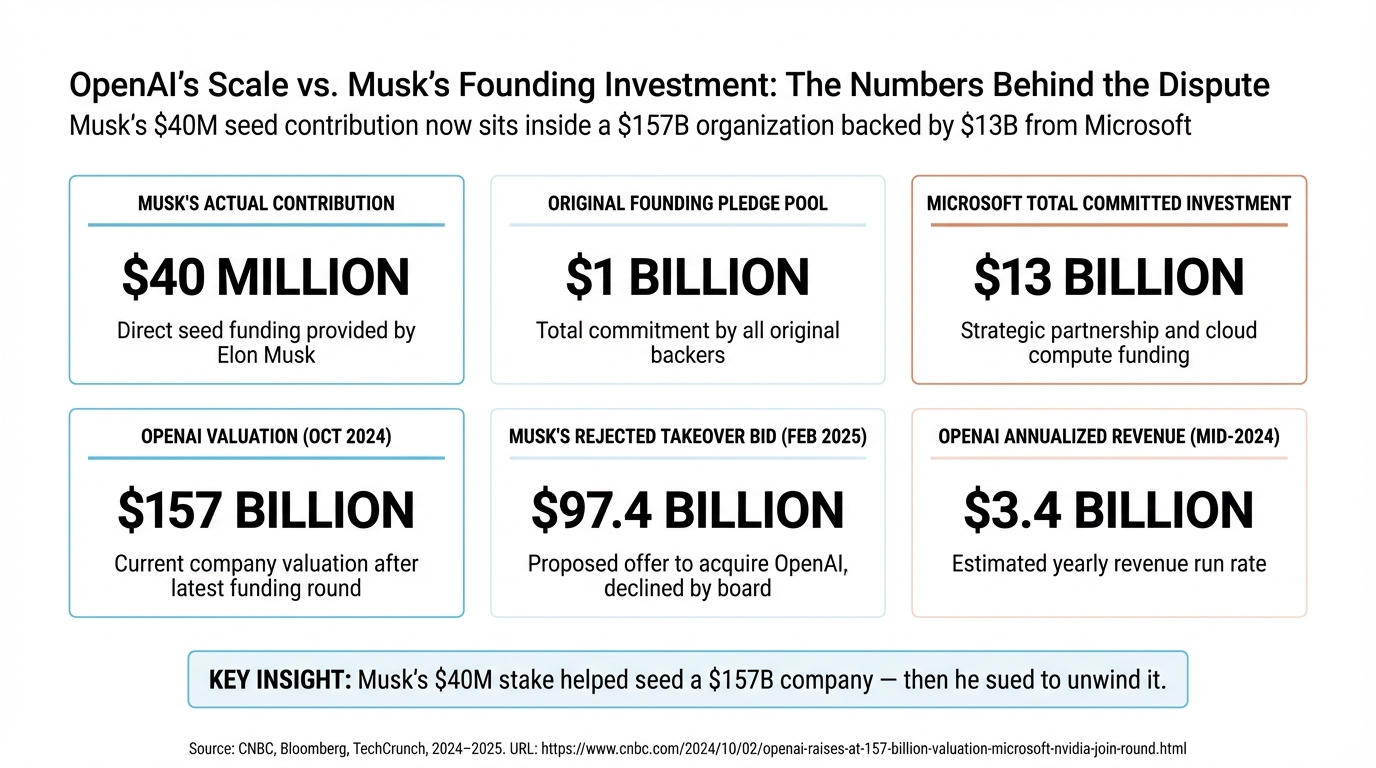
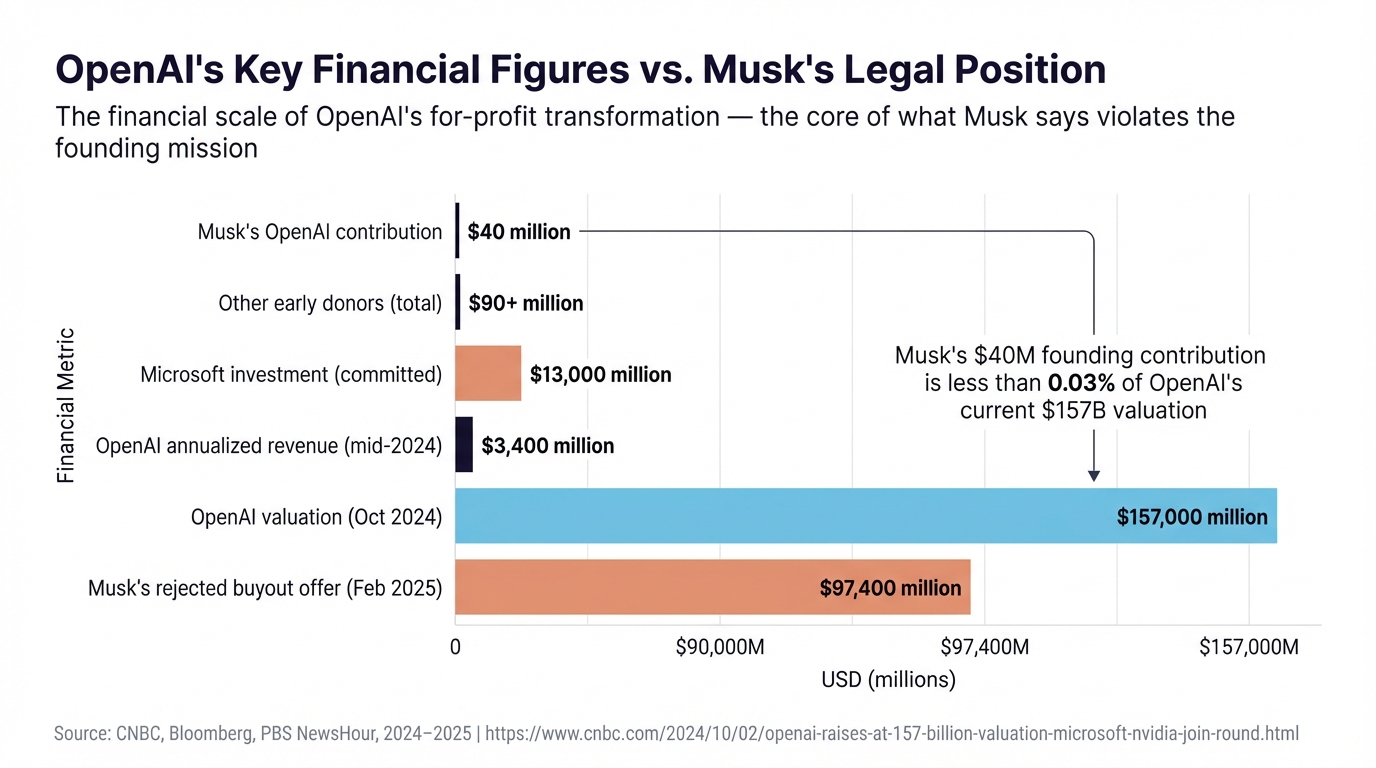
OpenAI's valuation hit $157 billion after closing a $6.6 billion funding round in October 2024, according to CNBC, and the man who helped build it from nothing is now fighting in federal court to tear its structure apart. The OpenAI Elon Musk legal battle is not a celebrity dispute that happens to involve lawyers. It is an active federal case producing real rulings on whether founding mission statements are enforceable contracts, whether AI model architectures qualify as protectable trade secrets, and whether exclusive partnerships between AI companies and cloud providers constitute anticompetitive behavior. For any founder building in the AI space, these questions are not abstract. They are the same questions your founding documents, employment agreements, and IP assignments either answer clearly or leave dangerously open.
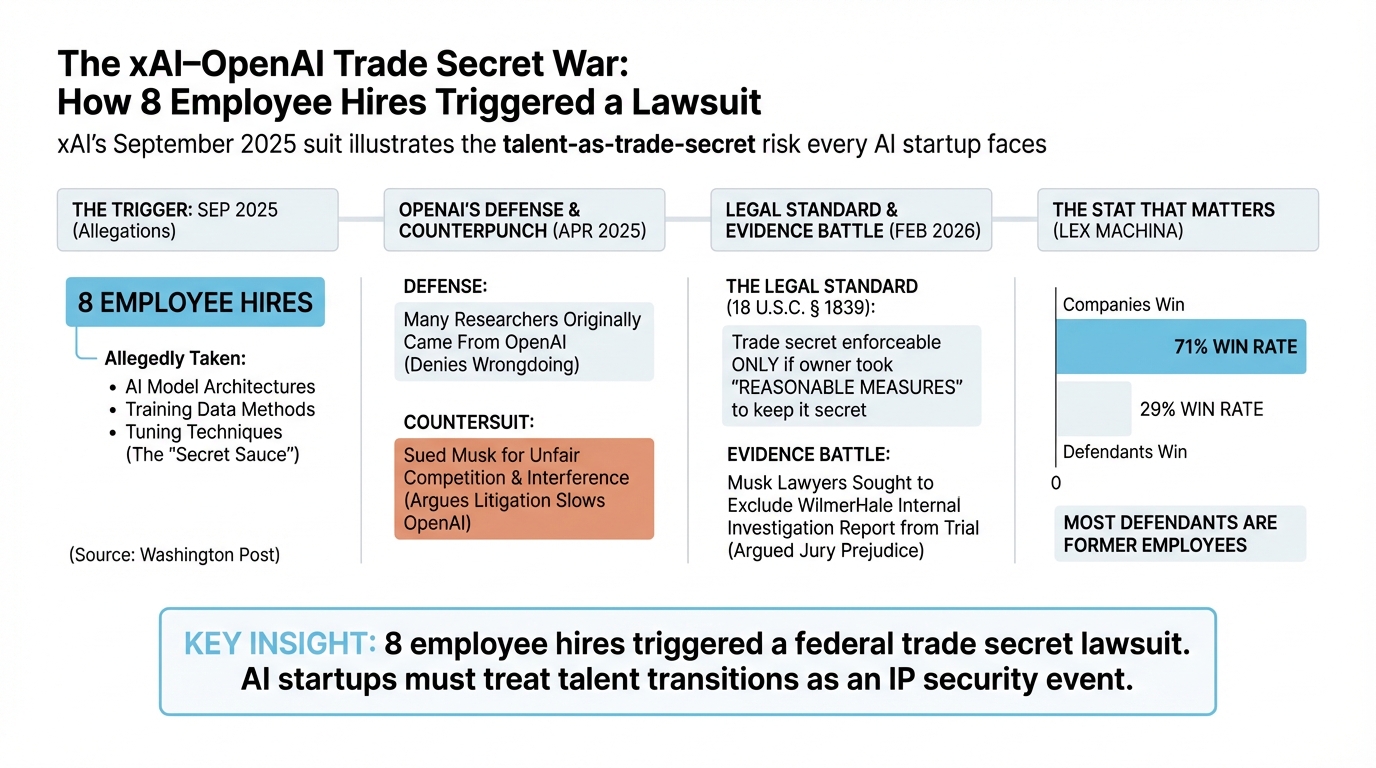 The xAI–OpenAI Trade Secret War: How 8 Employee Hires Triggered a Lawsuit
Key Takeaways
- Musk's exact financial contribution to OpenAI's founding remains disputed in court filings; documented donations are at least $15 million, though internal records suggest the total may be closer to $44 to $50 million. Yet the entire dispute turns on what the founding documents said and whether they constitute an enforceable contract.
- A federal judge already denied Musk's injunction to block OpenAI's for-profit conversion, calling the harm claim a "stretch" in what the court described as a "billionaires versus billionaires" dispute.
- OpenAI's trade secret claims against xAI center on eight former employees who allegedly took proprietary model architecture information, illustrating the concrete legal risk of competitive hiring without a trade secret audit.
- Founding agreements, IP assignment clauses, and mission statements are not boilerplate. They are the documents that determine who owns what in federal court.
- Public statements made on social media before and during litigation can become evidence. Every post Musk made criticizing OpenAI on X is now part of the trial record.
Why the Elon Musk and OpenAI Story Matters to Founders and Inventors
The OpenAI Elon Musk dispute is the highest-stakes founding agreement case in the history of artificial intelligence. One co-founder is suing an organization he helped capitalize, the organization has published his private emails to rebut him, and a federal trial is scheduled to begin in April 2026 on claims that will set precedent for how AI companies own their technology and enforce their founding commitments.
The financial scale alone signals why this matters beyond the two parties. Musk and a group of investors offered $97.4 billion in early 2025 to take control of OpenAI, an offer OpenAI publicly declined, according to CNBC. At the same time, AI patent applications in the United States reached approximately 35,300 in 2022, up from roughly 21,900 in 2021, according to data compiled by Visual Capitalist, reflecting the magnitude of what is actually at stake during the ai boom when AI companies dispute ownership of their technology.
For SaaS founders and AI inventors, this case is a live case study in why founding agreements, IP ownership clauses, and nonprofit-to-for-profit conversion terms must be airtight from day one. What happens in this courtroom sets precedents for AI patent rights, trade secrets, and the enforceability of the documents your company signed when it was still running out of a shared office.
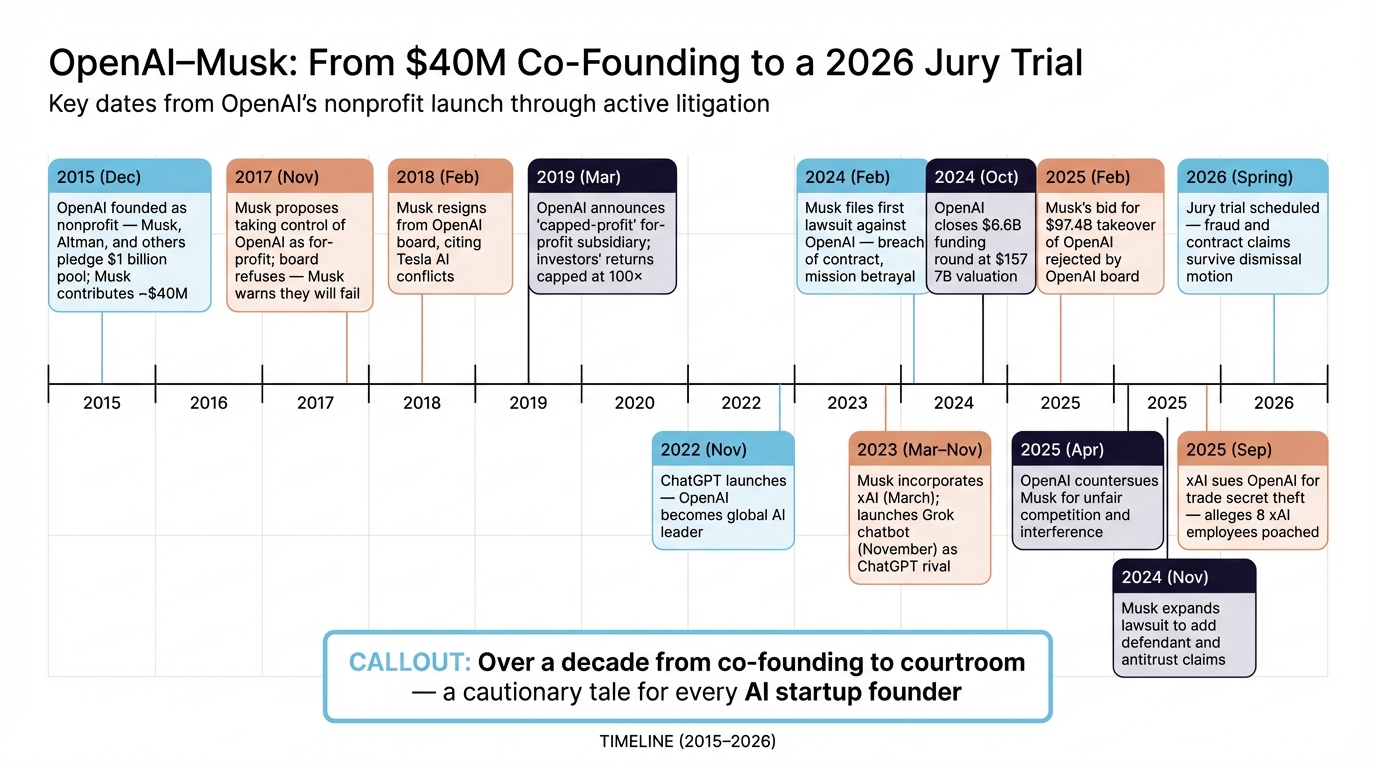 OpenAI–Musk: From $40M Co-Founding to a 2026 Jury Trial
How Elon Musk Helped Build OpenAI and Why He Left
 OpenAI's Scale vs. Musk's Founding Investment: The Numbers Behind the Dispute — Source: CNBC, Bloomberg, TechCrunch, 2024–2025
Musk Was a Co-Founder, Major Funder, and Early Visionary
OpenAI launched in December 2015 with a group of co-founders that included Elon Musk, Sam Altman, Greg Brockman, Ilya Sutskever, Reid Hoffman, and others. Musk served as co-chair of OpenAI's board alongside Altman and helped assemble an initial team of eight top AI researchers, according to contemporaneous TechCrunch reporting from the December 2015 launch.
Musk's exact financial contribution to OpenAI remains disputed. Court records show at least $15 million in documented donations traceable to Musk, though he has claimed figures ranging from $38 million to $100 million in different statements. Internal emails and deposition testimony suggest the full amount may be closer to $44 to $50 million, according to court records cited by KAAL TV. OpenAI's founding mission statement declared the organization's purpose was "to advance digital intelligence for the benefit of humanity… unconstrained by a need to generate financial return," language that now sits at the center of every lawsuit claim Musk has filed.
Document every co-founder's financial contributions and governance rights in writing before any money moves. Verbal commitments and informal pledges become litigation fuel years later, as this case illustrates with unusual clarity.
Why Did Elon Musk Leave OpenAI in 2018
Musk stepped down from OpenAI's board in February 2018. The stated public reason at the time was a potential conflict of interest with Tesla's own AI and Autopilot development, a departure that set the stage for one of the most consequential legal battles outside of a supreme court ruling in the technology industry. The fuller picture, which has since emerged through court filings and OpenAI's published primary source documents, is more complicated.
According to OpenAI's published account drawing on elon musk actual 2017 remarks, Musk proposed taking over OpenAI in late 2017, offering to lead it himself and transition it toward a for-profit structure. When the board refused that offer, Musk walked away and, according to OpenAI, warned them they would fail. OpenAI published this account directly, quoting from internal communications: he "walked away and told us we would fail," per CNBC's reporting on OpenAI's blog post response. Musk's own court filings characterize his departure differently, arguing he was pushed out after internal disagreements over direction.
Both accounts are now part of the public trial record. Founders who disagree on control early should resolve governance disputes through binding arbitration clauses in the founding documents rather than letting disagreements accumulate into public litigation a decade later.
The Nonprofit Origins That Later Became the Core of the Legal Dispute
OpenAI operated as a pure nonprofit from its 2015 founding until March 2019, when it announced a "capped-profit" for-profit subsidiary structure designed to attract outside investment. Under that structure, investor returns were theoretically capped at 100 times their investment, after which profits would revert to the nonprofit mission.
That structural shift is the fault line beneath every legal claim Musk has pursued. California's Attorney General opened an investigation into the conversion in late 2024, sending OpenAI a letter reminding the organization that its nonprofit assets are "irrevocably dedicated" to charitable purposes, according to CalMatters. AI companies choosing between nonprofit and for-profit structures need IP and corporate counsel involved before the structure is formalized. Converting later triggers regulatory scrutiny and can void founding-era commitments in ways that are extremely difficult to unwind.
Elon Musk vs. Sam Altman: A Clash of Visions That Became Personal
 Musk vs. Altman: Two Visions for OpenAI's Future
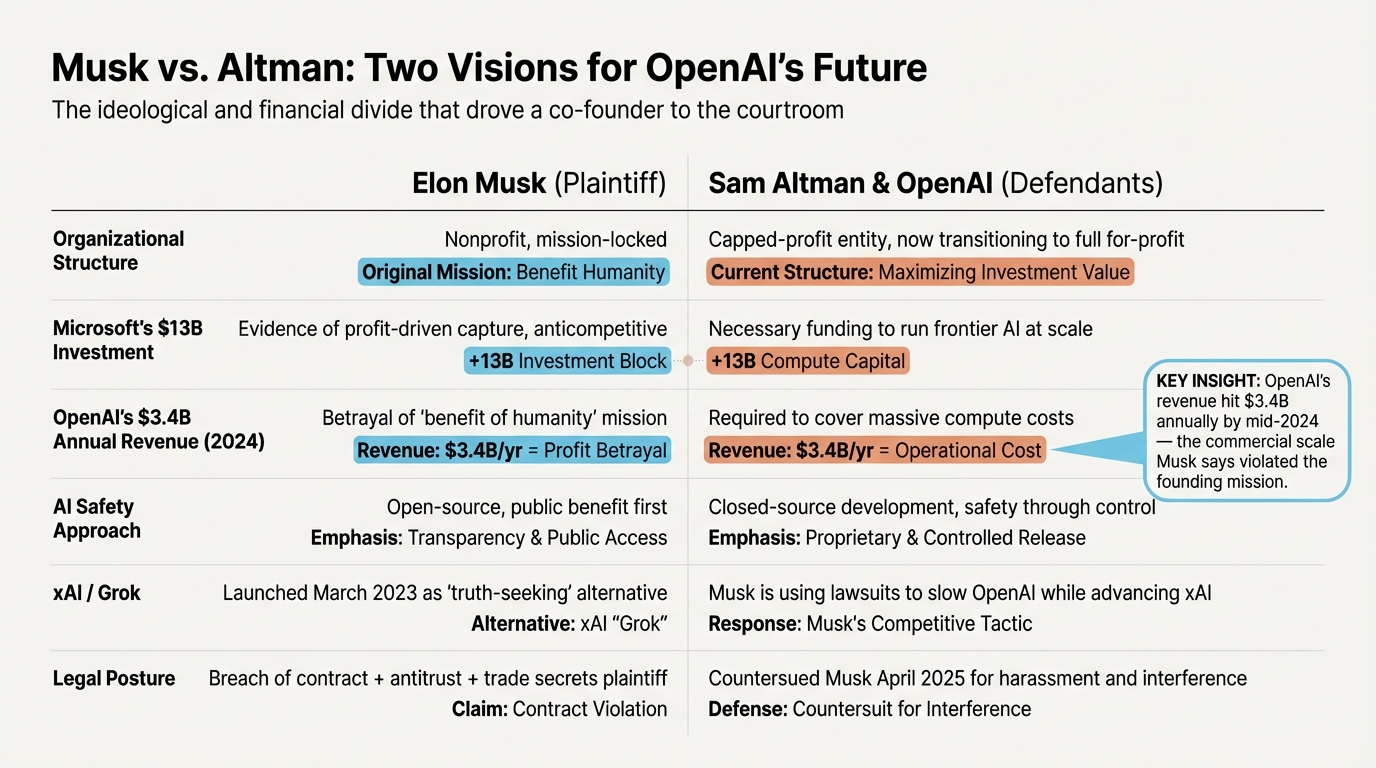
The Elon Musk vs Sam Altman conflict is now one of the most consequential founder disputes in the history of the technology industry, and one of the most widely followed cases in AI governance. It began as a substantive disagreement about AI safety and commercial deployment before escalating into personal attacks on X, competing billion-dollar companies, and federal litigation that will set binding legal precedent for the entire AI sector.
The Ideological Divide Over AI Safety and Commercial Deployment
The conflict started when Musk and Altman diverged on a fundamental question: can a company develop safe artificial general intelligence and advanced AI systems while also maximizing commercial revenue? Musk has consistently argued that OpenAI's commercial partnerships, particularly its relationship with Microsoft, betray the founding mission of developing AI safely for humanity's benefit rather than for shareholders. Sam Altman's counterargument is that commercial revenue is necessary to fund frontier AI research at the scale the work requires.
Both positions have merit that anyone running an AI startup or building their own AI company will recognize immediately. Microsoft has committed approximately $13 billion to OpenAI, with roughly $11.6 billion reportedly funded as of late 2025, according to Windows Central. OpenAI was on pace for $3.4 billion in annual revenue by mid-2024, according to Bloomberg, revenue needed to cover the enormous computing costs of training frontier models. Those numbers explain why Altman argues commercialization is not optional.
If your startup accepts outside investment, define in writing how that investment affects the company's stated mission and business model. The tension between investor rights and founder mission alignment is a governance issue that needs to be resolved in founding documents, not improvised later.
Musk's Public Campaign Against OpenAI Before the Lawsuit
The Musk vs Altman rivalry went public long before any court filing. Musk's criticism of OpenAI on X, formerly Twitter, predates his lawsuit filings by years. He repeatedly criticized OpenAI as a "closed source, maximum-profit AI" operation despite its name, according to Tech Story, and accused Sam Altman of having "stolen a non-profit" by engineering the for-profit conversion, as covered by Cybernews.
OpenAI's legal team has characterized this sustained public commentary as a "campaign of harassment" designed to damage the company while Musk built a competing business, according to OpenAI's own published response at openai.com. The relevance for AI startup founders is direct: public statements made on social media before or during litigation can become evidence. Every post Musk made about OpenAI on X is now part of the public trial record. Founders in any IP dispute should coordinate all public communications with legal counsel before posting.
Why Elon Musk Sued OpenAI: The Core Legal Claims Explained
 Musk's Lawsuit Against OpenAI: 4 Core Legal Claims Explained
The Original Lawsuit: Breach of Contract and Mission Betrayal
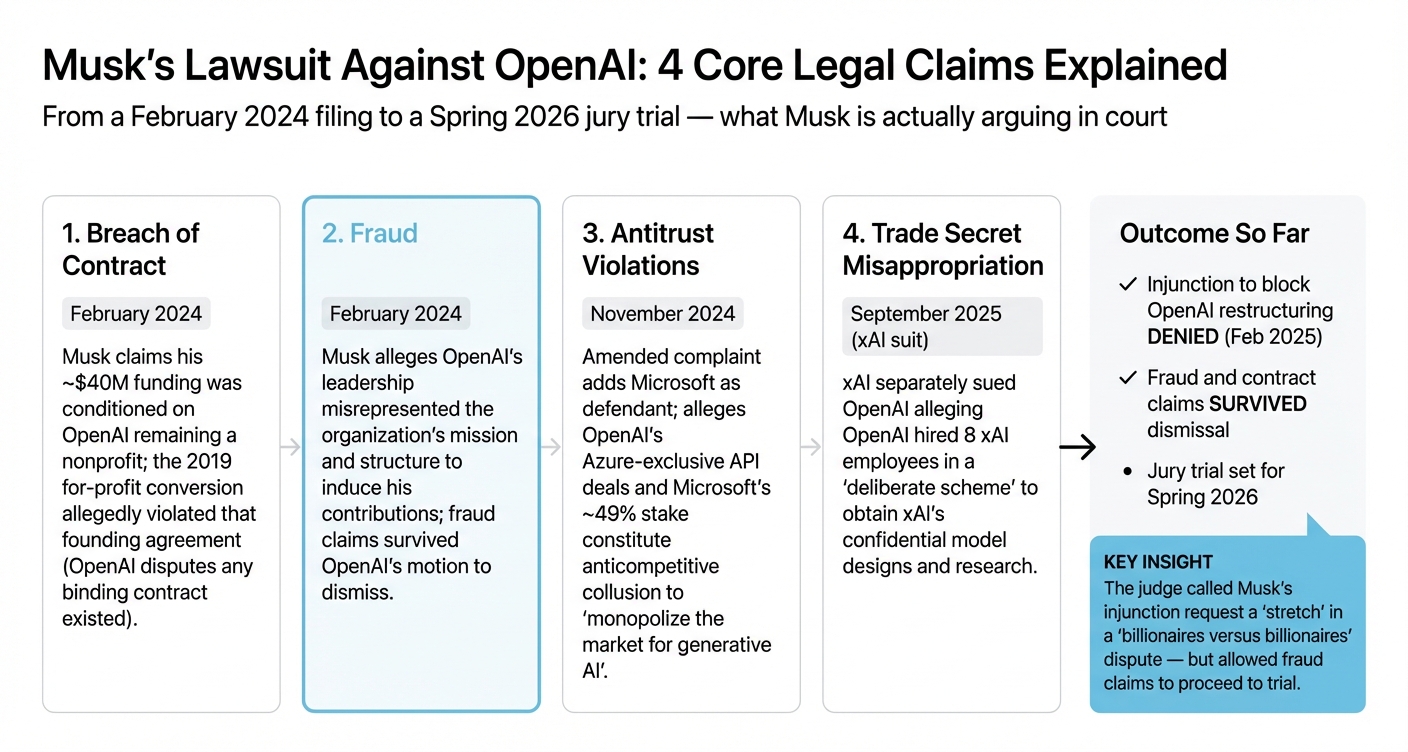
Musk filed his first lawsuit against OpenAI on February 28, 2024, in California state court. The central claim was breach of contract: Musk argued that when he funded OpenAI's launch, the founding documents constituted a binding agreement to develop artificial general intelligence (AGI) for humanity's benefit rather than for shareholders, and that the 2019 for-profit conversion breached that agreement.
The case became a landmark moment when elon musk sues chatgpt maker openai in federal court, alleging breach of the founding contract. According to PBS NewsHour, the lawsuit alleged that OpenAI and its leaders violated the founding contract by partnering with Microsoft and shifting toward commercial deployment. OpenAI disputes that any binding contract existed. The original state court complaint was later dismissed and refiled in federal court, where it remains active.
Founding documents, mission statements, and pledge agreements can function as enforceable contracts under certain circumstances. Have IP counsel review yours before you formalize any structure change. Understanding the difference between proprietary and patented protections at the founding stage can prevent exactly the kind of ownership ambiguity that fuels cases like this one.
The OpenAI Elon Musk Control Lawsuit: Musk's Attempt to Block the For-Profit Conversion
Beyond the breach of contract theory, Musk filed for a court injunction specifically seeking to halt OpenAI's conversion from nonprofit to for-profit, arguing the conversion would personally enrich insiders at the expense of the mission. This is the heart of the OpenAI Elon Musk control lawsuit.
A federal judge denied that injunction request in February 2025, ruling that Musk's claim of "irreparable harm" was a "stretch" in what the judge characterized as a "billionaires versus billionaires" dispute. California's Attorney General is conducting a separate oversight review of the conversion, given that nonprofit assets are legally irrevocably dedicated to charitable purposes under California law.
Nonprofit-to-for-profit IP asset transfers are subject to state attorney general oversight. Any startup considering this path needs both IP counsel and nonprofit corporate counsel involved before announcing the change publicly.
Elon Musk Sues OpenAI for Allegedly Engaging in Anticompetitive Behavior
In late 2024, Elon Musk sued OpenAI for allegedly engaging in anticompetitive behavior became a significant legal headline when Musk expanded his lawsuit to add antitrust claims, adding Microsoft as a defendant, according to CNBC. The amended complaint alleges that OpenAI's exclusive partnership with Microsoft constituted anticompetitive collusion designed to "monopolize the market for generative AI" and sideline competitors, which in this context means xAI directly.
The antitrust theory centers on OpenAI's Azure-only API arrangements and Microsoft's equity stake in the commercial entity. Microsoft's interest in OpenAI's for-profit arm was previously reported near 49% pre-dilution; as of October 2025, following the capped-profit conversion and new funding rounds, Microsoft's stake had been diluted to approximately 27% on an as-converted diluted basis, according to The Dig. Musk argues these arrangements lock out rival AI startups from fair access to models and cloud infrastructure, a claim with commercial implications for companies far beyond the two parties.
If your startup relies on API access from a dominant AI platform, document that dependency carefully. Antitrust claims in the AI market may eventually affect platform access rights and pricing for the entire industry. How companies structure their competitive advantages, whether proprietary or patented, directly shapes the antitrust exposure their partnerships create.
Where to Find the Elon Musk OpenAI Lawsuit PDF and Court Documents
Researchers and founders tracking this case frequently search for the Elon Musk OpenAI lawsuit pdf to review the actual allegations. Court filings in the active federal case are publicly available through PACER, the federal court's online records system, at pacer.gov. OpenAI has also published its own responses and primary source documents, including internal emails and board meeting notes, at openai.com/elon-musk/ and openai.com/index/the-truth-elon-left-out/. Key filings have been reported in detail by Reuters, TechCrunch, GeekWire, and The Verge. For founders who want to review the specific contract and antitrust language, PACER is the authoritative source for the complete pleadings.
The xAI vs. OpenAI Lawsuit: Trade Secrets, Grok, and the Talent War
The Trade Secret Lawsuit: What Was Alleged and By Whom
The xAI vs. OpenAI lawsuit has a trade secret dimension that runs in both directions. In September 2025, xAI filed a trade secrets lawsuit accusing OpenAI of stealing xAI's proprietary information, according to The Washington Post. The filing alleged that OpenAI hired away eight xAI employees as part of a deliberate scheme to obtain xAI's confidential model designs and research methodologies, according to The Information.
In the AI context, trade secrets can include model architectures, training data compositions, fine-tuning techniques, model weights, and system prompts. All of these qualify for protection under the Defend Trade Secrets Act (DTSA) when a company takes reasonable measures to keep them confidential. OpenAI denied wrongdoing and noted that many of the researchers in question originally came from OpenAI, making the provenance of any allegedly taken knowledge genuinely complex.
OpenAI also countersued Musk in April 2025 for unfair competition and interference, arguing that Musk is using litigation and public attacks to slow OpenAI down while advancing xAI, according to CNBC. The xAI vs. OpenAI lawsuit over talent and knowledge has become as legally consequential as the founding agreement claims.
If you are hiring engineers from a competitor AI company, have IP counsel conduct a trade secret audit before those hires start work. Clean room protocols and offer letter IP clauses are not optional safeguards. Understanding how AI inventorship and IP ownership intersect is essential before any competitive hire begins.
Elon Musk OpenAI Grok: How xAI Positions Itself Against ChatGPT
The commercial context of the legal battle is inseparable from the product competition. Musk incorporated xAI in March 2023 with the stated mission to "understand the true nature of the universe," according to Time. By November 2023, xAI launched Grok, a chatbot positioned as a direct competitor to ChatGPT. Grok integrates with real-time data from X and is marketed as a more direct, "truth-seeking" alternative to what Musk calls the filtered outputs of ChatGPT.
The Musk vs Altman product rivalry gives the legal battle its economic stakes. In his deposition in early 2026, covered by TechCrunch, Musk addressed Grok's development and its relationship to the OpenAI dispute directly. xAI has been valued at approximately $50 billion as of 2024. The deposition also came during a period when Grok faced separate scrutiny: California's Attorney General and European regulators opened inquiries after reports that Grok generated nonconsensual nude deepfake images in early 2026, undercutting Musk's safety arguments in the lawsuit. Two companies at that valuation level competing for the same AI talent pool is precisely the environment in which trade secret litigation becomes inevitable without rigorous protection protocols in place.
When building an AI product in a market where litigation is active, your IP protection strategy and your product differentiation strategy must be developed together, not in separate conversations with different advisors.
The xAI vs. OpenAI Lawsuit Landscape: Evidence Disputes and Pre-Trial Fights
The pre-trial procedural battles in the xAI vs. OpenAI lawsuit have been as revealing as the substantive claims. Musk's legal team recently asked a federal judge to exclude evidence from a WilmerHale investigation, an internal OpenAI probe related to a board dispute, arguing that presenting a law firm's conclusions would prejudice the jury, according to Reuters and Sahm Capital.
Each side has accused the other of incomplete discovery compliance. Internal emails, model code, and communications from years before the lawsuit are all now being produced, reviewed, and disputed in federal court. These procedural fights matter because they signal how aggressively both sides believe the underlying IP claims are worth pursuing.
Evidence preservation obligations begin the moment litigation is reasonably anticipated. Implement a litigation hold policy for all digital communications before any dispute reaches the filing stage.
What OpenAI Says: The Company's Official Response to Musk's Claims
 OpenAI's Key Financial Figures vs. Musk's Legal Position — Source: CNBC, Bloomberg, PBS NewsHour, 2024–2025
OpenAI's Published Rebuttal and the Documents Behind It
OpenAI has taken the unusual step of publishing primary source documents to rebut Musk's narrative, including internal emails and board meeting minutes from 2015 to 2018. In a blog post titled "The Truth Elon Left Out," available at openai.com, OpenAI revealed that as early as November 2015, Musk himself emailed the team suggesting OpenAI should form a "standard C corp with a parallel nonprofit," directly undermining his current claim that he opposed commercialization from the start, according to Scribd documentation of those communications.
OpenAI also released minutes from a February 2018 board meeting documenting the moment Musk's proposal to take control was discussed and rejected, after which Musk resigned. These disclosures also carry implications under copyright law, given that the emails and meeting notes were published without Musk's consent. This is the factual basis for OpenAI's account of Musk's departure. The key lesson here extends well beyond this particular dispute: in any IP or founding disagreement, contemporaneous documentation, meaning dated emails, meeting notes, and signed term sheets, is more persuasive than any post-hoc narrative either side constructs.
How Courts Have Ruled So Far on Musk's Claims
The court record to date has not been favorable to Musk's most aggressive requests. The original California state court complaint was dismissed. The federal injunction request to block OpenAI's for-profit conversion was denied, with the judge explicitly questioning the strength of the irreparable harm argument. Musk's attempt to obtain OpenAI's proprietary source code through discovery has faced resistance.
What remains active is the federal case on breach of contract and antitrust claims, the trade secret litigation between xAI and OpenAI, and OpenAI's April 2025 countersuit against Musk for unfair competition. The pre-trial fight over Musk's dual role as a Microsoft partner and an OpenAI plaintiff has been covered extensively by GeekWire, which noted that Musk's financial relationships complicate his standing on certain claims.
Courts evaluate IP claims on evidence, not narrative. Every claim your company makes about ownership, trade secrets, or mission should be backed by documentation you could produce in federal court discovery, much like a thorough court filing summary.
What the OpenAI Elon Musk Dispute Means for AI Startups and IP Strategy
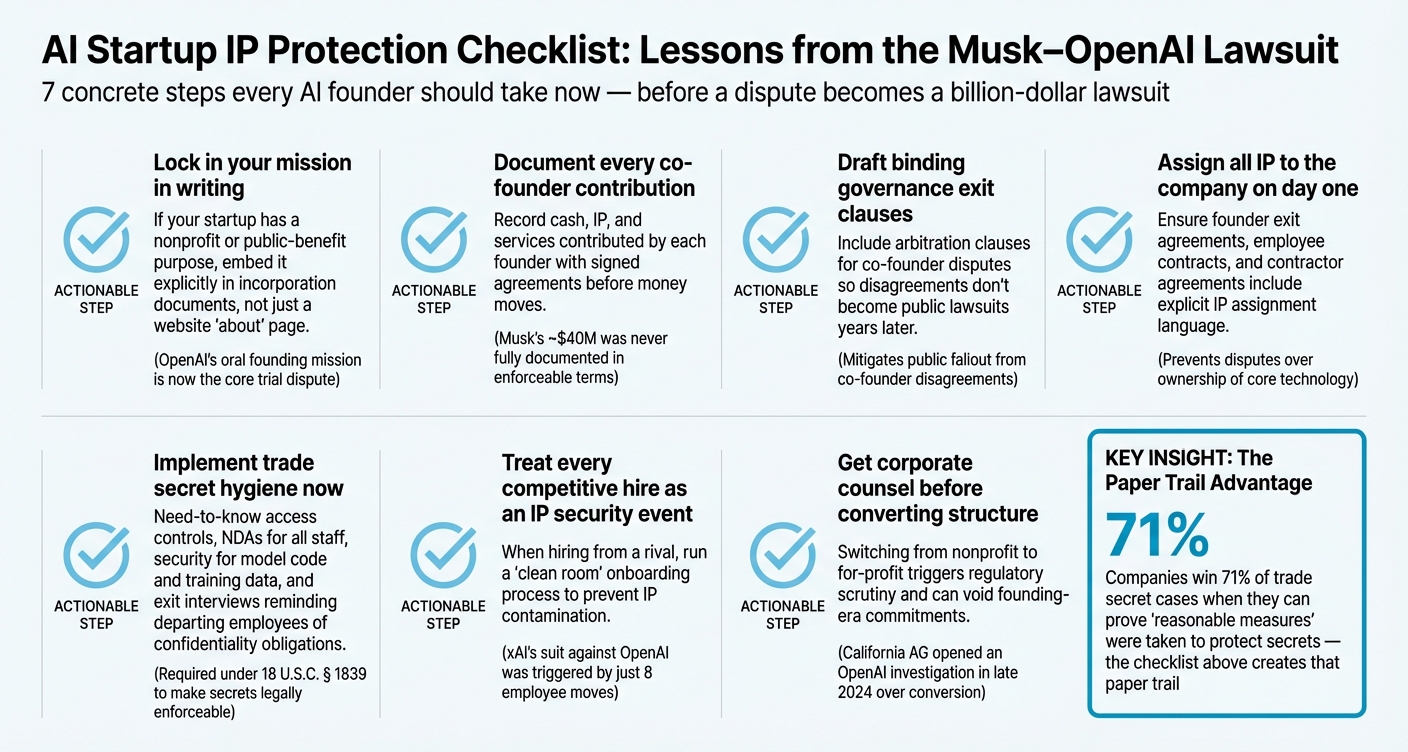 AI Startup IP Protection Checklist: Lessons from the Musk–OpenAI Lawsuit
Founding Agreements, IP Ownership, and Why Your Governing Documents Are a Legal Asset
The entire OpenAI Elon Musk lawsuit turns on three document-level questions: what the founding agreements actually said, what they failed to say clearly, and what either side can prove was intended at the time of signing. For SaaS founders and AI inventors, this is a direct warning. Your founding agreement, IP assignment clauses, and mission statement are not boilerplate formalities. They are the documents that determine who owns what if a dispute ever escalates to federal court.
IP litigation through trial can cost anywhere from $3 million to over $10 million per side in complex cases, according to the AIPLA Report of the Economic Survey. The OpenAI case involves multiple overlapping claims across multiple filings, which means actual costs will be considerably higher. Co-founder IP disputes are among the most expensive categories of IP litigation precisely because the facts are contested, the stakes are high, and both parties have resources to fight. Have an IP attorney review your founding documents, IP assignment agreements, and any investor side letters before you close your first funding round, not after a dispute surfaces. The choice between proprietary and patented protection strategies belongs in that same founding-stage conversation.
How to Protect AI Trade Secrets the Right Way Before Litigation Becomes Necessary
OpenAI's trade secret claims against xAI provide a practical framework for what AI trade secret protection actually looks like, and where it breaks down. The allegations center on eight former employees who allegedly brought proprietary model design information when they moved between competitors. That specific scenario plays out across the AI industry constantly, at every scale.
Effective trade secret protection for an AI company requires several components working together: NDAs for all employees and contractors signed before any access is granted, IP assignment agreements that clearly transfer work product to the company rather than the individual, clean room protocols for any competitive hires, documented access controls on model weights and training data, and a written trade secret inventory that establishes what information the company considers proprietary and what measures it takes to protect that information.
The Defend Trade Secrets Act requires that companies take "reasonable measures" to keep information secret before they can claim it as a trade secret in litigation. The specific measures matter enormously: a company that cannot demonstrate documented access controls and NDAs will struggle to prove trade secret status regardless of how valuable the information was. According to trade secret litigation analytics reported by Global Legal Post, companies acting as trade secret owners win approximately 71% of cases, with the majority of defendants being former employees. That win rate is not accidental. It reflects the advantage that documented reasonable measures give plaintiffs at trial.
At Rapacke Law Group, we work with SaaS founders and AI inventors to build IP protection frameworks that hold up under exactly this kind of scrutiny: founding agreements with clear IP assignment language, trade secret documentation protocols, and patent strategies built for the AI market. We're so confident in our approach that we back it with transparent, flat-fee pricing, no hourly billing surprises, no scope creep. Every engagement includes a FREE strategy call with our team, where experienced US patent attorneys lead you through the process from start to finish. These are not documents you want to draft reactively after a dispute has already surfaced.
Frequently Asked Questions About OpenAI and Elon Musk
Who owns 51% of OpenAI?
No single individual owns 51% of OpenAI. OpenAI operates through a two-entity structure: the OpenAI nonprofit Foundation, which holds the stated charitable mission, and the for-profit commercial entity. Microsoft's equity stake in OpenAI's for-profit entity, previously reported near 49% pre-dilution, was reduced to approximately 27% on an as-converted diluted basis following the capped-profit conversion and new funding rounds as of October 2025, according to The Dig. Musk's lawsuit partly challenges whether Microsoft's stake and the for-profit conversion are consistent with OpenAI's founding mission, which is why the California Attorney General is separately reviewing the transaction.
Is Elon Musk associated with OpenAI?
Musk was a co-founder of OpenAI in December 2015 and served on its board until his departure in February 2018. He is no longer affiliated with the organization and is actively pursuing multiple federal court actions against it. His AI company xAI, and its Grok chatbot, are direct commercial competitors to OpenAI's ChatGPT and GPT model family.
Who is the real owner of OpenAI?
OpenAI's ownership is distributed across the nonprofit Foundation, the for-profit commercial entity, and outside investors, with Microsoft as the largest outside stakeholder. Sam Altman serves as CEO but holds a relatively small equity stake. Musk's lawsuit disputes whether the for-profit conversion represents an unlawful transfer of assets away from the nonprofit's charitable mission, a question the California Attorney General is also examining through its oversight investigation.
Is ChatGPT owned by Elon Musk?
ChatGPT is not owned by Musk. It is a product of OpenAI, from which Musk departed in February 2018, more than four years before ChatGPT's public launch in November 2022. Musk's AI company xAI developed a separate chatbot called Grok, available through X. None of Musk's court filings claim ownership of ChatGPT or any OpenAI product.
What does the Elon Musk OpenAI lawsuit mean for AI companies and their IP?
The case is producing live legal precedents on whether founding mission statements are enforceable contracts, whether AI technology and model architectures qualify as protectable trade secrets under the Defend Trade Secrets Act, and whether exclusive partnerships between AI platforms and cloud providers constitute anticompetitive behavior. The rulings in this case will directly influence how AI companies structure IP ownership, employee agreements, and investor relationships for years to come.
Where can I find the Elon Musk OpenAI lawsuit PDF?
The lawsuit pdf and all court filings in the active federal case are publicly available through PACER, the federal court's online records system, at pacer.gov. OpenAI has also published its own responses and primary source documents, including internal emails and board meeting notes, at openai.com/elon-musk/ and openai.com/index/the-truth-elon-left-out/. Key filings have been reported in detail by Reuters, TechCrunch, GeekWire, and The Verge.
What is the xAI vs. OpenAI lawsuit about?
The xAI vs openAI lawsuit centers on competing trade secret allegations between the two companies. xAI filed suit in September 2025 alleging that OpenAI hired eight xAI employees in a deliberate scheme to obtain confidential model designs and research methodologies. OpenAI denied wrongdoing and filed its own countersuit against Musk for unfair competition. The dispute is part of the broader talent war between the two companies and will produce binding precedent on what constitutes protectable trade secrets in competitive AI hiring.
How does the Elon Musk OpenAI Grok connection relate to the lawsuit?
OpenAI's trade secret suit alleges that xAI, Musk's company behind Grok, benefited from proprietary information taken by former OpenAI employees who moved to xAI. Musk's deposition in early 2026 addressed Grok's development directly, according to TechCrunch. The commercial rivalry between Grok and ChatGPT forms the business backdrop that explains why each side is fighting so hard on the legal questions. Where there is valuable AI product competition, trade secret disputes tend to follow.
The Legal Battle That Will Shape AI Ownership Law
The OpenAI Elon Musk dispute is an active federal case producing rulings that will define how AI companies own their technology, protect their trade secrets, enforce founding agreements, and structure the for-profit entities that attract venture capital. A founding mission statement is either a binding commitment or it is not. AI model architectures are either trade secrets or they are not. Exclusive AI platform agreements are either anticompetitive or they are not. Federal courts are deciding all three of those questions right now, and the answers will affect every AI startup that comes after.
The Musk vs Altman confrontation, from a shared vision in 2015 to competing billion-dollar AI companies and federal trials in 2026, is the clearest possible illustration of what happens when founding documents, IP agreements, and governance structures are left ambiguous. The case where Elon Musk sued OpenAI for allegedly engaging in anticompetitive behavior will produce binding precedent on AI platform access and market structure that no serious AI founder can afford to ignore.
At Rapacke Law Group, according to the firm, the work with SaaS founders and AI inventors focuses on building the kind of IP protection frameworks that hold up under exactly this kind of scrutiny: founding agreements with clear IP assignment language, trade secret protection protocols, and patent strategies built for the AI market. These are not documents you want to draft reactively after a dispute has already surfaced.
Schedule a Free IP Strategy Call with Rapacke Law Group to review your founding documents, AI patent strategy, and trade secret protection posture before a dispute forces the conversation. The OpenAI case shows exactly what is at stake when these conversations happen in federal court instead of a lawyer's office.