
A patent claim is the only part of your patent application that legally defines what you own, and according to the USPTO, more than 646,000 patent applications were filed in FY 2022 alone, with claim drafting errors ranking among the leading reasons applications are abandoned before a patent ever issues. Your specification can describe your invention in exhaustive detail, your drawings can illustrate every component, and your abstract can summarize everything perfectly, but if your claims are too narrow, a competitor can copy your product and stay entirely outside your patent's legal protection. This guide walks you through exactly how to write patent claims that are broad enough to provide real protection, specific enough to survive examination, and structured correctly under U.S. patent law.
Key Takeaways
- A patent claim functions like a property boundary survey: everything inside the boundary is protected, everything outside is not. Write the fence too tight, and competitors walk around it.
- Every element you include in an independent claim becomes required for infringement. Keep independent claims lean and move specific features to dependent claims as fallback protection. A good claim at the independent level covers the inventive concept without unnecessary implementation detail.
- Use "comprising" as your default transition phrase. It keeps claims open-ended, meaning an accused product can have additional elements and still infringe.
- Pro se applicants abandon their applications at a 76% rate compared to 35% for attorney-represented filers, according to research published in PLOS ONE. Professional claim drafting is almost always worth the cost for a commercially important invention.
- A provisional patent application establishes your priority date for 12 months without requiring formal claims, but it only protects what is fully and specifically disclosed. Treat it as a near-complete specification, not a rough sketch.
What a Patent Claim Actually Does and Why It Matters
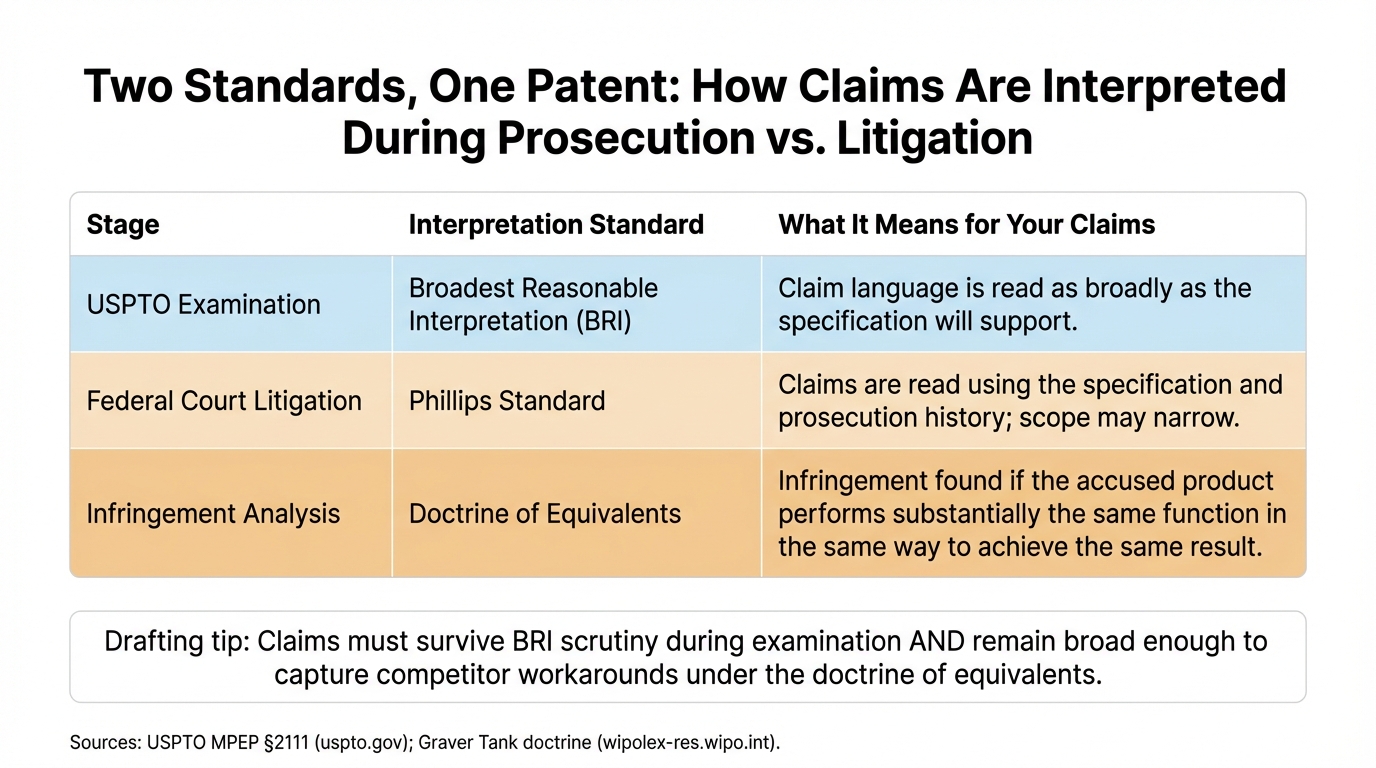 Two Standards, One Patent: How Claims Are Interpreted During Prosecution vs. Litigation — Source: USPTO MPEP §2111 (uspto.gov); Graver Tank doctrine (wipolex-res.wipo.int)
The Claim Is the Legal Boundary of Your Patent
A patent claim functions exactly like a property boundary survey. It defines the precise legal territory you own. Everything inside those boundaries is protected; everything outside is not. Write your fence too tight, and competitors walk around it. Write it incorrectly, and the USPTO rejects it entirely.
Understanding what patent claims actually cover is the foundation of any effective filing strategy. The interpretation standard for claims shifts depending on where the dispute occurs. During examination, according to USPTO guidance in MPEP § 2111, claims are given the "broadest reasonable interpretation" consistent with the specification. Once the patent issues and ends up in litigation, courts apply the narrower Phillips standard, taking the full specification and prosecution history into account. That shift matters because a claim scope that looks reasonable during prosecution can look surprisingly narrow when a Federal Circuit panel applies Phillips.
The doctrine of equivalents provides one additional layer of coverage. Even if an accused product does not literally match every claim element, it may still infringe if it performs substantially the same function in the same way to achieve the same result. But relying on the doctrine of equivalents as your primary enforcement strategy is risky. Well-drafted, broad claims are always more reliable.
Before drafting a single word, define what behavior you want to prevent a competitor, or other people, from doing. That behavior is what your claims must cover.
Independent Claims vs. Dependent Claims
An independent claim stands alone and defines the invention without reference to any other claim. A dependent claim references and narrows an independent claim, adding a specific feature. This structure is not just organizational, it is strategic.
The USPTO fee schedule covers up to 3 independent claims and 20 total claims within the basic filing fee. Each independent claim beyond three costs approximately $600, and each claim beyond 20 costs approximately $200 (large entity rates effective January 19, 2025). Most applications file 1-3 independent claims and fill the remaining slots with dependent claims.
Dependent claims serve as fallback positions. If your broad independent claim is narrowed or invalidated during examination or post-grant review, a dependent claim that adds a specific feature can survive and still protect that particular variant. Under 37 C.F.R. § 1.75, a dependent claim incorporates all the limitations of every claim it depends from. That means claim 2, which depends from claim 1, automatically requires everything in claim 1 plus its own added limitation.
Draft your broadest independent claim, your main claim, first, then use dependent claims to capture every meaningful variation. Each dependent claim is a fallback if the independent claim is narrowed during prosecution.
How Claims Differ From the Rest of Your Application
The specification, drawings, and abstract describe your invention. The claims define it. Under 35 U.S.C. § 112, claims must "particularly point out and distinctly claim" the invention on their own terms. Understanding the complete structure of a patent application helps clarify how each section interacts with and supports your claims.
U.S. courts have repeatedly held that limitations from the specification cannot be imported into the claims unless the claims explicitly include them. This principle, called claim differentiation, directly determines whether your patent protects your commercial product or just a theoretical version of it. If your specification describes a specific material but your claim does not include it, a competitor can omit that material and potentially avoid infringement and the specification description does not save you.
Read your claim in isolation. If it reads differently from how you described the invention in the spec, that discrepancy will be used against you in prosecution or litigation.
The Three-Part Structure Every Patent Claim Requires
The Preamble Sets the Stage
Every patent claim opens with a preamble that introduces the category of invention: "A method for encrypting data…" or "A system comprising…" The preamble may or may not limit the claim depending on how the rest of the claim is drafted.
According to Federal Circuit case law, a preamble is limiting only when it gives "life and meaning" to the claim body or recites essential structure not found in the body itself. A preamble that merely states a purpose or intended use generally does not limit claim scope. This distinction affects your prior art search strategy and your prosecution options.
Choose your preamble category carefully. "A computer-implemented method" signals software and may trigger § 101 eligibility scrutiny, while "A system comprising" or "An apparatus comprising" frames the invention as a physical thing and can sidestep some eligibility issues. For a deeper look at how claim type selection affects your overall strategy, see this guide to types of patents and how to choose the right one.
The Transition Phrase Controls Claim Scope
The transition phrase sitting between your preamble and claim body is one of the most consequential choices in claim drafting. "Comprising" is open-ended: an accused product can include additional elements beyond those listed in the claim and still infringe. "Consisting of" is closed: any element not listed destroys infringement. "Consisting essentially of" occupies a middle ground used primarily in chemistry and pharmaceuticals.
According to USPTO guidance on transitional phrases in MPEP § 2111.03, the term "comprising" is the default for utility patent claims precisely because it preserves coverage against products that add features to the claimed combination.
Use "comprising" in nearly every utility patent claim unless you have a specific reason to close the claim. Open-ended claims almost always provide stronger commercial protection, and they are the foundation of strong claims that hold up under litigation.
The Body Defines Every Required Element
The claim body lists each essential element of the invention. Every element you include becomes required for infringement. If an accused product omits even one listed element, there is no infringement under the all-elements rule.
This is why skilled patent drafters fight to keep independent claims as element-light as possible. Extra details belong in dependent claims. For every element you consider adding to your independent claim, ask: "Can my invention work without this?" If yes, move it to a dependent claim. This approach is central to building a patent application like a legal fortress. A process covered in depth in our patent documentation blueprint.
How to Write Independent Claims That Are Broad Enough to Matter
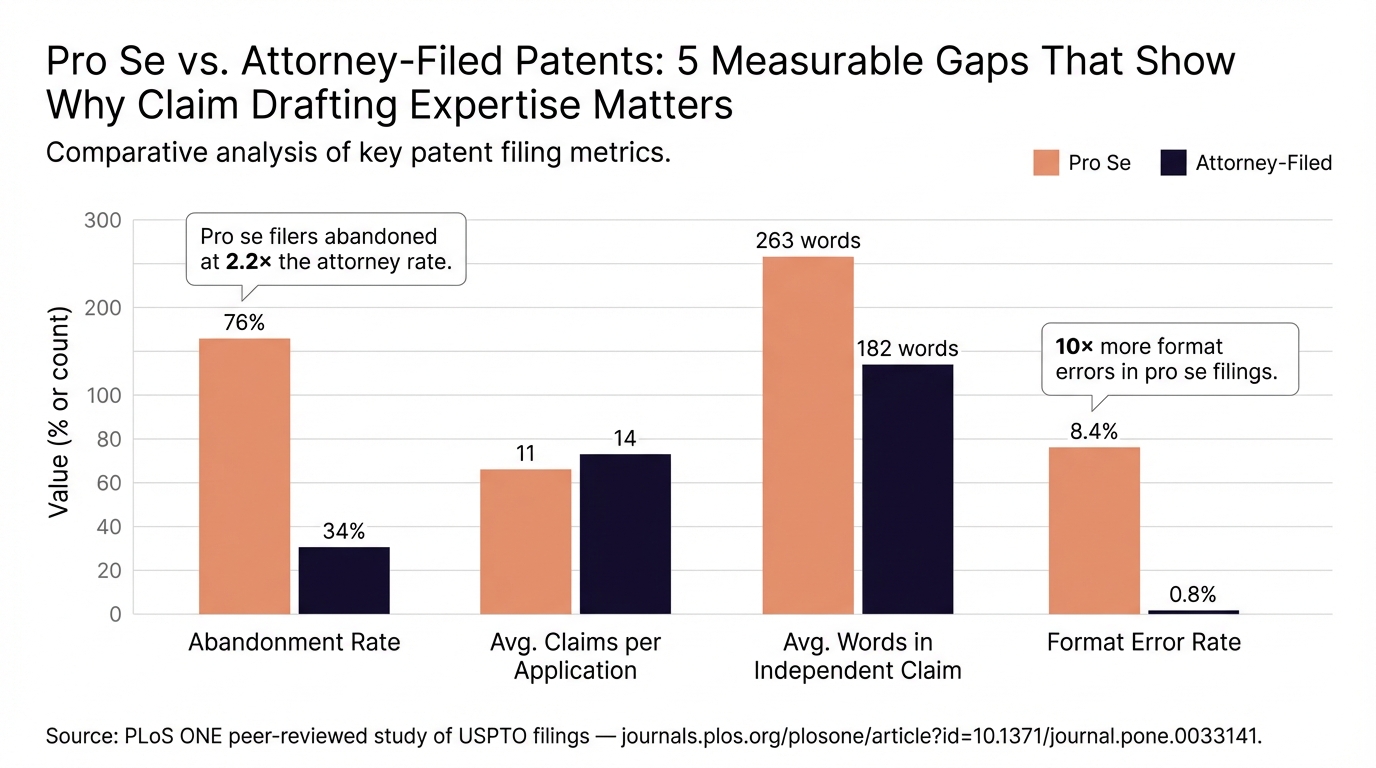 Pro Se vs. Attorney-Filed Patents: 5 Measurable Gaps That Show Why Claim Drafting Expertise Matters — Source: PLoS ONE peer-reviewed study of USPTO filings, journals.plos.org
Start With the Broadest Possible Version of Your Invention
Before drafting the claim you think you want, draft the single-sentence version that captures the core inventive concept stripped of every specific implementation detail. This super-broad draft will almost certainly face prior art rejections, but it forces you to identify what your invention actually is at its most fundamental level.
Think of the process like writing a thesis statement before an essay. The thesis states the core argument; the body paragraphs add the supporting detail. Your independent claim is the thesis. Every dependent claim is a supporting paragraph.
Write your broadest claim, the broadest claim in your application, before you look at any prior art. Then use your prior art search to determine how far you can actually push that scope. For utility inventions specifically, this broad-first discipline is one of the most important principles covered in utility patents explained.
Use Functional Language Strategically
Functional language claims an element by what it does rather than what it is: "a processor configured to analyze incoming data" rather than "an Intel Core i7 processor running at 3.6 GHz." This keeps claims broad and technology-neutral, covering future implementations your competitor might build.
Under 35 U.S.C. § 112(f), "means for" language triggers means-plus-function interpretation, which limits the claim to the specific structures disclosed in your specification. According to USPTO guidance in MPEP § 2181, means-plus-function claims are limited to the corresponding structures described in the specification and their equivalents. Modern drafters largely avoid "means for" phrasing and instead use functional language without the trigger phrase. "A processor configured to" does the same descriptive work without invoking the narrowing effect of means-plus-function.
Use functional language freely, but avoid "means for" phrasing unless you intentionally want means-plus-function interpretation.
Avoid Claim Terms That Create Ambiguity
Ambiguous claim terms, the product of ambiguous language in drafting, give the USPTO grounds for indefiniteness rejections under 35 U.S.C. § 112(b) and give courts grounds to invalidate issued patents. Words like "approximately," "substantially," "fast," and "high-quality" are problematic unless the specification defines them with precision.
Since the Supreme Court's 2014 decision in Nautilus, Inc. v. Biosig Instruments, the Federal Circuit has applied a stricter indefiniteness standard, requiring that claims inform a person of ordinary skill in the relevant field with reasonable certainty about the scope of the invention. Patents have been invalidated on indefiniteness grounds that previously would have survived.
Every relative or qualitative term in your claims must be defined numerically or by example in your specification. Treat your specification as a private dictionary for your claims. If you use the word "substantially" in a claim, your specification should define what percentage deviation that word encompasses.
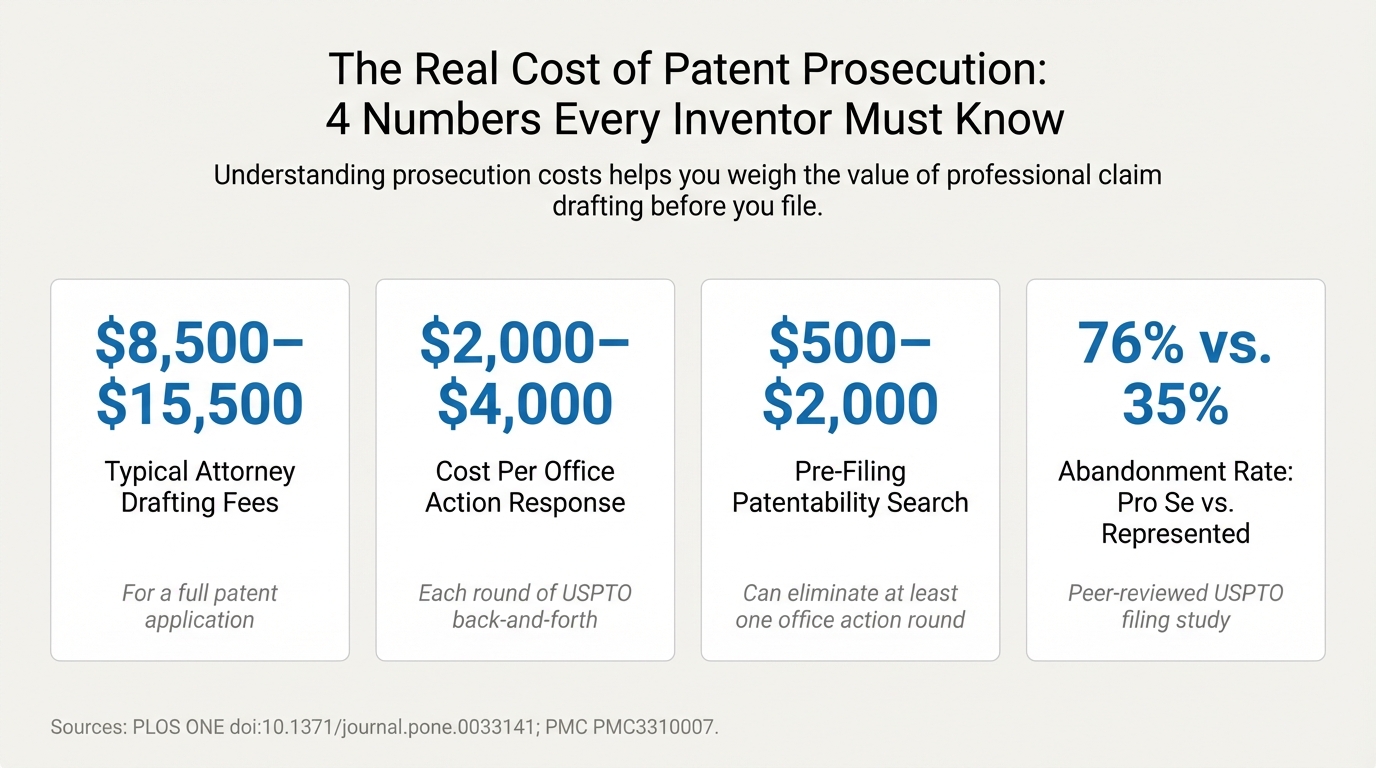
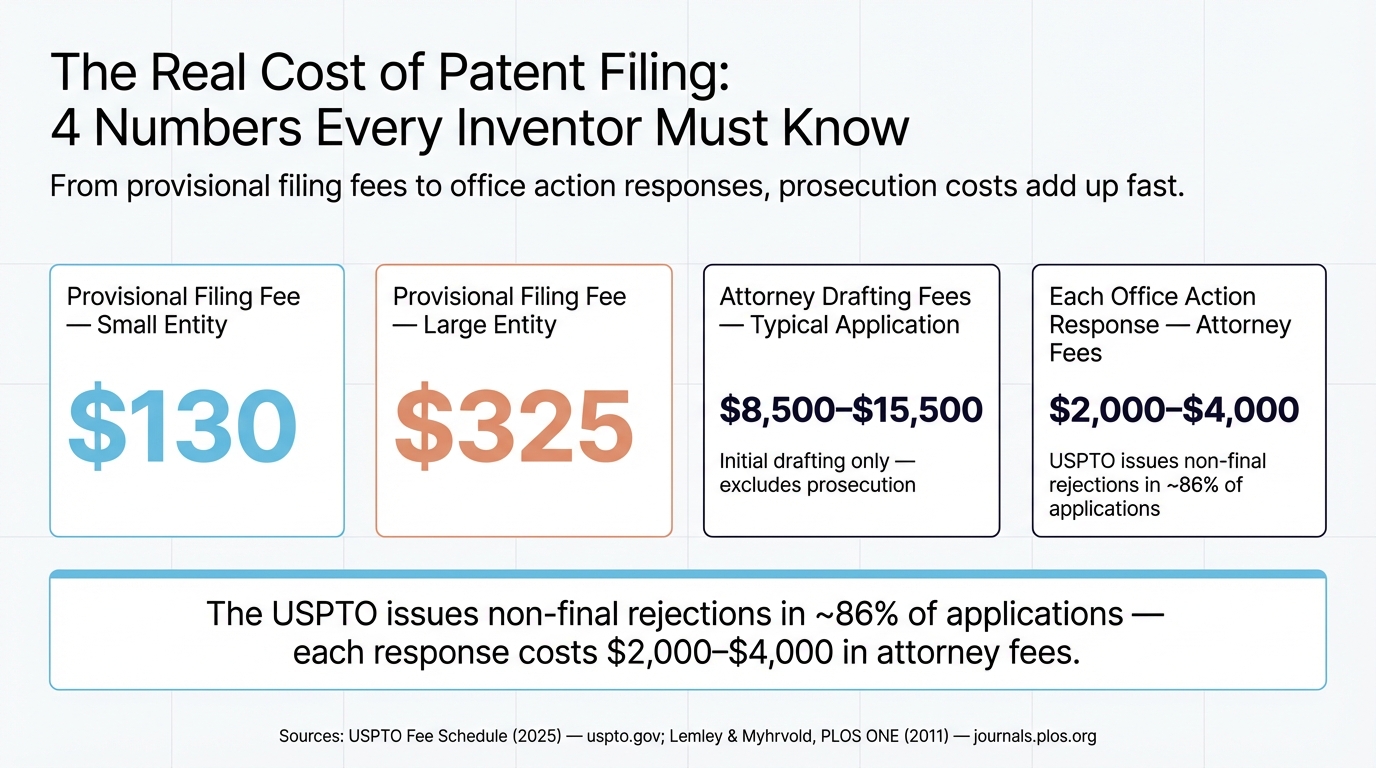
The average patent application costs $8,500 to $15,500 in typical attorney drafting fees, with each office action response adding another $2,000 to $4,000 in professional fees. Vague claim language that triggers avoidable rejections multiplies those prosecution costs directly.
Pro se applicants abandon their applications at a 76% rate compared to approximately 35% for attorney-represented filers, according to research published in PLOS ONE. The gap in outcomes between represented and unrepresented inventors is measurable and consistent.
Writing Method Claims for Software and Process Inventions
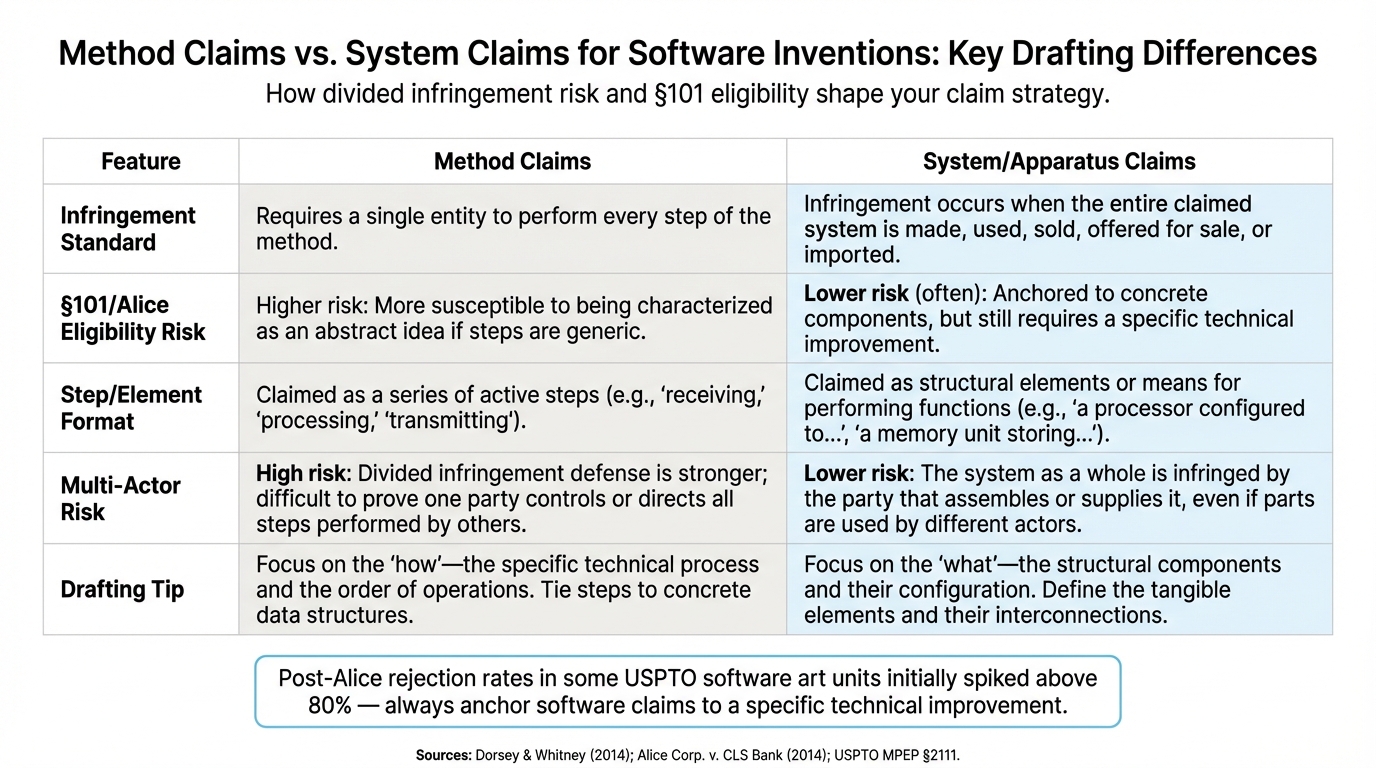 Method Claims vs. System Claims for Software Inventions: Key Drafting Differences — Source: Dorsey & Whitney (2014); Lexology / Alice Corp. v. CLS Bank (2014)
Structure Method Claims as Active Steps, Not Passive Descriptions
Method claims protect a process — the way something is done rather than a physical thing. Each step must be written as an active present-tense verb: "receiving," "analyzing," "generating," "transmitting." Courts have held that method claims require each step to be performed, so every step you include must be essential to the invention.
The divided infringement doctrine creates a specific trap for software and network method claims. Under Akamai Technologies v. Limelight Networks, direct infringement of a method claim requires that a single party, or a party directing and controlling other actors, must perform every step. A debatable claim on divided infringement grounds can become unenforceable even when the underlying invention is clearly novel. If your method naturally involves multiple actors, say, a client device and a server, and no single entity performs all steps, you may have an unenforceable claim against direct infringers.
If your method requires steps performed by different actors, restructure the claim so a single entity controls all steps. Drafting patent applications that cover multi-actor processes requires careful structural choices to avoid divided infringement vulnerabilities. Alternatively, write a system claim that captures the hardware architecture, which can be infringed by a single manufacturer. Software founders will find additional guidance on this tradeoff in how to identify patentable features in your software.
Software Patents Require Specific Claim Drafting to Survive § 101
The Supreme Court's 2014 decision in Alice Corp. v. CLS Bank International, 573 U.S. 208 (2014) established that software claims merely implementing an abstract idea on a generic computer are patent-ineligible under 35 U.S.C. § 101. Analysis of the Alice decision and its aftermath has documented that § 101 rejection rates in some USPTO software art units spiked above 80% in the immediate post-Alice period, forcing applicants to draft much more technically specific claims.
To survive § 101, your claims must articulate a specific technical improvement, not just a business method automated with computers. A claim that recites "a method for processing transactions" is vulnerable. A claim that recites "a method for reducing latency in transaction processing by routing encrypted data through a hardware security module using a specific symmetric key rotation protocol" is not the same claim. The technical specificity in the second version is what creates patentability.
For every software claim, identify the specific technical problem being solved and make sure the technical improvement, not just the outcome, is recited in the claim itself. If your claim reads equally well describing a manual process performed by humans, it almost certainly will not survive Alice scrutiny.
Prior Art Searches Before Drafting Save Expensive Prosecution Time
Filing a patent application without a prior art search is like buying land without a survey. According to data published by BigPatentData, approximately 80% of applications that ultimately issue as patents receive at least one non-final rejection during prosecution, and over 90% of abandoned applications receive at least one non-final rejection. Each round of back-and-forth with an examiner costs money.
A professional patentability search costs $500 to $4,000. Given that each office action response typically runs $2,000 to $4,000 in attorney fees, a pre-filing search often eliminates at least one office action and pays for itself in the process.
At minimum, search Google Patents and the USPTO full-text database using the 3 to 5 terms that best describe your invention's core function. Review the 10 most recent and most relevant results before drafting a single claim.
Dependent Claims and How They Protect Your Invention in Layers
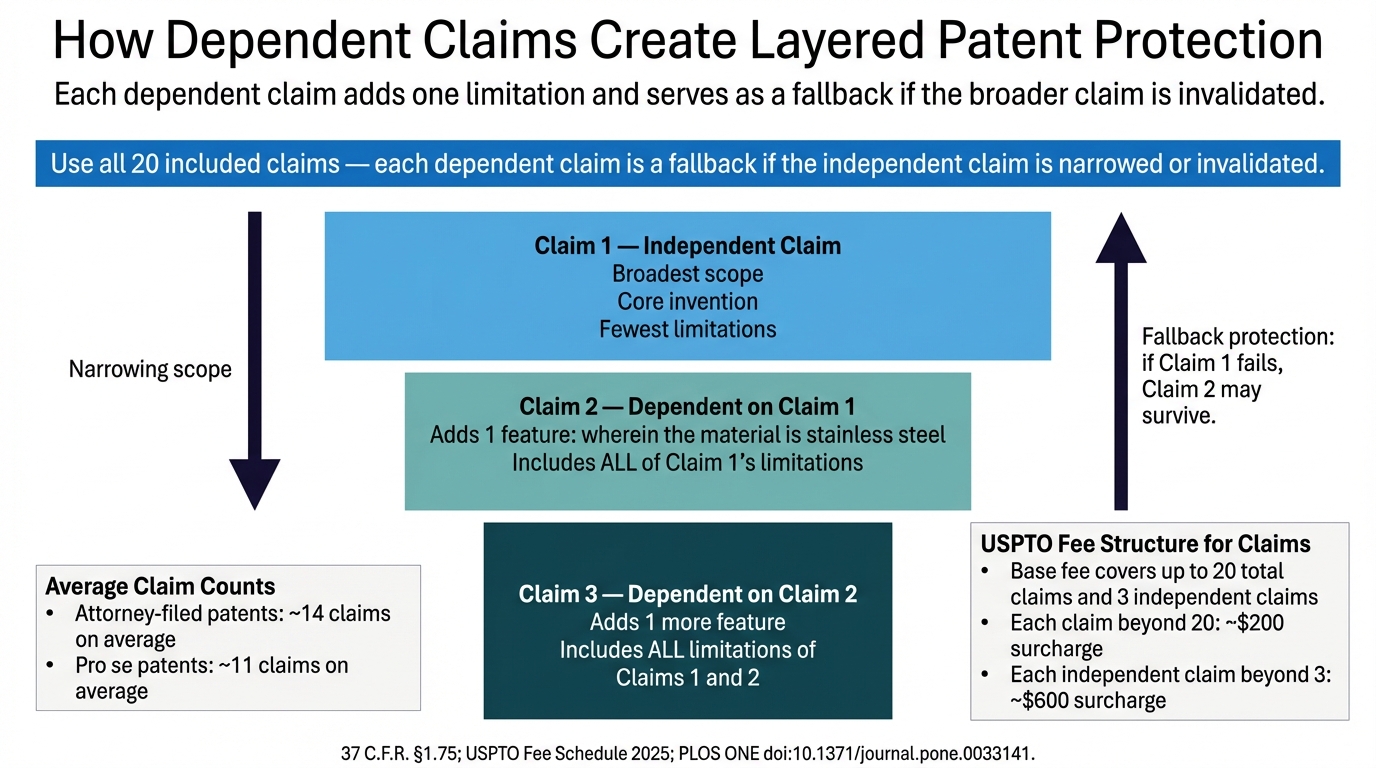 How Dependent Claims Create Layered Patent Protection — Source: 37 C.F.R. §1.75 (law.cornell.edu); USPTO Fee Schedule 2025; PLOS ONE, 2012
Every Dependent Claim Is an Insurance Policy
If an independent claim is invalidated during litigation or narrowed during prosecution, dependent claims survive independently as long as their additional limitations distinguish them from the prior art. A layered claim structure is why experienced patent attorneys rarely file applications with a single claim. A single claim is a single point of failure.
Under 37 C.F.R. § 1.75, each dependent claim incorporates all the limitations of the claims it depends from, plus its own additional limitation. This means a dependent claim automatically has a narrower scope than its parent and is therefore more likely to survive if the parent claim is challenged. If your broad independent claim 1 is knocked out by prior art, a narrower claim 2 that adds "wherein the processing is performed by a hardware security module" can still be enforceable for that specific implementation.
Attorney-filed patents average approximately 14 claims per application, while pro se filers average approximately 11 claims per application, according to PLOS ONE research on patent prosecution. That gap in claim count reflects a gap in fallback protection. The USPTO fee structure allows 20 total claims before surcharges kick in, giving you substantial space to add meaningful dependent claims at no additional cost.
Draft dependent claims to cover every commercially important feature of your product. If a competitor can design around your independent claim and still copy your key feature, you need a dependent claim on that feature. This layered approach is especially important for complex innovations — see types of claims in medical device patent applications for a practical illustration of how multi-layer claim structures work in a highly regulated field.
Structuring Dependent Claims From Broad to Narrow
The most effective patent applications build dependent claim trees, starting from one invention concept at the broadest independent claim level and adding one specific feature per layer. A well-structured tree might have three claims at the second level, each adding a different feature, then six or more at the third level building on each of those.
This structure maximizes coverage while giving the examiner clear alternatives to consider during prosecution. It also makes post-grant review challenges harder: an IPR petitioner must challenge each claim separately, and invalidating a well-branched claim tree requires knocking out every branch, including strong claim positions that may have survived if the independent claim falls.
Map your dependent claims visually before writing them. A claim tree diagram reveals gaps in coverage that you will miss if you draft claims sequentially. The best claims emerge from this structured, visual planning process rather than linear sequential drafting.
What Claim Amendments Do During Prosecution and Why They Matter
When the USPTO issues a rejection, you can argue against it, amend the claims to distinguish the prior art, or both. Amendments narrow your claims, and those narrowing amendments create prosecution history estoppel. Under the Supreme Court's Festo Corp. v. Shoketsu Kinzoku decisions, amendments made to overcome prior art rejections cannot later be recaptured through the doctrine of equivalents for the surrendered territory. This is why each applicant's own claim amendments are among the most consequential decisions in prosecution.
This makes the amendment decision high-stakes. Before amending a claim to overcome a rejection, ask whether filing a continuation application to pursue the broader scope separately is worth the additional cost. A continuation preserves your priority date while allowing you to pursue a broader claim set for the same invention that was not amended in the parent application. For commercially important inventions, the cost of a continuation is almost always justified. For a full walkthrough of how prosecution decisions affect your outcome, see patent prosecution simplified.
Common Claim Drafting Mistakes That Undermine Patent Protection
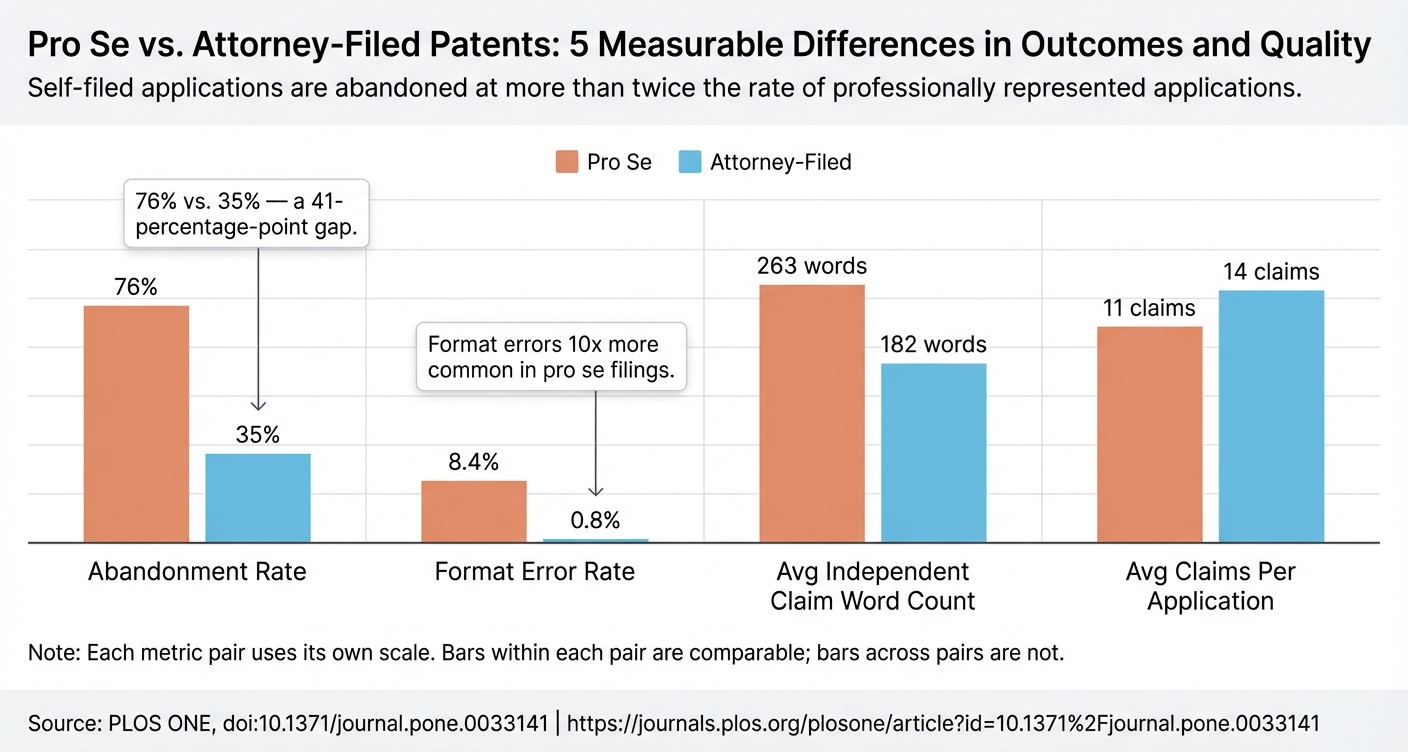 Pro Se vs. Attorney-Filed Patents: 5 Measurable Differences in Outcomes and Quality — Source: PLOS ONE (Frakes & Wasserman), 2012
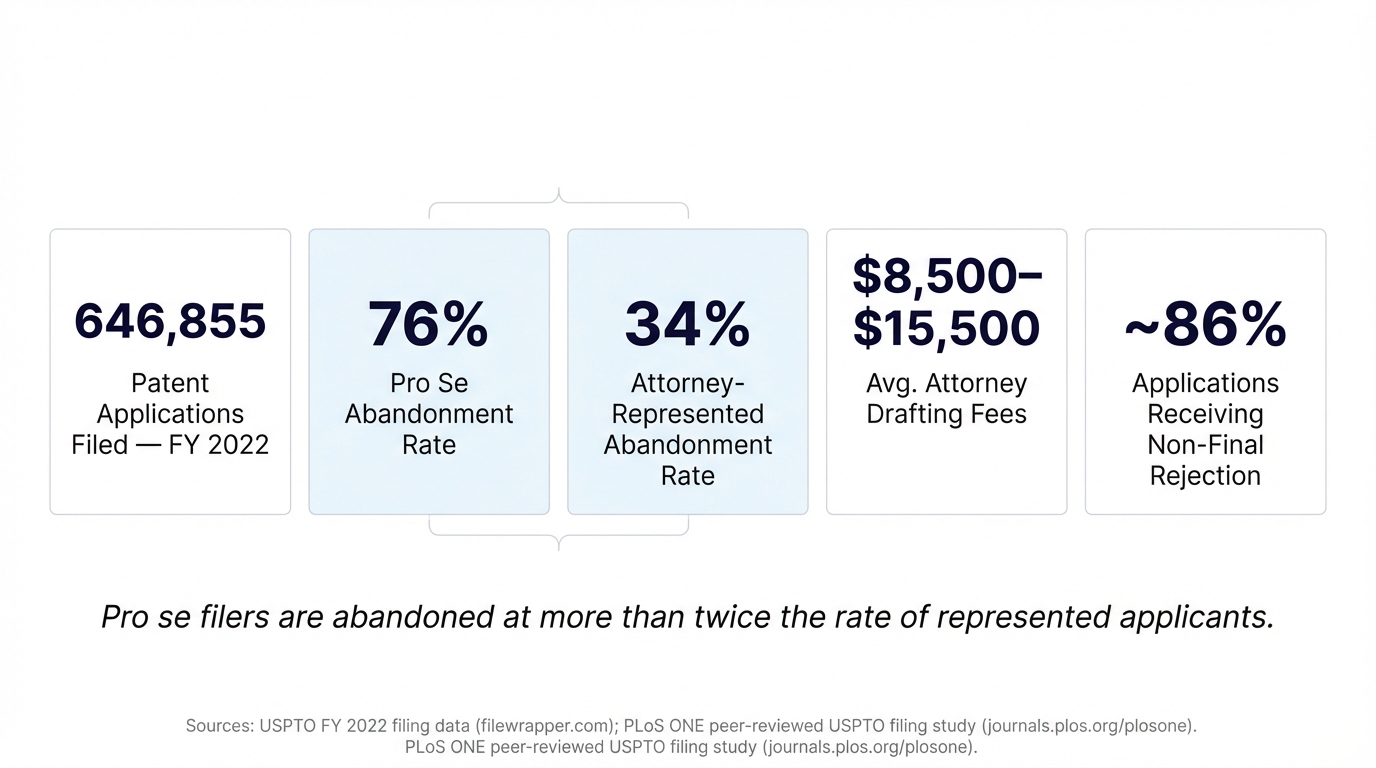 U.S. Patent Filing Reality: 4 Numbers Every Inventor Must Know — Source: USPTO FY 2022 filing data (filewrapper.com); PLoS ONE USPTO filing study (journals.plos.org)
Claiming the Preferred Embodiment Instead of the Invention
The most common mistake solo inventors and first-time applicants make is describing their specific prototype in the claims rather than the broader inventive concept. Your patent protects what the claims say, not what you built. A claim that describes your product precisely enough to read like a product specification is narrow enough for a competitor to design around with minimal effort.
The data is unambiguous here. According to PLOS ONE research on pro se patent prosecution, 76% of pro se patent applications were abandoned compared to approximately 35% of attorney-represented applications. The pro se patents that did issue tended to have narrower claims covering fewer alternatives and rarely contained arguable claims that could be enforced broadly. A solo inventor who files without professional help is not just risking rejection, they are risking a patent that issues but stops no one.
If your independent claim reads like a product spec sheet, it is too narrow. Abstract it up by one level: replace specific values, specific materials, and specific implementations with functional language that covers what those specific choices accomplish.
Using Inconsistent Terminology Across Claims and Specification
Patent claim construction requires courts and examiners to give claim terms their meaning in the context of the specification. If you call the same element "a processor" in one claim and "a computing unit" in another, a court may interpret them as different elements, or may use the inconsistency against you during claim construction in a way that narrows your coverage.
The USPTO's MPEP guidance on claim formatting requires clear, consistent use of terminology throughout the application. Federal Circuit decisions have repeatedly penalized applicants for inconsistent claim language during construction proceedings.
Create a terminology list before you draft. Every element gets one name, and that name appears identically in every claim and every relevant passage of the specification. Consistent claim statements throughout the document prevent construction disputes that undermine your coverage. If you want to call something a "transaction module," call it that in every claim, in every section of the spec, and in every drawing reference. Learning how to read a patent through the claims-first lens makes this consistency requirement intuitive. The same discipline that helps you analyze a competitor's patent helps you draft your own more precisely.
Failing to Include Claims That Cover Competitor Workarounds
Sophisticated competitors conduct freedom-to-operate analyses that identify gaps in your claim coverage before they begin designing their product. If you only claim a method but not the system that implements it, a competitor who sells the system without running the method themselves may avoid infringement entirely.
Different claim types cover different categories of infringers. Method claims cover parties who perform the process. Apparatus claims cover the manufacturer of the device. System claims cover combinations of components. Product claims cover anyone who makes, uses, sells, or imports the product. For every invention, file at least one method claim and one apparatus or system claim. These cover different commercial actors and give you enforcement flexibility across the supply chain.
Continuation applications can add new claim types after the original application files, as long as the specification supports them. This is a critical strategic option for investors and startup founders. The connection between claim breadth and investment value is explored in detail in why investors care about IP.
When to Work With a Patent Attorney or Patent Agent
 The Real Cost of Patent Prosecution: 4 Numbers Every Inventor Must Know — Source: PLOS ONE (Frakes & Wasserman), 2012; PMC3310007
What a Registered Patent Attorney or Agent Actually Does
Only individuals registered with the USPTO, patent attorneys (who hold a law degree and have passed the Patent Bar) and patent agents (who have passed the Patent Bar but do not hold a law degree), can legally represent inventors before the USPTO. Both can draft and prosecute patent applications. Patent attorneys can additionally represent clients in patent litigation and licensing negotiations.
According to the USPTO, there are approximately 45,000 registered patent practitioners in the United States, all qualified to assist with patent marking requirements and prosecution strategy. Not all of them have deep experience in every technology category. For software and SaaS inventions, the practitioner's technical background matters as much as their legal credentials. A patent attorney who understands distributed systems will draft materially better software claims than one who does not.
For a first patent application on a core product, the cost of professional drafting is almost always less than the cost of a narrowly written patent that issues but fails to stop a competitor. The U.S. patent system is designed to reward precise claim drafting, and shortcuts here are rarely recoverable. Typical attorney drafting fees of $8,500 to $15,500 represent the floor of what investors and acquirers expect to see protected in a startup's IP portfolio.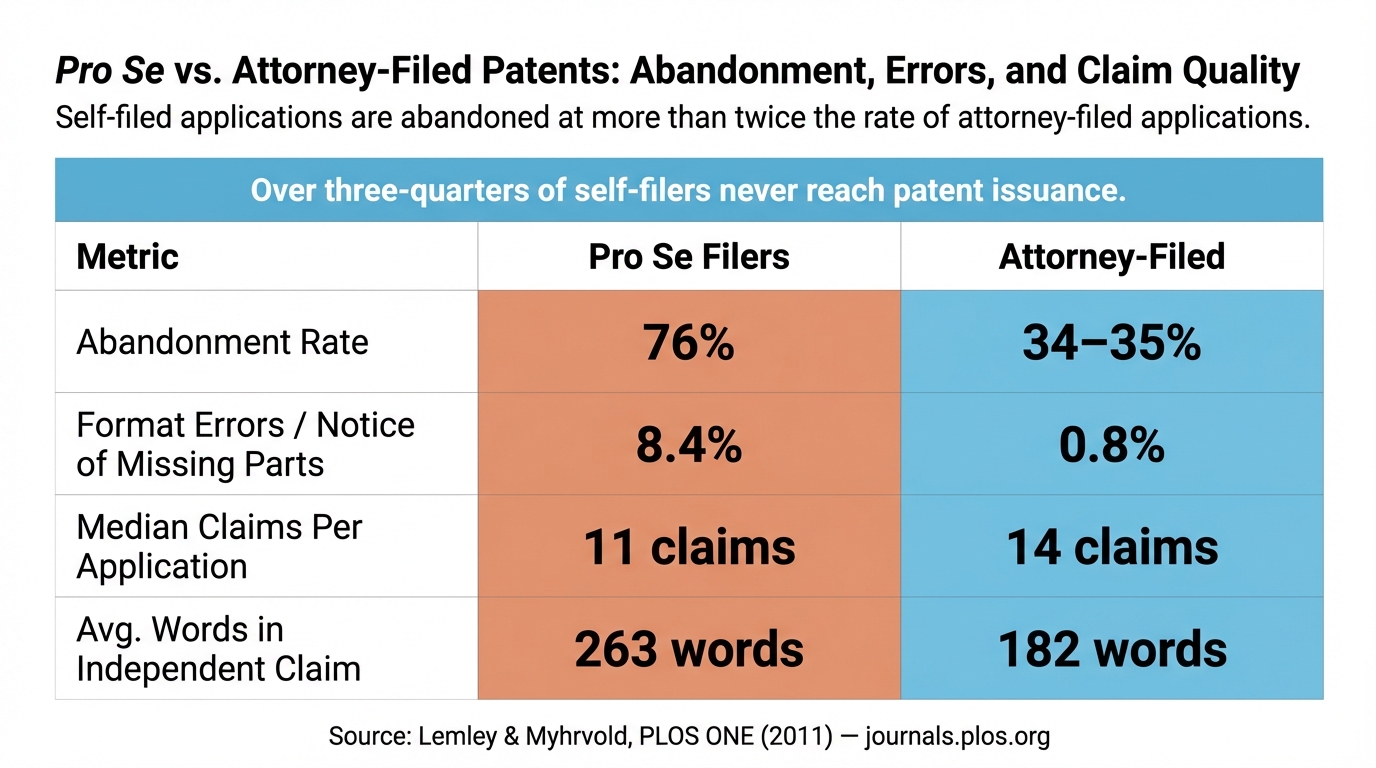 Pro Se vs. Attorney-Filed Patents: Abandonment, Errors, and Claim Quality — Source: Lemley & Myhrvold, PLOS ONE, 2011
How Rapacke Law Group Approaches Claim Strategy for Tech Inventors
According to Rapacke Law Group, the firm's approach to patent claims starts with a strategic conversation, not a form. As a firm built around tech startups and SaaS founders, the team understands that patent claims must align with your business model, covering what your competitors are likely to build, not just what you have already built.
Rapacke Law Group reports that its flat-fee structure means inventors know the cost upfront, without hourly billing surprises that make prosecution amendments feel financially threatening. Protecting intellectual property effectively requires both strong drafting and a clear understanding of costs. For a solo inventor or early-stage startup, cost predictability matters almost as much as claim quality, and both affect whether you can afford to see the process through to issuance.
Andrew Rapacke, a registered patent attorney and Managing Partner, works with inventors to map the commercial landscape before a single claim word is written. The entry point for that process is a free IP Strategy Call where the claim strategy conversation begins before any commitment.
Rapacke Law Group backs its work with a satisfaction guarantee: if you are not satisfied with the quality of your patent application, the firm will make it right at no additional charge. That commitment is part of why the firm's clients can engage with confidence rather than uncertainty.
Request a free IP strategy call before deciding whether to file yourself or with professional help. The conversation itself will clarify your claim strategy and your realistic scope of protection.
The Provisional Patent Application as a Low-Cost Starting Point
A provisional patent application establishes your priority date for 12 months without requiring formal patent claims. There is no initial claim requirement at this stage. It only needs a written description and drawings sufficient to support future claims. This gives inventors time to test the market, refine the invention, and raise funding before committing to full prosecution costs.
Provisional application fees start at approximately $320 for small entities and $160 for micro-entities under current USPTO fee schedules. The low entry cost makes provisionals an attractive starting point, but there is a critical caveat: a provisional only protects what is fully and specifically disclosed. A rough sketch with vague descriptions provides weaker priority protection than inventors typically assume.
Research shows that the priority date established through a provisional application can be critical for excluding prior art that arises in the 12-month window before your non-provisional filing. Unlike academic claims to priority, a provisional's protection is bounded strictly by what was actually disclosed. But that benefit only applies to subject matter that was properly disclosed in the provisional itself.
A provisional application buys time, not protection. It only protects what is fully disclosed, so treat it as a near-complete specification, not a rough sketch.
 The Real Cost of Patent Filing: 4 Numbers Every Inventor Must Know — Source: USPTO Fee Schedule, 2025; Lemley & Myhrvold, PLOS ONE, 2011
Frequently Asked Questions About Writing Patent Claims
How do you write a claim example?
A basic independent patent claim follows this structure: a preamble naming the category ("A method for processing payment data"), a transition phrase ("comprising"), and a body listing the essential steps or elements ("receiving, by a server, encrypted transaction data from a user device; decrypting the transaction data using a hardware security module; and transmitting an authorization token to the user device"). Every element listed becomes required for infringement, so include only what is truly essential to distinguish your invention from the prior art. Think of this like constructing a claim statement: the claim states the core argument of your patent, and everything else in the application supports it.
How do you write claims in a patent application?
Writing patent claims begins with identifying the core inventive concept. This is the one thing your invention does that nothing in the prior art does. Draft the broadest independent claim that captures that concept without unnecessary implementation details. Then draft 10 to 15 dependent claims that each add one specific feature, building a protection layer from broad to narrow. Every claim must be supported by your specification. The specification cannot introduce new matter not already in the original disclosure, and the claims cannot rely on structure only described in the spec without explicit claim language.
What are some examples of patent claim types?
Patent claims fall into three main categories recognized by the USPTO: method claims (covering a process or series of steps), apparatus claims (covering a physical device or machine), and system claims (covering combinations of components working together). A software invention might have a method claim covering the steps a server performs, an apparatus claim covering the server itself, and a system claim covering the server in combination with a client device. Filing all three types for a single invention maximizes enforcement flexibility across different categories of potential infringers and produces effective claims across method, apparatus, and system categories.
Can you give me an example of a strong vs. weak patent claim?
A weak claim (really a general claim) reads: "A method comprising using a computer to recommend products to users based on their purchase history." This fails because it uses vague language, covers an abstract idea on a generic computer, and any recommendation system could be designed around it or challenged under Alice Corp. v. CLS Bank International, 573 U.S. 208 (2014). A stronger claim specifies the technical mechanism: "A method comprising: generating, by a neural network executing on a GPU-based server, a ranked product recommendation list by applying collaborative filtering to a sparse user-item matrix; and transmitting the ranked list to a user device in under 200 milliseconds." The stronger claim identifies specific technical steps that distinguish the invention from prior art and ground it in a concrete technical improvement.
How do you write a simple claim for a first-time inventor?
Start with one sentence describing what your invention does at its most essential level. Strip out every word describing how you specifically built it. What remains is the core of your independent claim. Add the preamble ("A method for…" or "A device that…"), the transition word ("comprising"), and format each element as its own clause. Have a registered patent attorney review the result before filing. Even inventors with strong technical backgrounds consistently write claims that are either too narrow to provide real protection or too broad to survive examination without prior art rejection.
What is the difference between an independent claim and a dependent claim?
An independent claim stands alone. It defines the invention completely without referencing any other claim, and it sets the outer boundary of your patent's legal coverage. A dependent claim references and incorporates an independent claim and then adds one or more additional limitations, narrowing the scope. Dependent claims serve two functions: they capture specific valuable implementations that deserve separate protection, and they provide fallback positions if the independent claim is invalidated during reexamination or litigation. Every claim in your application is either independent or dependent, and under 37 C.F.R. § 1.75, a dependent claim must include all limitations of the claim it references.
Do I need a patent attorney to write patent claims?
Legally, no. Inventors can file their own patent applications as "pro se" filers. Practically, yes, in almost every case that matters commercially. Research published in PLOS ONE found that pro se applicants abandon their applications at a 76% rate, compared to approximately 35% for attorney-represented applicants. More importantly, a patent granted on poorly drafted claims may provide no real protection even after it issues. Competitors can design around narrow claims without infringement. For inventions worth protecting commercially, professional claim drafting almost always delivers a positive return on the investment.
Your Next Step Toward a Patent That Actually Protects Your Invention
A patent with weak claims is not an asset. It is a document that cost you $15,000 and stops no one. Claim drafting is the most technically demanding part of the patent process, and the mistakes made here cannot be fully corrected after your application publishes. Scope surrendered during prosecution is scope you never recover.
The stakes are real: according to research on patent abandonment, 18% of abandoned patent claims were later found to be valid, meaning inventors regularly lose enforceable rights not because their inventions lacked merit, but because the prosecution process was mismanaged. Claim drafting is where that process either succeeds or fails.
Rapacke Law Group works exclusively with tech inventors, SaaS founders, and startup teams who need patents that align with real business strategy, not just applications that technically issue. Every engagement begins with a free IP Strategy Call where Andrew Rapacke personally reviews your invention, identifies your strongest claim position, and explains what the process looks like and what it costs before you commit to anything.
**Schedule your free IP Strategy Call at ****arapackelaw.com/contact-us** and get clarity on what your invention is actually worth protecting and how to protect it the right way.