

Most patent holders fundamentally misunderstand what their patents actually grant them, and this confusion costs billions in lost competitive advantage annually. Patents in IP-intensive industries generate over $8 trillion in U.S. economic activity annually, yet the critical distinction between what patent ownership grants versus what it doesn’t determines whether you build an $8 billion licensing empire like Qualcomm or watch competitors freely manufacture your invention. Patent protection benefits not only individual inventors but businesses alike, offering widespread advantages across industries.
And, the stakes have never been higher for tech startups and SaaS founders. The U.S. had 3.5 million active patents in force as of 2023, creating a labyrinth where as many as 250,000 patents can cover a single smartphone. In this environment, understanding precisely what your patent grants, and equally important, what it doesn’t, determines whether you control your market or face shutdown before your first sale.
This complexity multiplies for AI patents and software innovations. Even groundbreaking machine learning algorithms or novel software architectures require careful patent strategy to navigate overlapping rights, maintain your competitive edge, and attract investor confidence.
This guide unpacks every dimension of the rights of patent, from the foundational principle that even experienced business owners trip over to advanced monetization strategies that generate billions in licensing revenue. Whether you’re filing your first patent application or managing a portfolio of thousands, you’ll learn how understanding and leveraging these legal tools can provide a significant competitive edge in the marketplace for maximum competitive advantage.
Patent protection is a vital tool for safeguarding intellectual property, enabling monetization, and enforcing rights against infringement.
Fundamental Rights of Patent Explained
Patent holders receive the exclusive right to exclude others from making, using, selling, or importing their patented invention within the United States for the patent term. This exclusive right is the legal privilege granted by a patent, allowing the patent holder to prevent others from making, using, selling, or importing the invention without permission. As codified in U.S. law, a patent grant confers “the right to exclude others from making, using, offering for sale, or selling” the invention in the U.S., as well as from importing the invention.
Here’s where it gets counterintuitive: this is a negative right, and this distinction catches most patent holders off guard. What is granted is not the right to practice the invention oneself, but the right to exclude others from doing so. You can own a patent and still be legally barred from manufacturing or selling your own invention if other patents or requirements impose restrictions.
Think of it this way: your patent is a “No Trespassing” sign, not a permission slip. You can stop others from entering your territory, but you might still need permission from other patent holders to operate in theirs. The patent holder’s ability to control who can use, make, or sell the invention provides a significant strategic advantage in the marketplace.
The smartphone industry illustrates this complexity perfectly. With 250,000 patents potentially covering a single device, companies must secure licenses from dozens of patent holders even to use their own patented improvements. This creates what patent attorneys call “patent thickets”, overlapping rights so dense that navigating them becomes as important as the innovation itself. The exclusive right also enables patent holders to prevent others from commercially exploiting their invention without authorization, supporting monetization through licensing and sales.
For AI and software patents, this complexity becomes even more critical. Your machine learning model improvement may require licenses for underlying algorithms, data structures, or training methodologies patented by third parties. Understanding this landscape before you invest heavily in development or pitch to Series A investors saves you from costly pivots or due diligence failures later.
The Social Contract Behind Patent Protection
The patent system operates on a fundamental exchange: inventors publicly disclose their innovations in complete detail, and society rewards them with time-limited exclusivity. This temporary monopoly incentivizes innovation by allowing inventors to recoup R&D investments. Numerous economic studies have confirmed that robust patent protection encourages R&D spending and creates a “market for inventions,” facilitating technology transfer via licensing.
After the patent expires, the invention enters the public domain, enabling anyone to use the knowledge freely. Through this mechanism, patent rights spur research and development by offering a window of competitive advantage while ultimately enriching collective technological understanding.
The disclosure of inventions through patents not only shares technical details but also drives ongoing technological advancement by enabling others to build upon existing innovations.
For tech startups, this framework is compelling. Your AI innovation today becomes your licensing revenue stream tomorrow, and potentially your competitive moat when raising Series A funding.
Types of U.S. Patents
The U.S. Patent and Trademark Office grants two primary types of patents, each with different subject matter and term lengths:
Utility patents cover functional aspects of inventions and have a term of 20 years from the effective filing date. For software and AI innovations, utility patents protect the functional elements: how your algorithm processes data, how your system generates predictions, or how your application solves a technical problem.
Design Patents safeguard ornamental designs for functional items; the way an article looks. U.S. design patents last 15 years from the grant date for those issued from applications filed on or after May 13, 2015, and do not require maintenance fees during their term. Think user interface designs, app icon designs, or the unique visual presentation of your software dashboard.
Patent rights begin upon patent grant. There is no enforceable right until the patent is issued. During the patent term, the patentee can enforce exclusive rights and seek remedies against infringers, including court injunctions to stop unauthorized use and monetary damages.
Exclusive Rights Granted by Patent Ownership
The scope of exclusive rights granted through patent ownership extends far beyond simple possession of a certificate. Patent ownership encompasses various aspects, including enforcement, commercialization, and licensing. Patent holders gain comprehensive control over their patented inventions through multiple enforcement mechanisms and commercial opportunities.
Right to Exclude Others from Manufacturing and Use
At the most basic level, patent owners have the authority to prevent unauthorized manufacturing of products or use of processes covered by the patent claims. Under patent law, the unauthorized making, using, selling, or importing of a patented invention can constitute infringement, meaning such actions fulfill the legal criteria for infringing the patent holder’s rights. This right extends to all forms of production, whether domestic manufacturing or foreign production intended for U.S. markets.
The exclusionary power also extends to the commercial use of patented processes or systems. A patented manufacturing process, for instance, cannot be used by a competitor to produce their goods without permission. Even if a competitor independently developed the same process, the patent gives its owner the right to stop the competitor from using it or to seek damages for past use.
For SaaS companies, this means you can prevent competitors from implementing your patented software architecture, even if they independently code it from scratch. The first-to-file system rewards speed with the patent office, not necessarily the first inventor, making early filing critical for startups.
The only way others can legally use a patented invention is to obtain a license from the patent holder or to challenge and invalidate the patent. This legal authority to control usage ensures patent holders maintain oversight of how their innovations are implemented across industries.
Right to Control Sales and Distribution
Patent holders can bar others from selling or offering to sell the patented invention, as well as from importing it into the country. This means the patent owner effectively controls the invention’s supply chain.
Through licensing agreements, patent owners can segment markets, grant exclusivities, or impose quality controls. For example, a patent holder could license one company to sell the product in North America and another to sell in Europe, while excluding all others. Such territorial or field-of-use licenses allow strategic partnership and expansion under the patent’s protection. By strategically licensing and segmenting markets, patent owners can fully leverage their rights to maximize financial returns and strengthen their market position.
For tech founders, this creates powerful monetization opportunities. You might license your patented AI algorithm to healthcare companies for medical diagnostics while reserving financial services applications for your own SaaS product. This segmentation maximizes value across different markets without direct competition.
Import and Export Control Rights
A potent enforcement tool for U.S. patentees is the ability to block importation of infringing products at the border. Under Section 337 of the Tariff Act, patent holders can seek an exclusion order from the U.S. International Trade Commission (ITC) to stop imports of products that infringe a U.S. patent.
In fiscal year 2024, the ITC initiated 61 new Section 337 patent-infringement investigations, underscoring how frequently companies use this venue to police imports. The ITC typically operates faster than courts, averaging 12-18 months to reach a final determination, making it an attractive option for quickly halting infringing imports.
Customs and Border Protection will enforce exclusion orders, preventing counterfeit or infringing goods from entering U.S. commerce. This import control mechanism is invaluable in today’s global marketplace, where unauthorized manufacturing often occurs overseas.
Scope and Limitations of Patent Rights
A patent’s power to exclude is limited to what is claimed in the patent. The patent claims, as granted by the patent office, define the exact scope of the invention’s protection. Any product or activity that does not include each element of at least one claim is not infringing, and thus falls outside the patent’s reach.
This limitation places a premium on careful patent drafting and claim strategy. Broad claims capture more competitor activity but are harder to obtain, whereas narrow claims may leave room for design-arounds. Patent owners must recognize that their rights hinge on the specific language of the claims.
Working with experienced patent counsel who understands your technology deeply, especially for complex AI and software innovations, makes the difference between claims that protect your competitive advantage and claims that competitors easily circumvent.
Another key limitation: patent rights are negative rights and can conflict with others’ patents. Owning a patent doesn’t mean you aren’t infringing someone else’s patent if your product incorporates their patented invention. Companies need to conduct freedom-to-operate (FTO) analyses to ensure that their own patent practices do not infringe others’ patents.
Furthermore, patent rights don’t override regulatory laws. Even with a patent, a medical device must still obtain FDA approval before it can be sold, and environmental or safety regulations still apply.
Patent Infringement and Enforcement Mechanisms
Understanding what constitutes patent infringement and the enforcement mechanisms available is essential for patent holders seeking to protect their intellectual property rights. Patent enforcement and infringement proceedings are governed by United States patent law and are administered by the United States Patent and Trademark Office (USPTO). A United States patent grants the right to exclude others from unauthorized use of the invention within the U.S.
Patent infringement occurs when an unauthorized party makes, uses, sells, offers to sell, or imports a patented invention within the country during the patent term without the patent holder’s permission. Infringement can be literal (the accused product contains every element of a patent claim) or based on the doctrine of equivalents (it contains insubstantial differences).
Federal Court Litigation
The primary avenue for enforcing patent rights is filing a civil lawsuit in federal court. Patent cases are under exclusive federal jurisdiction in the U.S., usually filed in a U.S. District Court and appealed to the specialized Court of Appeals for the Federal Circuit.
Litigation is a significant undertaking. The process can be lengthy, often 1-3 years to reach trial. In recent years, patent lawsuits have fluctuated: 3,111 patent cases were filed in U.S. district courts in 2023, the lowest in a decade. However, 2024 saw a rebound with 3,806 new patent cases filed, about a 22% increase over 2023.
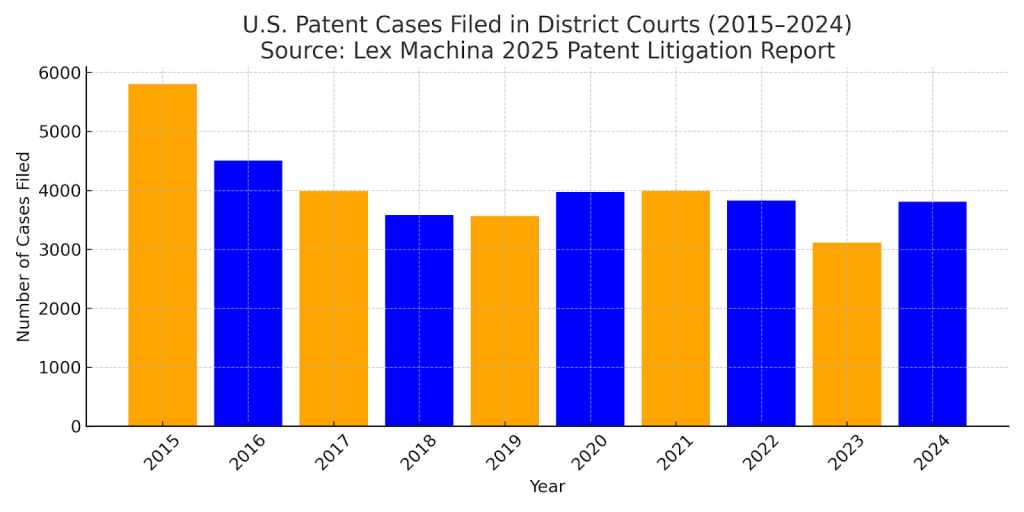
Figure 1: U.S. patent litigation filings from 2015–2024, showing a decade-low of 3,115 cases in 2023 followed by a strong rebound to 3,806 cases in 2024. Source: Lex Machina 2025 Patent Litigation Report.
If a patent owner prevails in court, they can obtain powerful remedies:
Injunctive Relief: Courts may issue an injunction to stop the infringer from continuing the infringing activity. However, since the U.S. Supreme Court’s eBay v. MercExchange decision in 2006, injunctions are no longer automatic even if infringement is proven. Courts apply a four-factor equitable test. Non-practicing entities (patent owners who don’t use the patent themselves in their own products) often cannot obtain injunctions; they can only obtain monetary relief. Practicing companies are more likely to secure injunctions, especially if the patented technology is core to their business.
Monetary Damages: A patent owner is entitled to seek financial damages as a remedy for infringement. This includes damages adequate to compensate for the infringement, at a minimum, a “reasonable royalty” for the use of the invention, and potentially lost profits. In cases of willful infringement (where the infringer knowingly violated the patent), courts can award enhanced damages up to triple the proven amount.
While headline-grabbing verdicts of hundreds of millions or even over a billion dollars occur in some cases, the median patent damages award in recent years is approximately $3.7 million. The vast majority, roughly 95-97%, of patent cases settle before trial, so many disputes end with a negotiated license or payment rather than a court judgment.
The Economics of Patent Litigation
Patent litigation in federal court is resource-intensive. Legal fees alone can run into the millions of dollars for a full case through trial. The American Intellectual Property Law Association has estimated median litigation costs in the range of $2-4 million per side for patent cases with significant amounts at risk.
This cost factor is precisely why many startups and solo inventors hesitate to enforce their patent rights, and why having a strategic legal partner who works on transparent, fixed-fee arrangements changes the equation. When you know precisely what enforcement will cost upfront, you can make informed business decisions about when to assert your rights.
Litigation funding has fueled more patent assertions by enabling smaller companies or individual inventors to afford to enforce their patents. Third-party funding companies finance patent lawsuits in exchange for a share of the recovery.
Patent Enforcement Strategies Beyond Lawsuits
Cease-and-Desist Letters: A common first step is to send a formal notice to the alleged infringer demanding that they stop the infringing activity. These letters outline the patent owner’s rights and how the target is infringing, and typically threaten litigation if the behavior doesn’t cease or a license agreement isn’t reached. A well-crafted letter can resolve the matter quickly and avoid costly litigation.
International Trade Commission (ITC) Proceedings: The ITC provides an alternative forum to address the importation of infringing goods. An ITC Section 337 action is an administrative proceeding in which the only remedies are exclusion orders (to bar imports) and cease-and-desist orders (to stop sales of imported goods already in the U.S.). The ITC cannot award damages, but investigations are generally faster than court proceedings and can have a worldwide effect by stopping products at U.S. borders.
Alternative Dispute Resolution (ADR): Parties may choose arbitration or mediation to resolve patent disputes privately. Arbitration can be binding and is sometimes stipulated in license agreements. Mediation involves a neutral facilitator helping the parties negotiate a settlement. ADR can save time and legal expenses and can be tailored by the parties.
Patent Litigation Insurance: A newer tool in the enforcement landscape is insurance products that cover some of the costs and risks of patent litigation. A patent holder can purchase enforcement insurance that helps fund the legal costs of suing an infringer, or companies can buy defense insurance to cover expenses if they are sued.
Licensing and Monetization of Patent Rights
Beyond excluding others, patent ownership creates significant monetization opportunities. Patent owners have the right to grant licenses to others, allowing them to use the patented invention in exchange for compensation. A patent is a property right that can be licensed or sold, enabling the owner to generate revenue without manufacturing the product themselves.
Patent Licensing Agreements
A license is permission from the patent owner for someone else to do something that would otherwise infringe the patent. The patent holder (licensor) and the other party (licensee) negotiate terms, including scope, territory, duration, and compensation. A well-drafted patent license agreement is crucial because it clearly defines the rights and responsibilities of both licensors and licensees, helping prevent disputes and facilitate effective commercialization.
Any use of the patented invention requires the patent holder’s permission, which is typically formalized through a license agreement.
Exclusive License: The patent owner grants all rights to a single licensee for a specific field or territory and agrees not to license others. An exclusive licensee assumes the role of the patent owner within the scope of the granted rights. This type of license can command higher fees because it grants the licensee market exclusivity.
For example, a small biotech company with a patented drug candidate might grant a large pharmaceutical company an exclusive license to develop and commercialize the drug worldwide, in exchange for milestone payments and royalties on sales. The pharma company has an incentive to invest in development and marketing because it doesn’t face competition on that patented drug. Royalty payments are a key financial term in such licensing agreements, ensuring the patent owner receives ongoing revenue from the licensee’s use of the invention.
For SaaS startups, exclusive licensing can be particularly attractive when you’ve developed foundational AI technology but lack the resources to commercialize it across all potential markets. You might exclusively license your patented machine learning optimization algorithm to a primary cloud provider while retaining rights to continue developing your own applications.
Non-Exclusive License: The patent owner grants rights to one licensee while retaining the ability to license others. Multiple non-exclusive licenses can be given for the same patent. This approach maximizes the patent’s reach.
For instance, a university with a fundamental patent might license it non-exclusively to several companies, enabling the technology to become widely used and generating multiple royalty streams. Non-exclusive licenses are standard when the goal is broad adoption, as with standard-essential patents, where everyone implementing a standard needs a license.
Cross-Licensing: This occurs when two companies each hold patents that the other needs and agree to grant each other licenses. Cross-licensing agreements are prevalent in technology-intensive industries such as semiconductors, smartphones, and telecommunications, where companies hold large patent portfolios.
Rather than litigate, they effectively trade rights, allowing each to use the other’s patented inventions. When Google launched the Android ecosystem with relatively few patents of its own, it acquired Motorola Mobility in 2012 primarily to gain Motorola’s 17,000+ patents and bolster its cross-licensing position against competitors.
Patent Sales and Assignments: Sometimes patent owners choose to sell their patent outright via an assignment agreement, transferring ownership to the buyer. Selling patents can generate immediate capital.
BlackBerry’s 2023 patent sale stands as a notable example: it sold a portfolio of about 32,000 patents, mostly related to mobile devices and messaging, to a patent monetization company for up to $900 million. This allowed BlackBerry to monetize its legacy IP, while the buyer will seek to generate revenue from those patents going forward.
Revenue Generation Through Patent Rights
When structuring licenses, parties have flexibility in designing financial terms:
Running Royalties: The licensee pays a percentage of sales revenue of products that use the patent, or a fixed dollar amount per unit sold. This aligns with the licensee’s success. The more they sell, the more the patent owner earns. For example, a 5% royalty on net sales is a typical structure in many industries.
Upfront Payments and Milestones: In some cases, especially in biotech/pharma, a license may involve a large upfront payment and milestone payments (on regulatory approval, on the first commercial sale, on reaching certain sales thresholds), plus smaller running royalties. This helps the innovator recoup R&D costs early and share risk. For those developing new technologies or innovations, particularly in complex fields such as AI, it’s essential to choose an AI patent attorney with expertise in navigating the patent application process and securing intellectual property rights.
Patent Pools and Standards: In sectors where industry standards are key (wireless communication, audio/video codecs), patent pools often form to streamline licensing. A patent pool is a consortium where multiple patent owners aggregate their standard-essential patents and offer a package license to implementers.
MPEG LA has operated pools encompassing over 24,000 patents from 260 patent holders, serving thousands of licensees worldwide. These arrangements can generate hundreds of millions in annual royalties while accelerating the widespread adoption of the technology.
Standard-Essential Patents (SEPs): Companies holding SEPs, patents essential to an industry standard, often commit to licensing them on FRAND (Fair, Reasonable, and Non-Discriminatory) terms to anyone. As of 2023, over 60,000 patent families have been declared essential to 5G standards. Major SEP holders like Qualcomm, Nokia, and Ericsson earn significant revenue licensing these to device makers.
For AI and software companies, understanding SEP dynamics becomes critical if your technology could become essential to emerging industry standards in machine learning frameworks, data exchange protocols, or API architectures.
University Licensing Revenue: Licensing university patents to industry has enabled numerous products, from Google’s search algorithm to pharmaceutical drugs. U.S. universities collectively earned $3.6 billion in licensing revenue in 2023, demonstrating how licensing revenue can sometimes far exceed what the patent owner could have achieved alone.
Duration and Maintenance of Patent Protection
Patent rights don’t last forever. Both the duration of a patent and the requirements to maintain it in force are critical for patent owners to manage.
Patent Term Lengths and Expiration
In the United States, utility and plant patents filed on or after June 8, 1995, have a term of 20 years from the effective filing date. Design patents last 15 years from issuance for applications filed on or after 2015. For information on safeguarding innovations in fields like machine learning, see machine learning intellectual property.
The 20-year term can be adjusted in some instances. The USPTO may grant Patent Term Adjustments (PTA) to compensate for undue delays during examination. Especially in fields like pharmaceuticals or biotech, lengthy examinations or FDA regulatory reviews can lead to term extensions, ensuring that inventors aren’t penalized for delays beyond their control.
Once a patent’s term (plus any adjustments/extensions) expires, the patent rights end, and the invention enters the public domain.
Maintenance Fee Requirements
Obtaining a patent is not a one-time cost. In the U.S., utility and plant patent owners must pay maintenance fees at 3.5, 7.5, and 11.5 years after the grant date. There is a window to pay (6 months before each due date) and a 6-month grace period after each due date (with a surcharge). If the fee isn’t paid by the end of the grace period, the patent lapses.
The maintenance fees increase at each stage:
| Fee Due (from grant) | Large Entity | Small Entity | Micro Entity | Late Payment (within six months) |
| 3.5 years | $2,150 | $860 | $430 | +$540 (large) / $216 (small) |
| 7.5 years | $4,040 | $1,616 | $808 | +$540 (large) / $216 (small) |
| The average duration of protection for certain types of intellectual property is 11.5 years. | $8,280 | $3,312 | $1,656 | +$540 (large) / $216 (small) |
Maintaining a patent for the full term can be costly. For a large entity, the total USPTO maintenance fees over 12 years exceed $14,000. Many patent owners choose to let patents expire early if they are no longer commercially relevant.
For startups and solo inventors, understanding these escalating costs is crucial for portfolio planning. You don’t want to be blindsided by a $3,312 maintenance fee when your patent hits 7.5 years, and you’re bootstrapping your next product launch.
Statistics on Patent Maintenance
A significant portion of patents are not maintained for their full term. Thousands of U.S. patents expire each year due to missed maintenance fee payments, often not because the inventions have no value, but because the owners decide the cost exceeds the benefit.
According to WIPO statistics, about 36% of patents are still in force 10 years after filing, but only about 17.5% last the full 20-year term. In other words, 4 out of 5 patents have lapsed by the time they would have reached expiration.
For patent owners, this means it’s wise to periodically audit your portfolio and decide which patents to maintain. The escalating fee schedule reflects policy; it weeds out less valuable patents over time, thereby freeing up the public domain and reducing the number of older patents that others must navigate.
Design Patents and Maintenance: Notably, U.S. design patents require no maintenance fees. Once granted, a design patent simply lasts 15 years without additional payments. This is one reason design patents are relatively affordable to maintain.
Corporate Patent Rights and Employee Inventions
In a corporate setting, inventions are often made by employees. Patents can be held and managed within a corporate structure, which provides benefits such as liability protection and easier management of intellectual property assets. Additionally, patents are considered personal property and can be transferred or assigned through proper documentation. Determining who owns the patent rights for those inventions is crucial.
Employment Agreements and Invention Assignment
It is standard practice for companies to include invention assignment clauses in employment contracts, especially for R&D staff, engineers, scientists, and developers. These clauses require that any invention conceived or developed by the employee (within the scope of their employment or using company resources) is automatically assigned to the employer. In contrast, when a license is granted, the original patent owner retains full ownership rights, whereas an assignment transfers complete ownership to the assignee.
For tech startups, having clean invention assignment agreements with every engineer and developer from day one is non-negotiable. Investors conducting due diligence will scrutinize these agreements. Missing assignments can derail funding rounds or acquisitions.
There’s also a legal principle called the “hired to invent” doctrine: if an employee is explicitly hired to invent or solve a particular problem, the employer may automatically own any inventions arising from that work even absent a signed agreement.
Another concept is “shop rights.” If an employee, on their own initiative, invents something using the employer’s equipment, facilities, or trade secret information. However, there was no contract assigning it to the company; the employer may still have a non-exclusive, royalty-free shop right to use that invention. The employee retains ownership of the patent, but the employer can continue to use it.
State Laws on Employee Inventions
Some U.S. states have laws protecting employee-inventors in certain situations. For example, California law (Cal. Labor Code § 2870) provides that any invention developed entirely on an employee’s own time without using the employer’s resources or trade secrets cannot be claimed by the employer. California voids any contract term that would require an employee to assign an invention developed on their own time and with their own resources, unless it relates to the company’s business.
A recent Federal Circuit case (Whitewater West v. Alleshouse, 2020) confirmed that California’s firm public policy against non-compete agreements also invalidates overly broad invention assignment clauses that attempt to grab post-employment inventions. The court struck down an agreement requiring the assignment of inventions conceived after leaving the company, even if unrelated to trade secrets.
Assignment and Ownership Transfer
To perfect ownership, the company should obtain a written assignment signed by the inventor. The USPTO requires assignments to be in writing, and they can be recorded in the USPTO’s assignment database. An assignment document typically states that the inventor “hereby assigns all right, title, and interest in the invention and any patent application or patent to [the company].”
It’s good practice to record this within three months of execution to secure priority against any subsequent bona fide purchasers of the patent. Timely recordation provides constructive notice to third parties that the company owns the rights.
In mergers and acquisitions, patent rights due diligence is critical. Acquiring companies will verify that all key inventions have proper assignment chains from the inventors to the target company. If an assignment is forgotten or done incorrectly, it can create serious problems.
International Patent Rights and Global Protection
In today’s global economy, inventors and companies often need patent protection beyond a single country. Patent rights are territorial; a U.S. patent protects you only in the United States.
Patent Cooperation Treaty (PCT)
The PCT is an international treaty that provides a unified procedure for filing patent applications in multiple countries. As of 2024, the PCT has 157 contracting states. Through a single PCT application, an inventor can effectively delay the decision of which specific countries to pursue while preserving a filing date in all member countries.
The process works like this: you file one international application under the PCT, then it undergoes a global search and is published. A PCT application does not itself result in a patent; it must be followed up by entering national or regional phases in the countries where you want patents (usually by 30 months from your earliest priority date).
In 2024, about 273,900 PCT applications were filed worldwide, an all-time high, with China and the U.S. as the top users of the system. The PCT simplifies the initial filing and buys time to assess an invention’s commercial potential before incurring the full cost of multi-country filings.
For SaaS companies evaluating international expansion, the PCT framework provides breathing room. You can file your AI patent application via PCT, spend the next 18-24 months validating product-market fit in different regions, then strategically enter the national phase only in markets where you’re gaining traction.
Paris Convention Priority
The Paris Convention (established in 1883) provides a mechanism for claiming priority. If you file a patent application in one member country, you have 12 months to file in other member countries for the same invention, and those later filings can claim the benefit of the first filing date.
Regional Patent Systems
Some regions have centralized patent offices. For example, the European Patent Office (EPO) allows one application to cover up to 39 European countries. The EPO examines the application and, if granted, can be validated into national patents in the member states.
TRIPS Agreement
On a policy level, the WTO’s TRIPS Agreement sets minimum standards for IP protection that all WTO members must adhere to. For patents, TRIPS requires at least 20-year patent terms from the filing date, availability for both products and processes across all fields of technology, and specific enforcement provisions. TRIPS harmonized many rules, ensuring nearly every country now has a 20-year term.
Global Patent Strategy Considerations
When devising a global patent strategy, consider:
Market Importance: Identify which countries/regions are key markets or manufacturing centers for your invention. Companies often file in the U.S., Europe, China, Japan, and, if relevant, South Korea or India, as these are large markets or IP-intensive economies.
Cost-Benefit Analysis: Foreign patent prosecution is expensive. Filing fees, attorney fees, translation costs, and annual renewal fees in each country add up. Obtaining a patent in just the U.S., Europe, China, and Japan can easily cost tens of thousands of dollars. Each country’s legal environment (how vigorous enforcement is, how long it takes) also factors in.
Working with a law firm that offers transparent, fixed-fee international filing services eliminates the uncertainty. You’ll know precisely what global protection costs before committing, allowing you to make strategic decisions based on business priorities rather than fear of runaway legal bills.
Patent Family Management: Coordinating claims and prosecution across jurisdictions is complex. It’s wise to maintain consistency where possible. Different claims can be issued in other countries, potentially providing broader overall coverage when combined.
Timeframe and Deadlines: Using the PCT, you get 30 months from the first filing to enter the national stage. If you don’t use PCT, you have 12 months via the Paris Convention. Keep track of these deadlines meticulously. Missing them can result in the forfeiture of your rights in that country.
Maximizing Patent Value and Portfolio Management
For companies with many innovations, strategically managing a patent portfolio is where the real competitive advantage lies.
Portfolio Assessment and Audits
It’s good practice to conduct periodic patent portfolio audits. This means reviewing all the patents and pending applications you have, and evaluating: What products/processes are they covering? How important are those to our business or licensing strategy? Are there unused patents that could be licensed or sold?
Such audits often reveal patents that are no longer relevant, which may be candidates for abandonment at the next maintenance fee to save costs. Conversely, an audit might identify “hidden gems”; patents obtained for one purpose that could have broader application in a new market or to a potential licensee.
During an audit, commercialization opportunities can surface. For example, a company might realize a particular patent could be licensed to a non-competing industry. Audits also facilitate cost optimization: large, worldwide portfolios rack up significant maintenance fees; rationalizing the portfolio can save money.
Patent Landscaping and Competitive Analysis
A patent landscape analysis is a broader look at the patent environment in a specific technology area. Companies use landscaping to understand where they stand relative to competitors. It typically involves searching patent databases to map out who has patents in your space, what sub-technologies are heavily patented, and where there might be “white space” (areas with little patent coverage that could be ripe for innovation or filing).
Landscaping can highlight whether a competitor is dominating a particular technology or whether a new player is amassing patents. This can guide R&D investments, licensing decisions, or even acquisition targets.
For AI and software companies, landscape analysis reveals which machine learning techniques, neural network architectures, or data processing methods are heavily patented versus open for innovation. This intelligence shapes both your R&D roadmap and your patent filing strategy.
Freedom-to-Operate (FTO) Studies
Before launching a new product, it’s crucial to ensure you’re not infringing on others’ patents. An FTO search will identify patents that your new product might infringe. If any are found, you have options: design around the patent (alter your product so it no longer infringes), seek a license, challenge the patent’s validity, or, in some cases, proceed with business risk.
Doing an FTO early (in the R&D stage) can save a company from costly pivots later or lawsuits post-launch. Good portfolio management means not just looking inward at your patents, but also outward at others’ patents that could impact your freedom.
For more guidance on navigating the AI patent landscape specifically, download our AI Patent Mastery guide for comprehensive strategies on protecting machine learning innovations.
Patent Quality vs. Quantity
A trend among sophisticated IP holders is to focus on patent quality metrics. What makes a patent “high quality”? Typically: broad claim scope (covering important implementations of a concept), strong prior art position (the patent is likely to withstand validity challenges), and relevance to market (covering features consumers care about or industry standards).
Some companies rate their patents on such criteria to prioritize which to assert or license. A quality-focused portfolio (even if smaller) often provides a more decisive competitive advantage than a large quantity of weak patents. There’s an oft-quoted insight: 80% of a patent portfolio’s value may lie in the top 10% of its patents.
Strategic Patent Prosecution
Maximizing patent value starts even before a patent is granted, during prosecution. A strategic approach includes drafting claims not just for the immediate product, but with an eye toward future developments and competitor workarounds.
Using continuation applications is a common strategy to keep a patent family alive. In the U.S., as long as you have a pending application, you can file a continuation to pursue different claims. This can be used to broaden coverage over time or to tailor claims to a competitor’s emerging product.
Divisional applications (when you have multiple inventions disclosed in one application) also allow more patents from one disclosure. Ensuring you pursue worthwhile opportunities can multiply your portfolio.
For SaaS companies developing rapidly evolving products, continuation strategies let you adapt your patent protection as your technology matures. You might file initial claims on your core architecture, then file continuations covering specific implementations as you roll out new features.
Patent Marking and Notice
Once you have patents, if you’re selling products covered by them, mark your products with the patent numbers. U.S. law says you can only collect damages for infringement from the time the infringer had notice. Marking a product with “Pat. US1234567” counts as constructive notice to the world that the product is patented.
If you don’t mark and a competitor innocently infringes, you can’t recover damages for the period before you gave them actual notice (e.g., by sending a cease-and-desist letter). So patent marking maximizes potential damages and also serves as a deterrent.
For software products, virtual patent marking (providing a URL to a webpage listing your patents) has become standard practice and carries the same legal weight as physical marking.
Integration with Overall IP Strategy
Patents are one form of IP; others include trademarks, copyrights, and trade secrets. A comprehensive approach considers how these interact. For example, some technology might be better kept as a trade secret (if it’s hard to reverse engineer and you can keep it confidential). Others must be patented, or you’d lose them when the product is out. Copyright law protects expressive works from copying, such as software code or documentation, whereas patent law grants the right to exclude others from using an invention.
Trademarks protect brand names and can last indefinitely, complementing patents, which expire. Copyright might protect software code or technical documentation that isn’t covered by patents.
A savvy strategy might use patents to protect core functional features, trade secrets for manufacturing processes, and trademarks to maintain brand recognition. By integrating these, a company ensures there are no gaps in its protection.
For comprehensive guidance on protecting your SaaS business holistically, check out our SaaS Patent Guide 2.0 and SaaS Agreement Checklist.
Your Next Steps to Patent Ownership Success
Understanding your patent rights is only valuable if you act on that knowledge strategically. The difference between companies that build licensing empires and those that watch competitors freely use their innovations comes down to execution: putting the proper protections in place, maintaining them, and leveraging them effectively.
The bottom line: Weak patents that leave gaps in coverage or use overly narrow claims help your competitors more than they help you. They give you a false sense of security while competitors design around your protection or challenge the validity when you try to enforce. Strong patents with strategically drafted claims, proper maintenance, and integrated portfolio management deter competitors and create genuine competitive moats.
The consequences of poor patent strategy compound over time. Every day without proper protection is another day competitors can study your innovations, develop workarounds, or file their own patents that block your future development. For startups, weak or missing patent protection translates directly to lower valuations, difficulty raising VC funding, and vulnerability to larger competitors who can outspend you in litigation if disputes arise.
Take these immediate actions:
- Schedule a Free IP Strategy Call with our patent team to evaluate your current patent position, identify gaps in protection, and develop a strategic filing roadmap aligned with your business objectives and budget.
- Conduct a patent portfolio audit if you already have patents, assess which are worth maintaining, identify monetization opportunities through licensing, and eliminate patents that no longer serve your strategic goals to optimize maintenance fee spending.
- Review all employment and contractor agreements to ensure proper invention assignment clauses are in place for everyone who contributes to your technology development, preventing ownership disputes that could derail future funding or M&A opportunities.
- Perform a freedom-to-operate analysis before your next product launch to identify potential infringement risks early when design-arounds are still feasible, rather than after you’ve invested in manufacturing and marketing.
Here’s what makes Rapacke Law Group different: We work exclusively on transparent, fixed-fee arrangements so you know precisely what patent protection costs before you commit—no surprise bills, no hourly rate uncertainty. Our specialization in tech IP, particularly AI and software patents, means we understand the nuances of protecting algorithms, data structures, and system architectures that general practice firms miss. And we back our work with service-specific guarantees.”
The RLG Guarantee for Patent Services:
- FREE strategy call with the RLG team.
- Experienced US patent attorneys lead the application from start to finish.
- One transparent flat-fee covering the entire provisional patent application process (including office actions).
- Full refund if USPTO denies provisional patent application*.
- Full refund or additional searches if the application has patentability issues (your choice)*.
Your patent rights represent more than legal protection; they’re assets that appreciate when managed strategically. Companies that treat patents as afterthoughts scramble to defend their market position when competitors emerge. Companies that integrate patent strategy into product development from day one build sustainable competitive advantages, attract premium valuations from investors, and generate licensing revenue that funds future innovation.
The patent landscape will only grow more complex as AI, machine learning, and software innovations accelerate. In 2023-2024, U.S. lawmakers from both parties introduced proposals to strengthen patent rights, recognizing that robust patent protection drives economic growth and innovation incentives. Position yourself to capitalize on these strengthening protections by securing comprehensive patent coverage now.
Don’t let competitors patent around your innovations or challenge weak patents that could have been drafted more strategically. Schedule your free IP strategy call today to evaluate your patent position and develop a protection plan that turns your innovations into defensible competitive advantages.
To Your Success,
Andrew Rapacke, Managing Partner
Registered Patent Attorney
Rapacke Law Group
Connect with us:
LinkedIn: Andrew Rapacke
Twitter/X: @rapackelaw
Instagram: @rapackelaw