


A product marked “patent pending” on the shelf tells you almost nothing on its own, but the underlying patent application filed with the United States Patent Office can reveal the full scope of what a competitor, inventor, or potential partner is trying to protect. Knowing how to search pending patent applications gives you a direct window into innovation before it becomes legally enforceable intellectual property, and the primary tools to do it are completely free.
This article walks you through exactly what a pending patent search is, why it matters, which databases to use, how to read what you find, and what to do once you have results. Whether you are an inventor checking for prior art, a founder assessing competitive risk, or an engineer researching technical features in a new product category, you will leave knowing how to run the search yourself and when to bring in a patent attorney.
Key Takeaways
- Most U.S. patent applications remain confidential for 18 months after filing, meaning a clean search result does not guarantee no conflicts exist.
- Provisional patent applications are never published, so a “patent pending” product may have no searchable public record at all.
- USPTO Patent Center and Google Patents cover the vast majority of published pending applications worldwide at no cost.
- Read independent claims first when you find a relevant application; if even one claim element is missing from your product, there is no infringement.
- A clean search result is valid only on the day you run it. Set a schedule to re-run searches every six months in fast-moving technology sectors.
What “Patent Pending” Actually Means and Why It Matters
The United States Patent Office received 646,855 patent applications in fiscal year 2022, according to USPTO Patent Statistics, while only 382,559 patents were granted that same year. The gap between those two numbers represents an enormous volume of innovation sitting in “patent pending” status at any given moment, much of it invisible to the public.
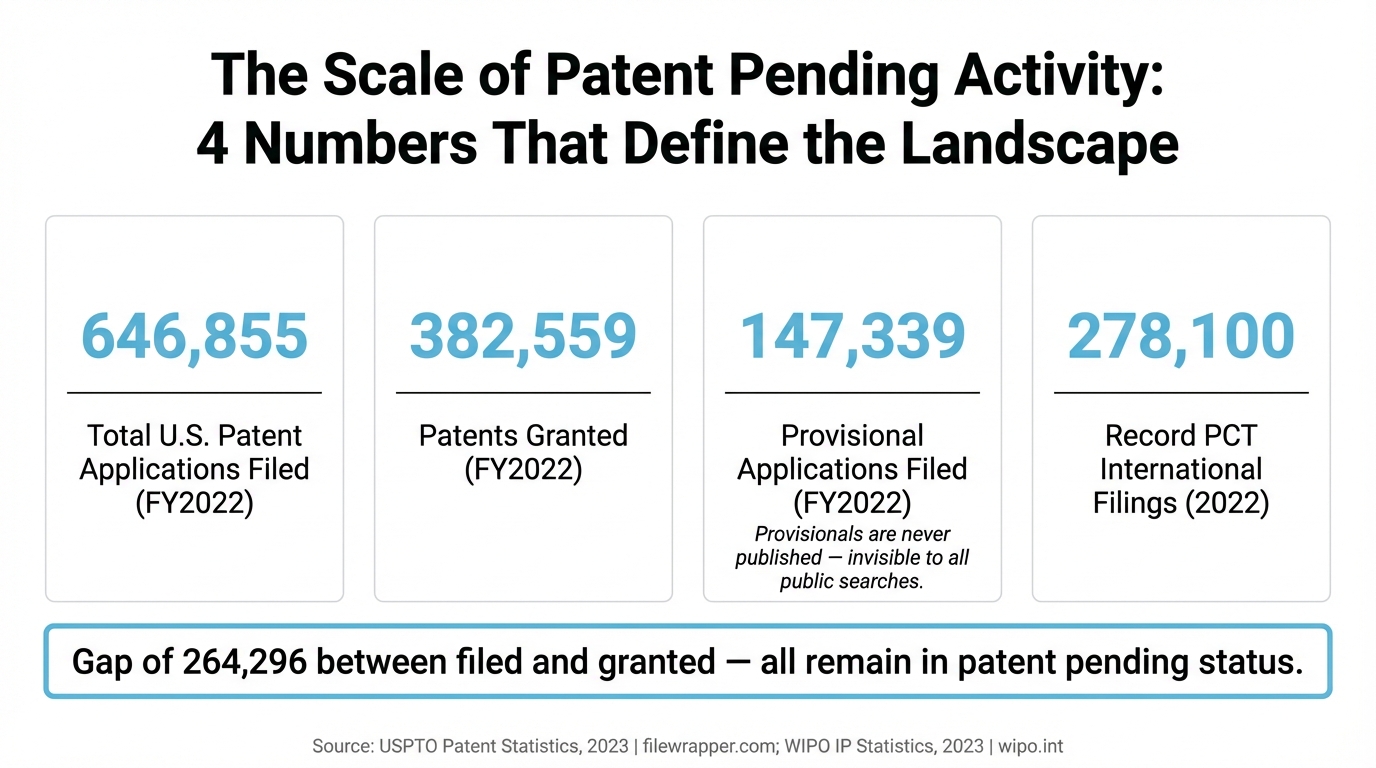 The Scale of Patent Pending Activity: 4 Numbers That Define the Landscape. Source: USPTO Patent Statistics, 2023; WIPO IP Statistics, 2023
The Gap Between Filing and Publication
When an inventor files a patent application with the United States Patent and Trademark Office, that application enters a legal limbo period. Under 35 U.S.C. § 122(b), most U.S. patent applications must be published 18 months after the earliest filing date. During that window, a product can carry the “patent pending” label while the underlying application is completely invisible to the public. There is one significant exception: if an applicant certifies that no foreign filings have been made and files a formal non-publication request, the USPTO will not publish the application at the 18-month mark.
The practical implication is direct. If a competitor filed six months ago, their application may not appear in any public patent database yet, regardless of which tool you use or how thorough your search is.
Provisional vs. Non-Provisional Applications
A provisional patent application secures an early filing date but is never examined or published on its own. It simply establishes priority while the applicant has 12 months to file a corresponding non-provisional application. According to USPTO Patent Statistics, 147,339 provisional applications were filed in FY2022 alone. Because provisional applications are never published in the USPTO’s system under 35 U.S.C. § 122, a pending patent search will miss them entirely. Many inventors use provisional patent applications to start the patent pending clock affordably, which means a “patent pending” label may have only a provisional application behind it, not a full non-provisional application with searchable public claims.
A pending patent search can only find what has been published, and intellectual property rights stemming from a provisional are not searchable until the non-provisional publishes. Provisionals are outside that scope by design.
Why Inventors, Founders, and Engineers All Run This Search
The reasons for searching pending patent applications vary by who is searching. An inventor needs to check existing prior art, confirm they have a patentable invention, and understand the patent process before investing in development. A startup founder needs to know whether a competitor has locked up key technical claims before a funding round, since solid intellectual property protection is often a prerequisite for securing investment. An engineer at an established company needs to confirm a new product feature does not risk patent infringement before launch. Understanding why investors care about IP adds another layer: a clean patent landscape strengthens your position with investors, while undiscovered conflicts can derail a deal entirely.
The financial stakes make this search non-negotiable. According to the American Intellectual Property Law Association’s Report of the Economic Survey, a patent infringement lawsuit that goes through trial costs roughly $600,000 for a small case and up to $5,000,000 for high-stakes litigation. A professional prior art search costs a fraction of that. Running a pending patent search before you build is always cheaper than designing around a patent, or litigating one, after the fact.
The Best Free Databases for Searching Pending Patents
The three major free databases cover the overwhelming majority of published pending applications worldwide. Google Patents alone indexes over 120 million patent publications from more than 100 patent offices, while Espacenet surpassed 160 million patent documents as of April 2025. Understanding what each database does best determines where you start your search.
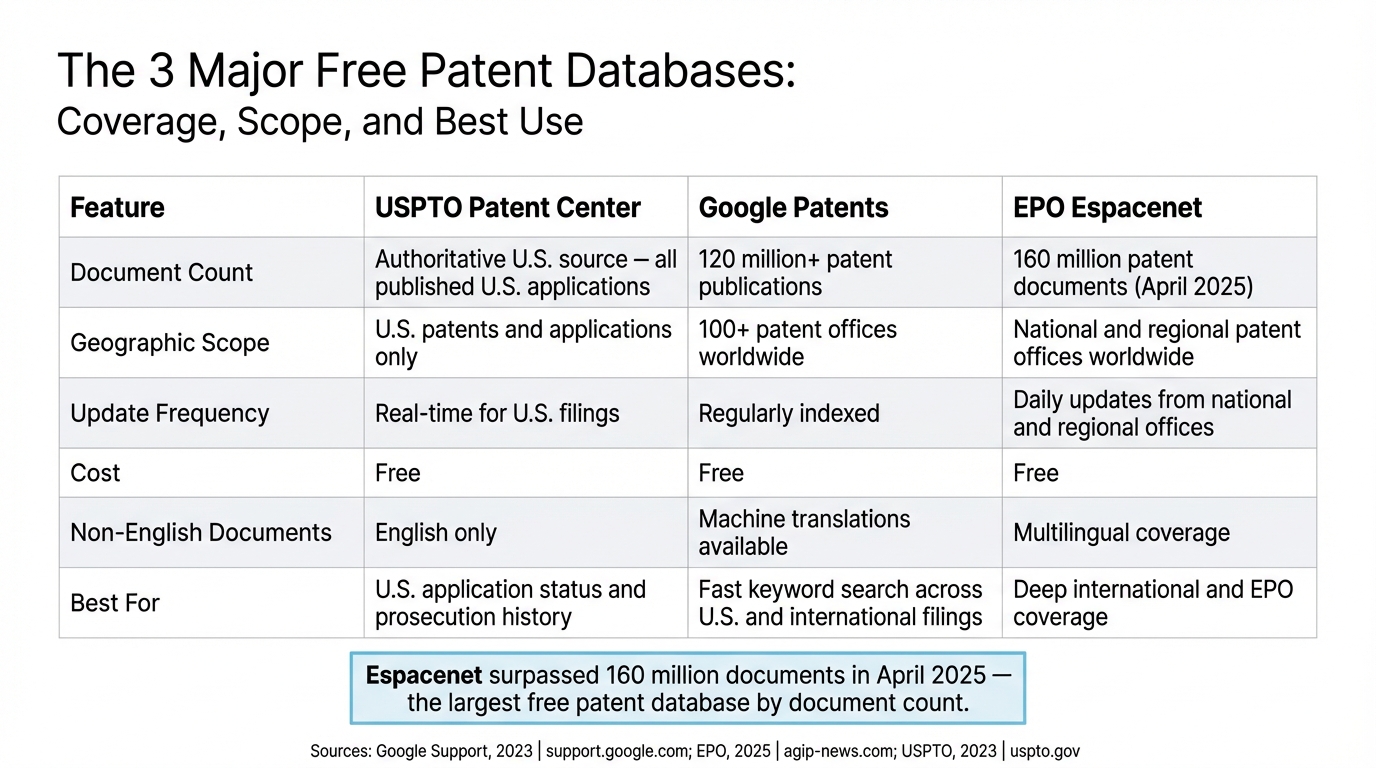 The 3 Major Free Patent Databases: Coverage, Scope, and Best Use. Source: Google Support, 2023; EPO, 2025; USPTO, 2023
USPTO Patent Center and Public PAIR
The United States Patent Office provides its primary search interface through Patent Center at patentcenter.uspto.gov. According to a USPTO announcement, Patent Center fully replaced legacy systems including EFS-Web and the older Private PAIR tool, consolidating filing and application management into a single platform. Using Patent Center, you can search published pending patent applications by inventor name, assignee, application number, or keyword. The public-facing Patent Application Information Retrieval system, accessible through Patent Center, lets you review the prosecution history of any published application, including office actions, responses, and current status.
Unpublished applications, including those within the 18-month confidentiality window, are not accessible through public search. Start every pending patent search at USPTO Patent Center; it is the authoritative source for U.S. patent applications and costs nothing.
Google Patents for Speed and Breadth
Google Patents indexes over 120 million patent publications from more than 100 patent offices worldwide, including published pending applications, granted patents, and documents from the European Patent Office and the China National Intellectual Property Administration. Its keyword search is faster and more intuitive than the USPTO’s native interface, and it supports Cooperative Patent Classification (CPC) filtering for precise technical searches. Google Patents also provides machine translations for non-English documents along with technical information from the original specifications, making it useful for researching international filings. No account or registration is required to use it.
Use Google Patents for quick keyword-based searches and cross-database coverage, including published patent applications from offices worldwide. Use USPTO Patent Center to verify status and access the full prosecution history.
Espacenet and International Patent Databases
If you are researching technology with global commercial potential, pending applications in the United States represent only part of the picture. The European Patent Office’s Espacenet database surpassed 160 million patent documents as of April 2025, covering filings from national and regional offices worldwide and updated daily. For applications filed under the Patent Cooperation Treaty (PCT), WIPO’s PatentScope database is the authoritative search tool, and the european patent register provides complementary status data for EP-designated applications.
According to WIPO IP Statistics, inventors worldwide filed 278,100 international PCT applications in 2022, a record high at the time. According to WIPO’s World Intellectual Property Indicators 2025, innovators worldwide filed 3.7 million new patent applications in 2024, a 4.9% increase over 2023, with AI-related and semiconductor technologies among the fastest-growing fields. For AI, software, or hardware inventions with international market relevance, searching Espacenet and WIPO PatentScope alongside USPTO databases gives you the full picture.
How to Run an Effective Pending Patent Search Step by Step
A systematic approach to searching pending patent applications produces far more reliable results than casual keyword browsing. The six steps below move you from a vague research question to a documented, actionable set of search results. According to USPTO MPEP § 2111, patent examiners read pending claims under the broadest reasonable interpretation standard, consistent with the specification. Understanding that principle shapes how you should structure your queries. For a broader overview of the filing process, see this step-by-step guide from idea to patent.
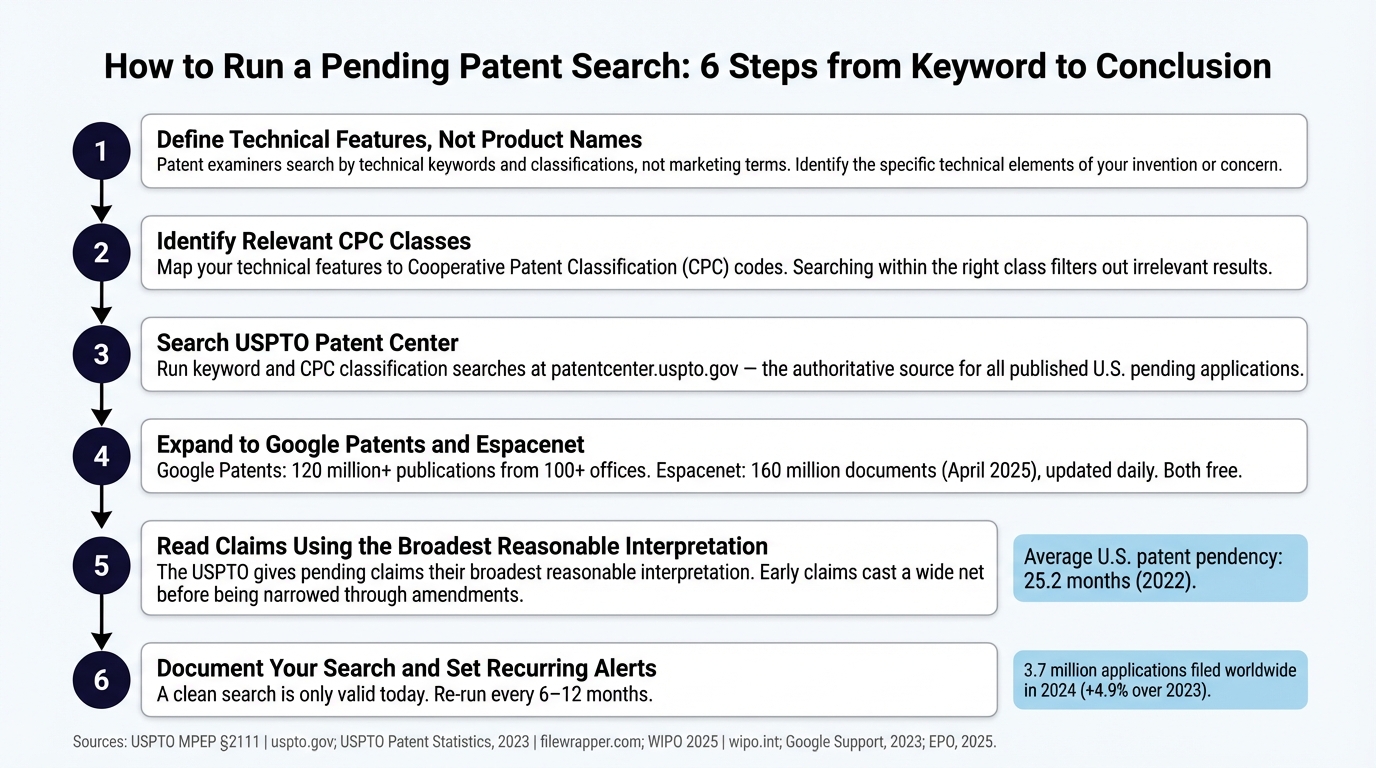 How to Run a Pending Patent Search: 6 Steps from Keyword to Conclusion. Source: USPTO MPEP §2111, 2019; USPTO Patent Statistics, 2023; WIPO IP Statistics, 2025; Google Support, 2023; EPO, 2025
Build Your Search Query Around Technical Features, Not Product Names
Product names almost never appear in patent claims. Patent applications describe inventions through their technical features and subject matter: the structural elements, method steps, or functional characteristics that define what is being protected. A search structured around the specific technical features of an image capture method, a machine learning model architecture, or a sensor configuration will surface relevant applications in a way that a brand name search never will.
The USPTO organizes patent applications by technology using the Cooperative Patent Classification system, also referred to as cooperative patent classifications, which works alongside the international patent classification framework used by patent offices worldwide. Finding the right CPC code for your technology area using the USPTO’s CPC scheme browser, then filtering your search to that classification, dramatically improves result relevance. Identify the three to five core technical features of the invention you are researching, then build search queries around those features rather than brand or product names. The patent analysis playbook covers advanced classification techniques and competitive intelligence strategies for more complex searches.
Use Application Numbers and Inventor Names to Track Specific Filers
When you know who filed, whether a named inventor, a company, or a research institution, searching by inventor name or patent applicant in USPTO Patent Center or Google Patents surfaces their full portfolio of pending and granted patent applications. U.S. patent application publication numbers follow a predictable format: “US” followed by the four-digit year and a seven-digit sequence number. If you have a patent number from a granted patent in the same technology family, the patent family view in Google Patents traces related pending applications and us patent applications through the same priority chain.
If a competitor has one published patent, search their inventor name and assignee in USPTO Patent Center to find every related pending application still in their pipeline, which often surfaces legal questions about claim overlap worth addressing early.
Filter Search Results for Publication Status and Filing Date
Not every result returned by a patent database search is a pending application. Search results will include issued patents, granted patents, abandoned applications, and expired patents alongside live pending applications. In USPTO Patent Center, application status codes indicate exactly where an application stands in the examination process. Common statuses include “Docketed New Case” (filed but not yet examined), “Non-Final Action Mailed” (an office action has been issued), “Response After Non-Final Action” (applicant has responded), and “Allowed” (a patent will be granted). In Google Patents, a status label appears on each result.
Always confirm the current legal status before drawing any conclusions. A patent that was once pending may have been abandoned years ago, and an abandoned application carries no enforceable patent rights.
How to Read a Pending Patent Application Once You Find It
Finding a relevant pending application is only half the work. Reading it correctly, understanding which sections carry legal weight and how to assess the scope of protection being sought, determines whether the application actually poses a risk to your product or filing strategy. Average patent prosecution from filing to final disposition takes approximately 24 to 26 months according to USPTO performance data, which means the claims you read today may look very different by the time a patent is granted. Learning how to read a patent properly before you interpret search results can save significant time and prevent costly misreads.
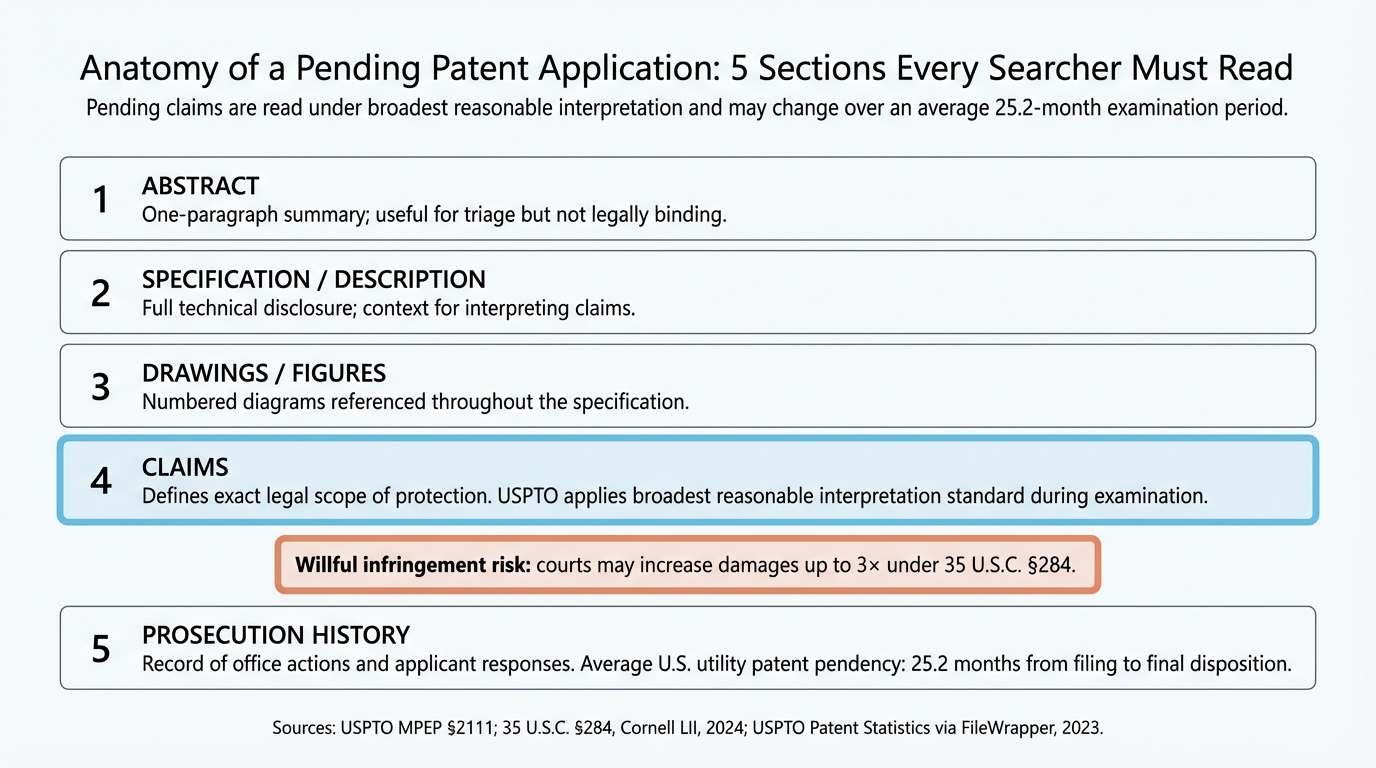 Anatomy of a Pending Patent Application: 5 Sections Every Searcher Must Read. Source: USPTO MPEP §2111, 2019; 35 U.S.C. §284, Cornell LII, 2024; USPTO Patent Statistics via FileWrapper, 2023
The Claims Section Is What Actually Gets Enforced
A patent application contains a specification (the detailed written description of the invention), drawings, an abstract, and claims, all of which an intellectual property law attorney will review when evaluating scope. The claims are the legally operative portion; they define the precise boundaries of what the patent applicant is seeking to protect. Independent claims stand alone and define the broadest scope of protection. Dependent claims narrow that scope by adding additional limitations to an independent claim.
During examination, the USPTO gives pending claims their broadest reasonable interpretation consistent with the specification, as specified in USPTO MPEP § 2111. This means early claims often cast a wide net until the applicant narrows them through amendments. When assessing whether a pending application poses a risk to your product or invention, read the independent claims first and map each element against your own technical features. If even one element of an independent claim is missing from your product or process, that claim does not read on your product.
The Prosecution History Reveals How Claims Are Evolving
Because a patent application is examined over months or years, the claims in the published application may not reflect what will ultimately be granted. Applicants frequently narrow claims in response to USPTO office actions rejecting them on prior art grounds. The prosecution history, also called the file wrapper, contains every communication between the applicant and the patent office, and it is publicly available for any published application through USPTO Patent Center.
Reviewing the prosecution history for a pending application that concerns you is essential. Pending claims may be significantly narrower or broader than the published version suggests, and amendments made during prosecution can limit the scope of protection in ways that affect your analysis. This is also why avoiding critical patent filing mistakes from the start matters: errors in the original application can create prosecution history that weakens the patent long before it is ever enforced.
When You Find Something Concerning, Document It Immediately
If a pending patent search surfaces an application that appears to cover technology you are developing or already selling, document the search date, the application number, the published claims, and the current prosecution status. This documentation matters for several reasons. Under 35 U.S.C. § 284, courts may increase patent infringement damages up to three times in cases of willful infringement. Documenting your search and seeking a formal freedom-to-operate opinion as a legal protection measure demonstrates good-faith diligence, helping to avoid enhanced damages if litigation arises later.
Screenshot, download, and date-stamp every relevant result from your search. That documentation is the starting point for any patent attorney you consult.
The Real Limitations of a Pending Patent Search
Every pending patent search has a structural ceiling. Understanding what the search cannot find is just as important as knowing what it can. The 18-month publication delay is built into patent law; it is not a database limitation, it is a feature of how the system works, and no tool available to the public can work around it.
The 18-Month Blind Spot Is a Structural Problem
Approximately 92% of U.S. patent applications are published at the 18-month mark, excluding those with non-publication requests, as established under 35 U.S.C. § 122(b). The remaining applications, those with non-publication requests, design patents, and certain other categories, remain unpublished until grant. This means a clean search result does not mean no conflicting applications exist. It means no conflicting published applications exist as of today. An inventor who filed six months ago has a fully pending application among the filed applications that could become legally enforceable, but that application does not appear anywhere in public patent databases yet.
A negative search result reduces risk; it does not eliminate it. Factor the 18-month window into any freedom-to-operate assessment.
DIY Searches Miss What a Trained Patent Attorney Finds
Patent claims use precise, sometimes counterintuitive language, and assessments of inventive step or novelty require reading claims in context with the full specification. A keyword search for your technology may miss relevant applications written in different technical terminology, filed under unexpected CPC classifications, or describing the same inventive concept from a different angle. USPTO examination statistics show that more than 90% of patent applications receive at least one prior art rejection during examination, which illustrates how difficult it is to identify all relevant prior art even for trained examiners with full access to professional search tools.
Professional patent searchers use Boolean operators, advanced search techniques including CPC hierarchies, and cross-referencing methods developed over years of practice. A DIY search provides a useful orientation and can surface obvious conflicts, but it is not a definitive clearance. Commission a professional search from a registered patent attorney; patent attorneys familiar with your technology area are ideally positioned to catch what keyword searches miss, before making any significant product launch or IP investment decision.
What to Do After You Complete Your Search
The value of a pending patent search comes from the decisions it supports, not the search itself. The right next step depends on what you found, or did not find.
If You Find a Directly Conflicting Application
A pending application is not yet a granted patent. Claims can still change, applications can be abandoned, and the scope of protection is not yet final. If your search surfaces an application with claims that appear to cover your product or process, consult a registered patent attorney who can provide a proper freedom-to-operate analysis before you make any business decisions based on your own reading of pending claims.
There are more options available than many founders realize. According to USPTO PTAB Statistics, a significant share of patents that reach a final written decision in an inter partes review have some or all claims invalidated. Even if a competitor’s pending application eventually becomes a granted patent, the patent holder’s claims may still be challenged through the USPTO’s Patent Trial and Appeal Board. A potentially conflicting pending application is a signal to get a legal consultation, not a reason to stop development.
If Your Search Comes Back Clean
Document your search methodology, the databases you used, the queries you ran, and the date you ran them. This documentation supports a good-faith defense if you are later accused of infringement, and it provides a baseline for periodic re-searches as new applications publish.
Patent activity is continuous. According to WIPO’s World Intellectual Property Indicators 2025, innovators worldwide filed 3.7 million new patent applications in 2024, a 4.9% increase over 2023. New applications publish every week. Set a calendar reminder to re-run the same search every six months if you are operating in a competitive technology sector. Understanding when to get a patent relative to your competitive landscape is just as important as the search itself.
When to Bring In a Patent Attorney Before You File
If your pending patent search reveals a relatively clear landscape, no directly conflicting published applications, no dominant players with obvious blocking positions, that is often the right moment to seek a legal consult with a registered patent attorney about protecting your own invention. Preparing and filing a non-provisional U.S. patent application with a patent attorney typically costs anywhere from roughly $3,000 for a simple invention to $10,000 or more for complex cases, according to the American Intellectual Property Law Association’s Report of the Economic Survey. A lower-cost provisional patent application can secure a priority date first while you work through the application process and prepare the full filing.
The best time to protect your new invention is before your competitors publish their own patent applications. Understanding the strategic timing of your filing can mean the difference between owning a dominant position and spending years designing around someone else’s claims. Rapacke Law Group offers a free IP Strategy Call to help inventors and founders assess patentability, identify the right filing strategy, and understand costs before committing.
FAQ: Common Questions About Searching Pending Patents
Is a patent lookup free?
Yes. The primary tools for searching U.S. patent applications are completely free. USPTO Patent Center, the public Patent Application Information Retrieval system, and Google Patents all provide free access to published pending applications, granted patents, and prosecution histories. Some third-party patent analytics platforms charge subscription fees, but for most individual searches, free tools are sufficient. The cost of a pending patent search comes from professional time, not database access fees, and any specific legal advice about what the results mean requires a registered patent attorney.
Is Google Patents search free?
Google Patents is entirely free to use and requires no account or registration. According to Google’s support documentation, it searches across more than 120 million patent documents from the U.S. and abroad, including applications from the European Patent Office and the China National Intellectual Property Administration. It also provides machine translations for non-English documents. For most inventors and founders beginning a pending patent search, Google Patents is the fastest and most accessible starting point for legal answers about the scope of published applications worldwide.
How do I check patent status?
The most reliable way to check the current status of a U.S. patent application is through USPTO Patent Center at patentcenter.uspto.gov. Enter the application number or publication number and navigate to the application’s page to view current status, the full prosecution history, and any recent office actions or responses. Google Patents also displays status labels on each result, though there may be a slight indexing delay compared to the USPTO’s own system.
Are pending patents publicly available?
Most pending patent applications become publicly available 18 months after the earliest filing date, as required under 35 U.S.C. § 122(b). Before that 18-month threshold, applications are confidential and do not appear in any public database. One exception exists: applicants can request early publication if they choose to waive the confidentiality period. Provisional patent applications are never published on their own; only the subsequent non-provisional application enters the public record.
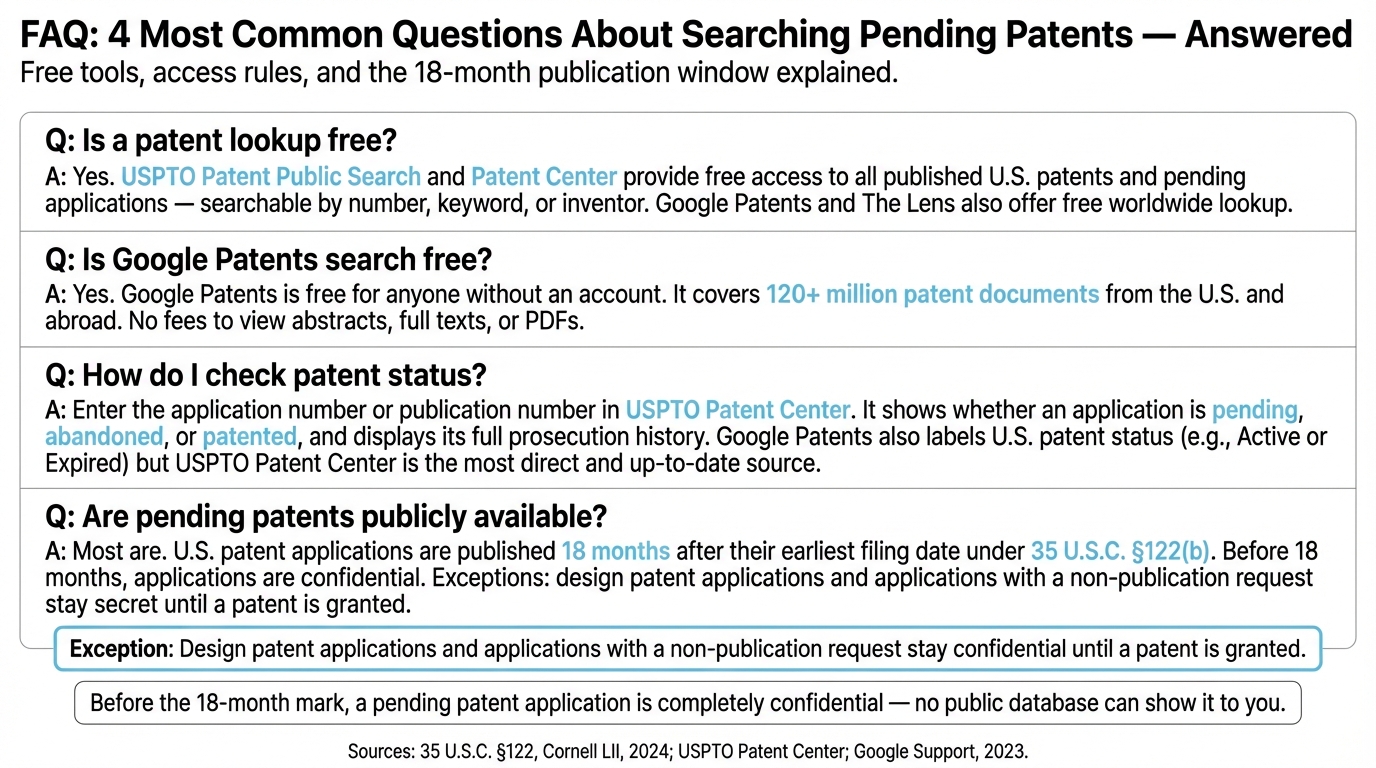 FAQ: 4 Most Common Questions About Searching Pending Patents Answered. Source: 35 U.S.C. §122, Cornell LII, 2024; USPTO Patent Center; Google Support, 2023
Search First, Then Protect What Is Yours
A pending patent search takes less than an hour with the right tools. USPTO Patent Center, Google Patents, and Espacenet cover the vast majority of published applications worldwide at no cost. The real value is not in the search itself but in what you do with the results: a clean landscape is an opportunity to file, a conflicting application is a signal to get legal counsel, and a complicated picture with multiple pending applications across jurisdictions is a strategic problem that needs a patent attorney’s analytical framework to work through.
The 18-month publication delay means no search is ever perfectly complete, but a documented, methodical search run today gives you a defensible baseline and a clearer picture of the competitive landscape than any competitor who skipped the step entirely.
If your search has surfaced questions about your own invention’s patentability, or if you need a professional review of what you found, Rapacke Law Group offers a free IP Strategy Call with a registered patent attorney. The firm operates on flat fees with the RLG Guarantee, so you know the cost before you commit. Schedule your free call to find out exactly where you stand before a competitor files first.