

Key Takeaways
- You cannot patent artificial intelligence as a concept, but you can patent specific AI-powered processes and systems that solve defined technical problems. The framing of your claims determines everything.
- Human inventors must make a significant contribution to the conception of every claimed element; AI cannot be a named inventor under U.S. law, and documentation of those human contributions is your inventorship defense.
- Algorithm patents are not categorically barred; the *Alice* two-step test determines whether a claimed algorithm is patent-eligible based on its specific technical application, not the math behind it.
- Trained model weights are not patentable, but the training methodology and inference system built around the model can be covered through process and system claims.
- A single patent rarely protects an evolving AI product. Continuation applications and a coordinated portfolio strategy are how leading AI companies maintain their competitive position over time.
AI-related patent applications at the U.S. Patent Office exceeded 80,000 by 2020, representing nearly 18% of all utility patent applications filed that year, according to the USPTO, a figure that underscores how rapidly ai technology is transforming the u.s. patent system. Yet Section 101 subject matter eligibility remains the primary challenge in AI patent applications, with examiners applying heightened scrutiny to algorithm and software-based inventions compared to hardware-based patents that more readily demonstrate a practical application. Most founders filing AI patents lose at a hurdle they never saw coming, not because their technology is weak, but because their claims were drafted wrong.
This " article explains exactly what it takes to answer the question "can you patent AI" with a yes that holds up. You will learn the legal standards that determine whether an AI invention qualifies for patent protection, what the United States Patent Office's 2024 inventorship guidance changed for founders using AI tools, how to approach algorithm and model patents, and what to do before you file.
The Short Answer to Whether You Can Patent AI and Why It Is More Nuanced Than Yes or No
The correct answer is: you cannot patent artificial intelligence as a category, so when founders ask can you patent AI, the honest answer is it depends entirely on how the invention is framed, but you can patent what your AI system specifically does. The U.S. Patent Office does not grant patents on AI technology in the abstract, on the general concept of machine learning, or on the broad idea of a neural network, as these fall into the category of abstract ideas excluded from patent eligibility. It does grant patents on specific, technically grounded implementations of AI technology that solve a defined problem in a novel, non-obvious way.
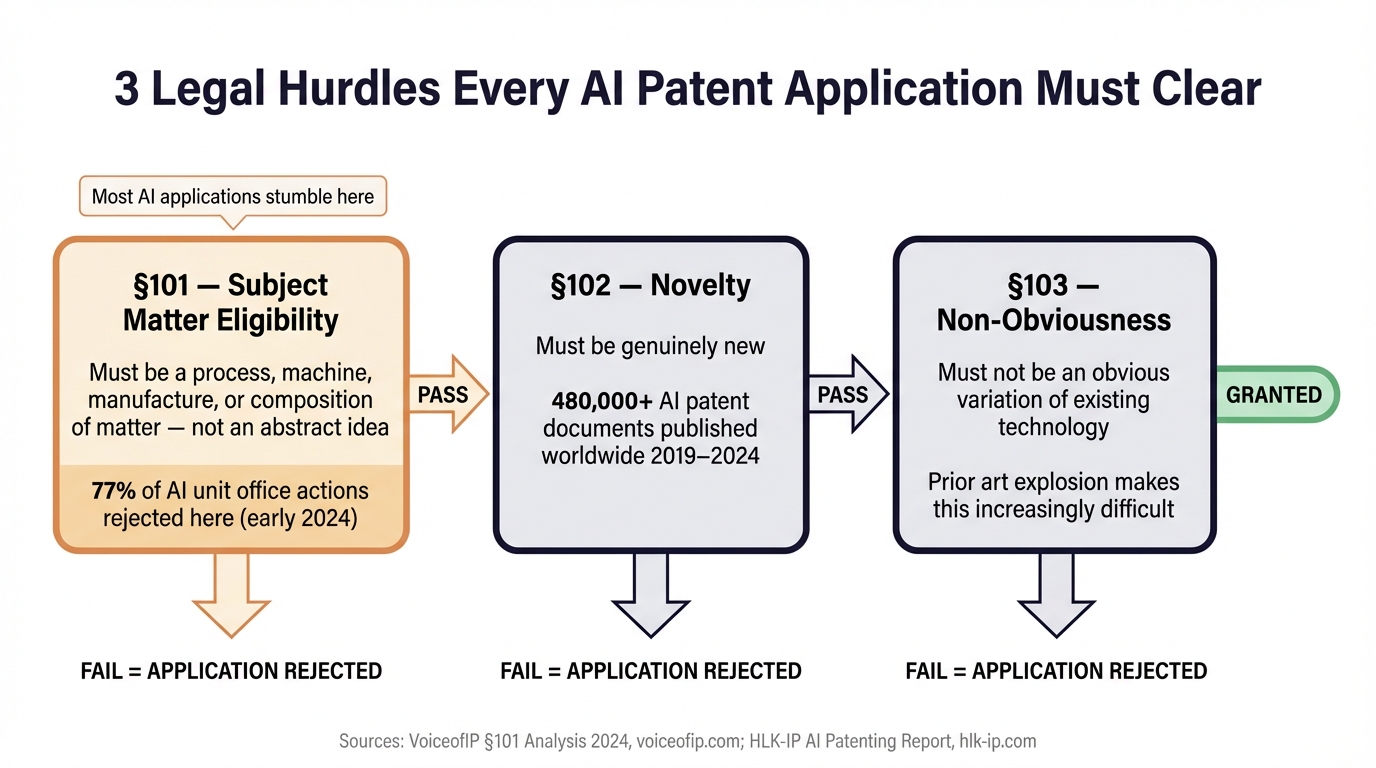 3 Legal Hurdles Every AI Patent Application Must Clear | Source: USPTO AI Patent Activity Report; HLK-IP AI Patenting Report
A useful analogy: you cannot patent electricity, but you can patent the light bulb. The same logic applies when asking can you patent AI: the question is never about the category but about the specific invention. The question is never "is this AI?" but "does this AI-powered system or method solve a specific technical problem in a significant manner that no prior art has addressed?" If your answer involves concrete technical results tied to a specific implementation, you likely have something worth protecting.
For a deeper look at how these principles apply to specific software architectures, see The Ultimate Cheat Sheet for Patents on Artificial Intelligence.
Why the USPTO Does Not Grant Patents on AI Itself, Only on What AI Does
Under 35 U.S.C. § 101, a patentable invention must fit one of four categories: a process, machine, manufacture, or composition of matter. The Supreme Court's ruling in Alice Corp. v. CLS Bank International, 573 U.S. 208 (2014), established that implementing abstract ideas on a generic computer is not patent-eligible under United States patent law. That decision controls how examiners evaluate AI patent applications today. An AI invention framed only as "a computer uses machine learning to perform task X" almost certainly fails under Alice. An invention framed as "a system that uses a specific convolutional architecture to reduce false positives in real-time fraud detection by a measurable margin" has a fighting chance.
Before asking whether your AI invention is patentable, define the specific technical problem it solves and the specific technical result it achieves. That framing determines everything.
The Four Patent Categories and Which Ones AI Inventions Fit Into
Most ai innovations fall under two of the four statutory categories: process (a method of doing something using AI technology) and machine (a system or computer that implements the AI). Knowing which category applies is a prerequisite to answering can you patent AI for any specific invention. Design patents are rarely relevant to AI, and plant patents have no application here.
The category you choose affects how broadly your patent claims can be written. Process claims capture the method regardless of what hardware runs it. Machine claims capture the configured system. Filing both types in the same application maximizes coverage and gives you prosecution flexibility if an examiner challenges one set of claims. Most registered patent attorneys drafting AI patent applications file both. For a detailed breakdown of how utility patent categories apply to AI inventions, see Utility Patents Explained: An Essential Guide for Every Inventor.
The Three Legal Hurdles Every AI Patent Application Must Clear
Every AI patent application must satisfy three independent legal requirements: subject matter eligibility under § 101, novelty under § 102, and non-obviousness under § 103. These are the three gates any founder must clear before the question of can you patent AI resolves in their favor. The first hurdle is where most AI applications fail. According to the USPTO, Section 101 subject matter eligibility rejections are the dominant challenge in AI patent prosecution, and the gap between AI and non-AI rejection rates is substantial.
§ 102 novelty and § 103 non-obviousness are equally important but addressed through prior art analysis rather than claim drafting strategy. The prior art landscape in AI is moving fast. WIPO has documented an eightfold increase in generative AI patent publications since 2017, and more than 480,000 AI patent documents were published worldwide between 2019 and 2024, reflecting how rapidly ai innovations are reshaping the global patent landscape. Commissioning a prior art search before drafting claims is not optional; it is the baseline for any credible AI patent strategy.
Can You Patent AI? What Artificial Intelligence and Patent Law Actually Require From Inventors Right Now
The legal framework governing artificial intelligence and patent law is more settled today than it was three years ago, largely because of a Federal Circuit ruling and subsequent United States Patent Office action that together define who can invent and what they must have done within the U.S. patent system.
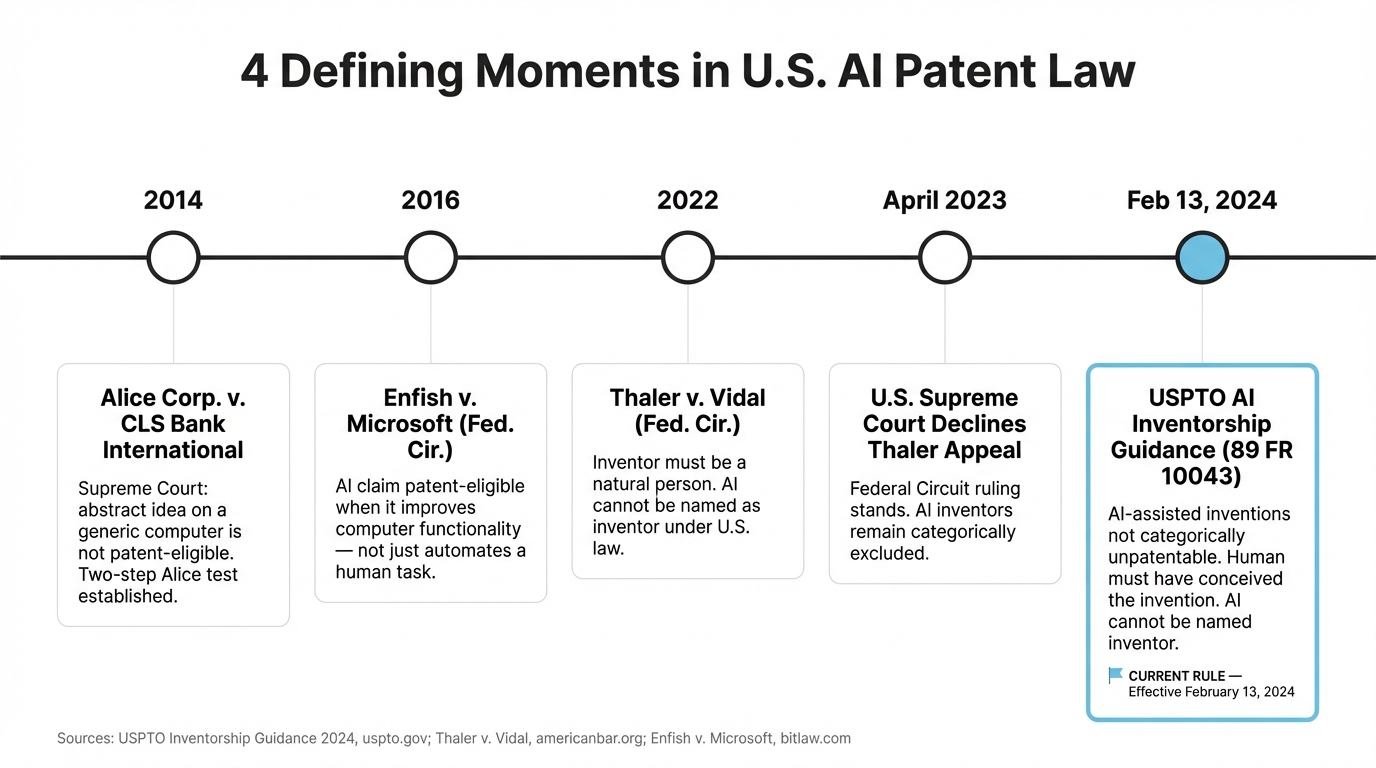 How U.S. Law Arrived at Today's AI Inventorship Rules: 4 Defining Moments | Source: USPTO AI Inventorship Guidance, 89 FR 10043 (Feb. 2024); Thaler v. Vidal, 43 F.4th 1207 (Fed. Cir. 2022); Enfish v. Microsoft, 822 F.3d 1327 (Fed. Cir. 2016)
The USPTO's 2024 Inventorship Guidance and What It Changed
In February 2024, the U.S. Patent Office issued formal inventorship guidance published at 89 FR 10043, directly addressing AI-assisted inventions and clarifying the legal requirements human inventors must satisfy to obtain patent protection. The core holding: AI-assisted inventions are not categorically unpatentable. For founders who have been asking can you patent AI when tools like large language models are involved in development, the 2024 guidance provides a clear answer: yes, provided human inventors made a significant contribution to the conception of each claimed element.
"Conception" in patent law means the complete and definite mental idea of the invention as it will be claimed: not just the idea that AI technology could help solve a problem, but the specific solution that forms the basis of each patent claim. The 2024 guidance resolved years of uncertainty for teams using large language models, generative AI, or automated design tools in their inventive process. Using AI as a tool does not eliminate inventorship; it shifts the analysis to what the human actually decided and directed.
Document every human decision made during development, including what problem you identified, what approach you chose, what you directed the AI system to do, and how human ingenuity shaped the final claimed invention, because that documentation becomes your inventorship record if the application is challenged. For a full breakdown of what the USPTO now requires, see AI Patent Requirements Explained: What Are the Conditions of Patentability?
The Significant Contribution Standard and How Patent Examiners Apply It
The "significant contribution" standard is how patent examiners determine whether human inventors qualify as named inventors on an AI-assisted patent application. A person who merely operates an AI system, accepts its outputs without creative direction, or prompts a general-purpose AI and files whatever it produces does not qualify. A natural person who conceives the problem, defines the parameters, interprets outputs, and applies the results to a specific technical application does qualify.
The USPTO's guidance, drawing on Pannu v. Iolab Corp., 155 F.3d 1344 (Fed. Cir. 1998), identifies the key factors: Did the person formulate the problem the AI was used to solve? Did they design the AI's parameters or training approach? Did they recognize and refine the AI's output into the claimed invention? A SaaS founder who specifies that their fraud detection model must flag real-time payment anomalies below a defined latency threshold, selects the training architecture, and validates the methodology against a defined benchmark is making significant contributions. Someone who prompts a general AI and files its response is not.
Build an inventor log that records each team member's specific contribution to the conception of each technical feature. This is the evidence that supports inventorship when an examiner challenges it.
How the Federal Circuit Has Shaped the Human Inventor Requirement
In Thaler v. Vidal, 43 F.4th 1207 (Fed. Cir. 2022), the Federal Circuit ruled that under 35 U.S.C. § 100(f) of the Patent Act, an "inventor" must be a natural person, specifically a human being. The case arose from inventor Stephen Thaler's attempt to list his AI system, DABUS, as the sole inventor on patent applications. The court rejected this, holding that the plain text of the Patent Act limits inventorship to natural persons, specifically human beings who can be identified as the source of the claimed invention. The Supreme Court declined to hear the patent case appeal in 2023, letting the Federal Circuit's ruling stand as controlling authority. Separately, in March 2026, the Supreme Court also declined to hear a related copyright case (Thaler v. Perlmutter, Case No. 25-449) involving the same DABUS AI system, reinforcing that AI-generated works require human authorship for IP protection across both patent and copyright law.
The practical implication is not that AI-generated innovations are worthless. It is that human inventors who directed the AI system must be identifiable, documentable natural persons, not AI systems or legal entities, who made significant contributions to each claimed element. Courts have not yet ruled on every edge case, and additional Federal Circuit decisions are expected as AI capabilities and the ways engineers use them continue to evolve.
Can You Patent an AI Algorithm and What Makes an Algorithm Patentable
The widespread belief that algorithms cannot be patented is wrong. When founders ask can you patent AI algorithms specifically, the correct legal rule is narrower: an algorithm expressed only as a mathematical concept or abstract idea is not patent-eligible, but an algorithm implemented in a specific technical context to produce a specific technical result can be. Understanding this distinction is essential before pursuing patenting AI algorithms.
Why Algorithms Are Not Automatically Excluded From Patent Protection
The Alice framework does not categorically exclude algorithms from patent protection. It requires that an algorithm claim more than abstract ideas; it must have a concrete, real-world technical application. A machine learning algorithm that detects manufacturing defects in real time using computer vision is not just one of the excluded abstract ideas: it is a specific process, a practical application of AI technology, applied to a specific technical problem in a defined industrial context.
The Federal Circuit's decision in Enfish, LLC v. Microsoft Corp., 822 F.3d 1327 (Fed. Cir. 2016), opened a pathway specifically for software and AI patent applicants: if the claims are directed to an improvement in the functioning of the computer itself, not merely an abstract result achieved using a computer, they can survive § 101 scrutiny. This "improvement to the computer itself" standard is the most reliable route for AI algorithm patents that address technical performance problems such as processing speed, memory efficiency, or inference accuracy. Draft algorithm claims around the specific technical improvement the algorithm produces, not around the mathematical steps it executes.
For a comprehensive guide on what separates patentable algorithms from excluded abstract ideas, see Can You Patent an Algorithm in 2025? Essential Facts You Need to Know.
The Alice Two-Step Test Applied to AI and Machine Learning Inventions
Patent examiners at the United States Patent Office apply the Alice two-step test to every AI patent application, and understanding this test is central to answering can you patent AI in any specific technical context. Step one: is the claimed invention directed to abstract ideas, a law of nature, or a natural phenomenon? Machine learning training processes and neural network architectures are frequently flagged at this step. Step two: if directed to abstract ideas, does the claim include an inventive concept that transforms it into something significantly more than the abstract idea itself?
The USPTO's January 2019 Revised Guidance on § 101 refined how examiners apply the Alice framework, clarifying that mathematical concepts, mental processes, and certain methods of organizing human activity are the primary abstract idea categories. The Federal Circuit's decision in Berkheimer v. HP Inc., 881 F.3d 1360 (Fed. Cir. 2018), further established that the "inventive concept" analysis at step two is partly a factual question. Meaning a well-supported specification can help defeat an abstract idea rejection by establishing that the specific implementation was not well-understood, routine, or conventional at the time of filing, and that the inventive process reflected genuine human ingenuity.
Before filing, map every claim to the Alice two-step. If you cannot articulate the inventive concept beyond "AI does the task," the claim needs redrafting.
Deep Learning, Neural Networks, and the Patentability of AI Architecture
Specific AI architectures, novel arrangements of artificial neural network layers and components, custom training methodologies, and specialized deep learning frameworks, can be patentable when they represent a genuine technical improvement over the prior art. Patenting the architecture is legally distinct from patenting the outputs the architecture produces.
A novel artificial neural network topology that achieves faster inference at lower computational cost addresses a technical problem in the computer system itself. A neural network that happens to generate creative content addresses no such technical problem and struggles under Alice. The distinction is whether the claimed arrangement improves the performance of the technical system or simply uses a technical system to perform a task. Given how rapidly the AI field moves, prior art searches in this space are especially time-sensitive, as what was novel in 2022 may already have been published, preprinted, or patented by a competitor. If your team developed a custom AI architecture to solve a specific technical problem, treat that architecture as a separate patentable invention from the application it powers.
Can You Patent an AI Model and How to Protect What Your Model Actually Does
The question of can you patent AI when the invention is a trained model requires separating the components of that model, because different components attract different forms of intellectual property protection.
What Parts of an AI Model Can Be Covered by a Patent
A trained AI model has multiple protectable components, but not all of them are patentable. The trained model weights themselves are data, not a process or machine in the patent law sense, and are not patentable. What is patentable is the training methodology that produced those weights, if it is novel and non-obvious, claimed as a process. The reduction to practice of a training methodology, the concrete implementation that demonstrates how the method actually works in a practical application, is central to establishing that the claimed process is more than an abstract idea.
The inference pipeline, the system that takes inputs and produces model outputs, is patentable as a machine or system claim if it is configured in a non-obvious way that produces a defined technical result. The application-layer system in which the model is deployed is often the strongest patent target: a specific AI-powered system for medical imaging analysis, real-time language translation with defined latency constraints, or anomaly detection in industrial sensor data is a concrete technical system with identifiable prior art boundaries. Filing separate claims targeting the training methodology (process claims) and the deployed system (system claims) protects different facets of your AI model and together creates a stronger IP position.
Why Trade Secrets May Protect AI Models Better Than Patents in Some Scenarios
When founders weigh can you patent AI models versus keeping them secret, the core tension is that patent protection requires public disclosure: when a patent issues, the full technical details of the invention are published and competitors can read exactly how the system works. For AI models with proprietary training datasets or fine-tuning methodologies, this disclosure requirement can hand competitors a roadmap.
Trade secret protection under the Defend Trade Secrets Act (DTSA) protects model weights, training data, and methodology indefinitely, provided the company takes reasonable steps to maintain their confidentiality. Patent protection lasts 20 years from the filing date; trade secret protection is indefinite, contingent on secrecy. Many leading AI companies combine both approaches: patent the application-layer systems and novel architectures, while protecting trained models and datasets as trade secrets, a strategy that recognizes how ai technologies evolve faster than traditional IP cycles. The right answer depends on the competitive landscape, the company's ability to maintain secrecy operationally, and whether the technology will be detectable in deployed products. If competitors can reverse-engineer it, trade secret protection is fragile.
Before filing a patent application on your AI model, assess whether the technical disclosure required by patent law outweighs the competitive advantage of keeping the methodology confidential.
What Copyright and Other IP Protection Cover That Patents Do Not
A full intellectual property strategy for an AI product layers multiple forms of protection. Copyright protects the source code, including any computer program that implements the AI model, automatically without registration — though registration is required to sue for infringement in U.S. courts. Copyright does not protect the trained weights, the model's outputs, or the underlying algorithm. The U.S. Copyright Office's 2023 guidance on AI-generated content clarified that outputs generated autonomously by AI without human creative authorship are not eligible for copyright protection, though code written by human inventors that implements AI systems retains full copyright coverage.
Trademark protects the brand name and product identity of the AI system, administered through the trademark office alongside patent prosecution. Together, the optimal IP protection stack for most AI companies looks like this: patent the novel technical process and system, copyright-register the source code, protect confidential methodology and training data as trade secrets, and trademark the product name. Each layer protects something the others do not.
How to Structure a Winning AI Patent Application Before You File
Understanding what is theoretically patentable is only useful if the patent application is built correctly. Founders who have confirmed that can you patent AI resolves to yes for their invention still face a second challenge: most AI patent rejections are not caused by unpatentable technology. They are caused by poorly drafted claims and underspecified specifications.
How to Write AI Patent Claims That Survive Examiner Scrutiny
The patent claims are the legal boundary of what the patent protects, and poorly drafted claims are the most common reason AI patent applications receive § 101 rejections. Three principles govern strong AI claim drafting. First, specificity: name the specific technical components rather than generic placeholders like "a processor" and "a neural network." Second, functional connection: show how the components interact to produce the specific technical result. Third, concrete outcome: articulate the measurable improvement in the technical process or computer system.
Avoid claiming the abstract goal; claim the specific implementation. Every independent claim in an AI patent application should pass a simple internal test: remove the AI element. Does anything technical remain that a court could evaluate? If yes, the claim is likely well-anchored in a specific technical application. If no, redraft to anchor it more concretely.
Understanding how to construct strong claims is the foundation of effective patenting your AI wrapper and any application-layer AI innovation.
Building the Patent Specification to Support Broad AI Claims
The patent specification must support every element of every claim. For AI inventions, this means describing the specific training data characteristics, the model architecture, the inference process, and the technical problem being solved with enough detail that a person skilled in the relevant field could replicate the invention. Under 35 U.S.C. § 112, the written description and enablement requirements are not formalities. A vague specification that describes AI technology as a general capability without explaining the specific implementation creates a written description problem that can invalidate claims even after a patent issues.
The specification is also where human inventors document the inventive concept: what makes this technical approach different from prior art methods, and why the reduction to practice of this specific approach was non-obvious at the time of filing. Courts, including in Berkheimer v. HP Inc., have confirmed that evidence in the specification about what was unconventional at the time of filing can defeat a § 101 challenge. Draft the specification before finalizing claims. The depth of the technical description should determine how broad the claims can legitimately be, not the other way around.
Provisional Patent Applications as the First Step for AI Inventors
A provisional patent application establishes a priority date without the full cost or formality of a non-provisional application. For AI founders, this matters urgently: the AI patent landscape is moving fast, prior art accumulates rapidly, and a provisional filing locks in the filing date while giving the inventor 12 months, under 35 U.S.C. § 111(b), to refine claims and conduct a freedom-to-operate analysis.
A provisional application must still disclose the invention with enough technical detail to support the later non-provisional, including a clear description of the reduction to practice. How the invention actually works in a concrete implementation that demonstrates a practical application of the claimed technology. A one-paragraph summary is insufficient. A well-drafted provisional can serve as the basis for multiple related applications and continuation applications as the AI product evolves. File a detailed provisional patent application before publicly launching or demoing your AI product. Public disclosure before filing can permanently bar patent protection under U.S. law.
The SaaS Patent Guide 2.0 covers provisional patent strategy in depth for founders building AI-powered software products.
The Inventorship Question That Could Invalidate Your AI Patent After It Issues
Inventorship is the most dangerous single issue in AI patent prosecution, and it is the one most founders treat as a formality, even after the question of can you patent AI has been answered in their favor.
Why Inventorship Errors Are the Most Dangerous Mistake in AI Patent Prosecution
Inventorship is a legal requirement: if human inventors who made a significant contribution are omitted, or if someone is listed who did not contribute significantly to the conception of the claims, the patent can be challenged and invalidated. This is not a technical error that can be quietly corrected. It is a legal defect that opposing counsel will raise in inter partes review (IPR) or litigation. For AI-assisted inventions, the challenge is sharper: if the AI system made decisions that are reflected in the patent claims, listing human operators as inventors without proper documentation invites the argument that the named natural persons never actually conceived the claimed subject matter.
Treat inventorship determination as a legal analysis conducted before the application is filed — not a checkbox completed at filing time. For a detailed review of how rights flow from properly documented inventorship, see Rights of Patent in the Modern Era: Blocking Competitors, Funding Growth, Monetizing IP.
How Joint Inventorship Works When Multiple Humans and AI Systems Collaborate
Under 35 U.S.C. § 116 of the Patent Act, joint inventors do not need to have worked together simultaneously or made equal contributions, but each named inventor must have made a significant contribution to the conception of at least one claim. The Federal Circuit's standard from Pannu v. Iolab Corp., 155 F.3d 1344 (Fed. Cir. 1998), requires that each joint inventor: (1) contribute to the conception of the invention, (2) make a contribution that is not insignificant in quality relative to the full invention, and (3) do more than merely explain real inventors known concepts or well-understood prior art to others on the team.
For AI startups with distributed development teams, one person trained the model, another designed the application layer, a third integrated the inference pipeline, the right approach is to map each team member's contribution to specific claims in the application before filing. AI systems cannot be listed as joint inventors under current United States patent law, and real inventors known concepts must be distinguished from AI-generated outputs in the documentation record. Document each contribution at the time it occurs. Retroactive documentation is harder to defend and easier to challenge.
What Happens When You Use Third-Party AI Tools in Your Inventive Process
Many founders build AI innovations on top of third-party foundation models. Large language models, generative AI platforms, or open-source frameworks. The human inventors at those foundation model companies are not inventors of what you build with their tools, just as a database vendor is not an inventor of the application you build using their software. These distinctions are especially important for related inventions that share underlying AI components across multiple patent applications. What matters is whether the founder made significant human contributions to the conception of the claimed invention, including problem definition, architectural decisions, training approach, and validation criteria. Real inventors' known concepts must be documented separately from what the AI tool contributed autonomously.
However, using third-party AI tools raises a separate question from inventorship: freedom to operate. If the foundation model or its outputs are covered by existing patents held by the tool's developers, the system you build on top of those outputs may infringe those patents regardless of who invented it. Real inventors known concepts must be clearly distinguished from what third-party AI tools contributed before filing. Inventorship may be clear, but the freedom to commercialize the invention requires a separate legal analysis.
The AI Patent Mastery resource covers third-party AI tool risks and freedom-to-operate strategy in depth for AI founders navigating this issue.
Building an AI Patent Portfolio Strategy That Grows With Your Company
A single patent is a legal document. A patent portfolio is a competitive strategy. For AI founders who have already answered can you patent AI affirmatively, the next question is how to build protection that scales and the difference between a single patent and a portfolio matters enormously at the Series A, in acquisition due diligence, and when a well-funded competitor enters your market.
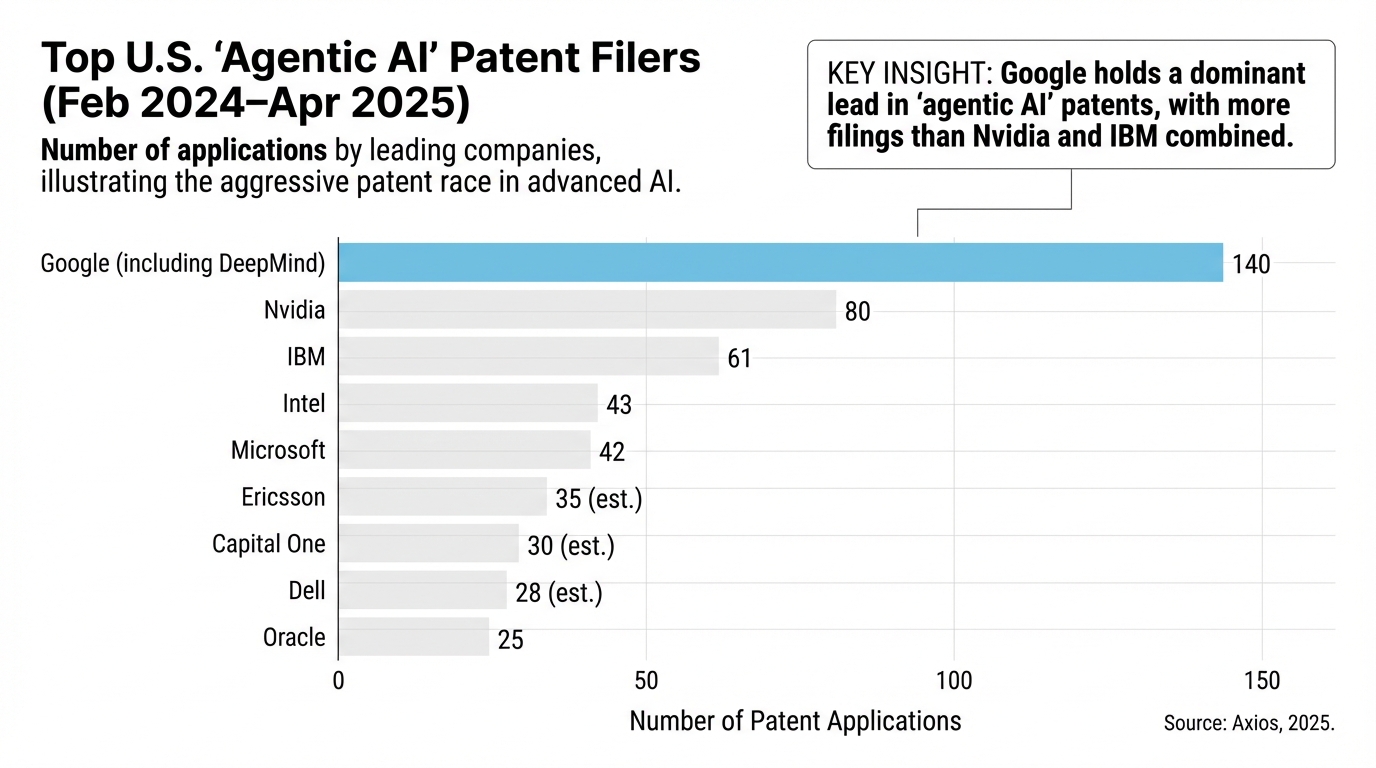 *Top AI Patent Filers (Agentic AI, Feb 2024–Apr 2025)/Google leads with 140 patents, followed by Nvidia (80), IBM (61), and Intel (43). Source: **Axios, May 2025*
Why a Single Patent Is Rarely Enough to Protect an AI Innovation
A single patent protects the specific claims as filed, and u.s. patents in particular are limited to domestic enforcement. As an AI product evolves, with new features, new use cases, and updated architecture, the original patent may not cover the current product at all. The right approach is to treat the first patent application as the foundation of a portfolio. Continuation applications capture new claim directions from the same original disclosure without requiring a new filing date. Divisional applications are filed when the U.S. Patent Office determines that a single application covers more than one distinct invention. A rolling provisional filing practice lets the team lock in priority dates for new technical developments as they occur.
According to WIPO's annual IP statistics reports, AI-related PCT filings have grown substantially as companies recognize that U.S.-only protection is insufficient for globally distributed AI products. A well-managed patent portfolio creates meaningful barriers to entry and strengthens the company's negotiating position with investors, acquirers, and potential licensees. Continuation practice is how leading AI companies stay ahead of competitors without starting from scratch with each product update. For a structured approach to building a portfolio that scales, see Planning A Rock Solid Patent Portfolio Strategy.
When to File International AI Patent Protection Through PCT Applications
A U.S. patent protects the invention only within the United States. If your AI product will be commercialized in Europe, Asia, or other markets, international protection requires separate filings. The Patent Cooperation Treaty (PCT) provides a single application mechanism that preserves the right to pursue patents in more than 150 countries, with 12 months from the priority date for initial PCT filing and 30 months for national phase entry. This timeline allows AI companies to assess market strategy before committing to the cost of individual national filings.
Key international jurisdictions for AI companies include the European Patent Office (EPO), which requires that claimed software and AI inventions have "technical character," a standard that shares ground with the USPTO's § 101 framework but is applied differently, and China, which has rapidly expanded its AI patent examination infrastructure to keep pace with surging ai technologies. WIPO confirmed that between 2014 and 2023, more than 38,000 generative AI inventions originated from China, six times more than from the second-place United States. The strategic filing destinations depend on where the AI product will be deployed commercially, where competitors are active, and where the most valuable licensing opportunities exist. Missing the PCT deadline eliminates international patent rights permanently.
How a Strong Patent Portfolio Supports VC Fundraising and Acquisition Conversations
Investors conduct IP due diligence, and an AI startup that cannot demonstrate defensible patent protection, or that has visible inventorship vulnerabilities, faces valuation discounts and deal delays. Patent applications signal that the technical innovation has been formally claimed and that the team has taken concrete legal steps to protect the competitive advantage. Issued patents go further: they are assignable assets, licensable revenue streams, and demonstrable moats in acquisition conversations.
According to Rapacke Law Group, the firm's flat-fee patent prosecution model and the RLG Guarantee ensure that founders can build a real patent portfolio without open-ended hourly billing uncertainty, backed by a commitment to your outcomes. Start building your portfolio before your Series A. Investors want to see that the IP is owned, documented, and defensible, not a plan to file something eventually. For real-world examples of how patent portfolios create enterprise value in AI-driven industries, see AI Patents for FinTech Explained: What Bank of America, FICO, and Lucinity Got Right.
Frequently Asked Questions
Can an AI system be patented?
An AI system can be patented when the patent application focuses on the specific technical problem the system solves and the specific implementation used to solve it. The USPTO does not grant patents on the abstract concept of artificial intelligence, but it does grant patents on specific AI-powered systems and processes that meet the novelty, non-obviousness, and subject matter eligibility requirements under 35 U.S.C. § 101. The critical requirement is that human inventors must have made a significant contribution to the conception of each claimed element, as confirmed by the United States Patent Office's 2024 inventorship guidance published at 89 FR 10043. A registered patent attorney can assess whether your AI system's architecture and functional design meet these thresholds.
What is the difference between patenting an AI model versus patenting an AI application?
Patenting an AI model typically means claiming the training methodology, the model architecture, or the inference pipeline as a process or system. The technical components that satisfy patent eligibility requirements. Patenting an AI application means claiming the deployed system in which a model operates to solve a specific real-world problem, such as a fraud detection engine or a medical imaging platform. The strongest intellectual property positions layer both: model-level patents protect the underlying technology, while application-level patents protect the commercial product. Together, both types of claims in a coordinated patent portfolio create coverage that neither achieves alone. Understanding the reduction to practice requirements for each type of claim is essential to drafting applications that survive examination.
Can you patent an AI algorithm if it was generated using another AI tool?
Yes, if human inventors made significant contributions to the conception of the claimed algorithm; including defining the problem, selecting the approach, and directing how the AI tool was applied. The U.S. Patent Office's 2024 guidance makes clear that using AI tools in the inventive process does not disqualify an invention from patent protection, provided a human inventor can be identified as the natural person who conceived the claimed subject matter. What current U.S. law does not permit is listing an AI system as an inventor, or filing claims where no human decision-maker can be identified as having conceived the core technical approach. The distinction between real inventors' known concepts and AI-generated outputs must be documented clearly before filing.
What is the most important thing to do before filing an AI patent application?
Two things are equally critical: commission a prior art search to establish that the AI invention is novel and non-obvious relative to existing publications and patents, and work with a registered patent attorney to draft claims that satisfy the Alice two-step test before the application is submitted. Filing without both steps significantly increases the probability of a § 101 rejection. The USPTO's data makes clear that the majority of AI applications that receive office actions face subject matter eligibility challenges. A problem that is far easier and cheaper to solve before filing than after.
Your Next Steps to AI Patent Protection Success
Protecting an AI invention requires more than a good idea and for any founder still asking can you patent AI, the answer is yes, but only if the claims are drafted to survive § 101 scrutiny, human inventors' contributions are documented and defensible, and a portfolio strategy grows alongside the product.
The bottom line: a weak AI patent application, or one filed without a prior art search and proper inventorship analysis, is not just a wasted filing fee. It is a liability that competitors can exploit. A strong AI patent application, built on a well-drafted specification with concrete reduction to practice details and claims anchored in specific technical improvements, creates a real competitive moat.
The AI patent landscape is moving fast. Every month you delay filing is a month during which a competitor may publish prior art that narrows your options. The U.S. Patent Office operates on a first-to-file system — the priority date you establish today determines your legal position against everything that comes after.
To protect your AI innovation before a competitor does:
- Schedule a Free IP Strategy Call with Andrew Rapacke to assess whether your AI invention qualifies for patent protection and what claims strategy makes sense
- Download the SaaS Patent Guide 2.0 for a step-by-step framework on building an AI patent portfolio as a software founder
- Access the AI Patent Mastery resource for advanced guidance on AI-specific patent prosecution strategy
Rapacke Law Group offers fixed-fee patent prosecution and the RLG Guarantee: a full refund if the USPTO denies your provisional patent application. Founders building on AI technology deserve IP counsel that is aligned with their outcomes, not billing by the hour against their runway.
To Your Success,
Andrew Rapacke
Managing Partner, Registered Patent Attorney
Rapacke Law Group