


In FY 2025, approximately 567,000 trademark applications were filed with the United States Patent and Trademark Office in just the first eleven months of the fiscal year, up from roughly 542,000 during the same period the prior year, according to USPTO trademark dashboard data. Behind that number are thousands of founders who learned the hard way that an LLC registration, a domain name, and a social media handles are not the same thing as owning your brand. A competitor can file for your business name before you do, and in the United States trademark system, priority often goes to whoever files first.
Why Your Business Name Needs Federal Trademark Protection Before a Competitor Claims It
When founders decide to trademark their business name, they quickly discover that registering your LLC or corporation with your state gives you the right to operate as a legal entity locally but provides no legal protection for your name across the United States. It does not give you exclusive rights to that name across the United States. Two businesses in different states can legally incorporate under identical names, and neither has trademark rights over the other without a federal filing. As trademark application volumes continue rising each year, existing brand owners are policing new filings more aggressively than ever. The longer you wait to file, the greater the chance someone else establishes prior rights to a brand you have been building.
To understand the full scope of what is actually at stake, it helps to know what a trademark covers beyond just logos and names and what trademark protection actually means before you decide whether to file.
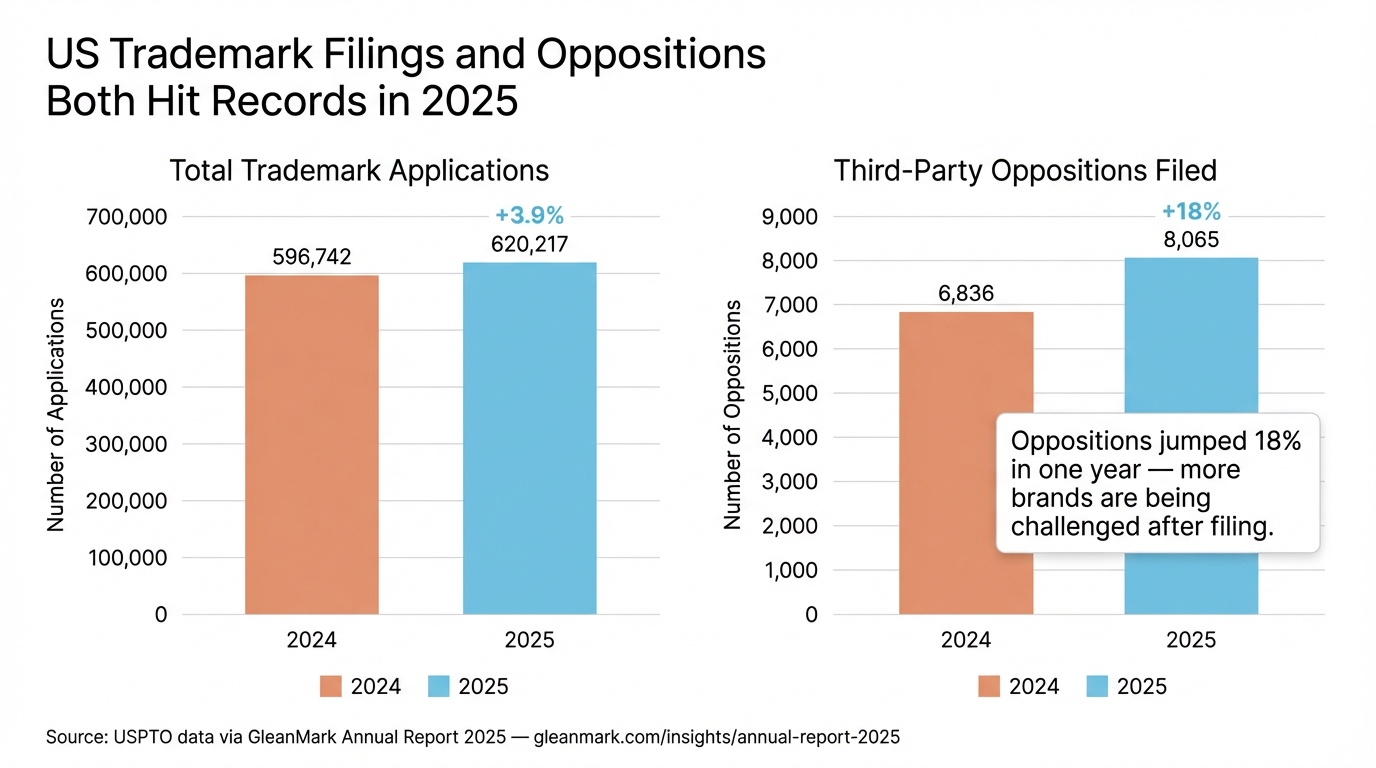
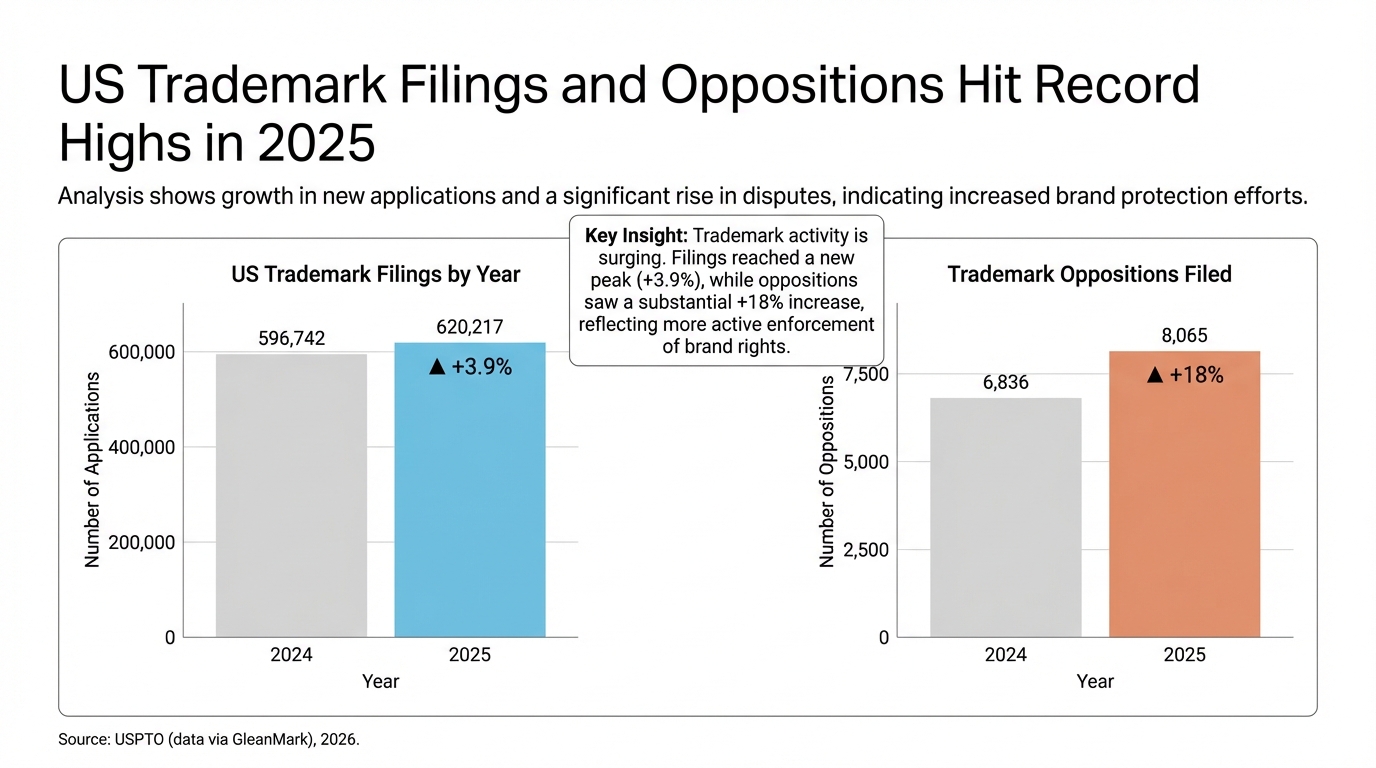 US Trademark Filings and Oppositions Have Trended Sharply Upward — Source: USPTO Trademark Dashboard
Federal trademark protection also matters commercially. Investors conducting due diligence routinely flag unregistered intellectual property as a risk factor. If your business name has value, it has risk without a trademark application on file. Remember, a registered mark is a valuable business asset that strengthens your legal rights and valuation.
What a Trademark Actually Protects (and What It Does Not)
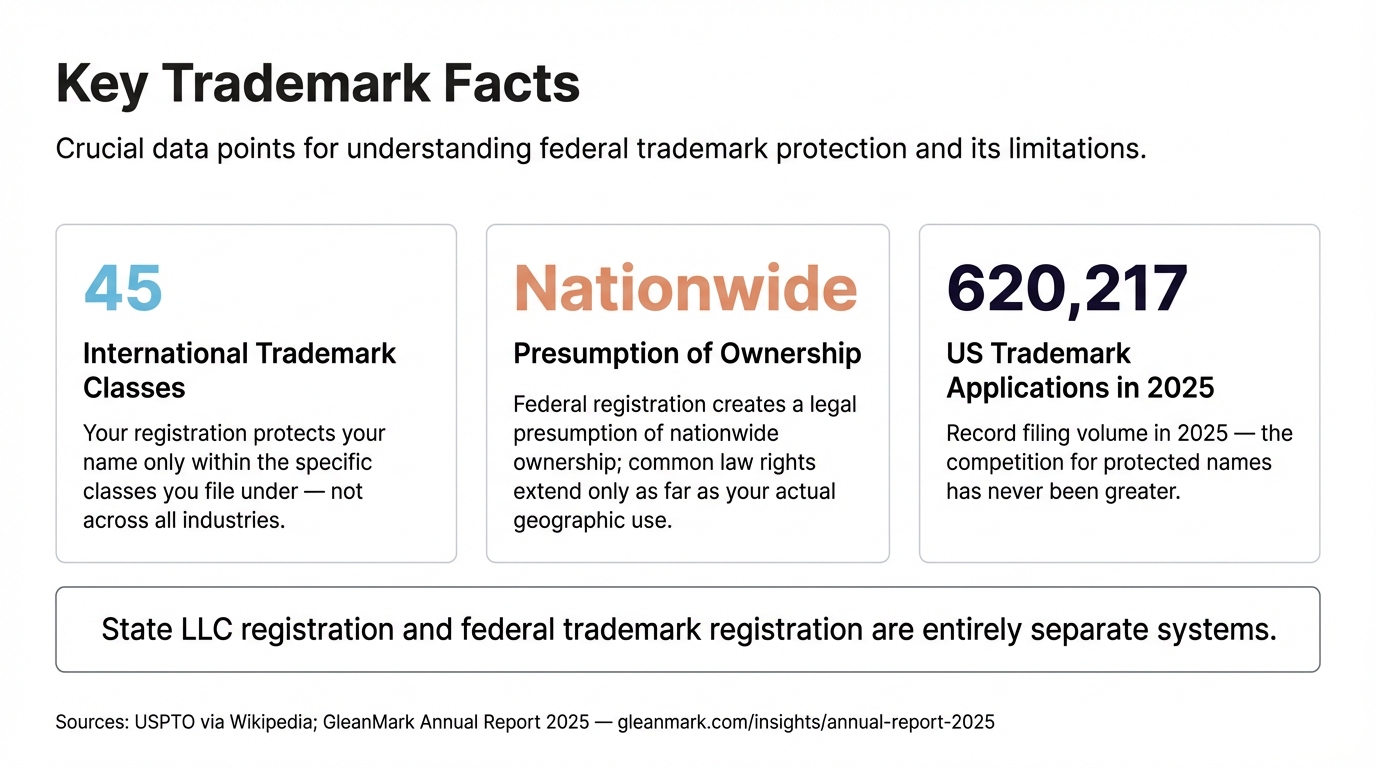 What a Federal Trademark Registration Actually Gives You — Source: USPTO
Federal Registration Gives You Nationwide Exclusive Rights
When you trademark your business name, you gain exclusive rights to use it in connection with specific goods or services across all 50 states, including in markets where you have not yet operated, offering significant advantages over unregistered marks. Under the Lanham Act, 15 U.S.C. § 1051 et seq., federal registration creates a legal presumption of nationwide ownership, a significant advantage over common law trademark rights that extend only as far as your actual geographic use. Registration also grants the right to use the ® symbol, enables you to record your mark with U.S. Customs and Border Protection to block infringing imports, and provides access to federal court for enforcement. For a deeper look at what the registered symbol actually signals, see what a registered logo symbol means and when to use it.
A State Business Filing Is Not Trademark Protection
Filing with your state’s secretary of state creates a legal business entity. However, it does not create trademark rights. The United States Patent and Trademark Office, which governs federal trademarks is entirely separate from state business registration. Assuming your state LLC filing protects your brand identity is one of the most common and costly misconceptions among early-stage founders, and it can lead to legal trouble down the road. For a full comparison, see state trademark vs. federal trademark: what’s the difference and which is right for you.
A Trademark Covers Your Name Within Specific Classes
The USPTO trademark system uses 45 international classes covering 34 goods categories and 11 services categories, as defined by the WIPO Nice Classification system. Your trademark registration protects your business name only within the specific classes you file under. Apple Inc. holds trademarks in technology and retail, but another company could theoretically apply and register the “Apple” mark in an unrelated industry class. Filing in the right classes is a strategic decision, not an administrative formality, and meeting all application requirements before submission reduces the risk of refusal.
How to Evaluate Whether Your Business Name Can Be Trademarked
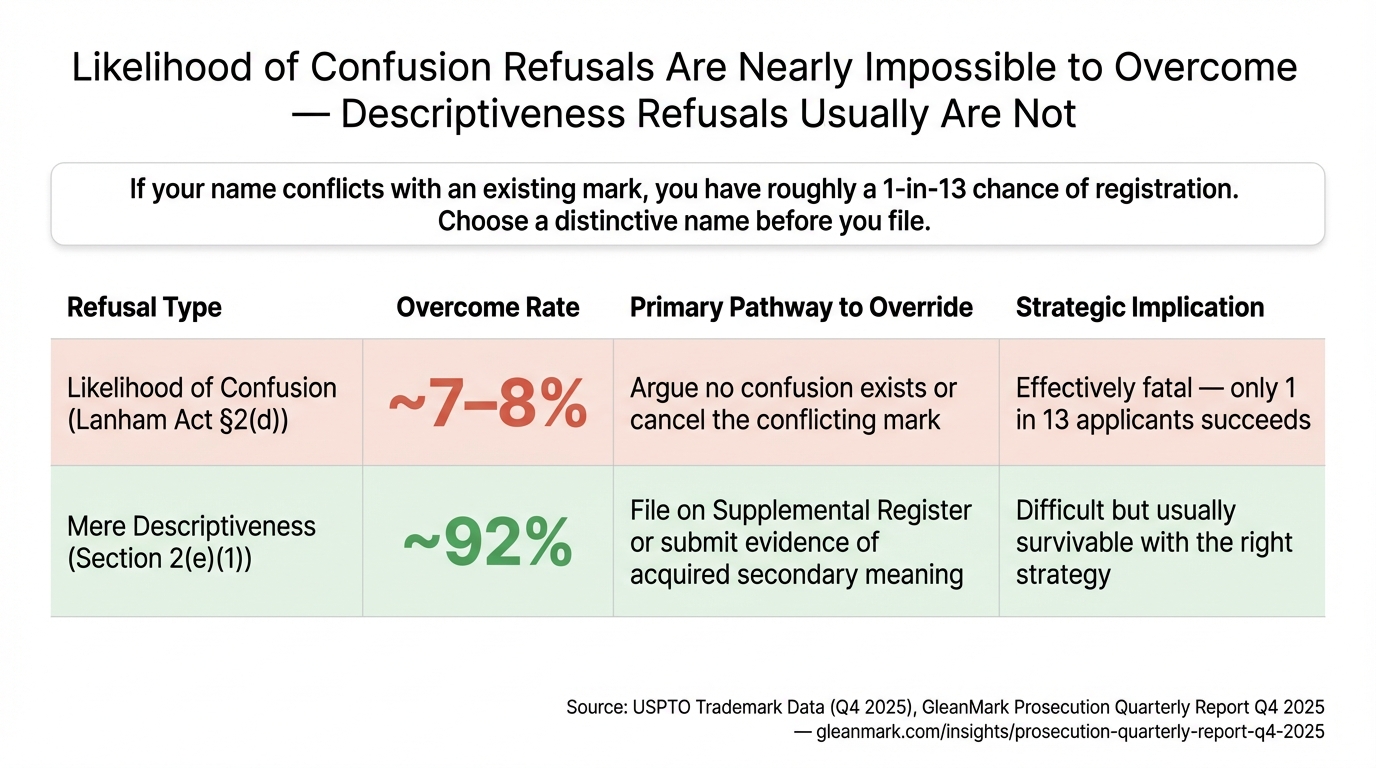 Likelihood of Confusion Refusals Are Nearly Impossible to Overcome — Descriptiveness Refusals Usually Are Not — Source: USPTO Trademark Data
The Distinctiveness Spectrum Determines Registrability
The USPTO evaluates trademark applications on a distinctiveness spectrum. Fanciful marks (invented words like Kodak or Xerox) and arbitrary marks (common words applied to unrelated goods, like Apple for computers) sit at the strongest end and earn the broadest trademark protection. Suggestive marks hint at a product quality without describing it directly. Descriptive marks require proof of acquired secondary meaning to register. Generic terms cannot be registered at all. A coffee shop named “Coffee Shop” is unregistrable under any circumstances, per USPTO examining guidelines.
A Comprehensive Trademark Search Is the First Real Step
Before you trademark your business name, you need to confirm that no one holds prior rights to the same or a confusingly similar name in your classes. The USPTO’s Trademark Electronic Search System is publicly available, but a thorough search goes beyond exact keyword matches. It includes phonetic equivalents, similar-looking marks, and marks in use but not yet registered, as well as any existing trademark that could create a likelihood of confusion. According to USPTO data, likelihood-of-confusion refusals under Lanham Act Section 2(d) are among the leading causes of application failure, and final 2(d) refusals are notoriously difficult to overcome. Skipping the search is not saving money; it is risking your entire filing fee and a costly Office Action Amendment.
If your brand includes a logo, a separate search and filing may also be warranted to protect against an international application by a foreign competitor. See trademarking a logo: all your questions answered for guidance on that process.
Common Grounds for Refusal You Should Know Before Filing
Beyond confusion with existing marks, the trademark office will refuse applications for names that are merely descriptive, geographically descriptive, or primarily a surname without acquired distinctiveness. Descriptiveness refusals are common, but applicants who receive them often find a path to registration through the Supplemental Register or by submitting evidence of secondary meaning. By contrast, likelihood-of-confusion refusals are far harder to overcome. Understanding these grounds before you file lets you build a stronger application or make a strategic rebrand decision before committing time and fees to a likely rejection.
 What the Trademark Application Process Looks Like Step by Step
 What the Trademark Application Process Looks Like Step by Step
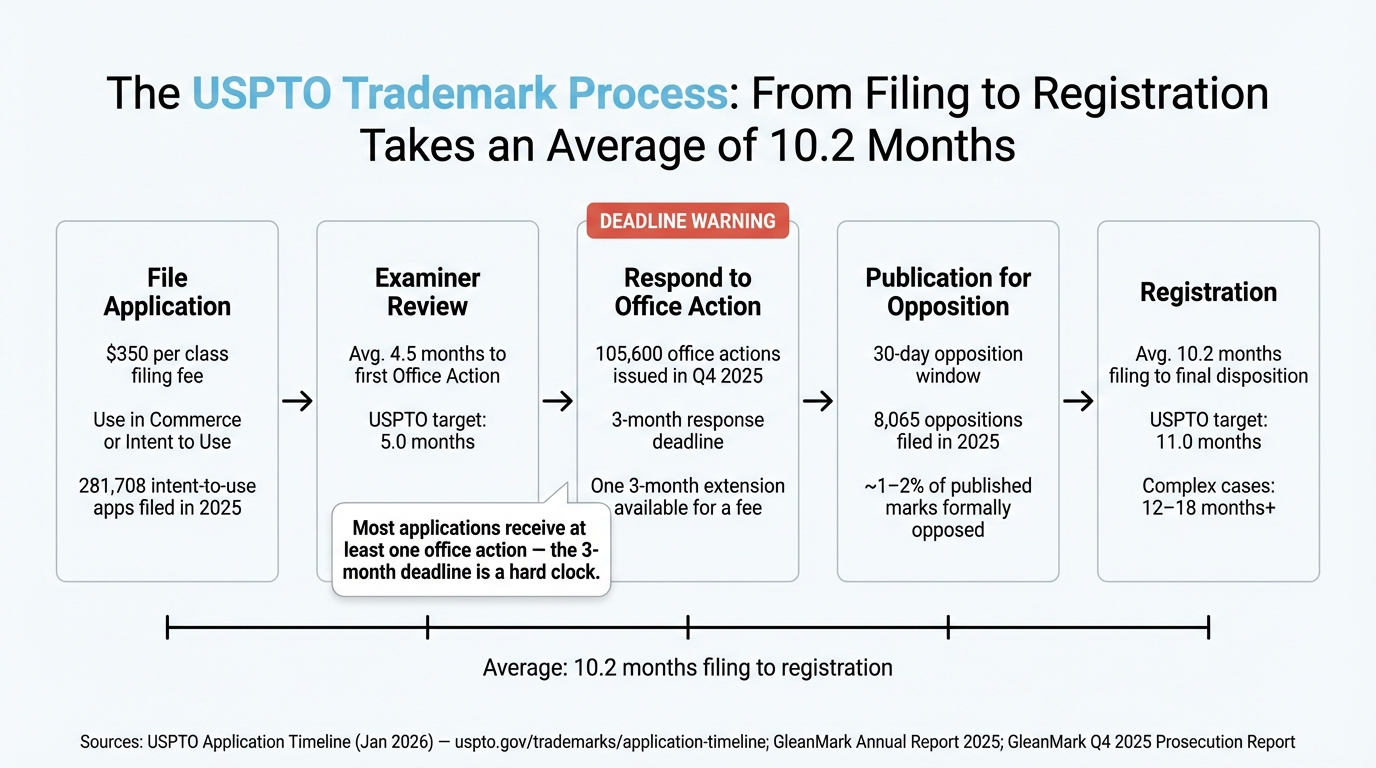 The USPTO Trademark Process: From Filing to Registration — Source: USPTO Application Timeline
Choosing the Right Filing Basis Before You Submit
Every trademark application to the United States Patent and Trademark Office requires a filing basis. The two most common basis are “use in commerce,” meaning the mark is already being used in connection with your goods or services in interstate commerce, and “intent to use,” meaning you have a bona fide intention to use the mark but have not yet offered goods or services for sale in commerce. An intent-to-use application reserves your priority date early, which is why intent-to-use filings have shown strong growth in recent years as sophisticated founders seek to lock in their trademark rights pre-launch. The intent-to-use path requires an additional Statement of Use filing before the trademark can fully register, so build that step into your timeline and budget.
Filing Through TEAS and Understanding the Filing Fee Structure
Trademark applications are submitted through the Trademark Electronic Application System (TEAS) on the USPTO’s official website, one of the secure websites maintained by the federal government for trademark filing. As of January 2025, the USPTO filing fee is $350 per class of goods or services for a standard electronic application. That fee is nonrefundable regardless of outcome. A business filing across two trademark classes pays $700 in government fees before any professional costs. A Statement of Use filing for intent-to-use applications costs an additional $150 per class. Maintenance filings at years five to six run $325 per class, and the 10-year renewal costs another $325 per class.
For a current breakdown of every fee in the trademark lifecycle, see new USPTO fee changes and what to expect.
What Happens After You File
 What Happens After You File
After submission, a USPTO examining attorney reviews your application. In FY 2025, the average time to first Office Action was 5.6 months, according to USPTO performance data. The most recent Q1 2026 data shows this figure has improved further to approximately 4.5 months, per the USPTO application timeline. If issues in the application exist, the examiner issues an office action with a three-month window to respond. Most applications require at least one round of examiner correspondence, so building response time into your business plan is essential. If the application clears examination, it publishes in the Trademark Official Gazette for a 30-day opposition period. If no opposition is filed before the trademark trial board, a use-in-commerce application registers shortly after. In FY 2025, the average time from filing to final disposition was 11.7 months, according to USPTO records, though Q1 2026 data shows that figure has improved to approximately 10.1 months.
How Much It Costs to Trademark Your Business Name
 How Much It Costs to Trademark Your Business Name
Government Filing Fees Are Only Part of the Total Cost
The USPTO filing fee is $350 per class as of 2025, and it is nonrefundable. A single-class filing costs $350. Filing across three classes costs $1,050 in government fees before any professional assistance. Intent-to-use applications add a $150 per class Statement of Use fee later. Extension requests cost $125 per class. The filing fee is the floor of your trademark budget, not the ceiling, and planning only for the initial cost will leave you underprepared for a typical application lifecycle.
Attorney Fees and Why Professional Help Often Pays for Itself
Working with a trademark attorney to trademark your business name typically adds $500 to $1,500 in professional fees for a standard application, in addition to government filing fees. That investment is well-supported by outcome data. According to research by trademark scholars Deborah Gerhardt and Jon J. Lee, 82% of attorney-represented applications achieved publication approval, compared to 60% of pro se filings, underscoring why professional legal advice matters. For a brand that anchors your business value, investor conversations, and long-term intellectual property portfolio, the additional cost is risk management, not overhead. A trademark attorney handles the search, advises on class strategy, drafts stronger descriptions of goods and services, and responds to office actions if they arise.
Rapacke Law Group handles trademark registration on a flat-fee basis, so you know the full cost upfront. Per the RLG Guarantee, if your trademark application is rejected, you pay nothing and will receive a 100% refund.
What Happens After Your Business Name Is Registered
The ® Symbol and What You Are Legally Allowed to Claim
Once registration is confirmed, you have the legal right to use the ® symbol with your business name in connection with your registered goods and services. Using ® before registration is a federal violation. According to USPTO trademark marking guidance, deliberate misuse of the ® symbol to deceive consumers can constitute fraud under U.S. trademark law. Before registration, you may use the ™ symbol to signal a trademark claim, but it carries no weight of federal registration behind it. For a practical explanation of when each symbol applies, see what a registered logo symbol actually means and when to use it.
Maintaining Your Trademark Requires Active Filings Over Time
A federal trademark registration does not remain valid automatically. Between the fifth and sixth year after registration, you must file a Section 8 Declaration of Continued Use to confirm the mark is still in active commerce. At the 10-year mark, a combined Section 8 and Section 9 renewal is required, and every 10 years thereafter. Miss these deadlines and the USPTO cancels your registration. Trademark rights can also be lost through abandonment, defined under 15 U.S.C. § 1127 as non-use for three consecutive years, or through genericide. “Escalator,” once a registered trademark, was declared generic in 1950 after it became the common public term for the product.
A Registered Mark Gives You Real Enforcement Tools
Trademark registration gives you standing to sue for infringement in federal court under the Lanham Act. You can also record your registered trademark with U.S. Customs and Border Protection to block counterfeit imports. In FY 2022, CBP seized 20,812 shipments of goods violating intellectual property rights, representing an estimated $2.98 billion in counterfeit products. Without registration, your common law trademark rights exist but are geographically limited and far harder to enforce.
When to File Your Trademark Application and What to Do Right Now
The Earlier You File, the Stronger Your Priority Position
In the United States trademark system, which is administered by the USPTO, priority is generally determined by who files first, not who uses the mark first. If a competitor files for a confusingly similar name before you, your application will likely be refused or face a trademark trial and opposition challenge even if you have been using the name longer in a limited market. Filing an intent-to-use application before your product launches locks in your priority date. The consistent year-over-year growth in intent-to-use filings reflects that sophisticated founders understand this dynamic and act accordingly.
If you are weighing whether your company name justifies filing, these resources offer concrete guidance: should I trademark my company name: pros and cons explained and how to protect your company name in a crowded market. If your brand includes a personal name, can you trademark your name addresses the specific rules that apply.
Signs Your Business Name Is at Immediate Risk Without a Trademark
Several situations signal near-term risk if you have not yet moved to trademark your business name: you are raising venture capital (investors routinely flag unregistered intellectual property during due diligence); you are expanding to new states or markets; you have found other businesses using similar names in your space; your brand identity is gaining brand recognition and public recognition; or you are about to invest heavily in marketing. Any one of these conditions makes a trademark application a business-critical step. Every day you wait is a day a competitor can file first and establish priority over a name you have been building.
Frequently Asked Questions About Trademarking a Business Name
How do I trademark my small business name? The first step to trademark your business name is a comprehensive trademark search in the USPTO database and on official websites to confirm no conflicting marks exist in your classes. Then select the correct trademark classes for your goods or services and file through the Trademark Electronic Application System on the USPTO’s official website. A trademark attorney can handle the search, prepare the application, and respond to any office actions that arise, which significantly increases your odds of a successful registration. For a full walkthrough, see how to get a federal trademark: a step-by-step guide.
Is it worth trademarking your business name? For most businesses where the brand name has commercial value, yes. Federal trademark registration gives you exclusive rights nationwide, legal standing to enforce your mark in federal court, and a documented intellectual property asset that matters to investors and acquirers. Government filing fees start at $350 per class, a modest cost compared to rebranding or litigating an infringement dispute.
What happens if I trademark my business name? You receive a certificate of registration and the legal right to use the ® symbol. You gain nationwide exclusive rights to use the name in connection with your registered goods and services, the ability to enforce those trademark rights against unauthorized use through cease and desist letters and federal litigation under the Lanham Act, and the ability to record your mark with U.S. Customs to stop counterfeit imports. Your trademark registration must be maintained with filings between years five and six and renewed every 10 years; for more information on maintenance deadlines, consult the USPTO website.
How expensive is it to trademark your business name? The current USPTO filing fee is $350 per class. A business filing across multiple trademark classes pays that fee per class, plus any downstream fees for a Statement of Use, extensions, or maintenance filings. Attorney fees for a full-service trademark registration typically run $500 to $1,500 in addition to government fees. A standard single-class filing with professional representation commonly totals between $850 and $2,000, depending on complexity.
Can I lose my trademark after it is registered? Yes. Trademark rights can be lost by failing to file required maintenance documents, through non-use for three or more consecutive years, or through genericide. Active monitoring of the USPTO database for conflicting applications and consistent use of your mark in commerce are both essential to keeping your registered trademark alive.
Do I need a trademark if I already have an LLC registered in my state? No. A state LLC registration gives you the right to operate as a legal entity in that state. It does not create trademark rights and does not prevent another business in a different state from using the same name. Federal trademark registration through the USPTO is the only mechanism for securing nationwide exclusive rights to your business name as intellectual property.
Conclusion
Choosing to trademark your business name is not something that happens automatically the moment you start using it or register your LLC. Federal trademark registration through the trademark office at the USPTO is what converts your brand identity into a legally defensible, nationwide intellectual property asset, one that carries exclusive rights, enforcement power under the Lanham Act, and documented value for investors and acquirers. The trademark registration process takes planning, but the protection it provides is foundational for any business where the name itself carries value.
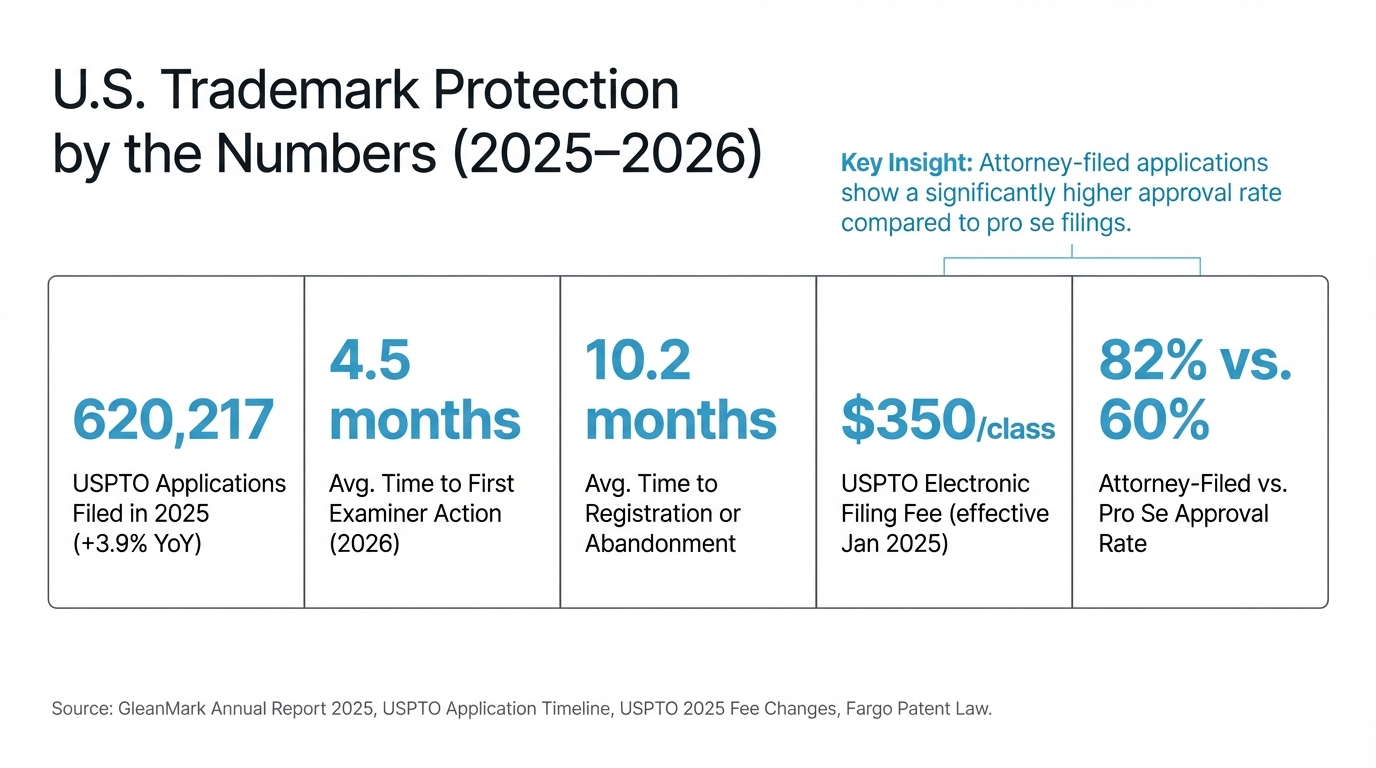 U.S. Trademark Protection by the Numbers (2025–2026) — Source: USPTO Trademark Dashboard; USPTO 2025 Fee Changes
Your Next Steps to Trademark Registration Success
Protecting your business name is one of the highest-return IP investments you can make, and the process is straightforward when you have the right guidance. The filing fees are fixed and transparent. The timeline is predictable. What varies is whether your application is filed correctly the first time.
The bottom line: A weak or self-filed trademark application risks rejection, wasted fees, and months of delay. A well-prepared, attorney-guided application with a thorough search behind it puts you in the 82% approval category, not the 60%.
Every day without a trademark application on file is a day a competitor can file first and establish priority over a name you have invested in building. That risk is real, it is measurable, and it is entirely avoidable.
Action items to protect your brand today:
- Schedule a Free IP Strategy Call with Rapacke Law Group to evaluate whether your business name qualifies, determine which trademark classes apply, and understand what a full trademark search will reveal.
- Review how to get a federal trademark: a step-by-step guide to understand what the application process requires before your first call.
- Download the SaaS Patent Guide 2.0 if your business also has patentable technology that needs protection alongside your brand.
Rapacke Law Group handles trademark registration on a flat-fee basis with the RLG Guarantee: get your trademark approved or pay nothing. A registered trademark is not just a legal filing. It is a competitive advantage that compounds in value as your brand grows.
To Your Success,
Andrew Rapacke Managing Partner, Registered Patent Attorney Rapacke Law Group