


Using the wrong trademark symbol on your brand can eliminate your right to recover damages in an infringement lawsuit. That is not a hypothetical risk. Under 15 U.S.C. § 1111, a registered trademark owner who fails to display proper notice may be barred from recovering profits or damages unless they can prove the infringer had actual knowledge of the registration. The choice between ™, ®, and ℠ is a legal decision, not a design preference.
What the Three Trademark Characters Actually Represent
The ™, ®, and ℠ trademark symbols are not interchangeable decorations. Each carries a specific legal meaning that tells consumers, competitors, and courts exactly what rights a brand owner is claiming. According to the International Trademark Association, trademark symbols exist for one purpose: to give public notice of trademark rights, whether those rights are registered or unregistered. Using the wrong symbol can undermine that notice and affect your ability to recover damages in an infringement dispute. To understand the full framework before diving in, see our guide to Trademark Basics for Entrepreneurs: How Do Trademarks Work?
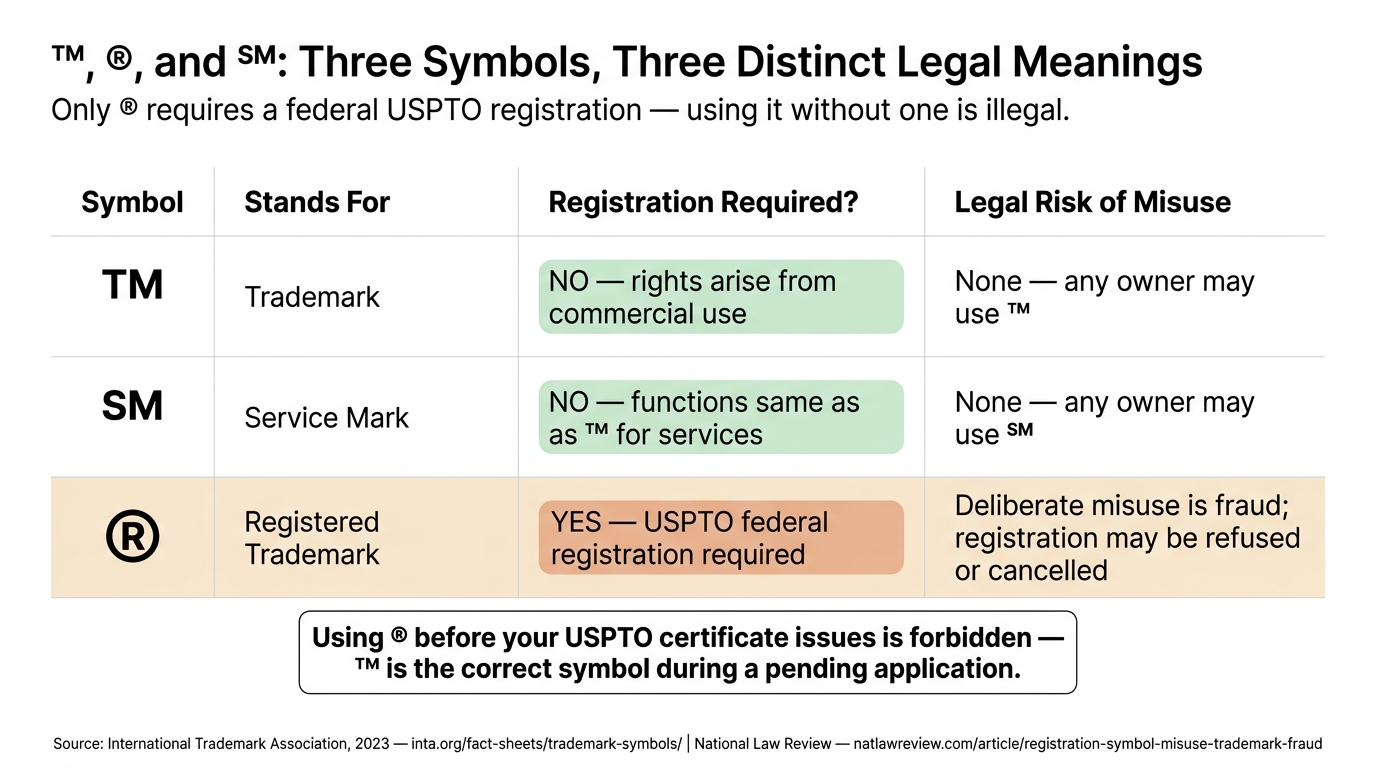 ™, ®, and ℠: Three Symbols, Three Distinct Legal Meanings — Source: International Trademark Association, 2023; National Law Review
The core distinction is registration status. ™ and ℠ signal unregistered claims. ® signals that the United States Patent and Trademark Office has granted a federal registration for the mark. That single difference carries enormous legal consequences covered throughout this article.
What the TM Symbol Means for Unregistered Trademarks
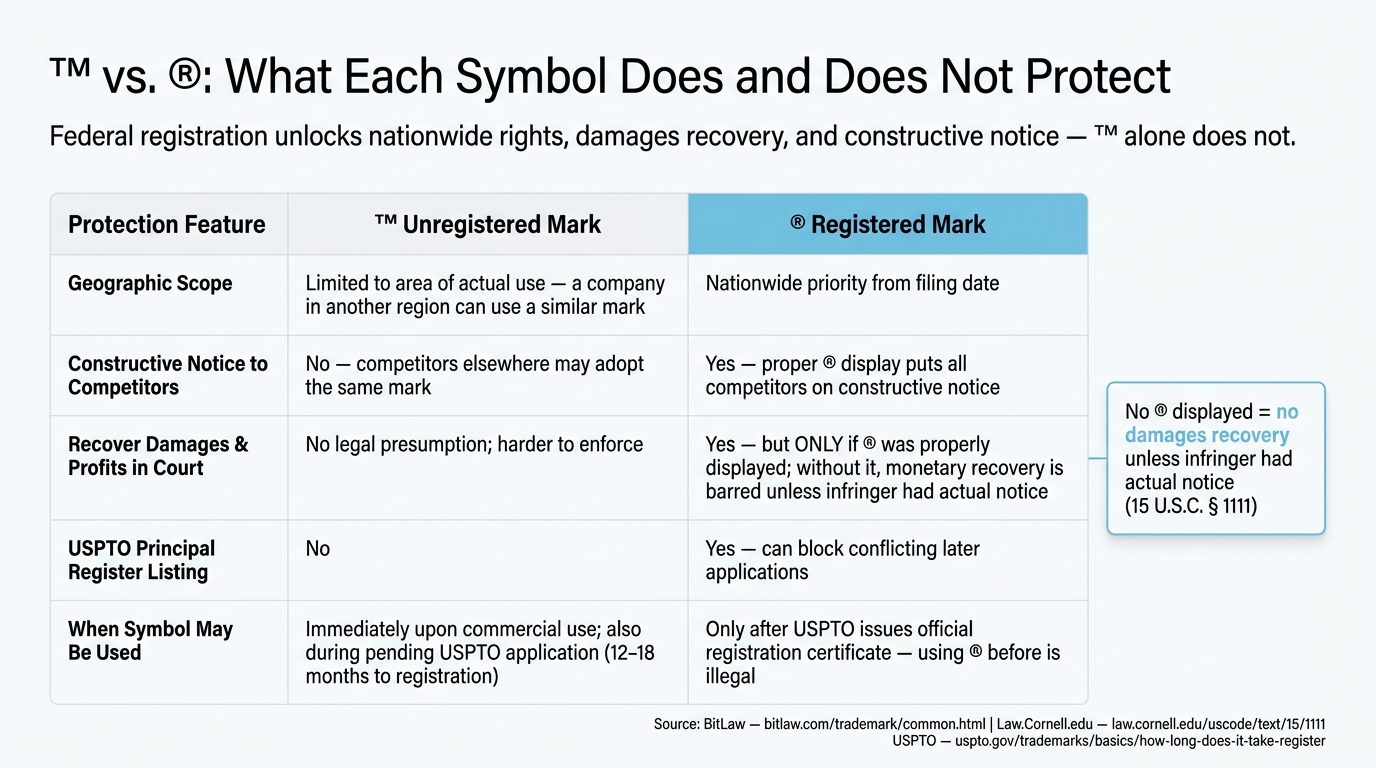 ™ vs. ®: What Each Symbol Does and Does Not Protect — Source: Law.Cornell.edu (15 U.S.C. § 1111); USPTO
The TM Symbol Claims Common Law Rights Without Federal Registration
The TM symbol signals that a business is claiming trademark rights in a word, logo, or phrase without a federal registration from the trademark office. Under U.S. trademark law, rights arise from actual commercial use of a mark in commerce, not merely from registration filing, as established under the Lanham Act (15 U.S.C. § 1125) and U.S. trademark common law. Any business using a mark in commerce can place ™ next to it immediately, with no USPTO filing required.
Common law trademark rights are geographically limited, however. A ™ owner is protected in the region where they actively use the mark commercially. A company operating only in Texas has no common law claim against a similar brand launching in Florida unless it can prove prior use in that market. For a deeper look at understanding trademark requirements, including what qualifies a mark for protection, see our dedicated guide.
How the TM Symbol Applies During a Pending Application
Brands that have filed a trademark application with the USPTO but have not yet received their registration certificate cannot legally use ®. The ™ symbol is the correct choice during this window. According to the USPTO, the full registration timeline typically runs 12 to 18 months from filing, depending on examination complexity and whether any office actions are issued. Using ® before the certificate issues is prohibited as false marking under federal law, and using ™ during the examination period is both accurate and legally appropriate. For a detailed breakdown of each stage, see our guide to understanding the trademark timeline.
What the TM Symbol Does and Does Not Protect
Displaying ™ gives public notice of claimed rights but does not grant the legal presumptions that come with federal trademark registration. A registered trademark owner enjoys nationwide presumption of ownership, the right to use ® as notice, and the ability to recover statutory damages and attorney fees in federal court. An unregistered mark backed only by ™ provides none of these advantages. As the visual comparison above illustrates, ™ and ® share the function of notice but diverge sharply on what legal protections they enable.
What the Registered Trademark Symbol ® Means Under Federal Law
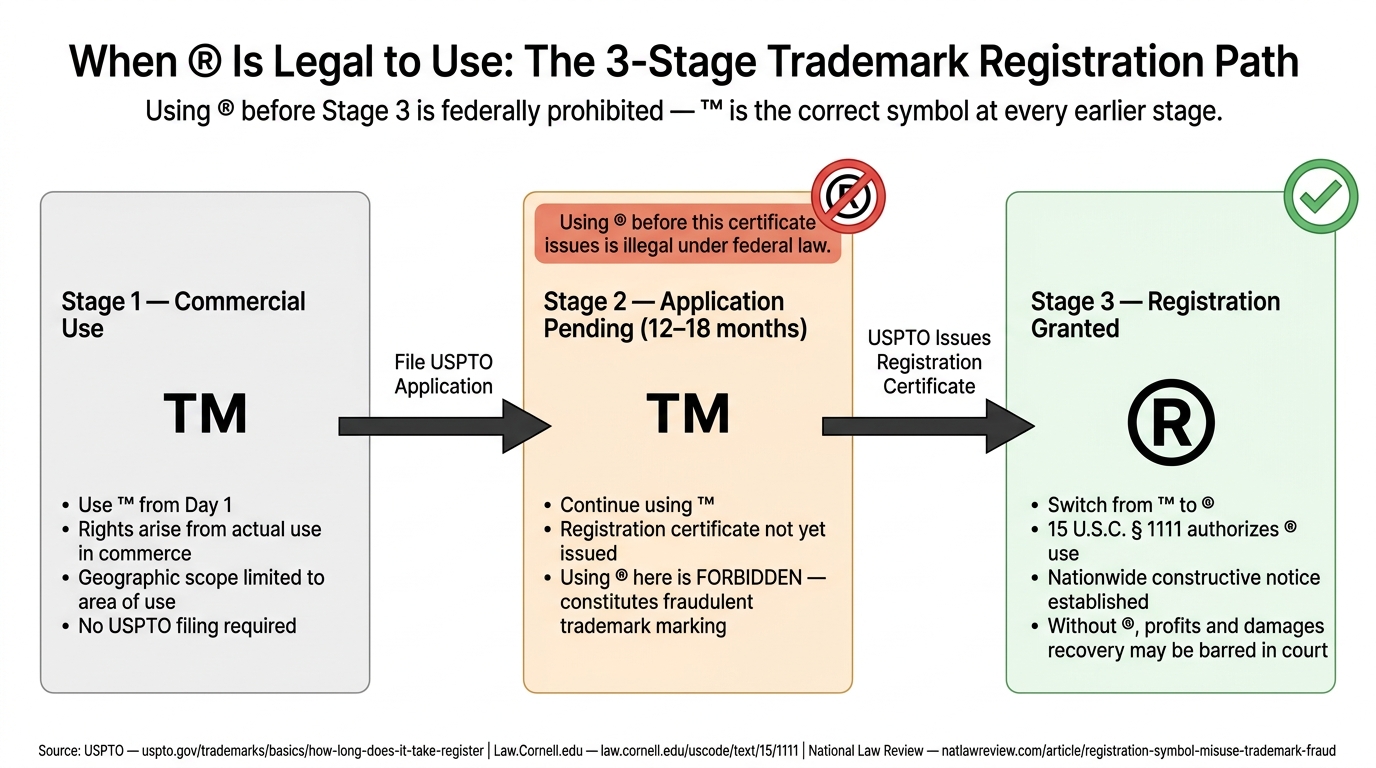 When ® Is Legal to Use: The 3-Stage Trademark Registration Path — Source: USPTO; Law.Cornell.edu (15 U.S.C. § 1111); National Law Review
Federal Registration Is the Only Basis for Using ®
The registered trademark symbol ® may only be used after the United States Patent and Trademark Office grants a federal registration. This is a legal requirement, not a stylistic choice. 15 U.S.C. § 1111 explicitly limits ® use to marks appearing on the federal register with an active registration. Using ® on an unregistered mark is considered fraudulent trademark marking under federal law. According to federal trademark law codified in 15 U.S.C. § 1111, deliberate improper use of ® constitutes fraudulent marking, which can result in refusal or cancellation of a trademark application or existing registration.
Not sure whether your mark qualifies for the ® yet? Our comparison of TM vs R Trademark: Which Symbol Can You Legally Use? walks through every scenario in detail.
What ® Communicates to Competitors and Courts
When a trademark owner properly uses the registered trademark symbol, they put competitors on constructive notice of their federal rights. This matters enormously in litigation. Under the Lanham Act, a defendant cannot claim innocent infringement if ® was properly displayed on the mark. Without that notice, courts may reduce or eliminate monetary damages entirely. The process chart above illustrates the three-stage registration path that must be completed before ® becomes legally available.
U.S. Registration Does Not Authorize ® Use Abroad
A U.S. federal trademark registration only confers rights within the United States. If a mark is registered in the European Union or another jurisdiction but not registered by the USPTO, using ® in U.S. commerce on that mark is improper regardless of its registration status elsewhere. As National Law Review confirms, only marks on the USPTO’s Principal Register should carry ® in U.S. commerce. Brands with international trademark portfolios must track registration status jurisdiction by jurisdiction, using mechanisms like the Madrid Protocol for multi-country filings.
What the SM Symbol Means and When It Applies
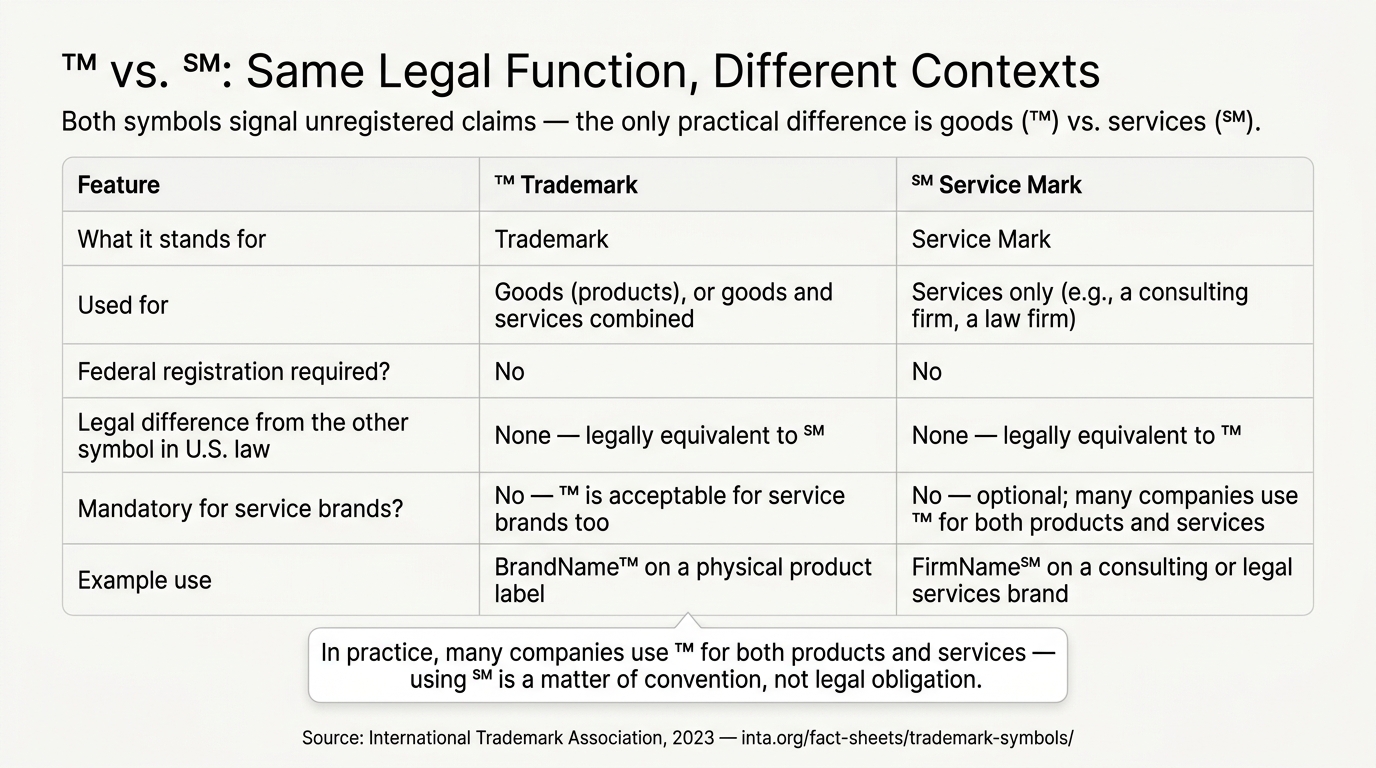 ™ vs. ℠: Same Legal Function, Different Contexts — Source: International Trademark Association, 2023
The ℠ Symbol Covers Service-Based Businesses Without Registration
The ℠ service mark symbol functions identically to ™ but applies specifically to marks used in connection with services rather than physical goods. A law firm, a consulting practice, or a software-as-a-service company offering intangible services would traditionally use ℠ rather than ™ when claiming unregistered rights. According to INTA, once a service mark receives federal registration, the owner transitions to ® just as goods-based trademark owners do.
Why Most Brand Owners Default to TM Even for Services
In practice, many businesses use ™ for both goods and service marks because ™ is universally recognized and legally sufficient for asserting unregistered rights regardless of what the mark covers. The legal effect of ™ and ℠ is identical under U.S. trademark law. The ℠ symbol is more common in industries with longstanding service-mark traditions, such as financial services and professional services, but INTA confirms that using ™ for service-based brands is fully acceptable.
Where to Place Trademark Characters on Logos and Text
Upper Right or Lower Right Corner Is Standard Placement
The conventional and legally accepted placement for trademark symbols is the upper right-hand corner or the lower right-hand corner of the mark itself. The symbol should appear at the edge of the logo, name, or phrase being claimed, not embedded within it. The upper right-hand corner is most common for wordmarks and logo treatments in marketing materials, packaging, and digital assets. Lower right-hand corner placement is equally valid as long as the symbol is clearly associated with the mark and used consistently across all brand touchpoints.
Misplacing or omitting these symbols is one of the most common and costly trademark icon mistakes that could cost your startup its brand. Review that guide to make sure your placement is compliant before your next product launch.
Trademark Characters on Websites and Social Media
On websites, trademark owners are not required to add the symbol every time the mark appears in body copy. According to the International Trademark Association and standard trademark usage practice, the accepted convention is to use the symbol on the first or most prominent appearance of the mark on each page, such as in the site header or product name. Some companies also include a footnote at the bottom of the page clarifying which marks are registered trademarks and which are not. One prominent placement per page satisfies the notice function without cluttering content.
How to Type TM Characters on Any Device
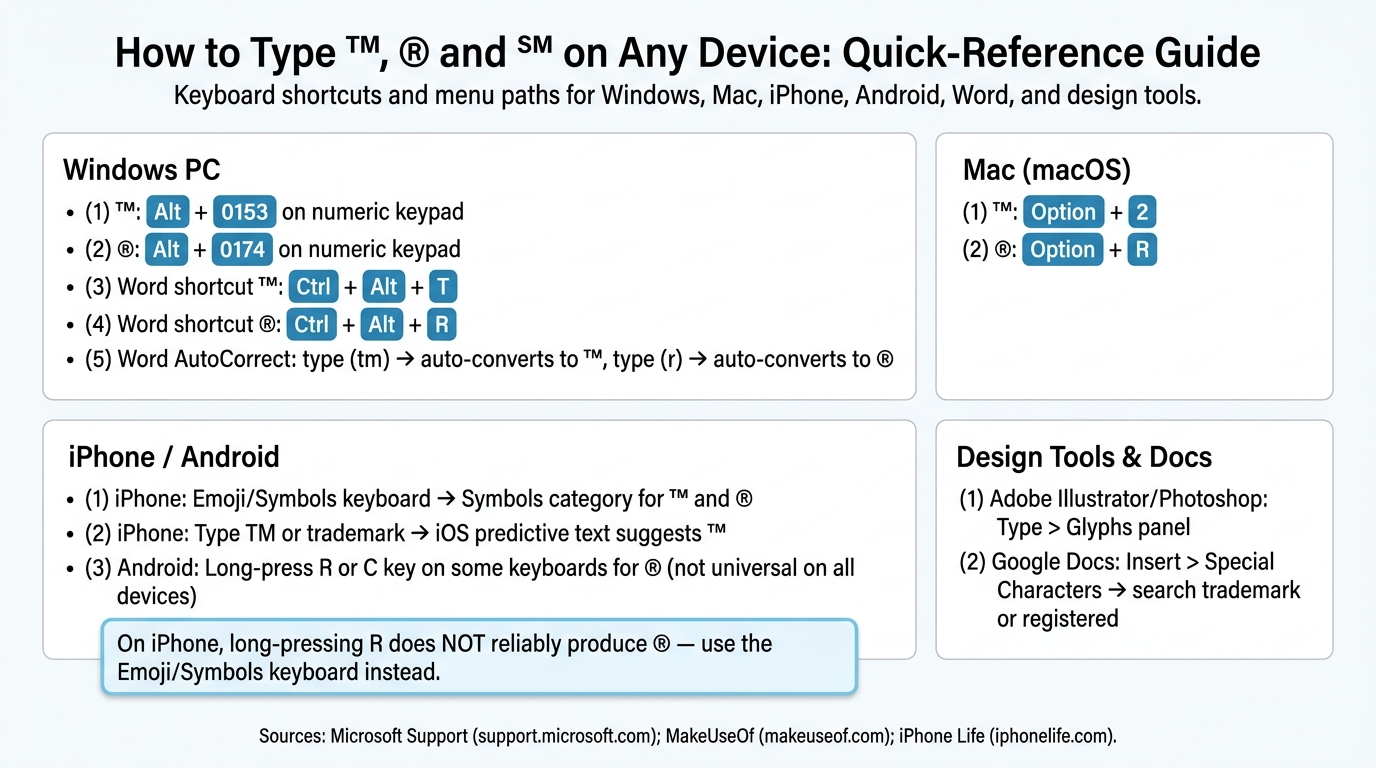 How to Type ™, ® and ℠ on Any Device: Quick-Reference Guide — Source: Microsoft Support; MakeUseOf; iPhone Life
Typing Trademark Symbols on Mac, Windows, and Mobile
On a Mac, type ™ using Option + 2 and ® using Option + R. On Windows, use Alt + 0153 for ™ and Alt + 0174 for ® on the numeric keypad, according to i2symbol’s alt code reference. Microsoft Support also documents methods for inserting trademark symbols within Office applications through the Insert > Symbol menu. On iOS, the ™ and ® symbols appear in the Emoji and Symbols keyboard, and iOS predictive text will suggest ™ when you type the letters “TM.” On Android, long-pressing the R key on many keyboards reveals ® as an option.
Inserting Trademark Characters in Design Tools and Documents
In Adobe Illustrator and Photoshop, trademark symbols are available through the Glyphs panel under the Type menu. In Microsoft Word, AutoCorrect automatically converts (TM) to ™ and (R) to ® by default. In Google Docs, use Insert > Special Characters and search “trademark” to locate all three symbols. For web properties, the HTML entities are ™ for ™, ® for ®, and ℠ for ℠, which ensure correct rendering across all browsers.
What Happens When Trademark Characters Are Used Incorrectly
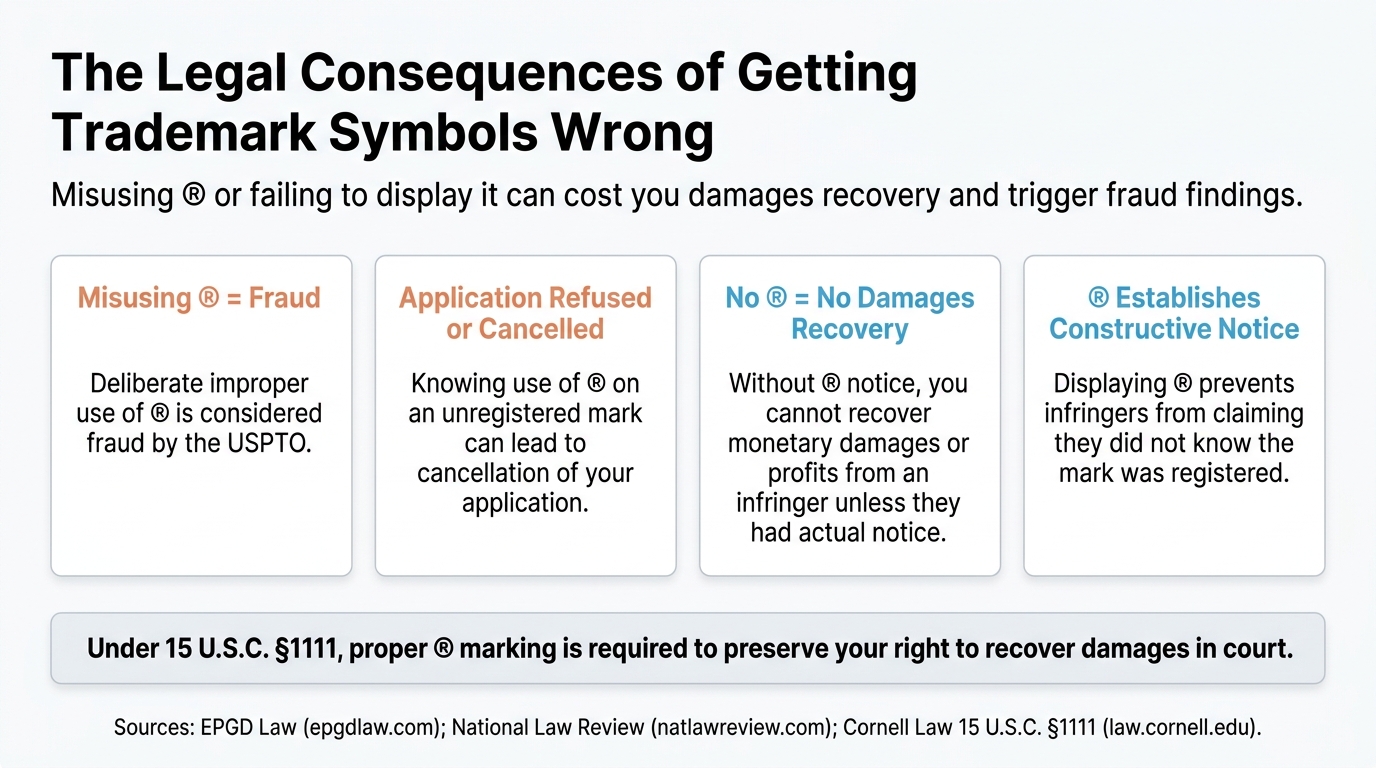 The Legal Consequences of Getting Trademark Symbols Wrong — Source: National Law Review; Cornell Law (15 U.S.C. §1111)
Using ® Before Registration Creates Legal Risk
Placing ® on a mark before the USPTO issues a registration certificate is a false designation under federal trademark law. According to National Law Review, a company’s knowing use of ® on an unregistered name has been raised as a fraud claim in Trademark Trial and Appeal Board (TTAB) proceedings, with potential consequences including refusal or cancellation of a later-filed application. A competitor who discovers improper ® usage has grounds to challenge your trademark rights directly. Audit all brand materials immediately after filing to confirm ® is not appearing before the registration certificate is issued.
Failing to Display Any Symbol Limits Your Damages
A trademark owner who never uses ™ or ® on their mark gives infringers a potential defense: they did not know the mark was claimed as a trademark. Under 15 U.S.C. § 1111, a registered trademark owner who fails to provide notice may be barred from recovering profits or damages unless actual notice of the infringement can be proven independently. Display the appropriate symbol on every material use of your mark to preserve your right to full remedies.
How Trademark Characters Fit Into a Broader Brand Protection Strategy
Trademark symbols are notice tools, not protection mechanisms. The legal protection itself comes from federal trademark registration with the USPTO, which establishes nationwide priority, creates a public record of ownership, and enables enforcement through U.S. Customs and Border Protection against counterfeit imports. The USPTO reported over 700,000 new trademark applications filed annually in recent years, reflecting how central trademark registration has become to brand strategy. Treat ™ as a placeholder and pursue federal trademark registration as early as possible. For a complete walkthrough of the process, see our guide on how to get a trademark that protects your brand long-term.
Before displaying ™ on a mark you intend to build a brand around, a comprehensive trademark search is essential. If an identical or confusingly similar mark is already registered or in active use, you may be infringing even without knowing it, and displaying ™ does not create a safe harbor. A search covering the USPTO database, state trademark registries, and common law uses including domain names and social media should precede any public launch. Our guide on how to choose a trademark for long-term success covers the selection and clearance process in full detail.
It is also worth noting that trademark protection does not last forever without maintenance. Registrations must be renewed on a set schedule to remain enforceable. See our guide on how long a trademark lasts to understand the renewal requirements that apply once your registration is in place.
FAQ: Trademark Characters and Symbols
How can I tell if a symbol is TM or ®? The ™ symbol appears as unenclosed superscript text, while ® is the letter R enclosed in a circle. Legally, ® signals that the USPTO has granted a federal registration, while ™ indicates only a claim of trademark rights without confirmed registration. You can verify any brand’s registration status by searching the USPTO’s Trademark Electronic Search System at USPTO.gov.
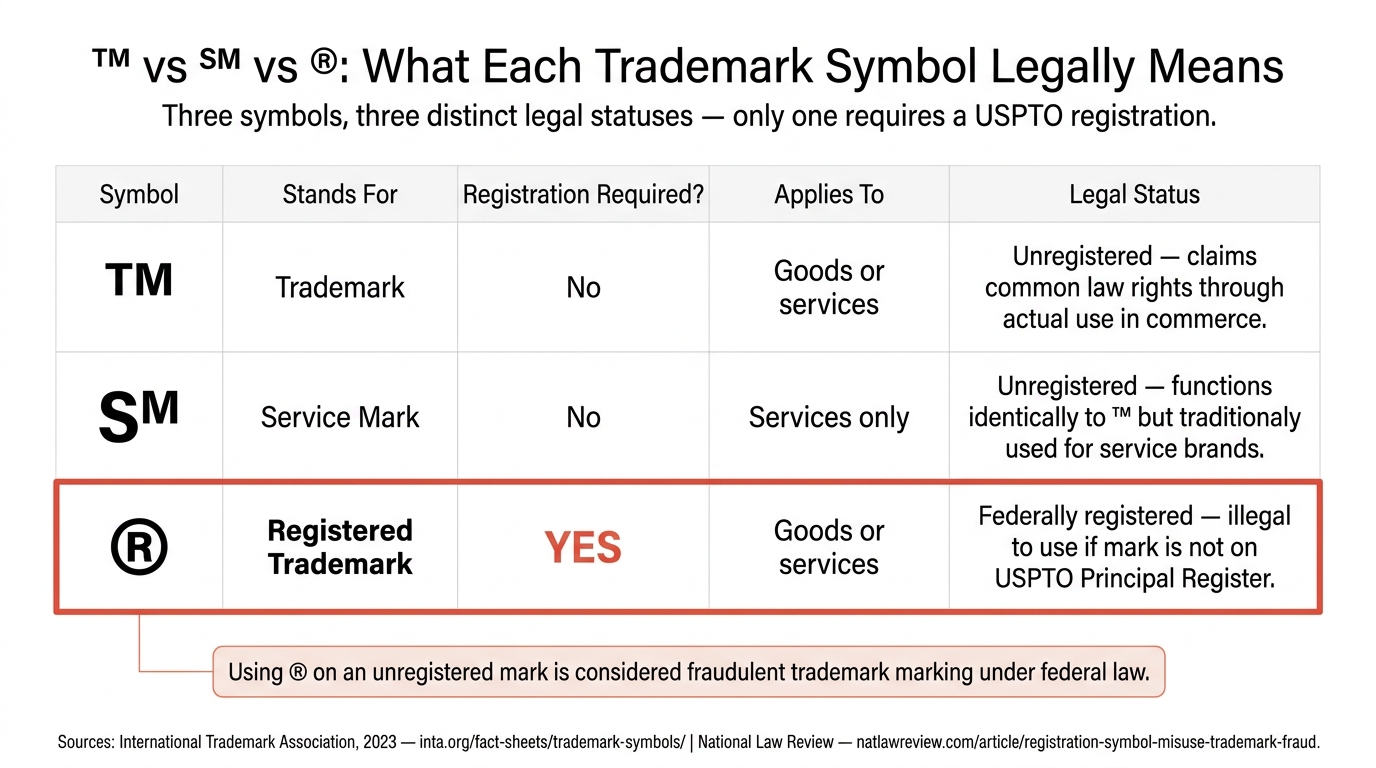 ™ vs ℠ vs ®: What Each Trademark Symbol Legally Means — Source: International Trademark Association, 2023; National Law Review
How do I type a TM symbol? On a Mac, press Option + 2. On Windows, hold Alt and type 0153 on the numeric keypad. In HTML, use the entity ™ to render ™ correctly on web pages. Microsoft Word automatically converts (TM) to ™ through its AutoCorrect feature.
What do the TM letters mean? TM is an abbreviation for “trademark.” Placing the ™ character next to a brand name, logo, or slogan is a public declaration that the owner claims trademark rights in that identifier, even if no federal registration has been applied for or granted by the trademark office.
Is it TM or R or C for brands? These three trademark symbols serve entirely different purposes. ™ and ℠ apply to unregistered trademarks and service marks respectively. ® applies only after the USPTO grants federal trademark registration. © applies to copyright, which protects original creative works and has no connection to trademark law. The choice between ™ and ® depends solely on whether federal registration has been completed.
Can I use ® if my trademark is registered in another country but not the United States? No. The ® symbol in U.S. commerce requires a U.S. federal registration issued by the United States Patent and Trademark Office. A registration in the European Union, Canada, or any other jurisdiction does not authorize ® use in the United States. Until a USPTO registration is issued, U.S. use of ® on that mark constitutes improper marking under federal trademark law.
Do I have to use a trademark symbol every time my brand name appears? No. The standard practice is to use the symbol on the first or most prominent use of the mark in any given document, web page, or marketing piece. Consistent use on primary placements such as product packaging, website headers, and key marketing materials is sufficient to establish constructive notice. For those selling products online, see our guide on why every seller needs an Amazon trademark lawyer before launching a brand to understand the added complexity of digital marketplace trademark compliance.
Your Next Steps to Trademark Symbol Compliance Success
Choosing the right TM character is a small action with outsized legal consequences. The ™ symbol belongs on marks being used in commerce without federal registration, including during a pending trademark application. The ® symbol is reserved exclusively for marks with an active USPTO registration. The ℠ symbol applies to unregistered service marks. Correct placement, in the upper right-hand corner of the mark as industry standard dictates, matters as much as symbol selection itself.
The bottom line: A weak or improperly marked brand leaves you exposed. A properly marked and federally registered trademark gives you the presumptions, remedies, and enforcement tools you need to protect what you have built.
Every day you use ™ without pursuing federal registration is a day your rights remain geographically limited and legally vulnerable. Infringers who discover you never completed registration have a stronger position than they deserve. And if you have been using ® before your certificate was issued, that exposure needs to be addressed immediately before a competitor raises it in a TTAB proceeding. Also note that trademark filing costs have recently increased following USPTO fee changes, so acting sooner rather than later is a practical financial consideration as well.
Get your trademark approved or pay nothing. We guarantee it.
We’re so confident we’ll get your mark approved that if your trademark gets rejected, we’ll issue a 100% refund. No questions asked. The Rapacke Law Group’s trademark guarantee means you can pursue federal registration with complete peace of mind.
Here is what the guarantee includes:
- FREE strategy call with our trademark concierge team
- Experienced US attorneys leading your registration start to finish
- One transparent flat-fee covering the entire trademark application process, including office actions
- Unlimited office action responses
- Full refund if the USPTO denies your trademark application*
- Full refund or additional searches if your brand has registerability issues — your choice*
Action items to take now:
- Schedule a Free IP Strategy Call with Andrew Rapacke to review which symbol applies to your mark right now and whether your current usage creates any legal risk
- Audit all brand materials, packaging, website headers, and social profiles to confirm the correct symbol is displayed in the upper right-hand corner or lower right-hand corner of every primary mark appearance
- If you have filed a trademark application, confirm you are using ™ and not ® until your registration certificate is issued
- If your registration is active, confirm ® appears on every material use of the mark to preserve your right to full damages
- Run a comprehensive trademark clearance search before committing to any new mark you plan to brand around
Rapacke Law Group works exclusively with tech founders, startups, and brand owners on flat-fee pricing, backed by the RLG Guarantee: Get Your Trademark approved or pay nothing, with a 100% refund if your application is rejected. That guarantee removes the financial risk from the most important brand protection decision your business will make.
To Your Success,
Andrew Rapacke Managing Partner, Registered Patent Attorney Rapacke Law Group