


Thousands of trademark applications are filed each year for phrases that never make it to registration, not because the phrases are bad, but because the applicants did not understand the one requirement that matters above all others. Anyone asking "can I trademark a phrase" needs to understand that requirement before filing. The U.S. Patent and Trademark Office, sometimes called the u.s. patent office, grants trademark protection to phrases only when they function as source identifiers, meaning consumers associate the phrase with a specific brand rather than a general message or product description.
Key Takeaways
- A phrase can be trademarked, but only if it identifies the source of goods or services rather than simply describing them or expressing a general sentiment.
- Copyright law does not protect phrases, making federal trademark registration through the U.S. Patent and Trademark Office the only viable federal IP tool for slogans and taglines.
- Generic and merely descriptive phrases face rejection under trademark laws unless years of consumer association can be documented as acquired distinctiveness.
- The USPTO base filing fee is $350 per class of goods or services as of January 2025, with total costs including professional fees typically running $1,150 to $2,000 for a single-class application.
- Inspirational or motivational phrases used on merchandise face a specific "failure to function" refusal and carry the highest rejection risk of any phrase category.
Why Phrases Earn Trademark Protection Only When They Do One Specific Thing
According to the USPTO, a slogan is registrable only when it is used in a trademark sense as a source identifier, not simply as decoration or a catchy expression. Creativity and memorability are irrelevant to the legal analysis. The threshold question is always whether a consumer who sees the phrase understands it as pointing to a specific brand. For a deeper look at what qualifies for protection, see Understanding Trademarks: What Does Trademark Mean & Why It Matters.
The Difference Between a Trademark and a Copyright for Phrases
Stanford University's Fair Use site notes that copyright law explicitly disfavors protection for short phrases, and the U.S. Copyright Office states that names, titles, slogans, and brief phrases cannot be copyrighted regardless of how original they are. Copyright protects original creative works fixed in a tangible medium. Phrases, taglines, and slogans fall outside that scope entirely, which makes trademark registration through the U.S. Patent and Trademark Office the only federal intellectual property mechanism available for protecting them. What Does Trademark Cover? 7 IP Assets That Go Beyond Logos and Names explains the full range of protectable brand assets.
How Common Law Trademark Rights Arise Without Registration
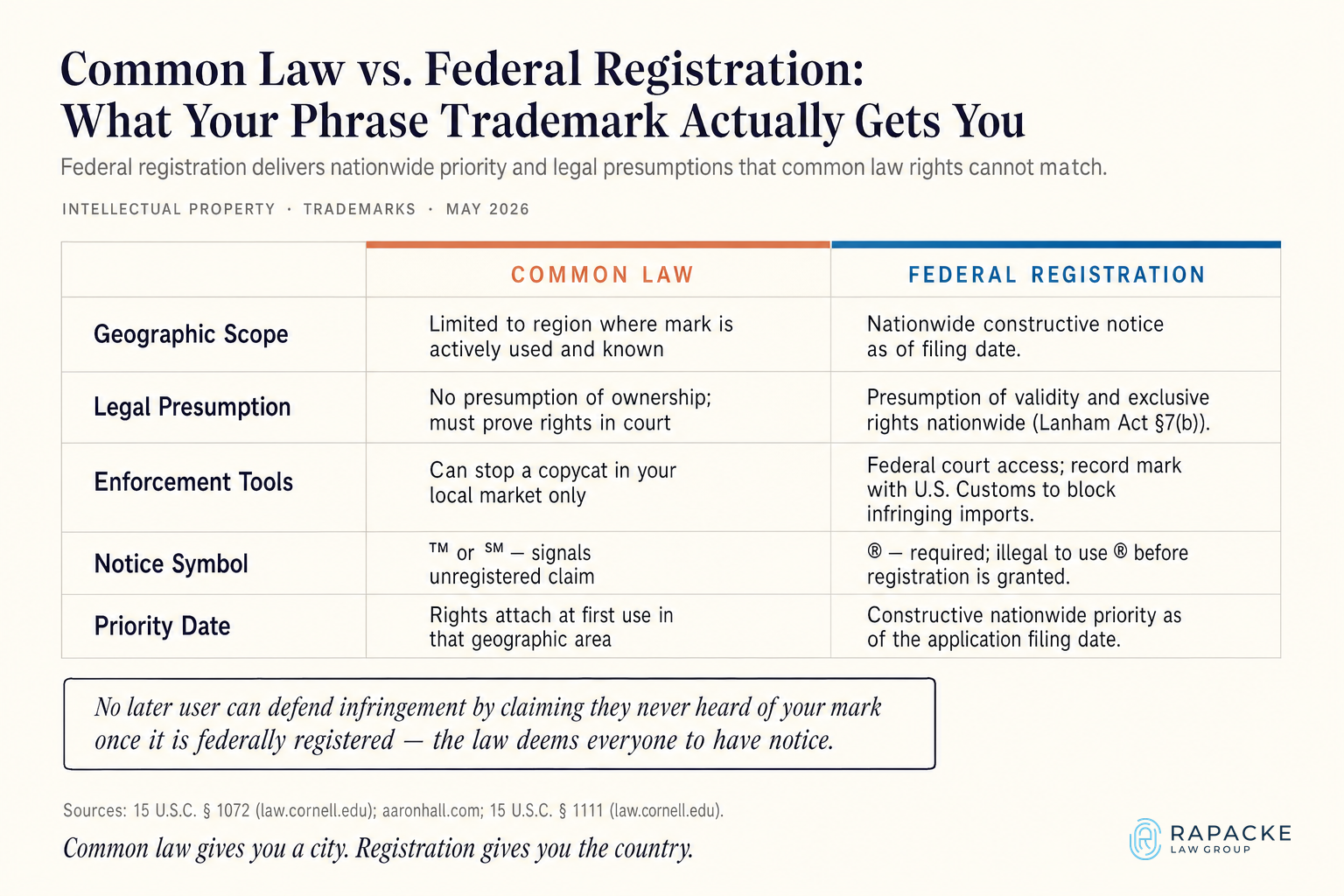
Using a phrase in commerce in the United States generates common law trademark rights in the geographic area where the phrase is actively used, even without a federal filing, though those rights do not extend to other countries. These rights attach at first use but are strictly localized. Over a century of case law, including the Tea Rose-Rectanus doctrine, established that trademark rights exist only as appurtenant to a business in a particular territory. A federal registration, by contrast, grants constructive nationwide rights as of the filing date, making common law rights a starting point rather than a substitute for registration. For a full breakdown of how these paths compare, see State Trademark vs Federal: What's The Difference and Which Is Right for You?
The Five-Level Distinctiveness Scale That Determines Whether Your Phrase Qualifies
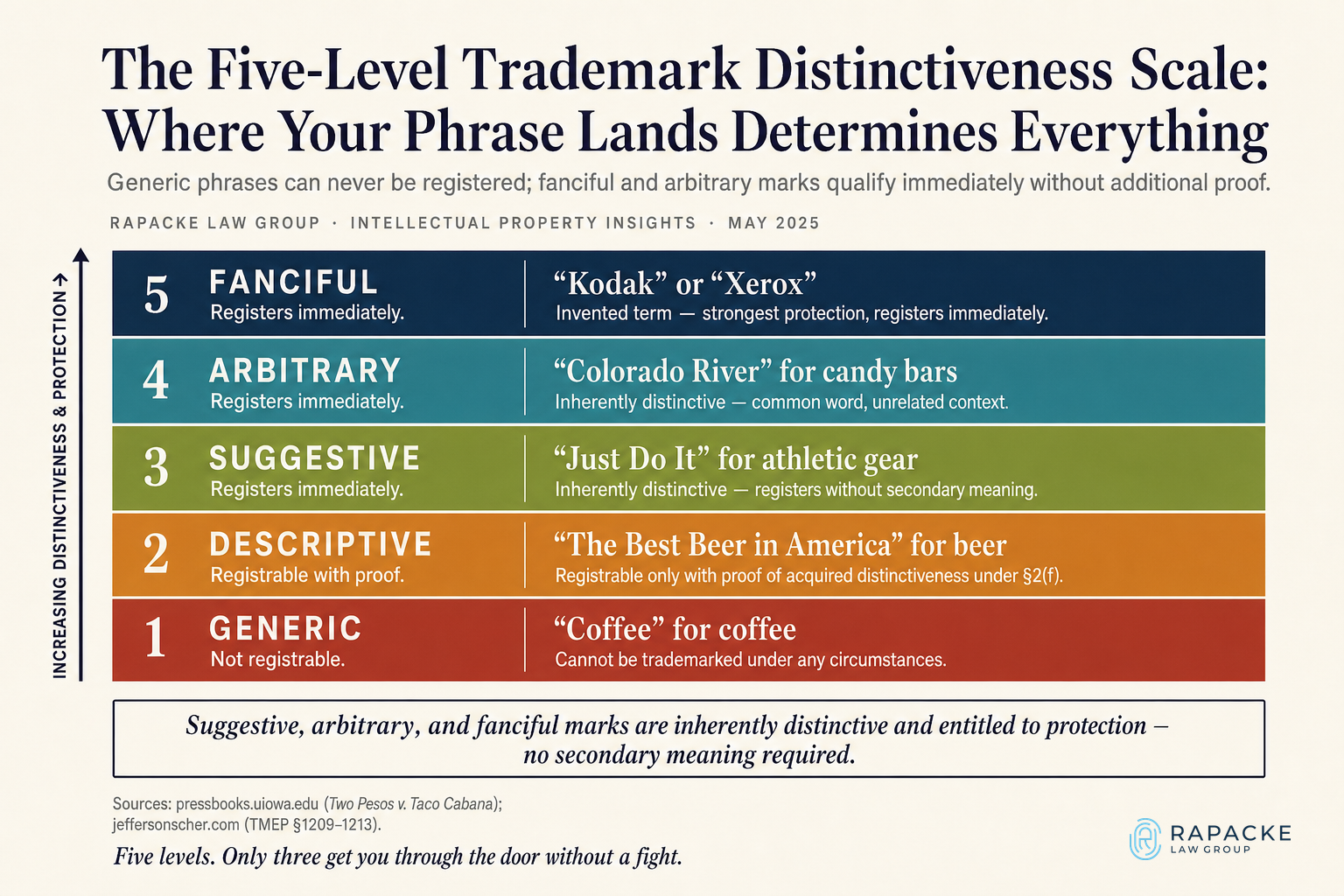
The U.S. Patent and Trademark Office evaluates every trademark application against a five-category distinctiveness spectrum: generic, descriptive, suggestive, arbitrary, and fanciful. As confirmed by the Supreme Court's holding in Two Pesos, Inc. v. Taco Cabana, Inc., 505 U.S. 763 (1992), suggestive, arbitrary, and fanciful marks are inherently distinctive and entitled to protection outright, while generic and merely descriptive marks are not registrable without additional proof. Where a phrase lands on this scale determines whether registration is possible at all.
Why Generic and Merely Descriptive Phrases Get Rejected
When people ask "can I trademark a phrase," generic phrases are the clearest case of what will not qualify: they can never be trademarked because they describe the product or service itself rather than identifying a source. Merely descriptive phrases face rejection under Lanham Act Section 2(e) unless the applicant proves acquired distinctiveness, showing that consumers associate the phrase exclusively with one brand through years of use, substantial advertising, or consumer surveys. The U.S. Patent and Trademark Office refused "The Best Beer in America" as incapable of acquiring distinctiveness because no single producer can claim exclusive rights to such a broadly laudatory phrase. Even well-known figures face this barrier. The Trademark Trial and Appeal Board initially refused Lizzo's "100% That Bitch" application on apparel, finding that consumers perceived it as a common expression; upon review, the TTAB reversed that refusal after finding consumers associated the phrase specifically with Lizzo as a brand identifier. For more real-world examples, see Real-World Examples of Descriptive Trademarks That Succeeded.
What Makes a Phrase Suggestive, Arbitrary, or Fanciful Enough to Register
Suggestive marks require consumers to use imagination to connect the phrase to the product. Nike's "Just Do It" is a registered trademark that suggests effort and empowerment without describing athletic gear directly. Arbitrary marks use real words with no logical connection to the goods. Fanciful marks are invented terms with no prior meaning in any language. All three categories qualify for federal trademark registration without requiring proof of secondary meaning, making them significantly faster and less expensive to register than borderline descriptive phrases. Understanding Trademark Requirements: Your Questions Answered walks through these standards in detail.
Can I Trademark a Phrase? The USPTO Application Process Step by Step
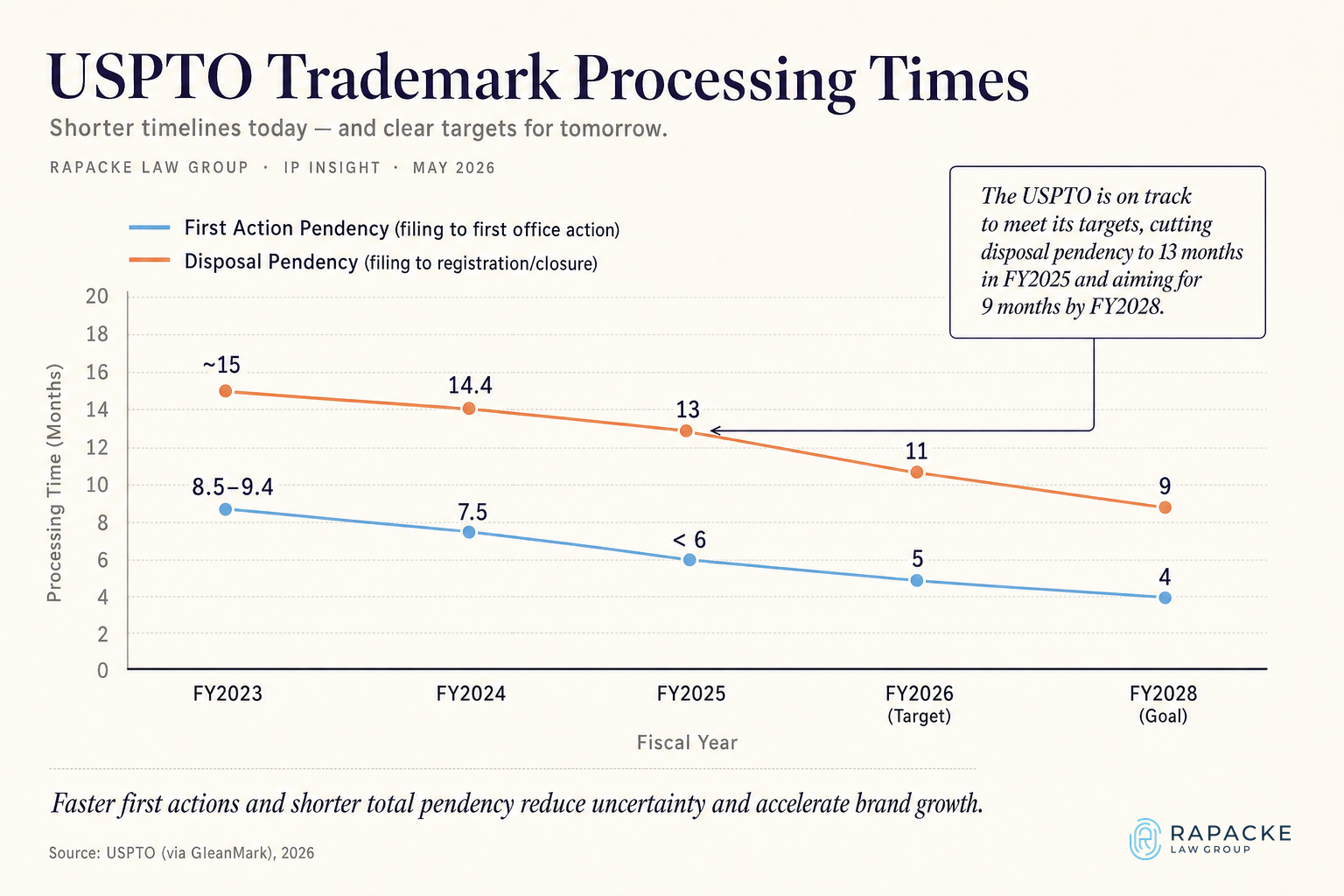
According to USPTO pendency data, the federal trademark registration process currently runs approximately 10 to 12 months from filing to registration, with first examining actions averaging 4 to 5 months. The U.S. Patent and Trademark Office is targeting a 9-month total pendency by 2028. The process moves through five milestones: search, application filing, examination, publication for opposition, and either registration or a final refusal.
Running a Trademark Search Before Filing with the USPTO
The USPTO's free TESS database contains over two million active and pending marks. A search must go beyond exact matches to catch phonetically similar marks, visual variations, and marks in related International Classes. A professional search conducted by trademark attorneys also covers state registrations, common law use, and domain names, which are areas TESS does not reach. Skipping this step risks losing a nonrefundable application fee when the u.s. patent office issues a likelihood-of-confusion refusal that a search would have predicted.
Filing the Application Through TEAS and Understanding the Fee Structure
Applications are filed through the Trademark Electronic Application System (TEAS). According to the USPTO's 2025 fee schedule, the U.S. Patent and Trademark Office eliminated the separate TEAS Plus and TEAS Standard fee tiers effective January 19, 2025. The base application filing fee is now $350 per class of goods or services for all Section 1 and Section 44 applications, with additional surcharges of $100 to $200 per class for incomplete information or custom identifications. A phrase used across multiple product or service categories requires a separate fee for each International Class. Applicants not yet using the phrase in commerce can file an intent-to-use application under Lanham Act Section 1(b), which reserves priority while allowing time to launch. Attorney fees for a professionally filed single-class application typically run $800 to $1,500, bringing the realistic total to $1,150 to $2,000 before accounting for office action responses. For guidance on what the trademark process covers more broadly, see What is Trademarking? A Complete Guide to Protecting Your Brand.
How Trademark Examiners Evaluate Phrase Applications and What Can Block Registration
After filing, a USPTO examining attorney reviews the application and may issue an office action, a written refusal that the applicant must respond to within six months. The two most common grounds for phrase applications are likelihood of confusion with an existing registered mark and failure to function as a source identifier.
Responding to a Likelihood of Confusion Refusal
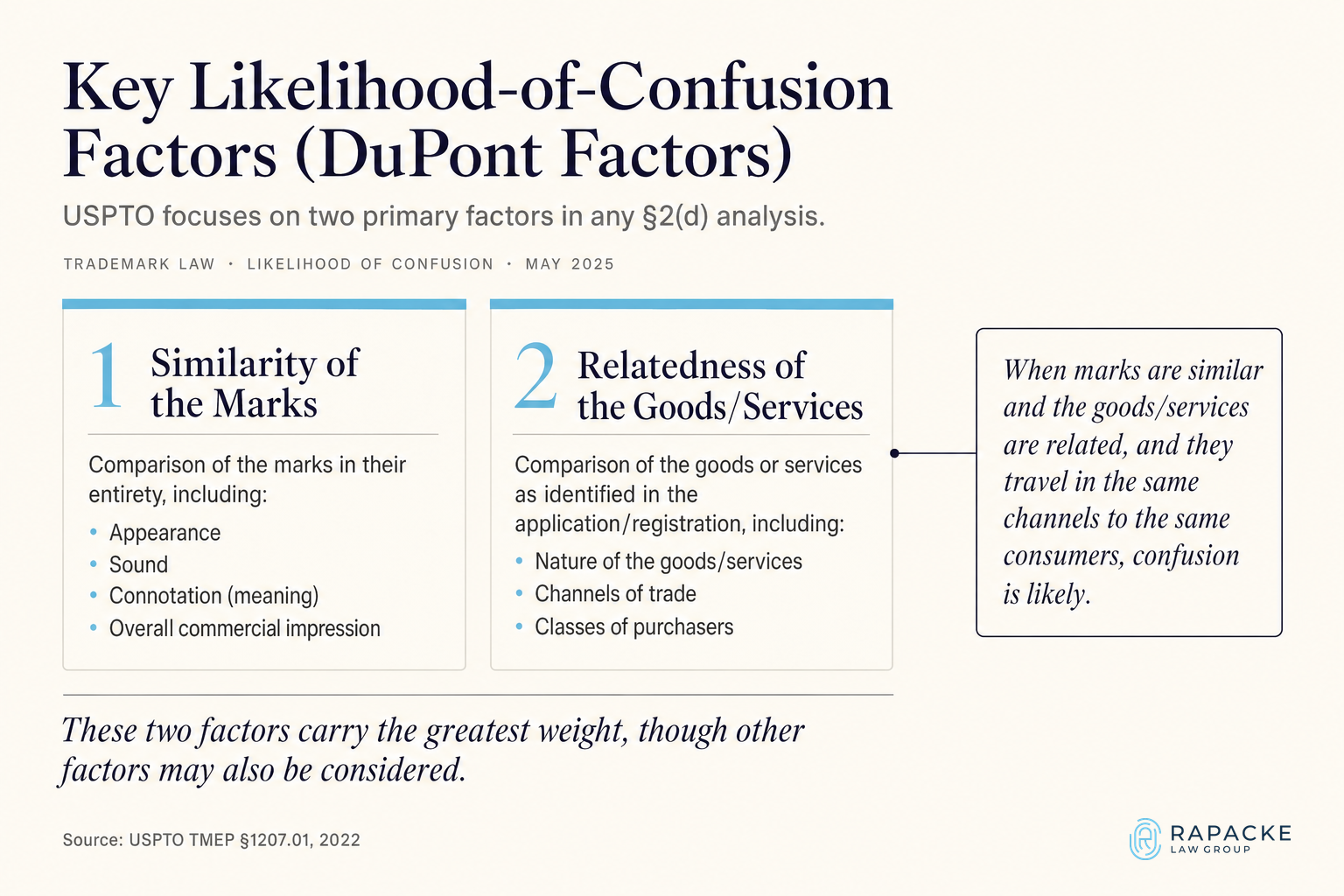
A likelihood of confusion refusal under Lanham Act Section 2(d) means the U.S. Patent and Trademark Office found an existing mark that consumers might confuse with the applied-for phrase, a core concept in trademark law. Examiners apply the DuPont factors established in In re E.I. du Pont de Nemours & Co. (1973), weighing mark similarity, relatedness of goods or services, and overlapping trade channels. This refusal is not automatically fatal. A well-drafted response that methodically addresses the DuPont factors can overcome many initial refusals, particularly when the goods or services are distinct or the marks differ meaningfully in appearance and commercial impression. The Ninth Circuit's decision upholding a $56 million jury verdict in Stone Brewing Co. v. Molson Coors (2024) illustrates how much is at stake in a trademark infringement dispute when confusion claims go unresolved.
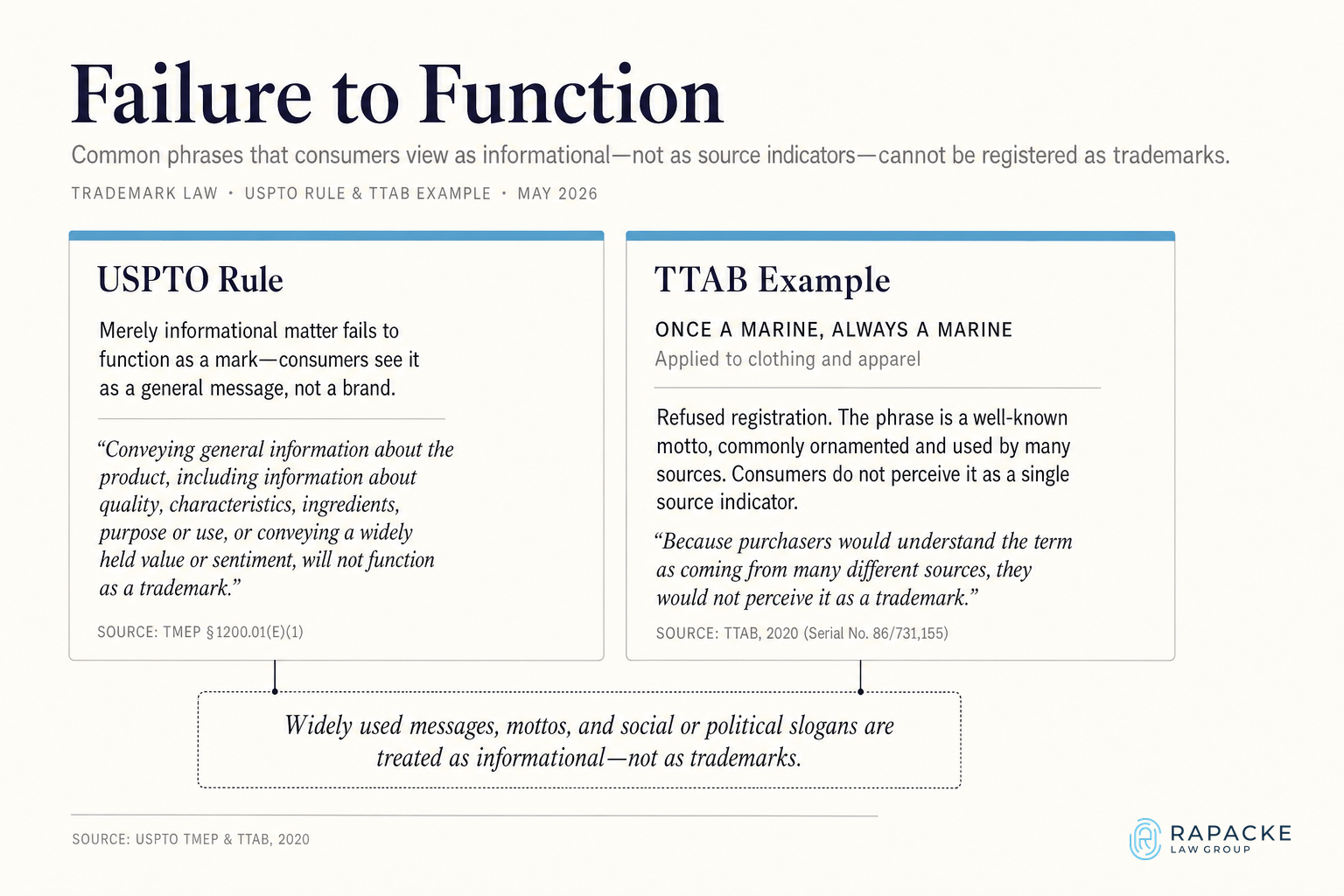
When the USPTO Refuses a Phrase for Failure to Function as a Trademark
The failure-to-function refusal applies to phrases the U.S. Patent and Trademark Office views as commonplace expressions that the public understands as general messages rather than brand identifiers, a critical obstacle for anyone wondering "can I trademark a phrase" drawn from everyday speech. Phrases like "You Got This" and similar motivational expressions have received this refusal because they appear widely in everyday language without pointing to a specific source. The USPTO's 2017 examination guidance specifically flags inspirational slogans and phrases used decoratively on merchandise as high-risk categories.
What Trademark Protection Actually Gives You Once a Phrase Is Registered
Federal trademark registration delivers concrete legal advantages that unregistered phrases cannot access, and understanding these benefits helps answer why "can I trademark a phrase" is such a common question from brand owners. A registration certificate from the U.S. Patent and Trademark Office provides nationwide constructive notice, the right to use the ® registered trademark symbol, the ability to record the mark with U.S. Customs to block infringing imports, and access to federal court jurisdiction for infringement claims. After five years of continuous use, a registered trademark can achieve incontestable status under federal law pursuant to Lanham Act Section 15, which significantly narrows the grounds on which a competitor can challenge the mark. Learn how to use trademark symbols correctly, including when the copyright symbol applies to related works, with TM Characters Explained: What ™, ®, and ℠ Mean and When to Use Each.
Using the ® Symbol Versus the TM Symbol
The ™ trademark symbol signals a claim of trademark rights and can be used with any phrase the owner treats as a brand identifier, registered or not; understanding trademark symbols is essential for proper brand use. The ® registered trademark symbol may only be used after the us patent office issues a registration certificate. Using ® on an unregistered mark violates Lanham Act Section 29 and can result in the loss of the right to collect certain damages in infringement litigation. The ℠ service mark symbol applies specifically to services, though ™ is widely accepted for service marks as well. See Understanding Service Marks: Your Essential Guide to Brand Protection for more on the distinction.
Maintaining and Renewing a Registered Trademark Over Time
Federal trademark registrations require periodic maintenance filings to remain active. Between the fifth and sixth years after registration, the owner must file a Section 8 Declaration of Continued Use with a specimen showing the mark in active commerce. Renewal is required every 10 years using a combined Section 8 and Section 9 filing. Current USPTO maintenance fees run $225 to $325 per class depending on the filing form. Missing these windows results in cancellation of the registration at the u.s. patent office.
When a Phrase Cannot Be Trademarked Regardless of How Famous It Becomes
Lanham Act Sections 2(a) through 2(e) create absolute bars to registration that fame cannot overcome. Deceptive phrases, phrases consisting of protected government symbols or insignia, phrases that are primarily merely a surname, and geographic phrases used in a primarily descriptive sense are permanently ineligible for federal trademark registration. The Supreme Court addressed the limits of Section 2(a) in Matal v. Tam (2017) and Iancu v. Brunetti (2019), striking down portions of the scandalous/immoral bar, but the remaining absolute bars are intact.
Phrases Involving Government Symbols, Geographic Locations, or Public Figures
Phrases containing national flags, government insignia, or the name or likeness of a living person without consent are barred from registration at the United States Patent Office, also referred to as the United States Patent and Trademark Office. Geographic phrases like "New York Style Pizza" face rejection when the geographic term is the dominant element and the product is associated with that location, regardless of how widely recognized the phrase becomes. Reviewing Lanham Act Section 2 bars before investing in a phrase that may be permanently ineligible is essential, since no amount of use, advertising, or consumer recognition will clear a statutory bar; for specific situations, seek qualified legal advice.
FAQ
Is it worth it to trademark a phrase? Federal trademark registration is worth pursuing when the phrase functions as a core brand identifier used consistently in commerce over time. A registered trademark provides nationwide rights, a legal presumption of ownership, and access to federal court enforcement, which outweighs filing costs for businesses where brand recognition drives customer decisions. For a short-lived marketing campaign, the cost-benefit calculation is less favorable.
What phrases can you not trademark? Phrases that cannot be trademarked include generic terms describing the product itself, merely descriptive phrases without acquired distinctiveness, common inspirational or motivational expressions that function as general messages, primarily geographic phrases, and phrases barred under Lanham Act Section 2 for being deceptive or incorporating protected government symbols. The U.S. Patent and Trademark Office will also refuse any phrase likely to cause confusion with an already-registered mark.
How much does it cost to trademark a phrase? As of January 2025, the U.S. Patent and Trademark Office charges a base filing fee of $350 per International Class for all TEAS applications, with additional surcharges of $100 to $200 per class in some cases. Professional fees from a trademark attorney for a straightforward single-class application typically run $800 to $1,500, making the realistic total $1,150 to $2,000 before accounting for office action responses or multi-class filings.
How hard is it to copyright a phrase? Copyright does not protect phrases. The U.S. Copyright Office explicitly excludes names, titles, slogans, and short phrases from copyright protection, as stated in Copyright Office Circular 34. Trademark registration through the U.S. Patent and Trademark Office is the correct intellectual property mechanism for protecting a phrase used in commerce, and trademark lawyers can help navigate the process.
Your Next Steps to Phrase Trademark Success
Whether a phrase qualifies for trademark protection comes down to one question: does it identify the source of your goods or services in consumers' minds, or does it describe, inspire, or decorate? Ultimately, "can I trademark a phrase" is a question with a fact-specific answer that depends entirely on how consumers perceive the phrase in the marketplace. The distinctiveness threshold is real, the USPTO review process is substantive, and phrases drawn from everyday language face specific legal barriers that fame cannot remove. For phrases that do qualify, federal registration through the U.S. Patent and Trademark Office delivers enforceable nationwide rights and a legal foundation that strengthens over time.
The bottom line: a weak or unregistered phrase leaves your brand exposed to copycats and limits your enforcement options to expensive common law litigation. A properly registered trademark gives you nationwide priority, the presumption of ownership, and the legal tools to stop infringers before they gain a foothold.
At Rapacke Law Group, we guarantee your trademark gets registered or you pay nothing.
Delaying registration means losing priority to competitors who file first. Determining whether your phrase clears the distinctiveness bar, running a search that actually catches conflicts, and preparing a trademark filing that survives examination are decisions where a misstep costs more than professional guidance.
- Schedule a Free IP Strategy Call to evaluate whether your phrase qualifies and what a realistic path to protection looks like
- Download the SaaS Patent Guide 2.0 if your phrase is tied to a software product or platform
- Review Get Your Trademark approved or pay nothing. We guarantee it. with Rapacke Law Group's trademark guarantee: your phrase gets registered or you pay nothing
A registered trademark is not just a legal formality. It is a business asset that compounds in value with every year of continued use.
To Your Success,
Andrew Rapacke
Managing Partner,
Registered Patent Attorney Rapacke Law Group