

Key Takeaways
- A pure algorithm or mathematical formula is not patentable, but a specific technical process that applies the algorithm to solve a real-world problem can be.
- Every algorithm patent application is judged under the *Alice/Mayo* two-step test, and generic "implement it on a computer" language fails step two almost every time.
- Following *Alice*, the USPTO recorded a 31% jump in first-office §101 rejections for software-related applications over 18 months, so claim drafting is the highest-leverage step in the process.
- The European Patent Office uses a "technical effect" standard that sometimes grants protection where a U.S. claim struggles, making a PCT international filing worth considering.
- Total cost to patent a software or algorithm invention commonly lands between $15,000 and $25,000 through grant, with USPTO micro entity fees as low as $65 for a provisional under the current fee schedule.
*Written by Andrew Rapacke, Managing Partner, Registered Patent Attorney.* Andrew Rapacke is a registered patent attorney and the Managing Partner of The Rapacke Law Group, a full-service intellectual property law firm. He helps individuals and corporations across industries with the protection, prosecution, licensing, and enforcement of their intellectual property, with deep experience in patent, trademark, and copyright matters spanning software, AI and machine learning, blockchain, medical devices, and autonomous vehicle technology. A graduate of the United States Naval Academy, Andrew served as a Naval Engineering Officer before pursuing law and remains active in the startup and inventor communities throughout Florida.
A SaaS founder ships a novel artificial intelligence or machine learning model on Monday, and by Friday a competitor has reverse-engineered the core logic during software development and shipped a knockoff. That scenario is exactly why the question "can you patent an algorithm" matters so much, and the honest answer frustrates most inventors. Algorithms feel like inventions, but U.S. patent law treats them as abstract ideas by default, which is the central challenge of patenting algorithms. You cannot patent a formula. You can sometimes patent a specific technical process that applies that formula to solve a real problem.
This article gives you the legal threshold that separates a patentable algorithm from an unprotectable one, the two-step test every USPTO examiner applies, how the European Patent Office and other patent offices handle the question differently, what the process costs, and the practical steps to build a claim that survives examination. By the end you will know whether your algorithm has a viable path to a granted patent. For a focused companion read, see our guide on whether you can patent an algorithm in 2025.
Why the Law Treats Algorithms as Abstract Ideas by Default
The reason your algorithm is presumed "unpatentable" under United States patent law comes down to a fear courts have held for fifty years, granting a patent on math itself would lock up a fundamental tool everyone needs.
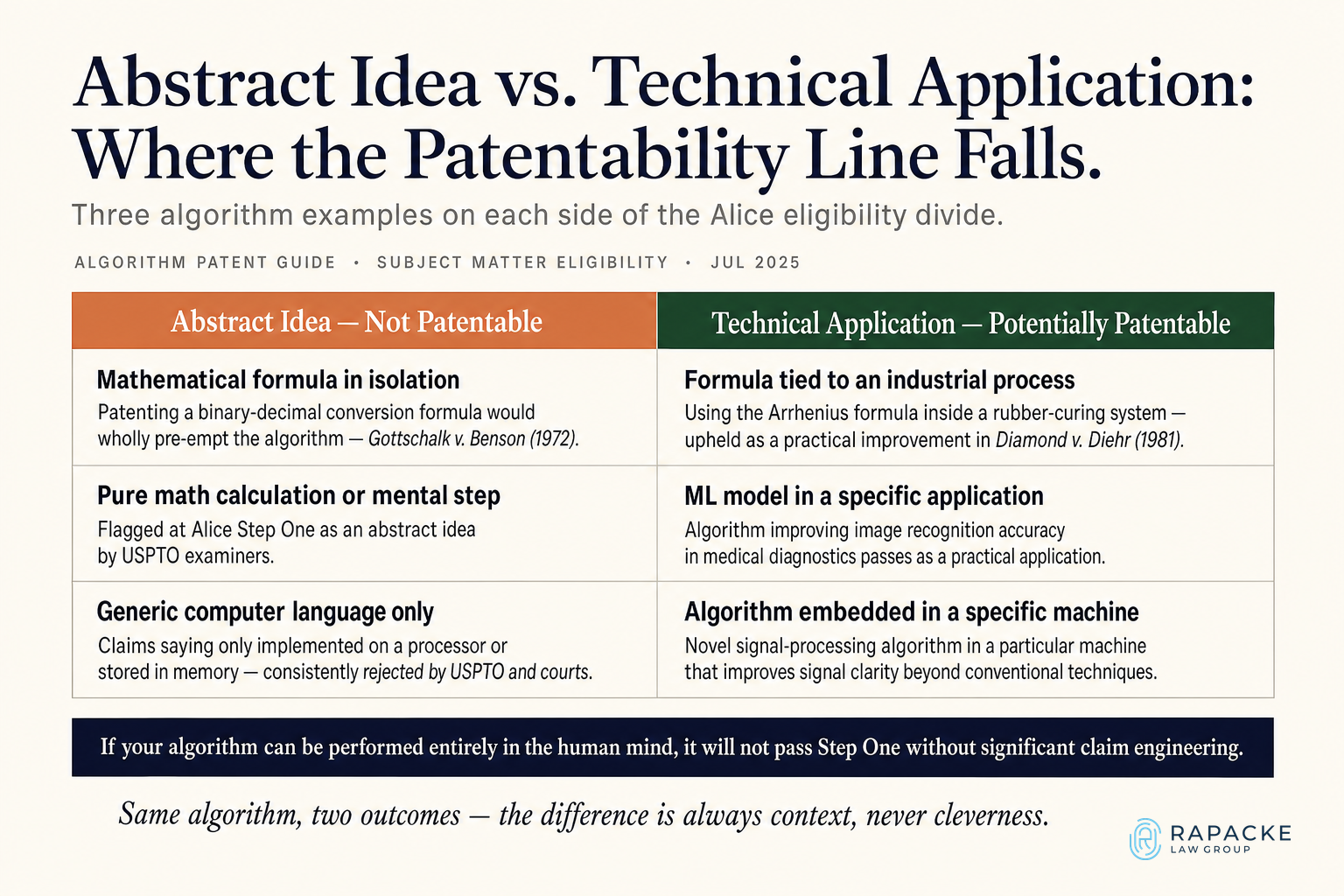 *Abstract Idea vs. Technical Application: Where the Patentability Line Falls - Source: U.S. Supreme Court, Gottschalk v. Benson *(1972); *Diamond v. Diehr *(1981); Alice Corp. v. CLS Bank (2014); USPTO Subject Matter Eligibility Guidance, 2019
The Supreme Court Cases That Set the Current Rules
In Gottschalk v. Benson (1972), the Supreme Court refused to patent a formula for converting binary-coded decimals because doing so would "wholly pre-empt the mathematical formula" and effectively patent the algorithm itself, according to Cornell Law School. Nine years later in Diamond v. Diehr (1981), the Court upheld a patent that used a math formula inside a rubber-curing process because the claims described "an improved process for molding rubber articles," not the equation, per Justia. Then Alice Corp. v. CLS Bank International (2014), commonly abbreviated as Alice Corp. v. CLS Bank International_, created the two-part eligibility framework that governs every algorithm patent application filed today. Alice did not ban software patents; it raised the bar. Know which precedent controls your claim before drafting, a theme we explore in our overview of patenting AI algorithms.
What Abstract Idea Actually Means Under Patent Law
An abstract idea is a mathematical concept, a mental process, or a method of organizing human activity. These are abstract principles, and none of these qualify as patentable subject matter on their own. A formula for calculating compound interest is abstract. A specific machine that uses that formula to flag fraudulent loan applications in real time is not. The term is not defined exhaustively in statute, which is why court interpretation drives everything. If your algorithm can be performed entirely in a human mind and relies on nothing beyond human thought, it will not pass step one without serious claim engineering. This is the same logic that explains why patenting software is about patenting the process, not the code.
Mathematical Formulas Versus Technical Processes
The line falls between the formula and what the formula does, a distinction central to both computer science and patent law. Patenting mathematical formulas is barred. Patenting a process that applies a formula to transform real-world inputs into a concrete technical result is potentially allowed, exactly the distinction Diamond v. Diehr drew. Natural phenomena fall under the same exclusion, which matters for AI trained on natural data patterns. Frame your invention around what the algorithm does to inputs and outputs in terms of technical innovation, not what the algorithm is.
How the Alice/Mayo Two-Step Test Actually Works
This is the framework a USPTO examiner applies to your claim, in the order they apply it.
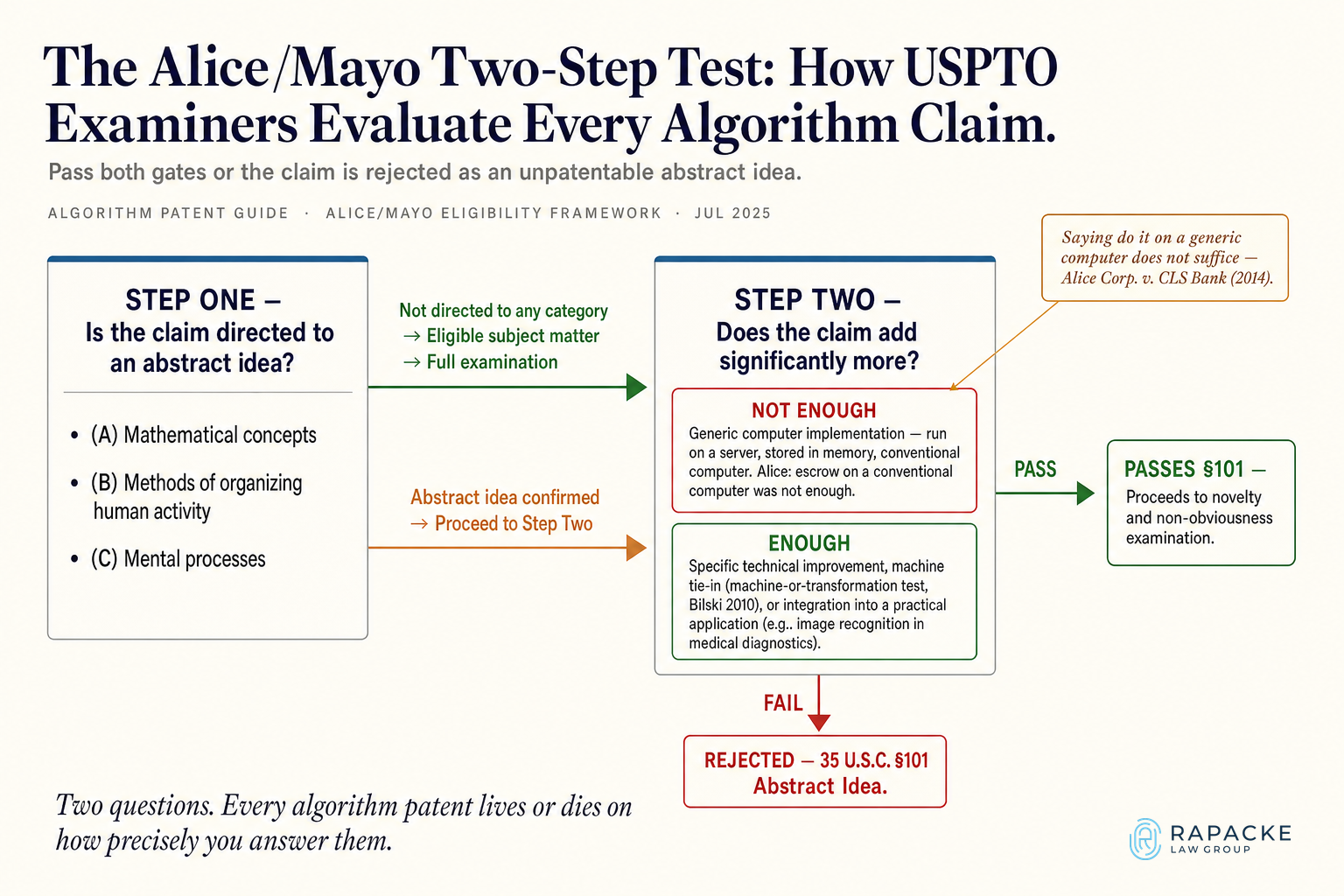 The Alice/Mayo Two-Step Test: How USPTO Examiners Evaluate Every Algorithm Claim - Source: Alice Corp. v. CLS Bank International (2014);* USPTO 2019 Patent Eligibility Guidance*
Step One: Does Your Claim Involve an Abstract Idea
Step one asks whether your claim is "directed to" a judicial exception under the patent eligibility criteria, that is, whether it is a mere abstract idea, a law of nature, or a natural phenomenon. For algorithms, patent examiners read the claim's character as a whole and ask whether it covers a mathematical concept, a mental process, or a method of organizing human activity. A claim reciting "a method of calculating a risk score" fails immediately. A claim reciting "a method of reducing network intrusion detection latency using a trained classifier" has a fighting chance. Draft around the technical problem being solved, not the mathematical steps solving it.
Step Two: What Significantly More Means in Practice
If step one flags an abstract idea, step two asks whether the claim adds "significantly more" than the idea itself. Running it on a generic server or storing it in memory does not count. The Supreme Court in Alice held that implementing an escrow arrangement on a conventional computer was not enough, as the Court's opinion makes clear. What does count is a specific improvement to computer functionality or a technical process producing a non-routine result. The machine-or-transformation test, sometimes called the machine transformation test, from Bilski v. Kappos (2010) is still a useful indicator, though no longer the sole test. Every claim element beyond the algorithm must do technical work, not administrative work.
How Examiners Apply This Test to AI and Machine Learning Claims
AI and machine learning claims get the same analysis. A bare machine learning model trained on data, covering software algorithms without a defined technical application, is abstract. A model that improves the speed or accuracy of image compression, network intrusion detection, or medical image diagnosis has a real path through practical applications, and the USPTO's 2019 guidance directs examiners to check whether a claim integrates the abstract idea into a practical application. One caveat on inventorship related to generated inventions, in Thaler v. Vidal (Fed. Cir. 2022), the court confirmed only a natural person can be a named inventor. Tie every machine learning claim to a measurable technical improvement in a specific system, demonstrating real world applications of the algorithm, a point we develop in our analysis of whether machine learning algorithms are patentable.
What a Patentable Algorithm Claim Actually Looks Like
Knowing the test is one thing. Recognizing what a winning claim reads like is another. Here is the anatomy.
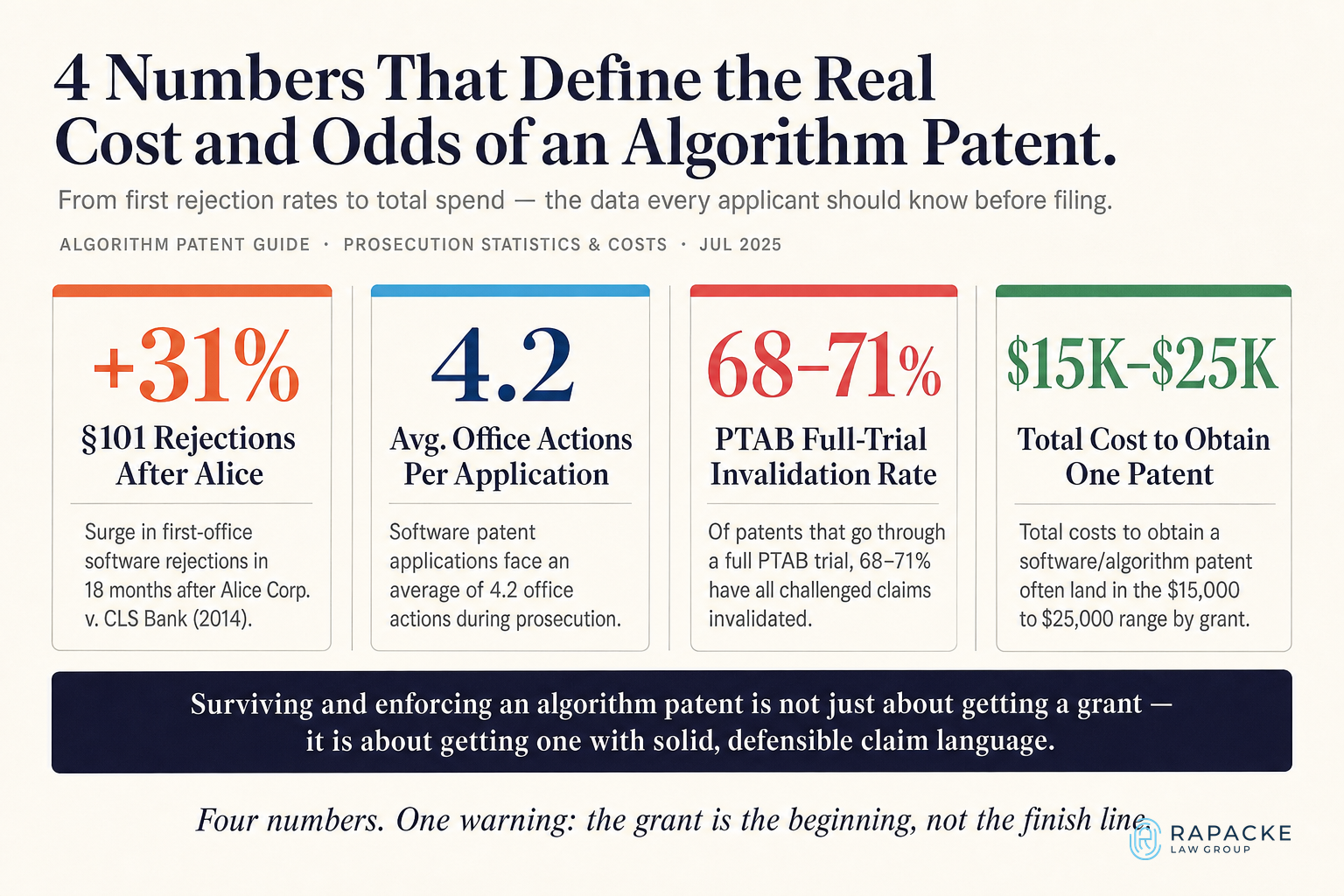 4 Numbers That Define the Real Cost and Odds of an Algorithm Patent - Source: National Law Review (natlawreview.com); BlueIron IP / AIPLA Survey (blueironip.com); IPWatchdog, 2024 (ipwatchdog.com)
The Elements That Separate Rejected Claims From Approved Ones
A claim that survives Alice scrutiny defines a patentable invention by establishing three things: a specific hardware or software environment, a concrete technical problem the algorithm addresses, and a non-obvious process that produces a defined technical result. Instead of "a mathematical method for optimizing traffic routes," a patentable claim in a specific application recites a networked traffic control system that uses a new algorithm to cut data packet loss by a measurable margin in congested networks. The strongest granted patents on patentable inventions feature innovative algorithms tied to a measurable improvement, not to the math itself. Reviewing real software patent examples shows how this plays out in issued claims. Every claim element should map to either a technical problem or a technical result.
Why Implemented on a Computer Is Not Enough
After Alice, the cost of generic implementation language became brutal. The USPTO recorded a 31% surge in first-office §101 rejections for software-related applications in the 18 months following the decision, according to the National Law Review. Adding "on a processor" or "stored in memory" without explaining how those elements are specially configured, as computer programs running on generic hardware, fails. A claim that specifies how new algorithms reconfigure hardware to improve that hardware's performance, demonstrating an inventive step beyond generic implementation, survives. The 2019 guidance later helped, dropping §101 rejection rates by roughly 25% the following year and reducing uncertainty by 44% for Alice-affected technologies, but the burden still sits on the drafter. For founders who want a deeper playbook, our guide on protecting your proprietary algorithm covers claim strategy in detail.
How Algorithm Patenting Works Outside the United States
International protection is a real decision point, and the rules abroad differ enough to change your strategy.
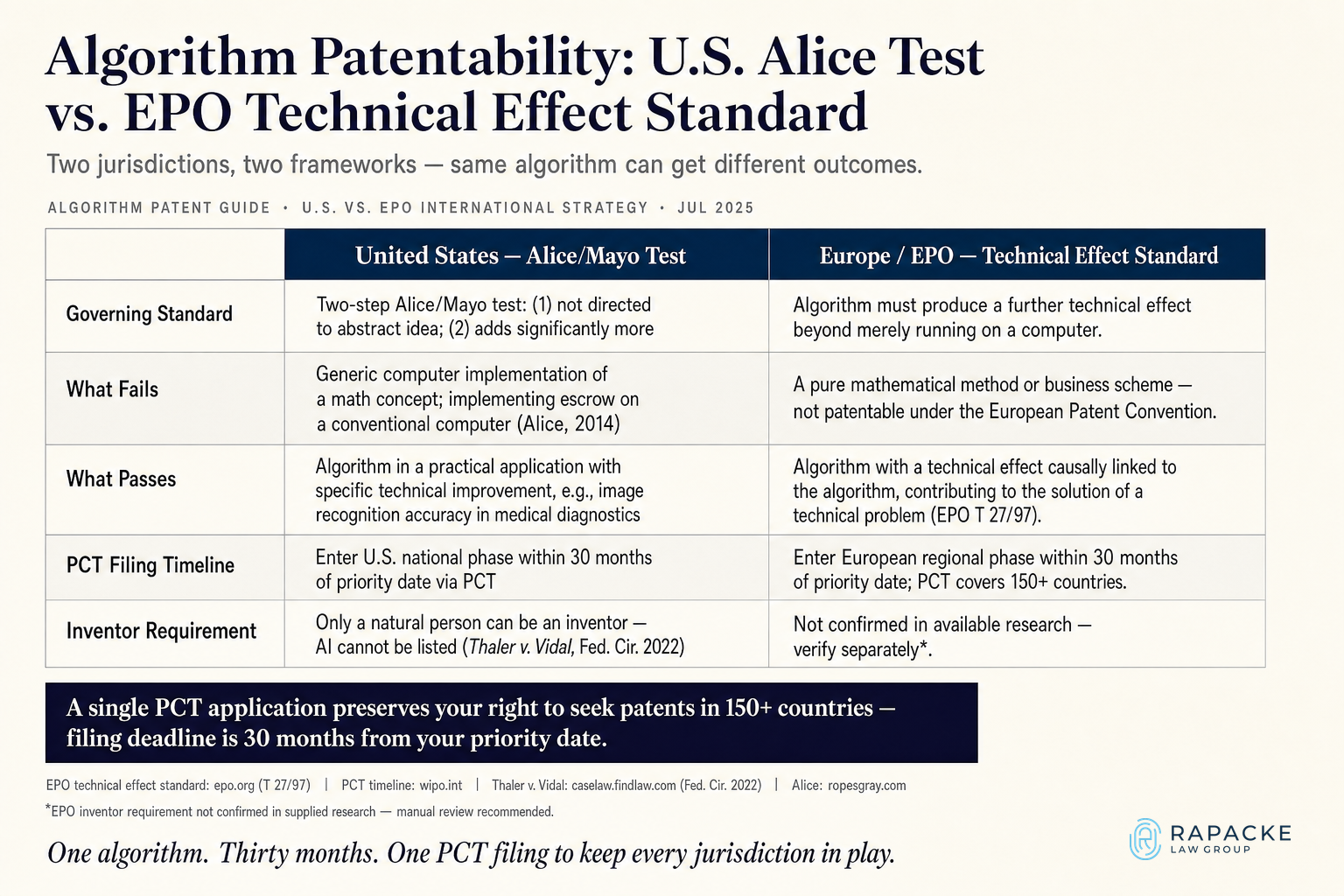 Algorithm Patentability: U.S. Alice Test vs. EPO Technical Effect Standard - Source: EPO Case Law T 27/97 (epo.org); WIPO PCT System (wipo.int); Thaler v. Vidal, Fed. Cir. 2022 (caselaw.findlaw.com); Alice Corp. v. CLS Bank (2014) (ropesgray.com)
The European Patent Office Standard for Software and Algorithm Patents
The European Patent Office applies a "technical character" standard rather than the U.S. Alice framework. An algorithm is patentable in Europe only if it produces a technical effect beyond software simply running on hardware. The EPO Boards of Appeal have held that an abstract algorithm must have a technical effect "causally linked to the algorithm, contributing to the solution of a technical problem" to confer patentable technical character, per the European Patent Office. Pure mathematical methods or business schemes are not patentable under the European Patent Convention, but an algorithm controlling a specific machine or improving signal processing can be. If a U.S. claim is struggling under Alice, evaluate whether the EPO's technical effect standard offers a viable path in European markets.
Using a PCT Application to Pursue Global Algorithm Protection
A Patent Cooperation Treaty application lets you file one international application before committing to national-phase costs in each country. After filing, you receive an international search report assessing prior art, and you have 30 months from your priority date to enter national phases including the U.S. and the EPO, according to WIPO. A PCT filing does not grant a patent anywhere, it preserves your options. File a PCT application alongside or shortly after a U.S. provisional to keep European and other markets open while your domestic strategy develops.
The Biggest Challenges That Kill Algorithm Patent Applications
Most algorithm patent applications die for predictable reasons, and the legal challenges at each stage are well-documented. Knowing where they fail lets you avoid the same fate.
Prior Art Searches Reveal More Competition Than Founders Expect
A patent search before filing is not optional, it is the foundation of your claim differentiation strategy. The scale of existing documentation is enormous. You can use patent public search tools or advanced search databases to survey the landscape before filing. Innovators worldwide filed 3.46 million patent applications in 2022 alone, according to WIPO. Many founders discover that a technique they believed was novel already appears in earlier patents or papers, underscoring why reviewing patent information early is essential. A patentability search asks whether your idea is new, a freedom-to-operate analysis asks whether selling your product infringes someone else's patent. You need both before commercializing. Run the prior art search using advanced search techniques before drafting claims, so you can find the white space your claims can occupy.
Overly Broad Claims and the 101 Rejection Cycle
The most common prosecution failure starts with claims drafted at the algorithm level instead of the application level. Broad claims draw a 35 U.S.C. § 101 abstract-idea rejection, a cycle especially common in software-based patent applications. Amended claims become too narrow to protect anything meaningful. Survey data summarized by BlueIron IP from the AIPLA Economic Survey show that , much of that ping-ponging over eligibility. Understanding the patent application process from the start is key: begin with narrow, application-specific claims and build outward, rather than starting broad and retreating under rejection pressure. Our step-by-step guide to patenting software in 2025 walks through this claim-building sequence.
How Poor Claim Drafting Produces Weak Patents
A granted patent with weak claims can be invalidated at the Patent Trial and Appeal Board through inter partes review. In recent years, , according to IPWatchdog. Claim quality at filing determines enforceability years later, and a patent owner who invested in strong drafting is far better positioned at trial. Treat claim drafting as the highest-leverage investment in the process, not a line item to minimize.
What It Costs to Answer Can You Patent an Algorithm and How Long It Takes
For budget planning, here is the real picture, broken into fees, professional costs, and timeline.
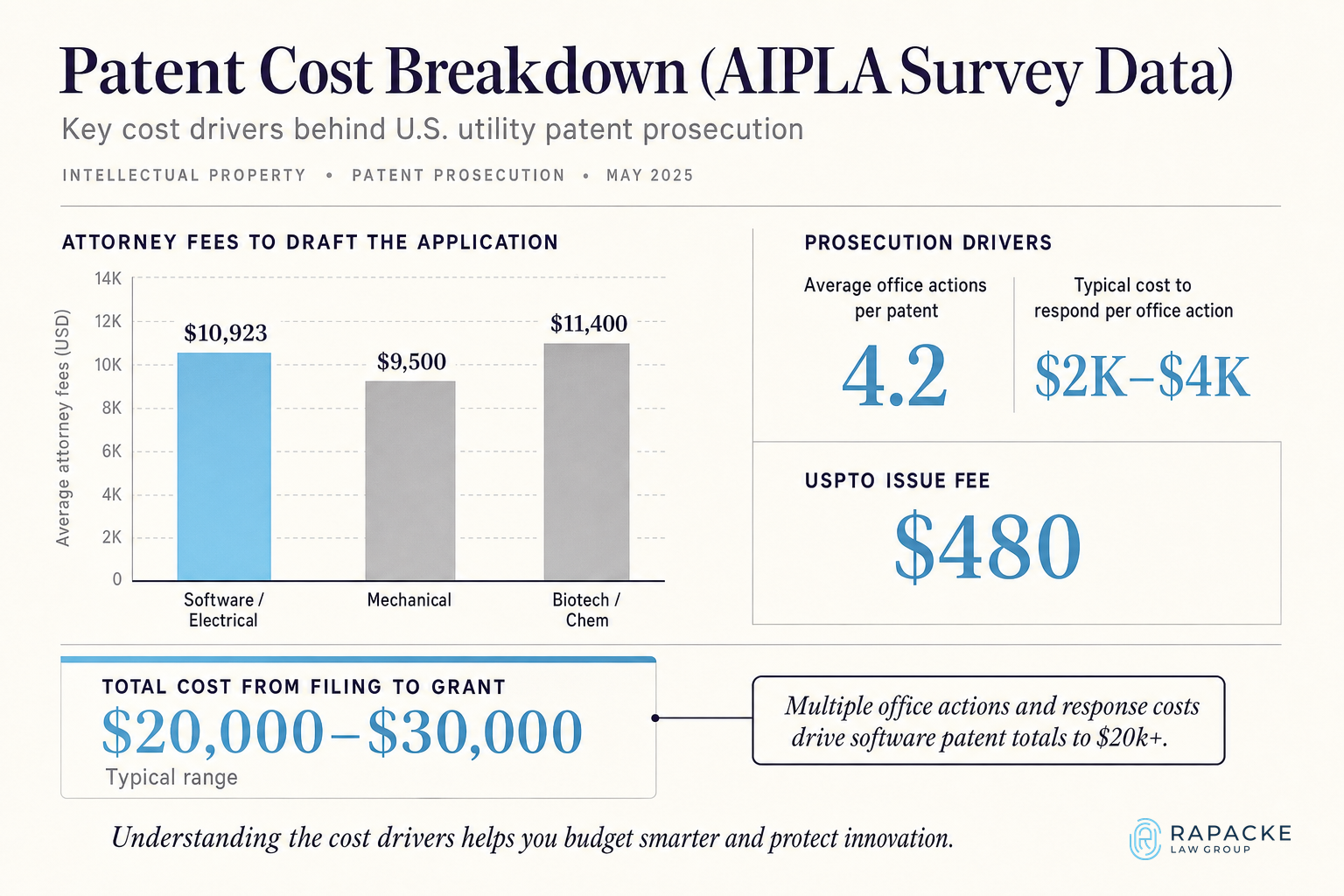 Patent Cost Breakdown (AIPLA Survey Data) - This infographic summarizes typical U.S. patent costs. Notably, drafting a software/electrical patent averages $10,900 in attorney fees, - Source: American Intellectual Property Law Association (AIPLA), 2019 survey (via BlueIron IP, 2023)
USPTO Filing Fees and Attorney Costs
The USPTO's own fees are modest. Basic filing, search, and examination for utility patents run roughly $400 for micro entities, $800 for small entities, and $2,000 for large entities, per the USPTO fee schedule. A provisional costs as little as $65 in government fees for a micro entity. The real spend is professional drafting. Survey data summarized by BlueIron IP from the AIPLA Economic Survey put the cost of preparing a quality software patent application at around $10,900 in attorney fees, with total cost through grant commonly landing between $15,000 and $25,000 once office action responses are counted. Budget the full prosecution cycle, not just the filing fee, a discipline we reinforce in our walkthrough of how to patent your product.
Timeline From Filing to Grant
Patenting an algorithm is not fast. A provisional secures your priority date immediately during algorithm development and buys 12 months before the non-provisional must be filed. Remember the patent term runs 20 years from the non-provisional filing date. Founders who cannot wait years often weigh prioritized examination, where the ROI of Track 1 can compress that timeline to months. File a provisional to lock in your priority date now, then use the 12-month window to refine claims and assess commercial viability.
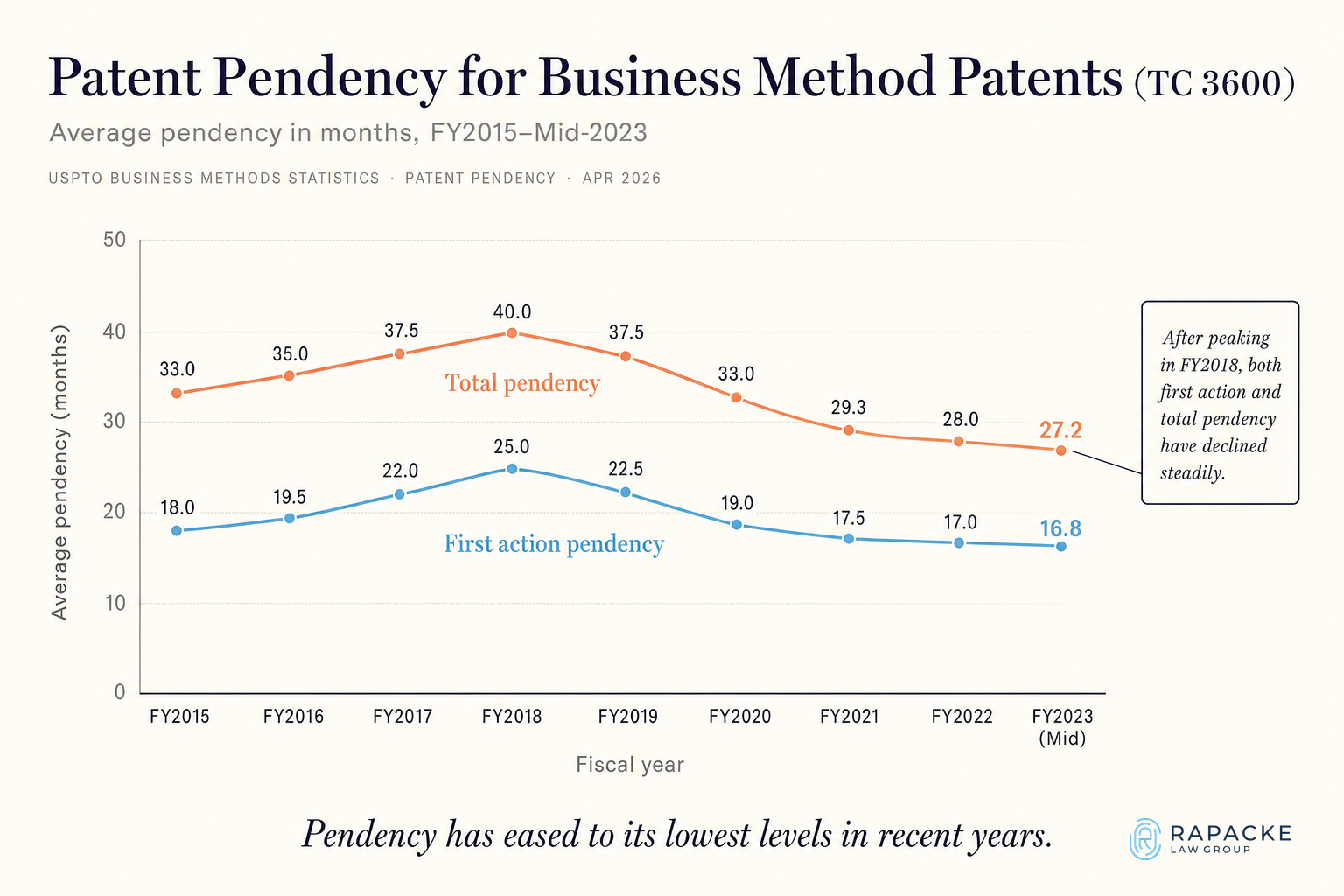 Patent Pendency for Business Method Patents (TC 3600) - This chart shows the average wait times in FY2015-FY2023. In FY2018 the backlog peaked, but by mid-FY2023 the First Action p - Source: USPTO Business Methods Statistics, 2023
Frequently Asked Questions
Why are algorithms not patentable?
In their pure form, a pure algorithm is treated as an abstract idea, which 35 U.S.C. § 101 excludes from patent protection. The question of can you patent an algorithm comes down to whether the claim is tied to a novel method or system that applies the algorithm to produce a real-world technical result, not the algorithm standing alone.
What is the most ridiculous patent granted?
One frequently cited example is U.S. Patent No. 6,368,227, granted in 2002, which claimed a "method of swinging on a swing" by pulling alternately on the chains to move side to side, according to Google Patents. It was widely mocked, and the USPTO has since tightened its examination standards.
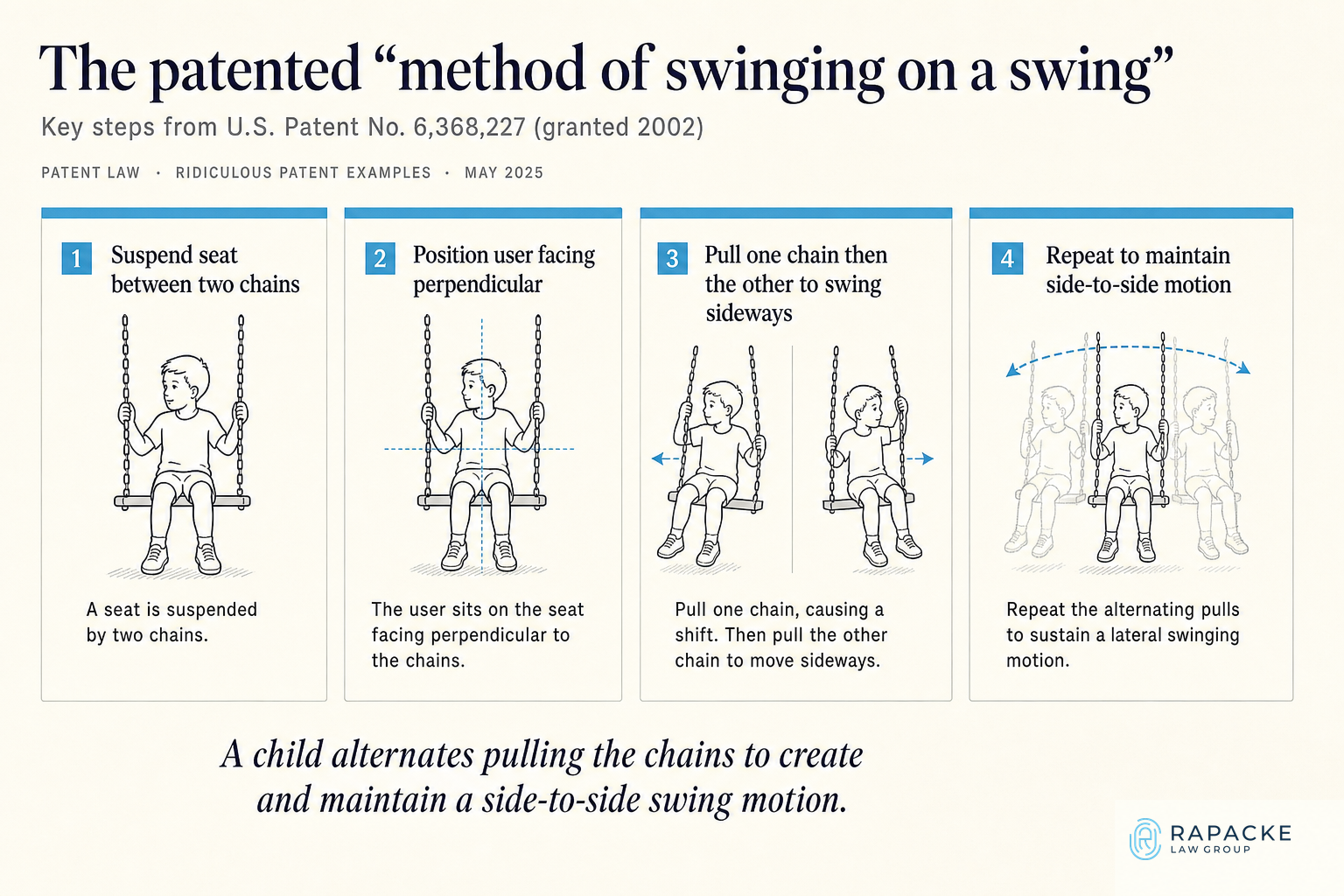 Excerpt from U.S. Patent No. 6,368,227 showing the patented “method of swinging on a swing” – the key steps involve a child’s seat suspended by two chains, the child pulling one ch , Source: U.S. Patent and Trademark Office, 2002 (via Google Patents)
How much does it cost to patent an algorithm?
Expect USPTO filing fees from a few hundred dollars for a micro entity up to around $2,000 for a large company, plus attorney fees of roughly $8,000 to $15,000 to draft a solid software patent application. Including office action responses, many startups budget $15,000 to $25,000 total through grant. A provisional, as low as $65 in government fees for a micro entity, spreads out the cost while holding your place for 12 months.
Can an algorithm be trademarked?
No. Trademark law protects brand identifiers like names, logos, and slogans, not the functional content of how software works. To secure legal protection for the algorithm itself and your broader intellectual property rights, you would use patent law or trade secret law. You could trademark the name of a software product, but not the underlying logic.
Is ChatGPT patented?
Not as a broad concept. The general idea of large language models cannot be patented, but OpenAI and other AI companies have sought patents on specific model architectures and training methods that meet the Alice/Mayo criteria. These patents protect particular technical implementations and training methods that meet the Alice/Mayo criteria.
What to Do Next If You Think Your Algorithm Qualifies
An algorithm without protection is a product feature any competitor can copy the day it ships, and securing patent rights is the most reliable way to prevent that. The path forward is concrete, confirm eligibility under the Alice/Mayo framework, run a prior art search to define the white space your claims can occupy, decide whether U.S.-only or PCT international filing fits your market, and work with registered patent attorneys who draft software and AI patent claims regularly. Sound claim drafting is what separates an enforceable patent from one that collapses under review, so it deserves the bulk of your attention and budget. Nothing in this article constitutes legal advice, and you should consult a registered patent attorney for guidance specific to your situation.
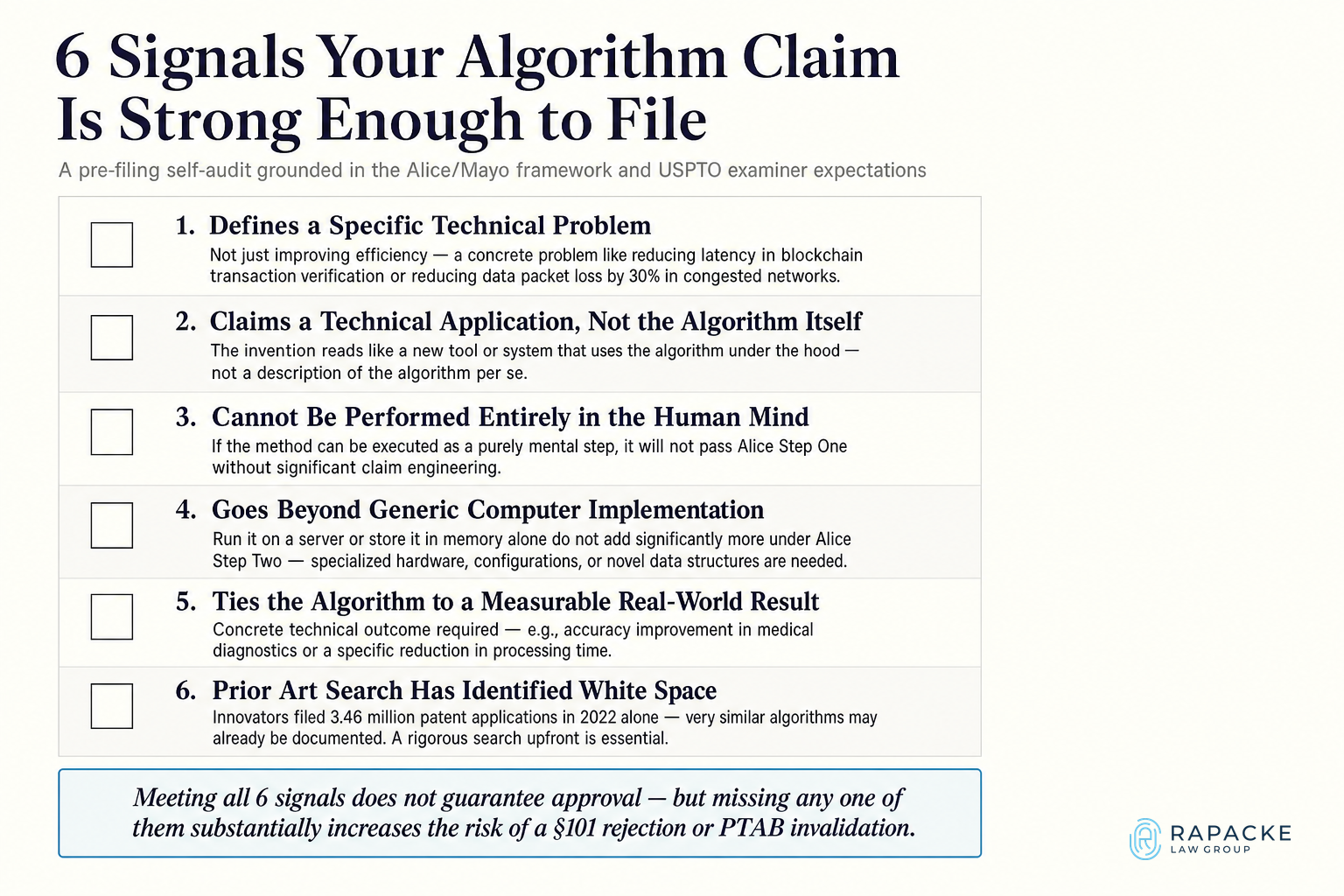 6 Signals Your Algorithm Claim Is Strong Enough to File - Source: Alice Corp. v. CLS Bank (2014), ropesgray.com; USPTO 2019 Subject Matter Eligibility Guidance, uspto.gov; WIPO IP Statistics 2023, wipo.int
If you are building a broader IP strategy around a software product, including strategies for software developers who need to protect their work, our SaaS Patent Guide 2.0 walks through the full approach, and AI Patent Mastery covers the specifics when your algorithm involves machine learning. Inventors who want to see how a single algorithm can anchor a defensible portfolio should read securing an algorithm patent. When you are ready for a candid read on your odds, the firm offers a free IP strategy call.
The Rapacke Law Group stands behind its work with the RLG Guarantee. If we take your case and do not deliver results, you do not pay. Learn more about the RLG Guarantee.
To Your Success,
Andrew Rapacke Managing Partner, Registered Patent Attorney Rapacke Law Group