

Key Takeaways
- WIPO is a self-funded United Nations specialized agency that derives most of its revenue from fee-based services like the Patent Cooperation Treaty, aligning its incentives with the inventors who use it.
- A single PCT application preserves your right to seek patents in 158 contracting states and buys up to 30 months before you commit to expensive national filings.
- Generative AI patent families nearly doubled to 37,808 in 2025, and Asian companies are securing the majority of that protection while most U.S. startups wait.
- No major patent office recognizes an AI system as a legal inventor, so a human must make a meaningful contribution to every claim.
- WIPO's free tools, including PATENTSCOPE and the Global Brand Database, let you run competitive intelligence before spending a dollar on formal searches.
*Written by Andrew Rapacke, Managing Partner, Registered Patent Attorney.* Andrew Rapacke is a registered patent attorney and the Managing Partner of The Rapacke Law Group, a full-service intellectual property law firm. He helps individuals and corporations across industries with the protection, prosecution, licensing, and enforcement of their intellectual property, with deep experience in patent, trademark, and copyright matters spanning software, AI and machine learning, blockchain, medical devices, and autonomous vehicle technology. A graduate of the United States Naval Academy, Andrew served as a Naval Engineering Officer before pursuing law and remains active in the startup and inventor communities throughout Florida.
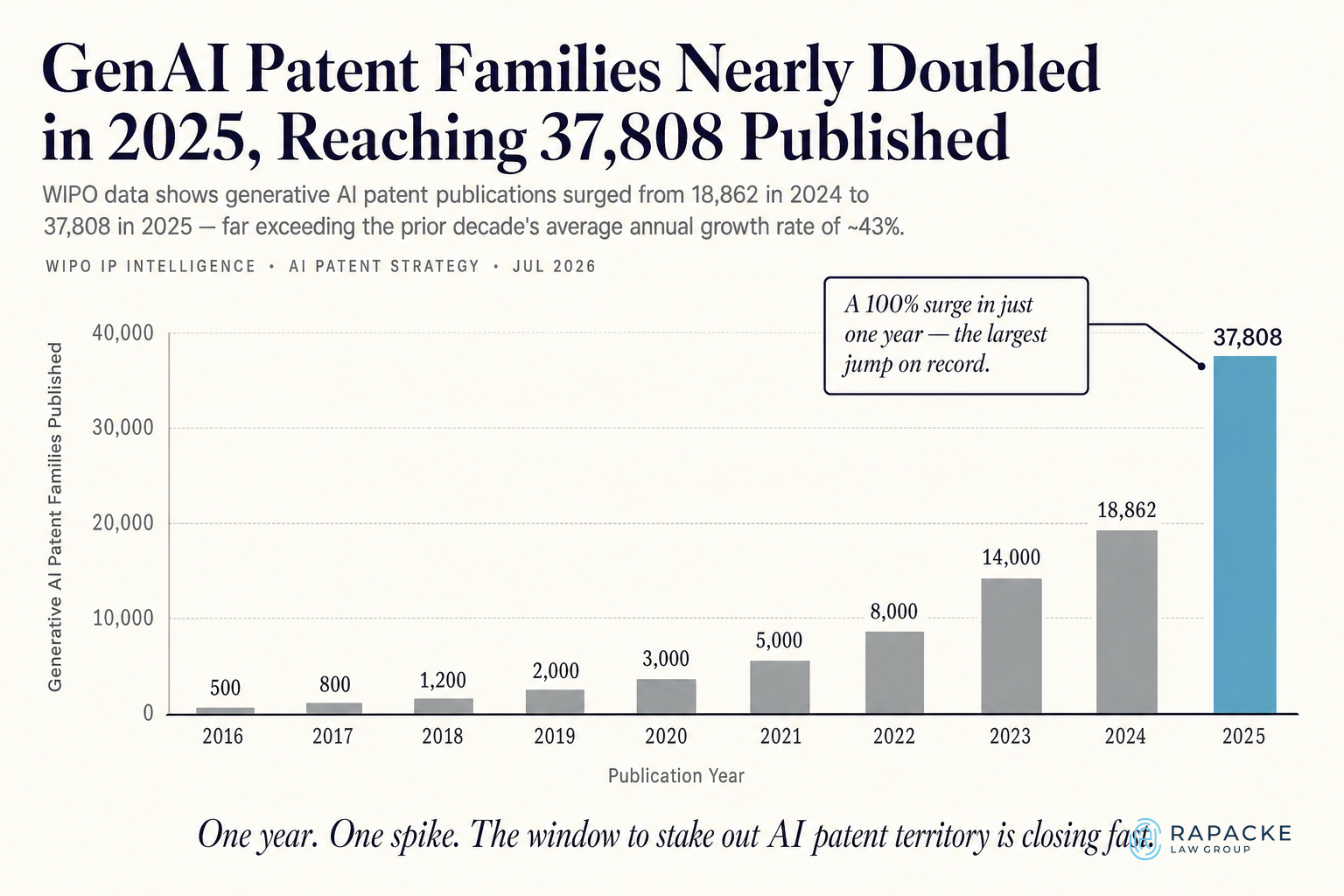
Generative AI patent activity is no longer rising at the margins. Artificial intelligence patents are accelerating at a scale that changes the competitive landscape for every company building with AI. The World Intellectual Property Organization (WIPO) reports that published GenAI patent families climbed from about 14,000 in 2023 to 37,808 in 2025, nearly tripling in two years.
Even more striking, the 56,000-plus GenAI patent families published in 2024 and 2025 exceeded the total published during the entire prior decade. For founders and technology companies, this is the central story: competitors are rapidly converting AI research into patent portfolios, while the window to claim a distinct technical advantage is becoming more crowded.
WIPO's latest data shows who is moving fastest, which AI technologies are attracting the most patent activity, and why U.S. innovators seeking patents on artificial intelligence should connect product development, patent eligibility, and international filing strategy earlier. Particularly given agreements on trade related aspects of intellectual property, overseen in part by the world trade organization, that shape enforcement across markets. The broader WIPO system still matters, but its most urgent lesson today is what the surge in AI patents means for the technology you are building now.
Generative AI Patent Activity Has Entered a Full-Scale Surge
WIPO's 2026 patent trends update shows a sharp break from the field's earlier growth curve. Published GenAI patent families rose from approximately 14,000 in 2023 to 18,862 in 2024 and 37,808 in 2025. GenAI's share of all AI-related patent family publications also increased from 6.1% in 2023 to 8.7% in 2025, according to WIPO's latest data.
That is not a gradual trend. It signals a shift from experimentation toward large-scale commercial deployment. World IP Review characterized the new WIPO data as a full-scale spike, and the underlying numbers support that framing: more GenAI patent families were published in 2024 and 2025 than during 2014 through 2023 combined.
China Has the Largest Lead, While the United States and Japan Are Accelerating
China remains the dominant origin of GenAI inventions, with more than 43,000 patent families published by China-based inventors in 2024 and 2025. Six of the world's top 10 GenAI patent applicants are based in China. Japan's SoftBank ranked first overall with nearly 3,000 published patent families during those two years, followed by Tencent, Ping An Insurance Group, and Baidu.
The lead is large, but the race is still moving. WIPO calculated a 92% compound annual growth rate for the United States from 2023 to 2025. Japan grew even faster at 210% and moved into third place among inventor locations. Europe remains comparatively underrepresented at the company level, although Germany has overtaken the United Kingdom as Europe's leading GenAI inventor location.
Large Language Models and Text Patents Are Driving the Next Wave
The type of technology being protected is changing too. Large language models overtook generative adversarial networks as the leading GenAI model category in 2025, with approximately 14,100 LLM-related patent families compared with 5,200 involving GANs. Text-related patent publications more than tripled in two years, while software, code, and 3D modeling emerged among the fastest-growing application categories in WIPO's report.
This shift matters because it brings patent competition closer to the products many startups are shipping now: copilots, workflow automation, model orchestration, developer tools, enterprise search, and industry-specific AI systems. The crowded field makes it more important to identify the concrete technical improvement behind an AI product instead of treating the use of AI itself as the invention.
What the AI Patent Surge Means for U.S. Founders
The right response is not to race an abstract AI idea to the patent office. It is to document what your system does technically better, such as reducing latency or compute, improving data handling, increasing security, controlling model behavior, or solving an industry-specific systems problem, and build claims around that implementation.
U.S. applicants still face patent eligibility scrutiny under the Alice/Mayo framework. The USPTO's 2024 Guidance Update on Patent Subject Matter Eligibility, Including on Artificial Intelligence emphasizes applying AI to a practical technological improvement rather than claiming a mathematical concept or mental process on its own.
For a startup, the practical priorities are to:
- Capture the human inventive contribution and technical architecture before details are lost across product iterations.
- Search the expanding prior-art landscape before investing in a full application.
- Coordinate filing decisions with product announcements, fundraising, and international expansion.
- Use the PCT timeline strategically when protection may be needed in several markets.
Founders often ask whether machine learning algorithms are patentable and whether software patents are enforceable. The surge does not change the legal tests, but it raises the cost of waiting to identify and protect new inventions with a genuinely differentiated technical solution.
AI and Intellectual Property Law Is Raising New Questions WIPO Is Actively Working to Answer
The intersection of artificial intelligence and intellectual property law is one of the most consequential intellectual property issues of this decade, and WIPO sits at the center of it. The core issue is inventorship, can an AI system be named as an inventor on a patent application?
Where WIPO and Major Patent Offices Currently Stand on AI Inventorship
WIPO has published extensive materials through its Conversation on AI and IP series, but individual offices make the call, and currently no major patent office recognizes an AI system as a legal inventor. The Federal Circuit affirmed in Thaler v. Vidal that a U.S. inventor must be a natural person, and the European Patent Office reached the same conclusion in its DABUS decision J 0008/20. AI tools can assist your inventive process, but a human must be named and must have contributed meaningfully to each claim.
How AI Patent Law Is Likely to Evolve Under WIPO Guidance
Since 2019, WIPO has issued issues papers and hosted global discussions on patentability of AI-generated outputs and disclosure requirements for AI-assisted inventions. No treaty changes have landed yet, but new international norms could follow. Early-stage filings made today will be examined under ai patent law rules that may look different in 18 to 30 months. Founders should start with a software patents checklist to get their filings right early.
How the Patent Cooperation Treaty Lets You File Internationally With One Application
The Patent Cooperation Treaty, or PCT, is the most practical WIPO tool for inventors and startups, enabling patent applications to be filed across multiple countries through a single streamlined process. A single international application preserves your right to pursue patent protection in 158 contracting states simultaneously, giving you up to 30 months from your priority date to decide which national offices to enter. That window is critical if you want to get a patent granted and enforceable before competitors file first.
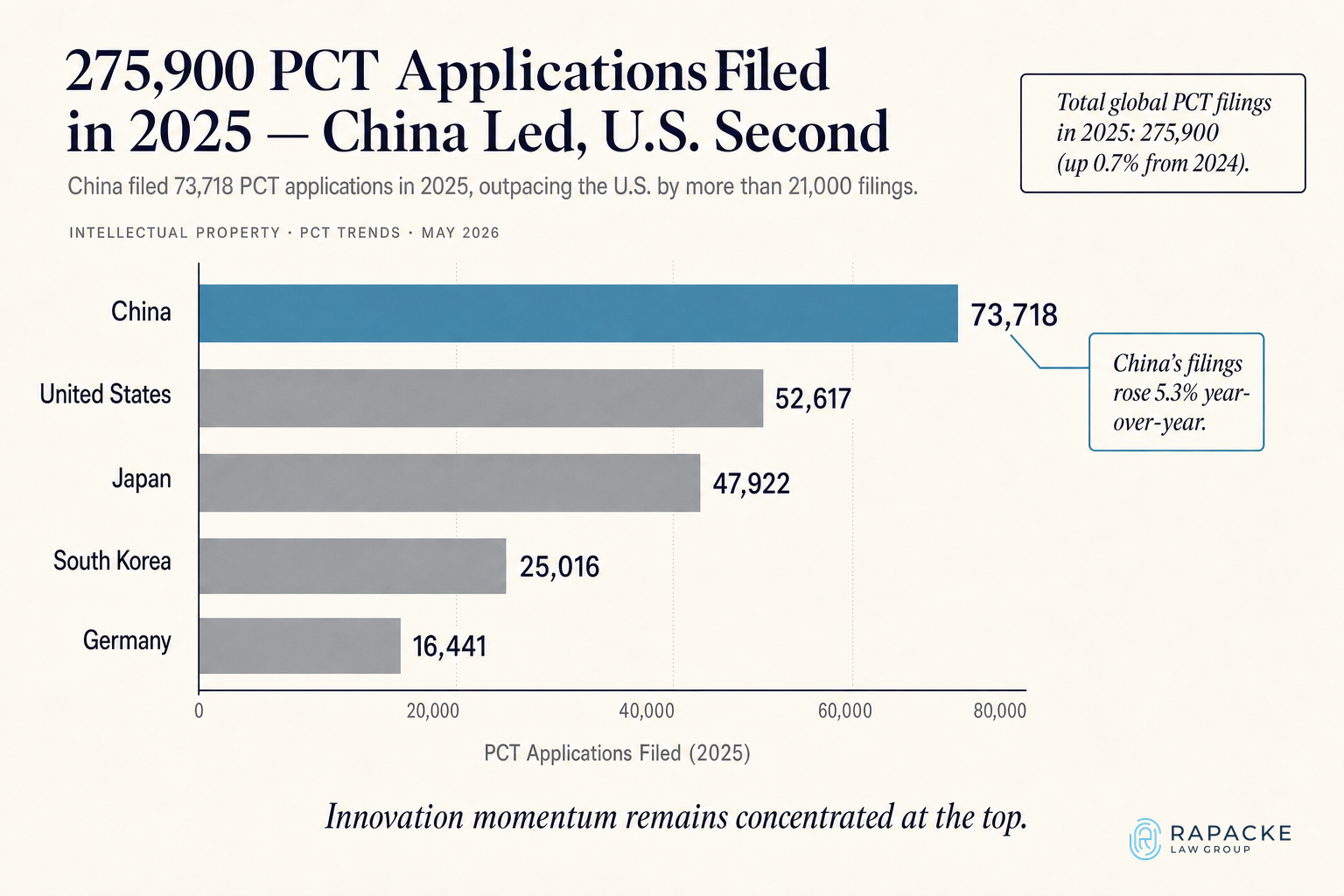 275,900 PCT Applications Filed in 2025/China Led, U.S. Second /Source: WIPO IP Statistics, 2026
What the PCT Filing Process Looks Like Step by Step
A PCT application moves through an international filing phase, an international search report, and an optional preliminary examination before entering national or regional offices. It does not grant a single global patent. It buys critical time and a professional prior art search. The USPTO confirms applicants typically have 30 months from their earliest priority date before national phase entry. Use that window to refine your claims based on the search report before committing to country-by-country fees.
When a PCT Application Makes Business Sense for a Startup
WIPO reported 275,900 applications filed worldwide in 2025, with China leading at 73,718 and the United States second at 52,617, followed by Japan and the Republic of Korea. For early-stage companies, PCT filing delays major foreign costs while keeping international rights alive. If you hold a 12-month provisional patent, a patent cooperation treaty application extends your decision window without surrendering priority, and it usually becomes cost-effective once you plan to file in three or more jurisdictions.
WIPO Is a United Nations Specialized Agency With Real Authority Over Global IP
The wipo world intellectual property organization is a specialized agency of the United Nations, headquartered in Geneva, Switzerland, with 194 member states, according to WIPO. Its mandate is to develop a balanced international intellectual property system, grounded in harmonized intellectual property laws, that rewards creativity, stimulates technological innovation, and contributes to economic development and economic growth. Understanding how that system protects your ip rights is the foundation of any intellectual property strategy for a growing business.
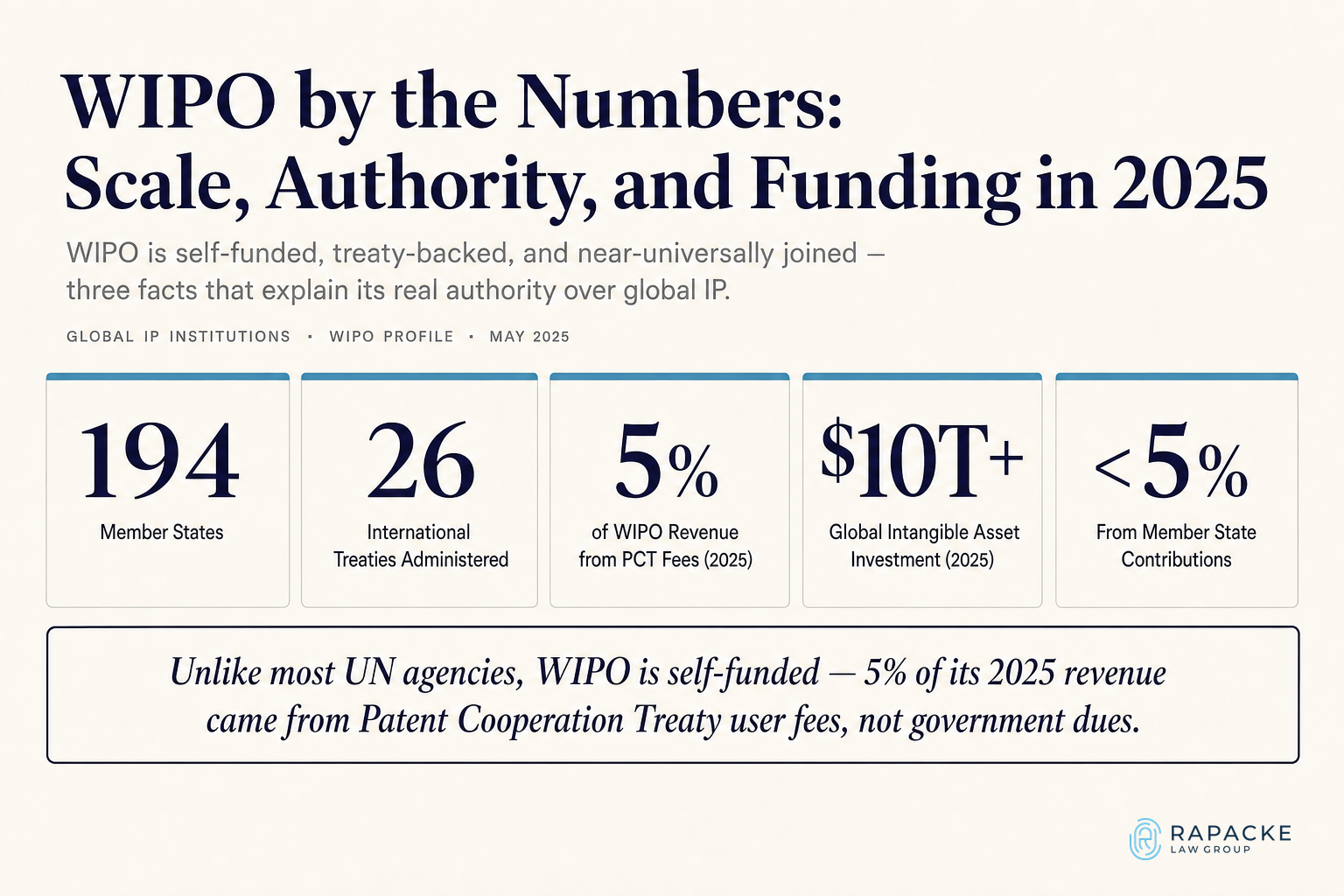 WIPO by the Numbers: Scale, Authority, and Funding in 2025/Source: WIPO Program and Budget Committee, 2026; WIPO Intangible Investment Report, 2026
How WIPO Came to Exist and What Gives It Power
WIPO was established in 1967 under the WIPO Convention and became a UN specialized agency in 1974, according to Britannica. It administers roughly two dozen international treaties, including the Paris Convention of 1883, which covers industrial property such as patents and trademarks, and the Berne Convention of 1886, which protects literary works and artistic works. That authority flows from international law, which is why WIPO sets global IP rules rather than merely suggesting them. To understand the deeper purpose of intellectual property, these founding treaties are where the modern system begins.
What WIPO Actually Administers Day to Day
The wipo world intellectual property organization runs international registration systems, provides dispute resolution services, publishes the Global Innovation Index, and plays a crucial role in tracking patent activity across member states. Unlike most UN agencies, it is largely self-funded, with most revenue coming from fees under the patent cooperation treaty and other registration systems, which also means wipo member states benefit from a financially sustainable organization. In 2024, assessed contributions from member states totaled CHF 18.6 million, just 3.7% of total revenue, according to WIPO's Annual Financial Report. That fee-based model aligns WIPO's incentives with the businesses and inventors who use its systems, from large corporations to small and medium-sized enterprises.
WIPO's Other International Registration Systems Cover Trademarks and Industrial Designs Too
Beyond patents, WIPO operates two major registration systems that SaaS founders and product companies use regularly, the Madrid System for trademarks and the Hague System for industrial designs.
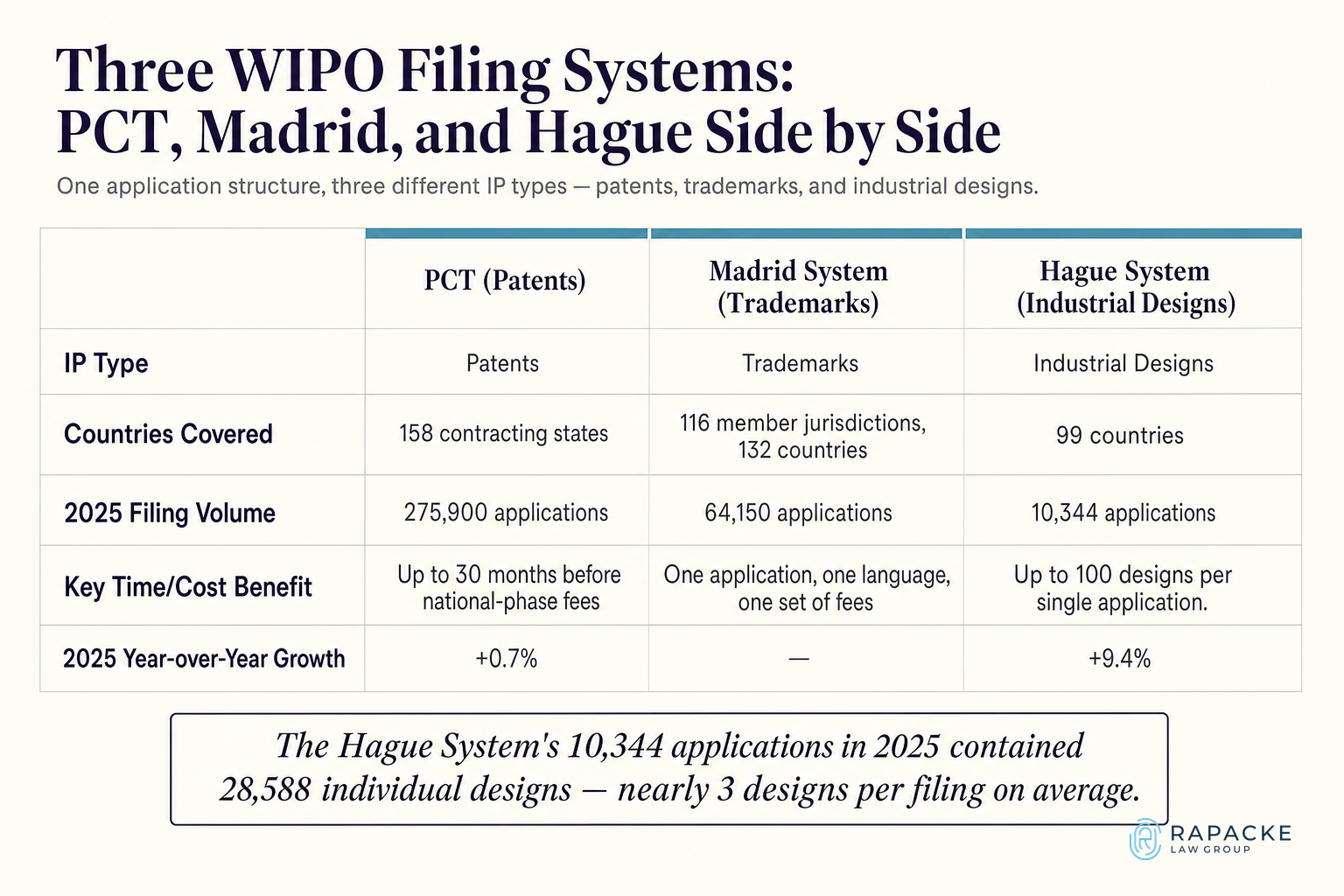 Three WIPO Filing Systems: PCT, Madrid, and Hague Side by Side/Source: WIPO IP Statistics, 2026; WIPO Madrid System Members, 2026; WIPO Hague System, 2026
The Madrid System Simplifies International Trademark Registration
The Madrid System lets a trademark owner file one application, in one language, and pay one set of fees to seek protection in over 130 countries. A U.S. business can use the united states patent and trademark office as its office of origin and extend protection through a single international registration. If your brand operates in more than two foreign markets, a Madrid filing is almost always more efficient than filing country by country. This matters even more once you understand how trademarks and logos work together to protect your brand and how to protect globally with international trademarks.
The Hague System Protects Industrial Designs Across Multiple Jurisdictions
The Hague System provides international registration for industrial designs, meaning the ornamental aspects of a product, and is one of the key wipo services available to product companies seeking trademark protection and design rights while expanding across different countries. A single application can protect up to 100 designs in 77 contracting parties covering 94 countries. Product companies launching hardware or physical goods should evaluate the Hague System before their first international release.
WIPO's Role in Developing IP Rules Around Traditional Knowledge and Emerging Technology
WIPO's work extends beyond registration systems. It shapes how intellectual property rights interact with traditional knowledge, genetic resources, and geographical indications, areas where international standards are still being negotiated.
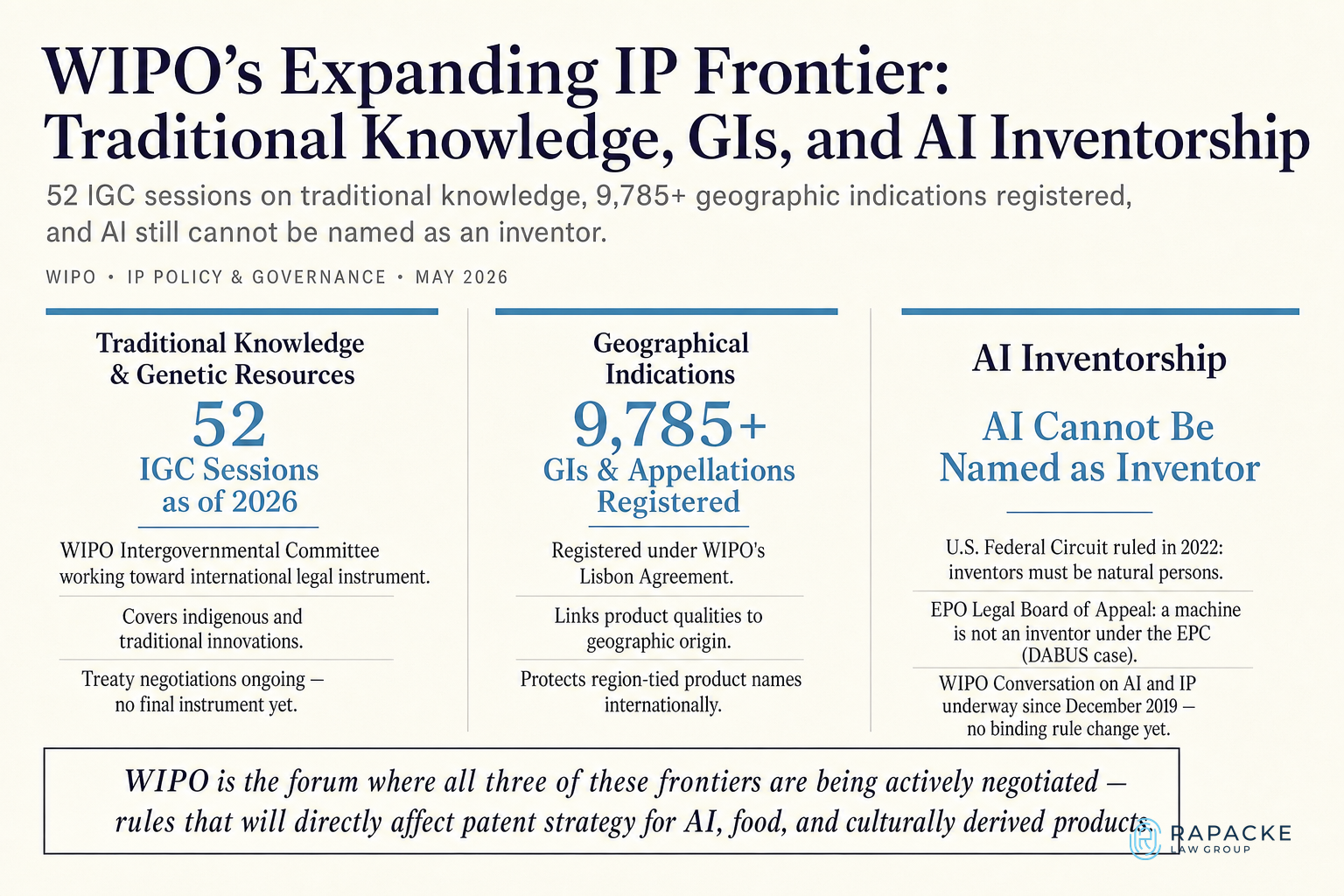 WIPO's Expanding IP Frontier: Traditional Knowledge, GIs, and AI Inventorship/Source: WIPO IGC, 2026; WIPO IP Facts and Figures 2024; U.S. Federal Circuit, 2022; EPO Legal Board of Appeal; WIPO AI Conversation, 2019
Why Traditional Knowledge and Geographical Indications Matter
Geographical indications like Champagne and Parmigiano-Reggiano are protectable under frameworks WIPO coordinates. Traditional knowledge protection addresses developing countries' concerns about unauthorized commercialization of indigenous innovations, including traditional cultural expressions, and WIPO's Intergovernmental Committee has held dozens of sessions working toward a binding instrument. If your product or brand draws on culturally specific knowledge or regional origin, these evolving frameworks may affect your IP strategy.
How WIPO Supports Developing Countries Through Capacity Building
WIPO's Development Agenda, launched in 2007, funds technical assistance, training programs, and innovation support centers for developing countries, aligning with sustainable development goals by building the infrastructure for equitable IP access. These programs build the infrastructure necessary for effective intellectual property protection and technology transfer. That matters as context when you assess IP enforcement risk before expanding into emerging markets.
WIPO's Free Online Tools Give You Real Intelligence Before You File
WIPO provides several publicly accessible digital services and databases that are genuinely useful at the pre-filing stage, covering patent search, trademark search, and domain name dispute resolution, with a large number of records updated continuously.
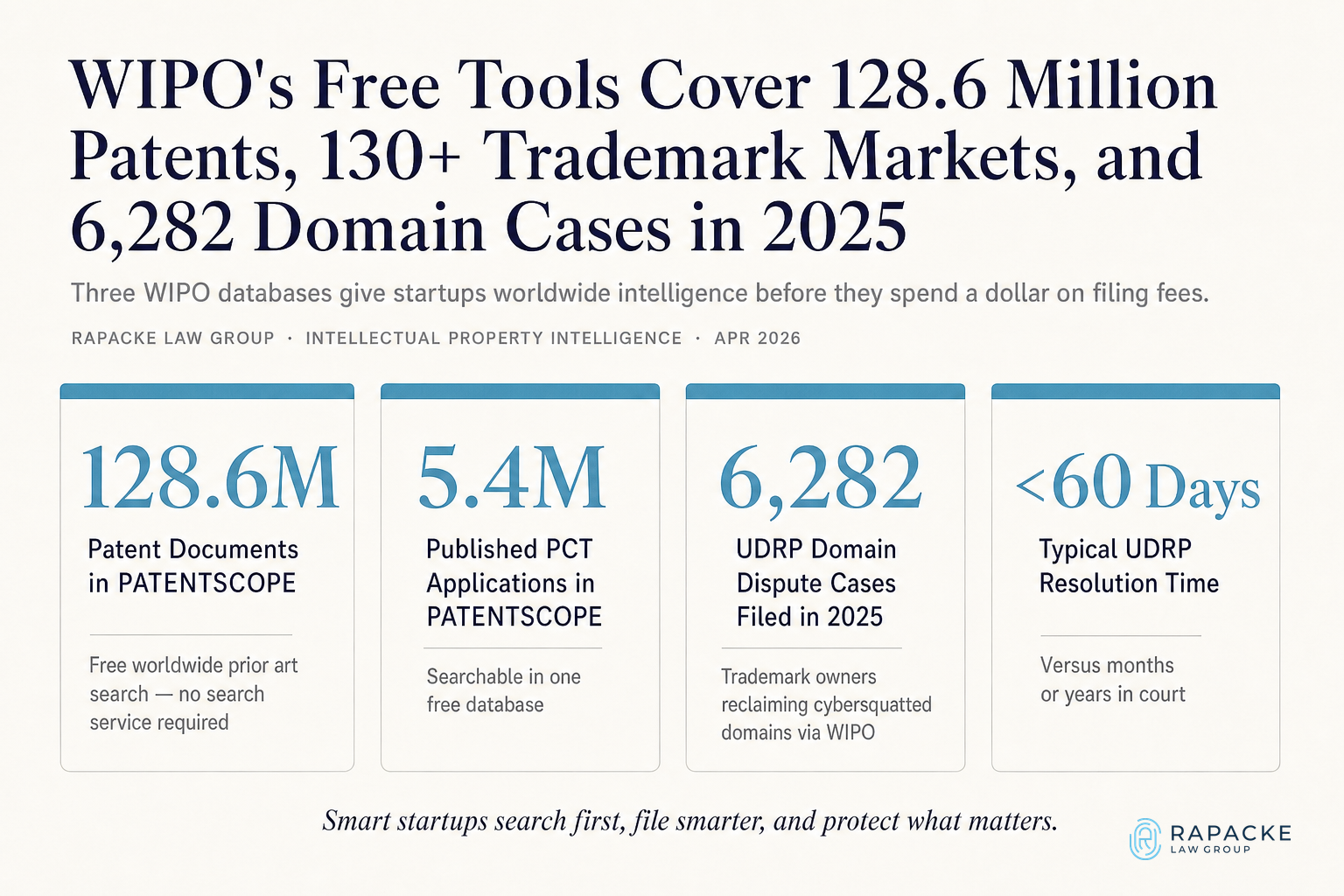 WIPO's Free Tools Cover 128.6 Million Patents, 130+ Trademark Markets, and 6,282 Domain Cases in 2025/Source: WIPO PATENTSCOPE (patentscope.wipo.int); WIPO International Patent Filing Statistics, 2026; domainincite.com
WIPO's PATENTSCOPE and Global Brand Database Save Real Money
PATENTSCOPE now contains 128.6 million patent documents, including 5.4 million published PCT applications, all searchable in one place and free. The Global Brand Database aggregates trademark and brand records from multiple national, regional, and international collections, including Madrid System registrations, giving applicants a copyright protection and trademark research tool covering records from around the digital environment. Run a PATENTSCOPE search before commissioning a formal prior art search to narrow scope and reduce attorney time.
WIPO's Domain Name Dispute Resolution Services Protect Digital Brands
The Uniform Domain Name Dispute Resolution Policy, administered through WIPO's Arbitration and Mediation Center, offers a faster, cheaper alternative to litigation for recovering domain names registered in bad faith. WIPO managed over 6,200 domain name cases in 2025, its highest caseload on record over a 25-year period. Most cases resolve far faster than federal court. If you have secured a brand, it also helps to know whether you can trademark a domain name.
Frequently Asked Questions About WIPO and International Patent Filing
What does the World Intellectual Property Organization (WIPO) do?
WIPO administers the international IP system, running registration programs like the PCT, Madrid, and Hague Systems, setting policy through treaties, providing dispute resolution, and tracking global patent trends, according to Britannica.
What are the 4 types of intellectual property?
Patents, trademarks, copyrights, and trade secrets, per Britannica.
Can you get a single global patent through WIPO?
No. A PCT application preserves your right to pursue protection in 158 contracting states, but you must still enter each national or regional office individually and meet local requirements, including those shaped by the WIPO copyright treaty and other relevant agreements.
Does WIPO decide whether an AI can be named as an inventor?
WIPO shapes the policy conversation, but individual patent offices make the final determination, and currently every major office requires a human inventor.
How many countries are members of WIPO?
WIPO has 194 member states, according to WIPO.
Turn the AI Patent Surge Into a Filing Strategy
WIPO's latest data is a warning and an opportunity. Generative AI patent families nearly tripled in two years, major Asian applicants are building large portfolios, and U.S. and Japanese filing activity is accelerating quickly. The competitive question is no longer whether AI patenting will grow. It is whether your core technical advantage will be clearly documented, searched, and protected before the surrounding field becomes even more crowded.
The Rapacke Law Group helps SaaS founders and technology companies build patent portfolios designed to hold up through examination, with flat-fee pricing and no billing surprises. Under the RLG Guarantee, our patentability searches come with a 100% refund if the search finds your invention is not novel.
Here are your next steps:
- Identify the specific technical improvement behind your AI product and the people who contributed to it.
- Run a preliminary PATENTSCOPE search to understand the competitive landscape.
- Confirm your priority date, public-disclosure timeline, and whether a PCT application fits your international plans.
- Schedule a Free IP Strategy Call to map the invention, claims, and filing sequence before launch.
Filing early does not mean filing vaguely. It means turning a defensible technical advance into a patent strategy while you still have room to distinguish it.
To Your Success,
Andrew Rapacke Managing Partner, Registered Patent Attorney Rapacke Law Group
Connect on LinkedIn (Andrew Rapacke) or follow the firm on X @rapackelaw and Instagram @rapackelaw.
Andrew Rapacke Managing Partner, Registered Patent Attorney Rapacke Law Group