

Inventors filed 273,900 PCT applications in 2024 alone, according to WIPO, and the reason is straightforward: filing one international patent application under the Patent Cooperation Treaty costs a fraction of filing separately in each country while buying you up to 30 months to decide exactly where to pursue patent protection. For tech founders and inventors managing tight runway, that time is as valuable as the filing itself.
What a Patent PCT Application Actually Does for Inventors
The Patent Cooperation Treaty (PCT) is not a world patent. It is a unified entry point into the national and regional patent systems of 158 contracting states, administered by the World Intellectual Property Organisation (WIPO). Filing one patent PCT application preserves your right to seek international patent protection in any participating country while you evaluate markets, secure funding, and refine your patent strategy.
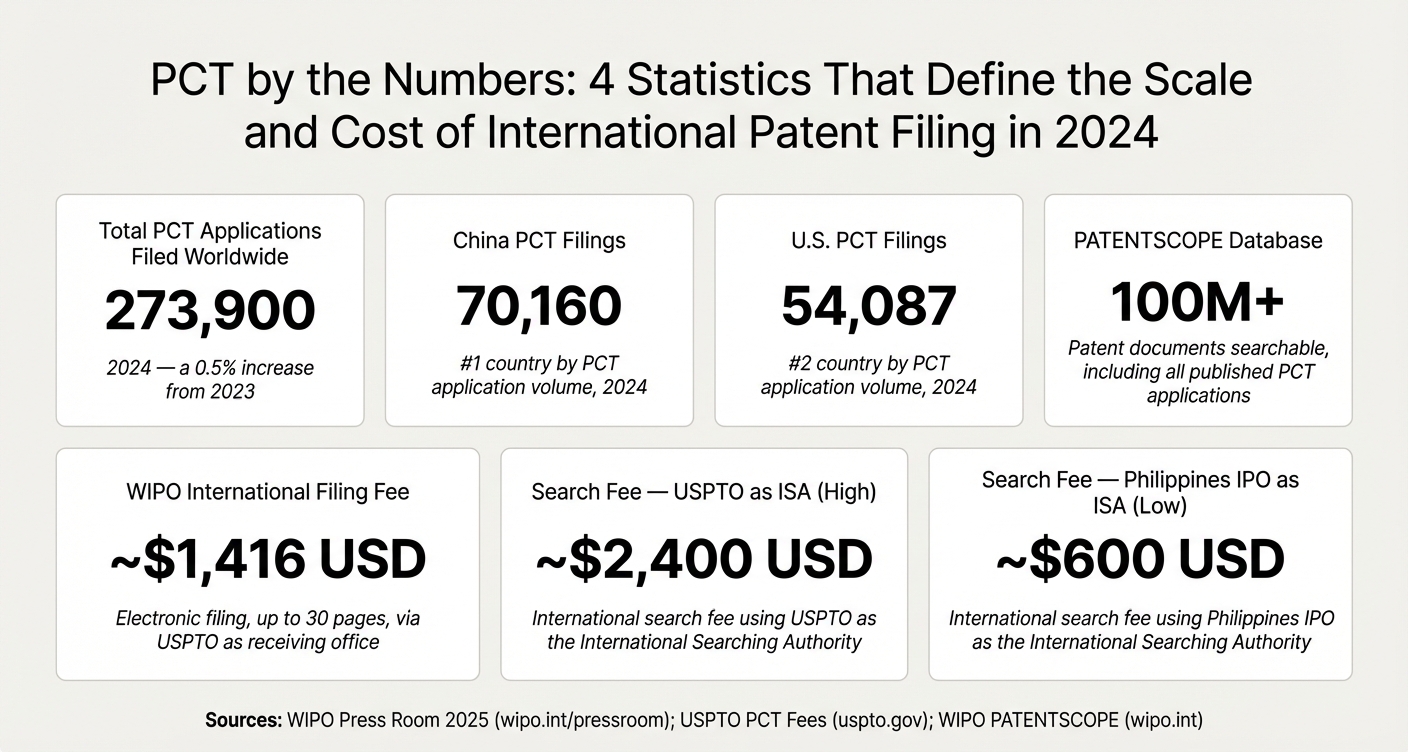 PCT by the Numbers: 4 Statistics That Define the Scale and Cost of International Patent Filing in 2024 — Source: WIPO Press Room 2025; USPTO PCT Fee Schedule; WIPO PATENTSCOPE
In 2024, China led all countries with 70,160 PCT applications, followed by the United States at 54,087, according to WIPO’s 2025 press release. Those numbers reflect a system that has become the default route for any inventor with serious international ambitions. The patent PCT process does not grant you a patent — WIPO itself makes no patentability decisions. What it grants is time and reach: a single priority date recognized across 158 countries and up to 30 months before you must commit to individual national filings.
How the PCT Application Process Moves From Filing to National Phase
The patent PCT process runs in two distinct phases: an international phase controlled by WIPO’s International Bureau, and a national phase controlled by each country’s national patent office. The WIPO PCT Applicant’s Guide is the authoritative reference for navigating both phases — the PCT applicant guide covers everything from receiving office requirements to national phase entry procedures for each contracting state.
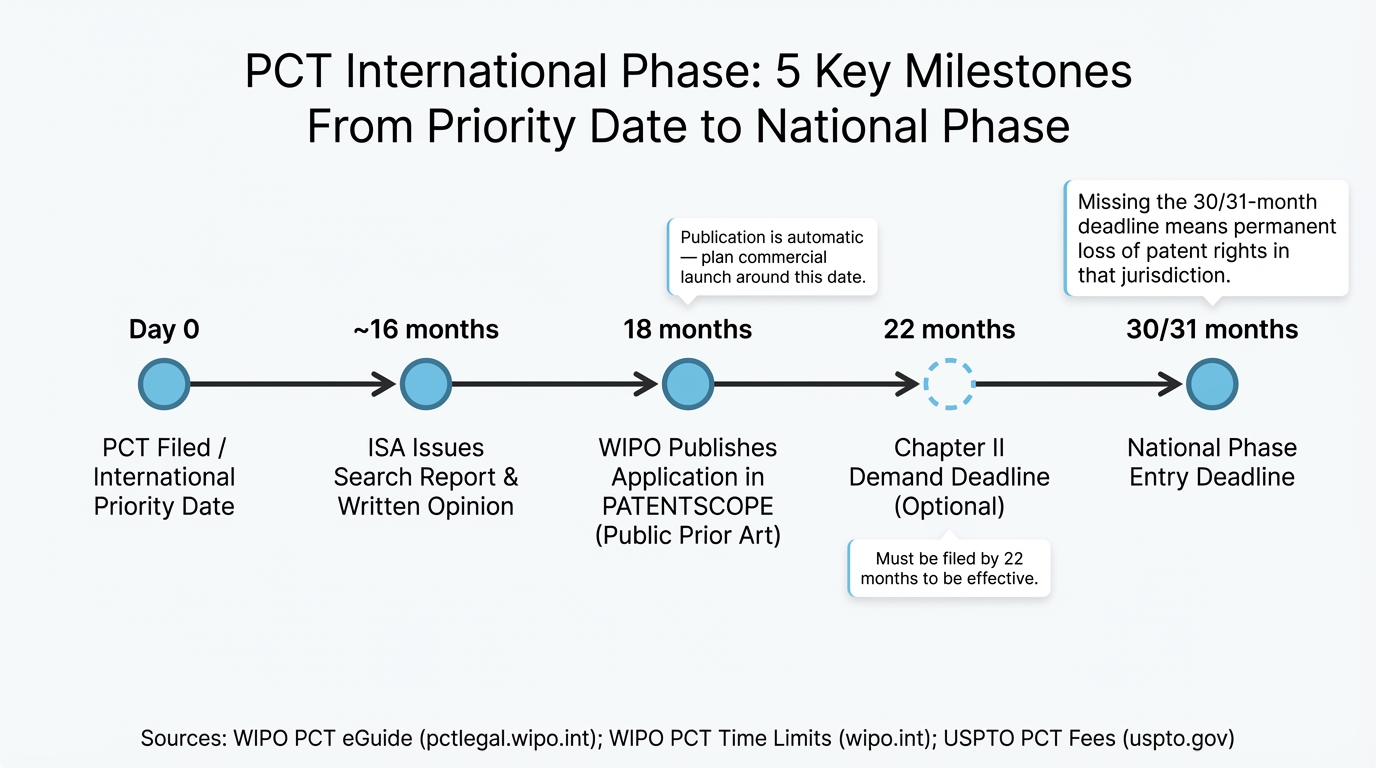 PCT International Phase: 5 Key Milestones From Priority Date to National Phase — Source: WIPO PCT eGuide; WIPO PCT Time Limits; USPTO PCT Fee Schedule
The International Phase Sets Your Priority Date
When you file a PCT application through a receiving office — such as the United States Patent and Trademark Office (USPTO) or the European Patent Office — WIPO records your international filing date as the priority date for every designated member country. That date is the most important date in your patent’s life. Filing through the USPTO as receiving office involves a $285 transmittal fee, an international filing fee of approximately $1,416 for an electronically filed application under 30 pages, and an international search fee ranging from roughly $600 to $2,400 depending on which International Searching Authority you select. Fees are current as of 2025; confirm current rates at USPTO.gov before filing.
For a deeper look at how the provisional patent timeline impacts your startup’s funding position, including how the priority date affects investor confidence, that resource walks through the key milestones.
The International Searching Authority Examines Your Claims
An International Searching Authority (ISA) — which can be the USPTO, the European Patent Office, or the Korean Intellectual Property Office, among others — conducts a formal prior art search across WIPO’s PATENTSCOPE database, which now contains over 100 million patent documents. The ISA then issues an international search report alongside a written opinion assessing novelty, inventive step, and industrial applicability. That written opinion arrives approximately 16 months after your priority date and functions as an early, candid read on whether your claims will survive national phase examination.
Publication at 18 Months Makes Your Application Public
WIPO publishes your international application in PATENTSCOPE 18 months after your earliest priority date, regardless of your national phase readiness. From that point, your application is searchable prior art for competitors worldwide. Plan any commercial launch and trade secret decisions around this publication date, not the 30-month national phase deadline.
What the International Preliminary Examination Adds to Your Strategy
Chapter II of the patent PCT process — the international preliminary examination — is optional, but worth understanding when your written opinion raises patentability concerns.
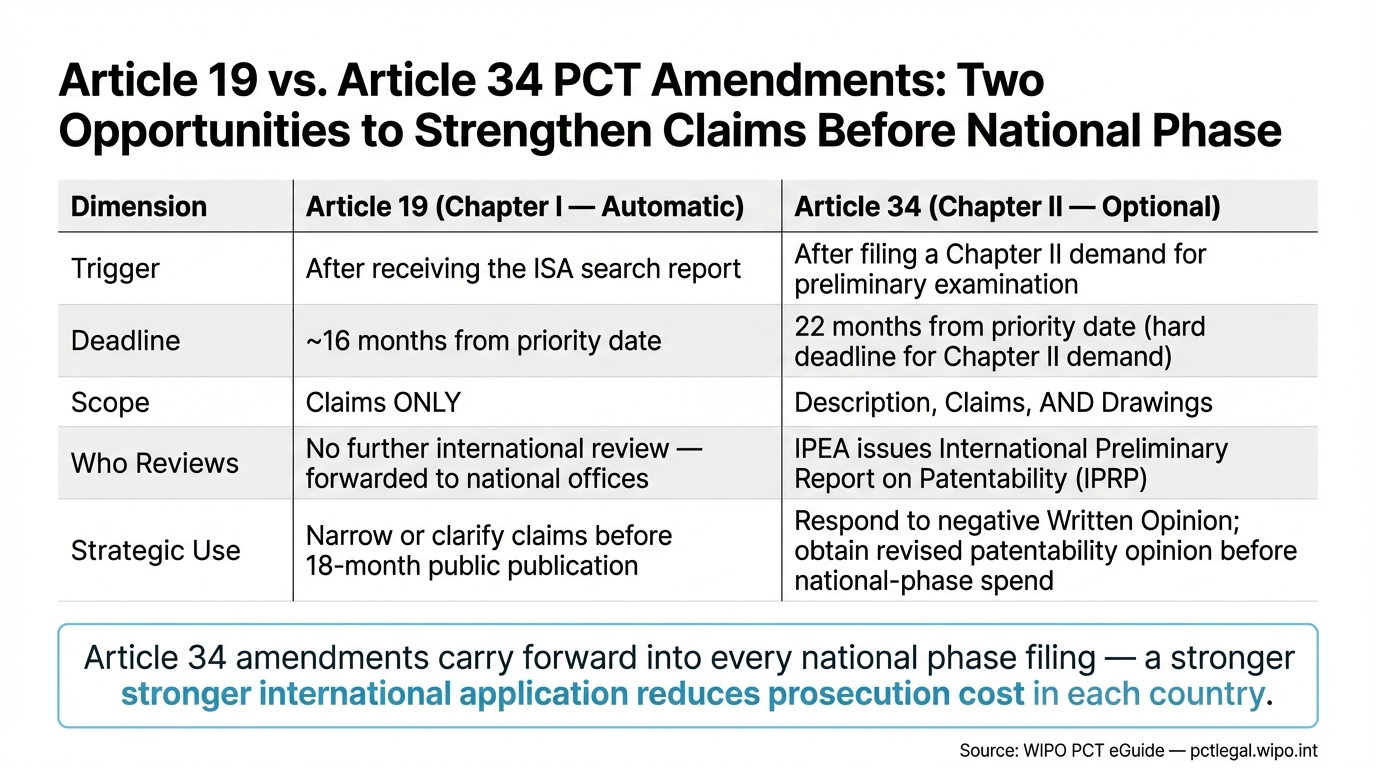 Article 19 vs. Article 34 PCT Amendments: Two Opportunities to Strengthen Claims Before National Phase — Source: WIPO PCT eGuide, 2024
Requesting Chapter II Gives You a Second Opinion
If the ISA’s written opinion identified prior art gaps or obviousness issues, you can file a demand for international preliminary examination with an International Preliminary Examining Authority (IPEA) before the 22-month deadline from your priority date. The IPEA issues an International Preliminary Report on Patentability (Chapter II) — also called the international preliminary examination report — which national patent offices use as additional guidance. This step is used by a small percentage of PCT applicants, but it can help resolve potential legal issues and justify the cost when you face expensive national phase entries across multiple jurisdictions.
Amending Claims During the International Phase Reduces National Phase Risk
PCT rules permit claim amendments at two points: once under Article 19 after receiving the international search report, and again under Article 34 if you file a Chapter II demand. Amendments made during the international phase carry forward into national phase and can significantly narrow the scope of examination at each national patent office. A skilled patent attorney uses this window to strengthen claims so national phase examiners start from a better position. See Understanding the Differences: Provisional Patent vs Non-Provisional Applications for context on how claim strength at each stage affects your overall prosecution strategy.
Which Countries You Should Include in Your National Phase Filing Plan
Entering national phase in every PCT country is neither practical nor cost-effective. Country selection is one of the most consequential decisions in the entire patent PCT process and a core element of any sound patent strategy.
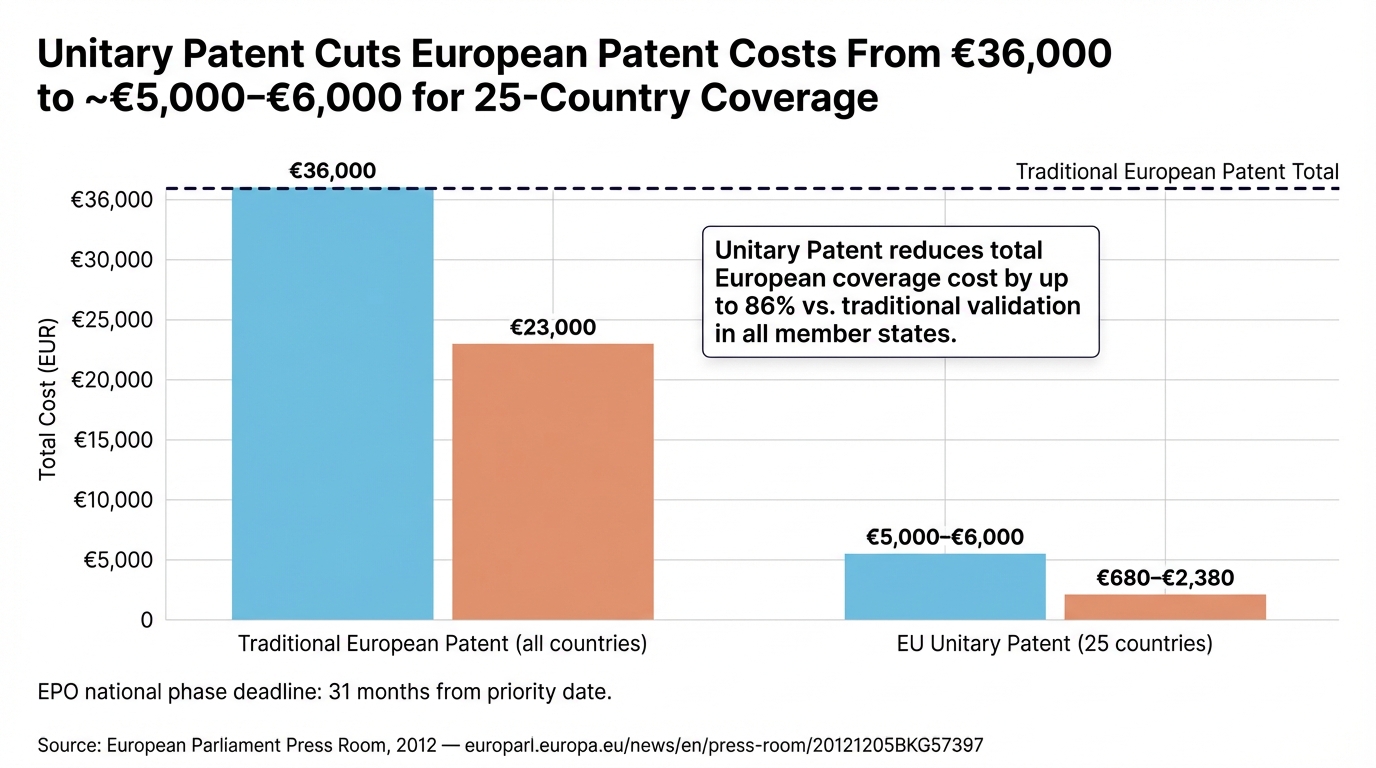 Unitary Patent Cuts European Patent Costs From €36,000 to ~€5,000–€6,000 for 25-Country Coverage — Source: European Patent Office, 2024
Target Markets, Manufacturing Hubs, and Competitor Territories Drive Selection
The standard framework combines three factors: where your customers are, where your products will be manufactured, and where your most likely infringers operate. For most U.S.-based tech startups, this means prioritizing the United States, the European Patent Office (which covers 39 member states through a single euro-PCT filing), China, Japan, and South Korea — jurisdictions accounting for the overwhelming majority of global patent activity, according to WIPO’s PCT statistics. The EU Unitary Patent, distinct from a Eurasian patent, provides 25-country coverage through the EPO for approximately €5,000 to €6,000 in total fees, compared to up to €36,000 for a traditional European patent validated across all member states, according to the European Patent Office. That cost differential makes the Unitary Patent a significant development for any startup filing European national phase entries.
The 30-Month and 31-Month Deadlines Are Hard Cutoffs
Most PCT member countries require national phase entry within 30 months of your earliest priority date. The United States, China, and Japan all use the 30-month standard. A significant subset — including the European Patent Office and many European national offices — allows 31 months. Missing either deadline permanently forfeits your right to pursue patent protection in that country via the PCT route. Calendar these deadlines immediately after filing. If you are already working within a 12-month provisional window, this guide on provisional patent extensions covers your options before that window closes.
What a PCT Application Costs Compared to Filing Directly in Each Country
The patent PCT international phase consolidates costs that would otherwise require separate filings in each country simultaneously.
International Phase Fees Are Predictable
Filing through the USPTO as receiving office involves the transmittal fee, the WIPO international filing fee (approximately CHF 1,330 — check USPTO.gov for the current USD equivalent, as exchange rates fluctuate), and the search fee — totaling a few thousand dollars for most applications. The PCT applicant guide details WIPO’s fee reduction schedule for micro-entities and applicants from certain developing countries. This combined cost is a fraction of what simultaneous national filings in five or six jurisdictions would require in local attorney fees and translation costs — a single application compared to the cost of filing in multiple countries before you even know whether the invention will succeed commercially.
National Phase Costs Scale With Country Count and Translation Requirements
Each national phase entry requires separate local filing fees, translation costs where the application language differs from the national office’s requirements, and local prosecution fees. Obtaining patent protection across five major jurisdictions for a software or tech invention typically runs $20,000 to $40,000 in cumulative costs, depending on claim complexity and jurisdiction-specific prosecution. The PCT system lets you spread that expenditure over 30 months and concentrate it on the jurisdictions that actually matter to your business. For a detailed breakdown of patent application structure and how claim drafting affects prosecution costs, that resource is worth reviewing before you file.
How PCT Applications Work Specifically for Software and AI Inventions
The patent PCT process defers subject matter eligibility questions to each national office — which matters significantly for software and AI intellectual property.
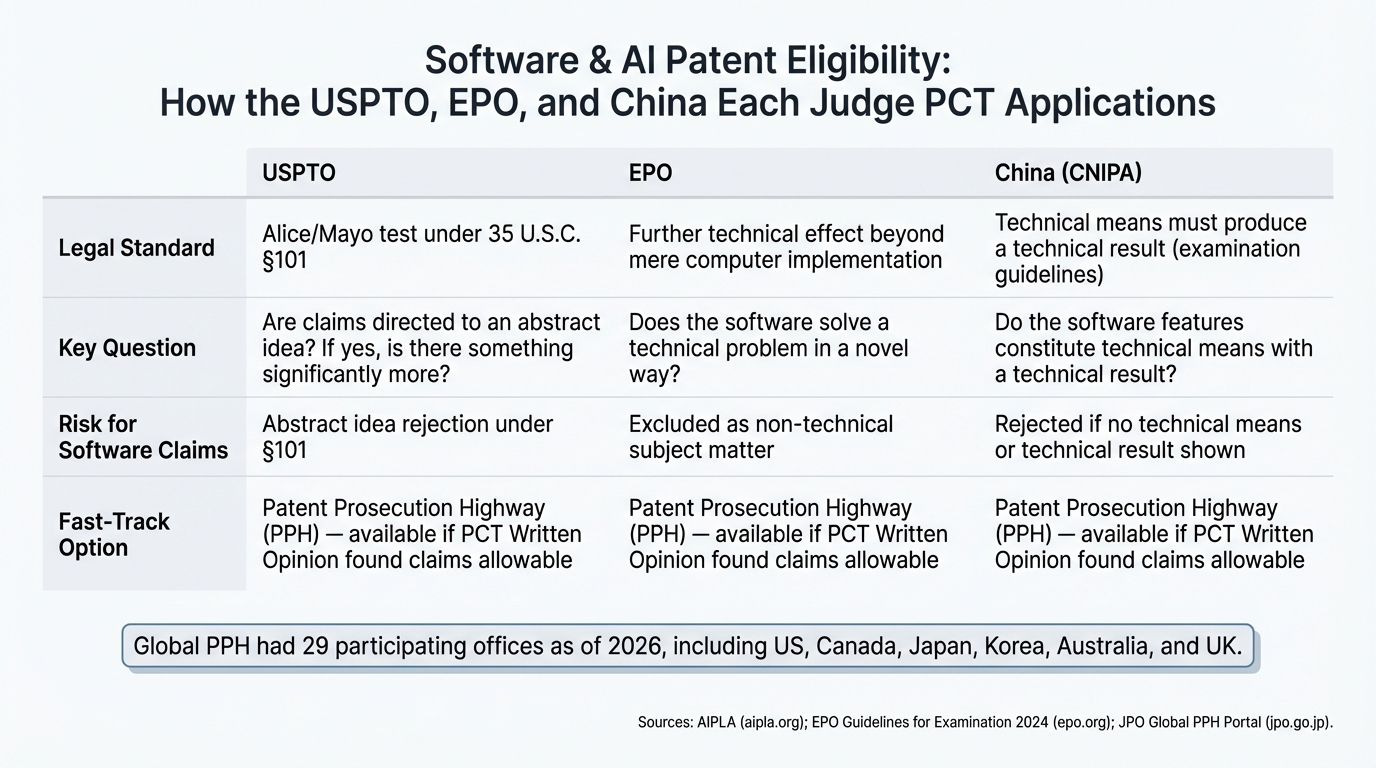 Software & AI Patent Eligibility: How the USPTO, EPO, and China Each Judge PCT Applications — Source: AIPLA; EPO Guidelines for Examination 2024; JPO Global PPH Portal
Software and AI Inventions Face Jurisdiction-Specific Patentability Standards
The USPTO applies the Alice/Mayo framework under 35 U.S.C. § 101 during national phase, asking whether claims are directed to an abstract idea and whether additional elements transform them into a patent-eligible application. The European Patent Office requires software to demonstrate a “further technical effect” beyond mere computer implementation. China applies its own examination guidelines focused on whether the software constitutes technical means producing a technical result. Draft your international applications with both U.S. and EPO standards in mind from the outset: claims too abstract for § 101 will face equivalent rejections in European national phase. The AI Patent Mastery resource covers claim drafting strategies specifically for AI inventions navigating these jurisdiction-specific standards.
The Patent Prosecution Highway Can Accelerate National Phase Examination
The Patent Prosecution Highway (PPH) is a bilateral fast-track program between participating patent offices. If your ISA or IPEA found at least one claim allowable, you can request accelerated examination during national phase in any PPH-participating country. The Global PPH pilot includes 29 participating offices as of 2026, including the USPTO, Japan Patent Office, and Korean Intellectual Property Office. For software and AI international applications that received a favorable written opinion, the PPH can compress national phase timelines and reduce prosecution costs considerably.
What to Do Before Filing a PCT Application to Maximize Its Value
Filing the patent PCT application is step three, not step one.
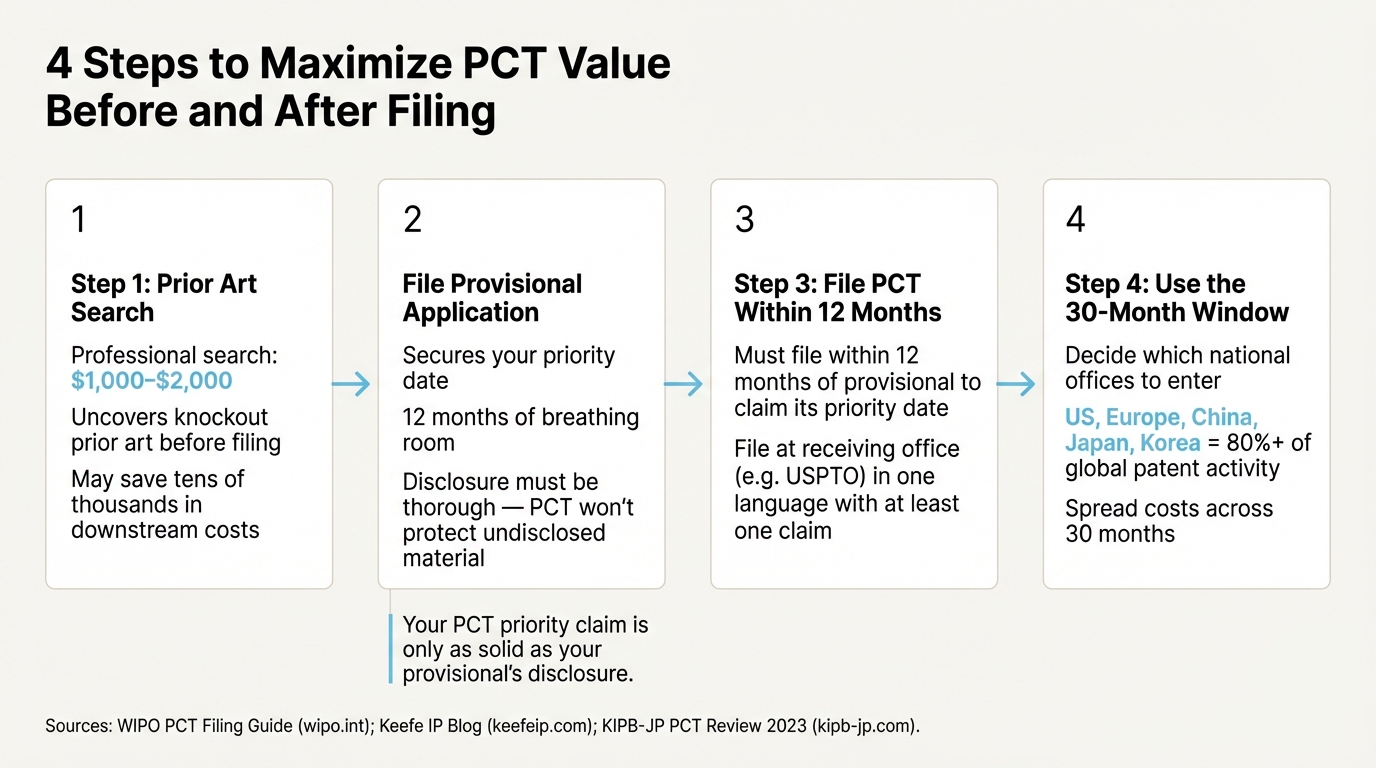 4 Steps to Maximize PCT Value Before and After Filing — Source: WIPO PCT Filing Guide; WIPO PCT Applicant’s Guide
A Prior Art Search Before Filing Identifies Claim Risks Early
A professional prior art search typically costs $1,000 to $2,000. The ISA will search the same databases — including WIPO’s 100-million-document PATENTSCOPE — but the difference is that pre-filing results let you amend claims before your patent PCT priority date is locked. Catching a critical prior art reference before filing can prevent a negative written opinion that undermines the entire application’s value across every designated country, helping your international applications succeed in national phase. If you are evaluating whether to file a patent on your own, understanding the prior art landscape first is especially important.
Your Provisional Patent Application Can Serve as the Priority Document
Most U.S.-origin PCT applications claim priority from a U.S. provisional patent application filed 12 months earlier under the Paris Convention. The provisional establishes your priority date at a lower cost as the original application, giving you 12 months to develop the invention and assess commercial viability before committing to full PCT filing fees. The provisional must fully support the claims in the international application — a placeholder provisional creates a priority claim that national phase examiners can challenge. Get your invention patent pending with a guaranteed provisional — Rapacke Law Group offers a full refund if the USPTO denies the provisional patent application. Every downstream benefit of your international applications rests on the quality of that foundation. The PCT applicant guide confirms that the priority document must fully disclose the invention as claimed in the international application.
FAQ
What does PCT patent mean? A “PCT patent” is shorthand for an international patent application filed under the Patent Cooperation Treaty. Technically, no single patent application filed under the PCT ever results in a granted patent — the PCT process produces one international application that preserves your right to seek national or regional patent protection in 158 contracting states. Granting decisions are made country by country during national phase entry, not by WIPO.
What does PCT stand for in patent terms? PCT stands for Patent Cooperation Treaty, an international treaty that enables international patent cooperation and is administered by WIPO, established in 1970 and entered into force in 1978. It created a unified filing system that allows inventors to file one international application designating multiple member countries, rather than filing multiple applications separately in each country from the start.
How long does a PCT patent last? The PCT process itself does not control patent duration — that is determined by each country’s national law. In most major jurisdictions, including the United States and European Patent Office member states, a granted patent provides protection for 20 years from the international filing date of the PCT application, subject to maintenance fee payments.
How to get a PCT patent? The process involves five steps: file a provisional or non-provisional patent application to establish a priority date; file the PCT international application within 12 months of that priority date through a receiving office such as the USPTO; receive and respond to the international search report and written opinion from the ISA; optionally request Chapter II international preliminary examination and receive an international preliminary examination report; and enter national phase in your target countries before the 30- or 31-month deadline. Working with a registered patent attorney throughout significantly improves claim quality and reduces national phase rejection rates.
Your Next Steps to PCT Filing Success
The patent PCT process gives inventors and tech founders a structured way to preserve international patent rights while deferring the full cost of country-by-country prosecution. One international application, one priority date, one international search report — and up to 30 months to decide where to invest in national phase applications.
The bottom line: a weak international application built on a thin provisional produces a damaging written opinion and expensive national phase prosecution. A well-drafted PCT application built on strong international applications, backed by a thorough prior art search and sound country selection strategy, gives you leverage in every jurisdiction you enter.
The decisions that determine whether a patent PCT application delivers real value happen before filing (claim drafting, prior art search, provisional quality) and during the international patent system’s international phase (ISA selection, Chapter II requests, claim amendments). Missing a national phase deadline or filing underprepared patent applications cannot be corrected retroactively — and no amount of prosecution effort at the national level recovers a forfeited priority date.
If you are approaching your 12-month priority window, act now:
- Schedule a Free IP Strategy Call to map out your international filing plan before that window closes
- Review the SaaS Patent Guide 2.0 if your invention is software-based
- Explore when to file a patent for startups to understand how PCT timing affects investor conversations
- Learn about patent continuation strategy to extend your protection as your technology evolves
According to Rapacke Law Group, every PCT engagement is backed by a fixed-fee model so you know your costs before committing — no billable-hour surprises as you move from international phase through national phase entry.
To Your Success,
Andrew Rapacke
Managing Partner – Registered Patent Attorney
Rapacke Law Group