

Brand Protection on Amazon Starts With This One Critical Step
Filing a trademark is the cornerstone of any successful brand protection strategy on Amazon. Without federal trademark registration or a pending application at the US…
[ARTICLE]Trademarks

If you hope to enroll Amazon Brand Registry without trademark protection, you can't, but you also do not need a registration certificate in hand to get started. Amazon accepts an active registered trademark or an eligible pending trademark application from a designated government trademark office, such as the United States Patent and Trademark Office. With neither, you cannot enroll, but you can still sell. The fastest legitimate path is the Amazon IP Accelerator program, which connects you with vetted legal service providers who file your application so you can apply while it is pending.
Selling your products on Amazon greatly expands your potential customer base. It also increases your risk of counterfeiters and knock offs, making brand protection on Amazon essential. Having an active registered trademark and enrolling in the Amazon Brand Registry can be a huge step toward safeguarding your brand on the platform.
In 2019, Amazon blocked over 2.5 million suspected bad actor accounts before they were able to make a single product available for sale and blocked over 6 billion suspected bad listings.
A trademark does more than enable you to register with Amazon. It also enhances your brand representation. It lets you protect your brand and company goodwill from those who would profit from it without your permission.
Amazon Brand Registry is a program designed to assist brand owners in safeguarding their intellectual property and enhancing the customer experience. This initiative offers access to robust tools that grant brand owners increased control over how their brand appears on the platform. These tools empower brand owners to report violations, manage listings more efficiently, and leverage advanced advertising and marketing features. Amazon Brand Registry is a complimentary program available to brand owners who possess a registered trademark for trademark protection.
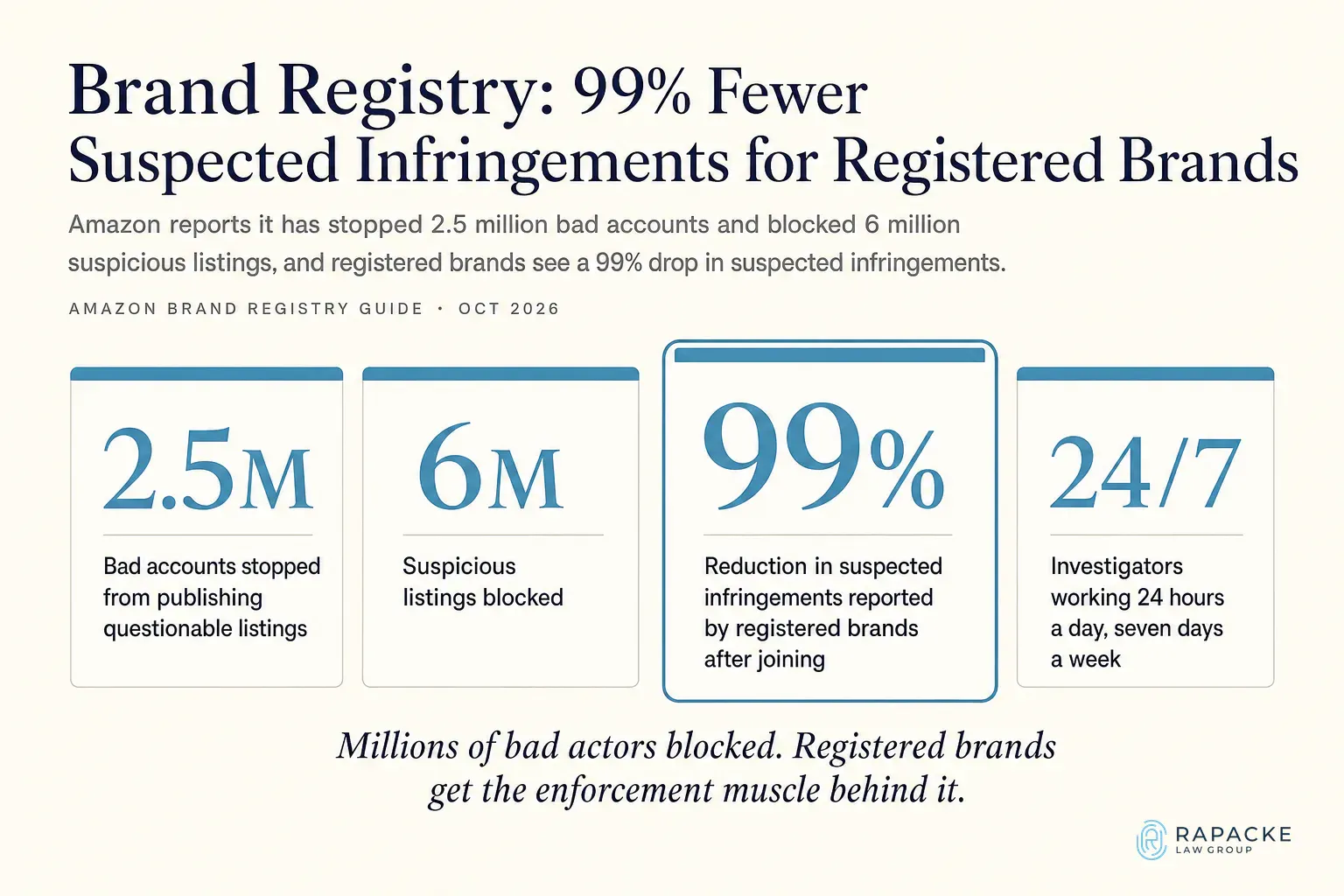
Enrollment in the Amazon Brand Registry program is free, and it unlocks the tools that separate a brand owner from a reseller. Amazon lists automated brand protections, infringement reporting, and brand-building features among the core benefits. The most valuable include:
Each tool carries its own requirements, so enrollment alone does not guarantee access to everything.
Do you need a trademark to sell on Amazon? No. Do you need a trademark for Amazon Brand Registry? Yes. To be eligible to enroll in the Amazon Brand Registry, you must have an active registered trademark or an eligible pending trademark application. The mark must be text-based or image-based with words, letters or numbers. A purely graphic logo with no text will not qualify, which is why understanding how trademarks and logos work together matters before you file.
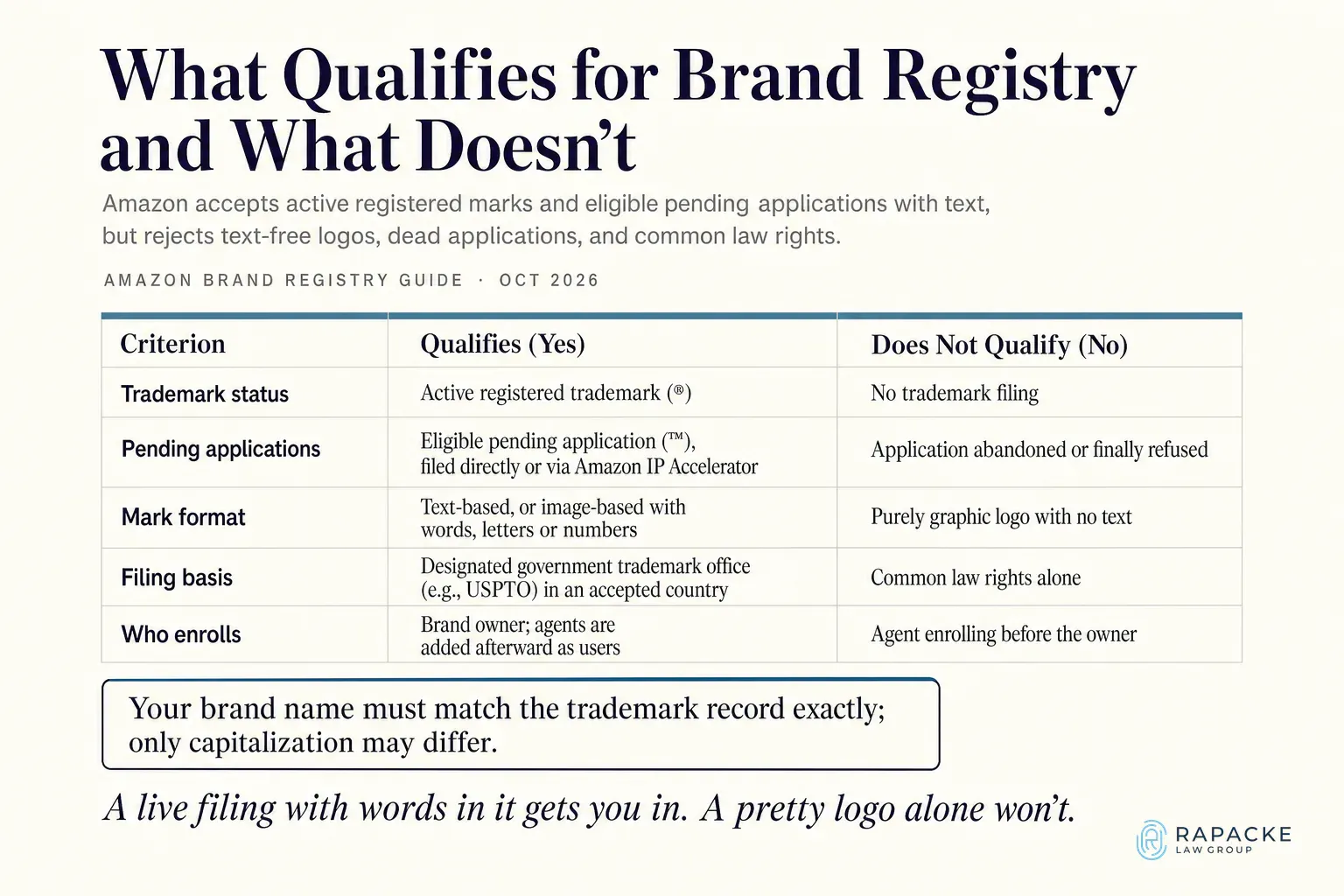
A pending trademark application can qualify whether you filed it directly with the trademark office or through the Amazon IP Accelerator program, according to Amazon. It must be filed with a designated government trademark office, such as the United States Patent and Trademark Office (USPTO), in the country where you want to register. That country must be one of the accepted countries. Amazon's global brand protection guidance confirms that both registered (®) and pending (™) marks are eligible across its marketplaces.
Only the brand owner can enroll a trademark. An authorized agent must have the owner enroll the brand first and then add the agent as an additional user.
Your trademark must be visible on either your product or its packaging, and your brand name must match the trademark record exactly. You'll need to provide the trademark registration number that was issued to you upon registration. Amazon cross-checks that number and your brand name against the official trademark office record, so a single typo can stall your application. You'll also need to specify the product categories under which you plan to sell your brand.
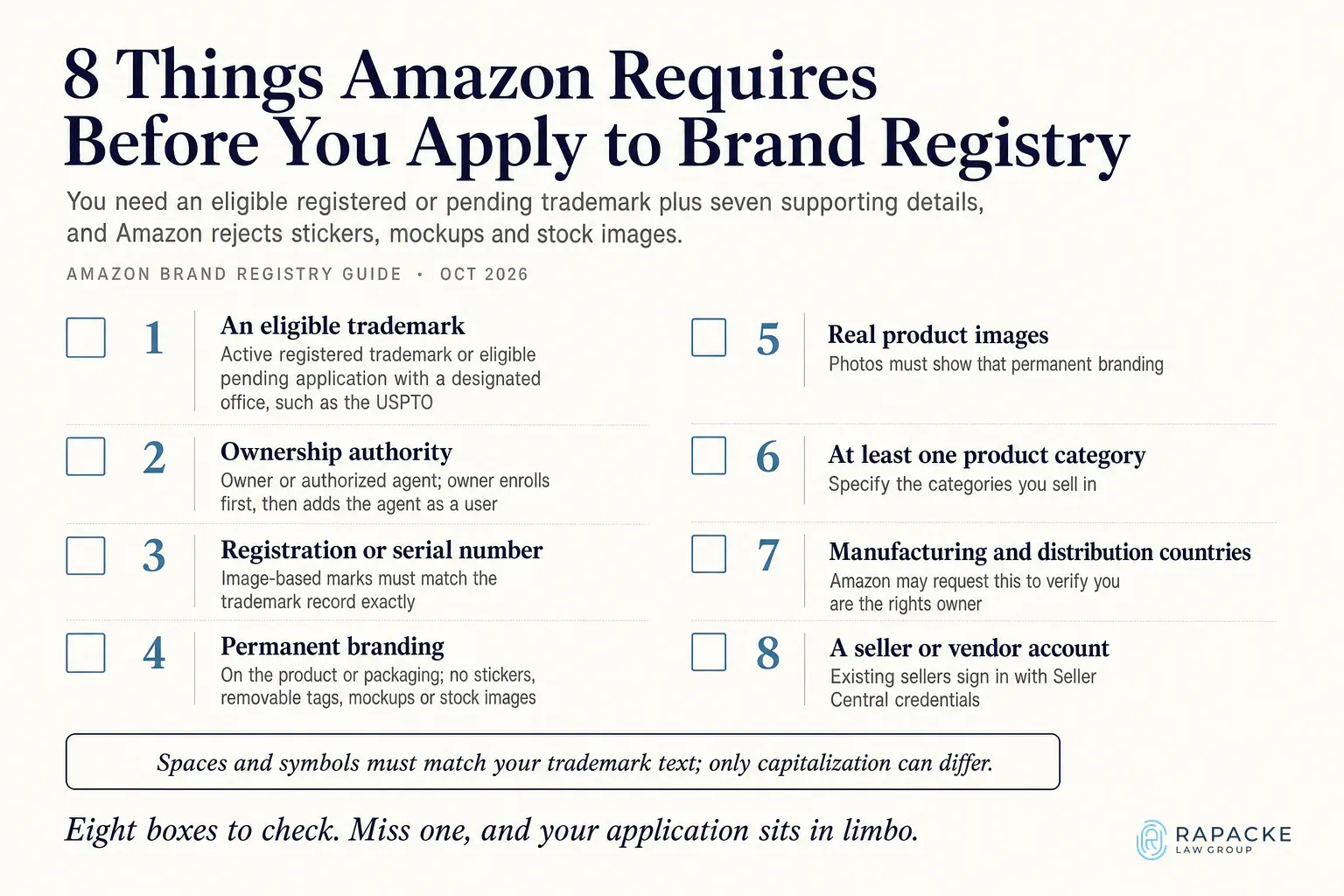
You need three things in place before you open the Brand Registry portal. These are an eligible trademark, owner-level authority over that mark, and real product photos that show permanent branding. Amazon's full checklist follows.
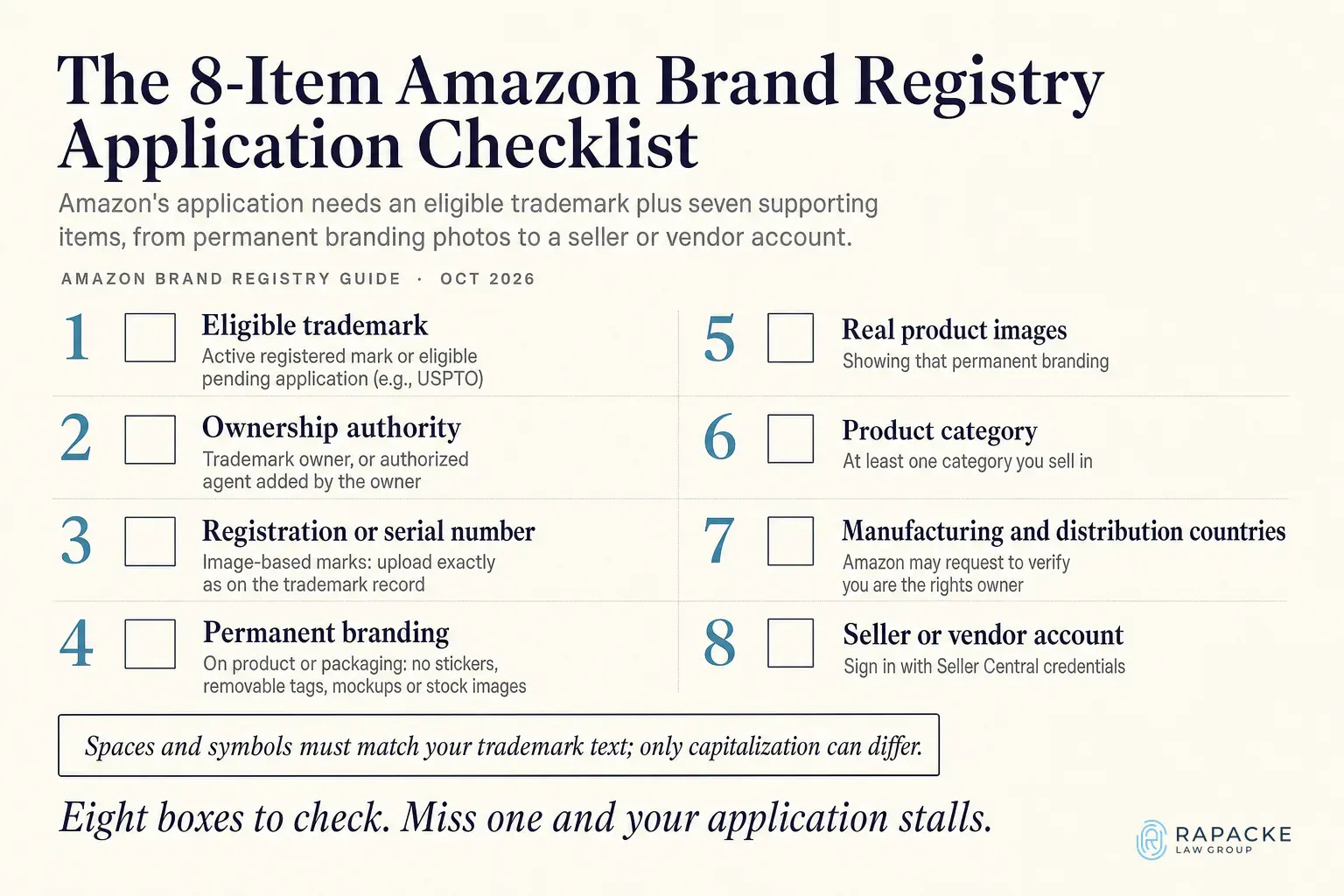
The Amazon Brand Registry requirements center on one core asset and a short list of supporting details. According to Amazon, your brand registry application needs:
Yes, you can sell on Amazon without joining the brand registry, even though you can't enroll Amazon Brand Registry without trademark filing. Trademark registration is not mandatory for an Amazon account either. For sellers who do not possess a registered trademark, listing a new brand involves following specific steps to meet Amazon's requirements. You apply for a GTIN exemption, and in some categories you also need brand name approval (BNA). In both cases, you submit product and packaging photos that show your permanently affixed brand name, which lets you list private-label products without a barcode or a trademark on file, according to Amazon Seller Central.
However, selling outside the registry does come with a few risks. Our guide to brand infringement on Amazon walks through the steps to protect your business when that happens.
Another common problem is low-cost manufacturers selling a similar product at a reduced price. Picture a hypothetical niche where 11,000 based independent sellers, U.S. and overseas alike, source from the same handful of factories. These two issues can result in category saturation. The only way to compete is with dramatic price drops to remain competitive. Additionally, increased marketplace competition can significantly impact pricing and sales.
[RLG]Free strategy call

Talk it through with a registered patent attorney.
Free 15 to 45 minute IP strategy call, no obligation.
Enrolling in the Amazon Brand Registry program is free, according to Amazon. The real cost is the trademark behind your brand registry application. The USPTO trademark fee schedule charges $350 per class, so two classes cost $700 before surcharges. Those surcharges include $100 per class for insufficient information and $200 per class for free-form identifications. You can avoid both by selecting your goods from the USPTO's Trademark ID Manual and completing every required field. Each mark, such as your name, logo or slogan, needs its own application.
The Amazon IP Accelerator program adds no connection fee. Amazon caps what its vetted legal service providers can charge at $700 plus government fees to file a U.S. application for one brand and one class, per Amazon. Attorney fees outside that program are optional. You should also budget for ongoing monitoring of your trademark record after you enroll.
Your trademark registration starts with choosing a mark that can be protected. Generic or merely descriptive names often fail, so pick a distinctive brand name or logo you plan to keep long term. Our guide to trademarks for Amazon sellers covers how to choose a name that holds up.
1. Run a clearance search. Search the United States Patent and Trademark Office (USPTO) database for similar marks covering related goods. Many sellers still call this agency the United States Patent Office, but it handles trademarks too. A conflicting mark can sink your application months later. Catching it now costs far less than rebranding.
2. File your trademark application. Decide between a word mark, a design mark, or both. Then file in Trademark Center and identify your goods and services. The USPTO's current trademark fee schedule sets the base fee at $350 per class. Surcharges apply for free-form descriptions or missing information, as the USPTO Trademark Examination Guide 1-25 explains.
3. Get through examination. A USPTO examining attorney reviews your filing. If problems surface, you receive an office action and must respond by the deadline. The USPTO recommends checking your status at least every three to four months so nothing lapses.
4. Clear publication. Once approved, your mark appears in the Official Gazette. Anyone who believes it conflicts with theirs has 30 days to file an opposition or request an extension. Under TTAB practice, extensions can stretch the opposition window up to 180 days from publication.
5. Receive your trademark registration certificate. This certificate and its trademark registration number prove ownership. Each federal registration term is ten years, but you must file a Section 8 declaration of use between the fifth and sixth years and combined Section 8 and Section 9 filings every ten years after that, according to the USPTO's post-registration FAQs. With ongoing use in commerce and timely maintenance filings, your registration can be renewed indefinitely. Our guide on how long a trademark lasts covers those deadlines in detail.
Expect roughly 12 to 18 months from filing to registration, according to the USPTO. Office actions extend that window. You do not have to wait for the certificate, though. A pending trademark registration can carry you into the program. Amazon accepts an eligible pending trademark application filed with the designated government trademark office or through the Amazon IP Accelerator program. Your serial number goes on the brand registry application, and enrollment can begin while examination continues.
Amazon's published enrollment guide breaks the process into five steps:
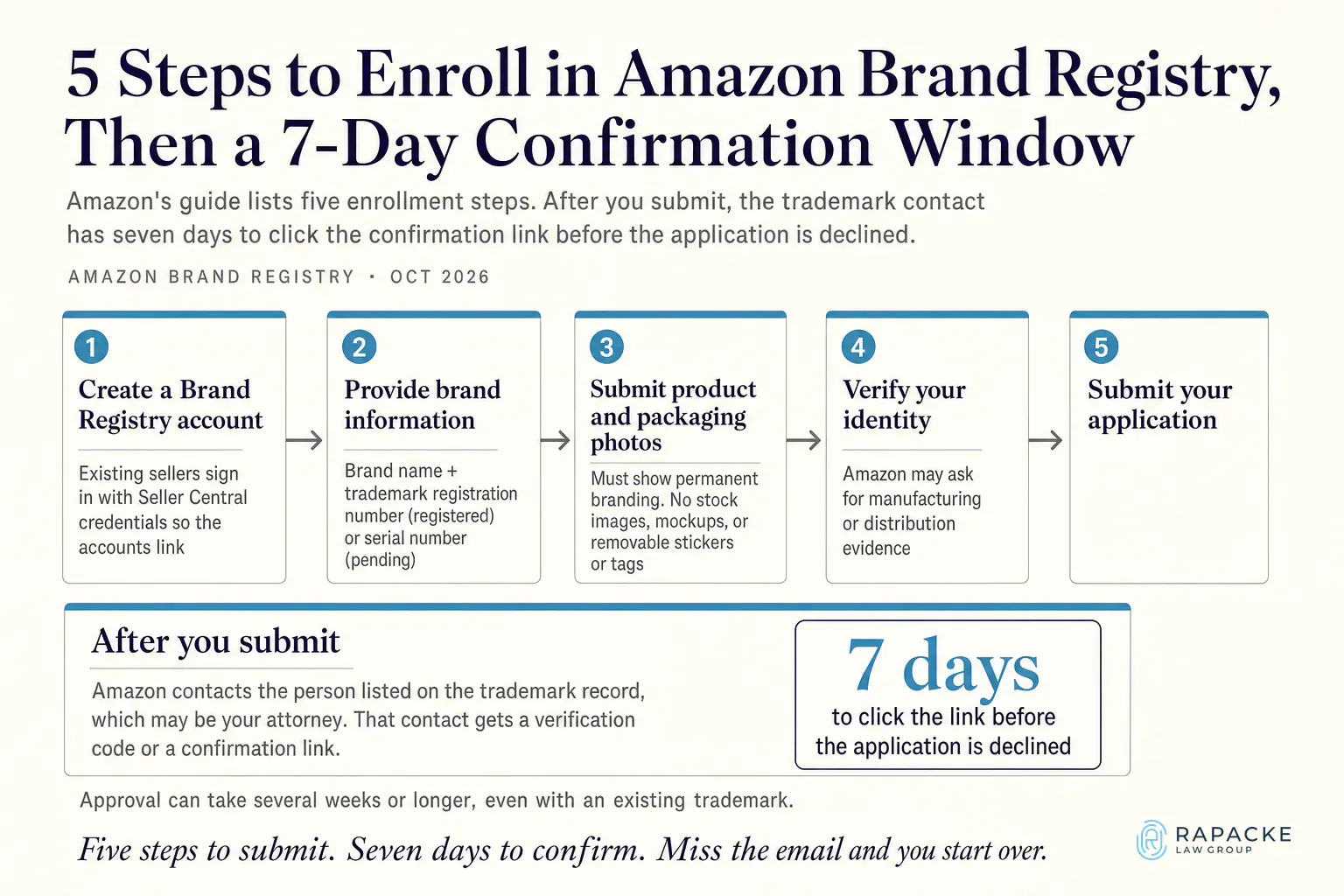
After you submit, Amazon contacts the person listed on the trademark record. That contact may be your attorney rather than you. Depending on your case, the contact receives either a verification code to return through your Brand Applications case or a confirmation link. Amazon's guide gives seven days to click that link before the application is declined.
Amazon Brand Registry approval also takes longer than many sellers expect. According to Amazon, approval can take several weeks or longer, even with an existing trademark.
Most delays in an Amazon Brand Registry application trace back to five avoidable errors:
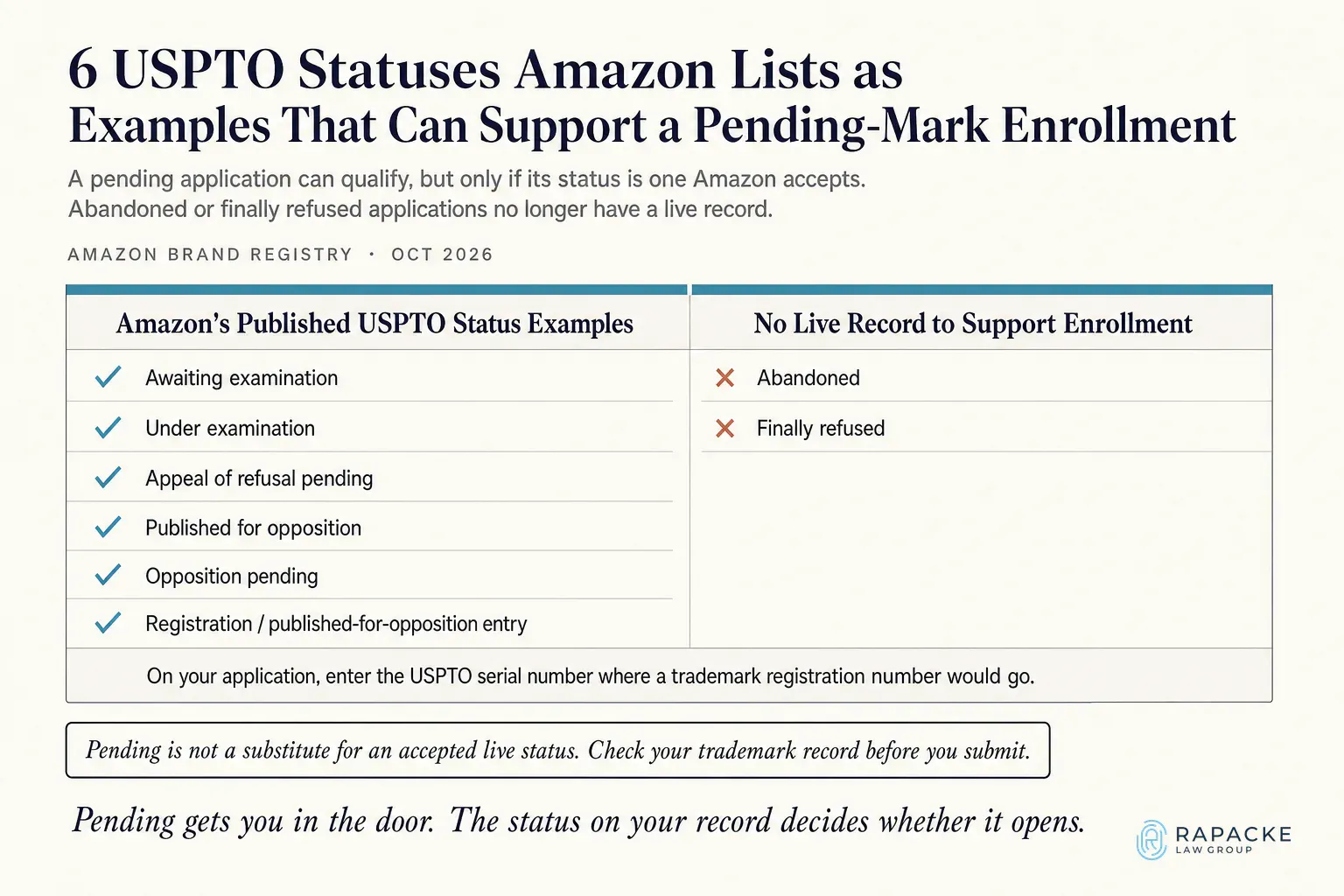
Yes. You can enroll with an eligible pending trademark application. Amazon accepts pending applications filed directly with the United States Patent and Trademark Office (USPTO) or through its IP Accelerator. On your brand registry application, enter the USPTO serial number where a trademark registration number would go. Amazon then checks that trademark record for an accepted status, such as under examination or published for opposition, according to its published status table.
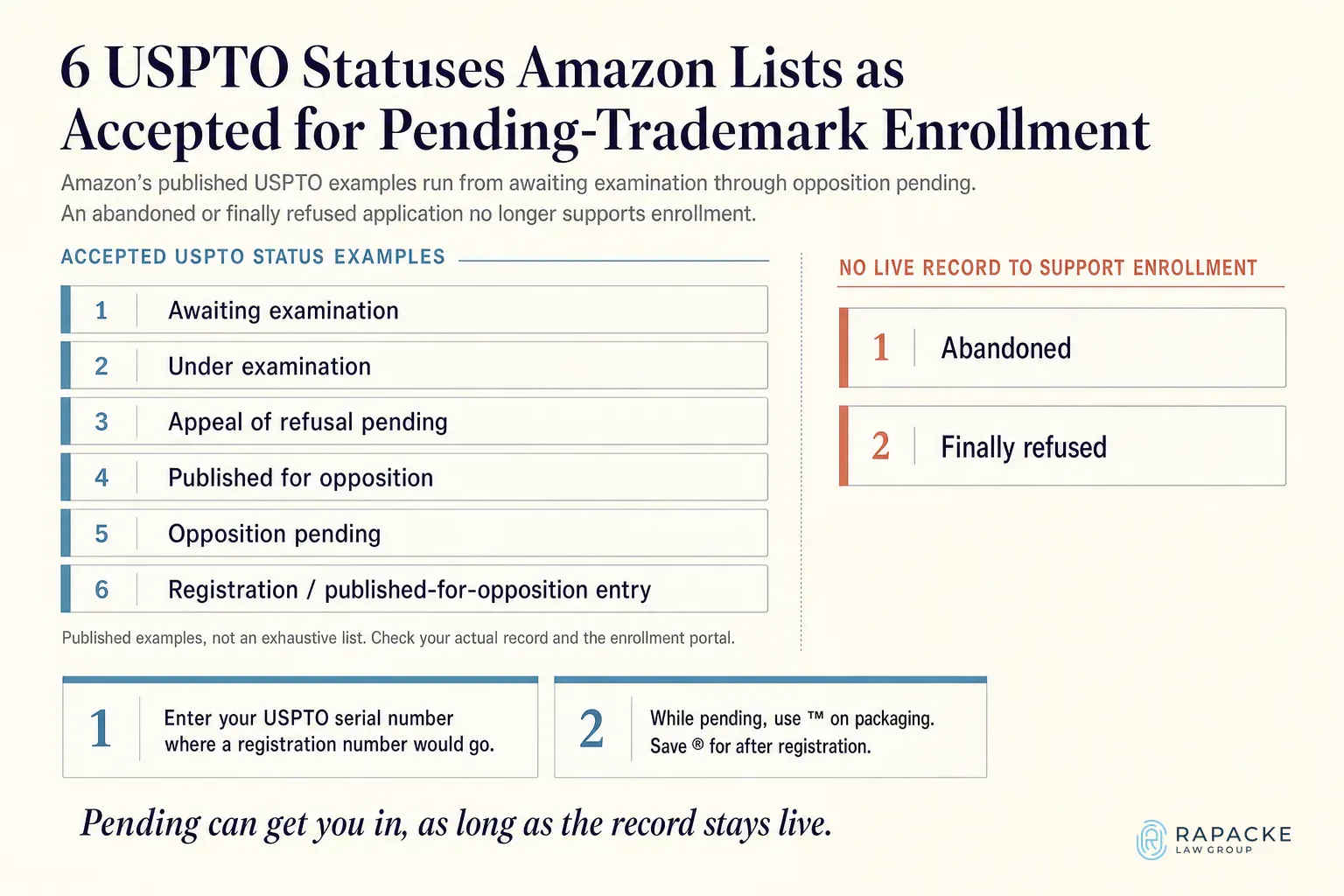
Pending status comes with limits. Amazon states that individual tools carry their own requirements, so enrollment does not guarantee every feature. Its USPTO list includes "appeal of refusal pending" as an accepted status. Once an application is abandoned or finally refused, however, you no longer have a live record to support enrollment. While your pending trademark registration moves through examination, use the ™ symbol on your packaging and save ® for after registration. Our guide to trademark icon mistakes explains why misusing ® can backfire.
The Amazon IP Accelerator program connects you with vetted legal service providers. They respond within two business days and tell you when you can enroll. Amazon caps their fee for a US filing at $700 plus government fees.
No workaround replaces a trademark filing. A few tools can still cover gaps while you build toward one.
The faster fix is the Amazon IP Accelerator program. According to Amazon, its vetted legal service providers charge no more than $700 plus government fees to file a U.S. application. Amazon also confirms that an eligible pending trademark application can qualify for enrollment, whether you file it through IP Accelerator or directly with the trademark office. That makes filing now your best route to Amazon Brand Registry approval.
If you’re ready to start selling on Amazon, you can do so without needing to enroll in the Amazon Brand Registry. Just remember that no seller can enroll Amazon Brand Registry without trademark filing in place. However, enhancing your brand presence on Amazon is crucial for maintaining brand control over your products and visibility in the marketplace. Registering a trademark enables you to register with the Amazon Registry and provides you with an extra layer of protection. Schedule a free consultation today and let our team of experienced lawyers help you register your trademark.
Selecting the right trademark attorney is crucial for securing your brand on Amazon. A skilled attorney can expertly navigate the trademark registration process, ensuring your brand is protected and ready for growth. At The Rapacke Law Group, we offer the RLG Guarantee, which provides peace of mind and underscores our confidence in delivering successful trademark registrations.
No, you cannot enroll Amazon Brand Registry without trademark filing of some form. Amazon requires an active registered trademark or an eligible pending trademark application from a designated government trademark office. You can file directly with the trademark office or through the Amazon IP Accelerator program.
No. Amazon's seller registration guide lets you choose "None, I am an individual" as your business type. You still have to pass Amazon's registration and identity checks.
Create a Seller Central account, select your business type, and complete identity verification, according to Amazon's registration guide. After you file a trademark, sign in to Brand Registry with those same Seller Central credentials so the two accounts link, as Amazon's Brand Registry requirements explain.
Amazon says Amazon Brand Registry approval can take several weeks or longer, even with an existing trademark. Watch for the verification email sent to your trademark's designated contact. Amazon's live guidance gives that contact seven days to confirm before the application is declined.
Yes, if its status is one Amazon accepts. For USPTO filings, Amazon's published examples include statuses from awaiting examination through published for opposition. Check your trademark record before you submit your brand registry application.
Take the first step towards protecting your Amazon brand by scheduling a free trademark strategy call with our team. During this call, we'll discuss your brand's unique needs and outline a tailored strategy to secure your trademark.Contact us today to learn more about how we can help you build a strong Amazon brand and safeguard your business's future.
By partnering with The Rapacke Law Group, you can ensure your brand is protected and positioned for success on the Amazon platform.
Amazon will not let you into Brand Registry without a trademark filing, but a well-prepared pending application gets you enrolled months before your certificate arrives. The sellers who win on Amazon file early, file clean, and enroll fast enough to capture the New Seller Incentives.
The bottom line: A weak trademark position means no filing, a design-only logo, or a sloppy application that triggers surcharges and office actions. A strong position means a distinctive word mark, filed in the right classes, that gets you into Brand Registry while it is still pending and holds up when a hijacker challenges your listing.
Every month without a filing is a month a copycat can undercut your listing with no enforcement tools standing in the way. Wait too long and you may also miss the six-month enrollment window tied to up to $52,500 in referral fee credits. Rebranding after a conflict surfaces costs far more than a clearance search today.
A $350-per-class filing fee is small next to what a registered brand unlocks, including up to a 20% sales lift Amazon attributes to Premium A+ content and the enforcement tools that keep counterfeiters off your listings. With our flat-fee trademark service and the RLG Guarantee, you get your trademark approved or pay nothing, so the only real risk is waiting.
To Your Success,
Andrew Rapacke
Managing Partner, Registered Patent Attorney
[RLG]Free strategy call
Talk it through with a registered patent attorney.
[01]Keep reading
Filing a trademark is the cornerstone of any successful brand protection strategy on Amazon. Without federal trademark registration or a pending application at the US…

A private-label seller woke up to find her Amazon listing locked. A competitor had filed for her brand name at the USPTO, claimed ownership through the Brand Registry…
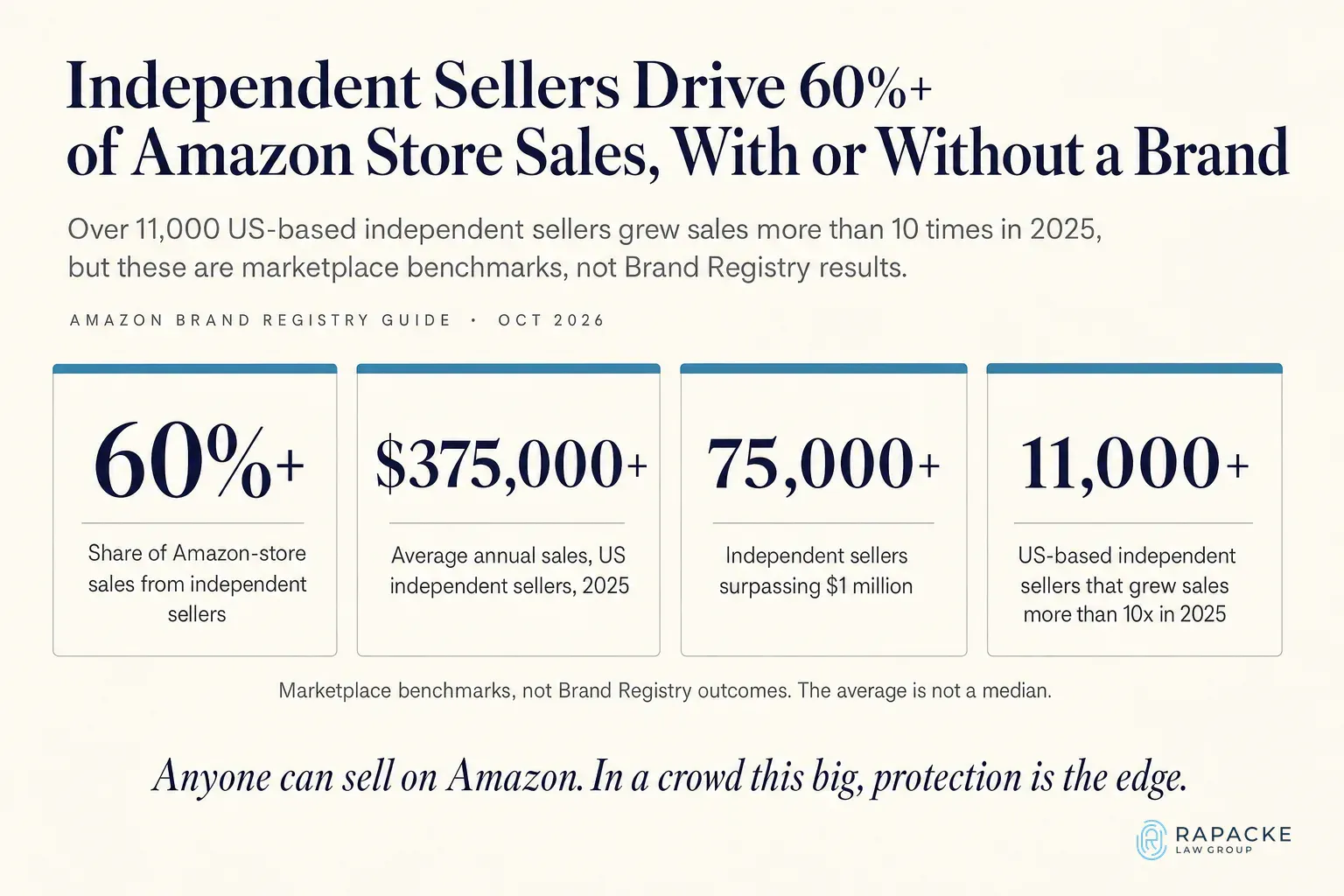
More than 60% of sales in Amazon’s store come from independent sellers. Here is why Amazon sellers need a trademark, how to file one, and how Brand Registry, IP Accelerator and Project Zero protect your brand…
The #1 top reviewed IP law firm.* Talk to a registered patent attorney, free.
*#1 top reviewed means the most public client reviews on Google, Trustpilot and Avvo of any US patent or trademark firm.