


How to Own the Rights to a Name: The Step-by-Step Legal Blueprint
Learn how to own the rights to a name through common law use, USPTO registration, state filings, and domain protection. Read the step-by-step guide now.
[ARTICLE]Trademarks

Facebook's parent company paid $60 million for the rights to "Meta" rather than fight the regional bank that already owned the name. Most founders can't buy their way out of a naming conflict. For them, the first warning is often a cease-and-desist letter that forces a rebrand after they've paid for the domain, packaging and marketing. The USPTO received 787,795 trademark application classes in FY 2022, and its annual reports show similar volume year after year, so overlap is a real risk in almost every industry.
This guide shows you how to run a free trademark search without a trademark attorney. You'll use the United States Patent and Trademark Office's current search tool, which replaced the Trademark Electronic Search System (TESS) in 2023. The clearance matters because federal trademark registration gives your brand legal protection nationwide.
Our trademark services come with The RLG Guarantee. That means a full refund if the USPTO denies your trademark application.
The most reliable way to determine if a company name is trademarked is through theUSPTO’s Trademark Electronic Search System (TESS), the official USPTO trademark search tool, which provides free access to all federally registered trademarks and pending applications. However, federal registration represents only one layer of protection. A comprehensive search involves checking federal, state, and common law sources to identify potential conflicts before registering a trademark.
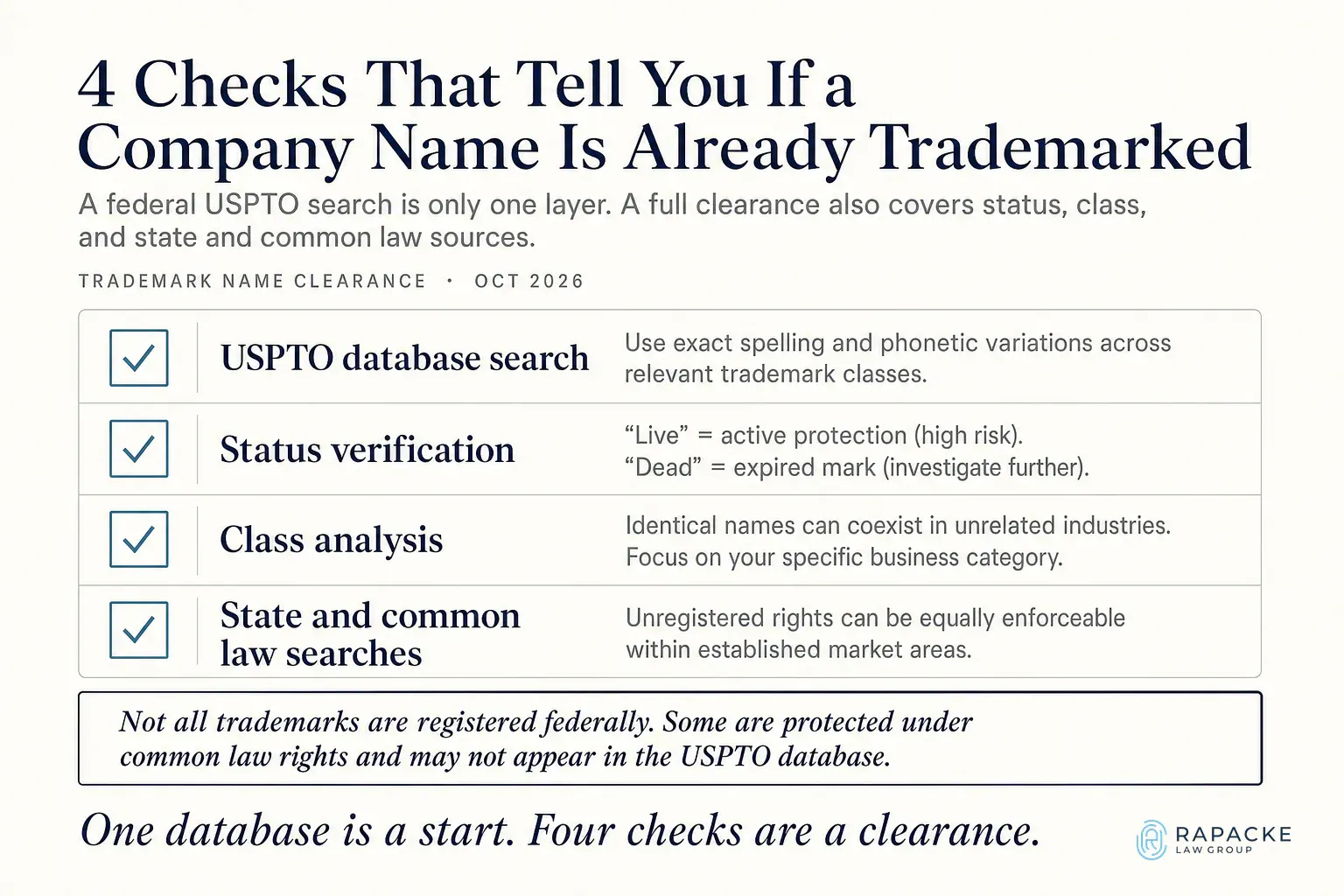
Essential search steps include:
It’s essential to note that not all trademarks are registered federally; some are protected under common law rights and may not appear in the USPTO database.
Company names gain common law trademark protection when used in commerce to identify and distinguish goods or services from competitors. The distinction between trade names and trademarks is significant: trade names identify the business entity for corporate purposes, while trademarks specifically protect names used to distinguish the source of products or services.
Federal registration through the USPTO provides nationwide exclusive rights within specific business categories. Intangible assets, such as brands and trademarks, now account for approximately 90% of the market value of S&P 500 companies, underscoring the strategic importance of effective trademark protection.
Common law trademark rights arise automatically when businesses use distinctive names in commerce, even without formal registration. These unregistered rights can be enforced locally or regionally, though proving ownership becomes more challenging than with registered marks. The famous Burger King case illustrates this principle: a local Illinois diner successfully defended its “Burger King” name against the national chain, creating a 20-mile exclusion zone where the corporation cannot operate under that name.
What is a trademark? A trademark is a word, phrase, logo, or symbol that identifies the source of your goods and sets them apart from competitors. It protects your brand identity in the marketplace, not the product itself.
Three related terms often get confused. A trade name is your legal business name, the one on your formation documents. A trademark identifies products, while a service mark identifies services. Registering a trade name with your state does not, by itself, give you trademark rights.
The ® symbol marks a registered trademark. Only owners of a federal trademark registration with the United States Patent and Trademark Office (USPTO) may use it. The ™ symbol signals an unregistered claim based on common law rights from use in commerce. Those rights mean a reliable trademark search has to reach beyond the federal database to state trademarks and real-world use.
Trademarks are only one of the four types of intellectual property, and founders often mix them up. A utility patent protects new machines, processes and software methods. A design patent protects invention design aspects, such as the ornamental shape of a product or a distinctive user interface. Copyright covers creative works like code and content. If you run a free copyright search, search results show registered books, software and artwork, not brand names.
To see if a name is trademarked, run a free trademark search in the United States Patent and Trademark Office (USPTO) database and review every live record for the same or similar wording in your industry. The steps below show exactly how.
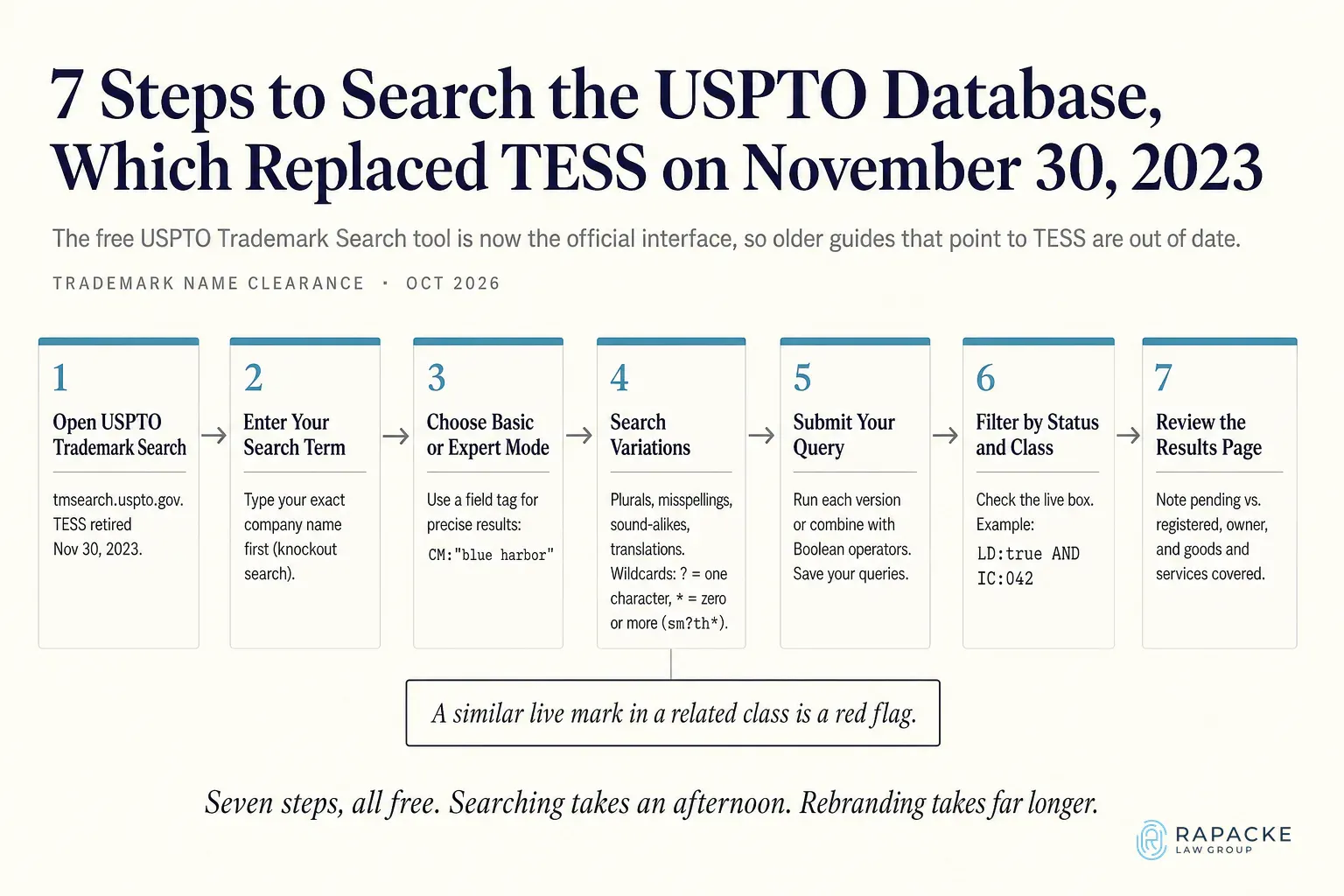
Go to USPTO Trademark Search. It replaced the old Trademark Electronic Search System (TESS), which the trademark office retired on November 30, 2023, beginning at 11:59 p.m. ET. The USPTO's trademark search announcements page confirms the new cloud-based application is now the official search interface. Older guides that send you to TESS are out of date. For a deeper walkthrough, see our guide to trademark and patent office search tools.
Type your exact company name first. This knockout search surfaces obvious conflicts that would sink a trademark application before you spend a dollar on filing fees.
The USPTO's Getting Started guide describes two modes. Basic works like a basic word mark search, with simple drop-downs such as Wordmark and Goods and Services. Expert adds class filters and result tagging. A multiword name in the Wordmark drop-down is not an exact-phrase search, because the system treats each word as a separate term. Use a field tag such as CM:"blue harbor" for precise results, following the syntax in the USPTO's field tag searching handout.
Exact matches are only the start. Phonetic similarity drives many disputes. Search these variations:
? replaces one character and * replaces zero or more characters (sm?th* catches Smith, Smyth and Smithfield)According to the USPTO's Transitioning from TESS to the new search system guide, a space between terms acts as OR. Use AND to require both words.
[RLG]Free strategy call

Talk it through with a registered patent attorney.
Free 15 to 45 minute IP strategy call, no obligation.
Run each version separately or combine them with Boolean operators. Save your queries so you can repeat the trademark search before filing.
Check the live box to remove dead records. In Expert mode, narrow by international class. Field-tag searches need these limits in the query itself, such as LD:true AND IC:042 for live software and tech service marks.
Open each match. Note whether it is a pending application or a registered trademark, who owns it, and which goods and services it covers. A similar live mark in a related class is a red flag for legal issues and weak trademark protection.
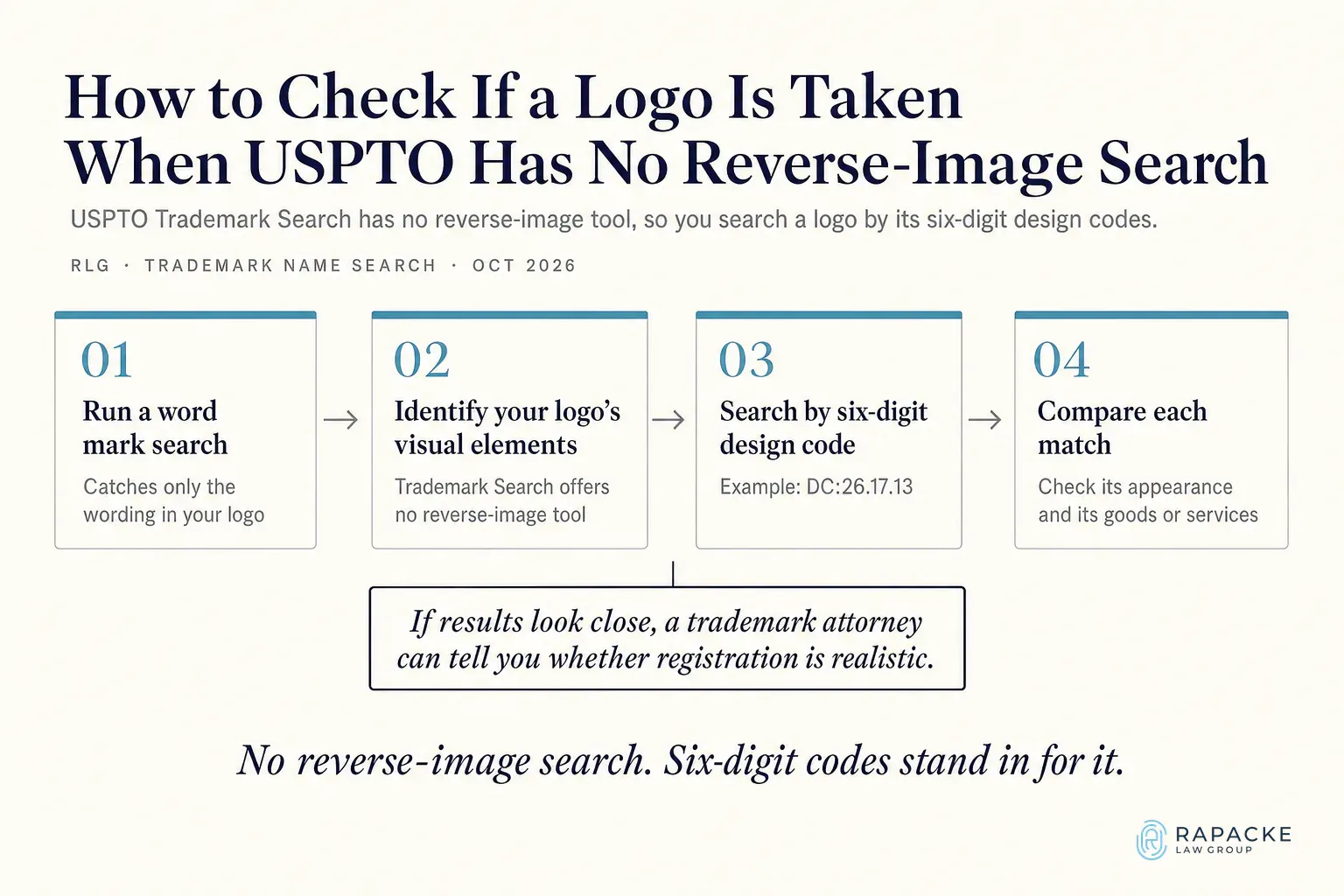
Checking a logo? The tool has no reverse-image search. Identify your logo's visual elements, find their six-digit design codes, and search them (for example, DC:26.17.13). If results look close, a trademark attorney can tell you whether your trademark registration and legal protection are realistic.
A clean result for your exact name means little until you know which class it falls in. U.S. trademark law sorts every product and service into the Nice Classification system, which comprises 45 classes. Classes 1 through 34 cover goods, and Classes 35 through 45 cover services. To find yours, look up your offering in the USPTO's Trademark ID Manual. It lists pre-approved descriptions of goods and services along with their class numbers. Software companies typically land in Class 9 (downloadable computer programs) and Class 42 (software as a service and software design and development).
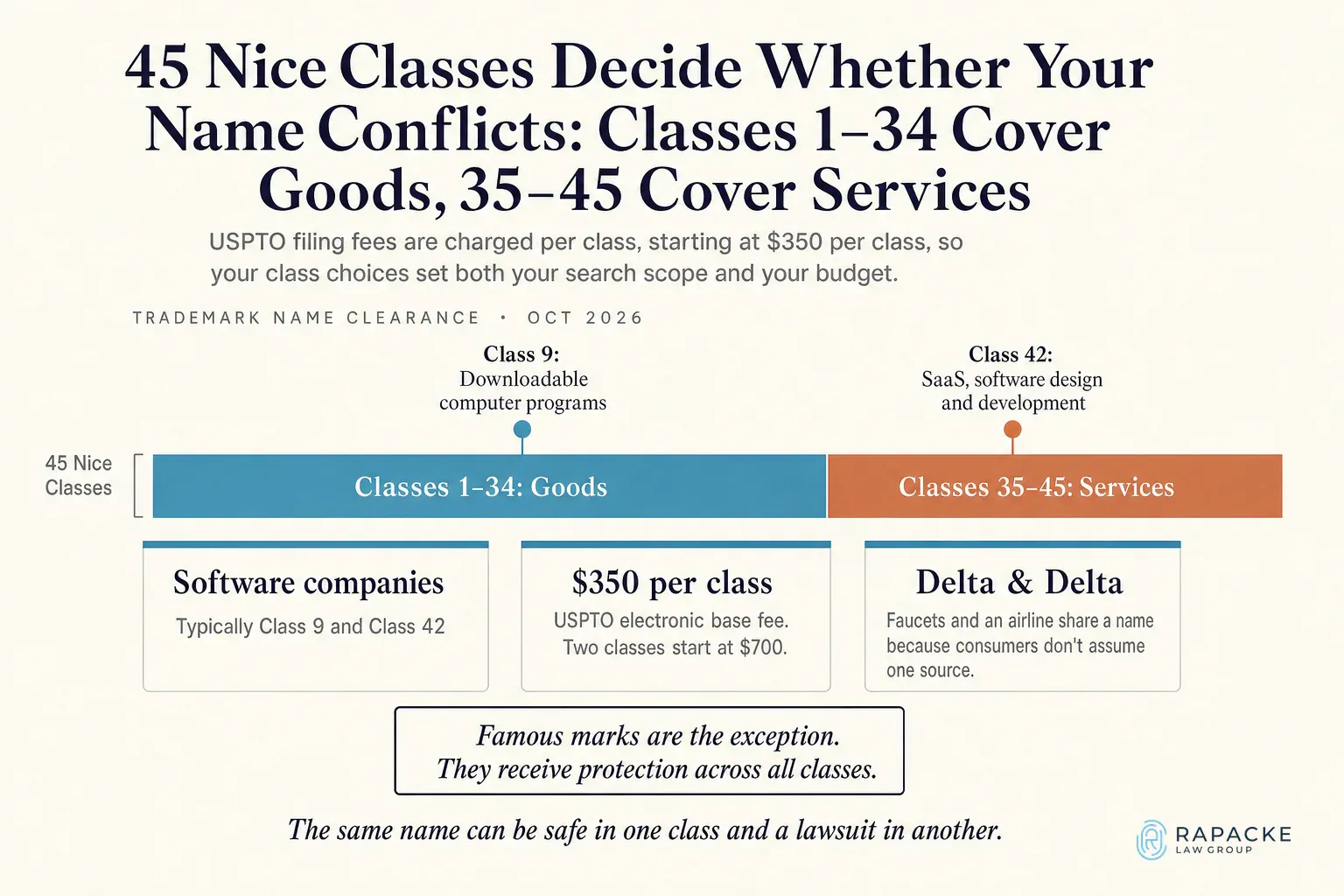
Because USPTO filing fees are charged per class, choosing classes shapes both your search scope and your budget. The USPTO's goods and services guidance explains how identifications work, and our breakdown of trademark service classes shows how modern brands file.
Classes explain why identical names can coexist. Delta makes faucets, and Delta runs an airline, yet consumers don't assume one company provides both. The trademark office measures this risk by asking whether consumers might reasonably expect goods or services to originate from the same source. Famous marks are the exception. A famous mark can receive broader protection beyond related goods or services, through likelihood of confusion or, if the mark qualifies as famous under federal law, dilution by blurring or tarnishment, so borrowing one for an unrelated business still invites trouble.
Different classes do not guarantee safety. Coffee and tea brands can conflict because they share store shelves and buyers. Before you file a trademark application, run your trademark search in every class that covers your current products and logical expansions. Then weigh complementary products, shared distribution channels and overlapping customers.
Federal registration represents only one layer of protection. State trademark databases and common law usage can create equally enforceable rights within specific geographic markets. In trademark disputes or legal proceedings, each party must demonstrate its rights and proper use of the mark.
Each state maintains its own separate trademark registry, typically through the office of the Secretary of State. State registration grants protection only within state boundaries, but it can block your use in those markets. Many small businesses opt for state-only registration because it's faster and less expensive than federal filing, particularly for locally focused operations.
Search state databases in any region where you plan significant business operations. State business entity records (corporate and LLC registrations) also provide valuable intelligence about existing business names, even without formal trademark protection.
Common law trademark rights develop through actual business use rather than registration, making them invisible in official databases but legally enforceable within established market areas. Comprehensive due diligence requires detective work across multiple channels:
Essential standard law search methods:
Modern trademark disputes increasingly involve digital assets. Active use of domain names matching your proposed company name signals potential common law rights, even without formal registration. Similarly, established social media accounts with business content provide evidence of commercial use.
Secure relevant domains as soon as you confirm name availability. Cybersquatting remains a persistent threat—unscrupulous actors register business names as domains, hoping to sell them at inflated prices.
Search results require sophisticated legal analysis to determine the actual risk of infringement.The USPTO provides specific guidance on likelihood of confusion factors; however, practical application requires an understanding of how courts weigh competing evidence. Conducting a trademark search before submitting a trademark application can help prevent conflicts and refusals.
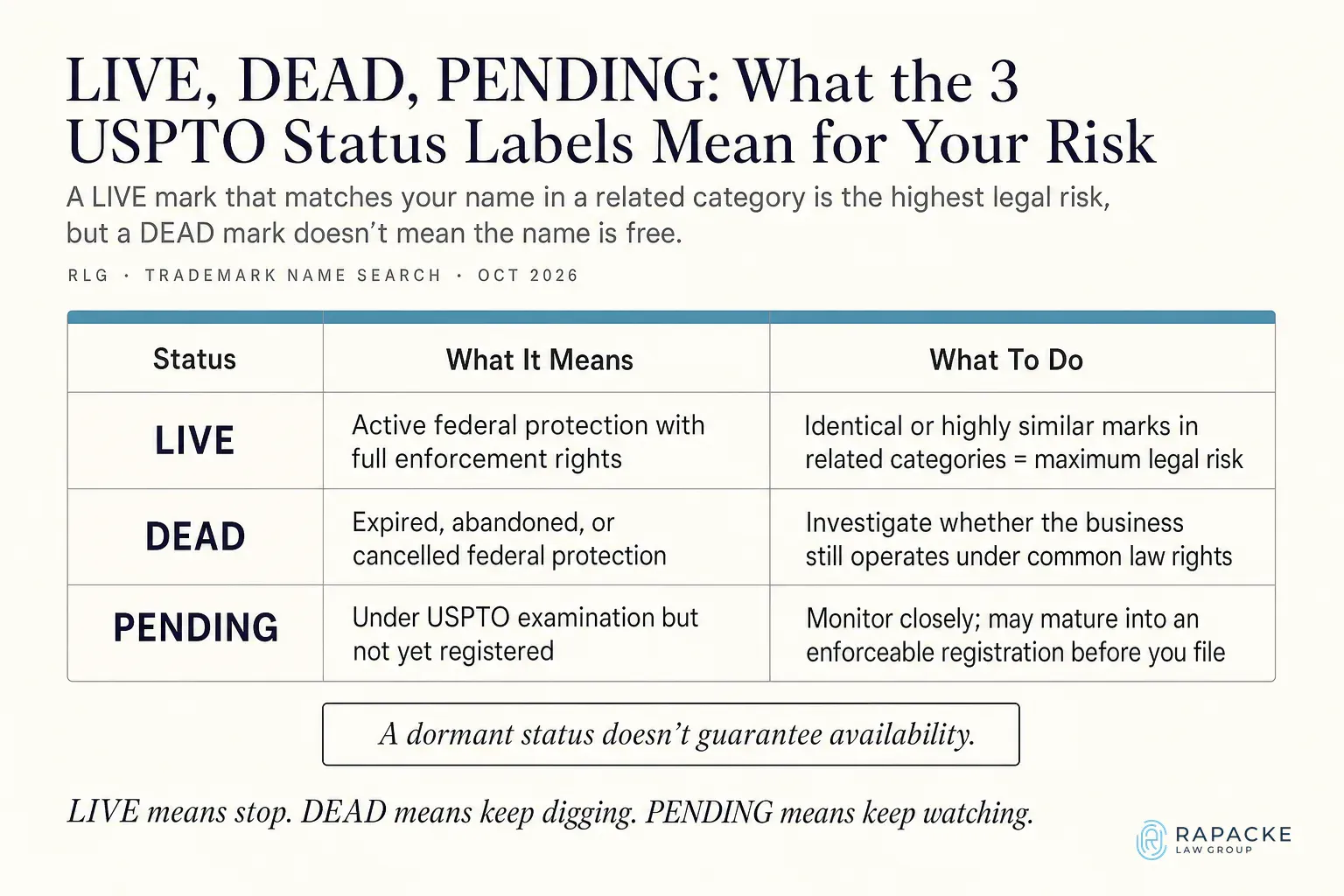
"LIVE" registrations: Active federal protection with full enforcement rights. Live marks that are identical or highly similar to your name in related categories present the maximum legal risk.
"DEAD" registrations: Expired, abandoned, or cancelled federal protection. However, a dormant status doesn't guarantee availability—investigate whether the business continues to operate under common law rights.
"PENDING" applications: Under USPTO examination but not yet registered. Monitor pending applications closely, as they may mature into enforceable registrations before you can file.
Courts and the trademark office use multi-factor tests, such as the DuPont or Polaroid factors, to decide whether two marks could confuse buyers. In plain terms, they ask two questions:
Famous marks reach beyond their registered classes. A coined brand name also earns broader protection than descriptive terms or common surnames. Our guide to trademark requirements explains how distinctiveness affects registrability.
Can you still use a name if it is trademarked? Often yes, in an unrelated industry where no customer would confuse the two. It is not safe in the same or a related class. The USPTO's clearance guidance flags confusing similarity for related goods as the core problem. Crossing that line invites infringement claims and costly legal issues.
Complex search results with multiple similar marks warrant professional legal analysis. Trademark attorneys provide comprehensive clearance opinions typically costing $1,000-$3,500, but this investment prevents far costlier disputes later. Trademark lawyers can also assist with trademark searches, applications, and communications with the USPTO.
Online trademark search services offer middle-ground options for $150-$600, providing detailed reports that cover federal, state, and common law findings without requiring the assistance of a lawyer.
A clean search result only protects you once you act on it. A competitor can file for the same name while you're still building your product, so move quickly.
Start by filing a federal trademark application with the United States Patent and Trademark Office (USPTO). Choose a use-in-commerce basis if you already sell under the name. Choose an intent-to-use basis to reserve the name before launch. Our step-by-step trademark filing guide walks through each part of the application.
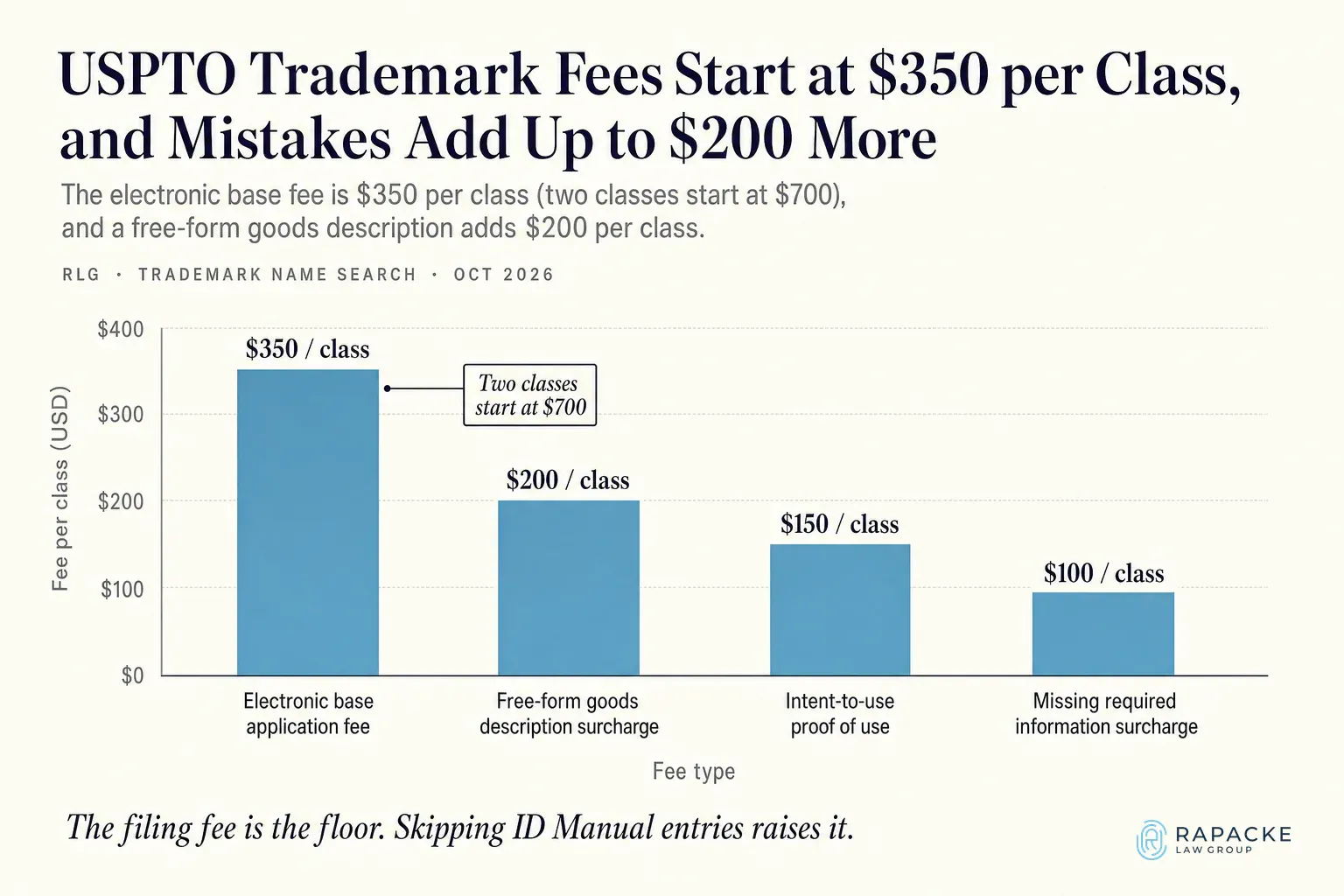
According to the USPTO fee schedule, the electronic base fee is $350 per class, so two classes start at $700. Intent-to-use filers later pay $150 per class to prove use. Under the USPTO's additional fees rules, an application missing required information adds $100 per class, and a free-form goods description adds $200 per class.
Plan for a wait. USPTO processing data shows applications averaged 10.4 months to registration or abandonment as of October 1, 2026.
Federal registration gives a registered trademark three core advantages:
USPTO guidance adds that registration creates a legal presumption of nationwide ownership and places your mark in the federal database, where the next founder running this same search will find it. For the long view, see how to get a trademark that protects your brand from idea to IPO and our guide on how to trademark your business name.
Next, lock down your digital footprint. Register the .com and common misspellings, then claim matching social media handles. Consistent ownership across channels makes it easier to resolve domain name disputes later.
The trademark office registers marks but does not police them. Set alerts for new filings in your classes and document every commercial use. For ongoing brand protection, go to partner programs on each marketplace where you sell and enroll your mark there.
Your name is not the only asset worth protecting before launch. A utility patent protects new machines, processes and software methods behind your product. A design patent protects invention design aspects like a product's ornamental shape. For a hardware launch only weeks away, an expedited design patent best fits that timeline, because the USPTO offers expedited examination for design applications under 37 CFR 1.155. SaaS founders raising capital also get asked about their patent worth. AI powered patent valuation tools can produce a quick estimate, but investors care more about claim scope, which our SaaS Patent Guide 2.0 and AI Patent Mastery resources explain in depth.
U.S. rights stop at the border. The Madrid System lets a single application extend your trademark protection to multiple countries. According to WIPO, one international filing in one language with one set of fees can reach more than 130 countries. You need a U.S. application or registration first, and an international registration lasts ten years with indefinite renewals.
Start with the free, official USPTO Trademark Search, run by the United States Patent and Trademark Office. It replaced the old Trademark Electronic Search System (TESS) in November 2023. The USPTO recommends also checking state registries and the internet, because a federal search misses common law users.
A basic word mark search only catches the wording in your logo. According to the USPTO's search handout, Trademark Search offers no reverse-image tool. You search the logo's visual elements by six-digit design code instead. Then compare each match's appearance and its goods or services.
The USPTO fee schedule sets the electronic base trademark application fee at $350 per class, so two classes start at $700. Under the USPTO's additional fees rules, typing your own free-form description instead of selecting an ID Manual entry adds $200 per class. Attorney fees for clearance and trademark registration are separate.
No, because the U.S. Copyright Office states that names are not protected by copyright. If you run a free copyright search, search results will show registered works like books, code and artwork, not brand names. That search tells you nothing about whether a registered trademark already covers your company name. For legal protection of a business name, search trademark records and rely on trademark law.
Your company name carries your customer recognition, so clear it in the right order. Start with a free trademark search in the USPTO database. Then narrow the results to your class and related classes. Next, check state registrations and common law use. Finish with domains and social handles.
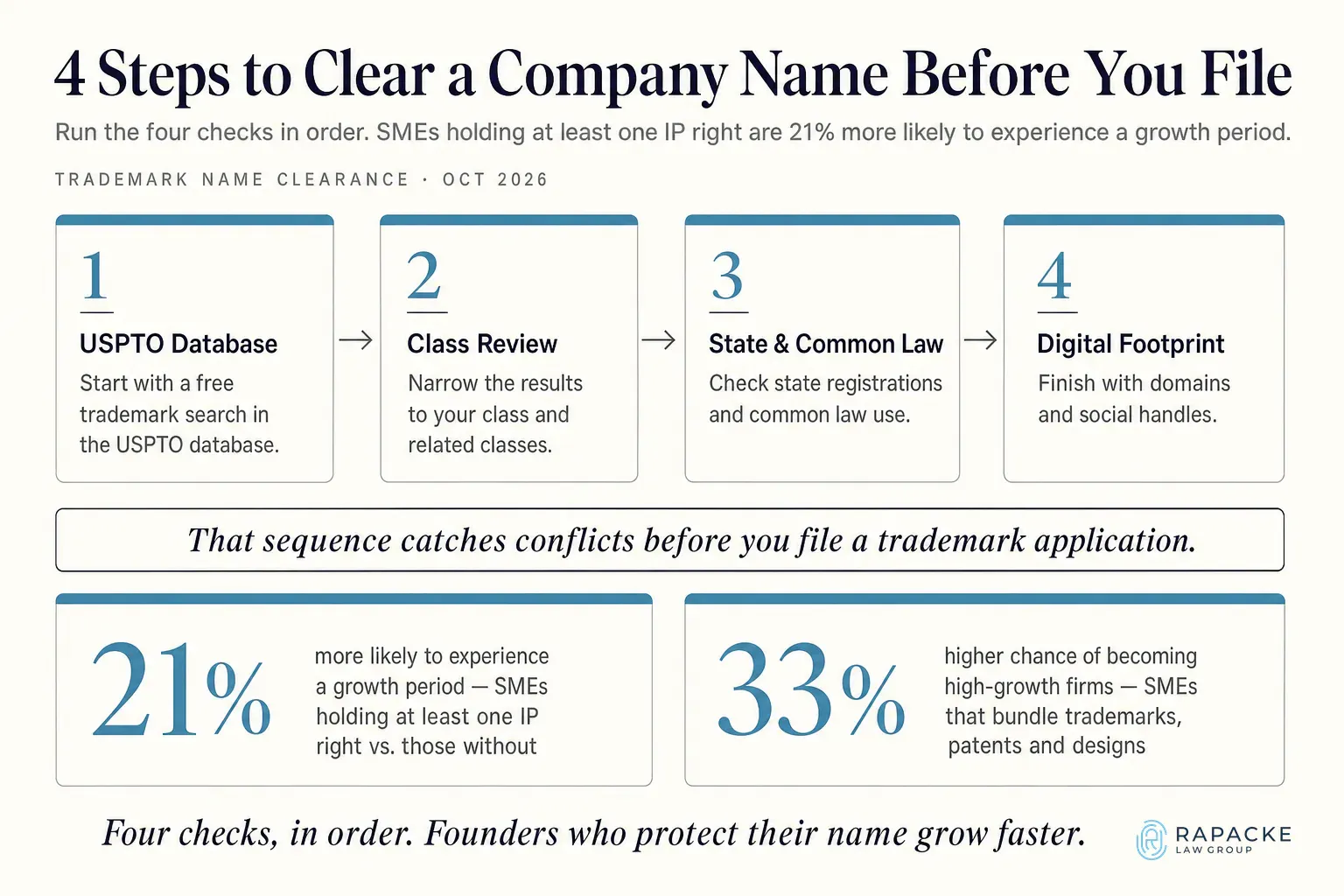
That sequence catches conflicts before you file a trademark application. According to a joint EPO and EUIPO study summarized by WIPO, SMEs that hold at least one IP right are 21% more likely to experience a growth period than those without IP rights. SMEs that bundle trademarks, patents and designs have a 33% higher chance of becoming high-growth firms. That makes trademark registration a competitive advantage, especially when paired with the right patents. If your product has a signature look, an expedited design patent best protects it while your trademark application moves through examination. Investors will eventually ask about your patent worth. AI powered patent valuation numbers mean little unless the underlying rights are strong, so build your portfolio deliberately.
Before launching your business with that perfect company name, you need to know it's not only available but fully protected. That's why smart entrepreneurs secure federal trademark registration—the gold standard that gives you nationwide exclusive rights and prevents costly legal battles down the road.
Here's what makes our approach different: we guarantee your trademark registration success.
Our Complete Trademark Registration Service:
The RLG Guarantee for Trademark Registration:
Schedule Your Free Trademark Strategy Call
Ready to protect your company name with federal trademark registration? Our experienced trademark attorneys will secure your brand rights and give you the exclusive protection you need to build with confidence.
Schedule Your Free Trademark Strategy Call →
During this consultation, we'll analyze your company name, explain exactly how our guaranteed trademark registration process works, and map out your path to federal protection. You'll get the peace of mind that comes with knowing your brand is legally yours—with zero financial risk.
Don't leave your most valuable business asset unprotected. Secure your trademark rights today.
[RLG]Free strategy call
Talk it through with a registered patent attorney.
[01]Keep reading
Learn how to own the rights to a name through common law use, USPTO registration, state filings, and domain protection. Read the step-by-step guide now.

Learn how to run a trademark and patent office search using free USPTO tools, interpret results, and protect your IP before you file. Get a free strategy call.

A step-by-step trademark filing guide covering USPTO search, filing basis, 2026 fees, and timelines. Book a free IP strategy call to file yours right.
The #1 top reviewed IP law firm.* Talk to a registered patent attorney, free.
*#1 top reviewed means the most public client reviews on Google, Trustpilot and Avvo of any US patent or trademark firm.