


By Andrew Rapacke, Managing Partner, Registered Patent Attorney
Intellectual property‐intensive industries (including trademarks, patents, and copyrights) accounted for approximately $5-7 trillion of U.S. GDP in 2019, with trademark‐intensive industries representing a significant portion of this contribution. Yet, most business owners drastically underestimate the cost of securing federal protection for their brands. Federal registration provides nationwide rights and is the focus of the cost analysis in this guide. With over 767,000 trademark classes filed in FY 2024 alone, the stakes have never been higher, and neither have the fees.
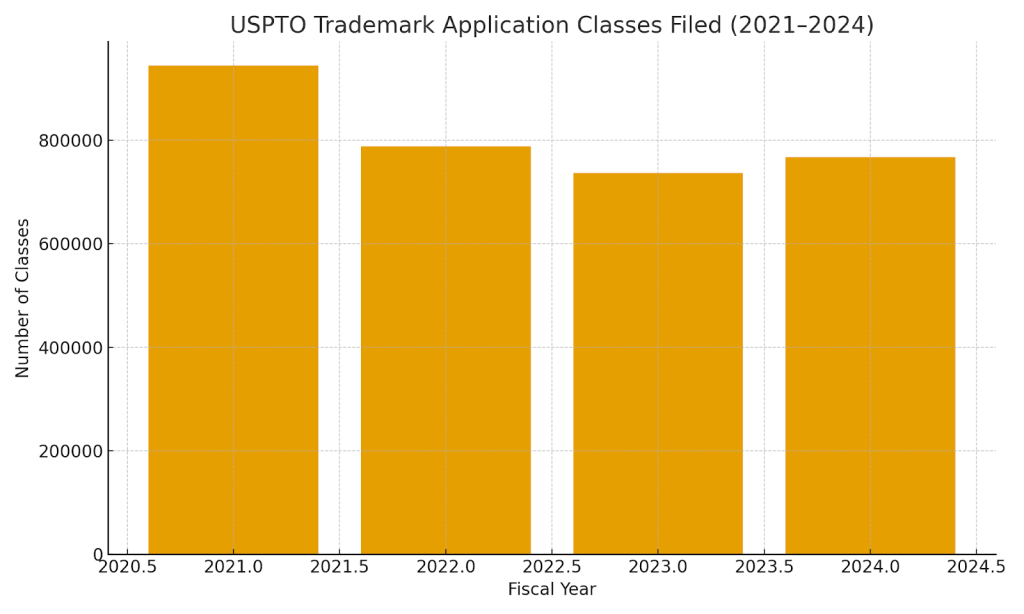
Figure 1: New trademark application classes filed in the U.S. by fiscal year, showing the 2021 surge, the 2022 correction, and the rebound by FY 2024.
The USPTO implemented sweeping fee changes in January 2025 that eliminated the budget-friendly TEAS Plus option and introduced a new minefield of surcharges. What used to cost $250 per class now starts at $350, which is now the basic cost for filing a trademark application for a single class. A single misstep in your application can trigger penalties ranging from $100 to $400 per class. Even more concerning: only 46% of self-filed applications ultimately succeed in registration, compared to roughly 60% for those filed by attorneys.
This guide breaks down the complete cost structure: from the base USPTO fees to hidden surcharges, attorney expenses, and decades of maintenance requirements. You’ll learn how to budget accurately and avoid the costly mistakes that derail thousands of trademark applications every year.
This is precisely why Rapacke Law Group created The RLG Guarantee—the industry’s only trademark registration program that offers a 100% refund if your trademark is rejected. While other firms charge hourly fees that balloon with every Office Action, our flat-fee model covers the entire process from search to registration, including unlimited Office Action responses. You either get your trademark approved or you pay nothing.
Current USPTO Trademark Filing Costs
The United States Patent and Trademark Office significantly restructured its fee system, effective January 18, 2025, fundamentally changing how applicants pay for trademark protection. Understanding current fees is essential to accurately budgeting your intellectual property protection strategy. The basic filing fees are set by the trademark office, USPTO, and are determined by the number of classes of goods and services selected in your application.
The base electronic application fee is now $350 per class of goods or services for Section 1 or 44 applications. This $350 is the basic filing fee for each class of goods and services, based on international classes recognized by the USPTO. This unified fee replaced the previous two-tier system. As the USPTO acknowledged, this change “increases the cost of filing for many applicants because it eliminates the $250/class TEAS Plus option”.
For international applications filed through the Madrid Protocol (Section 66(a)), the USPTO charges $600 per class, increased from $500 to reflect additional coordination with the World Intellectual Property Organization. International classes are used to categorize goods and services for trademark registration worldwide. Paper applications, permitted only in exceptional circumstances, carry a substantial surcharge of $850 per class to discourage manual submissions.
The per-class fee structure means costs multiply quickly. Protecting a brand name across three categories (clothing, online retail, and cosmetics) would cost $1,050 in basic USPTO fees alone. According to USPTO data, businesses filed over 767,000 trademark classes in FY 2024, a 4% increase from the prior year, demonstrating both the high demand for brand protection and the revenue generated by these fees.
Breakdown of USPTO Application Types and Fees
Understanding the different application types helps you select the most cost-effective filing strategy for your situation. Applicants must choose the appropriate application form, such as the online TEAS application form or the paper form, each with its own cost implications.
Most applications are submitted through the Trademark Electronic Application System (TEAS), the USPTO’s preferred online platform.
Current Electronic Filing Options
| Application Type | Cost per Class | Key Features |
| Base Application (Sections 1 or 44) | $350 | Standard electronic filing for use-based, intent-to-use, or foreign-based applications. |
| Madrid Protocol (66(a)) | $600 | International application fee for extension to the U.S. via WIPO. |
| Paper Filing | $850 | Only allowed by petition in extraordinary cases. |
The old TEAS Plus system (which had a $250 fee) has been eliminated. All electronic applications now start at $350/class. However, new surcharges in 2025 effectively recreate a two-tier structure.
New Surcharge Structure (2025)
The USPTO now imposes several additional surcharges designed to encourage complete and accurate filings:
Insufficient Information Surcharge: $100 per class if your initial application is missing any required element for a complete filing. Failing to include proper entity information or a verified signature triggers this fee.
Custom Description Surcharge: $200 per class for using a free-form description of goods/services instead of picking only from the USPTO’s pre-approved ID Manual entries. This penalty applies when you write your own product descriptions rather than using standard classifications.
Length Surcharge: $200 per class for each additional 1,000 characters in the description of goods/services beyond the first 1,000. If your description runs over roughly 200 words, expect another $200 per class for every block of 1,000 characters.
These surcharges stack aggressively. An application using custom descriptions (adding $200) that runs 1,500 characters (another $200) would cost $750 per class instead of $350: more than double the base fee.
Avoiding Surcharges: The TEAS Plus Workaround
While the formal TEAS Plus option no longer exists, you can still avoid all surcharges by following TEAS Plus-like best practices:
- Use only pre-approved goods/services descriptions from the USPTO’s Trademark ID Manual.
- Provide all required information and a complete, accurate application upfront.
- Communicate electronically and agree to email correspondence.
- Keep descriptions concise (under 1,000 characters per class).
Meeting these requirements qualifies your filing as a “stand-alone base” application with no surcharges. Working with experienced IP counsel like Rapacke Law Group can help you navigate these requirements and avoid unnecessary charges, ensuring you pay only the base $350 fee under our fixed-fee model, which includes strategic preparation to avoid all surcharges.
Additional USPTO Fees You May Encounter
Beyond the base application fee, several contingent government fees can significantly impact your total costs depending on your filing basis and examination requirements.
Statement of Use (SOU) Filing
If you filed on an intent-to-use (Section 1(b)) basis, you must file a Statement of Use after USPTO approval to prove you’ve begun using the trademark. The SOU costs $150 per class, recently increased from $100. You have six months from the Notice of Allowance to submit this filing.
The consequences of missing this deadline are severe. In fact, 84% of published intent-to-use applications that ultimately fail to register do so because the applicant never filed a Statement of Use. This represents thousands of abandoned applications annually and thousands of wasted filing fees.
Extension Requests
If you’re not ready to use the mark within the first six-month window, you can request up to five 6-month extensions. Each extension request is $125 per class. Using all five would add $625 in extension fees per class. The extension fee remained at $125 in 2025, one of the few fees that USPTO did not increase.
First Office, Action Responses
Responding to an examiner’s Office Action doesn’t incur a USPTO fee itself, but these challenges create significant additional expenses. Most trademark applications receive at least one Office Action during examination, whether for simple corrections or substantive refusals. The cost comes in attorney fees to craft legally persuasive responses.
Responding to an examiner’s Office Action doesn’t incur a USPTO fee itself, but these challenges create significant additional expenses that traditional law firms love to bill for. Most attorneys charge $1,500 to $3,500 per Office Action response—and since over 60% of applications receive at least one Office Action, this “hidden” cost catches many applicants off guard.
This is where The RLG Guarantee transforms the equation. Our flat-fee trademark registration includes unlimited Office Action responses at no additional cost. Whether you receive one Office Action or five, your price stays the same. Traditional firms profit when your application hits obstacles; we only succeed when you get registered.
Petition and Revival Fees
If your application is deemed abandoned, a Petition to Revive costs $250 (per application) as of 2025, up from $150 previously. This requires proving the delay was unintentional. A Petition to the Director (to review an examiner’s procedural decision) is $400. These “last resort” options underscore the importance of meeting all deadlines.
Amendment Filings
Filing an Amendment to Allege Use (AAU) costs $150 per class. Dividing an application (splitting out certain classes) costs $100 per new application created. While many amendments don’t carry fees, substantive changes that require republishing can incur additional charges.
Intent-to-use filings often cost significantly more than use-based filings due to the $150 SOU fee plus potential extensions. Careful preparation and proactive deadline monitoring can save hundreds or thousands in these contingent fees.
Trademark Attorney Costs and Services
While self-filing is legally permissible, the complexity of trademark law makes professional representation a high-value investment for most applicants. The data is compelling: applications filed by attorneys have significantly higher success rates; only about 46% of pro se applications ultimately succeed in registration, compared to roughly 60% for those filed by attorneys.
The USPTO’s Commissioner for Trademarks noted in 2024 that roughly “30% of applications are filed pro se… however, the success rate of these applications pales in comparison: about 40% versus 60% for those filed by attorneys.” This success gap often justifies the additional cost.
The Hidden Cost Most Applicants Miss: Office Action Roulette
Here’s what most trademark guides won’t tell you: the application fee is often the smallest part of your total investment. The real budget-buster is Office Actions.
According to USPTO data, most trademark applications receive at least one Office Action during examination. Traditional law firms bill for these separately—typically $1,500- $3,500 per response. A single likelihood-of-confusion refusal requiring evidence gathering and legal argumentation can cost more than your entire original filing.
The RLG Guarantee eliminates this uncertainty:
- One flat fee covers your complete trademark journey
- Unlimited Office Action responses included at no extra cost
- 100% money-back guarantee if your trademark is ultimately rejected
This isn’t just about saving money—it’s about removing the financial anxiety that causes applicants to abandon viable marks when Office Actions arrive. With RLG, you never have to choose between your budget and fighting for your brand.
Comprehensive Trademark Search Services
Before filing, a trademark attorney will usually conduct a thorough clearance search that goes beyond the free USPTO TESS database, including state registries, common law usage, business names, domain names, and phonetic or design variations. Professional search firms charge between $500 and $1,500 for a search report.
Why invest in this? Because discovering a conflict before filing saves exponentially more than discovering it afterward. Realizing a search is far less than fighting an infringement lawsuit or rebranding after launch. At Rapacke Law Group, comprehensive trademark searches are included in our fixed-fee packages, ensuring you understand potential conflicts before investing in filing fees.
Application Preparation and Filing
Trademark attorneys typically charge a flat fee in the range of $1,000 to $2,500 for preparing and filing a trademark application (for one class). This usually includes initial consultation, search review, goods/services strategy, application preparation, specimen review, and correspondence through the filing receipt. According to the AIPLA’s 2021 survey, the average cost for an attorney to conduct a clearance search and file an application was about $2,500.
The True Cost Comparison: RLG vs. The Competition
| Service Component | Cheap Online Services | Traditional Law Firms | Rapacke Law Group |
| Total Cost | $1,847+ | $4,050+ | $1,950 all-inclusive |
| Application Preparation & Filing | $599+ | $1,100+ | ✅ Included |
| Comprehensive Trademark Search | $299+ | $1,200+ | ✅ Included |
| Office Action Responses | $599+ each | $1,400+ each | ✅ Unlimited, Included |
| USPTO Filing Fees | $350 | $350 | ✅ Included |
| 100% Refund if Rejected | ❌ | ❌ | ✅ Guaranteed |
The math is straightforward: With over 60% of applications receiving Office Actions, traditional firms can easily exceed $5,000+ for a single-class trademark. RLG’s $1,950 flat fee covers everything—and if we can’t get you registered, you get your money back.
At Rapacke Law Group, we take a different approach. Our fixed-fee model means you know precisely what you’ll pay upfront, with no hourly billing surprises. Unlike traditional firms that charge $300-$600 per hour with unpredictable final costs, our transparent pricing includes comprehensive search, application preparation, filing, and handling of non-substantive Office Actions—all for one flat fee. This allows you to budget confidently and focus on building your brand, not worrying about escalating legal bills.
Office Action Response Services
Simple, non-substantive Office Actions cost a few hundred dollars if handled on an hourly basis. However, substantive refusals (such as likelihood-of-confusion refusals or descriptiveness refusals) require legal research, drafting arguments, and evidence gathering. It’s not uncommon for an attorney to charge $1,500 to $3,500 per Office Action response.
Consider the math: if you receive two substantive Office Actions (not uncommon for competitive marks), you could pay $3,000-$7,000 in response fees alone—on top of your initial filing costs. This unpredictable billing model is precisely why Rapacke Law Group built The RLG Guarantee with unlimited Office Action responses included. Your total investment is locked in from day one, regardless of how many hurdles your application encounters.
The stakes are high: About half of all applications receive at least one substantive refusal from the USPTO. Successfully overcoming these often depends on skilled legal arguments. Many pro se applicants give up when faced with a refusal; one study noted 44% of applications that couldn’t overcome a first Office Action were filed pro se.
Full-Service Trademark Packages
Many attorneys offer comprehensive packages covering the entire process for $2,000 to $3,500, including initial consultation, clearance search, application filing, and handling non-substantive Office Actions or minor issues. More robust packages (including substantive refusal responses or monitoring through publication) could be $3,000 to $5,000.
Hourly Rate Considerations
Trademark attorneys’ hourly rates typically range from $300 to $600 in large markets (and $200-$300 in smaller markets). Highly experienced IP attorneys in major cities might charge $600 or more per hour. Many individuals and small businesses prefer flat fees for predictability.
Professional help typically doubles or triples the upfront cost of obtaining a trademark. However, as the success rates demonstrate, this investment often pays for itself by preventing costly mistakes, avoiding delays (and the surcharge fees or extensions those delays trigger), and significantly improving the likelihood of registration.
Trademark Maintenance and Renewal Costs
Trademark protection requires ongoing maintenance through specific filings, creating long-term costs that many applicants overlook when budgeting for brand protection.
Initial Maintenance: Sections 8 & 15 (Year 5)
Between the 5th and 6th year after registration, you must file a Section 8 Declaration of Continued Use. The fee for a Section 8 filing is $325 per class (electronic) in 2025, increased from $225. You can optionally file a Section 15 Declaration of Incontestability at the same time. The particular 15 filing is $250 per class, up from $200.
If you file both, the total government fee is $575 per class. Achieving incontestable status under Section 15 is highly recommended, as it provides stronger immunity against particular challenges. Still, it’s only available if there have been no adverse legal decisions and the mark has been used continuously for 5 years.
Critical: Failure to file the Section 8 by the deadline will result in cancellation of your registration. The USPTO does not send reminders; it’s on you to calendar the date. This is why many trademark owners work with firms like Rapacke Law Group that provide ongoing maintenance, monitoring, and deadline tracking to ensure you never miss these critical filings.
Renewal: Section 9 (Year 10 and Every 10 Years)
Between the 9th and 10th year after registration, you must file a Section 9 Renewal to keep the registration active for the next 10-year term. As of 2025, the renewal fee is $325 per class. You also need to file another Section 8 declaration of use at the 10-year mark.
The USPTO allows these to be filed together as a combined Section 8 & 9 filing. The combined filing fee is $650 per class ($325 for Sec. 9 and $325 for Sec. 8), a significant increase from prior years, when the combined fee was $525. Every subsequent decade, the same process repeats.
Grace Periods and Late Fees
The USPTO provides a grace period if you miss a maintenance deadline; you get an extra 6 months, but with a penalty. For the Section 8 or 9 filings, the grace period surcharge is $100 per class. Filing during the grace period is risky; if you miss that window, the registration is dead with no revival option.
Attorney Assistance for Maintenance
Attorneys might charge a flat fee of a few hundred dollars for a Section 8 or 9 filing (often $300–$700, depending on the number of classes and complexity). For trademark portfolios with multiple marks, outsourcing maintenance helps track all deadlines and ensure compliance.
Total 10-Year Costs
For a single-class trademark kept for 10 years, you will pay: $325 (Section 8 at year 5) + $250 (Section 15 at year 5, if chosen) + $325 (Section 8 at year 10) + $325 (Section 9 at year 10). That totals $1,225 over the first decade. Without the optional Section 15, it would be $975. This is in addition to your initial application fees.
Over 10 years, the government fees to maintain one trademark roughly equal or exceed the initial filing cost. For each additional class, those fees multiply proportionally.
Missing a maintenance deadline can be devastating. If your registration is canceled, you may have to start over with a new application, losing your original priority date and incontestability. The USPTO’s fee increases in 2025 for maintenance (Section 8 now $325, up from $225; Section 9 $325, up from $300) reflect the Office’s efforts to cover the costs of policing use and updating the register.
Cost Examples by Type of Trademark
Real-world scenarios illustrate how trademark filing costs vary significantly depending on business needs, industry complexity, the scope of protection, and the type of trademark.
Business Name in a Single Industry
Scenario: A restaurant owner wants to protect their unique restaurant name (word mark) in Class 43 (restaurant services).
- USPTO base filing fee: $350 (1 class, electronic filing)
- Attorney search & application: ~$1,500 (including basic clearance search and application preparation)
- Office Action response budget: $0 to $2,000 (depending on whether refusals arise)
- Total Estimated Cost (Traditional): $1,850 to $3,850+
With The RLG Guarantee: $1,950 flat—including unlimited Office Action responses and a 100% refund guarantee if rejected.
For a relatively straightforward mark in one class, the filing fee itself is only $350. However, many restaurant owners hire attorneys due to the high failure rate of DIY filings, which pushes costs into the few-thousand-dollar range but provides greater confidence in securing registration.
Logo with Design Elements
Scenario: A small company has a distinctive logo and wants to protect both the word mark and the design across two classes of goods.
- USPTO filing fees: $1,400 (2 classes × $350 for each of two applications)
- Comprehensive trademark search: $800 (covering word mark and design clearance)
- Attorney preparation and filing: $2,000 (~$1,000 per application as a package)
- Design complexity add-on: $500 (additional work for design mark description and coding)
- Total Estimated Cost: ~$4,700
Designs require searching not only for word similarities but also for design codes maintained by the USPTO. This example shows that protecting a logo and name can double the cost compared to protecting just a name.
Product Name in Multiple Categories
Scenario: An e-commerce company has a new gadget spanning multiple categories: computer software, a handheld device, and an online service (three classes).
- USPTO filing fees: $1,050 (3 classes × $350)
- Enhanced search (multi-industry): $1,200 (more extensive clearance across different fields)
- Attorney services for complex classification: $2,500 (strategizing and drafting multi-class application)
- Total Estimated Cost: ~$4,750
Multi-class applications increase USPTO fees linearly, but attorney time also increases because each class needs proper identification and strategic consideration.
Band Name with Merchandise
Scenario: An indie band wants to trademark their band name for entertainment services (Class 41) and branded T-shirts (Class 25).
- USPTO filing fees: $700 (2 classes)
- Entertainment industry search: $800 (checking band names and common law uses)
- Attorney services (including ownership structuring): $2,000 (bands often need guidance on member ownership)
- Total Estimated Cost: $3,500
Band trademarks present unique challenges. Many similar names exist, and usage must be demonstrated through recordings or advertising for performances. Attorney guidance helps navigate ownership issues among band members.
Software Trademark with Services
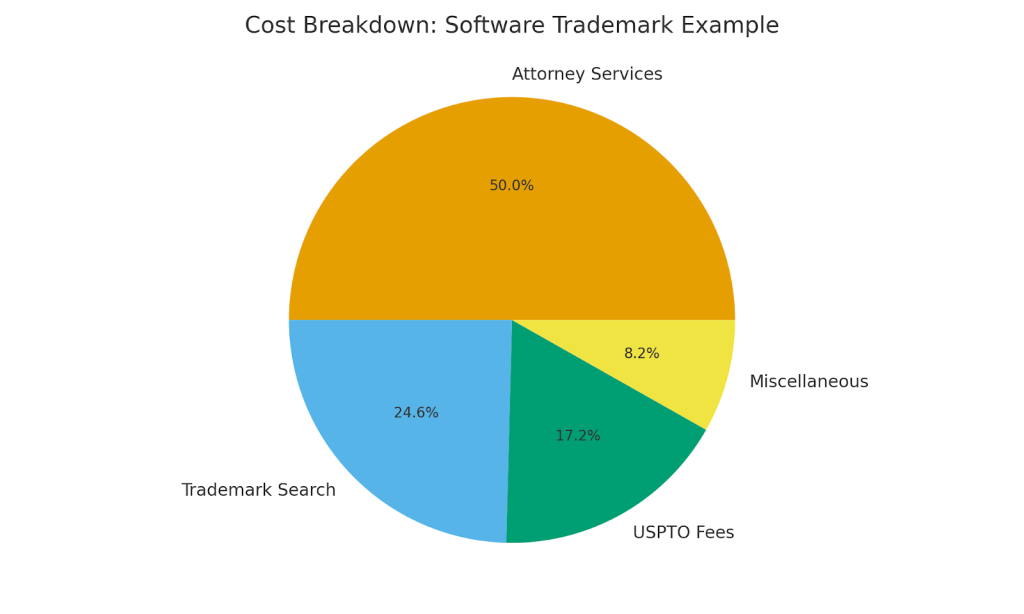
Figure 2: Breakdown of typical cost components for a multi-class software trademark filing, illustrating how attorney and search fees often exceed USPTO filing fees.
Scenario: A B2B software company offers cloud software and related consulting under one brand name across three classes (software, SaaS, and consulting).
- USPTO filing fees: $1,050 (3 classes)
- Technology sector comprehensive search: $1,500 (tech is crowded, requiring thorough clearance)
- Specialized attorney services: $3,000 (tech trademarks often face descriptiveness issues)
- Technical description refinement: $500 (extra work to craft descriptions, avoiding surcharges)
- Total Estimated Cost: ~$6,050
This scenario demonstrates how complex offerings lead to higher costs. The attorney worked to avoid $200 surcharges by selecting acceptable descriptions while still covering technical nuance, extra effort that prevents future problems.
These examples demonstrate trademark filing costs ranging from under $1,000 to well over $5,000 for initial registration. Key cost drivers include the number of classes (which directly affects USPTO fees), attorney complexity, and industry-specific challenges.
International Trademark Filing Costs
Expanding trademark protection beyond U.S. borders introduces additional costs and complexities requiring careful strategic planning.
Madrid Protocol: Multi-Country Filing via WIPO
The Madrid Protocol allows trademark owners to seek protection in multiple countries through one centralized application administered by WIPO in Geneva.
The basic fee paid to WIPO is currently 653 Swiss Francs (CHF) for a mark in black-and-white, or CHF 903 if in color. CHF 653 is roughly $700 USD. This creates an International Registration in the Madrid system.
Designation fees for each target country vary widely. For example, designating the European Union costs €850 for one class (approximately $990). Designating China may incur an individual fee of approximately CHF 400 ($440) per class. Australia charges about CHF 232 per class via Madrid, and Canada around CAD $458 (approximately CHF 320) for the first class. The United Kingdom is about CHF 219 (approximately £170) for one class via Madrid.
If you file an international application through the USPTO, the USPTO charges a $100 transmittal fee per application.
Hypothetical Madrid Application Cost
For a U.S. company seeking protection in four regions (EU, UK, Japan, and Canada):
- WIPO base fee: CHF 653 (~$700)
- EU designation: CHF ~897 (approximately €850)
- UK designation: CHF ~219
- Canada designation: CHF ~299 (CAD $478)
- Japan designation: CHF ~575
- USPTO handling fee: $100
- Total: approximately $2,900 in filing fees
The earlier example estimate of ~$6,853 for coverage in the EU, UK, Canada, and Australia presumably included about $3,000 in attorney fees, in addition to ~$3,800 in filing fees.
Direct National Filings
Some companies choose direct filing in key markets via local trademark agents:
European Union trademark (EUIPO): €850 for one class online, €50 for the second class, €150 for each class beyond two. This single application covers all 27 EU countries.
United Kingdom (UK IPO): £170 for one class online, plus £ 50 for each additional class. Paper filings are £200 + £50/class.
Canada: CAD $458 for first class (online) as of 2024, and approximately $144 for each additional class.
China: China allows up to 10 items per class at a base fee (roughly $50), but foreign businesses typically budget $800-$1,200, including agent fees, for a China application.
Attorney Coordination Costs
When filing internationally, you’ll likely incur additional attorney or agent fees. If you use Madrid, you might hire a U.S. attorney to prepare the international application (some charge a flat fee, perhaps $500-$1,000). If you go direct, you’ll need local attorneys in each country.
Local agents’ fees vary: for example, an agent in the EU might charge €600 to apply, in addition to the €850 official fee.
Total International Investment Examples
A U.S. small business wanting protection in the US, EU, and UK only: Estimated costs of U.S. ($2,000 including attorney), EU ($1,500 official + $800 agent), UK (~$300 official + $500 agent). Total ~$5,100.
A company seeking global protection in 10+ major markets using Madrid: WIPO fees could easily exceed $5,000 for all those designations. Attorney coordination might be $4,000. Total could be $9,000-$10,000 for that expansive first round.
International Strategy Considerations
A common strategy is to register in countries/regions where: (a) you are doing business or plan to soon, (b) the risk of knockoffs or squatters is high (e.g., China), or (c) key markets for manufacturing or distribution.
Using the Madrid Protocol is usually cost-effective if you have several countries in mind, but it requires a base application/registration, and some aspects are all-or-nothing. If your U.S. base fails in the first 5 years, the international registration is canceled (although you can convert to national filings).
For any international filing, consulting an attorney who specializes in global trademark strategy is wise to navigate classification differences, timing strategies, and local requirements. Rapacke Law Group’s international trademark experience helps clients develop strategic protection plans that maximize coverage while managing costs across multiple jurisdictions.
Money-Saving Tips for Trademark Filing
Strategic approaches can significantly reduce trademark costs without compromising protection quality.
Optimize Your Application to Avoid Surcharges
Use the ID Manual for your goods/services descriptions instead of inventing custom descriptions; this alone saves $200 per class. Keep descriptions concise to avoid the length fee. Double-check that every required field is complete to avoid the $100 insufficiency fee.
Meeting these standards keeps your USPTO fee at the base $350. If you’re filing in three classes, using pre-approved wording saves $600, which might cover an hour or two of attorney time to ensure the rest of your application is solid.
Conduct Preliminary Research Yourself
Use the USPTO TESS database for exact matches or obvious conflicts, and do basic Google searches for your name. Often, you can catch glaring disputes on your own before spending on filing fees or attorney searches. However, don’t skip a professional search based on clean basic results; many trademark issues won’t be obvious without specialized tools.
File Based on Actual Use (If Possible)
If your mark is already in use in commerce, file under Section 1(a) (use in commerce) rather than Section 1(b) (intent-to-use). This saves the $150 per-class SOU fee and potential extension fees. It can also speed up registration since you don’t need to wait for a Notice of Allowance.
Plan Your Timing to Minimize Extensions
If you must file an intent-to-use, be mindful of the 3-year limit. You get 6 months, plus up to 5 extensions (30 months total after the allowance), to start using. Each extension is $125 per class. Time your filing to minimize the gap between allowance and commercial launch.
Carefully Select Classes
Work with an attorney to identify the core classes covering your goods/services. Focus on where you are or will actually be using the mark. Each extra class is another $350 plus future maintenance. If the budget is tight, cover the primary class now and add others later as your business expands.
Bundle Trademark Projects Strategically
If you have multiple trademarks to register, see if a law firm offers a volume discount or a bundle. Often, firms doing three marks at once charge less per mark than if done separately, since they can handle searches together.
By applying these tips, you can significantly reduce trademark filing expenses. However, always weigh savings against potential risk. The cheapest route isn’t truly cheap if it leads to refusal and loss of filing fees with nothing to show.
When Professional Help Is Worth the Cost
Certain situations justify investing in professional trademark attorney services to avoid costly mistakes and maximize protection value.
Complex Applications
If your trademark application involves multiple classes, a custom logo design, or non-obvious goods/services descriptions, professional guidance is highly recommended. The $200 custom-description surcharge might tempt DIY filing, but a skilled attorney can avoid it entirely by crafting acceptable descriptions. Or if they do use custom language, it’s deliberate to get better protection even if it costs $200 more.
Crowded or Competitive Industries
In some sectors (technology, retail, cannabis, consumer products), trademark registers are crowded with similar names. If you operate in an industry where lots of similar marks exist, the risk of a confusing similarity refusal or opposition is higher.
An experienced trademark attorney can conduct nuanced searches and advise on positioning your mark, tweaking branding slightly, or carving out certain goods to avoid conflict. In competitive fields, third parties are more likely to challenge your mark, making legal preparation essential from the start.
Likelihood of Office Actions
If, based on preliminary research or the nature of your mark, you suspect the USPTO might have issues, engaging an attorney from the outset is wise. They can often predict and preempt sure refusals.
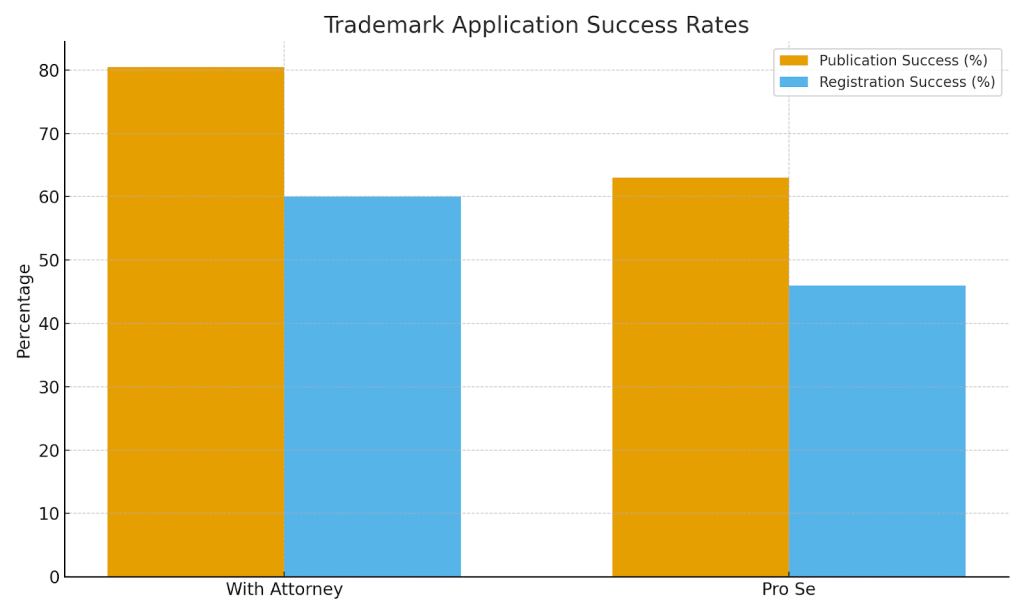
Figure 3: Comparison of publication and registration success rates for trademark applications filed with an attorney vs. filed pro se (self-represented).
Statistics show that only 63% of pro se applications even reach publication (and even fewer reach registration), often because they cannot overcome examiner refusals. By contrast, over 80% of attorney-filed applications reach publication. That gap is enormous; it shows that many DIY filings falter when faced with hurdles an attorney could likely clear.
International Ambitions
If you plan to use your brand overseas or expand internationally in the next few years, consulting an IP attorney with global experience can save you from costly missteps. They can develop an international filing strategy, for example, file in the U.S. first (so you have a base for Madrid), then, within 6 months, file in key foreign markets, claiming Paris Convention priority.
They’ll also know peculiar local rules. For example, China is a first-to-file country, meaning whoever files first can own the mark; use is less relevant. An attorney might urge filing in China ASAP to prevent trademark squatters.
High-Value Brand or Low Risk Tolerance
If your brand name is absolutely core to your business’s identity or value, then skimping on protection is ill-advised. If losing the trademark (or not getting it) would seriously damage your business’s value or ability to operate, hire an attorney.
Cost-Benefit Analysis
Many attorneys advise budgeting roughly 2x to 3x the government filing fee as your total cost when using an attorney. So, for one class ($350 fee), $700- $1,000 total, including legal. This generalization means professional help typically costs a couple of thousand dollars. Still, that investment can be the difference between a valid, strong registration and a dead application or a weak registration that can be attacked.
Consider the cost of corrections: If you file incorrectly and the application is refused or you have to re-file, you pay the fees all over again and lose time. As one study concluded, “applications filed by counsel had higher success rates,” and even experienced lawyers get better outcomes than inexperienced ones.
Risk Assessment Framework
You should strongly consider hiring a trademark attorney if any of these apply:
- Your trademark is critical to your business’s core identity or revenue.
- Your searches found potentially similar marks you’re unsure you can overcome.
- Your goods/services span multiple classes or involve technical descriptions.
- You anticipate international expansion within 3-5 years.
- The mark has elements that might trigger an Office Action (e.g., a surname, a descriptive word, or a geographic term).
- You’re unfamiliar with legal writing or the trademark process and can’t afford failure.
The key isn’t just minimizing immediate trademark filing cost, but ensuring the total cost of achieving reliable protection is optimized. Sometimes spending more upfront on expert help prevents far greater expenses or losses down the road.
The RLG Guarantee: Professional Help Without the Risk
The data is precise: attorney-filed applications succeed at dramatically higher rates. But what if you’re hesitant to invest $2,000-$5,000 in professional help when there’s still a chance of rejection?
The RLG Guarantee solves this dilemma. You get experienced US trademark attorneys handling every step—strategy call, comprehensive search, application drafting, unlimited Office Action responses—for one transparent flat fee. And if, despite our best efforts, your mark is rejected, you will receive 100% of your attorney’s fees refunded, or a new application will be filed on your behalf.
This isn’t just competitive pricing; it’s a fundamentally different business model. Traditional firms profit whether you succeed or fail. We only win when you get registered.
Your Next Steps to Trademark Registration Success
Understanding trademark costs is only half the battle. The real challenge lies in navigating the application process strategically to avoid $100-$400 in surcharges, prevent Office Action delays that can add $1,500-$3,500 in attorney fees, and secure approval on your first attempt.
The bottom line: A weak trademark application that triggers refusals or fails to register wastes your initial investment and leaves your brand vulnerable to competitors. A strong, well-executed application deters copycats, protects your market position, and gives you enforceable rights that translate directly into business value.
Here’s what’s at stake if you get this wrong: Every day without trademark protection is a day competitors can use confusingly similar names, erode your brand equity, and capture market share that should be yours. With the USPTO’s first-to-file system, hesitation could mean losing your brand name entirely to someone who files first. The cost of rebranding after you’ve built customer recognition dwarfs the investment in proper trademark protection upfront.
Take action now:
- Schedule a Free Trademark Strategy Call with our trademark concierge team to evaluate your brand’s registerability, identify potential conflicts, and develop a protection strategy that avoids costly mistakes.
- Conduct a comprehensive trademark clearance search before filing to uncover hidden conflicts that could derail your application after you’ve paid fees and invested time.
- Map your complete trademark needs across all classes where you’re actually using or intend to use the mark, ensuring comprehensive protection without overpaying for unnecessary classes.
- Review your brand protection timeline to determine the optimal filing strategy (use-based vs. intent-to-use) that minimizes extensions and accelerates registration.
Your brand is one of your most valuable business assets. While trademark protection requires an upfront investment, the cost of proper registration pales in comparison to the expense of rebranding, lost revenue from brand confusion, or, worse, losing your brand name entirely. Every successful business that scaled to a significant market share invested in comprehensive trademark protection early.
The RLG Guarantee: Your Trademark, Risk-Free
Get your trademark approved or pay nothing. We guarantee it.
While this article has shown you how trademark costs can spiral from $350 to $5,000+ with Office Actions, traditional law firm billing, and unexpected complications, Rapacke Law Group offers a different path:
$1,950. All-inclusive. Guaranteed.
That single flat fee includes everything: comprehensive trademark search, application preparation and filing, USPTO fees, and unlimited Office Action responses. No surprise bills. No hourly invoices. No “additional fees for complications.”
And if we can’t get your trademark registered? 100% refund. No questions asked. Or we’ll file a new mark on your behalf—your choice.
We’re the only trademark law firm confident enough in our results to put our fees on the line.
The RLG Guarantee for Trademark Registration:
- Get your trademark approved or pay nothing. We guarantee it.
- We’re so confident we’ll get your mark approved that if your trademark gets rejected, we’ll issue a 100% refund. No questions asked.
- FREE strategy call with our trademark concierge team
- Experienced US attorneys lead your registration from start to finish.
- One transparent flat-fee covering your entire trademark application process (including office actions).
- Unlimited office action responses at no additional cost.
- Full refund if USPTO denies your trademark application*.
- Full refund or additional searches if your brand has registerability issues (your choice)*.
*Terms and conditions apply.
Don’t let your competitors lock up trademark rights while you wait. The most successful brands protect their intellectual property strategically and early, before competitors can establish confusing market positions. Contact Rapacke Law Group today to secure your brand’s future with fixed-fee pricing, experienced guidance, and The RLG Guarantee.
To Your Success,
Andrew Rapacke
Managing Partner, Registered Patent Attorney
Rapacke Law Group
Connect with me: LinkedIn |Twitter/X: @rapackelaw |Instagram: @rapackelaw