


Key Takeaways
- ™ is available to any brand owner immediately upon first use in commerce; no application or federal registration required.
- ® may only be used after the USPTO issues a registration certificate; using it earlier is a federal violation that can sink your application.
- ℠ is the service mark equivalent of ™ and applies to services rather than goods, though ™ is broadly accepted as a substitute.
- Failing to display ® on a registered mark can eliminate your right to recover damages from infringers.
- A foreign trademark registration does not permit ® use in the United States; only USPTO registration qualifies.
Displaying the wrong trademark icon on your brand can bar you from recovering a single dollar in an infringement lawsuit. That is not a hypothetical risk: under 15 U.S.C. § 1111, a registered trademark owner who skips the ® symbol may be denied all profits and damages unless the infringer had actual notice of the registration. Getting trademark symbols right is a legal prerequisite, not a style decision.
The Three Trademark Symbols Serve Three Very Different Legal Purposes
™, ®, and ℠ are not interchangeable shortcuts. Each trademark symbol signals a specific legal status. Using the wrong one either misrepresents your rights or leaves legitimate protection uncommunicated to competitors and consumers. Before choosing any symbol, review common trademark icon mistakes that cost brands their legal standing.
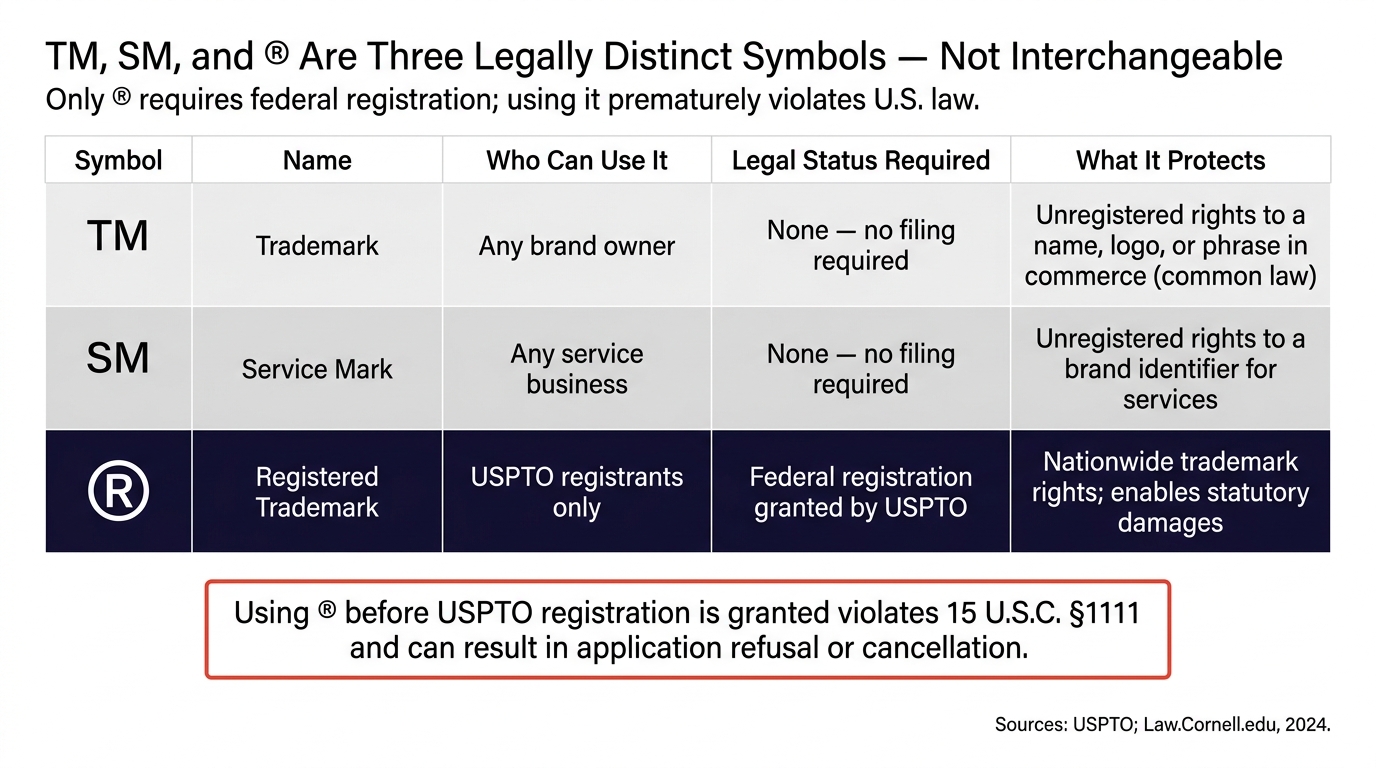
The ™ Symbol Signals an Unregistered Trademark Claim
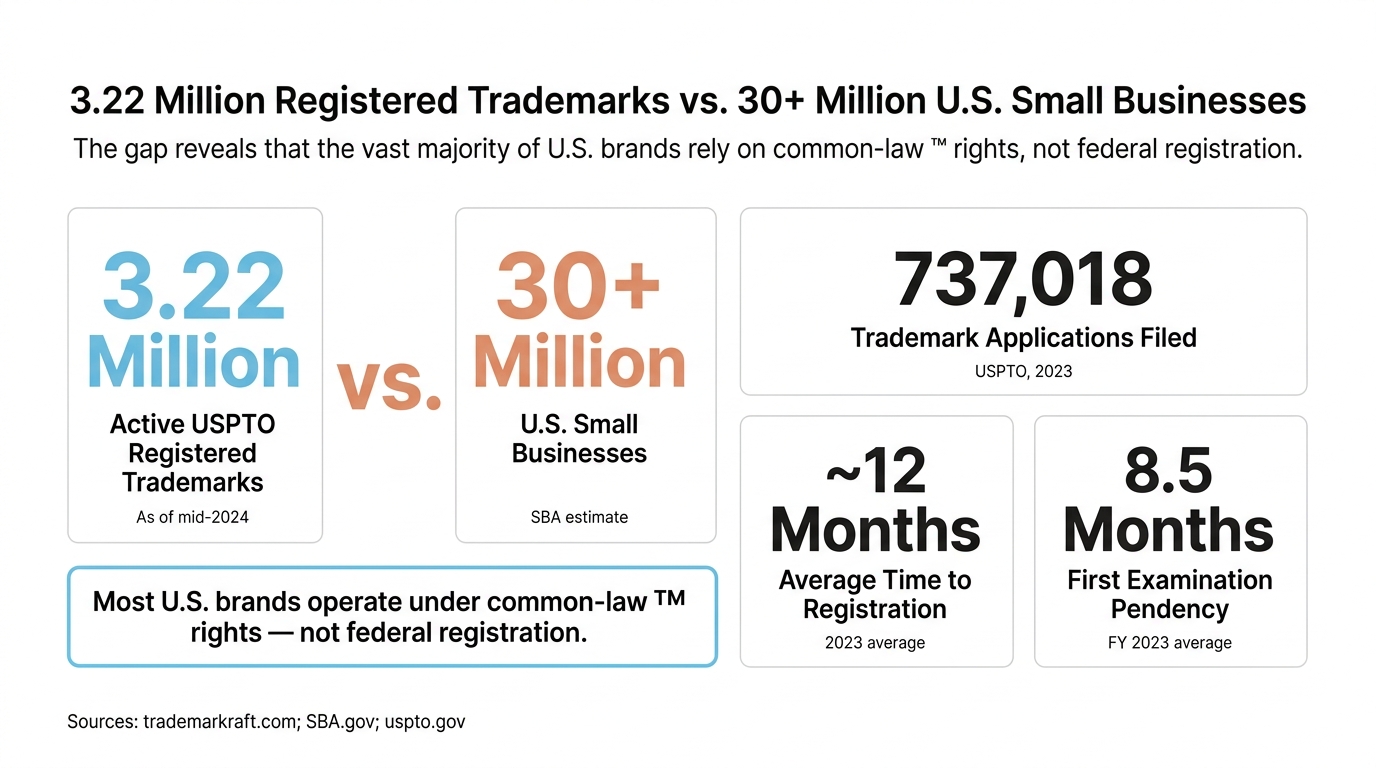
Any brand owner can place the ™ symbol on a word, logo, or phrase they are actively claiming as a trademark, with no filed or approved application required. U.S. trademark rights arise from first use in commerce, so ™ begins building your common law trademark rights the moment you launch. According to USPTO trademark statistics, only a fraction of the 33 million-plus U.S. small businesses tracked by the SBA hold active federal registrations, meaning the majority of brands rely on common law ™ rights alone. Use ™ from the first day your mark appears in commerce. For guidance on how to choose a trademark that holds up long-term, start with the distinctiveness analysis before you commit to a brand name.
The ℠ Symbol Is the Service Mark Equivalent for Service Businesses
The sm symbol stands for "service mark," which identifies the source of services rather than physical goods. According to Cornell Law's Legal Information Institute, the Lanham Act treats trademarks and service marks equivalently, so ™ on a service offering provides the same common law protection as ℠. Law firms offering legal services, SaaS companies, and consultants can use ℠ to assert unregistered service mark rights, though ™ is broadly accepted as a substitute. Understanding which trademark requirements apply to your specific business type helps you choose the correct symbol from day one.
The ® Symbol Is Reserved Exclusively for Federally Registered Trademarks
The registered trademark symbol ® may only appear after the United States Patent and Trademark Office has granted federal registration. Under 15 U.S.C. § 1111, only a registrant of a mark on the U.S. Principal Register may lawfully display ®. The USPTO's Trademark Manual of Examining Procedure instructs examiners to flag any specimen showing ® on an unregistered mark. Do not use ® until you hold the registration certificate. For a plain-English breakdown of what a registered logo symbol actually means, including when and where to display it, that resource covers the specifics in detail.
Using the Wrong Trademark Symbol Creates Real Legal Risk
The consequences of symbol misuse go beyond technicality. Both over-claiming (using ® prematurely) and under-claiming (skipping symbols entirely) carry measurable legal costs.
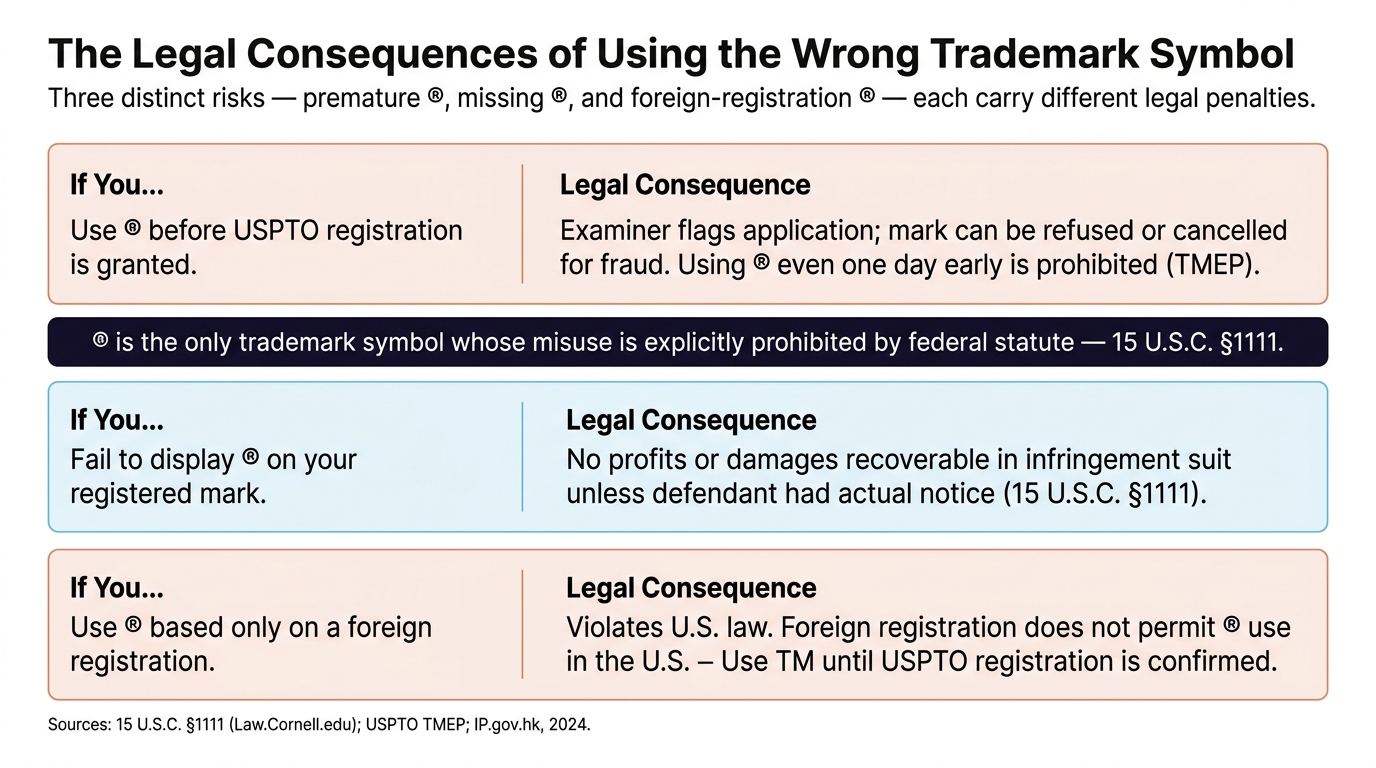
Misusing ® Before Registration Can Sink Your Trademark Application
Fraudulent use of the registered trademark symbol is grounds for the USPTO to refuse or cancel a trademark registration. Examiners at the trademark office treat premature ® use as a misrepresentation, and opposing parties in TTAB proceedings can raise it as evidence of bad faith. Even an honest mistake carries consequences because the standard is objective use, not subjective knowledge. Audit every public-facing asset before your registration certificate arrives. Knowing the difference between TM and ® and which symbol you can legally use at each stage of the application process eliminates this risk entirely.
Failing to Use Any Symbol Weakens Your Infringement Position
15 U.S.C. § 1111 bars a registrant from recovering profits or damages when they omit ® and the infringer lacked actual notice of the registration. Federal courts have enforced this rule by denying plaintiffs full monetary remedies. Consistent use of the correct trademark symbol is therefore not a branding nicety; it is the cheapest trademark infringement prevention step a brand owner can take.
International Registration Does Not Permit ® Use in the United States
A trademark registered in the EU, Canada, or any other country does not qualify for the ® symbol in the United States. The USPTO's notice provisions apply domestically only. Brands registered through the Madrid Protocol in other jurisdictions must complete the U.S. designation and receive separate USPTO approval before displaying ® on U.S. materials. Until then, ™ is the correct choice. If you are weighing the tradeoffs between state trademark vs. federal trademark protection, the symbol rules differ significantly between those two tracks as well.
Where to Place the Trademark Symbol So It Actually Does Its Job
Placement determines whether the symbol delivers its legal notice function. Getting it wrong undermines everything else.
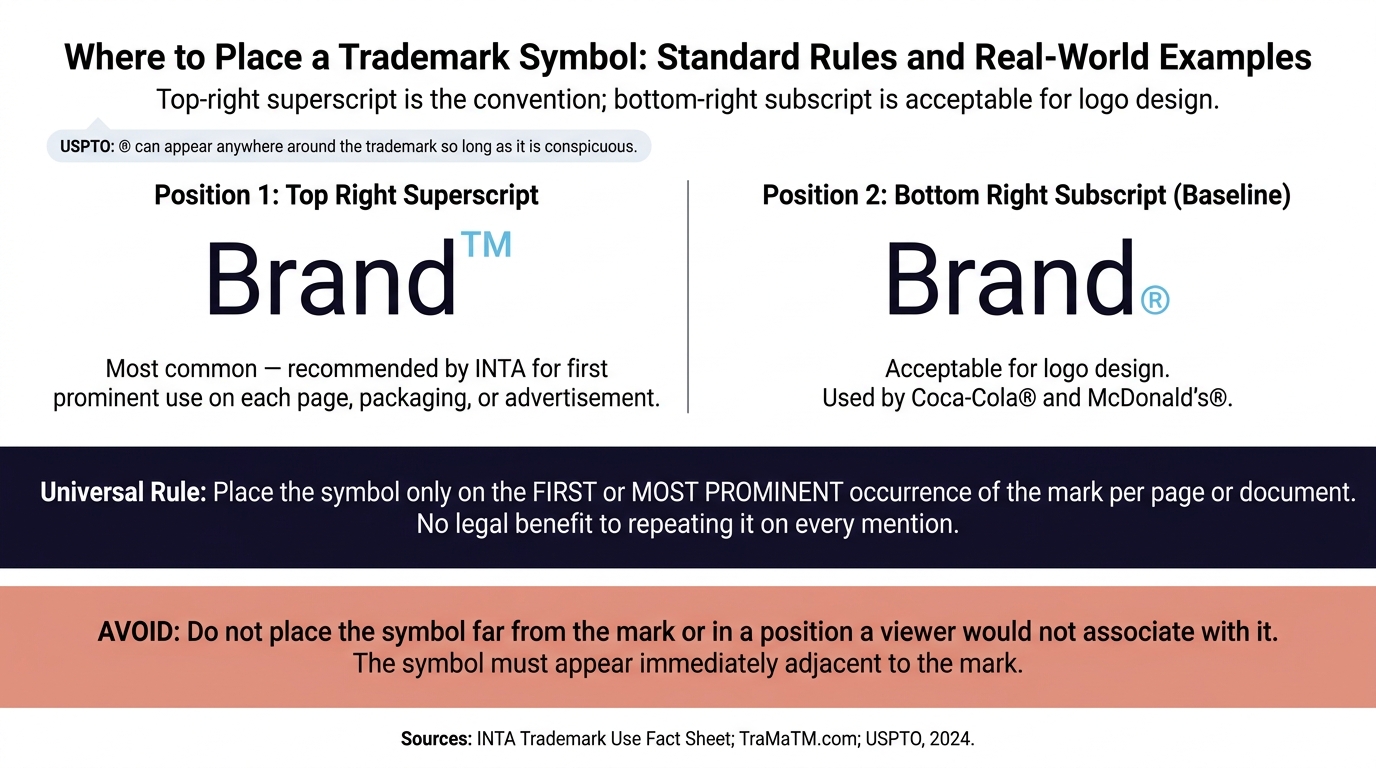
The Top Right Corner Is the Standard and Legally Recognized Position
By convention, trademark symbols appear as a superscript at the top right corner of the trademark mark, immediately adjacent to the brand name or logo being protected. According to the International Trademark Association, this is the recognized standard placement. The USPTO has noted that ® can appear anywhere around the mark as long as it is conspicuous; bottom-right placement is acceptable when design constraints require it.
You Do Not Need to Add the Symbol Every Single Time the Mark Appears
INTA guidance confirms that you only need to use the trademark symbol on the first or most prominent instance of the mark in any document, webpage, or packaging. Repeating it on every occurrence is unnecessary and visually cluttered. Mark the first prominent instance per page or piece of content and you have satisfied the notice requirement.
How to Type Any Trademark Symbol on Windows, Mac, or Mobile
A significant share of people searching "trademark icon" want a copy-paste solution or keyboard shortcut. Here are the reliable methods for every platform.
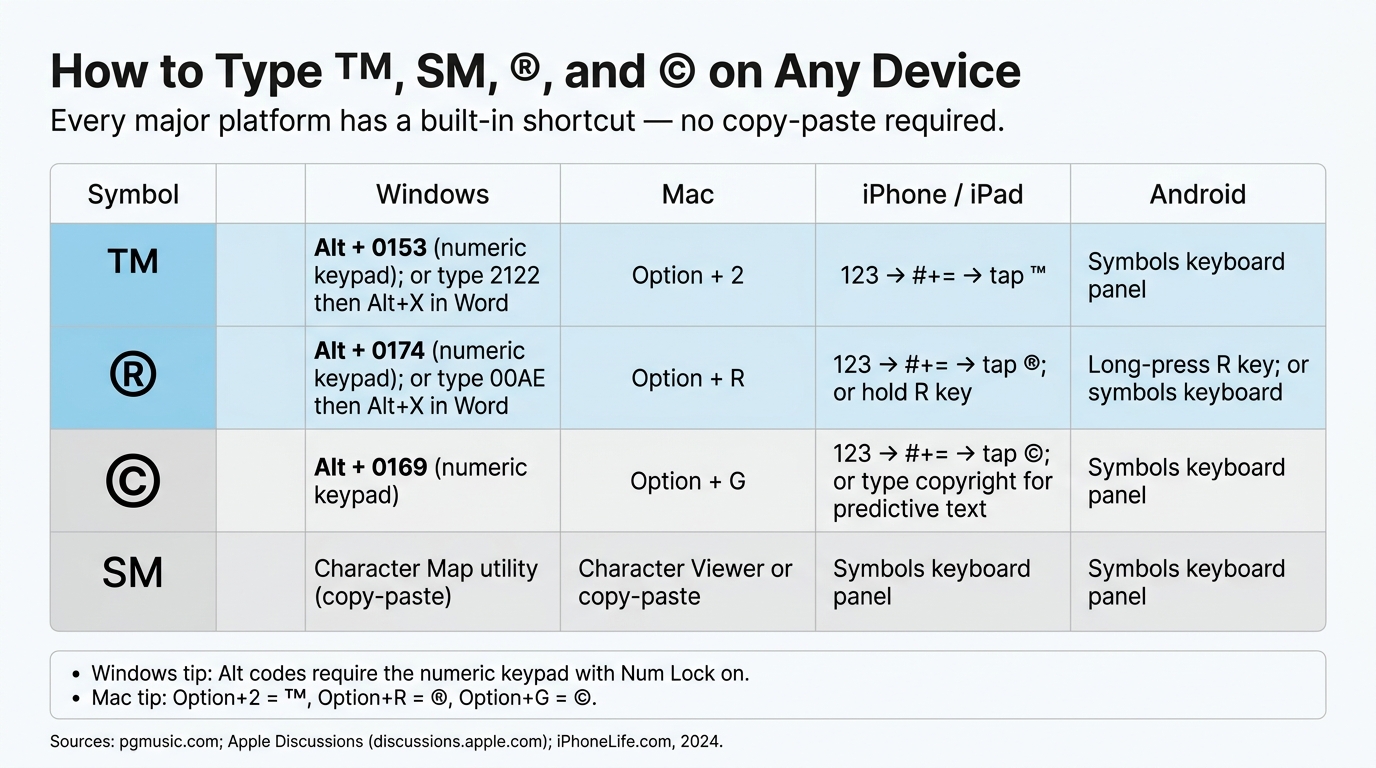
Windows Users Have Three Reliable Methods
On Windows, Alt+0153 produces ™ and Alt+0174 produces ®. In Microsoft Office, type the Unicode code point (2122, then Alt+X) to insert ™, since U+2122 is the Unicode designation for the symbol. For the less common ℠ symbol, which lacks a universal Alt code, use the Windows Character Map utility: search "Character Map" in the Start menu, locate the symbol, and copy it directly.
Mac and Mobile Users Can Insert Symbols With a Single Shortcut
On Mac, Option+2 produces ™ and Option+R produces ®. On iPhone, long-pressing the letter R surfaces ® as a pop-up option; on Android, access the symbols panel from your keyboard. The © copyright symbol is Option+G on Mac and Alt+0169 on Windows.
How Trademark Registration Converts ™ Into ® and Why That Upgrade Matters
Common law ™ rights protect unregistered trademarks but are geographically limited. Federal trademark registration changes the picture substantially.
Federal Registration Adds Nationwide Rights That Common Law Cannot Provide
Common law ™ rights extend only to the geographic area where the mark is actually used in commerce. Federal registration with the USPTO grants nationwide priority as of the application filing date under 15 U.S.C. § 1072, covering markets the brand has not yet entered. According to USPTO trademark statistics, the USPTO received approximately 737,018 trademark applications in 2023, reflecting how many brands recognize this advantage. File as soon as your mark is commercially viable; the filing date, not the launch date, determines nationwide priority at the trademark office.
The USPTO Review Process Determines When You Can Switch Symbols
After filing, a trademark application moves through examination, a potential trademark office action, a 30-day publication period for oppositions, and then registration. The full process typically averages 10 to 18 months, though USPTO pendency data shows significant variation by application track. During this entire period, ™ or ℠ must be used. Track your application in the USPTO's TSDR database so you know precisely when switching to ® becomes legally appropriate.
What Trademark Symbols Cannot Do and Where Other IP Protections Apply
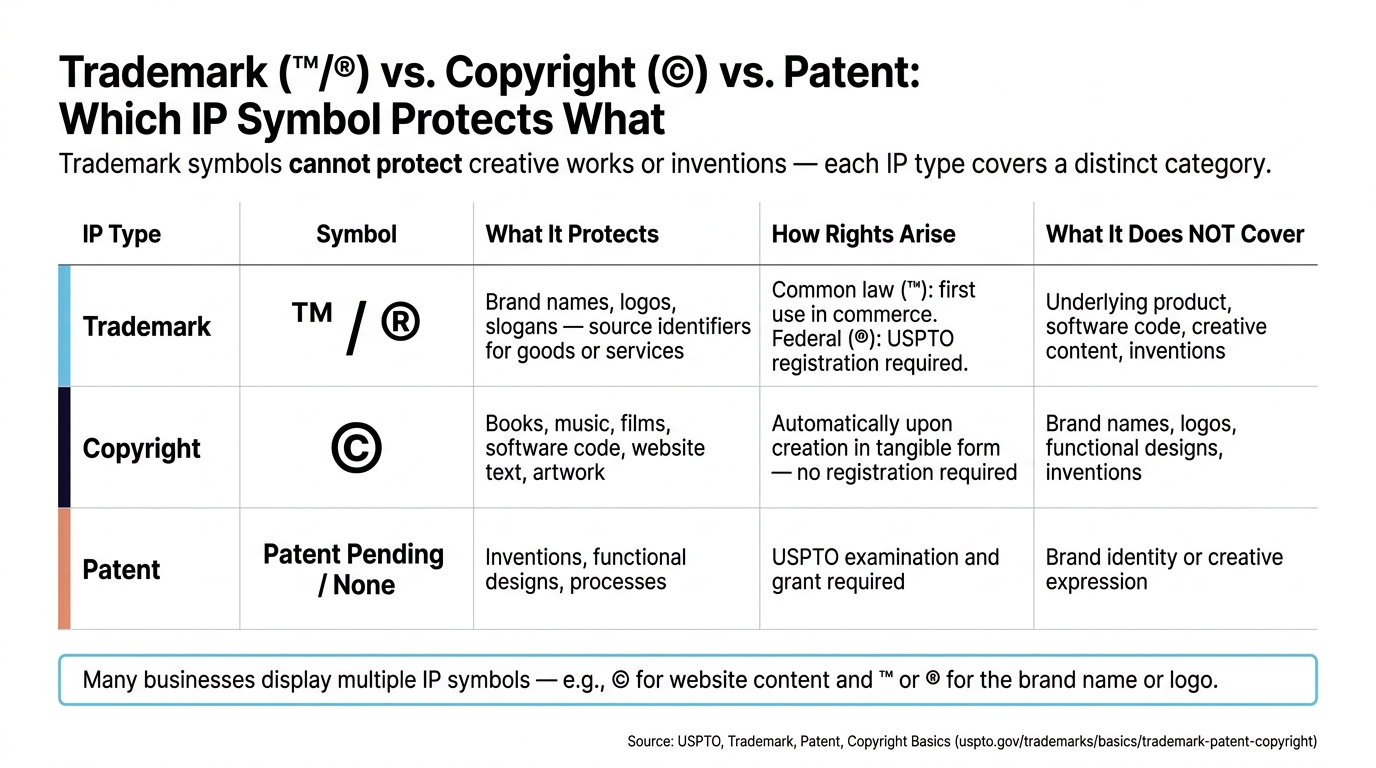
Trademark symbols cover source identifiers, not all intellectual property. Confusing their scope creates real gaps in protection.
Trademark Symbols Protect Brand Identity, Not Creative Works
Trademark registration protects brand names, logos, and slogans, including any word trademark, used in commerce. It does not protect original software code, written content, music, or creative works. Copyright protection, signaled by the © symbol, arises automatically at creation under 17 U.S.C. § 102 without registration. Use ™ or ® on your brand identifiers and © on original content your company creates; they are distinct legal protections with different scopes. For mobile app companies navigating both brand and product protection, trademarks for mobile apps require a layered strategy covering both the app name and underlying assets.
A Trademark Registration Does Not Block All Similar Names Across Every Market
Trademark rights are class-specific. Under trademark law, a registered trademark in one international class does not automatically prevent similar marks in unrelated classes under the USPTO's international class system. Brand owners who want comprehensive intellectual property rights need to file in each relevant goods and services class. When filing, identify every product and service category your brand operates in because protection does not extend beyond the registered classes.
Frequently Asked Questions About Trademark Symbols
Is the trademark symbol TM or R? Both are trademark symbols, but they indicate different legal statuses. The ™ symbol applies to any claimed trademark regardless of registration status. The ® symbol, sometimes called the circled latin capital letter R, can only be used after the USPTO has granted federal registration. Using ® without that registration violates 15 U.S.C. § 1111.
How can I tell if a symbol is TM or R? Look at the superscript adjacent to the trademark sign. ™ displays the letters T and M together; ® displays a capital R inside a circle. The ℠ service mark symbol resembles ™ but uses S and M, and it applies specifically to services rather than goods.
How do you type a circle C? The © copyright symbol is not a trademark symbol but is frequently searched alongside trademark symbols. On Windows, use Alt+0169. On Mac, use Option+G. On iPhone and Android, it appears in the special characters keyboard panel, separate from mathematical symbols. In HTML, use © or Unicode character U+00A9.
How do I type an R symbol? On Windows, use Alt+0174 on the numeric keypad. On Mac, use Option+R. On iPhone, long-press the letter R to reveal ® as an option. On Android, open the symbols panel from your keyboard. You can also copy it directly: ®.
Can I use ® in the U.S. if my trademark is registered in another country? No. The ® symbol in the United States requires USPTO federal registration specifically. A foreign registration, even one filed through the Madrid Protocol, does not permit ® use in the United States until the USPTO separately grants U.S. registration. Use ™ on all U.S. materials until that registration is confirmed.
Your Next Steps to Trademark Symbol Compliance
Using the correct trademark icon is the lowest-cost legal step a brand owner can take, and skipping it can eliminate your right to damages in an infringement case. Use ™ from the first day your mark is in commerce, switch to ® only after the USPTO issues your registration certificate, and place the symbol on your most prominent brand uses per piece of content.
The bottom line: brands operating on ™ alone have real but geographically limited rights. Federal registration converts that local foothold into nationwide priority, unlocks statutory damages, and signals to competitors that your brand is protected. Every month you delay filing is a month your priority date moves forward, and a month another applicant could beat you to registration.
If your brand is still on ™ rights alone, the window to secure stronger protection is open now. Here is what to do next:
- Schedule a Free IP Strategy Call to identify which marks to file, which classes to cover, and where your brand has gaps.
- Review RLG's trademark service page, where we guarantee your trademark gets approved or you pay nothing.
- Take the Intelligent IP Quiz to benchmark your current IP protection against where your business needs to be.
Federal registration is not just a legal formality. It is the foundation that makes every other brand-building investment defensible.
To Your Success,
Andrew Rapacke
Managing Partner, Registered Patent Attorney
Rapacke Law Group