

Executive Summary
~2 min listen
~14 min read
~14 min read
The Bottom Line
Under 35 U.S.C. § 262, any co-inventor can independently license your shared patent to a direct competitor and keep every dollar — a 2026 Federal Circuit ruling also confirmed that a patent is invalid when an omitted inventor cannot be located, making correct inventorship documentation worth the entire 20-year patent life.
Share of 2022 USPTO utility patents owned by individual inventors at grant — the rest were assigned to companies.
Patent lifespan during which an inventorship error creates an exploitable invalidity vulnerability.
Utility patents awarded by the USPTO in 2022, per National Science Foundation data.
What You Need to Know
Most co-inventors don't realize that contributing labor — building prototypes, running tests, or drafting specs — does not create inventorship rights under U.S. law. The Federal Circuit's conception standard, established in Burroughs Wellcome (1994), requires a definite mental contribution to at least one patent claim. In Meng v. Chu (2016), researchers who co-authored papers and received royalties still lost their inventorship claim due to insufficient notebook documentation.
The Leahy-Smith America Invents Act's 2013 shift to first-inventor-to-file made filing speed critical for co-inventor teams: whoever files first cuts off others' rights regardless of who conceived the idea earlier. Meanwhile, the default rule under 35 U.S.C. § 262 lets any co-owner license the entire patent without consent or accounting — a permissive default that only a written co-inventor agreement, signed before filing, can override.
What To Do Next
Review every patent claim individually to identify all contributors to conception before filing.
Draft and sign a co-inventor agreement before filing to override the permissive defaults of 35 U.S.C. § 262.
Maintain dated lab notebooks, version-controlled code, and email records showing each inventor's specific conception contributions.
File a Request to Correct Inventorship under 37 C.F.R. § 1.48 before grant if any error is discovered — pre-grant correction is faster and cheaper.
Consult a patent attorney immediately if an inventorship question arises, as complexity and cost increase at every stage of prosecution.
Jump to Section
The conception standard that determines true inventorship
The default ownership rule most joint inventors don't know
How a 2026 ruling confirmed patents can be invalidated
7 steps to document contributions before you file
How the AIA made filing speed critical for co-inventor teams
The 3 dispute scenarios that destroy startup IP
0:00
Most founders and researchers who collaborate on an invention assume the legal definition of "co-inventor" is obvious. It is not, and the gap between assumption and U.S. patent law has invalidated real patents and destroyed real business relationships. Under 35 U.S.C. § 116, the question of who qualifies as a co inventor turns entirely on a single legal concept: conception. Everything else follows from that.
What Makes Someone a Co Inventor Under U.S. Patent Law
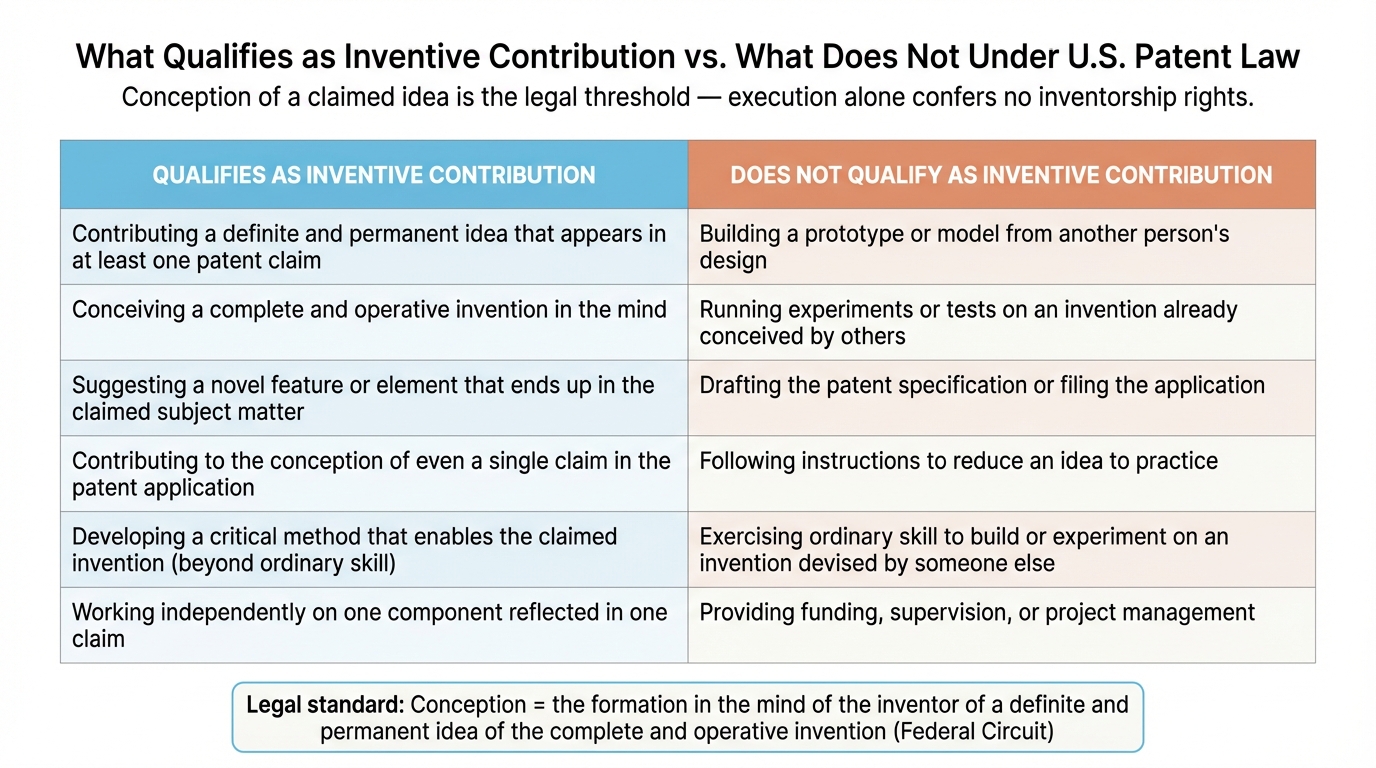 What Qualifies as Inventive Contribution vs. What Does Not Under U.S. Patent Law — Source: Federal Circuit, 1994; Federal Circuit, 2012; 35 U.S.C. § 116
The Conception Standard That Determines True Inventorship
Inventorship in the United States turns on conception. The Federal Circuit defines it as "the formation in the mind of the inventor of a definite and permanent idea of the complete and operative invention" — a definite idea of what the invention is and how it works — a standard established in Burroughs Wellcome Co. v. Barr Laboratories, 40 F.3d 1223 (Fed. Cir. 1994) and consistently applied since. A co inventor must contribute to the conception of at least one claim in the patent application. Providing funding, supervising experiments, or executing another person's detailed instructions does not meet this standard.
The practical line is this: if a collaborator only builds what you designed, they are not a joint inventor. Contribution to the claimed invention's conception is the threshold under U.S. patent law. For a deeper look at how these standards apply to software and AI inventions, see Which Are the Conditions of Patentability for Software & AI in 2026?
How Reduction to Practice Differs from Inventive Contribution
Reduction to practice, whether actual (building a working prototype) or constructive (filing a patent application), is legally distinct from the inventive act — bringing an invention to practice does not by itself establish inventorship. According to Burroughs Wellcome Co. v. Barr Laboratories, 40 F.3d 1223 (Fed. Cir. 1994), exercising ordinary skill to build or test an invention conceived by someone else does not qualify as inventive contribution. Courts have consistently held that running experiments and drafting specifications are execution tasks, not conception.
This distinction matters most in collaborative research and startup environments, where engineers and scientists contribute substantial technical labor without contributing to the conception of the claimed subject matter and where actual reduction to a working prototype is often mistaken for inventorship. Understanding what every inventor needs to know about patent claims can help collaborators assess whether their specific contribution rises to the level of inventorship before a dispute arises.
The One Claim Rule That Expands Who Qualifies as a Joint Inventor
Under 35 U.S.C. § 116, as amended by the Leahy-Smith America Invents Act, joint inventors do not need to have worked together at the same time, contributed equally, or each contributed to every claim, meaning two joint inventors can contribute to entirely separate claims and both qualify. A person qualifies as a co inventor by contributing to the conception of a single claim in the patent application. A collaborator working on one component of a multi-claim invention may hold co-inventor status for the entire patent, even if they touched nothing else.
Review every claim in your patent application individually before filing. A collaborator who contributed to just one claim has full joint inventorship rights under United States law.
What Co Inventor Status Actually Means for Patent Ownership
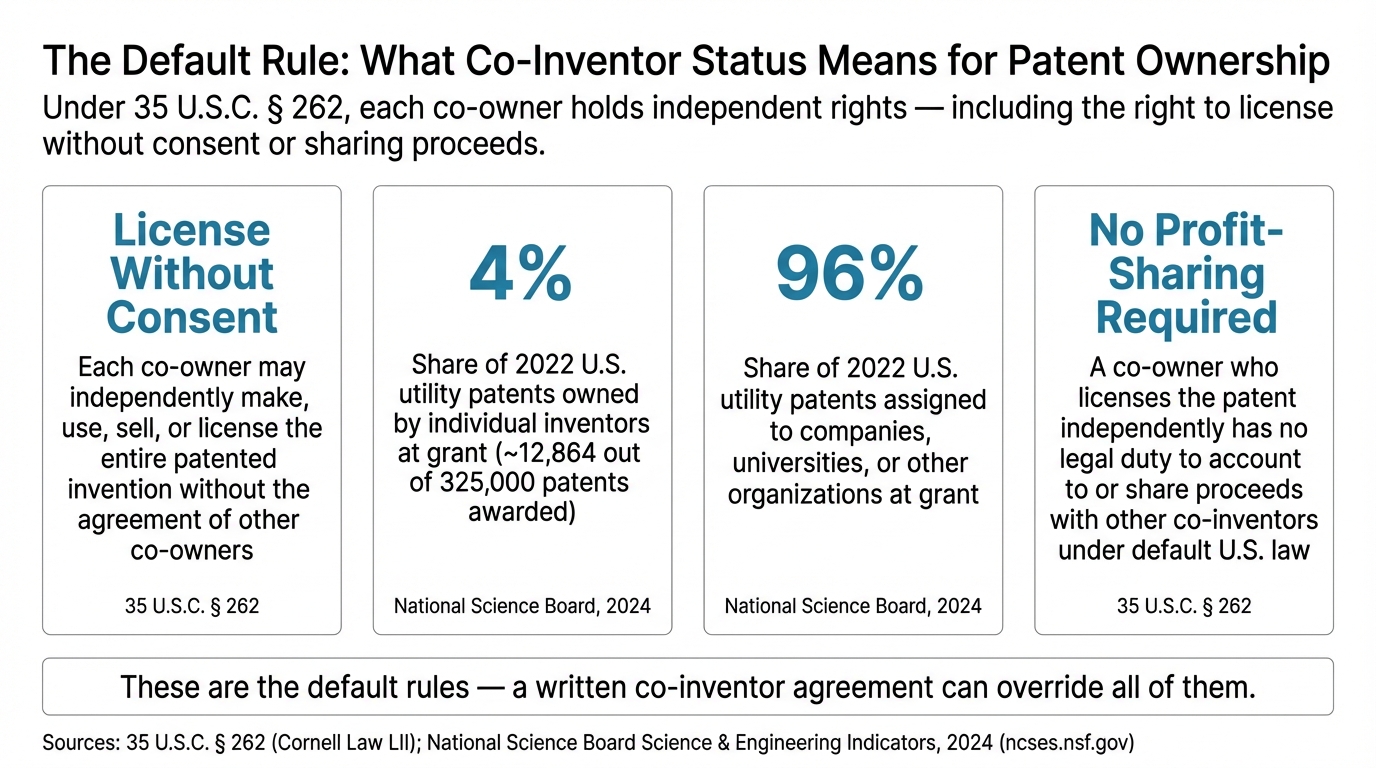 The Default Rule: What Co-Inventor Status Means for Patent Ownership — Source: National Science Board Science & Engineering Indicators, 2024; 35 U.S.C. § 262
Each Co Owner Holds Independent Rights to the Entire Patent
This is the rule that most joint inventors do not know until it is too late. Under 35 U.S.C. § 262, each co-inventor who holds co-ownership rights in the patent may independently make, use, sell, or license the entire patented invention without the consent of, and without any duty to account to the other co-owners. One co-owner can license your shared patent to a direct competitor and keep every dollar. That is the default under U.S. patent law, and it applies the moment the patent issues, making patent holders without a written agreement extremely vulnerable unless a written agreement provides otherwise.
This default is far more permissive than most people expect, and it means that a handshake arrangement between joint inventors is legally insufficient. To understand the full scope of what patent ownership actually grants, see Rights of Patent in the Modern Era: Blocking Competitors, Funding Growth, Monetizing IP.
How Employment and Assignment Agreements Override Default Ownership
Co-inventor status identifies who contributed to the conception of the invention. Patent ownership is a separate legal question governed by assignment. According to National Science Foundation data, in 2022, the USPTO awarded approximately 325,000 utility patents. Of those, individual inventors owned only about 1,164 patents at grant which is roughly 0.36% of all utility patents issued that year because the vast majority were assigned to companies, universities, or government agencies through employment and contractor agreements.
Employees who invent within the scope of their employment typically assign patent rights to their employer by contract. Founders, contractors, and academic researchers face different default rules depending on what intellectual property assignment provisions they signed. Inventorship and ownership are legally separate under United States patent law. Always have a patent attorney review assignment obligations before filing patent applications that name co inventors. For guidance on how investors view these dynamics, see Why Investors Care About IP: The Patent Process Explained for High-Growth Startups.
Why Incorrect Inventorship Can Invalidate Your Patent
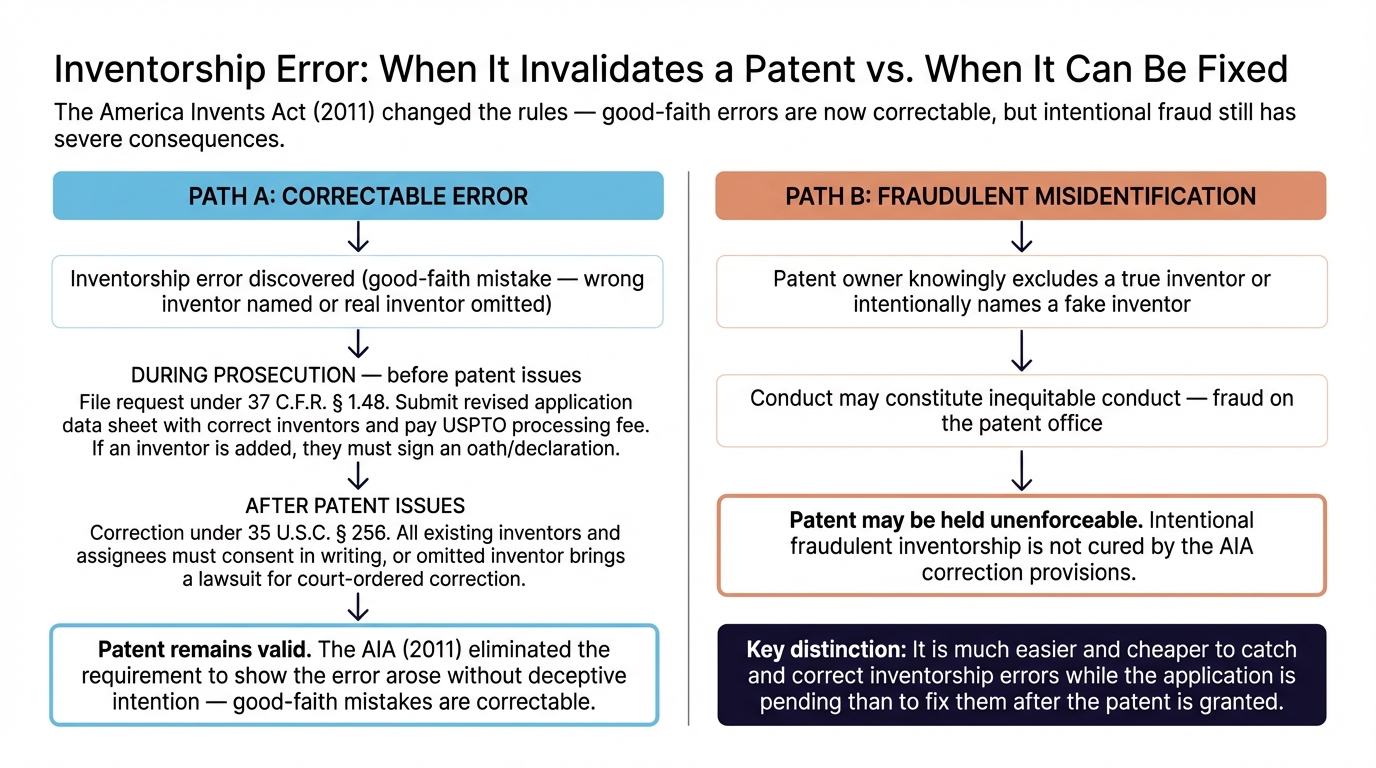 Inventorship Error: When It Invalidates a Patent vs. When It Can Be Fixed — Source: Federal Circuit, 2020; USPTO Rules (37 C.F.R. § 1.48); U.S. Patent Act Amendments, 2011
How Courts Have Invalidated Patents for Omitted and Falsely Named Inventors
Incorrect inventorship is not a technical paperwork issue. The Federal Circuit has held that inventorship is a legal requirement rooted in the Constitution and no patent can validly issue unless it is granted to the real inventors known concepts of the claimed subject matter. An omitted inventor who should have been named, or a falsely added inventor who contributed nothing to the claimed invention, each create grounds to challenge the patent's validity in litigation, including through challenged claims at the USPTO. Competitors routinely probe inventorship records when defending infringement claims.
In Fortress Iron, LP v. Digger Specialties, Inc., Case 24-2313 (Fed. Cir. Apr. 2, 2026), the Federal Circuit reinforced this principle directly, holding that "a patent is invalid for the error of omitting inventors when that error cannot be corrected" and that inventors "occupy the central role in the patent process" such that their explicit references in the statutory framework "cannot be taken lightly." This decision is a critical reminder: if an omitted co-inventor cannot be located to consent to a correction, the patent itself may be unrecoverable. Incorrect inventorship on a patent application creates a litigation risk that lasts the life of the patent.
The Process for Correcting Inventorship Before and After Patent Grant
The USPTO provides correction mechanisms at both stages. Before a patent issues, a patent attorney can file a Request to Correct Inventorship under 37 C.F.R. § 1.48, submitting a revised original application data sheet listing the correct inventors and paying the applicable processing fee. If an inventor is added, they must execute a new oath or declaration.
After a patent issues, correction under 35 U.S.C. § 256 requires a petition with written consent from all existing inventors and assignees or, in contested situations, a federal district court order. The Leahy-Smith America Invents Act eliminated the old requirement to show that an inventorship error "arose without deceptive intention," making good-faith corrections more straightforward post-March 16, 2013, and improving the patent system's ability to reflect true inventorship. However, as Fortress Iron confirms, if an omitted inventor cannot be located to provide the required consent, post-grant correction may be impossible, leaving the patent vulnerable to invalidity. A pre-grant correction is significantly faster, less expensive, and avoids this locatability problem entirely. Audit the inventive entity before filing.
How to Document Co Inventor Contributions Before You File
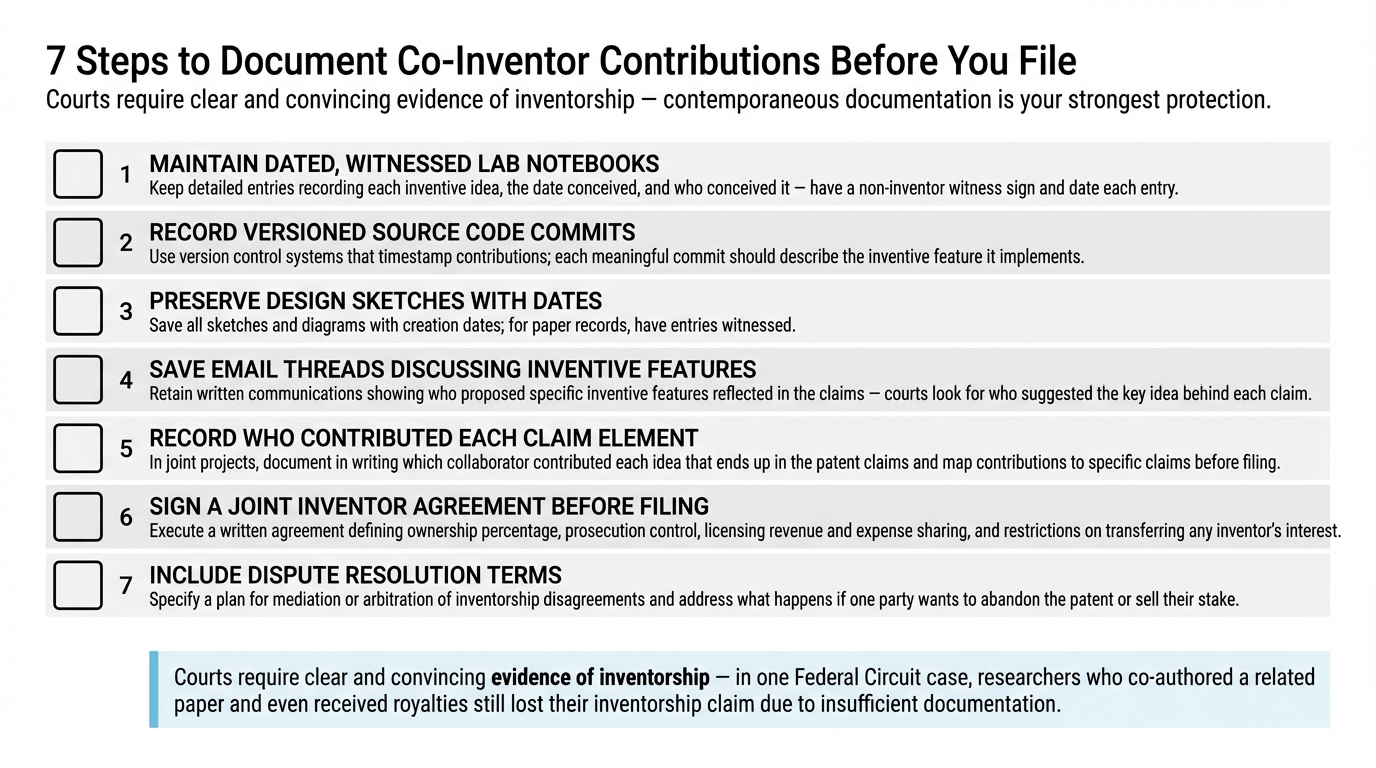 7 Steps to Document Co-Inventor Contributions Before You File — Source: USPTO & IP Law Practice, 2016; IP Practice Guide, 2025
Creating a Paper Trail That Protects Each Inventor's Rights
Courts require clear and convincing evidence of inventorship in a dispute. In Meng v. Chu, 816 F.3d 1369 (Fed. Cir. 2016), two researchers who were co-authors on a related paper and even received royalties from the patent still lost their inventorship claim because their notebook entries did not convincingly show they conceived any element of the claimed invention, illustrating that patent claims must be tied to documented conception. That outcome illustrates exactly what is at stake when documentation is treated as an afterthought.
Each co inventor should maintain complete records of their specific contributions to the inventive process: lab notebooks with witnessed entries, version-controlled code repositories, dated design documents, and email chains discussing specific claimed features. Participation in meetings or product testing is not enough. For a practical framework on building this kind of record, see Our Patent Documentation Blueprint To Build Your Patent Application Like a Legal Fortress.
Why Co Inventor Agreements Should Be Signed Before Filing
A co-inventor agreement is distinct from an IP assignment. It documents the agreed ownership split, licensing rights, decision-making authority over prosecution, and restrictions on transferring a co inventor's interest without group approval. A well-drafted joint inventor agreement governing joint invention rights can restrict one co-inventor from unilaterally licensing the patent or selling their share to a third party, effectively overriding the permissive defaults of 35 U.S.C. § 262. Such restrictions must be carefully drafted as enforcement challenges can arise if the agreement terms are ambiguous or if reversion clauses conflict with applicable state contract law.
Signing this agreement before filing the patent application avoids the leverage imbalances and factual ambiguities that arise once the patent is granted. It is the single most effective tool for protecting invention rights and preventing ownership disputes between joint inventors. For founders evaluating their broader IP protection obligations, the Intellectual Property Rights in Business: The Founder's Complete Playbook provides a useful complement to the inventorship-specific steps covered here.
What the Leahy-Smith America Invents Act Changed for Co Inventors
The Shift from First to Invent to First Inventor to File
The Leahy-Smith America Invents Act took effect on March 16, 2013, converting the United States from a first-to-invent to a first-inventor-to-file system. This was one of the most significant structural changes to U.S. patent laws in decades. For co inventors, this change made filing speed more consequential. Prior art from whoever files first now cuts off patent rights for others working on the same invention, regardless of who conceived the idea earlier. Co inventors who delay filing while negotiating ownership arrangements risk losing their rights entirely to a competitor who files first.
The Leahy-Smith America Invents Act does include prior art exceptions under 35 U.S.C. § 102(b)(1) for disclosures made by the inventor or a joint inventor within one year before the filing date, but these exceptions are narrow, do not protect against prior art rejections from third-party disclosures, and should not be relied upon as a substitute for timely filing. Understanding how the provisional patent timeline impacts startup funding and investor confidence is especially relevant for co-inventor teams navigating this urgency.
How the AIA Affects Joint Inventor Declarations and Oaths
Under the Leahy-Smith America Invents Act, each joint inventor, and no less than one inventor, must execute an oath or declaration under 37 C.F.R. § 1.63 stating that they believe themselves to be an original inventor of the claimed subject matter. The AIA simplified these oath requirements relative to pre-AIA practice and allows assignees to file applications on behalf of inventors in defined circumstances. Missing or defective declarations from any named co inventor delay prosecution and create validity exposure. Every named joint inventor on a patent application must execute a legally compliant declaration before the application can proceed.
How Co Inventor Disputes Arise in Startups and Research Collaborations
The Three Scenarios Where Inventorship Becomes Contested
Inventorship disputes in startups and research environments cluster around three fact patterns. First, a co founder claims inventorship over a product built primarily by a hired engineer whose conception contribution was never clearly separated from execution. Second, a researcher contributes to a project where the supervising professor is named as the sole inventor despite the researcher's conception of a specific claimed feature. Third, a contractor contributes an inventive idea to a product feature that ends up in a patent application naming only company employees.
Each scenario turns on the same legal question which is who contributed to the conception of the claimed subject matter, but the factual evidence and contractual context differ significantly. The most common inventorship disputes arise not from bad faith but from a genuine misunderstanding of what qualifies as inventive contribution under intellectual property law. Early-stage founders can find additional guidance in Startup Patent: How Early-Stage Founders Should Protect and Leverage Their IP.
When to Involve a Patent Attorney in a Co Inventor Dispute
If a co inventor dispute surfaces after a patent application has been filed, voluntary correction under 37 C.F.R. § 1.48 is available during prosecution with consent from all parties. After the patent issues, correction under 35 U.S.C. § 256 requires either unanimous written agreement from all inventors and assignees or a united states court proceeding. As the Fortress Iron decision makes clear, if a co-inventor cannot be located, post-grant correction may be impossible, making early identification and documentation of the full inventive entity critically important. Contested inventorship litigation is slow, expensive, and uncertain. Early intervention through voluntary correction at the USPTO is the preferred path in every case where the error is identified promptly.
Contact a patent attorney as soon as an inventorship question arises for legal advice as the cost and complexity of resolution increases substantially at each stage of the patent process.
Frequently Asked Questions
What is a co inventor? A co inventor, also called a joint inventor, is any person who contributed to the conception of at least one claim in a patent application. The term inventor under 35 U.S.C. § 116 does not require that co inventors have worked together simultaneously or contributed equally and each must have contributed to the claimed subject matter of at least one claim. Together, they form the inventive entity named on the patent application.
What does co invented mean? Co invented means that two or more people jointly conceived the complete invention described and claimed in a patent application. An invention is co invented when no single person can claim sole credit for the formation of the complete and operative idea underlying at least one patent claim and each named inventor contributed something to that conception that the others did not supply alone.
Does a co inventor automatically own part of the patent? Not automatically in every situation. Co inventors who have not signed intellectual property assignment agreements generally hold co-ownership rights under 35 U.S.C. § 262, but employment agreements, contractor agreements, and startup founding documents frequently include invention assignment clauses that transfer those rights to an employer or company. Inventorship and ownership are legally separate questions under United States patent law.
What happens if the wrong person is named as a co inventor on a patent application? Incorrect inventorship is a legal defect. Good-faith errors can be corrected through the USPTO under 35 U.S.C. § 256, but correction requires consent from all named inventors and assignees — and if an omitted inventor cannot be located, correction may be impossible, leaving issued patents at risk of invalidity as confirmed in Fortress Iron, LP v. Digger Specialties, Inc. (Fed. Cir. 2026). Post-AIA, the deceptive intent requirement was removed for corrections, making honest mistakes more fixable when all parties are reachable. A patent attorney should be consulted immediately upon discovery of any inventorship error.
Who is the only U.S. president to hold a patent? Abraham Lincoln is the only U.S. president to hold a patent. In 1849, he received U.S. Patent No. 6,469 for a device designed to lift boats over shallow waters using inflatable chambers. He never commercialized the invention.
Your Next Steps to Co Inventor Protection Success
Getting inventorship right is not a formality. It is the foundation on which every other patent right depends. A correctly identified inventive entity, backed by thorough documentation and a written co inventor agreement, gives your patent the legal durability it needs to block competitors, attract investors, and support licensing deals and that durability depends on patent eligibility being established from the outset. Cutting corners at this stage creates a vulnerability that can be exploited for the entire 20-year life of the patent.
The bottom line: a patent built on a weak inventive entity is a patent waiting to be challenged. Strong co inventor documentation and a properly drafted co inventor agreement are what separate patents that hold up in litigation from those that collapse the moment a competitor runs a patent search or probes the prosecution history.
Co inventor situations are fact-specific and benefit from legal review before filing, not after a dispute arises. Every month of delay in resolving inventorship questions is a month your competitors can use to file first under the Leahy-Smith America Invents Act's first-inventor-to-file rules and a month closer to a dispute that costs far more to fix.
Action items to protect your patent rights:
- Schedule a Free IP Strategy Call with Rapacke Law Group to evaluate inventorship questions, review co inventor agreements, and confirm your patent application correctly names every member of the inventive entity.
- Download the AI Patent Mastery guide if your invention involves software or AI components, where conception standards require careful analysis.
- Review the SaaS Patent Guide 2.0 for additional guidance on protecting technology inventions with multiple contributors.
- Search pending patent applications to verify no competing application has already been filed on overlapping claimed subject matter.
Rapacke Law Group operates on a flat-fee model, so you know the full cost before committing. The RLG Guarantee means that if a patentability search finds your invention is not novel, you receive a 100% refund. If your invention is found in the search to be patentable, we will credit the cost of the search toward your new application.
To Your Success,
**Andrew Rapacke **
Managing Partner, Registered Patent Attorney
Rapacke Law Group