

What Is a Patent Licensing Agreement? Key Terms and Why They Matter
Learn what a patent licensing agreement grants, how exclusive and non-exclusive terms differ, and which clauses protect you. Book a free IP strategy call.
[ARTICLE]Patents

Patent rights are the legal rights a patent gives its owner: the right to exclude others from making, using, offering for sale, selling, or importing the patented invention in the United States for a limited time, usually 20 years from filing. They are negative rights, they are personal property you can license or sell, and they stop at the U.S. border.
Under 35 U.S.C. § 154, a patent grants the right to exclude others from making, using, offering for sale, selling, or importing the invention in the U.S., and for a process, products made by it. It is a bargain: you publish how the invention works, and in return get exclusivity for a limited time.
As the invention's rights holder, you decide who may make, use, or sell it, and that control is what you license, sell, or enforce. It also means you can stop competitors from commercially exploiting the invention without your permission.
The catch is that other rights holders have the same power. In crowded fields such as smartphones, software, and AI, overlapping patents (a “patent thicket”) can mean you need licenses from others even to use your own patented improvement. A machine learning improvement, for example, may rely on algorithms or training methods that third parties have patented. Mapping this before you invest heavily in development or raise a round saves costly pivots and due diligence problems later.
A patent is a negative right. It lets you stop others; it is not a positive right to make, use, or sell the invention yourself. In the USPTO's words, it grants only the right to exclude others. Think of it as a “No Trespassing” sign, not a permission slip: you can keep others off your territory, but you may still need permission to operate in theirs.
Every right below flows from the right to exclude, which is the answer to “which right does a patent give its holder?”
| Right | What it lets you do | Source |
| Exclude | Stop unauthorized making, using, offering, selling, or importing in the U.S. | 35 U.S.C. § 154(a) |
| Sue | Recover damages, up to triple if the infringement was willful, and sometimes an injunction | §§ 271, 283, 284 |
| License | Earn royalties while keeping ownership | License agreement |
| Sell or pledge | Assign it, borrow against it, or leave it to heirs | § 261 |
| Block imports | Have the ITC exclude infringing goods | 19 U.S.C. § 1337 |
| Pre-grant royalty | A reasonable royalty for use after publication, if the claims stay substantially identical and the user had actual notice of it | § 154(d) |
The USPTO grants three types of patents:
| Type | Protects | Term | Maintenance fees |
| Utility | How something works, such as a software method or compound | 20 years from filing | Yes |
| Design | How something looks, such as a user interface | 15 years from grant | None |
| Plant | Asexually reproduced plant varieties | 20 years from filing | None |
An invention must meet the patent requirements: eligible, useful, new, and non-obvious; abstract ideas alone cannot be patented (MPEP 2106), which shapes software claims. A patentability search tests this early.
A patent’s power to exclude is limited to what is claimed in the patent. The patent claims, as granted by the patent office, define the exact scope of the invention’s protection. Any product or activity that does not include each element of at least one claim is not infringing, and thus falls outside the patent’s reach.
This limitation places a premium on careful patent drafting and claim strategy. Broad claims capture more competitor activity but are harder to obtain, whereas narrow claims may leave room for design-arounds. Patent owners must recognize that their rights hinge on the specific language of the claims.
Working with experienced patent counsel who understands your technology deeply, especially for complex AI and software innovations, makes the difference between claims that protect your competitive advantage and claims that competitors easily circumvent.
Another key limitation: patent rights are negative rights and can conflict with others' patents. Owning a patent doesn't mean you aren't infringing someone else's patent if your product incorporates their patented invention. Companies need to conduct freedom-to-operate (FTO) analyses to make sure their own products do not infringe others' patents.
Furthermore, patent rights don’t override regulatory laws. Even with a patent, a medical device must still obtain FDA approval before it can be sold, and environmental or safety regulations still apply.
Your rights also stop at the U.S. border and end when the patent expires or lapses. Three more limits apply:
[RLG]Free strategy call

Talk it through with a registered patent attorney.
Free 15 to 45 minute IP strategy call, no obligation.
The U.S. rewards the first inventor to file, so speed and secrecy come first:
You may file your own application (37 C.F.R. § 1.31), but only a registered patent attorney or agent may represent others before the USPTO (§ 11.10). For AI inventions, see how to choose an AI patent attorney and our AI Patent Mastery guide.
Most owners start with a cease-and-desist letter, which also proves notice and starts the damages clock if products are unmarked (§ 287). Suits go to federal district court, with appeals to the Federal Circuit.
Since eBay v. MercExchange (2006), a winning owner gets damages but no automatic injunction.
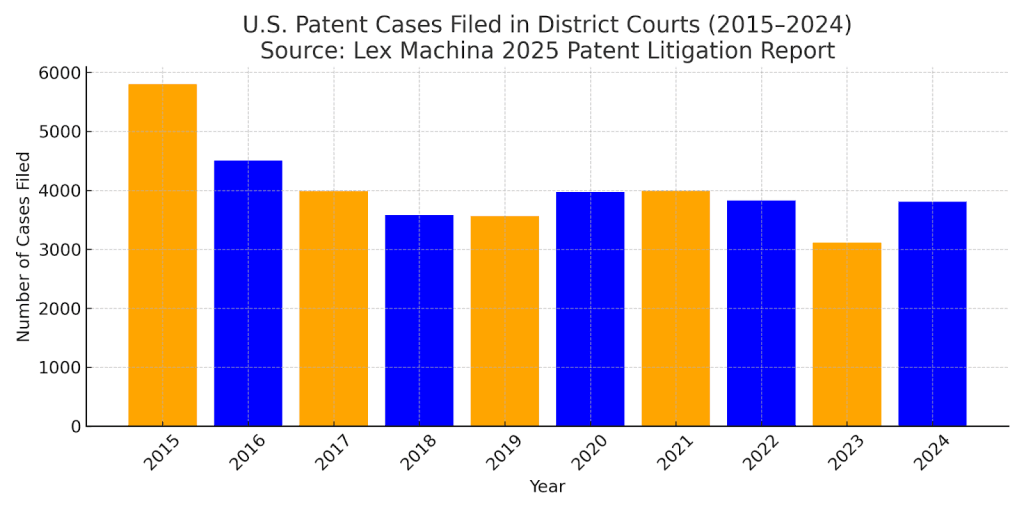
Filings are rising: 3,111 district court patent cases in 2023, 3,803 in 2024, and 4,547 in 2025, a ten-year high, according to Lex Machina.
A license is permission, given by the patent holder (licensor), for someone else (the licensee) to do something that would otherwise infringe the patent; you keep ownership. An assignment transfers ownership itself. The parties negotiate scope, territory, duration, and compensation, and a well-drafted agreement that sets out both sides' rights and duties prevents disputes later. The main ways patents let their owners earn from them:
Licensing costs you some control, so vet the partner and settle these in a patent licensing agreement:
To sell a patent, sign a written assignment and record it with the USPTO within three months to protect against later buyers (§ 261). Joint owners may each use and license the patent without the others' consent unless they agree otherwise (§ 262).
A U.S. utility patent generally lasts 20 years from the date the application was filed, as long as maintenance fees are paid. A design patent lasts 15 years from the date it is granted, with no maintenance fees, and a plant patent lasts 20 years from filing. A provisional application does not start the 20-year clock, but your enforceable rights begin only when the patent issues, so time spent in examination comes out of the term unless the USPTO grants a patent term adjustment.
A patent cannot be renewed.
Utility patents stay in force only if maintenance fees are paid 3.5, 7.5, and 11.5 years after grant: currently $2,150, $4,040, and $8,280 for a large entity, with small entities paying 40% and micro entities 20%. Design and plant patents have none (§ 41(b)).
Docket all three dates at grant: each fee is payable in the six months before it is due (37 C.F.R. § 1.362), payment in the six-month grace period after it costs a surcharge, and the USPTO reminds you only once a fee is overdue. A lapsed patent can be revived by petition if the delay was unintentional (§ 1.378).
The inventor, until they assign the rights in writing. A company can apply for the patent only if the inventors have assigned the invention or must do so (§ 118); recorded owners appear in the USPTO's assignment search.
Employers rely on invention assignment clauses, which investors check. Without one, an employer may still own the work of an employee hired to invent, or get a “shop right” to use it. California Labor Code § 2870 protects inventions made on an employee's own time and equipment.
Founders often assign patents to their company, which makes them assets investors can value and keeps ownership clear if a founder leaves.
A U.S. patent stops at the border. The Paris Convention gives you 12 months from your first filing to file abroad with the same priority date; a PCT application covering 159 contracting states lets you wait up to 30 months before choosing countries. Published PCT filings are searchable in WIPO's PATENTSCOPE, and licensing foreign patents to a local distributor can open a market for you.
Federal law: Title 35 of the U.S. Code, which rests on Article I, Section 8 of the Constitution. The USPTO grants patents and federal courts decide infringement cases.
Yes. Federal law gives patents “the attributes of personal property” (35 U.S.C. § 261), so they can be sold, licensed, used as collateral, or inherited.
Here’s what makes Rapacke Law Group different: We work exclusively on transparent, fixed-fee arrangements so you know precisely what patent protection costs before you commit, with no surprise bills, no hourly rate uncertainty. Our specialization in tech IP, particularly AI and software patents, means we understand the nuances of protecting algorithms, data structures, and system architectures that general practice firms miss. And we back our work with service-specific guarantees.
The RLG Guarantee for Patent Services:
Don’t let competitors patent around your innovations or challenge weak patents that could have been drafted more strategically. Schedule your free IP strategy call today to evaluate your patent position and develop a protection plan that turns your innovations into defensible competitive advantages.
To Your Success,
Andrew Rapacke, Managing Partner
Registered Patent Attorney
Rapacke Law Group
Connect with us:
LinkedIn: Andrew Rapacke
Twitter/X: @rapackelaw
Instagram: @rapackelaw
[RLG]Free strategy call
Talk it through with a registered patent attorney.
[01]Keep reading
Learn what a patent licensing agreement grants, how exclusive and non-exclusive terms differ, and which clauses protect you. Book a free IP strategy call.

Your patent application has just been published. Within 48 hours, three competitors downloaded it, and their engineers are already designing around your claims. This…
Are you ready to transform your patented technology into financial success? One of the most common questions we come across is “how to sell my patent.” This…
The #1 top reviewed IP law firm.* Talk to a registered patent attorney, free.
*#1 top reviewed means the most public client reviews on Google, Trustpilot and Avvo of any US patent or trademark firm.