

Executive Summary
Key Takeaways
-
PPH reduces USPTO first-action pendency to approximately 7.5 months, and PPH applications in high-activity regions achieved grant rates of around 88% in fiscal year 2022, well above the overall USPTO average. -
Global PPH now covers participating patent offices across all five IP5 jurisdictions, including the United States Patent Office (USPTO), EPO, JPO, KIPO, and CNIPA, plus dozens of additional offices. -
PPH requires no government fee at the USPTO under the current Global PPH pilot, making it one of the most cost-efficient fast track examination procedures available. -
Claims in the corresponding application must sufficiently correspond to the allowed claims from the first office, misalignment is the most common reason PPH requests are denied. -
PCT-PPH lets applicants use a positive international preliminary examination report (IPER) to fast-track national phase examination in multiple countries simultaneously.
0:00
USPTO data shows that PPH patent prosecution highway applications receive a first office action in roughly 7.5 months, while standard applications have seen pendency climb substantially since 2020 -- a difference that can determine whether a startup secures patent protection before or after a funding round closes. For any applicant already holding an allowance from one patent office, the PPH patent prosecution highway converts that existing work product into a queue-jumping asset at dozens of other participating offices worldwide. Rapacke Law Group backs every patent prosecution engagement with the RLG Guarantee: if a prior art search finds your invention is not novel, you receive a full refund -- so you invest in prosecution only when the fundamentals support it.
What the Patent Prosecution Highway Actually Does for Patent Applicants
The Patent Prosecution Highway (PPH) is a bilateral or multilateral agreement between participating patent offices that allows applicants to skip to the front of the examination queue. Rather than waiting for an examiner to start from scratch, you leverage allowed claims from one jurisdiction to accelerate substantive examination at a second patent office. According to the EPO's examination guidelines, PPH lets the second office exploit available work results from the first, eliminating duplicated effort across borders. This efficiency is why Rapacke Law Group includes PPH strategy as a standard part of every global prosecution engagement backed by the RLG Guarantee.
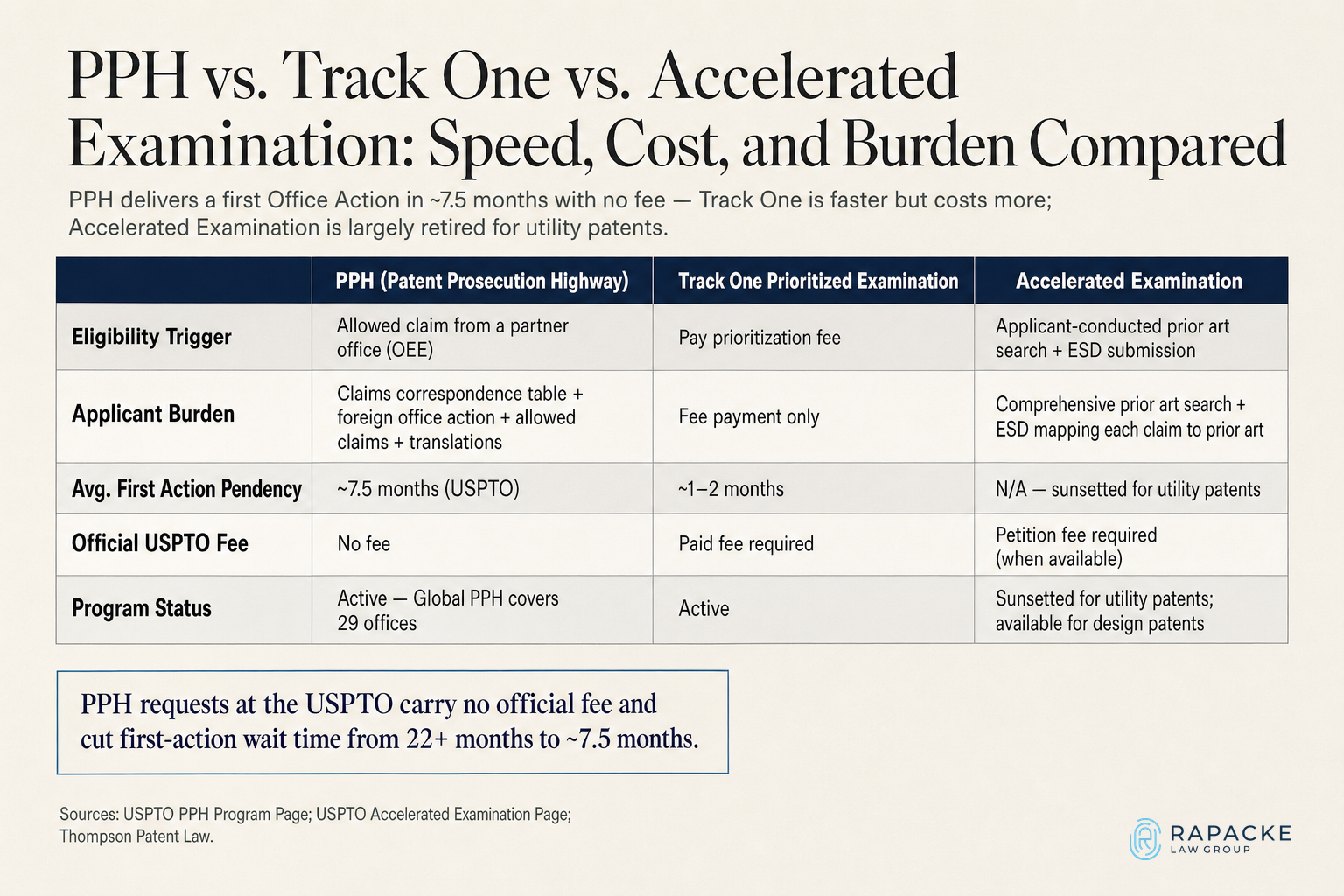 PPH vs. Track One vs. Accelerated Examination: Speed, Cost, and Burden Compared - Source: USPTO PPH Program Page; USPTO Accelerated Examination Page; Thompson Patent Law
How the PPH System Eliminates Redundant Examination Work
When a patent office (the Office of Earlier Examination, or OEE) finds at least one claim allowable, that work product becomes a reusable asset. The Office of Later Examination (OLE), such as the European Patent Office or Japan Patent Office, can rely on the first office's prior art search and patentability findings rather than conducting a fully independent review. At the end of 2022, 91% of all patents in force worldwide were valid in one of the five IP5 offices, according to the IP5 Statistics Reports portal, making work-sharing between them especially impactful. The PPH patent prosecution highway program is particularly valuable because the USPTO reports that PPH applications represent only about 2% of filings, yet they achieve a first office action in approximately 7.5 months versus substantially longer waits for non-PPH cases. Rapacke Law Group's RLG Guarantee means clients pursue this advantage only after a prior art search confirms the invention's novelty -- reducing wasted prosecution spend from the start.
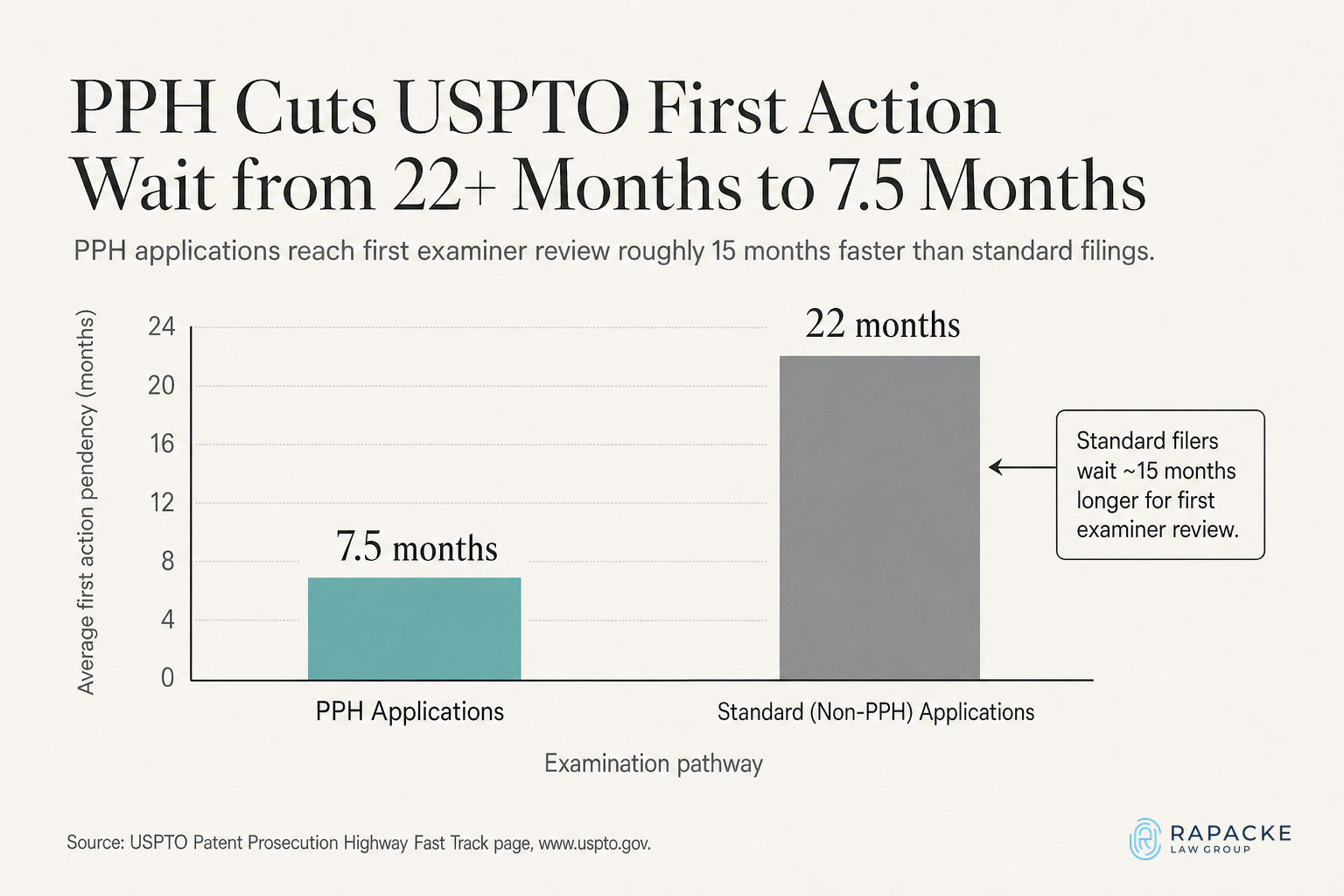 PPH Cuts USPTO First Action Wait from 22+ Months to 7.5 Months - Source: USPTO Patent Prosecution Highway Fast Track page
The Three Types of PPH Programs You Need to Know
Three distinct program structures exist: bilateral PPH agreements between two specific offices; Global PPH, launched in 2014 as a multilateral framework covering participating offices including Australia, the Canadian Intellectual Property Office (CIPO), the German Patent and Trade Mark Office (DPMA), the Israel Patent Office (ILPO), Singapore, and the African Regional Intellectual Property Organization (ARIPO); and PCT-PPH, which uses PCT work products -- including a positive international preliminary examination report (IPER) from an international preliminary examining authority (IPEA) acting as the qualifying international preliminary examining authority -- as the qualifying basis. According to the JPO's PPH portal, all IP5 offices participate in the Global PPH framework under a common set of rules and a shared request form. If you need a broader view of global filing strategies, see our guide on Patent PCT Filing to Protect Your Invention Globally.
Why PPH Is Not the Same as Accelerated Examination
Accelerated examination at the United States Patent Office historically required applicants to conduct a comprehensive prior art search and submit an Examination Support Document (ESD) -- a time-consuming and costly obligation. PPH requires no such search; the qualifying work has already been done by the first office. Track One prioritized examination, the modern alternative for U.S. applicants without foreign work product at the United States Patent and Trademark Office (USPTO), historically delivered a first action in an average of 1.72 months as of fiscal year 2019 but carries a government fee exceeding $4,000 for large entities. PPH, by contrast, carries no USPTO government fee under the current Global PPH pilot and achieves first-action pendency of roughly 7.5 months, making it the more cost-efficient fast track examination procedures when a foreign allowance already exists. The RLG Guarantee from Rapacke Law Group ensures that before any prosecution begins, a prior art search validates novelty -- so clients only invest in PPH when the invention is worth protecting. For a deeper comparison, see Patents in Months, Not Years: The ROI of Track 1 for High-Growth Companies.
Which Patent Offices Participate in the PPH Program Today
The Global PPH pilot encompasses a substantial network of patent offices, dramatically expanding from the handful of initial bilateral agreements that launched in the mid-2000s. Knowing exactly which offices participate, and under which framework, determines whether PPH is available for your target markets before you build a filing strategy around it.
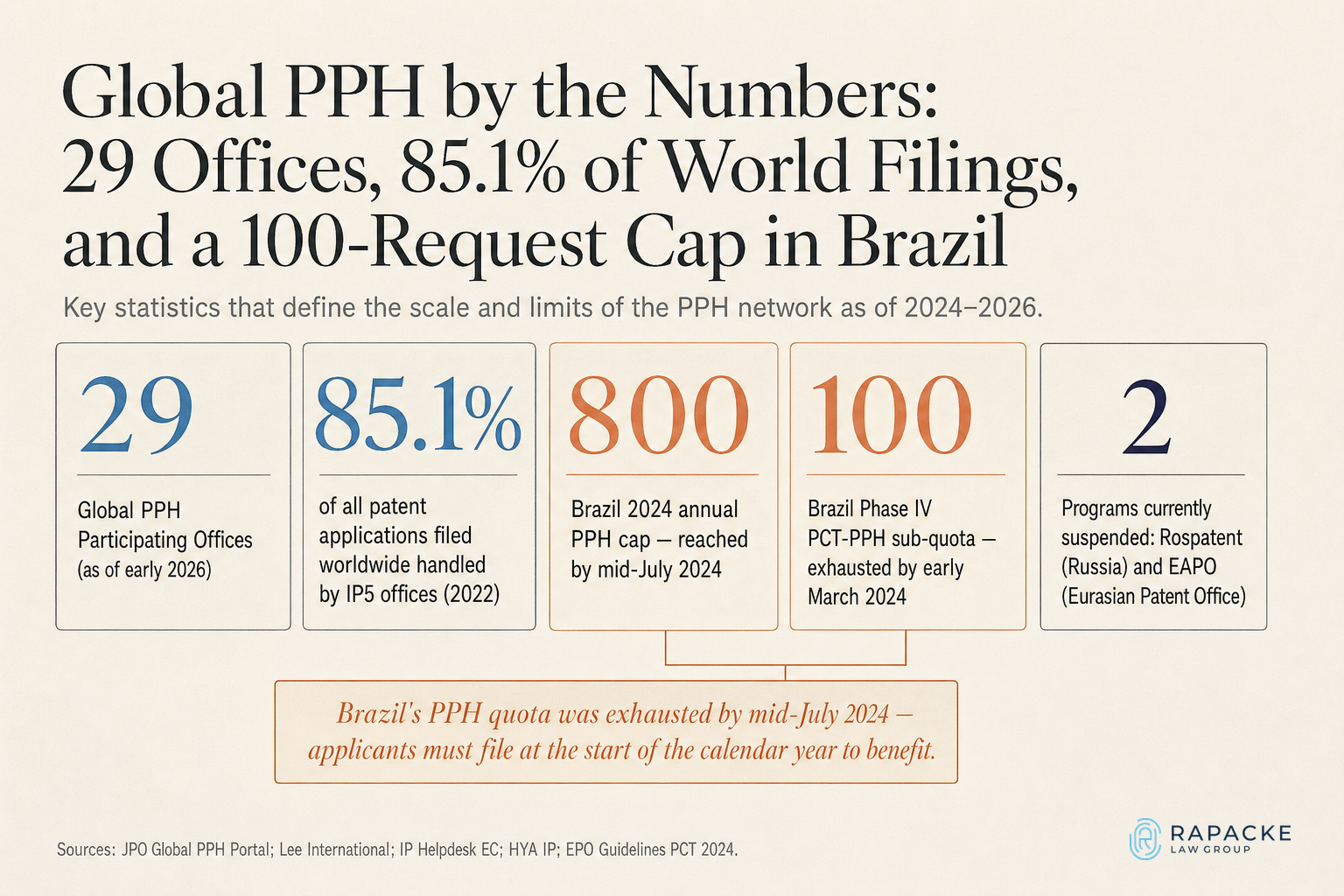 Global PPH Participating Offices and Key Statistics - Source: JPO Global PPH Portal (jpo.go.jp); IP5 Statistics Reports (fiveipoffices.org); IP Helpdesk EC (intellectual-property-helpdesk.ec.europa.eu); EPO Guidelines PCT 2024 (epo.org)
The IP5 Offices and Their PPH Relationships
All five IP5 offices participate in the Global PPH and maintain numerous bilateral agreements with each other and with smaller offices, according to EPO guidance. The EPO's PPH partner list includes the United States Patent Office, Japan Patent Office, Korean Intellectual Property Office (KIPO), China National Intellectual Property Administration (CNIPA), the Canadian Intellectual Property Office, the Israel Patent Office, Mexico (IMPI), Singapore (IPOS), Australia (IP Australia), Brazil (INPI), Peru, and Saudi Arabia (SAIP), among others. The German Patent and Trade Mark Office (DPMA), also referred to as the german patent mark office, and the United Kingdom Intellectual Property Office (UKIPO) also participate through the Global PPH network. The Austrian Patent Office similarly participates, extending coverage across Central Europe. PPH cooperation with Russia (Rospatent) and the Eurasian Patent Office (EAPO) is currently suspended.
The ip5 pph relationships are particularly significant because, as noted above, 91% of all patents in force worldwide are held in one of the five IP5 jurisdictions. The IP5 PPH framework means a single strong allowance from the United States Patent and Trademark Office or the EPO can potentially unlock fast track examination procedures across the majority of commercially relevant markets. Rapacke Law Group's RLG Guarantee supports this strategy: every engagement begins with a prior art search to confirm novelty before prosecution resources are committed.
Offices With Notable Limitations or Conditional Participation
Some offices impose significant restrictions. Brazil's national institute (INPI), the Brazilian National Institute of Industrial Property, operates PPH as a phased pilot with strict annual caps. In 2024 (Phase IV), INPI set an annual cap of 800 total PPH entries, which was exhausted by mid-year, according to the European IP Helpdesk. As of 2025 Phase V, INPI increased the annual cap to 3,200 requests with quarterly allocation, per updated INPI ordinances. New Zealand's IPONZ participates in Global PPH, though PPH cases still typically receive at least one examination report before grant. Always verify participation status directly on the target office's website within 30 days of filing for more information, as program terms change without broad public notice.
How to Qualify Your Application for a PPH Patent Prosecution Highway Request
Not every patent application with a foreign allowance is automatically eligible. The qualifying criteria are specific, and a failed PPH request resets your timeline rather than accelerating it. For software-specific considerations, see How to Expedite the Software Patenting Process and Options for Expediting the Patent Process For Computer Software Inventions.
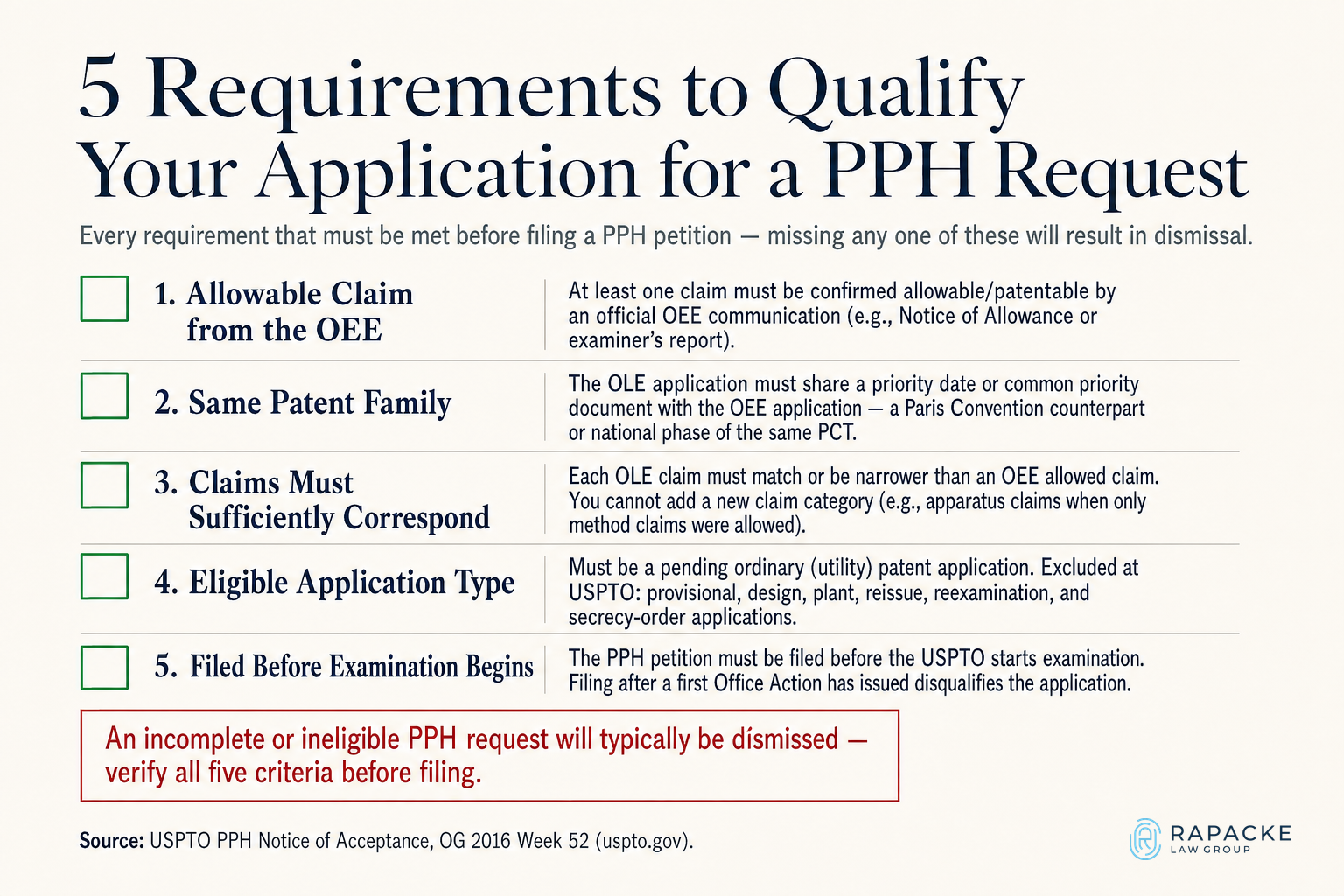 5 Requirements to Qualify Your Application for a PPH Request - Source: USPTO PPH Notice of Acceptance, OG 2016 Week 52
The Allowable Claims Requirement and Claims Correspondence
To qualify, at least one of the patentable allowable claims in the corresponding application must be found allowable or patentable by the OEE. The claims in the application you want fast-tracked at the second office must sufficiently correspond to those allowed claims. The second patent office requires a claims correspondence table documenting how each set of corresponding claims in the pending application relates to the OEE's allowed claims. All independent claims in the corresponding application must correspond to allowed claims; partially corresponding claim sets do not qualify. Drafting or amending claims to align with the OEE's allowed claims before submitting the PPH request is the single most important preparatory step, because claim misalignment is the most common cause of denial.
Document Requirements for a Complete PPH Request
A complete PPH request typically requires: a copy of the office action or examination report from the OEE indicating the allowed claims; a copy of the allowed claims themselves; the claims correspondence table; and copies of documents cited by the OEE examiner that are not already in the second application's record. For PCT-PPH, the IPER and the written opinion of the IPEA serve as the qualifying work product for a PCT application in place of a national office action. An incomplete PPH request is typically dismissed without substantive review, so assembling the full document package before filing is essential.
Applications That Are Ineligible for PPH
Reissue applications, design patent applications, and applications that have received a final disposition are generally ineligible. Some offices exclude continuation and divisional applications under specific circumstances. If a united states patent application is a continuation, the OEE work product must come from the parent application, not an unrelated foreign filing. Confirm eligibility against the specific rules of the second patent office, not just the first.
The Real-World Speed and Allowance Rate Advantages PPH Delivers
The reason PPH matters to tech startups and inventors is concrete: faster patents mean earlier enforcement rights, stronger IP portfolios during VC due diligence, and faster licensing conversations. The published data supports using the PPH patent prosecution highway as a core prosecution strategy, not an optional add-on. Rapacke Law Group backs every prosecution engagement with the RLG Guarantee -- if a prior art search shows the invention lacks novelty, clients receive a full refund, ensuring prosecution spend is never wasted.
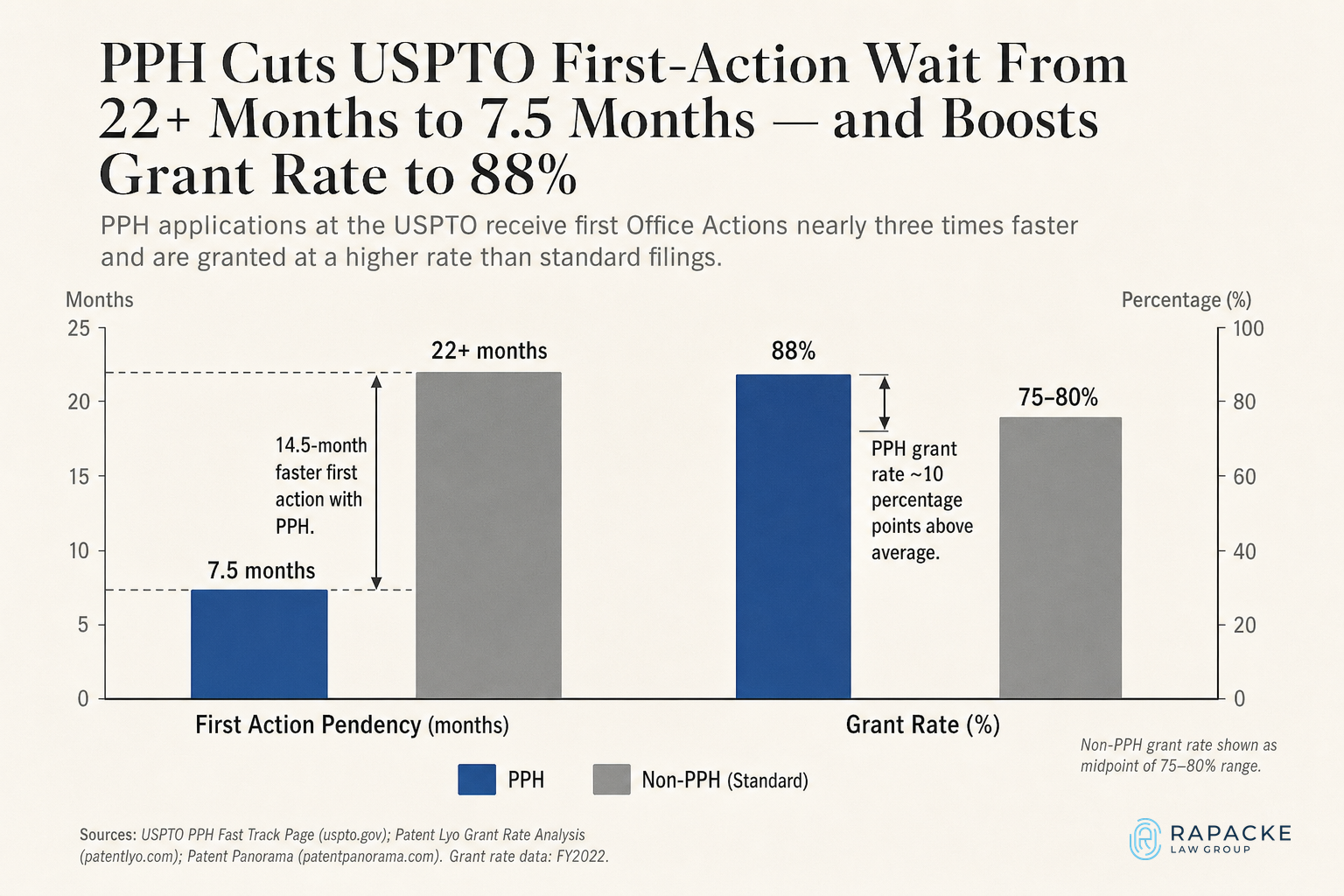 PPH Cuts USPTO First-Action Wait and Boosts Grant Rate to 88% - Source: USPTO PPH Fast Track Page (uspto.gov)
First Action Pendency and Time-to-Grant Statistics
According to the USPTO's PPH program page, PPH applications at the United States Patent and Trademark Office receive a first office action in approximately 7.5 months on average. Standard application pendency has grown considerably since 2020, and even in busier art units, PPH delivers a meaningful queue advantage. For SaaS and software patent applicants, where standard examination can stretch even longer, leveraging PPH fast track examination procedures from a favorable Japan Patent Office or European Patent Office action can compress the timeline significantly. See also How Long Does It Take To Get A Software Patent? for baseline comparisons.
Allowance Rate Differences Between PPH and Non-PPH Applications
PPH applications in regions with significant PPH activity at the USPTO achieved grant rates of approximately 88.3% for regions with 100 or more petitions filed, and 88.0% for regions with fewer than 100 petitions, according to USPTO FY 2022 statistics. This is substantially above the overall USPTO average grant rate of approximately 77%. The elevated allowance rate reflects both selection bias (applicants using PPH already hold one office's validation) and the examiner efficiency benefit of having prior work product in hand. Fewer office actions mean lower prosecution costs, which compounds the fee savings from PPH's zero government-fee structure at the United States Patent Office. This is precisely why the RLG Guarantee from Rapacke Law Group pairs a prior art novelty search with every prosecution engagement -- clients only proceed when the invention is patentable, maximizing the return on every PPH filing. For more on what a granted patent means for your business, see Stop Bleeding IP Value: Get Your Patent Granted and Enforceable Before Competitors File First.
How PCT-PPH Works and When to Use It Over Standard PPH
PCT-PPH is a distinct pathway within the PPH patent prosecution highway framework that uses PCT international phase examination work products, rather than a national office allowance, as the qualifying basis. For applicants pursuing intellectual property protection in multiple countries simultaneously through the Patent Cooperation Treaty (PCT) route, PCT-PPH is often the more efficient tool.
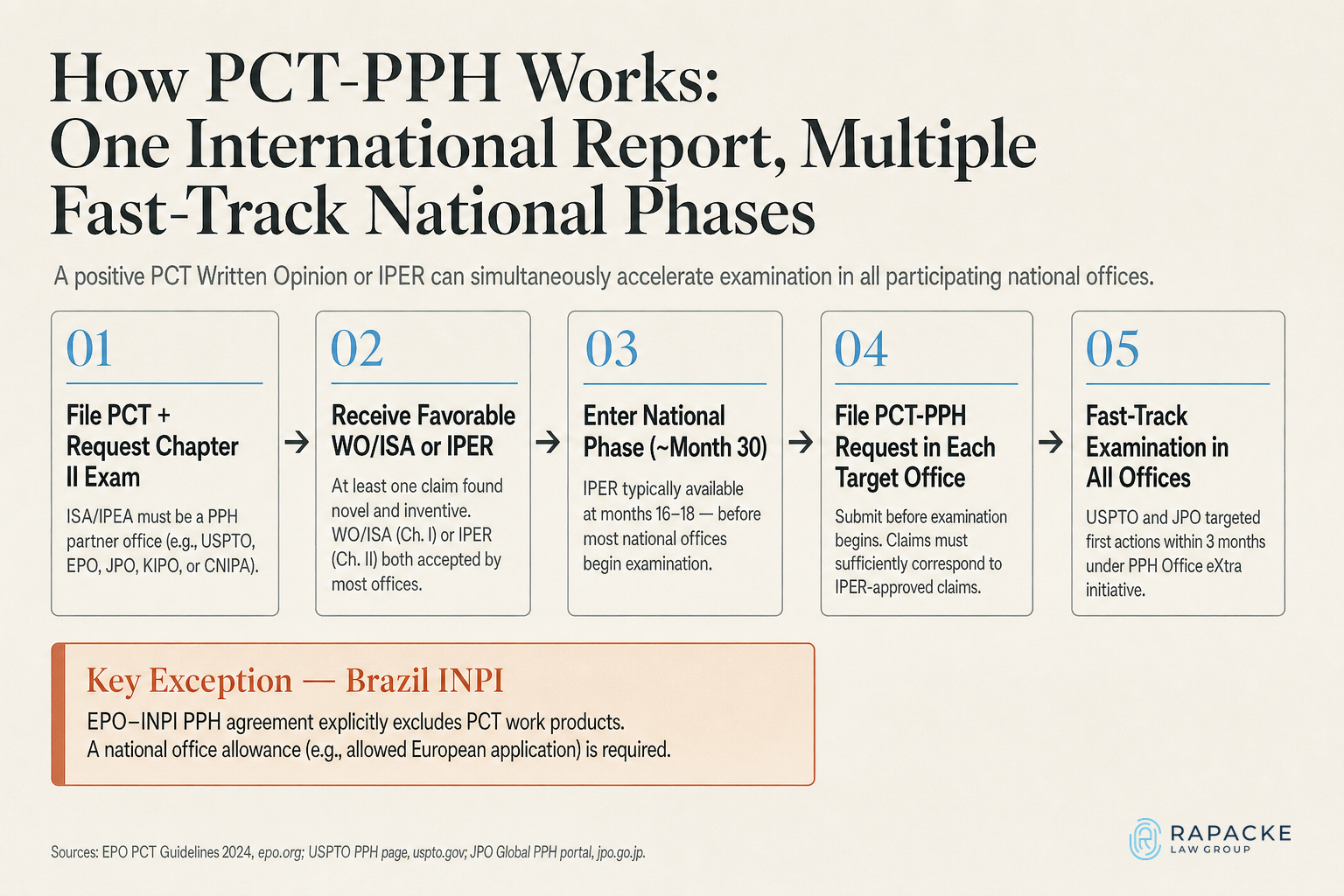 How PCT-PPH Works: One International Report, Multiple Fast-Track National Phases - Source: EPO PCT Guidelines 2024; USPTO PPH Fast Track page; JPO Global PPH portal
Using PCT Work Products as the OEE Basis
When an international preliminary examining authority (IPEA) issues a positive international preliminary examination report (IPER) indicating that at least one claim is novel, meets the inventive step requirement, and is industrially applicable, that IPER can serve as the qualifying work product for a PCT-PPH request at participating national offices. The United States Patent Office, European Patent Office, Japan Patent Office, Korean Intellectual Property Office (KIPO), and China National Intellectual Property Administration (CNIPA) all accept PCT-PPH under the Global PPH framework. Some offices accept a positive written opinion from the International Searching Authority (ISA) as sufficient; others require a full IPER. If you are entering national phase in three or more IP5 countries, requesting international preliminary examination during the PCT phase to generate a usable IPER is worth the added cost.
PCT-PPH vs. National Work Product PPH: Choosing the Right Path
If a national allowance already exists before entering national phase elsewhere, standard PPH using that first application's national work product is the simpler path. If you are coordinating a simultaneous multi-country filing strategy without a prior national allowance, PCT-PPH using a positive IPER is the more efficient route. One important exception: Brazil's INPI requires a national office allowance rather than PCT work product, according to EPO PCT guidelines. Map your filing timeline before national phase entry, because the correct PPH patent prosecution highway pathway depends entirely on which qualifying work product exists first. Rapacke Law Group's RLG Guarantee applies here too: a prior art search confirming novelty is completed before prosecution begins, so you never invest in a PCT-PPH pathway on an invention that won't survive examination.
The Limitations and Strategic Trade-offs of Using PPH
PPH is not the right strategy for every application. The efficiency gains come with specific constraints that can affect claim scope and long-term enforcement options.
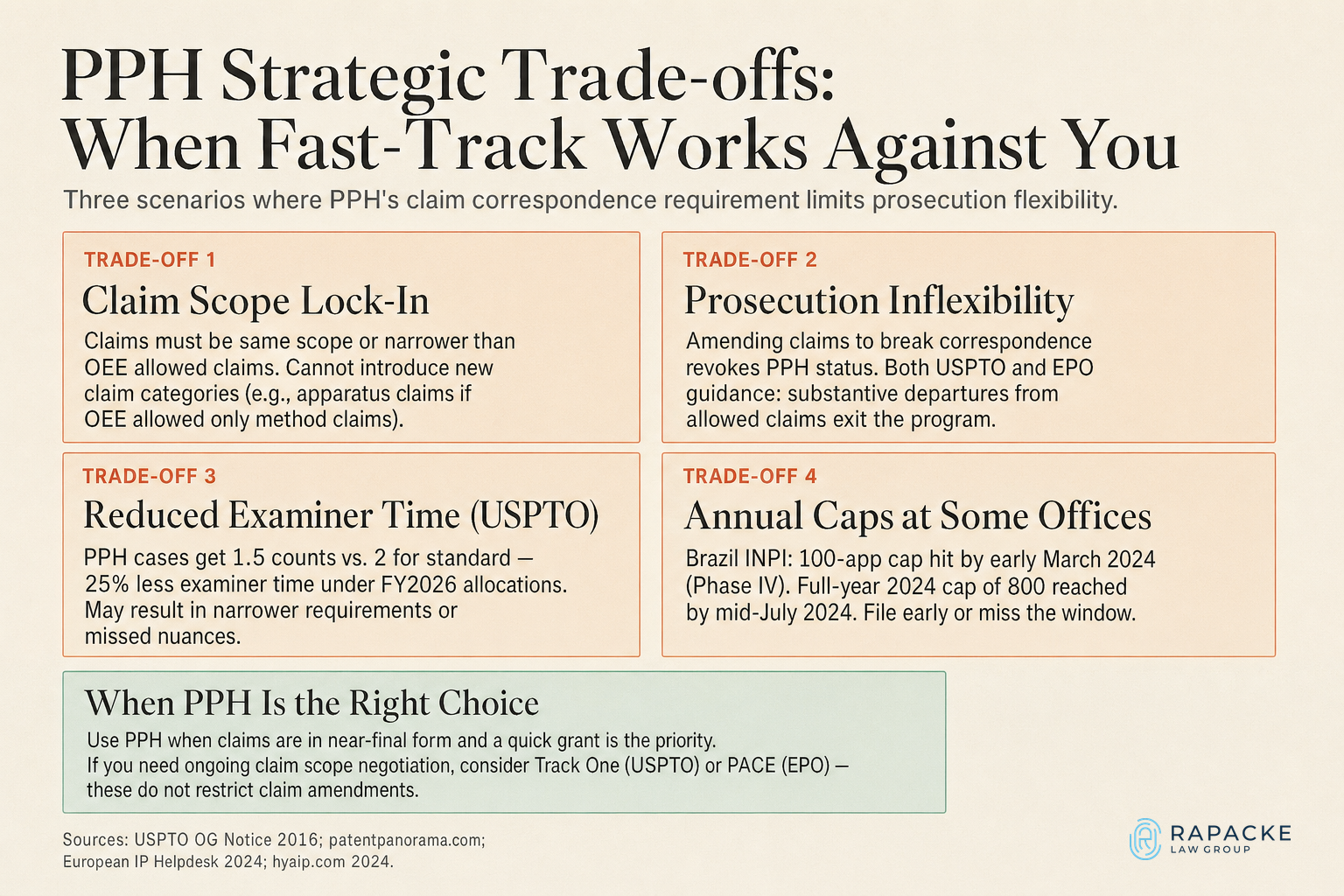 PPH Strategic Trade-offs: When Fast-Track Works Against You - Source: USPTO OG Notice 2016; European IP Helpdesk 2024
Claim Scope Constraints Imposed by the Correspondence Requirement
Because corresponding application claims must align with the OEE's allowed claims, PPH can effectively narrow the scope you pursue at the second office. If the allowed claims from the first jurisdiction are narrower than what independent examination at the second office might yield, PPH could lock you into a narrower global scope. Practitioners often manage this by filing continuation or divisional applications to pursue broader claims outside the PPH track, preserving the speed benefit for the core claim set while keeping broader scope options open.
When PPH Makes Prosecution Inflexible
PPH requires that pending claims in the second application correspond to allowed claims from the OEE. Pursuing fundamentally different claim sets broader independent claims or claims directed to a different aspect of the invention is blocked within the PPH track. Claim amendments that move outside the OEE's allowed claims can result in withdrawal of the PPH request. If your allowed claims are narrower than what the second office might independently grant, independent examination there may better serve your long-term intellectual property portfolio, particularly for enforcement and licensing purposes. Rapacke Law Group's RLG Guarantee ensures that regardless of the prosecution path chosen, a prior art search validates the invention's novelty before any fees are committed. See How Long Do Software Patents Last? The Definitive Timeline for Tech Startups for context on why patent scope and duration together determine portfolio value.
How to File a PPH Request at the USPTO Step by Step
For U.S.-based applicants using a foreign allowance to accelerate examination at the United States Patent and Trademark Office, the PPH patent prosecution highway request process follows a defined procedure. Errors in the request result in dismissal and lost time.
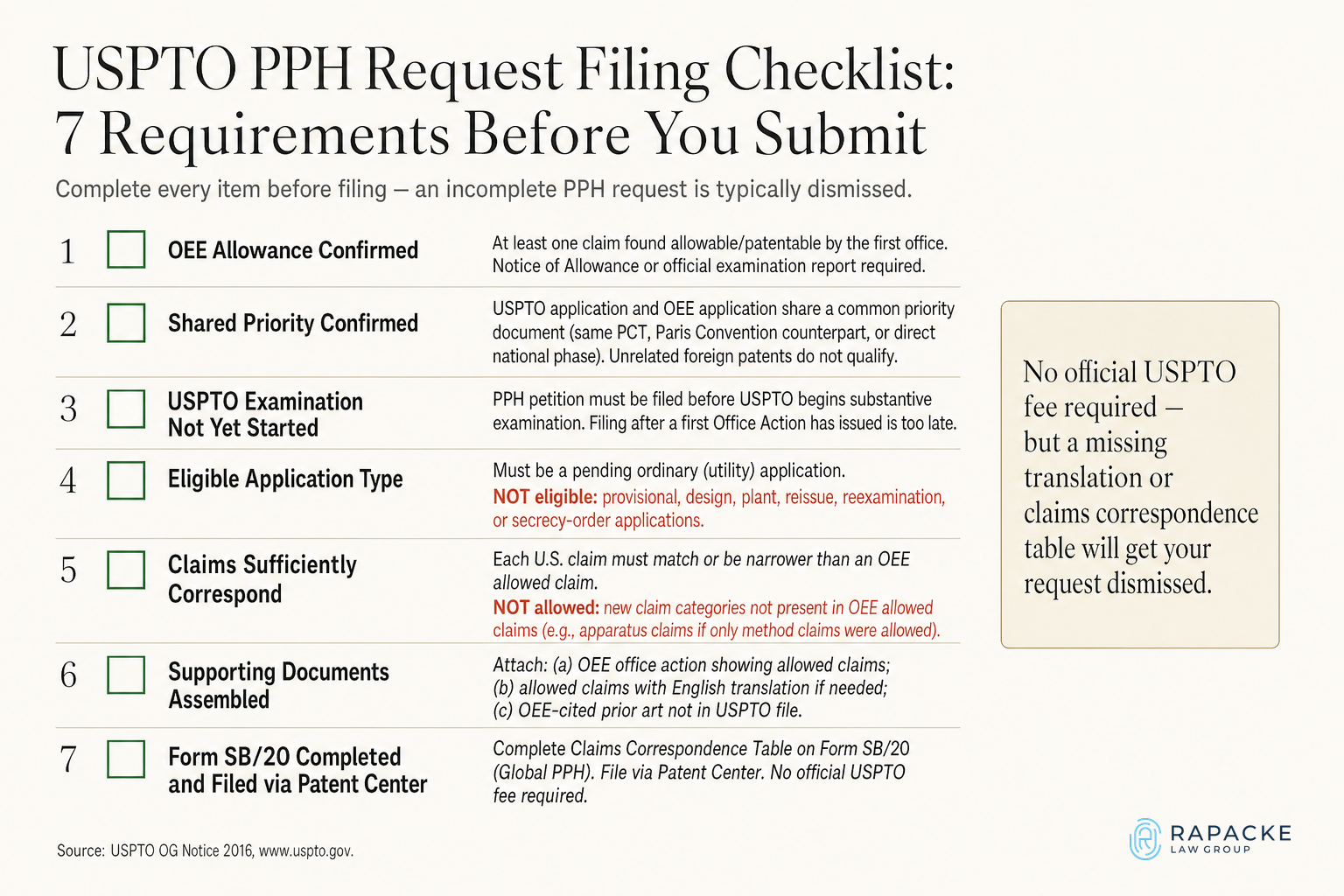 USPTO PPH Request Filing Checklist: 7 Requirements Before You Submit Source: USPTO OG Notice 2016
Preparing the Claims Correspondence Table
The claims correspondence table maps each claim in the U.S. patent application to the corresponding allowed claim from the OEE, explaining how each U.S. claim is the same as, or closely corresponds to, an allowed claim. All independent claims in the U.S. application must correspond to allowed claims partial correspondence is insufficient. Build the correspondence table before amending the U.S. claims; it is far easier to design amendments around the table than to retrofit the table to claims drafted independently.
Filing the PPH Request Through USPTO Patent Center
A PPH request covering a united states patent application is filed as a petition through Patent Center at the United States Patent Office, not as a standard prosecution document. Under the current Global PPH pilot, there is no government fee for filing the PPH request, according to the USPTO PPH program page. The request must be filed before the USPTO issues a first office action on the merits and should be filed as early as possible after the qualifying OEE allowance is obtained. Delays reduce the time-savings advantage that makes fast track examination procedures valuable in the first place.
Frequently Asked Questions About Patent Prosecution Highway
What is a patent prosecution highway?
The PPH patent prosecution highway is a set of international agreements between participating patent offices that allows applicants to request accelerated examination when at least one claim in a corresponding application has been found allowable by another participating office. The second office uses the first office's examination work to fast-track its own review, rather than starting from scratch. The program exists in bilateral form, under the Global PPH multilateral framework, and as PCT-PPH for applications using PCT international work products. Offices including the United States Patent Office, EPO, Japan Patent Office, the Canadian Intellectual Property Office, the Israel Patent Office, the Austrian Patent Office, and the German Patent and Trade Mark Office all participate.
How much does the patent prosecution highway cost?
At most major participating patent offices, including the USPTO under the Global PPH pilot, there is currently no government fee for filing a PPH request. Attorney fees for preparing a complete request drafting the claims correspondence table, gathering OEE work product documents, and potentially amending pending claims typically range from a few hundred to over a thousand dollars depending on claim complexity. Verify current fee schedules directly with each office, as structures can change when pilot programs are renewed.
When can a PPH request be filed?
A PPH request must generally be filed before the second patent office issues a first office action on the merits. At the United States Patent and Trademark Office, this means filing as early as possible after the qualifying OEE allowance ideally at the time of national phase entry or shortly after filing the corresponding U.S. application. The specific deadline varies by office, so confirm the timing rules for each participating office before filing.
What is the difference between PPH and PACE at the EPO?
PACE (Program for Accelerated Prosecution in Europe) is the EPO's internal accelerated examination program, available to any applicant upon request without requiring a foreign allowance. PPH at the European Patent Office specifically requires at least one claim found allowable or patentable by a participating office of earlier examination. PACE can be requested at any time during examination or appeal; EPO PPH has specific eligibility requirements tied to the OEE's work product. Both programs represent fast track examination procedures, but PPH requires prior foreign validation while PACE does not.
Can PPH be used for software and AI patent applications?
PPH is available for any technology area where participating offices have active PPH agreements, including software and AI inventions. However, the correspondence requirement means that allowed claims from the first office must also survive subject matter eligibility analysis in the second jurisdiction. A claim allowed under the Japan Patent Office's or EPO's examination standards may still face subject matter eligibility rejections at the United States Patent Office, particularly for software and AI patents. Applicants should assess whether the OEE's allowed claims are likely to be robust in the second jurisdiction before relying on the PPH track.
Does PPH guarantee faster examination or just priority?
PPH grants priority placement in the examination queue, which typically results in significantly faster first office actions. It does not guarantee allowance, and it does not prevent the second office from issuing rejections. USPTO data on PPH applications shows a grant rate substantially above the overall office average, but it is not 100%. Treat PPH as a tool to accelerate the examination process using fast track examination procedures not to bypass it entirely.
Your Next Steps to Patent Prosecution Highway Success
The patent prosecution highway program is one of the most cost-effective tools available for compressing the global patent prosecution timeline. Starting with a jurisdiction where examination is fast and allowance rates are strong, then using that work product to accelerate filings at the United States Patent and Trademark Office, European Patent Office, Japan Patent Office, the Canadian Intellectual Property Office, the Austrian Patent Office, the Israel Patent Office, and other participating offices, the PPH patent prosecution highway can cut years off the time to patent protection while reducing total prosecution costs through fewer office actions and zero government fees at the USPTO.
The key decisions are sequential: confirm whether your application will generate qualifying work product from an OEE; verify that the target office participates in a relevant PPH or IP5 PPH agreement; and structure your corresponding application's claims to satisfy the correspondence requirement without sacrificing scope needed for enforcement or licensing. For SaaS founders and tech startups building international IP portfolios, the time advantage fast track examination procedures provide translates directly into earlier enforcement rights and stronger positions during VC due diligence.
The bottom line: a weak prosecution strategy waits years for examination and burns budget on redundant office actions. A strong strategy uses every qualifying allowance to unlock the PPH patent prosecution highway across all relevant markets simultaneously.
If your application is approaching allowance in any participating jurisdiction, the window to act is narrow, PPH requests must be filed before the second office issues a first action.
- Schedule a Free IP Strategy Call to determine whether PPH is the right approach for your pending applications
- Download the SaaS Patent Guide 2.0 to understand how PPH fits into a broader software IP strategy
- Explore the AI Patent Mastery resource if your application involves AI or machine learning inventions
Rapacke Law Group works with tech founders and inventors to build and execute patent prosecution strategies across the United States Patent and Trademark Office, EPO, JPO, the German Patent and Trade Mark Office, the Canadian Intellectual Property Office, and other major patent offices worldwide. Every patent prosecution engagement at Rapacke Law Group is backed by the RLG Guarantee: if a prior art search finds your invention is not novel, you receive a full refund -- ensuring you invest in prosecution only when the fundamentals support it. The RLG Guarantee removes the financial risk of starting prosecution before novelty is confirmed, so founders and inventors can pursue the patent prosecution highway with confidence.
To Your Success,
Andrew Rapacke
Managing Partner, Registered Patent Attorney
Rapacke Law Group