
Apple Inc. holds over 98,000 active patents worldwide, and that number is not a vanity metric. It is the infrastructure behind every product launch, every licensing negotiation, and every lawsuit Apple has either won or avoided. Studying patents by Apple reveals how systematic IP protection translates into durable competitive advantage. Understanding patents by Apple gives inventors and founders a working model for how systematic IP protection translates into durable competitive advantage.
Why Apple’s Patent Portfolio Is One of the Most Studied in the Technology Industry
Apple Inc. consistently ranks among the most active patent filers in the United States. Its intellectual property strategy directly shapes product roadmaps, competitive positioning, and investor confidence. For a deeper look at how tech giants build licensing leverage from their portfolios, see What Company Has the Most AI Patents? The Licensing and Cross-Licensing Reality Behind the AI Arms Race.
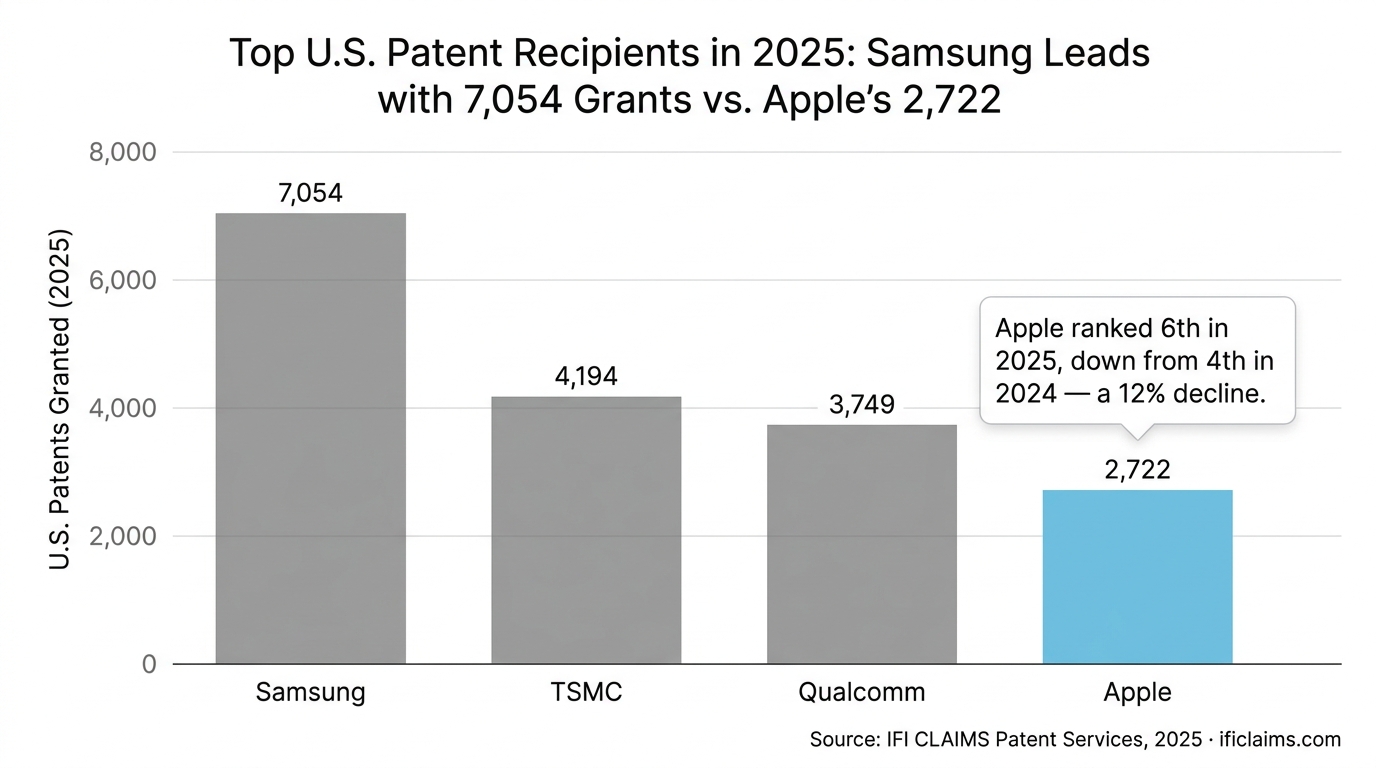 Top 10 U.S. Patent Recipients in 2025: Samsung Leads with 7,054 Grants vs. Apple’s 2,722; Source: IFI CLAIMS Patent Services, 2025
How Many Patents Does Apple Actually Hold
According to GreyB’s analysis, Apple holds approximately 116,492 patents globally, of which around 98,761 are active. In the United States alone, Apple holds over 52,000 patents spanning both utility and design categories at the u.s. patent office. The annual grant volume tells a complementary story: Apple received approximately 3,082 U.S. patent grants in 2024, then saw a roughly 12% decline to approximately 2,722 grants in 2025, which dropped it from 4th to 6th place in IFI Claims Patent Services annual rankings. Both granted patents and pending applications matter: granted patents provide enforceable rights, while pending applications signal where protection is being built.
What Types of Patents Apple Files Most Often
The vast majority of Apple’s portfolio consists of utility patents, which protect functional inventions. According to GreyB, Apple has filed over 47,000 utility patent applications with the United States Patent Office historically. Design patents, which protect a product’s ornamental appearance, form a smaller but strategically significant share. Apple’s design patent D618,677, covering the iPhone’s icon grid layout, and D593,087, covering its bezel design, were both enforced in the landmark Apple Inc. v. Samsung Electronics litigation. Apple pursues both categories because a competitor who designs around a utility patent may still infringe a design patent covering the same product. For more on how Apple vs. Samsung changed the course of design patents, the case remains the definitive reference point for design patent enforcement strategy.
How Apple’s Patent Filing Rate Compares to Peers
Apple’s approximately 2,722 U.S. grants in 2025 placed it behind Samsung (7,054), TSMC (4,194), and Qualcomm (3,749), according to IFI Claims Patent Services data. Samsung leads in raw volume, and IBM historically dominated for two decades before intentionally scaling back filings and falling to 11th place by 2025. Apple’s strategic edge is not volume but concentration: patents by Apple cluster in high-value consumer technology categories, smartphones, AI inference, health sensors, that generate substantial licensing leverage and litigation deterrence.
What Technologies Apple Patents Most Heavily and Where the Next Products May Come From
Patents by Apple function as a public roadmap of its R&D investments, often surfacing years before a product ships.
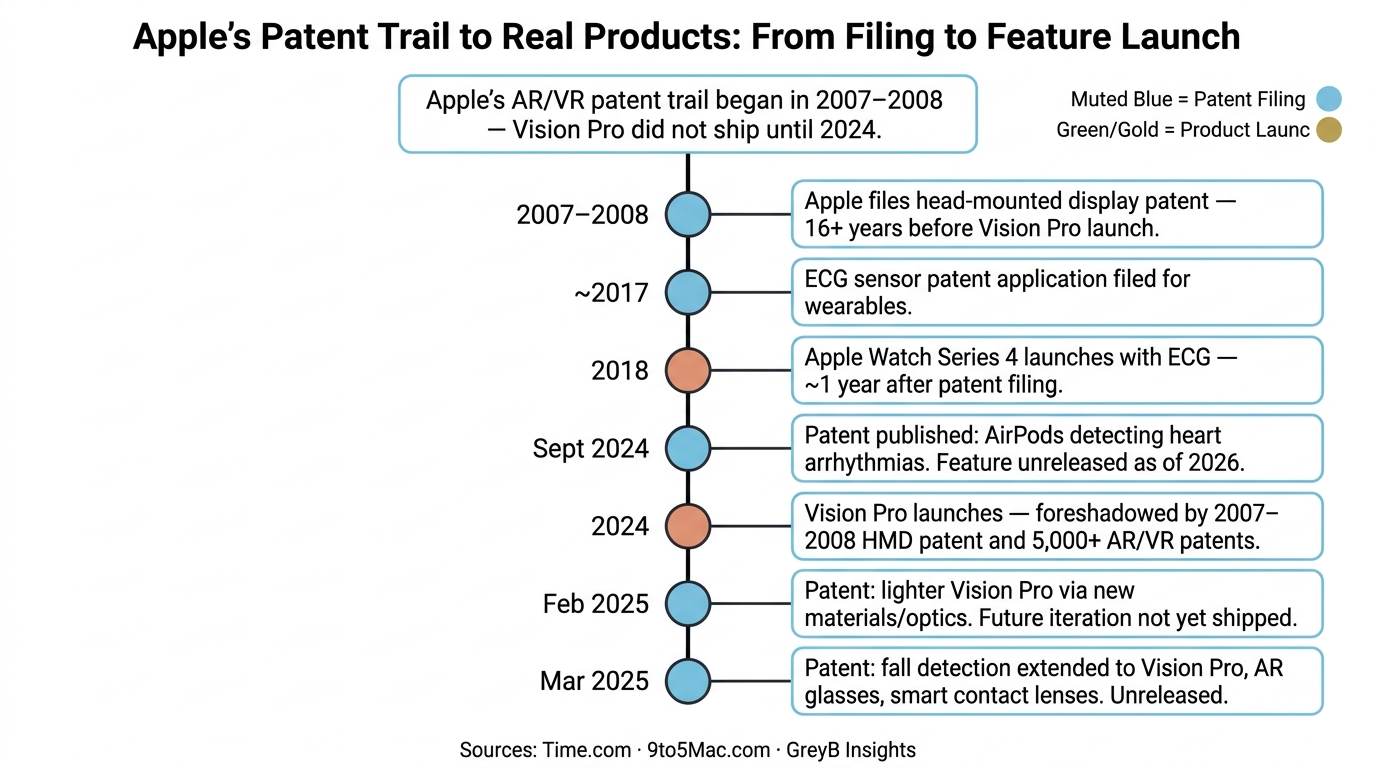 Apple’s Patent Trail to Real Products: From Filing to Feature Launch; Source: Time.com, 2015; 9to5Mac, 2024–2025; GreyB Insights, 2025
Machine Learning and Artificial Intelligence Patents Are Reshaping Apple’s Portfolio
Apple has significantly accelerated AI and machine learning patent activity. In October 2024 alone, Apple published 20 AI-related patent applications and received 7 AI patent grants, according to GreyB’s patent activity tracking. One of those grants, U.S. Patent 12,106,206 B2, covers a neural engine circuit designed for efficient convolution and sorting in AI tasks, directly relevant to the Apple Silicon chips powering current iPhones and Macs. These filings cover on-device inference, natural language processing, and computer vision, all already embedded in shipping features like Face ID and on-device Siri. To understand how these AI patent families compare to the broader landscape, see Most Valuable AI Patents Revealed: From Google’s Transformers to IBM’s $400M Licensing Empire. Any founder building AI-powered software needs to conduct a prior art search before assuming a feature method is unprotected. For context on how AI inventorship intersects with patent eligibility, see Can AI Be an Inventor? Intellectual Property in the AI Era.
Apple Watch and Health Sensor Patents Signal Wearable Innovation Priorities
Among patents by Apple, health and wearable sensor filings are the most strategically valuable, and they consistently precede actual product releases. Apple patented ECG sensing for wearables before introducing the feature in Apple Watch Series 4 in September 2018. A September 2024 patent application, reported by 9to5Mac, described using AirPods to detect heart arrhythmias. A new patent covering a March 2025 filing extended Apple Watch’s fall detection technology to Vision Pro, AR glasses, and smart contact lenses. The patent-to-product lag in this category typically runs one to three years, making current Apple Watch and health sensor filings a reliable indicator of near-term product priorities.
Spatial Computing and Vision Pro Patents Reflect Apple’s Longest Investment Horizon
Apple applied for a head-mounted display patent as early as 2006, according to Time, over a decade before the Vision Pro launched commercially in early 2024. Apple has since accumulated an estimated 5,000-plus patents in AR, VR, and spatial computing. Current filings continue building on that foundation: a February 2025 application described making Vision Pro significantly lighter using new materials and optics, per 9to5Mac, while a late 2024 patent revealed adjustable-focus lenses for lightweight AR glasses, reported by TechRadar. Foundational patents filed more than a decade before a product ships still generate enforceable rights at launch — and that long-horizon discipline is something every founder can replicate from day one.
How to Search Patents by Apple Using Free Public Tools
The tools to search patents by Apple are free and accessible. Running a search before filing your own patent application can reveal prior art that would otherwise cost thousands to discover through an attorney-led search.
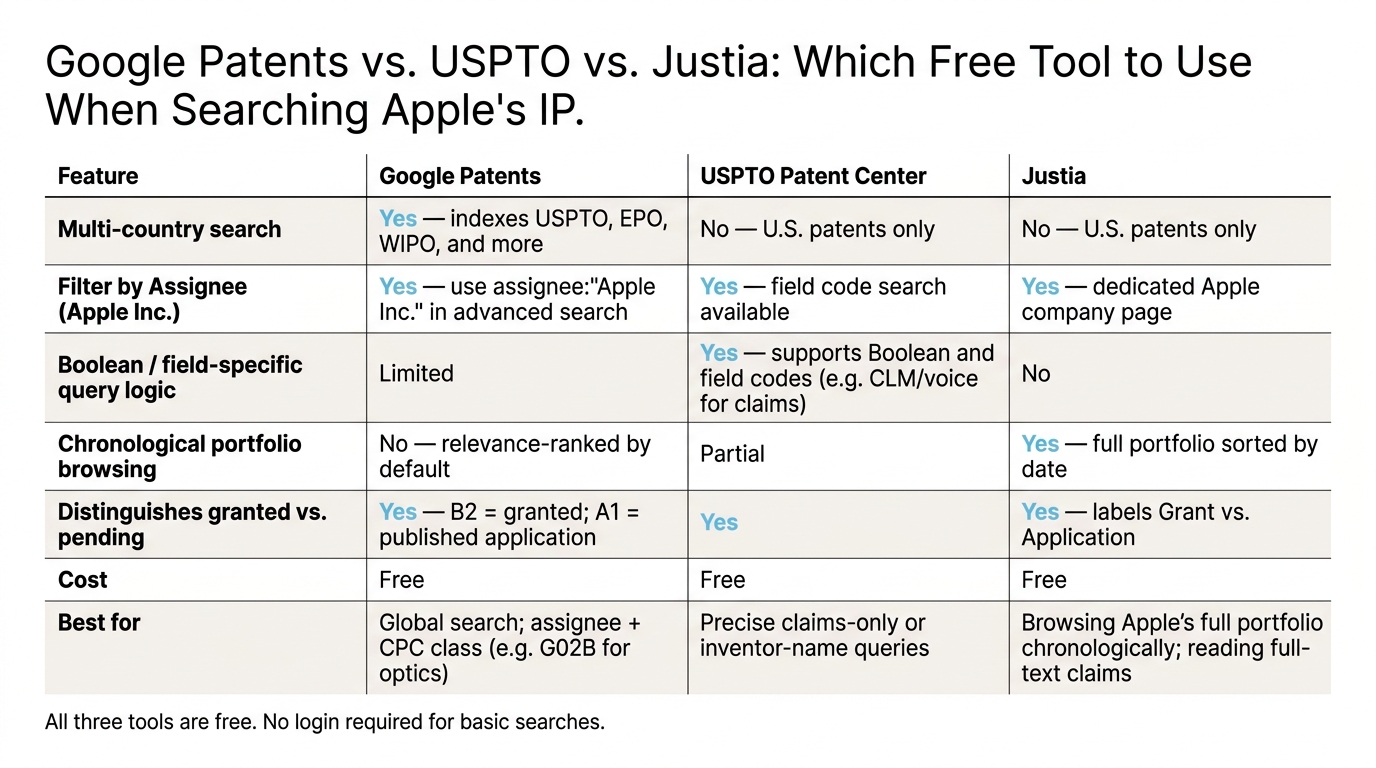 Google Patents vs. USPTO vs. Justia: Which Free Tool to Use When Searching Apple’s IP; Source: Google Patents; USPTO.gov; Justia.com
How to Use Google Patents to Search Apple’s Portfolio
Google Patents is the most accessible starting point. In the advanced search interface, enter “Apple Inc” in the assignee field to pull Apple’s filings across the United States Patent Office, the European Patent Office, and other jurisdictions simultaneously. You can refine results by date range, Cooperative Patent Classification (CPC) code, or keywords in the title and abstract. Published applications appear with an “A1” suffix (e.g., US 2025/0119780 A1), while granted patents carry a “B2” designation. Understanding that distinction tells you immediately whether you are reading an enforceable patent or a pending application.
What USPTO and Justia Offer That Google Patents Does Not
The United States Patent and trademark office’s Patent Full-Text Database (PatFT) and Patent Application Full-Text Database (AppFT) support Boolean keyword searches at the claim level, a capability not always available in Google’s interface. This matters when you need to find patents that claim a specific method rather than simply mentioning it. Justia’s Apple company page aggregates the firm’s full U.S. patent history in a browsable format organized by filing date and technology category. IFI Claims Patent Services provides portfolio-level patent data and analytics useful for understanding Apple’s grant trends over time. Using all three tools in combination gives a more complete picture than any single database alone.
How to Read an Apple Patent Application Without a Law Degree
Every patent document follows a consistent structure: abstract, drawings, specification, and claims. The claims section is the legally operative part. Independent claims define the broadest scope of protection; dependent claims narrow that scope by adding specific limitations. In a utility patent covering Apple Watch’s ECG sensor, for example, independent claim 1 might cover any method of detecting electrical cardiac signals via a wearable electrode array, while claim 2 adds the specific constraint of a particular sampling rate. The broadest independent claim is the first place to look when evaluating whether your product could infringe an existing patent.
What Apple’s Patent Strategy Teaches Founders About Building an IP Moat
Apple does not file patents reactively. The strategy behind patents by Apple is systematic, forward-looking, and tightly integrated with product development and its core principles scale regardless of company size. For founders protecting software innovations specifically, Source Code Intellectual Property: Why Software Patents Are Your Strongest Protection Against Copycats covers the strategic tradeoffs in detail.
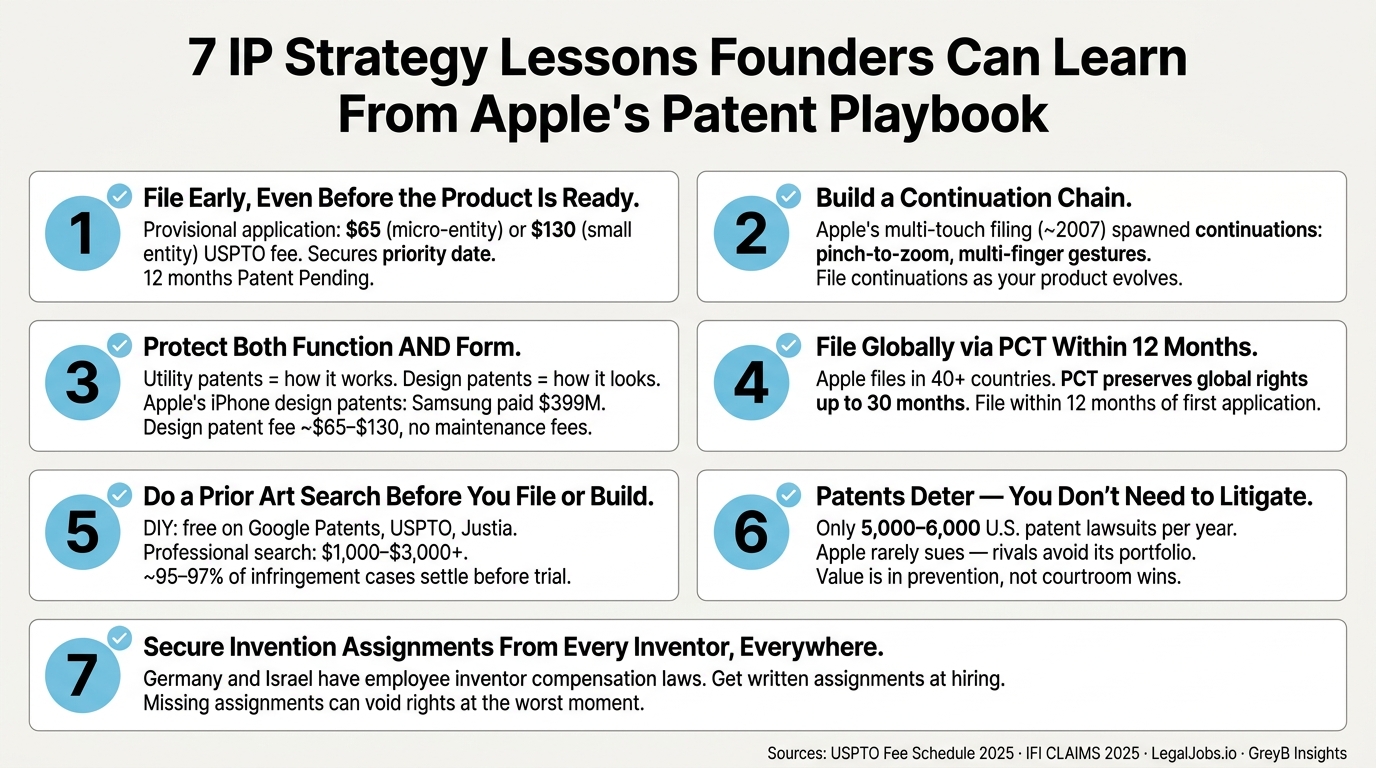 7 IP Strategy Lessons Founders Can Learn Directly From Apple’s Patent Playbook; Source: USPTO Fee Schedule, 2025; IFI CLAIMS, 2025; GreyB Insights, 2025
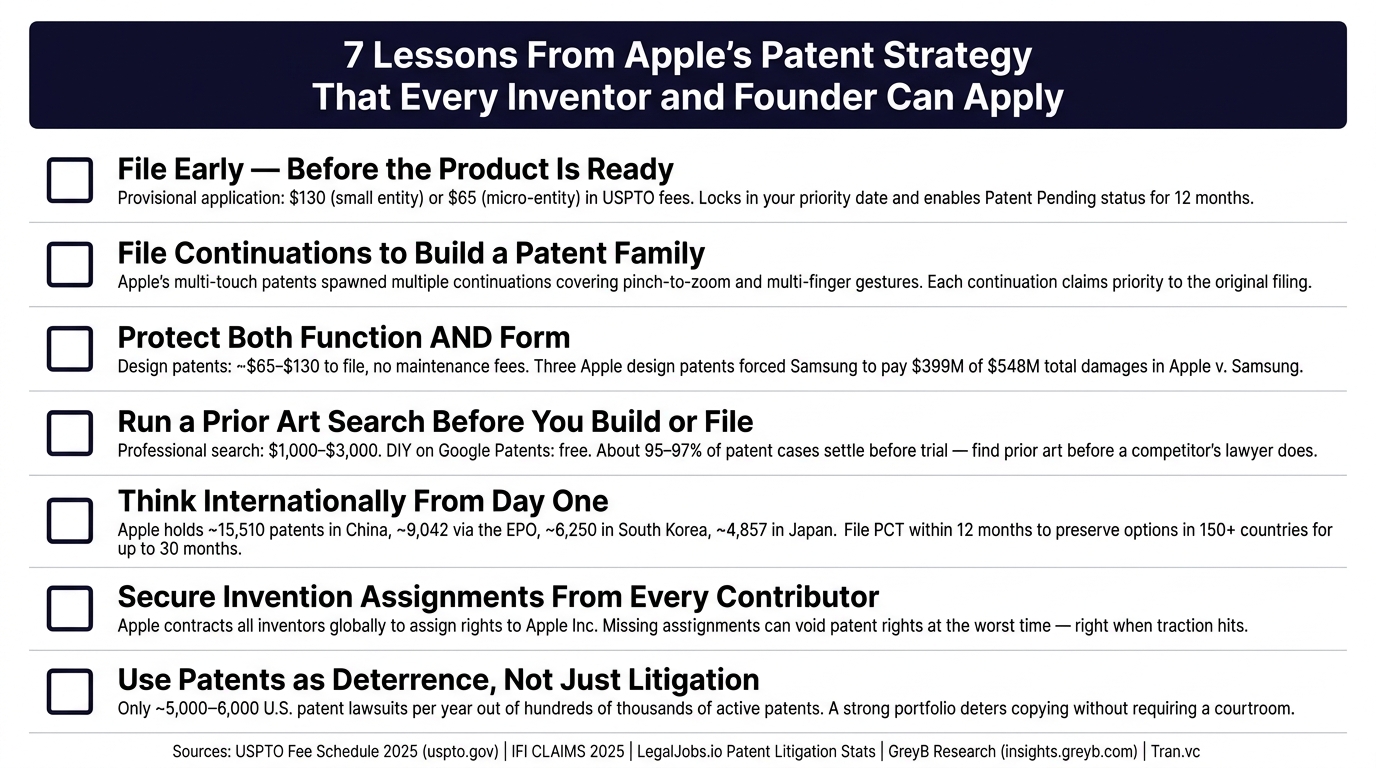 7 Lessons From Apple’s Patent Strategy That Every Inventor and Founder Can Apply; Source: USPTO Fee Schedule 2025 / IFI CLAIMS 2025 / LegalJobs.io / GreyB Research / Tran.vc### Apple Files Early and Files Often on Core Platform Technologies
Apple’s standard pattern is to file provisional and non-provisional patent applications on foundational technologies years before product release, then build continuation and divisional applications as the technology matures. A single core innovation can generate multiple granted patents with different claim scopes through this continuation strategy. Multi-touch technology, Face ID, and Apple Silicon each represent patent families with numerous related filings rather than a single patent. For founders weighing whether to patent or maintain trade secrecy, The Future of Innovation: Why the Proprietary vs Patented Debate Defines Competitive Success lays out the tradeoffs clearly. One strong provisional patent application establishing a priority date is the starting point, not the finish line.
How Apple Uses Patent Filings to Deter Competitors Without Always Litigating
The Apple v. Samsung litigation, which ultimately reached the federal circuit on appeal, is the canonical example of Apple enforcing its design patents, with damages involving three Apple design patents including D618,677. A related dimension of that strategy, Apple’s use of import ban proceedings, is illustrated in the Qualcomm Accuses Apple of Patent Infringement case, which shows how patent portfolios function as leverage in cross-licensing disputes as well. But the vast majority of Apple’s patents never see a courtroom. The portfolio’s primary value is structural: a dense collection of patent filings raises the cost and risk for competitors considering whether to build a similar feature, often making licensing or design-around more attractive than infringement. For founders, a patent portfolio’s greatest value is frequently in the negotiations it prevents, not the lawsuits it enables.
Why Apple Protects Both Function and Form Across Its Product Lines
Apple’s simultaneous investment in utility patents and design patents creates layered protection that is genuinely difficult to work around. A competitor who engineers around a utility patent on a functional method may still infringe the design patent covering the product’s appearance, and vice versa. This dual-layer approach is achievable at startup scale, particularly in consumer hardware and SaaS products with distinctive user interfaces. A design patent application costs significantly less than a utility application, making it a high-leverage addition to any early IP strategy.
How Apple’s International Patent Filings Protect Its Technology Globally
Apple’s IP strategy extends well beyond U.S. borders, reflecting where it manufactures, competes, and sells.
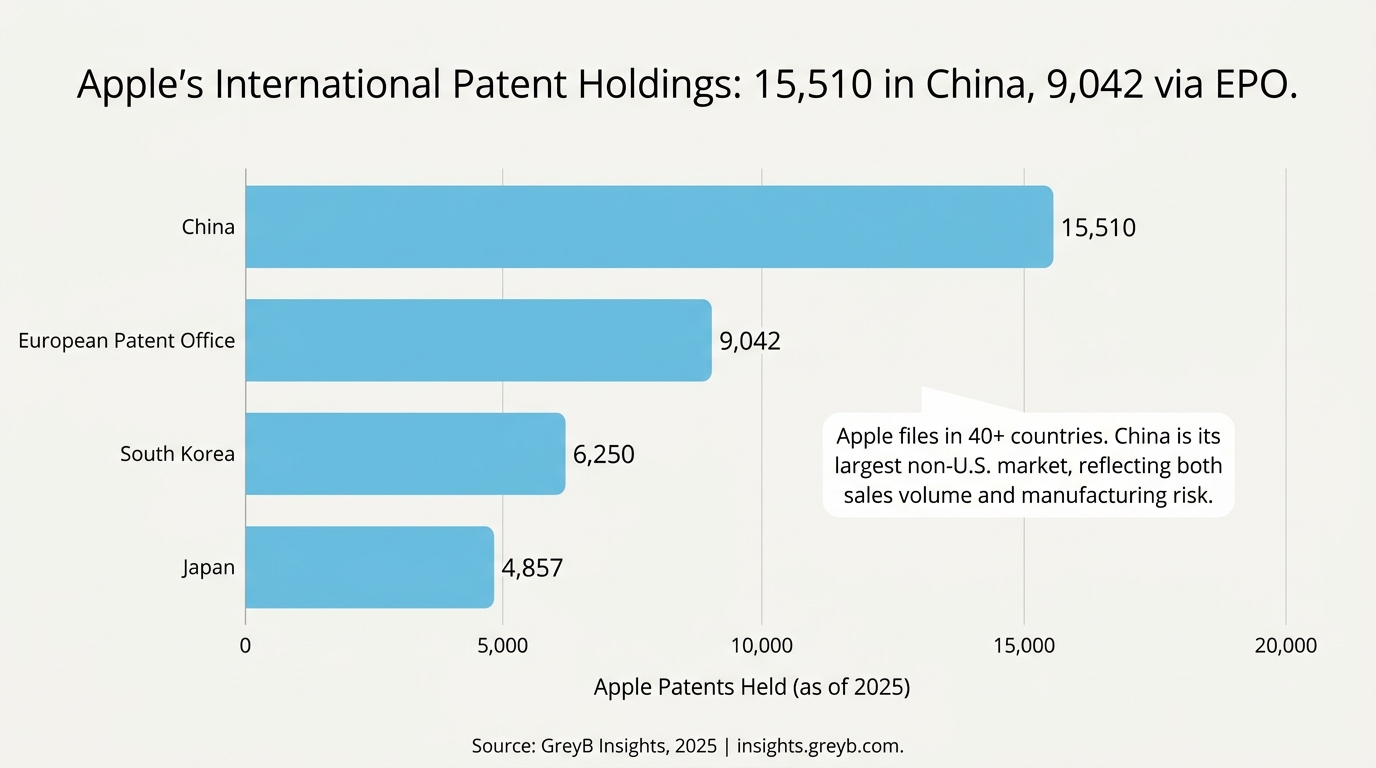 Apple’s International Patent Holdings: 15,510 in China, 9,042 via EPO; Source: GreyB Insights, 2025
Where Apple Files Beyond the United States Patent Office
Apple holds 15,510 patents in China, 9,042 through the European Patent Office, 6,250 in South Korea, and 4,857 in Japan, according to GreyB’s international filing data. These filings use a combination of Patent Cooperation Treaty (PCT) international applications and direct national filings in major markets. The PCT process allows a single application to preserve filing rights in over 150 countries for up to 30 months from the priority date, a critical mechanism for startups that plan to launch internationally but cannot yet afford to file in every target market simultaneously. Apple’s heavy filing volume in China reflects both its manufacturing concentration there and its exposure to local patent litigation.
How Apple’s Research Center Locations Map to Its Patent Output
Apple’s R&D footprint in Cupertino, Austin, Seattle, and international centers in Israel, Germany, and Cambridge correlates directly with the geographic distribution of inventor addresses in its patent applications. Apple’s Israeli R&D center, historically focused on camera and chip technology, has produced a notable share of imaging and silicon-related filings. For founders with distributed teams, the inventor’s location and the assignee’s location are legally distinct concepts in patent law. Properly assigning rights from employees and contractors in different jurisdictions requires explicit IP assignment agreements executed before any patent application is filed.
What Apple’s Most Notable and Unusual Patents Reveal About Its Thinking
Not every entry among patents by Apple reflects near-term commercial intent. Some filings are exploratory, some are defensive, and a few have attracted widespread attention for their novelty.
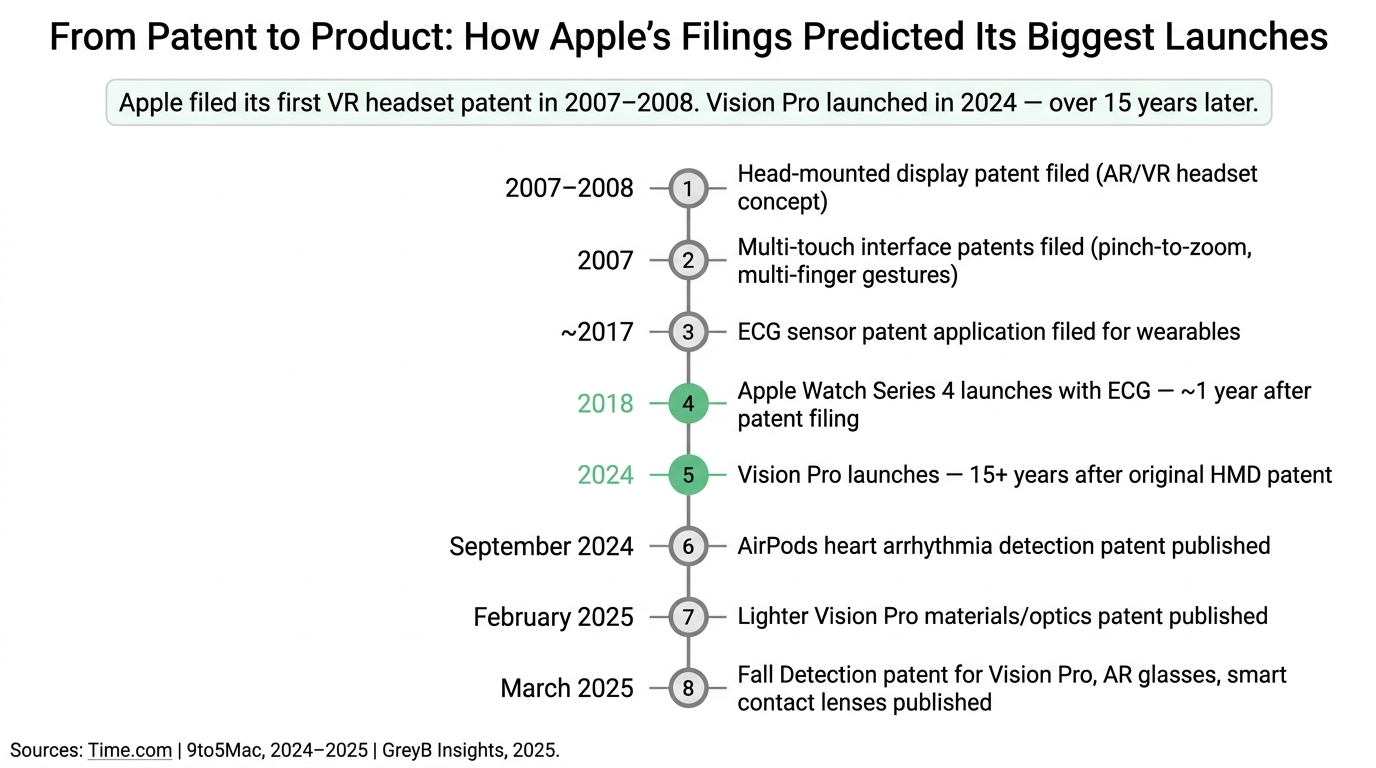 From Patent to Product: How Apple’s Filings Predicted Its Biggest Launches; Source: Time.com; 9to5Mac, 2024–2025; GreyB Insights, 2025
Apple Patents That Became Real Products Versus Patents That Never Shipped
Vision Pro’s 2024 launch traced directly to patent filings going back well over a decade, illustrating how patient IP building pays off. ECG in Apple Watch, Face ID, and on-device neural processing followed similar trajectories from patent application to shipping feature. On the other side, Apple has filed applications for a trackball-equipped Apple Pencil, an all-glass MacBook, and an Apple Ring with Siri support, none of which have shipped. Filing a patent application for a technology you are not ready to build preserves your right to build it later while preventing competitors from claiming the same territory first.
The Most Surprising Apple Patents in the Public Record
Apple’s publicly searchable filings include a camera system designed to replace automobile side mirrors with live video projected onto the windshield, a security camera that identifies individuals by their gait rather than their face, and an AR content projector capable of displaying digital content spatially without any wearable headset. None have become products. These filings are not frivolous — they stake claims in adjacent technology spaces Apple may never commercialize but that competitors cannot safely enter without risking infringement. For a related look at how software-specific patent claims function in similar strategic contexts, Apple, Software Patents & Social Distancing offers a useful case study. Broad, speculative patent filings in emerging technology areas define the outer boundary of a company’s territorial ambitions.
What Founders and Inventors Should Do After Studying Apple’s Patent Strategy
Understanding Apple’s IP approach is useful only if it changes how you protect your own innovations.
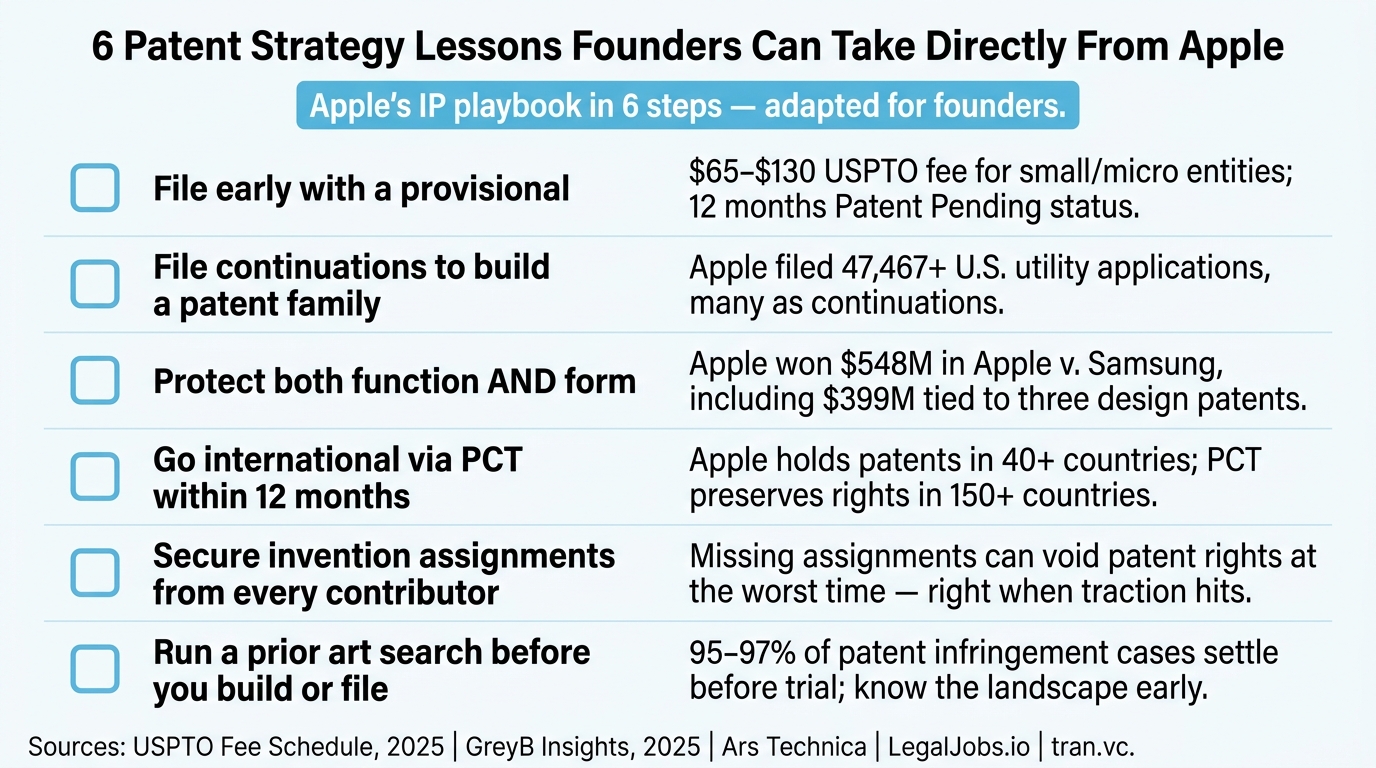 6 Patent Strategy Lessons Founders Can Take Directly From Apple; Source: USPTO Fee Schedule, 2025; GreyB Insights, 2025; Ars Technica
Starting Your Own Prior Art Search Before You Build or File
Before filing any patent application, search patents by Apple and the broader technology landscape using Google Patents, the United States Patent Office databases, and Justia. An assignee search for “Apple Inc” combined with relevant CPC classification codes for your technology category takes a few hours and can prevent wasted filing fees on an application that will face prior art rejection. Also search for Apple subsidiaries, Beats, Shazam, and others, because Apple’s acquired patent families extend beyond filings under the primary Apple Inc. assignee name. The more familiar you are with the landscape before your first attorney meeting, the more efficient that consultation becomes. For a broader overview of how the patent process works from a startup investor’s perspective, Why Investors Care About IP: The Patent Process Explained for High-Growth Startups is worth reviewing before that first call.
When a Provisional Patent Application Is the Right First Move
For most founders and solo inventors, a provisional patent application is the correct first filing. It establishes a priority date, provides 12 months to develop the invention before committing to full prosecution, and costs significantly less than a non-provisional utility application. The United States Patent Office’s current filing fees for micro-entity status make provisionals accessible even at pre-revenue stages. Among the patterns visible in patents by Apple, using provisional filings as part of a standard prosecution strategy before committing to full non-provisional applications is one of the most instructive. Filing a provisional within the first 12 months of your invention is the single highest-leverage early IP move most founders are not making. For software-specific examples of how companies use this approach in practice, 9 Recent Software Patent Examples from Top Companies (and Startups) provides useful benchmarks.
Frequently Asked Questions About Patents by Apple
How many total patents does Apple have? Apple holds approximately 98,761 active patents worldwide and over 52,000 in the United States, according to GreyB’s analysis. The total portfolio including expired and pending filings reaches approximately 116,492 patents globally. Both the United States Patent Office databases and Justia’s Apple company page allow real-time browsing of the full filing history.
Which company has the highest number of patents? Samsung received approximately 7,054 U.S. patent grants in 2025, the most of any company that year, according to IFI Claims Patent Services. IBM held the top position in annual U.S. grants for over two decades before intentionally scaling back and falling to 11th place by 2025. Raw grant volume does not directly equal portfolio value. Technology category, citation rates, and licensing revenue potential matter as much as total count.
What is the most unusual or surprising patent Apple has been granted? Apple has filed applications for a camera system replacing automobile side mirrors with windshield video projections, a gait-recognition security camera that identifies individuals without facial recognition, and an AR projector that displays spatial content without any wearable device. None have shipped as products. These filings reflect Apple’s practice of claiming territory in speculative adjacencies well before any commercial intent is established.
How do I find a specific Apple patent using Google Patents or the USPTO? On Google Patents, use the advanced search feature and enter “Apple Inc” in the assignee field. Add CPC classification codes to narrow by technology area. On the United States Patent Office site, use PatFT for granted patents or AppFT for pending applications, both of which support Boolean keyword searches with assignee filters. Justia’s Apple company page aggregates U.S. filings in a browsable format organized by date and category.
What has Elon Musk patented? Tesla made its patents open-source in 2014, with Musk committing that Tesla would not initiate patent lawsuits against anyone using its technology in good faith. SpaceX has filed patents but is generally considered less aggressive in prosecution relative to its scale. This contrasts directly with Apple’s dense, actively defended portfolio and illustrates that IP strategy is a deliberate business choice, not an automatic function of operating in the technology industry.
Can I use an Apple patent for my own research or product development? Reading and analyzing Apple’s published patents is unrestricted. Public disclosure is the purpose of the patent system. Building a product that practices the claims of an active Apple patent without a license creates infringement risk. A Freedom to Operate analysis conducted by a registered patent attorney determines whether your product design reads on any active Apple claim before you commit to development.
Your Next Steps to Patent Strategy Success
Apple’s dominance in the technology industry is inseparable from its intellectual property infrastructure. A portfolio approaching 100,000 active patents worldwide reflects a systematic commitment to filing early, filing often, protecting both function and form, and building continuation strategies around core innovations. These are not practices exclusive to companies with Apple’s resources. They are executable principles available at any filing budget.
The bottom line: A weak or absent IP strategy leaves your core technology exposed to competitors who can copy your methods, replicate your interface, and undercut your market position without consequence. A strong patent strategy, built on the same principles Apple has used for decades, creates enforceable rights that deter copying, support licensing revenue, and signal credibility to investors.
The technology industry rewards the first filer, not the first inventor. If your product includes a novel method, a distinctive interface, or a hardware innovation, the window to establish a priority date is open now. Every month without a provisional patent application is a month a competitor could file first on the same idea.
To protect your innovation with the same disciplined approach Apple uses:
- Schedule a Free IP Strategy Call with a registered patent attorney to identify what is protectable in your current product
- Run an assignee search on Google Patents and USPTO before your consultation to map the existing landscape
- Determine whether a provisional patent application, utility patent, or design patent best fits your immediate priority
- Review the RLG AI Patent Mastery resource if your technology involves machine learning or AI inference
Rapacke Law Group works exclusively in intellectual property for tech founders, startups, and inventors, with flat-fee pricing and the RLG Guarantee: full refund if the USPTO denies your provisional patent application, and 100% refund if a patentability search finds your invention is not novel. You can protect your innovation without uncertainty about cost or outcome.
To Your Success,
Andrew Rapacke
Managing Partner, Registered Patent Attorney
Rapacke Law Group