


Key Takeaways
- Patents solve a real economic problem: without exclusive rights, competitors can copy costly innovations for free, eliminating the incentive to invest in R&D.
- The disclosure-for-exclusivity bargain means every issued patent eventually becomes public knowledge, accelerating cumulative innovation across entire fields.
- A provisional patent application costs as little as $320 for small entities and locks in your priority date for 12 months while you test commercial viability.
- Software and AI patents remain available post-*Alice*, but claims must be drafted to show a concrete technical improvement, not just a business outcome.
- Patent portfolios, not single patents, define competitive position for scaling technology companies.
The United States pharmaceutical industry invested over $100 billion in R&D in 2021 alone, according to PhRMA. That investment exists almost entirely because patents make it rational to spend that money. Without intellectual property rights that block competitors from copying a drug the moment it reaches market, the economic case for spending years and billions developing it collapses. Understanding how patents act as an incentive to technological innovation starts here: they are a precisely engineered economic mechanism designed to solve a specific market failure: knowledge, once created, is nearly impossible to keep exclusive without legal protection.
What a Patent Actually Is and Why the Design Matters
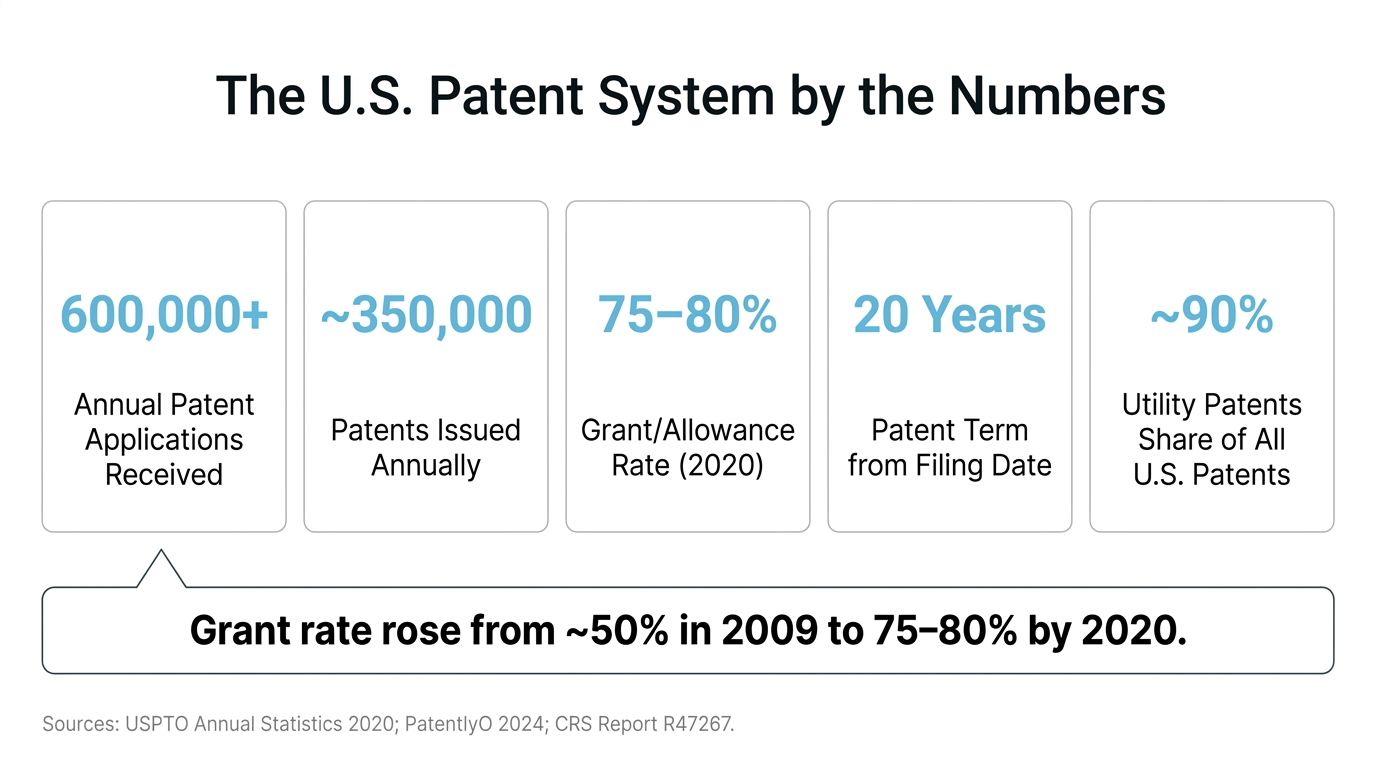 The U.S. Patent System by the Numbers. Source: USPTO Annual Statistics, 2020; PatentlyO, 2024; CRS Report R47267, 2022
The Core Bargain at the Heart of Patent Law
A patent is a legal contract between an inventor and the public. Under 35 U.S.C. § 154, the inventor discloses exactly how the invention works, and in exchange, the government grants an exclusive right to commercialize it for up to 20 years from the filing date. That disclosure requirement is the mechanism that drives innovation forward: once the patent expires, the invention enters the public domain and anyone can build on it freely. According to the Congressional Research Service, patent ownership is designed to incentivize invention while ensuring that knowledge eventually becomes available for public use.
According to Patently-O, USPTO patent grant rates have risen steadily from around 70 percent in 2015 to peak at approximately 80 to 81 percent around 2022 to 2023, up dramatically from roughly 50 percent in 2009. Understanding the disclosure-for-exclusivity trade and the patent process is the first step in deciding whether filing a patent serves your business strategy. For a deeper look at how patents translate directly into business value, see Why Patents Are Important to Investors: The IP Factor That Raises Startup Valuations.
The Three Types of Patents and What Each Protects
The United States recognizes three patent categories: utility patents, which cover new processes, machines, manufactures, and compositions of matter, including new inventions in every technical field; design patents, which protect the ornamental appearance of a functional item; and plant patents, covering new varieties of asexually reproduced plants. Utility patents account for approximately 90 percent of all U.S. patents issued, according to USPTO statistics, making them the primary vehicle through which new technologies receive legal protection.
AI-related utility patent filings more than doubled from roughly 30,000 in 2002 to over 60,000 in 2018, according to a USPTO benchmark study, and that growth has continued into the 2020s. Most tech founders need utility patent protection; design patents serve a complementary role for product aesthetics. For a country-by-country breakdown of where AI patent activity is accelerating, see AI Patents by Country Revealed: The Top 15 Nations Dominating the 2025 Landscape.
How the Patent Office Evaluates Whether an Invention Qualifies
For a claimed invention to receive a patent, it must be novel, non-obvious, useful, and directed to patent-eligible subject matter. Patent examiners conduct prior art searches against global patent databases and published literature. The non-obvious standard was reshaped by the Supreme Court in KSR International Co. v. Teleflex Inc., 550 U.S. 398 (2007), which rejected a rigid test and allowed examiners to use common sense when combining prior references. Practically, this means that a person of ordinary skill who could combine existing knowledge in a predictable way may defeat a patent claim. Conducting a prior art search before filing reveals whether your invention is genuinely novel, saving time and prosecution costs.
What the Economic Research Actually Says About How Patents Act as an Incentive to Technological Innovation
The relationship between patent system strength and innovation output is a core question of innovation policy, and the answer is positive but not linear. Countries that strengthen patent laws see increases in patent filings and foreign direct investment in technology sectors, but the magnitude depends heavily on enforcement capacity and broader institutional quality, according to research published in Science Direct. Economists Samuel Kortum and Josh Lerner have concluded that while patents correlate with increased innovation, expanding patent scope or length beyond an effective baseline yields diminishing returns.
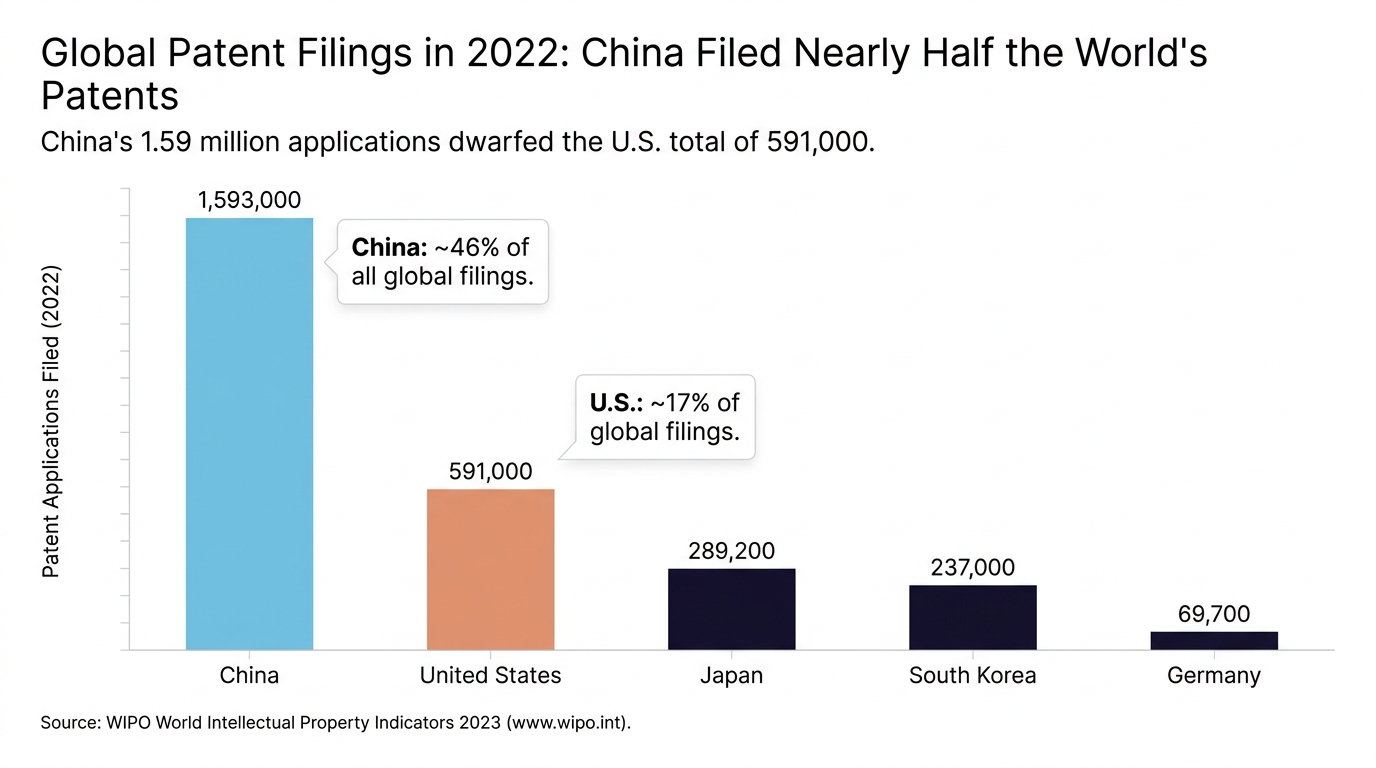 Global Patent Filings in 2022: China Filed Nearly Half the World's Patents. Source: WIPO World Intellectual Property Indicators, 2023
Globally, patent filings reached a record 3.46 million in 2022, with China accounting for nearly half of all filings at 1,593,000 applications, compared to 591,000 from the United States, according to WIPO. Japan filed 289,200, South Korea 237,000, and Germany 69,700. That concentration illustrates how national patent strategy has become a geopolitical instrument driving technological progress, not just a legal formality. Patent systems work best as one layer of a broader IP strategy rather than a standalone shield.
The Cost-Benefit Calculus Every Inventor Must Run
Obtaining a U.S. utility patent costs between $15,000 and $50,000 or more from filing through issuance, depending on complexity and the number of office action responses required. The American Intellectual Property Law Association (AIPLA) places the average lifetime cost of a patent at roughly $50,000 to $56,000. That investment must be weighed against the commercial value of 20-year exclusivity and the realistic risk of copying. For some inventors, trade secret protection or first-mover speed offers a better return. Running a business-case analysis on exclusivity value versus prosecution cost before committing to a full utility patent application is not optional for resource-constrained founders.
How Patent Policy Shapes Market Structure and Competition
Patents create temporary monopolies, and in aggregate they reshape competitive dynamics. The Federal Trade Commission's 2016 study found that approximately 88 percent of patents held by Patent Assertion Entities (PAEs) were in information technology and software fields, and that 96 percent of infringement lawsuits by PAEs studied were brought by entities that produce nothing. When entering a crowded technology space, a freedom-to-operate analysis identifies patent thickets before they become litigation exposure.
The Direct Mechanisms by Which Patents Drive Inventors to Innovate
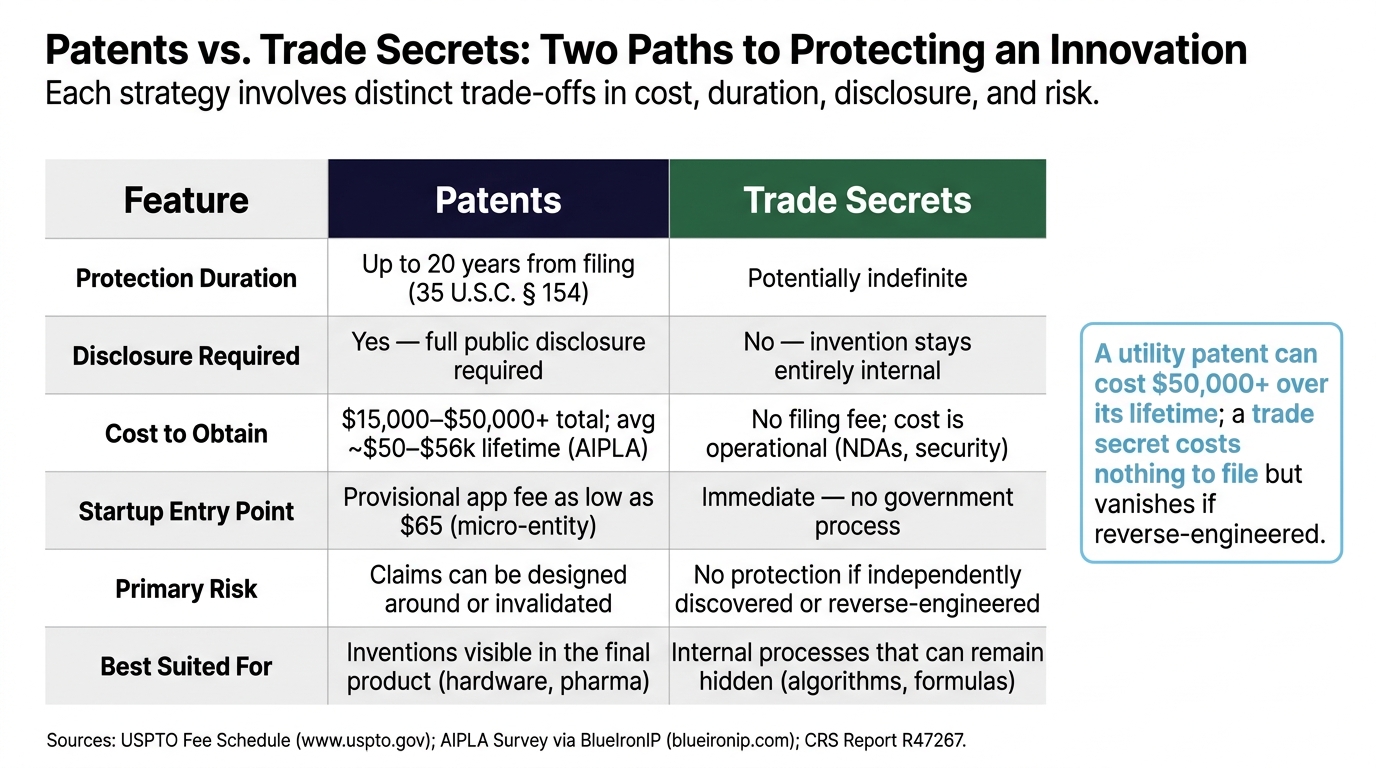 Patents vs. Trade Secrets: Two Paths to Protecting an Innovation. Source: USPTO Fee Schedule; AIPLA Survey; CRS Report R47267, 2022
Exclusive Rights Convert R&D Investment Into a Recoverable Cost
How patents act as an incentive to technological innovation is most visible in capital-intensive industries where market-driven innovation depends on exclusivity: without patent protection, a competitor can copy a successful product the moment it reaches market, capturing revenue without bearing any of the original development expense. Exclusive rights eliminate that free-rider problem by giving the patent holder a commercialization window. Bringing a new pharmaceutical to market costs an average of $2.3 billion in R&D per approved drug, according to Genetic Engineering and Biotechnology News, a figure that reflects a 15 percent increase from the prior year per Deloitte's analysis of the top global biopharmas. Firms will only commit those resources knowing that a patent blocks generic entry long enough to recover them. If your product is easy to reverse-engineer, patent protection may be the only reliable mechanism to recover development investment.
Patents Create Marketable Assets That Attract Capital
A filed patent application creates an investor-visible intangible asset. Research from ZEW, a German economic research institute, has found that patent applications reduce the time to first venture capital investment significantly, with patent-holding startups attracting VC funding faster and at higher valuations than comparable companies without patents. Investors use patent portfolios as a proxy for defensibility and proprietary technology. Beyond fundraising, patent licensing can generate royalty revenue, intellectual property rights can be used as loan collateral, or assigned outright in an M&A transaction. Filing provisional applications early converts inventive activity into a dated, investor-visible IP asset before a funding round. For a detailed look at how investors weight patent strength in due diligence, see Why Patents Are Important to Investors: The IP Factor That Raises Startup Valuations.
The Disclosure Requirement Accelerates Cumulative Innovation
Every issued patent becomes a permanent, publicly searchable record of patent information in global patent databases including the USPTO, the European Patent Office, and WIPO. Researchers and engineers search those disclosures to understand the state of the art, build upon existing technology, and design around existing claims. Economists Bronwyn Hall and Rosemarie Ziedonis have documented that patent citations, those referenced frequently by later patents, are associated with greater subsequent invention in the same technology class, a finding that establishes patent disclosures as a direct input to downstream innovation rather than merely a byproduct of it. This cumulative innovation effect is a key reason how patents act as an incentive to technological innovation extends beyond the original inventor to benefit future innovation across the entire technology ecosystem that follows. Reading competitor patent applications in your technology space is a legitimate and underused competitive intelligence strategy.
How Software and AI Patents Fit Into the Modern Innovation Incentive Structure
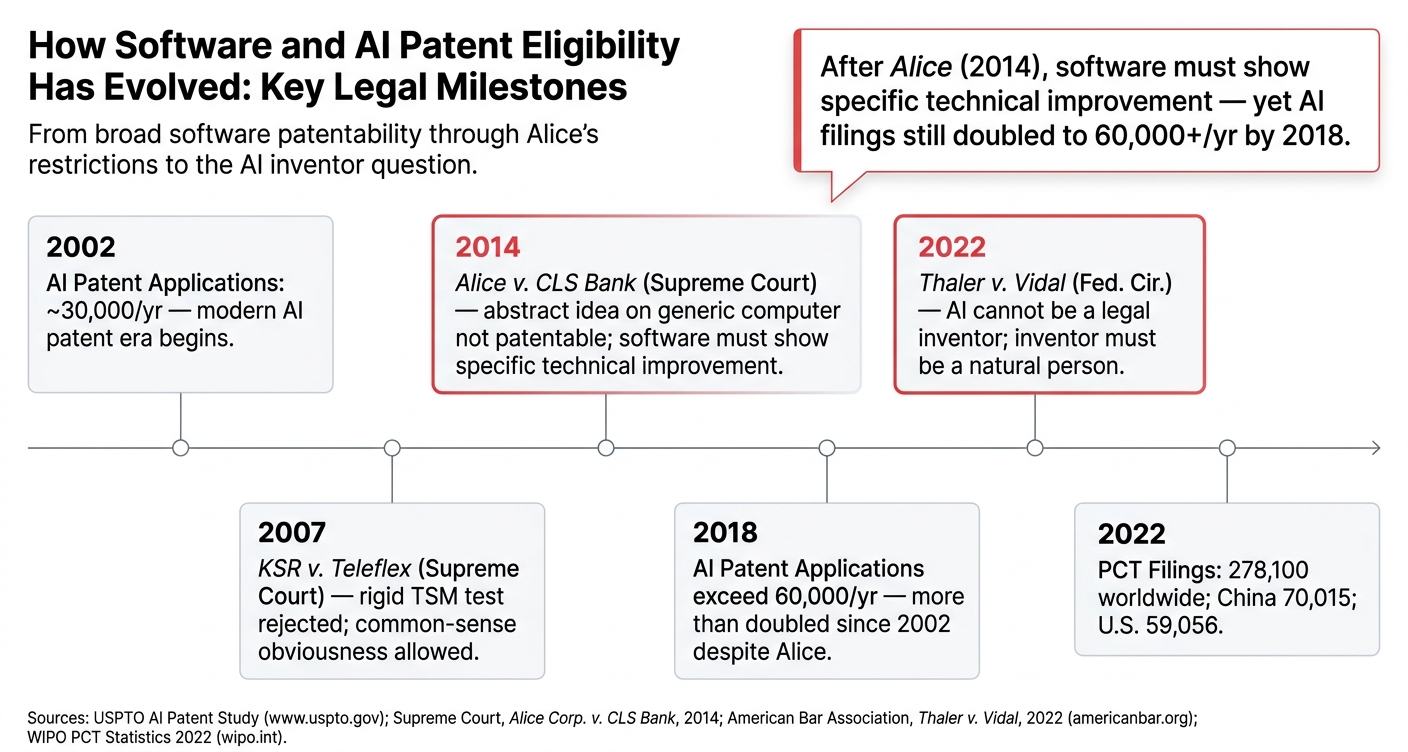 How Software and AI Patent Eligibility Has Evolved: Key Legal Milestones. Source: USPTO AI Patent Study; Supreme Court (Alice, 2014); Fed. Cir. (Thaler, 2022); WIPO PCT Statistics, 2022
Why Software Patent Eligibility Is More Complex Than Other Technology Categories
Software patents occupy contested ground in U.S. patent law because of the Supreme Court's 2014 decision in Alice Corp. v. CLS Bank International, which held that abstract ideas implemented on a computer are not patent-eligible subject matter. The USPTO responded with guidance requiring that software patent claims demonstrate a concrete improvement to computer functionality rather than simply automating a mental process. Despite this constraint, AI-related patent filings at the USPTO have continued to climb, with machine learning and computer science applications representing one of the fastest-expanding categories of new technologies receiving patent protection. Software patent claims must be drafted to emphasize the specific technical improvement to the computing system, not just the business outcome it produces.
The Emerging AI Patent Landscape and What It Means for Tech Founders
Artificial intelligence-driven inventions raise questions current patent law was not designed to answer. The Federal Circuit addressed inventor eligibility directly in Thaler v. Vidal (2022), holding that current patent law requires a human inventor. AI-assisted inventions, where a human uses AI tools during the development process, remain patentable as long as the human inventive contribution can be identified and documented. According to the USPTO benchmark study, AI-related patent filings have grown by over 100 percent in the span of just 16 years, a pace that shows no sign of slowing. For a global perspective on where this growth is happening and which jurisdictions are pulling ahead, see AI Patents by Country Revealed: The Top 15 Nations Dominating the 2025 Landscape.
Patent Portfolios as a Strategic Asset for Scaling Tech Companies
A single patent rarely defines a company's competitive position. Sophisticated technology companies build portfolios that surround core innovations with continuation applications, divisional applications, and design patents, creating layered protection that extends effective exclusivity and broadens the claims landscape across the entire technology landscape. Large enterprises like Qualcomm and IBM generate significant revenue through licensing rather than product sales alone, demonstrating that intellectual property rights can become a primary business model rather than a purely defensive tool. Filing continuation applications before a parent patent issues extends your ability to capture evolving claim scope as the market develops.
The Limits of Patent Protection and When They Affect the Incentive to Innovate
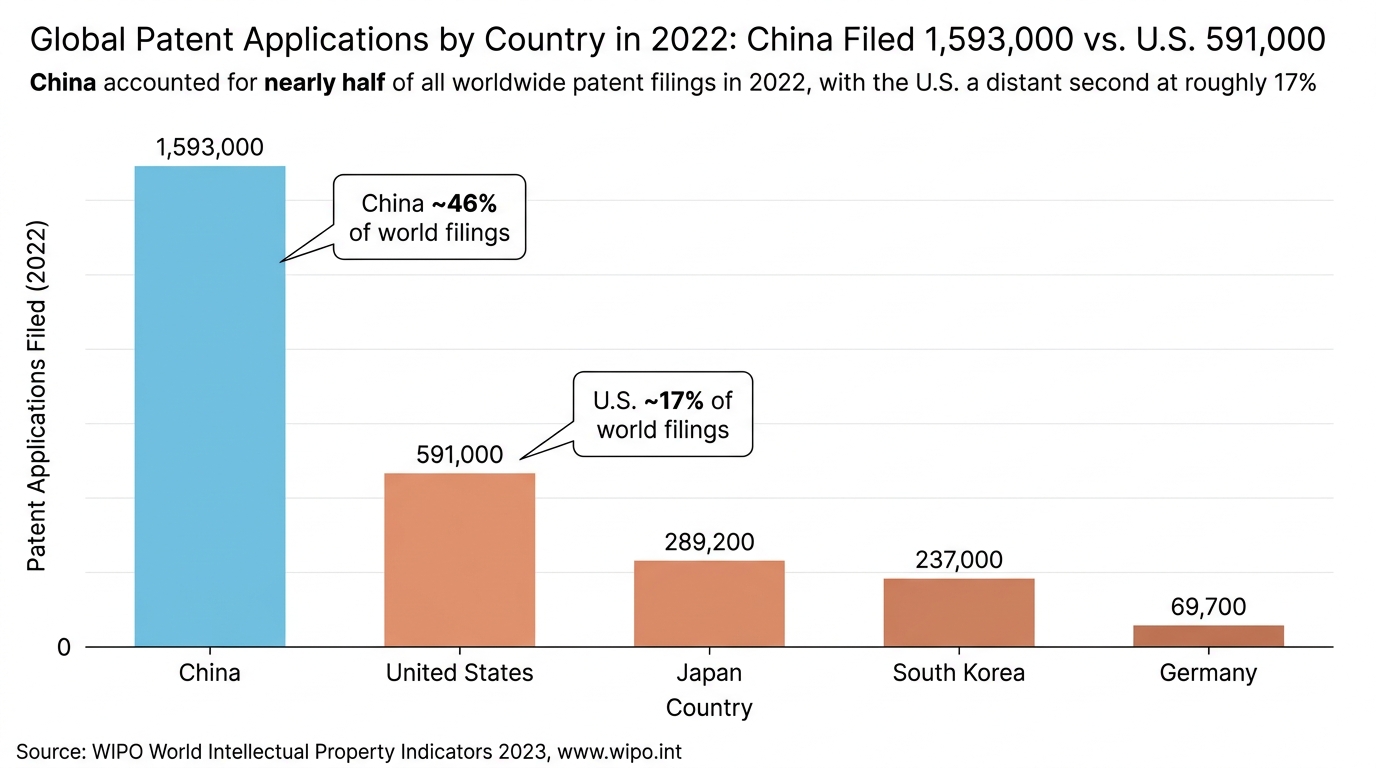 Global Patent Applications by Country in 2022: China Filed 1,593,000 vs. U.S. 591,000. Source: WIPO World Intellectual Property Indicators, 2023
When Patent Protection Fails to Incentivize Disclosure
The incentive structure breaks down in specific circumstances. When the expected commercialization window for a new technology is shorter than the average USPTO prosecution timeline of 23 to 27 months, companies may choose to protect innovations as trade secrets rather than file for patents. Consumer electronics companies operating on 18-month product cycles and tracking the latest technology trends routinely face this tension. If your technology cycle is shorter than the prosecution timeline, a provisional application preserves your priority date while you assess whether full prosecution makes commercial sense.
How the 20-Year Term Balances Inventor Reward Against Public Access
The 20-year exclusivity window reflects a policy judgment that the incentive to invent is sufficient reward while not permanently removing inventions from the public domain. When patents expire, competitors freely practice the patented inventions, typically driving prices down sharply. According to the FDA, generic drug entry after patent expiration reduces prices by an average of 80 percent or more, a dynamic that plays out most visibly when ten or more generic competitors enter the market simultaneously. This is the intended outcome of the patent system: the incentive mechanism and eventual public access are two sides of the same design. Build a commercialization timeline that front-loads revenue generation during the exclusivity period rather than assuming continued pricing power after expiration.
International Patent Protection and the Limits of U.S. Rights
A U.S. patent provides no protection in foreign markets. Companies seeking international coverage must file separately in each jurisdiction or use the Patent Cooperation Treaty (PCT), which allows a single international application to preserve rights in 158 Contracting States for 30 months before national phase entry costs begin. According to WIPO, the top five PCT filing countries by origin are China, the United States, Japan, South Korea, and Germany. Without international protection, a competitor can freely manufacture and sell a patented invention abroad, even if they cannot import it into the United States. File a PCT application at the same time as your U.S. non-provisional if you have any international commercial ambitions.
How to Use the Patent System Strategically as a Founder or Inventor
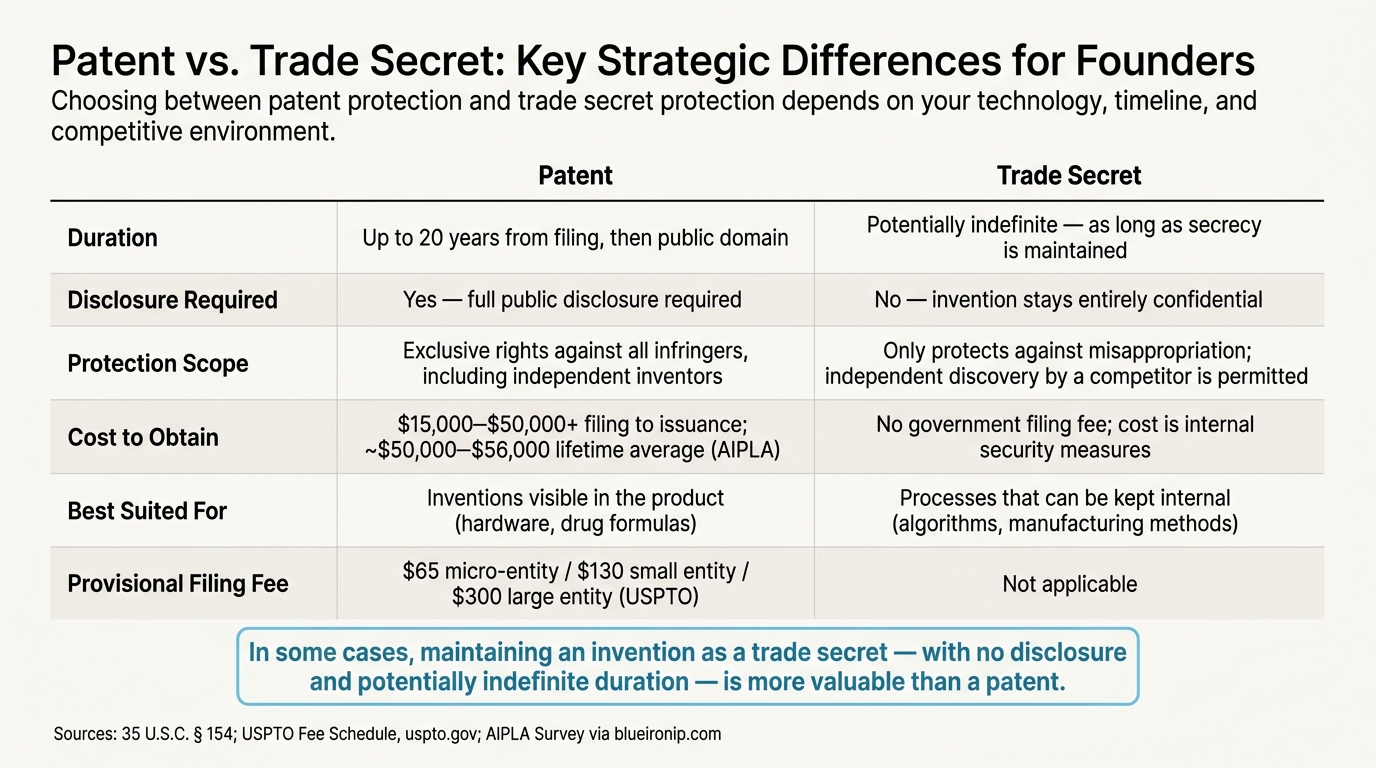 Patent vs. Trade Secret: Key Strategic Differences for Founders. Source: USPTO Fee Schedule, uspto.gov; AIPLA Survey; 35 U.S.C. § 154
The Provisional Application as a Low-Cost Entry Point
A provisional patent application costs $140 or less for small entities under current USPTO fee schedules, does not require formal patent claims, and gives the applicant 12 months to develop the invention commercially before committing to full prosecution costs. During that window, the applicant can use "patent pending" status, test market demand, seek investors, and refine the invention without losing priority date. Filing a provisional application on the date you first reduce an invention to practice is one of the highest-return actions available to an early-stage inventor. Rapacke Law Group offers a fixed-fee provisional patent service backed by the RLG Guarantee: if the USPTO denies your provisional application, you receive a full refund.
Claim Drafting Strategy Determines How Much Protection You Actually Get
The scope of patent protection is defined entirely by the claims, not by the drawings or the specification. Broad independent claims cover the widest range of equivalent products; narrow dependent claims provide fallback positions when prior art limits the independent claims during examination. The Federal Circuit established in Markman v. Westview Instruments (1996) that claim construction is a question of law for the court, meaning that how claims are worded at filing will be interpreted by a judge, not an engineer. A patent with poorly drafted claims can be designed around easily, rendering the exclusivity period commercially worthless. Invest in experienced patent claims drafting upfront because claim scope cannot meaningfully be expanded after filing.
Building a Patent Strategy Around Your Funding and Exit Timeline
For startups, patents serve different purposes at different stages. At the seed stage, a single provisional application signals to investors that IP protection is in progress. By Series A, a filed non-provisional and an IP due diligence-ready portfolio become expected. At exit, acquirers assign significant value to broad, defensible, and geographically diverse patent portfolios. Align your patent prosecution timeline with your fundraising calendar so granted patents are in hand before each major due diligence review.
Why Patents Still Matter Even When Innovation Moves Faster Than Prosecution
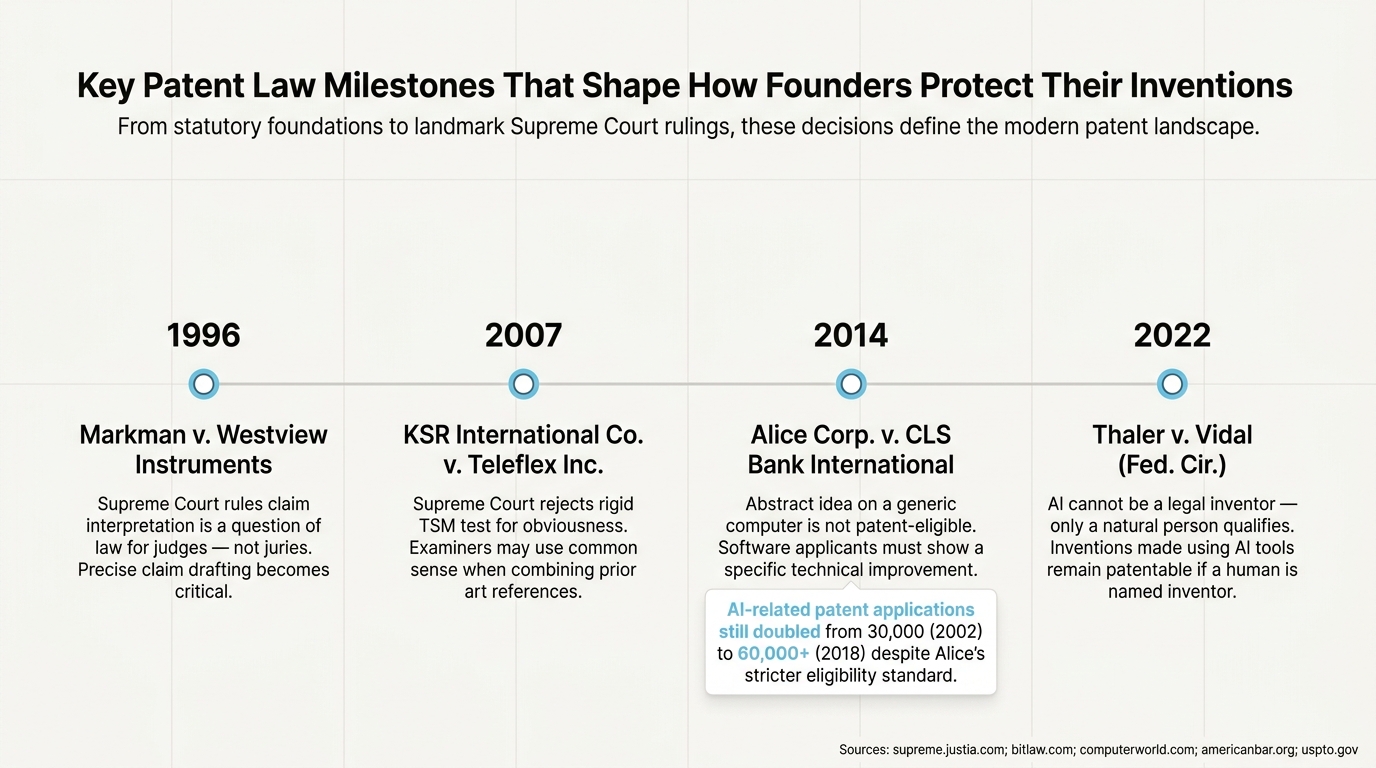 Key Patent Law Milestones That Shape How Founders Protect Their Inventions. Source: Markman v. Westview Instruments (1996); KSR v. Teleflex (2007); Alice Corp. v. CLS Bank (2014); Thaler v. Vidal, Fed. Cir. (2022); USPTO AI Patent Study
Patent Pending Status Provides Real Commercial Value Before a Patent Issues
From the date a non-provisional application is filed, any competitor who copies the invention during the pendency period may owe back-damages to the patent holder once the patent issues, provided the published application gave them constructive notice. Under 35 U.S.C. § 154(d), these provisional rights mean the incentive effect of patent protection begins at filing, not at issuance. Mark products and marketing materials as "patent pending" immediately after filing to put competitors on notice.
Continuation Applications Extend the Strategic Life of a Patent Family
A continuation application allows an inventor to file new claims directed to patented technology disclosed in a parent application, as long as the parent is still pending. This enables patent holders to adjust claim scope in response to how competitors design their products using newer technology, a strategy that companies like Qualcomm have used to maintain relevant protection across multiple technology generations. Keep at least one continuation application pending in each technology family to preserve the ability to capture evolving competitive designs.
Technology Obsolescence Does Not Automatically Diminish Patent Value
A patent on obsolete technology still carries licensing value if the claimed subject matter covers a standard, a component used in downstream products, or a technique that newer technologies build upon. Standard-essential patents in wireless communication retain licensing value long after specific standard versions are superseded. A patent remains in force for its full 20-year term regardless of market evolution. Before abandoning any patent portfolio due to functional obsolescence, conduct a licensing analysis to determine whether any claims read on current industry standards or downstream products.
Frequently Asked Questions About Patents and Technological Innovation
How do patents act as incentives to technological innovation? Patents incentivize technological innovation by granting inventors a temporary exclusive right to commercialize their inventions in exchange for publicly disclosing how the invention works. This exclusivity allows inventors to recoup R&D costs without immediately facing competition from copiers, making high-risk development economically rational. Once the patent expires, the disclosed invention enters the public domain, enabling others to build further on it.
How do patents encourage innovation beyond protecting a single inventor? Beyond individual protection, patents encourage innovation at the system level by creating a searchable, public database of technical disclosures. Researchers and engineers read patent databases to understand the frontier of a technology field, identify opportunities to design around existing patents, and find disclosed technical information they can build upon after expiration. This knowledge diffusion accelerates cumulative innovation across entire technology sectors.
Why are patents important in technology specifically? Technology products, particularly software, semiconductors, and AI systems, are expensive to develop and inexpensive to copy. Without the exclusive rights granted by patents, competitors could reverse-engineer a successful technology product at a fraction of the original development cost, eliminating the financial incentive to invest in novel research. Patents protect the intangible assets that constitute most of a technology company's competitive value.
How do patents act as an incentive to technological innovation in economics? In economic terms, patents address the market failure caused by the public goods characteristics of knowledge: once created, new technical knowledge is non-rivalrous and non-excludable. Intellectual property rights create artificial excludability, allowing inventors to charge for access and restoring the market mechanism needed to incentivize private investment. This is the foundational economic rationale for the patent system, traceable to economist Kenneth Arrow's 1962 work on the economics of knowledge production.
How long does patent protection last and how does the term affect the incentive to innovate? A utility patent in the United States provides protection for 20 years from the filing date, not from the date of issuance. This term balances allowing inventors to recover development costs while ensuring inventions eventually enter the public domain. Industries with long development cycles, such as pharmaceuticals and medical devices, can apply for patent term extensions when regulatory information and approval processes consume years of the exclusivity period.
Can a startup benefit from patents even if it cannot afford to enforce them? Yes. Patent pending status deters some copying behavior without requiring litigation. Issued patents create investor-visible IP assets that affect valuation. Patents can also be licensed to generate royalty revenue that funds operations or future enforcement. The deterrence and asset value of intellectual property rights operate independently of whether the holder can immediately finance litigation.
Your Next Steps to Patent Strategy Success
The patent system rewards inventors who move deliberately: file early, draft claims strategically, and build a portfolio that grows with your business. Whether you are a SaaS founder protecting a core algorithm, a solo inventor commercializing a hardware breakthrough, or a scaling tech company preparing for a Series A, the window to establish your IP position is narrowest at the start.
The bottom line: a weak or absent patent strategy leaves your most valuable technology exposed to copying in an era of rapid digital transformation, limits your leverage in investor negotiations, and reduces your exit valuation. A strong patent strategy, anchored by well-drafted claims and a timeline synchronized with your fundraising calendar, converts inventive work into defensible, transferable value.
Every month without a filed application is a month a competitor could independently develop the same invention and claim the priority date you left on the table. The cost of a provisional application is a fraction of what you will spend on a single round of investor pitches.
To get started:
- Schedule a Free IP Strategy Call with Andrew Rapacke to assess which inventions are worth protecting and what a realistic prosecution timeline looks like for your technology
- Download the SaaS Patent Guide 2.0 to understand how software and AI patent strategy works for product companies
- Review the AI Patent Mastery resource if your core innovation involves machine learning or generative AI
- Run a patentability search before filing to confirm novelty and scope, backed by Rapacke Law Group's 100% refund guarantee if the search finds your invention is not novel
Rapacke Law Group operates on a fixed-fee model, so you know your costs before prosecution begins, with no hourly billing surprises as office actions mount. Every engagement includes Andrew Rapacke's direct involvement as a Registered Patent Attorney and Managing Partner.
To Your Success,
Andrew Rapacke
Managing Partner,
Registered Patent Attorney
Rapacke Law Group