
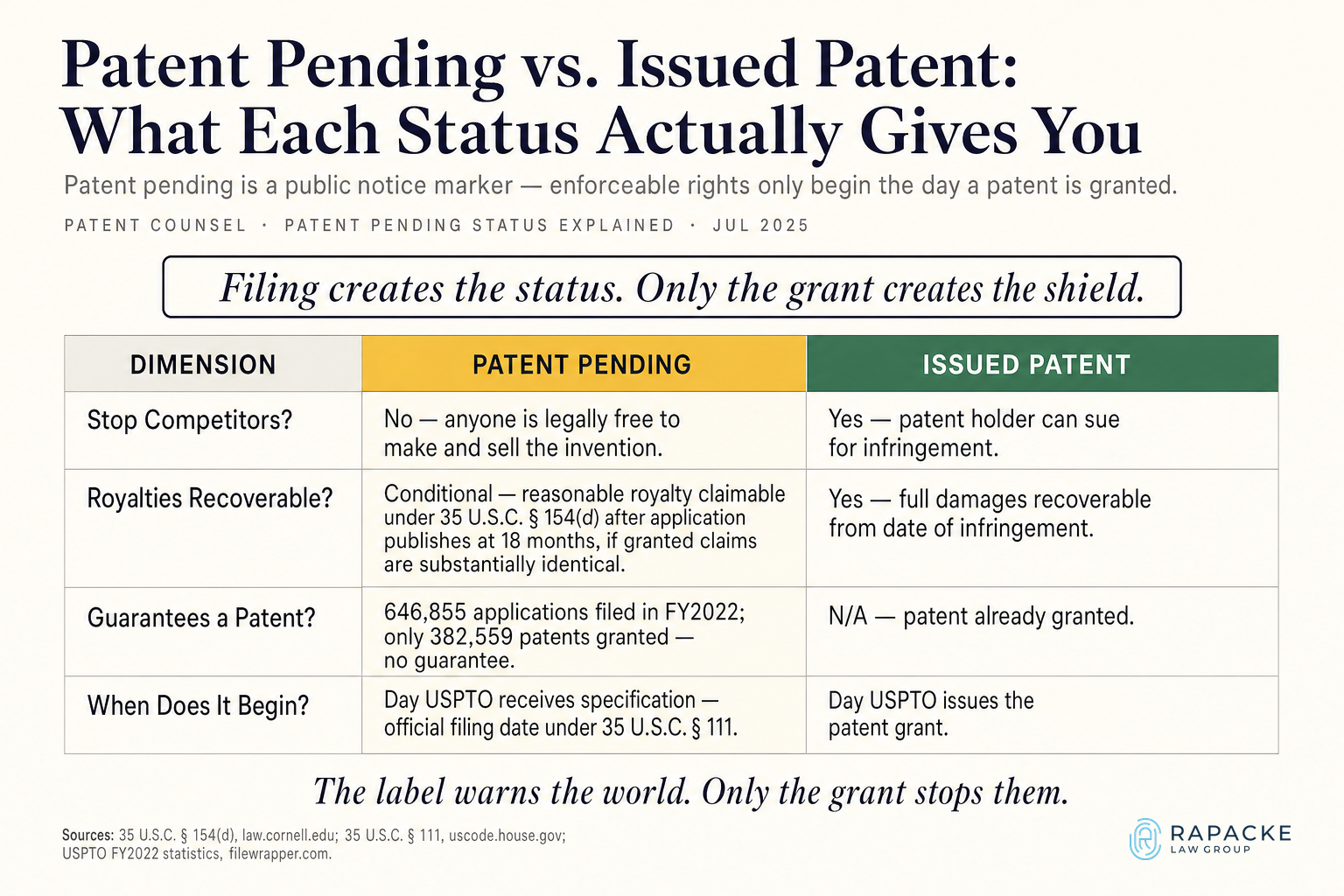
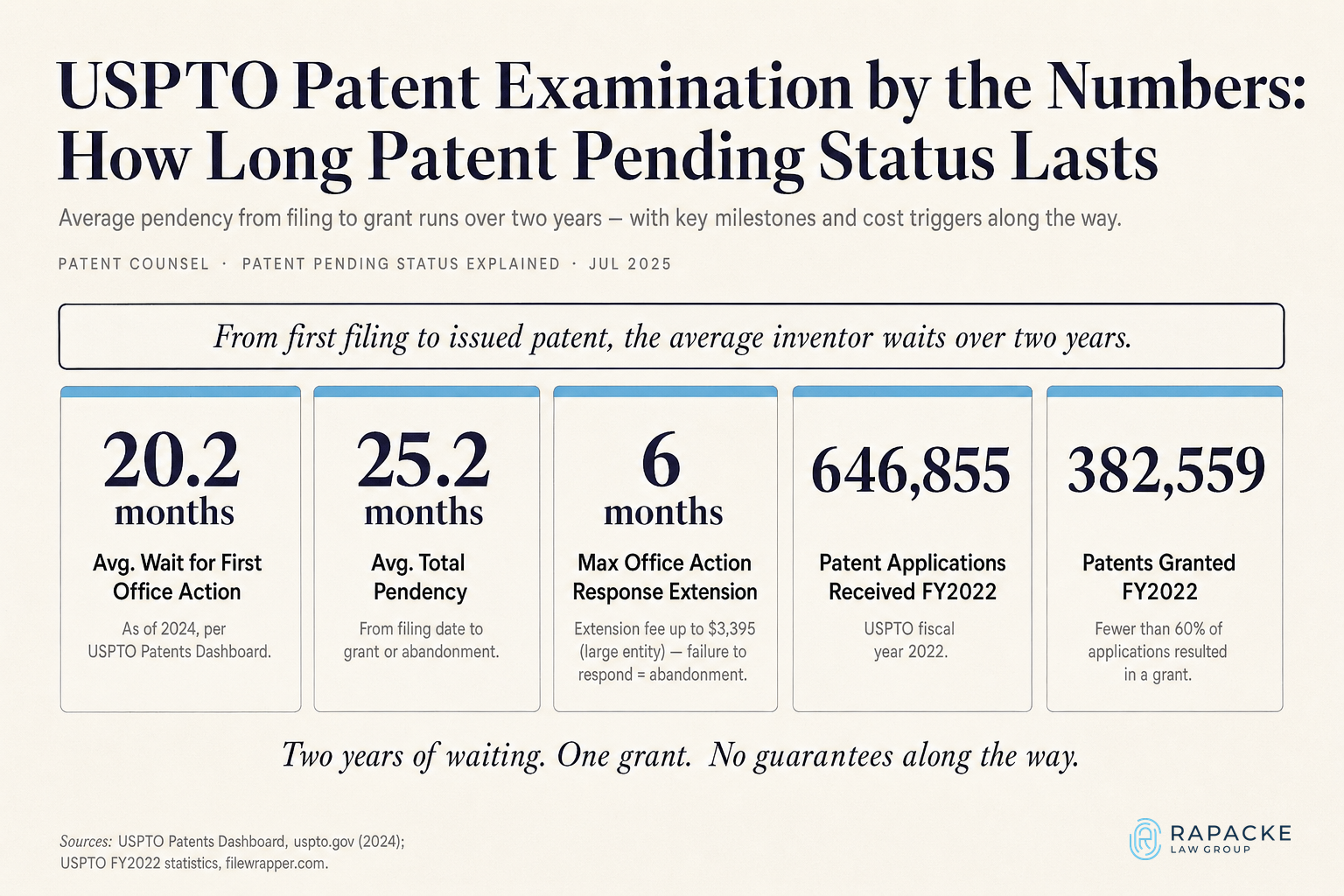
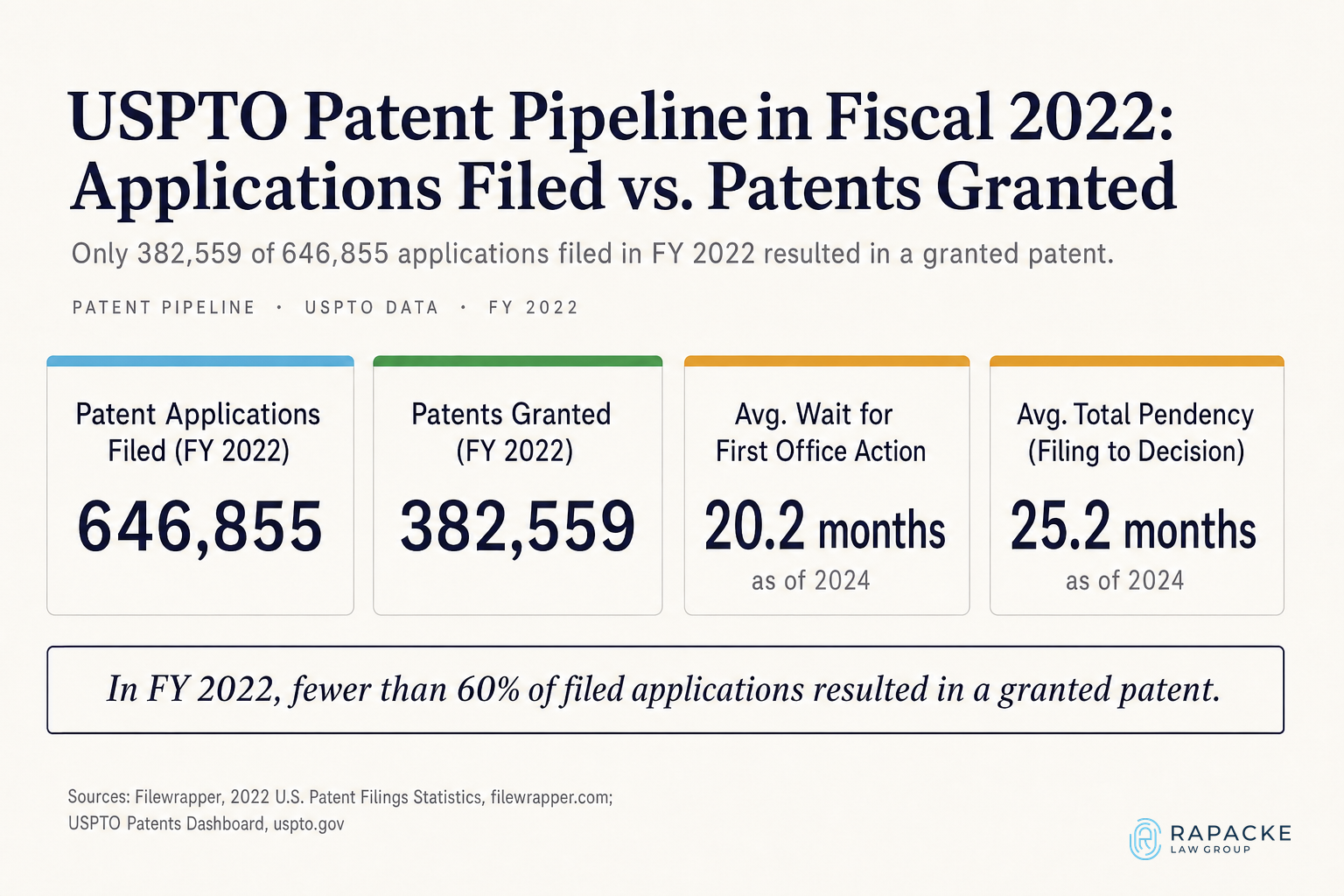
The United States Patent and Trademark Office received 646,855 patent applications in fiscal year 2022 but granted only 382,559 patents, according to the USPTO Patent Statistics Dashboard. That gap tells the core story of patent pending meaning: filing an application and holding a patent are two very different things, with very different legal consequences.
What “Patent Pending” Actually Means in Plain Terms
The Status Is a Legal Marker, Not a Legal Shield
Patent pending is a public declaration that a patent application has been filed with the United States Patent and Trademark Office and is currently under review, making it an essential step in the patent application process. The label notifies competitors, investors, and the public that the inventor has taken the first formal step toward securing exclusive patent rights. It is not itself a form of intellectual property protection, and it is not interchangeable with an issued patent.
How Filing Creates the Patent Pending Status
Under 35 U.S.C. § 111, the official filing date is the day the trademark office receives the specification. The moment a patent application — either a provisional patent application or a non-provisional application — is received and assigned an application number, the applicant may lawfully use the patent pending label. That early effective filing date becomes critical because it determines priority against competing inventors who file a similar application later. Before you file, it is worth running a search of pending patent applications to identify prior art and understand the competitive landscape your application will enter.
What the Label Does Not Legally Guarantee
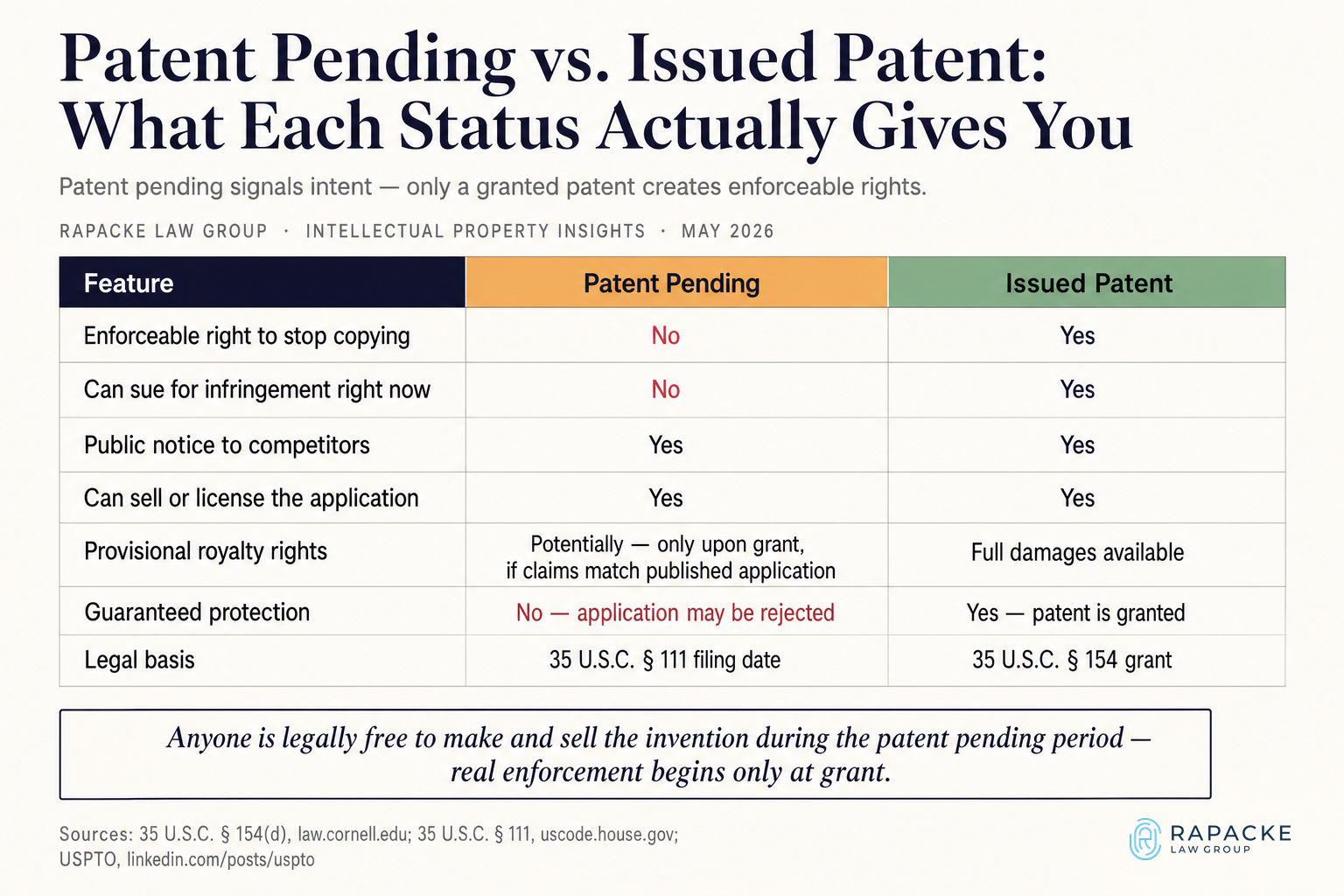
Patent pending status does not mean the invention will receive a patent, does not grant the right to stop competitors from copying the invention, and does not constitute an enforceable patent right. Many applications are rejected or significantly narrowed during examination, and understanding patent law is essential to navigating this process effectively. Most applications require at least one round of office action responses before progressing, which is why the quality of your initial claims matters as much as the filing date itself.
How to Achieve Patent Pending Status Through Two Application Routes
Provisional Patent Applications: Speed and Low Cost at a Strategic Price
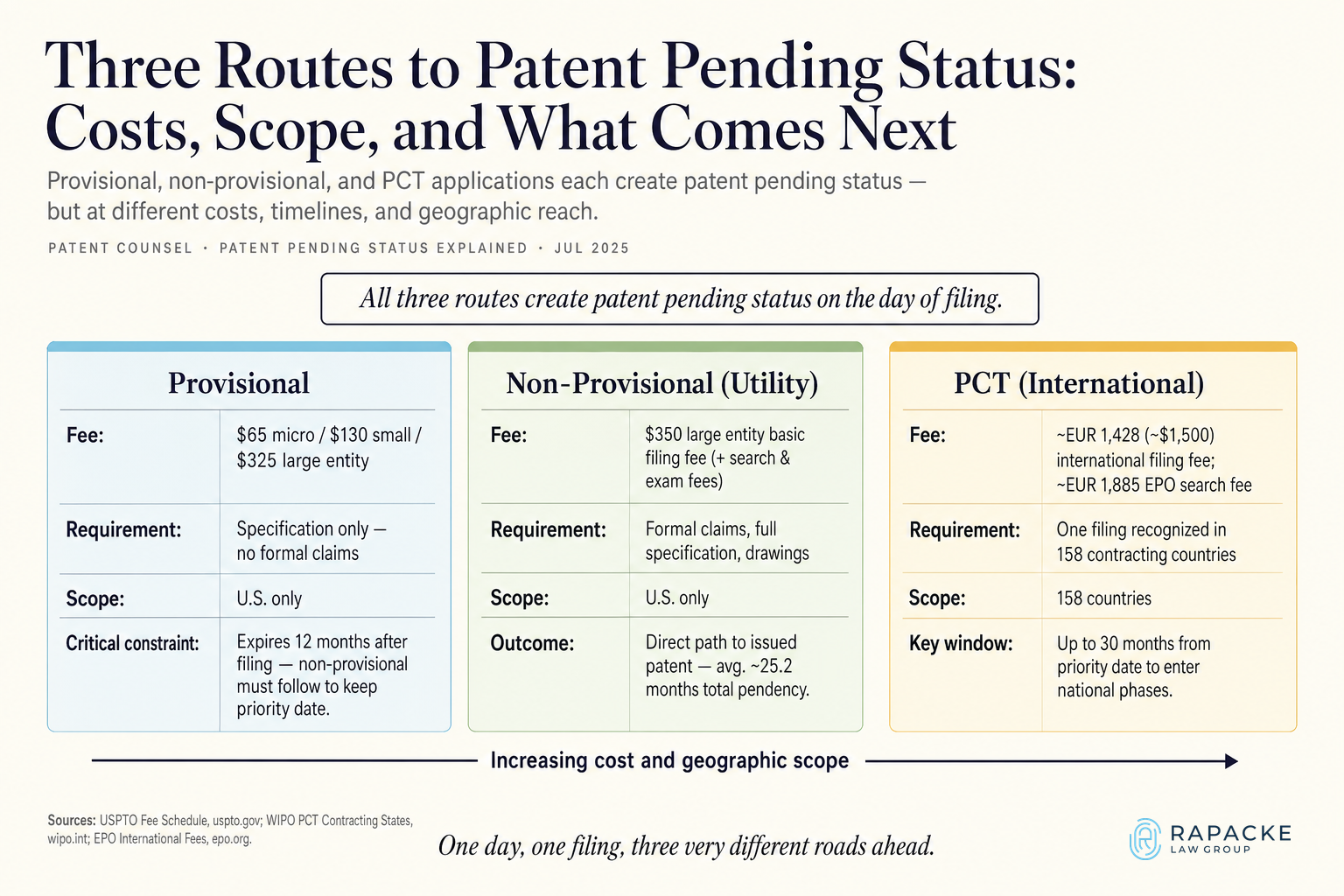
A provisional patent application establishes an early filing date without beginning the formal examination process. According to the USPTO fee schedule effective in 2026, the basic filing fee for a provisional application is $300 for large entities, with reduced fees for small and micro entities. Check the current USPTO fee schedule directly, as fees are updated periodically and the figures in any article can become outdated between revisions. Provisional applications expire after 12 months with no possibility of extension, requiring a non-provisional application within that window to preserve the early filing date. It is the fastest, least expensive way to achieve patent pending status, but it demands disciplined follow-through.
For founders who need more runway, understanding the provisional patent timeline and its interaction with investor milestones is essential before choosing this route.
Non-Provisional Patent Applications: Starting the Formal Examination Clock
A non-provisional utility patent application initiates full USPTO examination and is the direct path to an issued patent, providing the strongest patent protection available to inventors. It requires formal claims, a detailed specification, applicable drawings, and filing fees that vary by applicant size and application type — consult the current USPTO fee schedule for the most accurate figures. Once filed, the application joins the examination queue and the applicant holds patent pending status through the full examination cycle. For a detailed comparison of what each route delivers, see provisional patent vs. non-provisional applications. This route is more complex and expensive than a provisional, but it is the one that can mature into enforceable patent rights.
PCT Applications for International Patent Pending Coverage
Inventors who need patent pending status across multiple countries can file a single application under the Patent Cooperation Treaty. A PCT application establishes a priority date recognized in 158 contracting countries and gives inventors up to 30 months from the priority date to decide which national patent offices to pursue. This is particularly relevant for inventors seeking protection in major markets such as the United States, the European Union, Japan, and the United Kingdom, where separate national phase entries can be deferred under the PCT framework. International filing fees run approximately CHF 1,428 through WIPO (payable in Swiss Francs, not Euros), with additional search fees depending on the receiving office. For startups entering global markets or structuring international IP licensing, the PCT is the most efficient route to broad patent pending status without filing separately in every target country.
How Long Patent Pending Status Lasts and What Affects the Timeline
Standard USPTO Examination Timelines by Technology Category
Patent pending status, sometimes called an active application, lasts from the filing date until the USPTO either grants or finally rejects the application. According to the USPTO Patents Dashboard, as of late 2024, the average wait for a first office action was approximately 19.9 months, with total pendency from filing to grant or abandonment averaging approximately 26.3 months. Applications that go through a Request for Continued Examination average approximately 30 months total. Tech-heavy categories including software, AI, and computer-implemented inventions consistently run longer than mechanical or design patents due to examination backlogs. Understanding when to file a patent relative to your product launch and fundraising timeline is just as important as understanding what the filing actually does.
What Happens When Prosecution Extends or the Application Is Abandoned
If an inventor fails to respond to an office action within the required deadline — typically three months, extendable to six months under 37 C.F.R. § 1.136 with extension fees — the application goes abandoned and patent pending status ends immediately, with serious legal effect on any priority rights. Extension fees escalate with each additional month; consult the current USPTO fee schedule for the precise amounts applicable to your entity size, as these figures change with each fee revision cycle. Applicants who abandon and later refile lose the benefit of the original filing date for any new subject matter. Maintaining patent pending status requires active prosecution management — missed deadlines can permanently eliminate priority rights.
What Protection Patent Pending Status Actually Provides Against Copying
Deterrence Through Public Notice Is the Primary Real-World Benefit
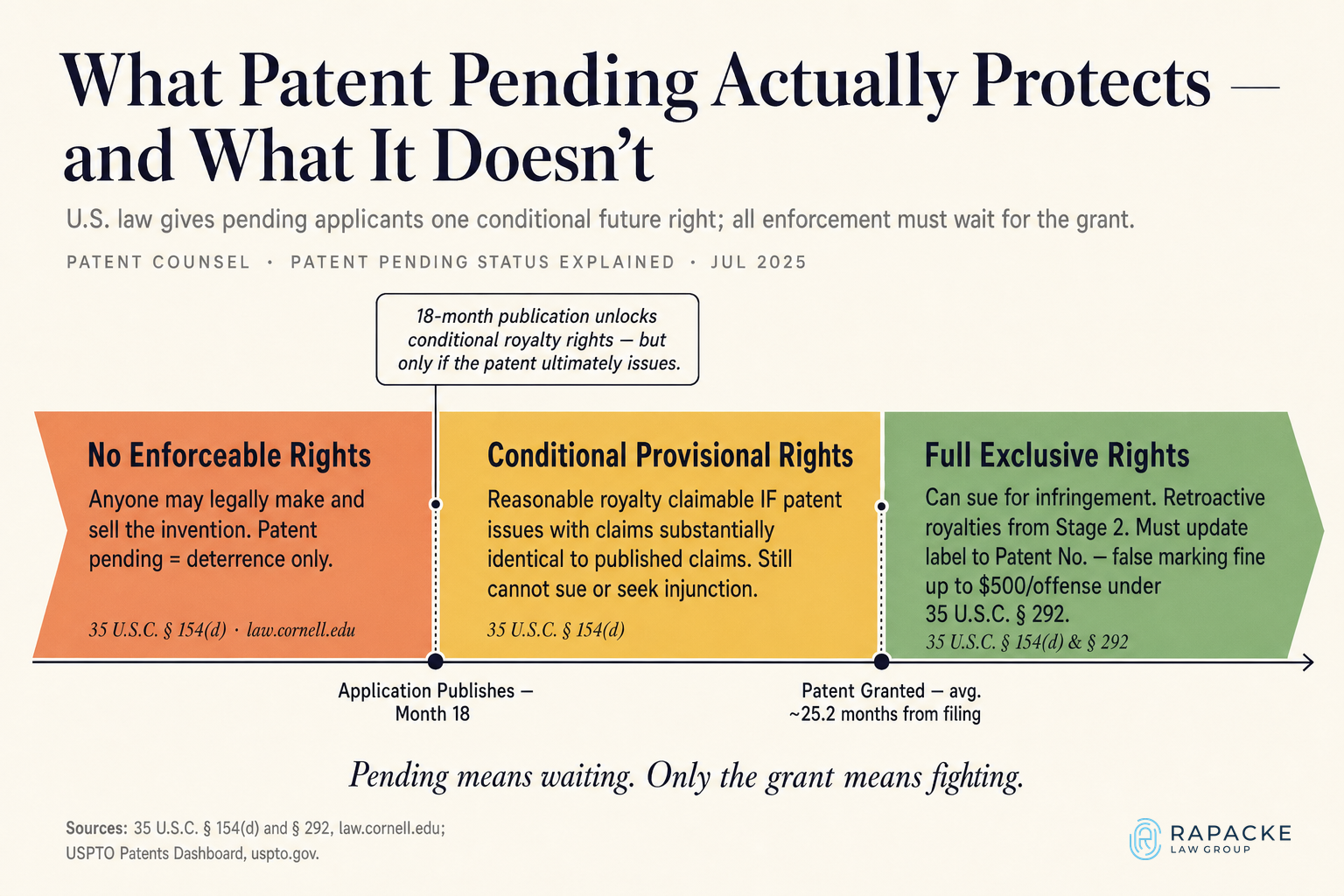
During the patent pending period, the inventor has no legal right to sue a competitor for patent infringement because no patent has been granted. The practical protection is deterrence: when a product is marked patent pending, competitors must weigh the risk that a patent will eventually issue and expose them to retroactive liability, creating real legal rights for the applicant upon grant. This risk assessment often changes product development decisions at competing companies, particularly larger ones with legal teams experienced in IP risk. The goal is to make copying look like a losing bet before the patent even issues.
Retroactive Damages Become Available After the Patent Issues
35 U.S.C. § 154(d) grants provisional rights to a reasonable royalty from anyone who uses the invention after the patent application publishes — typically 18 months after filing — and before the patent issues, provided the issued claims are substantially identical to the published claims. This means the patent pending period can become the starting date for a damages calculation once the patent grants. Marking products patent pending and ensuring the application publishes creates a documented notice date that directly affects the size of future damages recoveries. A granted, enforceable patent is the end goal, and the patent owner may recover damages once the patent issues, but the pending period is what sets the clock running on potential retroactive liability for infringers.
What Competitors Can and Cannot Do During the Pending Period
A competitor may legally manufacture, sell, and profit from a copied new invention while a patent application is pending. There is no legal remedy available to the applicant during this window beyond the deterrent effect of the label. However, a competitor who copies during the pending period and then faces a granted patent with substantially identical claims carries the highest retroactive exposure. The pending period is not a legal exclusivity zone — it is a documented notice period that shapes litigation outcomes later.
How Patent Pending Status Affects Business Strategy and Market Position
Using Patent Pending to Attract Investors and Signal Credibility
Investors in tech startups treat filed patent applications as evidence that the founding team has identified protectable intellectual property and acted on it. Research published through CEPR’s VoxEU found that startups whose patents were eventually granted showed 55% higher employment growth and 80% higher sales five years later than comparable firms without patents, and they raised venture capital at significantly higher rates — underscoring why trademark registration and patent filing are both valued IP signals to investors. Patent pending status appears on pitch decks and product pages as a concrete IP signal — before a single claim is allowed. For a deeper look at how the patent process maps to investor expectations, see why investors care about IP and how the patent process works for high-growth startups.
Founders sometimes treat patent strategy as something to revisit after launch, but when you file a patent for your startup has direct consequences for how investors assess your IP risk. Early filing is rarely a mistake; delayed filing often is.
Licensing and Partnerships During the Patent Pending Period
Under 35 U.S.C. § 261, patent applications are assignable property under intellectual property law, meaning a pending patent application can be licensed, assigned, or used as the basis for a partnership agreement before the patent ever issues. Many technology licensing deals are structured around pending applications, with royalty terms activating upon grant. Founders should ensure that any IP assignment agreements executed during employment or co-founder relationships clearly address pending applications and intellectual property rights — courts treat ambiguous assignment language strictly against the drafter.
When and Where You Are Legally Permitted to Use the Patent Pending Label
The Legal Rules for Marking Products and Marketing Materials
Once a patent application is filed and an application number is received, the applicant may mark their product, packaging, website, and marketing materials with “patent pending” or “patent applied for,” and these legal protections apply regardless of whether the patent ultimately issues. Using the label before filing is a federal offense under 35 U.S.C. § 292, which carries civil penalties of up to $500 per offense. In fiscal year 2022, the USPTO processed 646,855 applications — a volume that signals how seriously inventors treat their first patent application as a formal step in protecting their ideas. The application number is not required on the marking, but including it strengthens the notice argument if litigation arises later.
When Patent Pending Status Ends and What Marking Must Change
Patent pending status ends when the USPTO grants a patent or issues a final rejection that the applicant does not appeal. Upon patent grant, the product must be marked with the patent number rather than “patent pending,” and failure to update the marking can raise legal issues under the false marking statute. Continuing to use the patent pending label after abandonment or rejection violates the false marking statute just as using it before filing does. All product labels, packaging, and marketing materials should be updated promptly when the application resolves.
Frequently Asked Questions
Is patent pending a good thing? Yes. Patent pending status means a patent application has been formally filed with the USPTO, an early filing date has been established under the United States first-to-file system, and the applicant now has the legal right to use the label and deter competitors. However, it does not guarantee a patent will issue. The value of the status depends heavily on the quality of the claims drafted in the application, which is why consulting a patent attorney early in the process is advisable.
Does patent pending mean anything legally? It has limited but real legal significance. The applicant cannot sue for infringement during the pending period, but once a patent issues, the owner may recover damages dating back to when a competitor had actual notice of the published application under the provisional rights provision at 35 U.S.C. § 154(d), a key term patent professionals rely on to calculate retroactive liability. The label puts competitors on constructive notice, which courts treat as relevant in later infringement disputes.
Can I sell a product that is patent pending? Yes. Inventors and companies routinely sell, license, and market products that are patent pending. The pending status places no restriction on the applicant’s ability to commercialize the invention. Selling while patent pending is often a deliberate strategy, generating revenue and market data while the trademark office reviews the application.
Why do companies say patent pending? Three primary reasons: to deter competitors by signaling that a patent may issue and create retroactive liability, to signal credibility and intellectual property investment to investors and partners, and to build the legal record that supports future damages claims. The label costs nothing to apply once the application is filed and delivers disproportionate deterrent value relative to that cost.
What is the difference between a provisional and non-provisional patent application for patent pending purposes? Both a provisional patent application and a non-provisional application create patent pending status the moment they are filed and accepted by the USPTO. The key difference is what happens next. A provisional application never enters examination and expires after 12 months — it is a placeholder that establishes priority. A non-provisional application enters the full examination process and can result in an issued patent. Inventors who file a provisional must convert to a non-provisional within 12 months or lose the benefit of the provisional’s early filing date, and understanding the full patent process helps avoid this costly mistake. If you need more time after that initial period, review the options available through a provisional patent extension before your deadline passes.
Your Next Steps to Patent Pending Success
Understanding patent pending meaning is the first step — but the decisions that follow determine whether your pending status ever translates into real IP protection and competitive advantage.
The bottom line: a weak or poorly timed application gives you the label without the leverage. A well-drafted application filed at the right moment establishes priority, deters competitors, strengthens your investor narrative, and creates the legal record that makes a granted patent worth enforcing.
Every month you delay is a month a competitor could file first. In a first-to-file system, the inventor who acts wins — regardless of who came up with the idea first.
Here is what to do next:
- Schedule a Free IP Strategy Call with Rapacke Law Group to discuss which filing route — provisional, non-provisional, or PCT — fits your invention, timeline, and budget. The firm works with tech founders and inventors on a flat-fee basis with no billing surprises.
- If you are building a software or AI product, download the SaaS Patent Guide 2.0 to understand how software-specific claim strategies affect examination outcomes.
- If you are working on an AI invention, the AI Patent Mastery resource covers eligibility, claim drafting, and examination strategy for AI-based innovations.
- Run a search of pending patent applications before you file to identify competing applications and inform your claim strategy.
Your patent pending status is only as valuable as the application behind it. The right filing, drafted correctly and filed on time, is what converts a label into a competitive moat.
To Your Success,
Andrew Rapacke
Managing Partner, Registered Patent Attorney
Rapacke Law Group