
Key Takeaways
- File a well-drafted U.S. provisional patent application first to lock in a priority date, then use the 12-month window to decide which foreign markets justify the cost.
- China leads in raw AI patent volume, but the United States retains higher-impact AI patents, so headline patent counts do not equal a strong IP position.
- Only about 9% of 2025 generative AI patent families were filed in two or more jurisdictions, meaning high domestic volume rarely translates into enforceable global coverage.
- Every major patent office rejects abstract AI algorithms “as such” and rewards claims tied to a specific technical problem, technical means, and measurable technical effect.
- The Patent Cooperation Treaty preserves your options across more than 155 contracting states, but it never grants an international patent, each country still examines and grants separately.
Written by Andrew Rapacke, Managing Partner, Registered Patent Attorney. Andrew Rapacke is a registered patent attorney and the Managing Partner of The Rapacke Law Group, a full-service intellectual property law firm. He helps individuals and corporations across industries with the protection, prosecution, licensing, and enforcement of their intellectual property, with deep experience in patent, trademark, and copyright matters spanning software, AI and machine learning, blockchain, medical devices, and autonomous vehicle technology. A graduate of the United States Naval Academy, Andrew served as a Naval Engineering Officer before pursuing law and remains active in the startup and inventor communities throughout Florida.
Picture a SaaS founder who ships a generative AI tool, files a single patent application in the United States, and two years later learns a competitor already holds overlapping AI patents in three of the markets she planned to sell into. The similarity alone does not automatically block her, and options like design-arounds, licensing, or challenges may remain. But she now faces the real prospect of exclusion, costly redesign, or litigation in markets she thought were open. That gap between where founders file and where competition actually happens is the core problem behind AI patents by country.
This guide explains how AI patents by country differ in rules and outcomes across the world’s leading jurisdictions, which markets genuinely matter for AI founders, what patent quality versus patent quantity means for your competitive position, and what to evaluate before committing budget to a global filing strategy. By the end you will know how to prioritize countries, what standard each major patent office applies to AI claims, and when to file simultaneously versus sequentially.
The urgency is not theoretical. According to the World Intellectual Property Organization, generative AI patent families grew at roughly 43% average annual growth rate since 2014, and jumped about 100.4% from 2024 to 2025 alone. This pace of ai innovation means the AI patent race is already running. The only open question is whether your intellectual property is in it. If you are weighing a first filing, our guide on what patent pending means and how it protects your invention is a useful companion.
Why the AI Patent Race Looks Nothing Like Past Tech Patent Waves
Earlier software and internet patent waves grew steadily. AI patenting is compounding. WIPO reported more than 435,000 AI patent family publications in 2025 alone, and the fastest-moving slice, generative AI, is now reshaping strategy at every major office. This surge sits inside a wider trend, WIPO’s World Intellectual Property Indicators 2025 reports 3.7 million patent applications worldwide in 2024, up 4.9% from 2023 and the fastest growth since 2018, with artificial intelligence patents forming one of the most rapidly expanding slices of that broader wave.
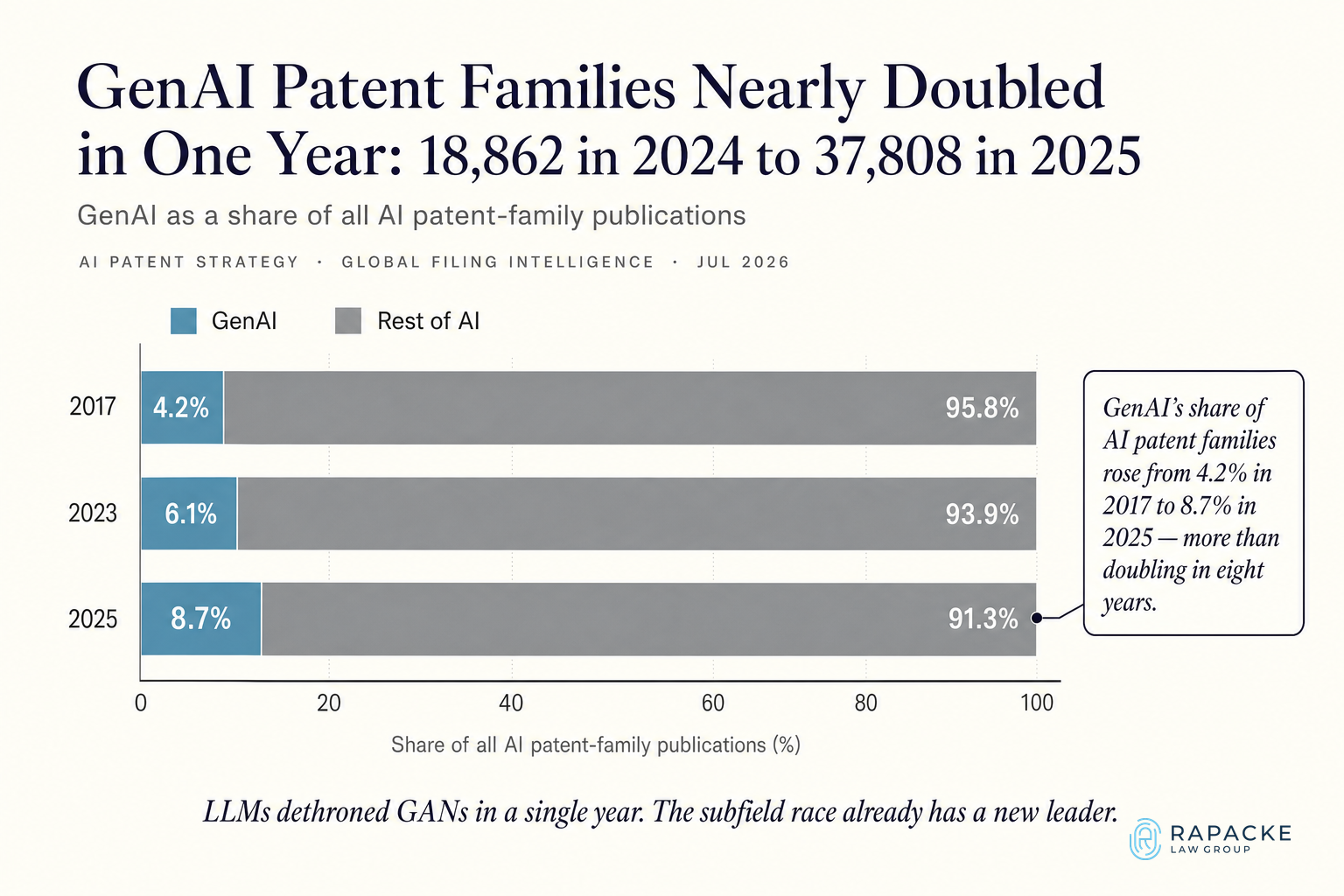
GenAI Patent Families Nearly Doubled in One Year: 18,862 in 2024 to 37,808 in 2025 — Source: WIPO, 2026 (datawrapper.dwcdn.net)
AI Patent Volume Has Exploded Across Every Major Office
The scale is hard to overstate. Generative AI (GenAI) patent families rose from 18,862 in 2024 to 37,808 in 2025, roughly 100.4% year over year, according to WIPO’s Global patenting trends analysis in its Patent Trends Update in GenAI report. More than 56,000 generative AI families were published across 2024 and 2025 combined, exceeding the entire 2014 to 2023 total, per WIPO’s executive summary. Generative AI also climbed from 4.2% of all AI patent families in 2017 to 6.1% in 2023 and 8.7% in 2025.
The AI patent landscape is not one race, and GenAI patents alone now constitute a distinct and fast-growing layer within it. Machine learning, deep learning, computer vision, natural language processing, and large language models each generate distinct patent filings, and the related patents in each subfield form separate prior art pools that cover a wide range of related inventions. Large language Models overtook generative adversarial networks during 2014 to 2025, with LLM patent families reaching 14,100 in 2025 versus about 5,200 GAN families, nearly a three-to-one ratio according to WIPO’s Patent Trends Update in GenAI. Founders filing only domestically cede ground in several AI subfields at once. For a foundational view of how software and AI claims are built, see our software patents checklist for founders.
Patent Quality vs. Patent Quantity Define Two Different Strategies
Raw patent counts and IP leverage are not the same thing. Stanford’s 2026 AI Index finds that China leads in AI patent output and grants while the United States retains higher-impact patents, and South Korea leads in AI patents per capita. Patent quality in practice means broader independent claims, higher citation impact, stronger enforceability, and relevance to real commercial applications.
One methodology caution matters here. A 2026 academic preprint found that an improved AI-patent classifier reached 97.0% precision, 91.3% recall, and a 94.0% F1 score, while the earlier widely used USPTO classifier scored around 40.5% precision, 37.5% recall, and 39% F1. Because rankings depend on how artificial intelligence patents are identified in the first place, country rankings can shift materially with the classifier used, and this sensitivity in patent data underscores why headline figures should be treated as directional. Treat headline rankings as directional, not definitive. Reviewing patent titles and abstracts directly can also help calibrate whether a classifier’s output reflects the actual scope of an AI claim. Our overview of the conditions of patentability for software and AI in 2026 explains what turns a raw filing into a defensible right.
Why Generative AI and Foundation Models Are Driving the Next Filing Surge
Generative AI, including large language models and diffusion models, is the highest-competition and highest-opportunity subcategory in AI patenting right now, and generative ai patents are accumulating faster than in any other emerging technology segment. Diffusion-model families rose from 18 in 2020 to 441 in 2023, per WIPO’s Patent Landscape Report. Foundation models are not just a patent story either. Survey research from the Federal Reserve Bank of St. Louis suggests generative AI tools may have raised U.S. labor productivity by as much as 1.3% since ChatGPT arrived, which helps explain why firms invest so heavily in patenting this artificial intelligence innovation. Examiners at every major office are still developing consistent standards for what counts as novel and non-obvious in this space, which creates a real window for well-crafted applications. Delay in this subcategory carries compounding risk. To see how leading portfolios are assembled, read our breakdown of the AI patent boom.
How AI Patents by Country Break Down Among the Top Five Filers
By inventor location, WIPO’s current generative AI data ranks China first, the United States second, the Republic of Korea third, Japan fourth, and India fifth. The top locations by count are China with 38,210 inventions, the United States with 6,276, the Republic of Korea with 4,155, and Japan with 3,409. The European Patent Office is a regional office covering many countries, per USPTO guidance on the EPO, so it sits outside a strict country ranking even though it is central to any European filing decision.
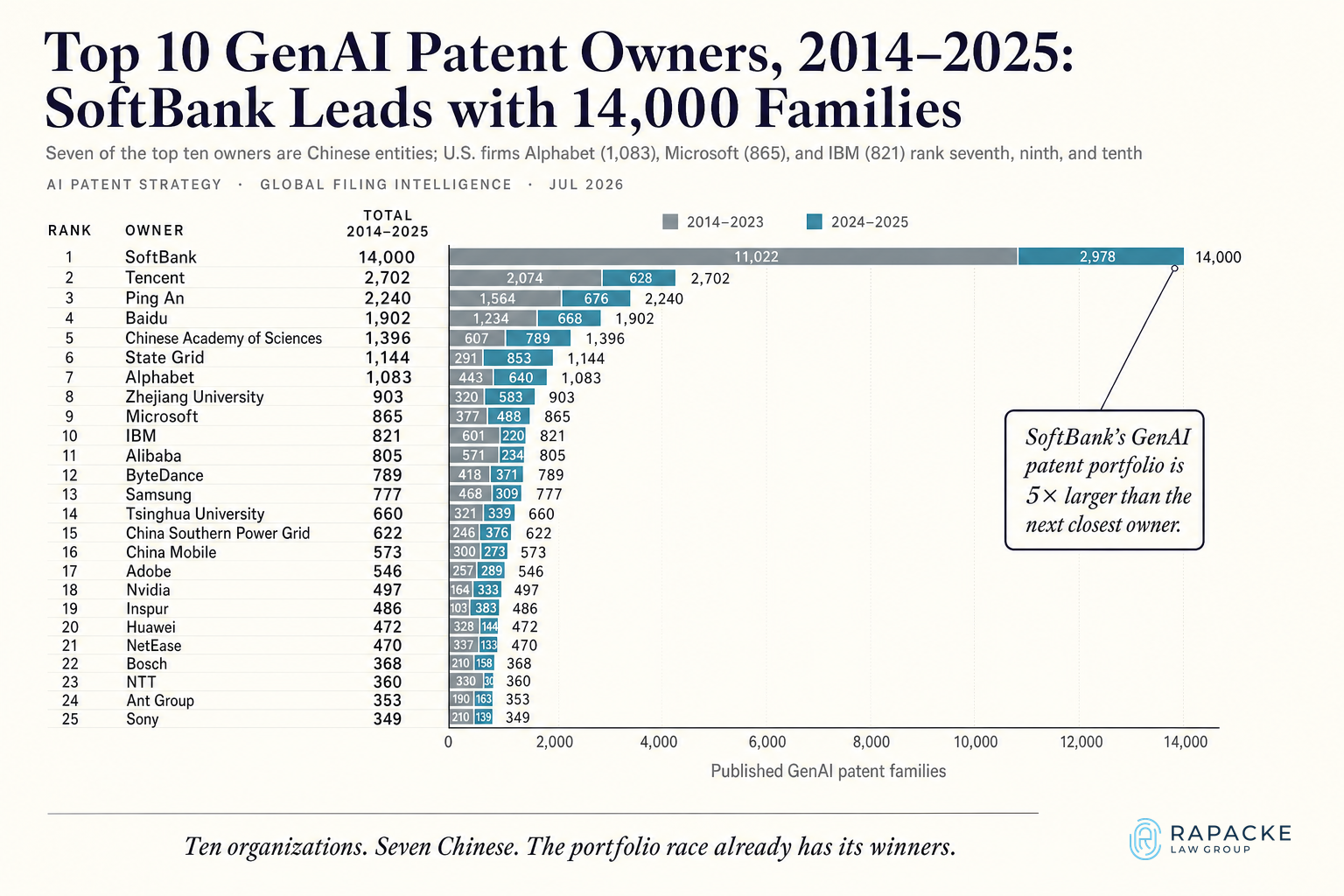
Top 10 GenAI Patent Owners, 2014–2025: SoftBank Leads with 14,000 Families — Source: WIPO, 2026 (datawrapper.dwcdn.net)
China’s Dominance in Raw AI Patent Volume
China leads global AI patent volume by a wide margin, and chinese ai patents now represent the single largest national share of generative artificial intelligence filings worldwide. It produced more than 43,000 generative AI patent families during 2024 and 2025, exceeding its entire prior decade, according to WIPO’s SPARK executive summary. China-based inventors were responsible for more than 38,000 generative AI patent families between 2014 and 2023, six times more than the second-place United States. Based on WIPO’s underlying data, one analysis from IPWatchdog estimates China’s generative AI families grew at roughly a 64% compound annual rate from 2023 to 2025. This scale of ai innovation in the ai sector is driven by government incentives, university output mandates, and large incumbents.
Most of these Chinese patents are filed at CNIPA, the China National Intellectual Property Administration, not at the USPTO, the U.S. Patent and Trademark Office, or the EPO. U.S. and European inventors are not automatically blocked, but competitors operating inside China may hold substantial local coverage. If you plan to sell or build in China, assume a crowded prior art landscape and run a targeted freedom to operate analysis first. To understand how enforcement actually works across borders, review the rights of patent in the modern era.
The United States Fewer Filings Stronger Claims
The U.S. receives fewer total AI patent applications than China, but its patents carry weight. American artificial intelligence patents are more frequently cited and remain higher impact on average, and they surface repeatedly in venture and acquisition due diligence. U.S. generative AI families still grew fast, with WIPO identifying the United States as one of the fastest-growing origins alongside Japan.
Claim drafting at the USPTO demands more sophistication than volume-driven markets. The Supreme Court’s decision in Alice Corp. v. CLS Bank International still governs software and AI eligibility, requiring claims directed to a specific technical improvement rather than an abstract idea. Granted patents in the U.S. are enforceable only within U.S. jurisdiction, but they often carry outsized commercial and due-diligence significance. For concrete claim ideas, study our roundup of recent software patent examples from top companies and startups.
Japan South Korea and the European Patent Office as Strategic Secondary Markets
Japan and South Korea are consistent top-five filers and matter for any founder targeting Asian markets outside China. Japan’s generative AI families surged from 398 in 2023 to 3,835 in 2025, a 210% CAGR tracked by the Japan Patent Office, largely because SoftBank published nearly 3,000 families. WIPO identifies SoftBank as the leading holder of generative AI patent families, with 2,985 families published between 2014 and 2025, followed by Tencent, Ping An, and Baidu.
The European Patent Organisation now has 40 member states after Moldova’s accession in March 2026, and a single European application can, after one examination, reach protection in up to 45 countries once validation states such as Morocco, Tunisia, Cambodia, Georgia, and Laos are included. A European application uses centralized examination, though the resulting patent generally takes national effect after grant unless unitary effect is requested. Europe requires a technical character argument that U.S. practice does not, which changes how you draft, not just where you file.
What Each Major Patent Office Actually Requires for AI Claims
Every major office rejects abstract mathematical algorithms “as such” and rewards claims integrated into qualifying technical subject matter, a standard that applies equally to ai techniques drawn from machine learning and statistics. Each reaches that result through a different doctrine, so identical claim language often needs country-specific adaptation.
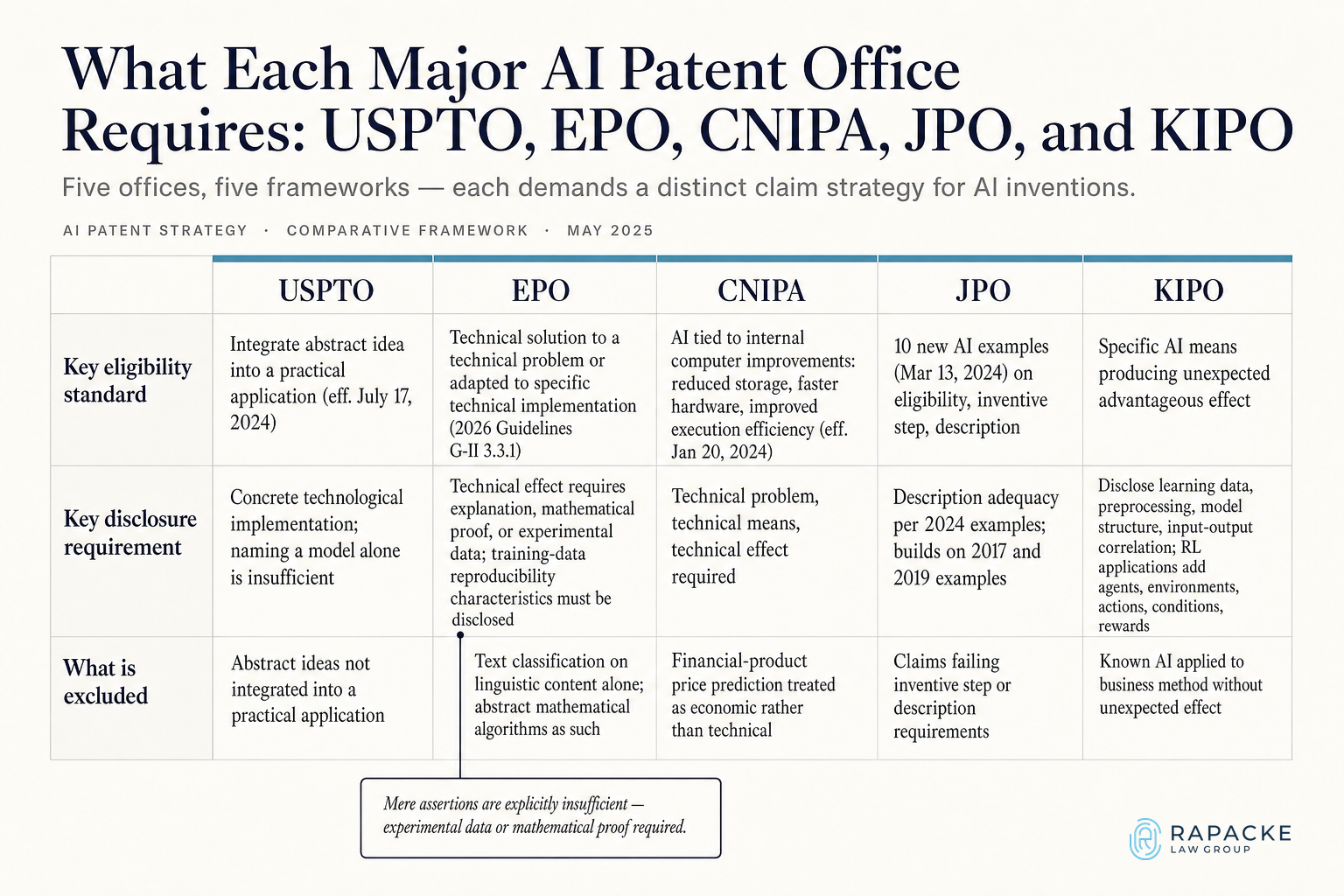
What Each Major AI Patent Office Requires: USPTO, EPO, CNIPA, JPO, and KIPO — Source: USPTO 2024; EPO Guidelines 2026; CNIPA 2024; JPO 2024; KIPO 2024
USPTO Eligibility Under the Alice-Mayo Framework
The USPTO applies a two-step analysis. Step one asks whether the claim is directed to an abstract idea such as a mathematical concept, mental process, or method of organizing human activity. Step 2A asks whether the claim integrates that idea into a practical application, and only if it does not, Step 2B asks whether additional elements add significantly more. A claim reciting “using a neural network to classify data” will likely fail, while a claim reciting a specific architectural technique that reduces inference latency in a convolutional neural network is far more likely to survive.
The USPTO’s AI subject matter eligibility guidance, effective July 17, 2024, added three hypothetical examples reinforcing that a concrete technological implementation, not the mere naming of a model, drives eligibility. Specificity at the technical architecture level is the single most important variable.
EPO’s Technical Character Requirement for AI and Machine Learning
The EPO treats AI and machine learning models as abstract mathematical methods as such. Under the EPO Guidelines G-II 3.3.1, those models contribute to patentability when they provide a technical solution to a technical problem or are adapted to a specific technical implementation. Neural-network identification of irregular heartbeats and low-level image or speech classification count as technical, while text classification based only on linguistic content does not.
Applicants must support a claimed technical effect with explanation, proof, or experimental data drawn from ai research, because mere assertions are insufficient. Where the effect depends on training-data characteristics, those reproducibility-critical features must be disclosed even if the full dataset need not be. Draft EPO claims around a stated technical application and a measurable technical effect.
How China’s CNIPA Japan’s JPO and Korea’s KIPO Evaluate AI Inventions
CNIPA’s revised guidelines, effective January 20, 2024, recognize AI claims tied to internal computer improvements such as reduced storage, faster processing, or improved execution efficiency, covering artificial intelligence technologies including machine learning and neural network architectures. Its examples show that an e-coupon usage analysis may qualify where it identifies a natural-law relationship, while a neural network predicting financial-product prices does not, because the price relationship is economic rather than technical. CNIPA issued additional trial guidance for AI applications on December 31, 2024.
The Japan Patent Office’s JPO has published AI-related examination case examples that demonstrate how it applies its standard of a creation of technical ideas utilizing natural laws. Korea’s KIPO requires disclosure of implementation details such as learning data, preprocessing, model structure, and input-output correlation, and it may reject claims that simply apply known AI to a business method.
How the Patent Cooperation Treaty Changes Your Global Filing Math
The Patent Cooperation Treaty is the mechanism most AI founders should understand before spending a dollar on foreign filings, because it buys time and preserves options across more than 155 contracting states without committing you to every country at once. Our dedicated guide on PCT filing to protect your invention globally walks through the process step by step.
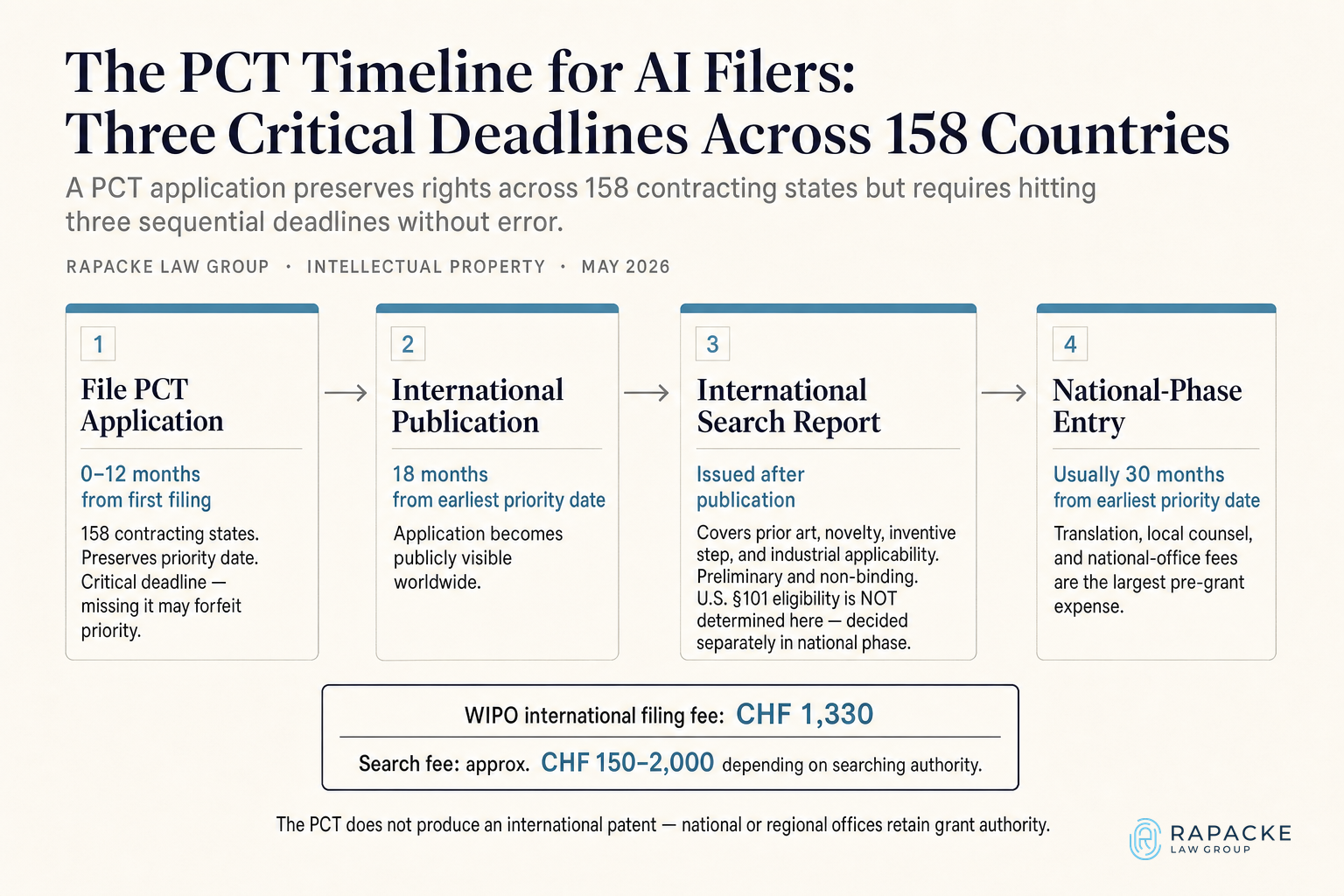
The PCT Timeline for AI Filers: Three Critical Deadlines Across 158 Countries — Source: WIPO PCT FAQ, 2026
What the PCT Buys You and When It Makes Sense
The PCT, administered by WIPO, lets you file one international application, receive an International Search Report and Written Opinion, and then enter national or regional phases in your chosen countries.
The critical point is that the PCT does not produce an international patent. It is a filing and search procedure. National and regional offices retain grant authority, and each examines separately. Filing PCT is a sound budgeting heuristic when you target three or more jurisdictions, though disclosure timing and examination factors still shape the call.
Choosing Which Countries to Enter at the National Phase
Not every market justifies the cost of national-phase entry, and wipo technology trends data can help founders prioritize which jurisdictions are seeing the fastest growth in related patents. Understanding AI patents by country is the foundation of a practical prioritization framework that asks three questions. Where do your customers and users operate? Where do your likely competitors manufacture or file? Where do potential acquirers or investors expect patent coverage? For most AI and SaaS founders this narrows to the USPTO for commercial and due-diligence weight, the EPO for pan-European reach through a single prosecution, and CNIPA if China is a target market or a competitive threat.
WIPO data reinforces the discipline. Only about 9% of 2025 generative AI families were filed in two or more jurisdictions, so filing everywhere by default is neither common nor necessary. Enter USPTO and EPO, then make a deliberate CNIPA decision based on real China exposure.
The 12-Month Priority Window Is the Constraint Everything Else Depends On
From your first patent application, provisional or non-provisional, you generally have 12 months to file a PCT or direct foreign applications claiming priority to that original date. International publication normally follows at 18 months, and national-phase entry is usually due at 30 months from the earliest priority date. Missing the 12-month window can, in some jurisdictions, allow your own disclosure to be used as prior art against you, though grace periods and priority-restoration mechanisms vary and warrant attorney review. Treat this as a critical deadline that determines whether global protection is even possible.
What the U.S.-China AI Patent Gap Means for Your Competitive Position
The generative AI surge can be captured in a few numbers. Generative AI families reached 37,808 in 2025, grew 100.4% from 2024, and have expanded at roughly 43% average annual growth rate since 2014, with China at an estimated 64% CAGR from 2023 to 2025, while the United States and Japan are among the fastest-growing origins. Read together, these figures tell a nuanced story, not a simple one.
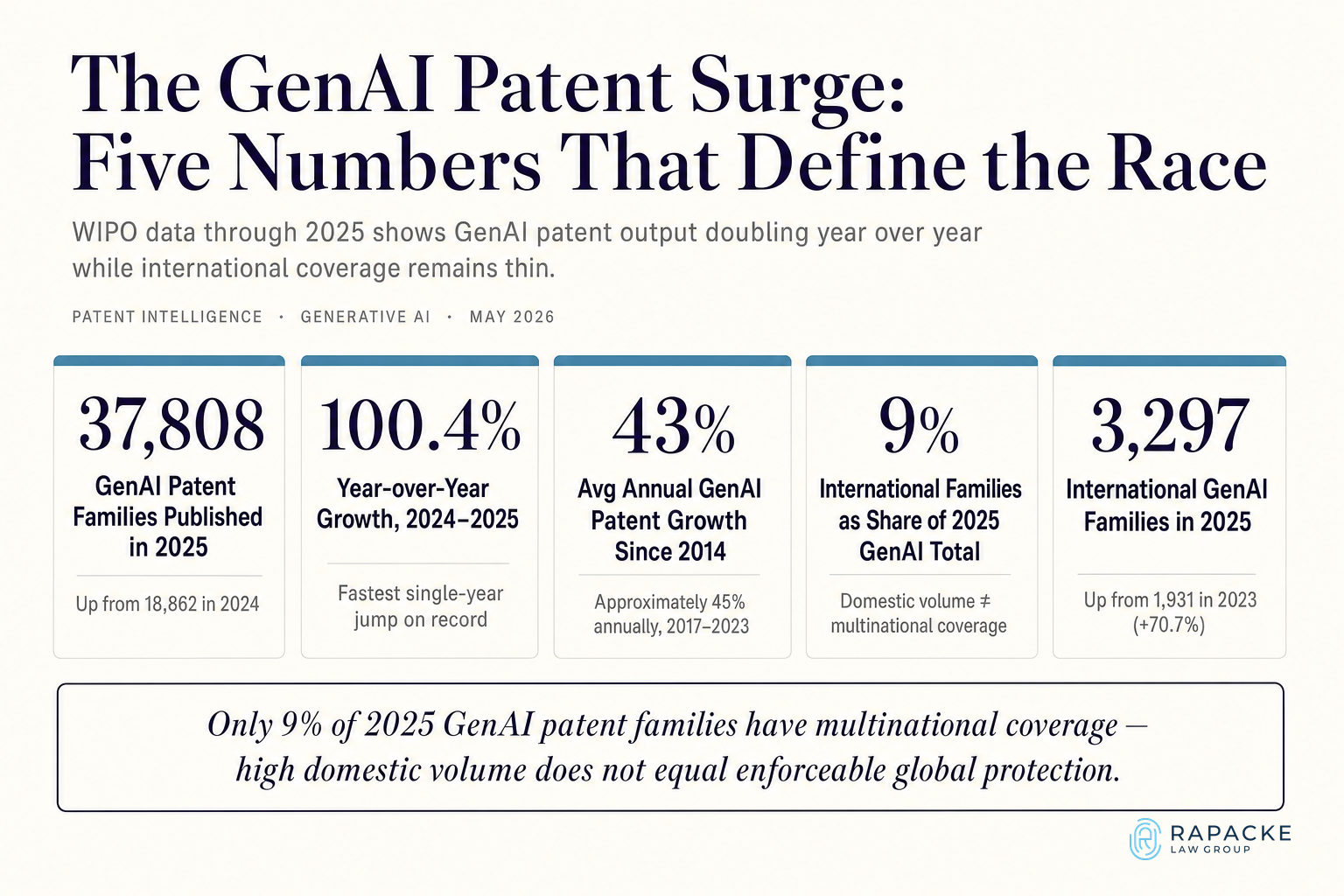
The GenAI Patent Surge: Five Numbers That Define the Race — Source: WIPO Technology SPARK, 2026
Reading the Data Without Overstating China’s Lead
China’s volume lead is real. A 2026 working paper finds China has surpassed the U.S. in recent annual AI patents granted, and AI patents reached about 20% of all patents in both countries in 2023. But high domestic volume is not the same as enforceable global coverage. Because only about 9% of 2025 generative AI families were multinational, a dense CNIPA count does not mean your invention is already patented in markets that matter to you. Run a targeted prior art search rather than abandoning a filing plan based on headlines.
Where American AI Patents Still Dominate
American AI patents, especially those held by large private incumbents such as Alphabet, Microsoft, IBM, Qualcomm, and Apple, dominate in commercially valuable subfields tied to natural language processing, large language models, computer vision, and deep neural networks applied to specific industries. Stanford’s finding that U.S. patents remain higher impact on average matters for anyone pursuing licensing revenue or acquisition value, and this advantage in ai development is reflected in how acquirers weight U.S. portfolio quality during diligence. The same 2026 research notes U.S. AI patenting is concentrated among large private firms, while Chinese activity draws more on universities and state-owned enterprises. Our deep dive into how Google built the most valuable patent portfolio in tech shows what a strategic incumbent portfolio looks like in practice.
How the AI Patent Race Is Reshaping IP Strategy for Startups
The competitive dynamic pushes every actor, startups included, to file earlier and broader than prior technology generations required, making this an emerging technology arms race unlike anything the software industry has previously seen. AI founders today face a more crowded prior art landscape than cloud or mobile founders did a decade ago, and the window for foundational claims is narrowing as the landscape fills in real time, particularly in innovation hubs like Silicon Valley, Beijing, and Seoul. That makes a strong provisional patent application and an early freedom to operate analysis more valuable, not less. File earlier than feels necessary, because delayed filings meet a denser field of related patents. For a sense of which firm holds the deepest AI position, see our analysis of what company has the most AI patents.
Building a Global AI Patent Filing Strategy That Actually Fits Your Stage
Filing strategy should match your funding stage, not a wish list. The right sequence for a seed-stage founder looks nothing like the multi-jurisdiction portfolio a well-funded company can support, and country-level growth rates reward founders who move early.
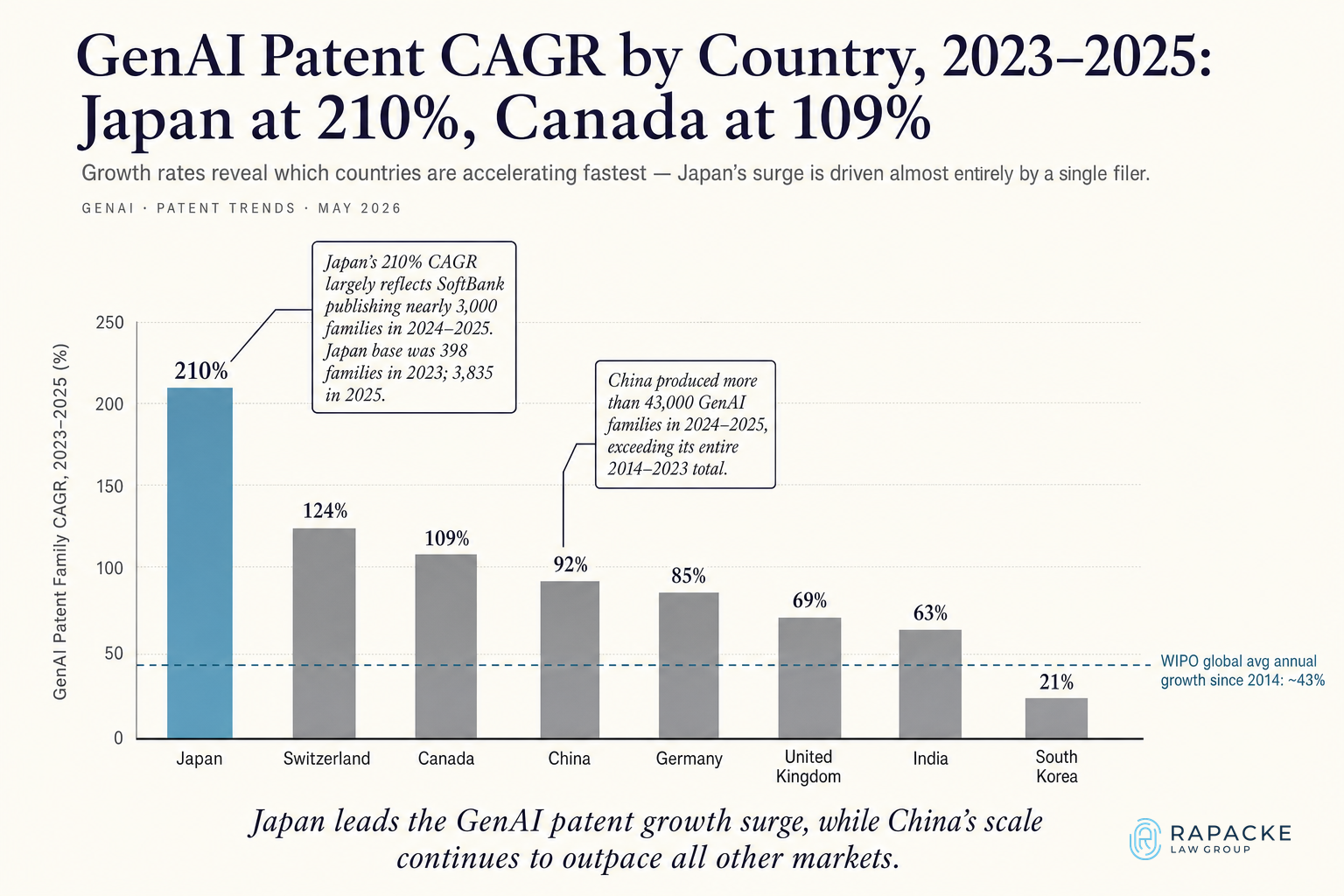
GenAI Patent Growth Rate by Country: Japan at 210%, Canada at 109% — Source: WIPO Technology SPARK, 2026
What Pre-Seed and Seed-Stage Founders Should File First
At the earliest stage, few founders can fund PCT entry in five jurisdictions at once. The right first move is a well-drafted U.S. provisional patent application. Current USPTO provisional filing fees are $325 for a large entity, $130 for a small entity, and $65 for a micro entity, per the USPTO fee schedule, before drafting costs.
A strong AI provisional describes the technical architecture, the training methodology, the specific problem solved, and the novel element, including inventor addresses and assignee details, in enough detail that a skilled practitioner could reproduce it. Only adequately disclosed subject matter earns the early priority date. Details you add later receive a later effective date, so a thin provisional quietly narrows what you can claim. Before assuming you can handle it alone, weigh the risks in our guide on filing a patent on your own.
When to Bring in a Patent Attorney vs. Using AI-Assisted Filing Tools
AI-assisted drafting tools are multiplying, but AI inventions carry specific eligibility risk. The Alice-Mayo framework demands nuanced claim drafting that anticipates rejection, and poorly drafted claims tend to draw office actions, require costly responses, and yield narrow grants competitors can design around. A registered patent attorney who focuses on AI and software patents can structure claims around the technical improvement from the outset, which is a risk-management benefit rather than a guaranteed savings. At Rapacke Law Group, flat-fee pricing means you know the full cost before you commit, with no billing surprises during examination. A meaningful advantage when you are already managing the uncertainty of a fast-moving filing landscape.
Japan’s 210% generative AI patent-family CAGR and Canada’s 109%, measured over WIPO’s multi-year dataset, show how quickly national landscapes are filling, alongside the United States at 92%, Germany at 85%, and China at 64%, all measured as GenAI patent-family growth over WIPO’s multi-year dataset. Moving deliberately with expert claim drafting matters when the field is this fast.
How IP Strategy Connects to Funding Rounds and Acquisition Readiness
Investors and acquirers increasingly assess IP with specificity. During diligence they may ask what you have filed, in which jurisdictions, whether claims are pending or granted, and how broad the scope is. Research associates AI patents with a market-value premium for listed firms in both the U.S. and China, which supports a link between patents and firm value without promising a fixed premium for early-stage startups. A portfolio of well-drafted AI patents in strategically chosen jurisdictions signals defensibility and reduces perceived risk. Predictable, flat-fee IP spend is something investors readily understand.
Frequently Asked Questions About AI Patents by Country
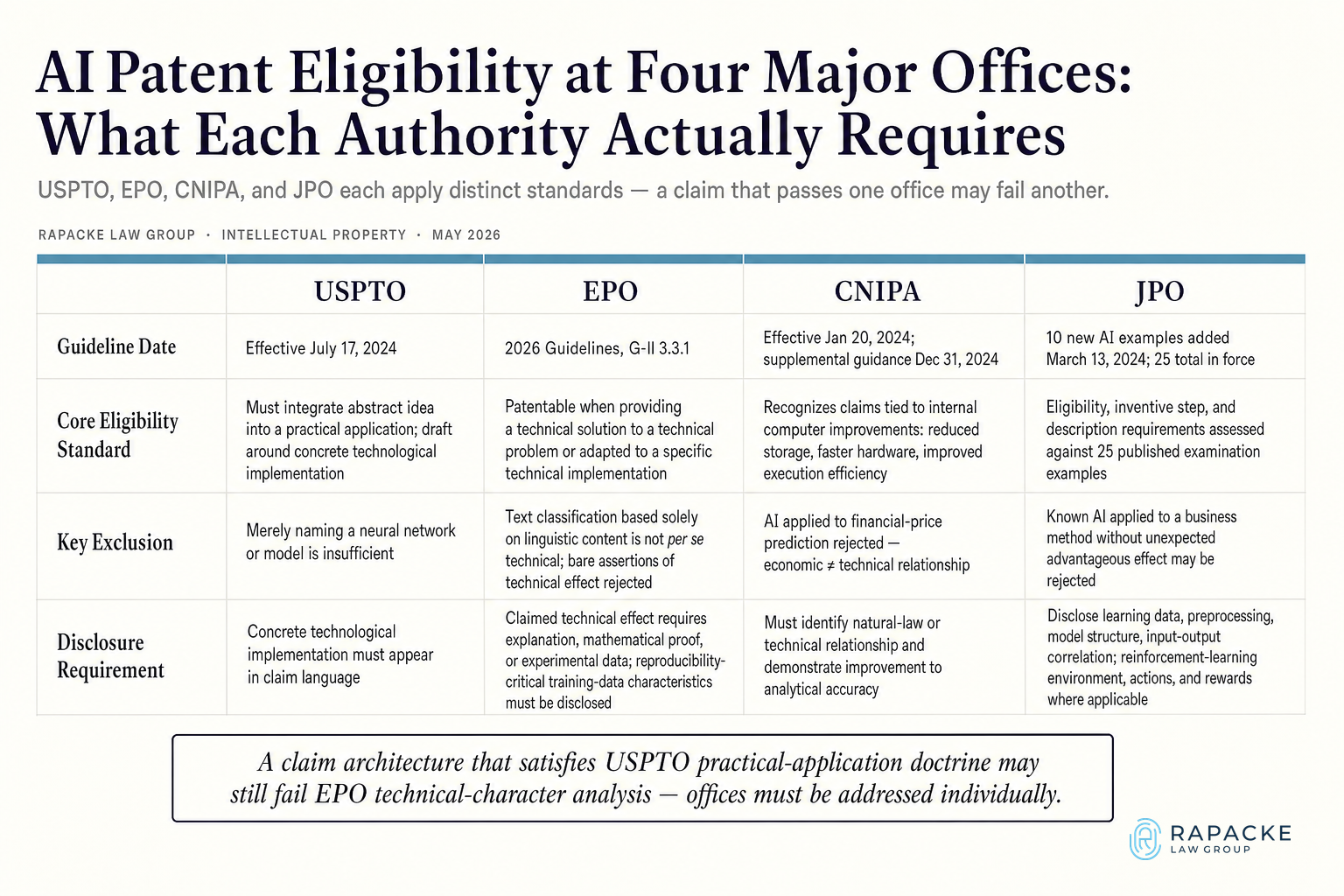
AI Patent Eligibility at Four Major Offices: What Each Authority Actually Requires — Source: USPTO 2024; EPO Guidelines 2026; CNIPA 2024; JPO 2024; KIPO 2024
Which country owns the most AI patents?
China leads all countries in total ai patents and grants by a wide margin, driven by government incentives, university mandates, and large filers like Ping An and Baidu. That said, “owns the most” is imprecise, because rankings vary by inventor location, applicant headquarters, or patent families. Stanford’s 2026 AI Index names China the volume leader while noting the United States retains higher-impact AI patents.
Which country is number one in artificial intelligence overall?
There is no single leader across every metric. China leads in AI publications, citations, and patent grants, while the United States produced 59 notable AI models in 2025 versus China’s 35 and invested $285.9 billion privately versus China’s $12.4 billion, according to Stanford HAI. For patent strategy, what matters is where your technology will be commercialized and where competitors file, not who leads in aggregate.
Who are the Big 4 of AI patent filers?
There is no universally recognized “Big 4” of AI. If the term refers to current generative AI patent portfolios, WIPO identifies SoftBank as the leading holder of generative AI patent families, with 2,985 families published between 2014 and 2025, followed by Tencent, Ping An, and Baidu. All ai companies with deep domestic filing operations. This signals where patent coverage is densest and, by contrast, where white-space opportunities remain for narrower application-specific inventions.
Does China have more AI patents than the U.S.?
Yes, by raw annual output and grants. A 2026 academic working paper finds China has surpassed the U.S. in recent annual AI patents granted, while Stanford reports U.S. AI patents remain higher impact on average; yet in terms of non-ai patents, both countries continue to file millions annually across other technology domains. For freedom-to-operate purposes, territorial coverage and international-family filings matter more than raw totals, since only about 9% of 2025 generative AI families were multinational.
Can you patent an AI algorithm itself or only its applications?
No major office, USPTO, EPO, CNIPA, JPO, or KIPO, grants patents on abstract mathematical algorithms as such. What is patentable is the application of an AI method, covering ai technologies ranging from deep learning to large language models, to a specific, concrete technical result, such as a neural network architecture that measurably improves computer vision accuracy or a natural language processing method that reduces computational overhead in defined hardware. The claim must recite the technical problem, the AI-based solution, and the measurable technical effect.
How does the Patent Cooperation Treaty work for AI inventions?
The PCT process is the same for AI as for any technology. You file one application, receive one International Search Report, and generally have until 30 months from the earliest priority date to enter national phases across the treaty’s more than 155 contracting states. The accompanying written opinion of the International Searching Authority applies international novelty, inventive-step, and industrial-applicability criteria, not binding national eligibility law, so you can use it to amend claims before each country’s separate examination, including U.S. Alice-Mayo review.
Your Next Steps to Global AI Patent Success
AI patenting is the fastest-growing segment of global IP activity, the prior art landscape is being built right now, and the 12-month priority window is the structural constraint that largely determines whether you can preserve your original filing date across jurisdictions. Founders who wait lose filing dates. Founders who file without strategy spend budget on the wrong jurisdictions or accept narrow claims competitors design around.
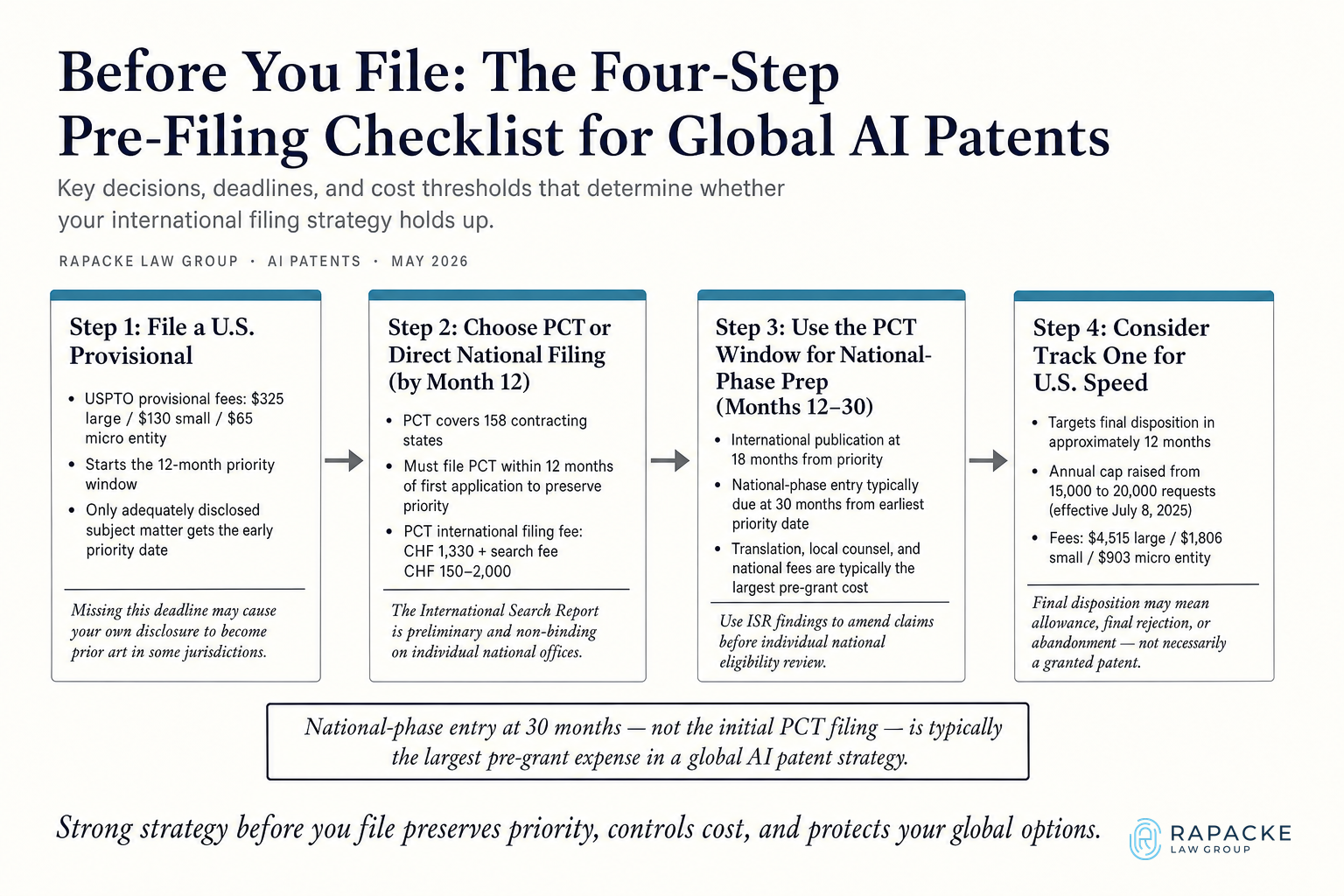
Before You File: The Four-Step Pre-Filing Checklist for Global AI Patents — Source: WIPO PCT FAQ 2026; USPTO Fee Schedule 2026; USPTO Track One Program
The bottom line, a weak patent is a thin provisional filed too late in the wrong jurisdictions, easy for competitors to design around. A strong patent is a technically specific application anchored by a U.S. provisional, extended through the PCT before the 12-month deadline, and entered into the national phases where your business actually competes.
The decisions that matter most are clear. Claim technical specifics over abstract methods. Anchor your strategy with a strong U.S. provisional. File PCT before the 12-month deadline to preserve global optionality. Enter national phases based on commercial exposure, competitor activity, and investor expectations, not habit. Every month of delay lets the prior art landscape fill in around your invention, which quietly raises your rejection risk and shrinks your claim scope.
Your action items:
- Schedule a Free IP Strategy Call with a registered patent attorney, not a sales representative, to map your filing plan.
- Commission a targeted prior art search before you build or launch in a crowded market like China.
- Draft a provisional that fully discloses your technical architecture and training methodology.
- Decide your PCT and national-phase countries based on customers, competitors, and investor requirements.
Rapacke Law Group works with AI founders and tech startups across this process, from prior art searches and provisional drafting through PCT filings and multi-jurisdiction national-phase strategy. The flat-fee RLG Guarantee means you know the cost before you commit, with no billing surprises during examination, our patentability work carries a 100% refund if a search finds your invention is not novel, and our provisional patent service carries a full refund if the USPTO denies your provisional patent application. In a race being built in real time, the founders who file early and file well capture the competitive advantage that a well-timed portfolio delivers.
For a deeper look at AI-specific patent strategy, explore the AI Patent Mastery resource and the SaaS Patent Guide 2.0.
To Your Success,
Andrew Rapacke Managing Partner, Registered Patent Attorney Rapacke Law Group