


Key Takeaways
- Intangible assets, including intellectual property, account for roughly 90% of the market value of S&P 500 companies, so treating IP as a balance-sheet asset is a business decision, not legal paperwork.
- Patents give up to 20 years of exclusive control but require public disclosure, while trade secrets last indefinitely as long as you keep them confidential.
- Copyright protection attaches automatically to original works, but you must register with the U.S. Copyright Office to sue for statutory damages.
- IP licensing lets you earn royalty revenue without giving up ownership, and U.S. companies earn substantial royalty revenue each year from charges for the use of intellectual property.
- In the U.S., contractors generally own copyright in the work they create unless rights are transferred in writing through a qualifying work-for-hire agreement or a signed IP assignment.
*Written by Andrew Rapacke, Managing Partner, Registered Patent Attorney.* Andrew Rapacke is a registered patent attorney and the Managing Partner of The Rapacke Law Group, a full-service intellectual property law firm. He helps individuals and corporations across industries with the protection, prosecution, licensing, and enforcement of their intellectual property, with deep experience in patent, trademark, and copyright matters spanning software, AI and machine learning, blockchain, medical devices, and autonomous vehicle technology. A graduate of the United States Naval Academy, Andrew served as a Naval Engineering Officer before pursuing law and remains active in the startup and inventor communities throughout Florida.
A founder ships a product, skips protection, and watches a competitor legally copy the design within a year. It happens constantly, and it is almost always avoidable. Learning how to use intellectual property is the difference between owning a defensible business and building one anyone can clone. Intellectual property rights convert raw ideas into enforceable, transferable assets. This guide walks you through the four main types of intellectual property, how each protects a different part of your company, how licensing turns IP into revenue, and how to build a strategy today.
What Intellectual Property Actually Is (and Why It Matters to Your Business)
Intellectual property rights give the owner exclusive control over how a creation is used, licensed, or sold, ownership over ideas, brands, and innovations rather than physical property. These rights, rooted in human intellect, are what make intangible assets so valuable in the modern economy. WIPO estimates corporate intangible assets worldwide reached about $97 trillion in 2025, up 23% from roughly $80 trillion in 2024 (WIPO). Intangibles now make up about 90% of the market value of S&P 500 companies (Ocean Tomo), up from about 17% in 1975. In 2022, the USPTO received about 591,000 patent applications, ranking second worldwide. In the United States, intellectual property law is primarily federal, administered through the U.S. Patent and Trademark Office and the United States Copyright Office. For more, see our breakdown of the real purpose of intellectual property.
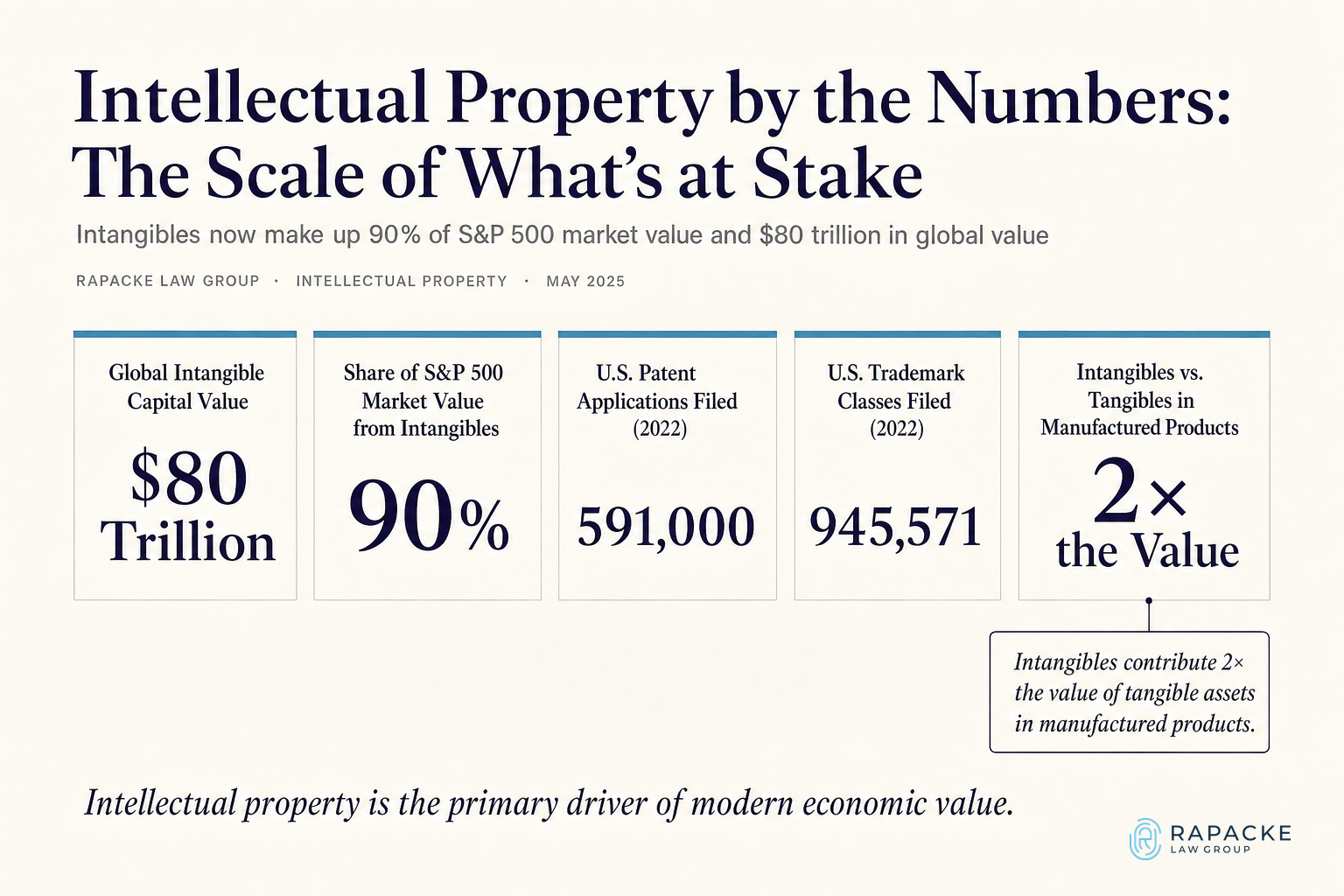 Intellectual Property by the Numbers: The Scale of What's at Stake — Source: WIPO, 2023
The Four Main Types of Intellectual Property Rights
U.S. law recognizes four categories, patents protect inventions, trademarks protect brand identifiers, copyrights protect original works, and trade secrets protect confidential information. The term intellectual property covers all of these categories collectively. Actionable takeaway: identify which category fits your core asset before deciding how to protect it. Our intellectual property asset playbook shows how to turn each category into a business asset.
Why IP Rights Are a Competitive Advantage, Not Just Legal Paperwork
Registered IP can be licensed for income, scrutinized during investor due diligence, and used to block competitors, providing legal protection that unregistered rights simply cannot match. WIPO found that nearly one-third of the value of manufactured goods sold worldwide between 2000 and 2014 came from intangible capital, with intangible returns reaching about $5.9 trillion in 2014 (WIPO). Actionable takeaway: treat your IP portfolio as a balance-sheet asset. See our intellectual property rights in business playbook.
How Patents Protect Your Inventions and Give You 20 Years of Market Control
A United States patent utility grant gives exclusive rights to make, use, sell, and import a patented invention for up to 20 years from the filing date, subject to maintenance fees, under 35 U.S.C. § 154 (USPTO). Utility patents are the most common type filed with the USPTO each year. The tradeoff, you disclose how your invention works in exchange for two decades of enforceable exclusivity. A provisional application buys 12 months of "patent pending" status while you refine the invention, a non-provisional application starts formal examination. Design patents protect a product's ornamental appearance rather than its function.
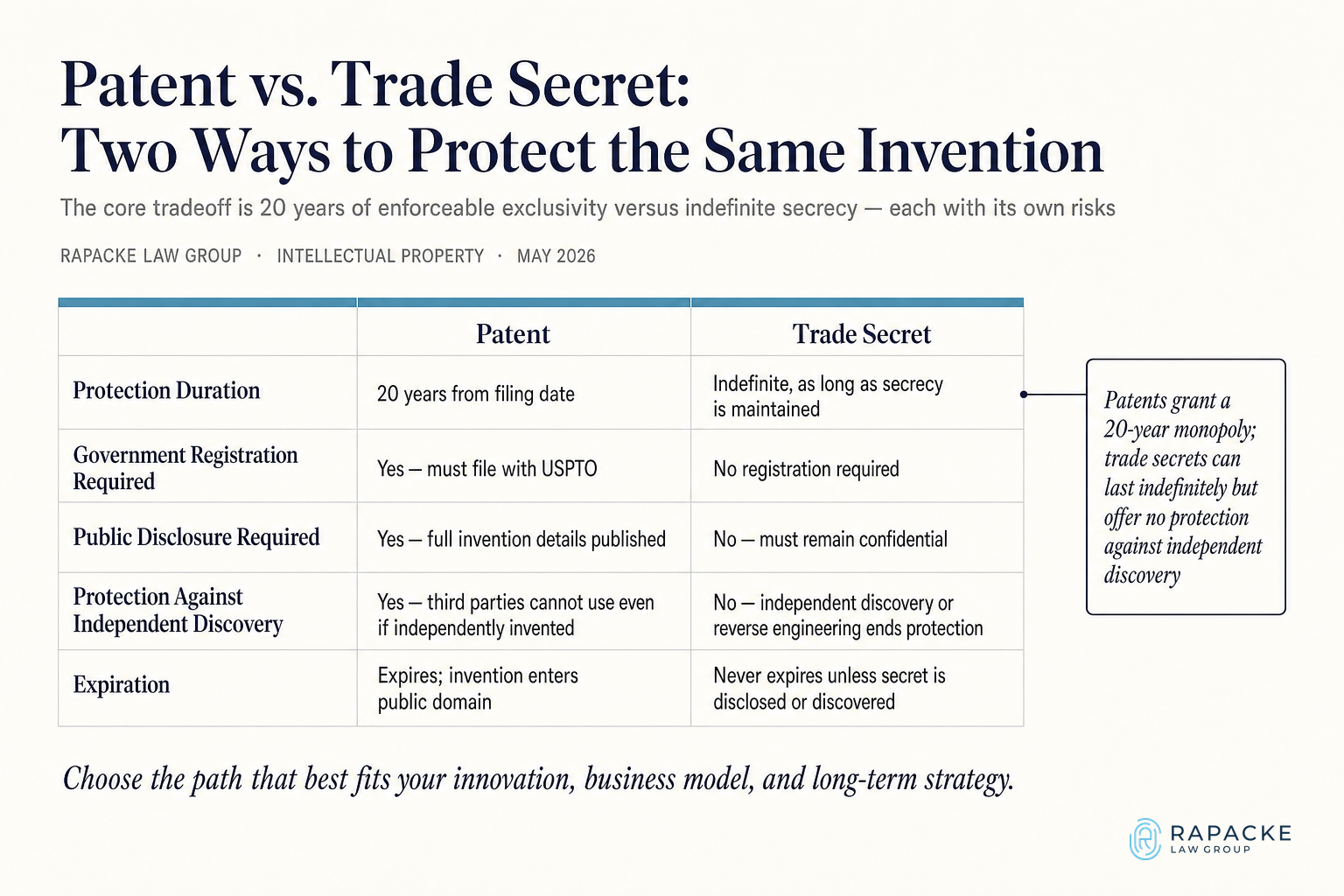 Patent vs. Trade Secret: Two Ways to Protect the Same Invention — Source: USPTO; WIPO
What Qualifies for Patent Protection in the United States
Patentable subject matter includes processes, machines, manufactures, and compositions of matter. Abstract ideas and laws of nature do not qualify, which matters heavily for software and AI founders. USPTO total pendency averages roughly 2.4 to 2.5 years from filing to final disposition. If your core product is software, our guide to software intellectual property rights covers how to protect functional code. Actionable takeaway: file a provisional patent application to lock in your priority date while you keep developing.
When a Patent Portfolio Becomes a Business Asset
A patent holder can license for royalty revenue, use patents as leverage in funding rounds, or sell them through IP assignment agreements. Investors read a strong patent portfolio as evidence of a defensible market position, a pattern clear in how Airbnb built a $79B empire on 1,717 patents. Actionable takeaway: build your portfolio with licensing and exit potential in mind, not just litigation defense.
How Trademarks Protect Your Brand Identity and Stop Competitors From Copying It
A trademark protects the brand identifiers, names, logos, and slogans, that distinguish your goods or services. Federal registration gives the owner nationwide priority and the right to use the ® symbol (USPTO). An unregistered mark only protects you where you actually use it. By 2022 there were about 3.1 million active federal trademark registrations in the United States (WIPO), and trademarks can be renewed indefinitely as long as the mark stays in use and maintenance filings are made (USPTO).
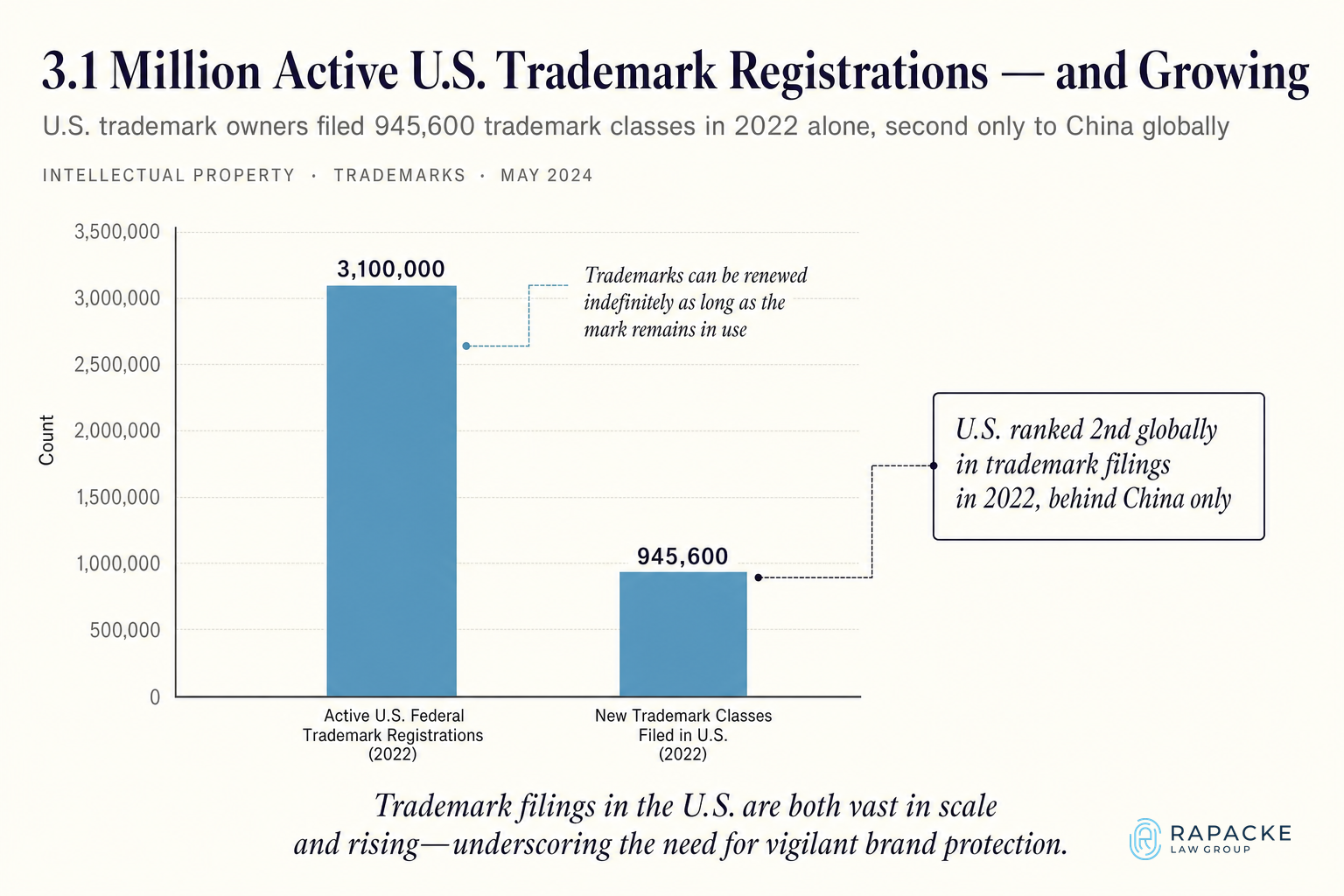 3.1 Million Active U.S. Trademark Registrations — and Growing — Source: WIPO, 2023
The Difference Between a Registered and Unregistered Trademark
The TM symbol signals an unregistered claim, the ® symbol signals federal registration, which triggers a legal presumption of ownership and nationwide exclusive rights. Actionable takeaway: file your trademark application before launching publicly to secure the earliest possible priority date.
How Trademark Infringement Happens and What Legal Action You Can Take
Trademark infringement turns on likelihood of confusion between two marks. Owners can send cease and desist letters, file oppositions at the Trademark Trial and Appeal Board, or pursue federal court action, where unauthorized use can result in injunctive relief and damages. Having a clear dispute resolution process in place helps you respond quickly when infringement surfaces. Actionable takeaway: monitor the USPTO database and major marketplaces regularly to catch infringing uses early.
How Copyright Protects Original Works Automatically and What That Means for Your Business
Copyright protection attaches automatically to original works the moment they are fixed in a tangible medium, no registration required. As a copyright owner, you hold these rights from the moment of creation. The scope is broad, literary works, artistic works, computer programs, and software code all qualify, and these copyrighted works are protected automatically from the moment of creation. In the United States, copyright generally lasts for the life of the author plus 70 years (U.S. Copyright Office). Registration still matters because it unlocks the ability to sue for statutory damages.
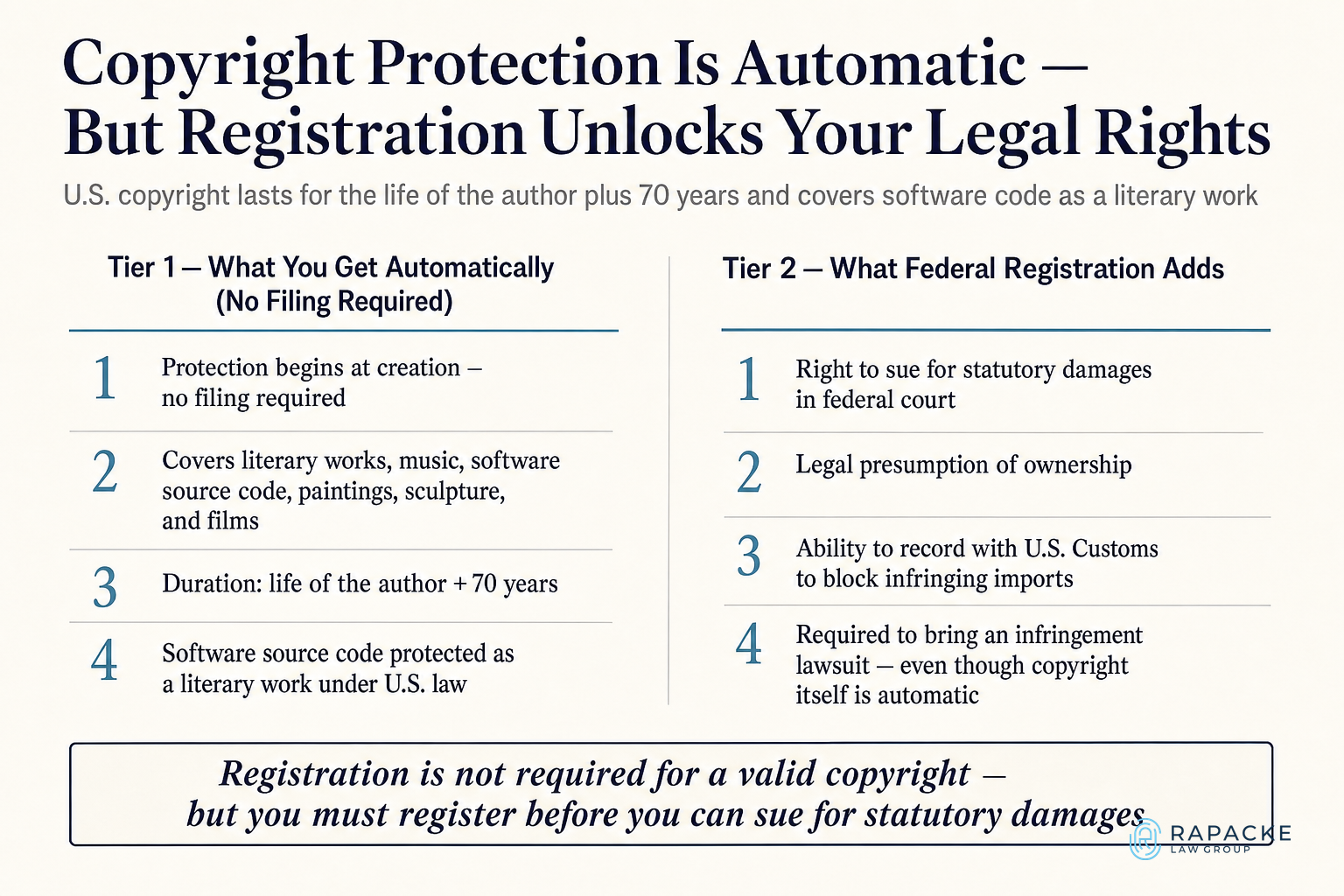 Copyright Protection Is Automatic — But Registration Unlocks Your Legal Rights — Source: U.S. Copyright Office; WIPO
What Copyright Covers (and What It Doesn't)
Copyright protects the expression of an idea, not the idea itself. Computer programs and source code are registrable as literary works when they contain sufficient human authorship (U.S. Copyright Office). In the digital age, protecting these assets early is critical for software founders. Copyright does not protect functional elements, facts, or abstract ideas, which is why software founders often pair it with patents. Copyright owners should also be aware that literary works such as technical manuals and API documentation may qualify for additional registration. Our guide to source code intellectual property explains when patents give stronger protection. Actionable takeaway: register your software, marketing content, and creative assets to unlock statutory damages.
Work-for-Hire Agreements and Who Owns the Copyright
In the U.S., independent contractors generally own the copyright in the work they create unless rights are transferred in writing. That happens two ways, the work qualifies as a "work made for hire" under 17 U.S.C. § 101, with a signed agreement and one of the nine enumerated categories, or the contractor signs a written assignment to your company. Work created by employees within the scope of employment generally belongs to the employer by default. Actionable takeaway: use signed IP assignment agreements and work-for-hire clauses in every contractor agreement before work begins.
How Trade Secrets Protect Confidential Information Without a Filing Date
A trade secret is any confidential information that gives your business a competitive advantage, formulas, algorithms, customer lists, technical information, and manufacturing processes. Unlike patents, trade secrets require no registration and have no expiration date (WIPO). The Uniform Trade Secrets Act and the federal Defend Trade Secrets Act supply the legal framework, and together these intellectual property laws set the baseline for trade secret protection across U.S. jurisdictions. Protection depends entirely on the security measures you put in place.
What Qualifies as a Trade Secret and How to Maintain Protection
A trade secret loses its protected status if you fail to take reasonable steps to keep it confidential. Under the Uniform Trade Secrets Act, courts look at whether you took reasonable precautions to guard the information. Key measures include NDAs, access controls, and employee confidentiality agreements. A bipartisan commission estimated that trade secret theft costs the U.S. economy between $180 billion and $540 billion per year (IEN). Actionable takeaway: put documented confidentiality policies and NDAs in place before sharing sensitive information with any third party.
When to Choose Trade Secret Protection Over a Patent
The tradeoff is disclosure versus secrecy. A patent requires public disclosure in exchange for a limited exclusive right, while a trade secret can last indefinitely but offers no protection if a competitor independently discovers the same information. The Coca-Cola formula is the classic example. Actionable takeaway: choose trade secret protection when the innovation is hard to reverse-engineer and you can maintain confidentiality long-term.
How to Use Intellectual Property Licensing to Generate Revenue
IP licensing lets you grant another party the right to use your intellectual property for royalties or other compensation, without giving up ownership. This makes licensed digital assets and software among the most valuable tools in a startup's IP portfolio. U.S. companies earn substantial royalty revenue each year from charges for the use of intellectual property (FRED, St. Louis Fed). Licenses come in three forms, exclusive, non-exclusive, and sublicensing arrangements. You can only license what you demonstrably own, a core reason to invest in formal IP registration. Our guide to monetizing intellectual property breaks down how to turn intangibles into recurring revenue.
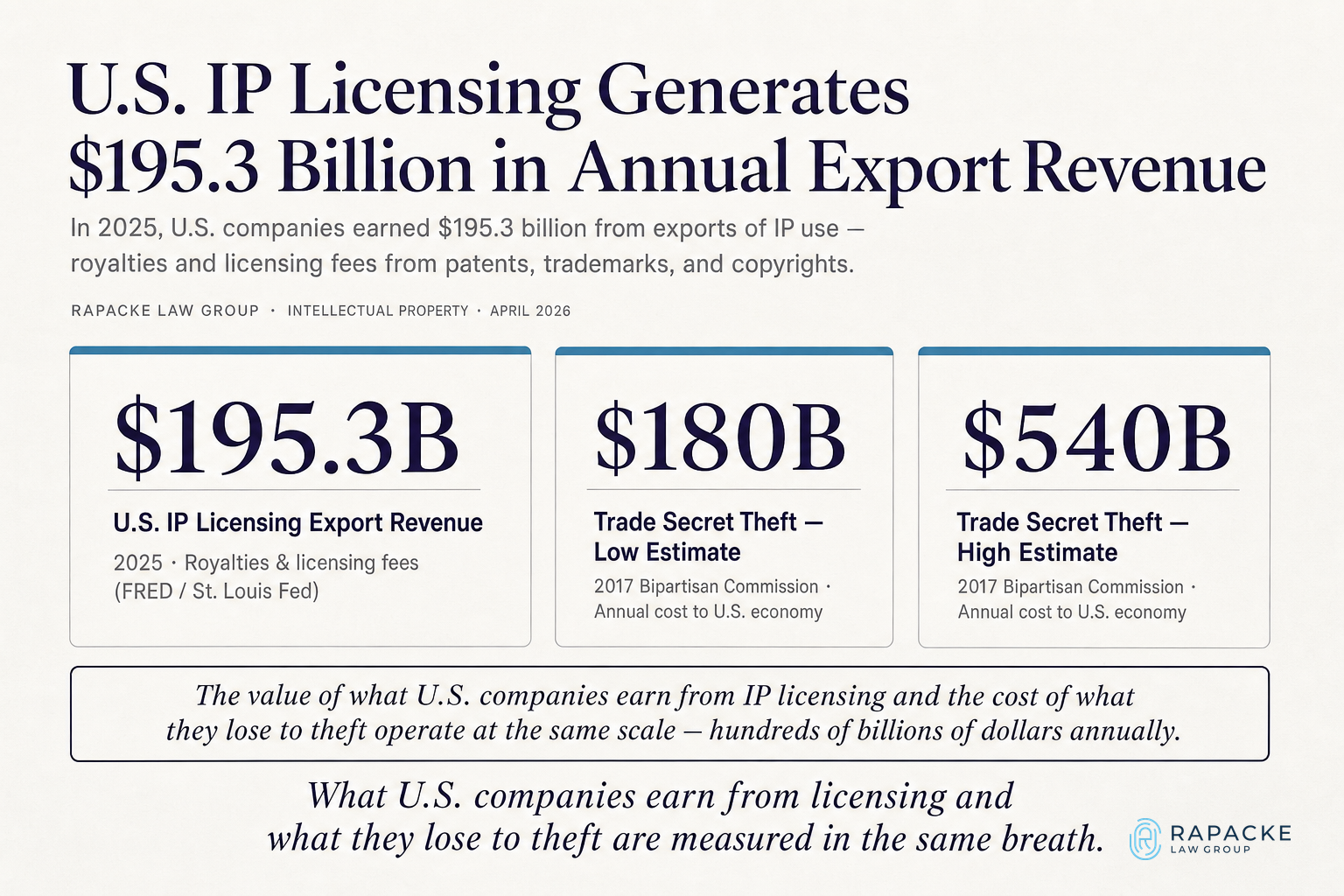 U.S. IP Licensing Generates $195.3 Billion in Annual Export Revenue — Source: FRED / Federal Reserve Bank of St. Louis, 2025; IEN.com / Bipartisan Commission Report, 2017
Key Components of a License Agreement
A well-drafted license agreement addresses the grant of rights, exclusivity, territory, term, royalty structure, quality controls (critical for trademarks), and termination. See our overview of IP licensing agreements and assignments. Actionable takeaway: work with an IP attorney to draft license terms before any deal, because verbal arrangements are rarely enforceable.
Using IP Licensing in a Startup Growth Strategy
Licensing can create recurring revenue, enable geographic expansion without operational overhead, and attract strategic partners through technology transfer arrangements. For tech startups, licensing patents or software is often faster than building new distribution channels. Actionable takeaway: map your licensable IP assets early and identify industry partners who could benefit from a licensing arrangement.
How to Build an IP Strategy That Protects Your Business at Every Stage
Effective IP protection is an ongoing strategy that tracks where your business is headed. Think in three stages. Pre-launch calls for clearance searches, provisional filings, and NDAs. Growth calls for federal registrations, portfolio management, and monitoring. Scale calls for licensing, international protection, and IP due diligence for fundraising or acquisition. The Patent Cooperation Treaty now covers 158 member countries through one international patent application.
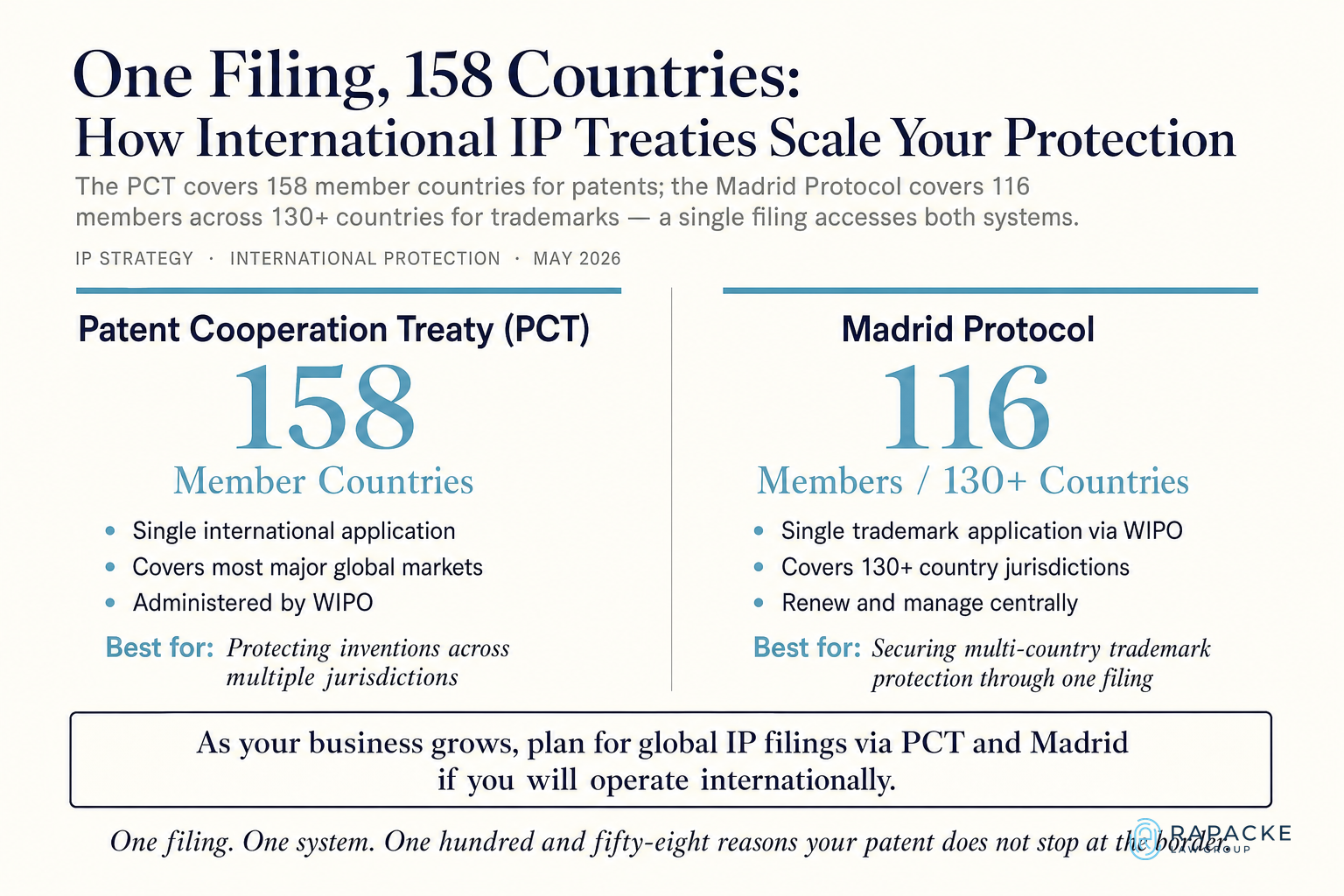 One Filing, 158 Countries: How International IP Treaties Scale Your Protection — Source: WIPO PCT System; WIPO Madrid System
Conducting a Prior Art Search and Freedom to Operate Analysis Before You Build
A prior art search identifies existing patents that could block your filing, covering both United States patent records and international databases. A freedom to operate analysis identifies whether your product could infringe existing patents. Both should happen before you sink real money into development, because late-stage IP disputes are far more expensive to unwind. AI-focused founders can go deeper with our guide to the importance of intellectual property for AI makers. Actionable takeaway: run a prior art search before your next product development sprint, not after.
International IP Protection for Businesses Expanding Beyond the United States
U.S. IP rights do not automatically extend abroad. International copyright law also varies by jurisdiction, so businesses selling globally should understand how their rights differ across borders. The Patent Cooperation Treaty provides a unified filing process across its 158 countries (WIPO), and the Madrid Protocol does the same for trademarks across more than 130 jurisdictions (WIPO). Actionable takeaway: if you plan to sell internationally, budget for PCT or Madrid Protocol filings from the start.
Frequently Asked Questions
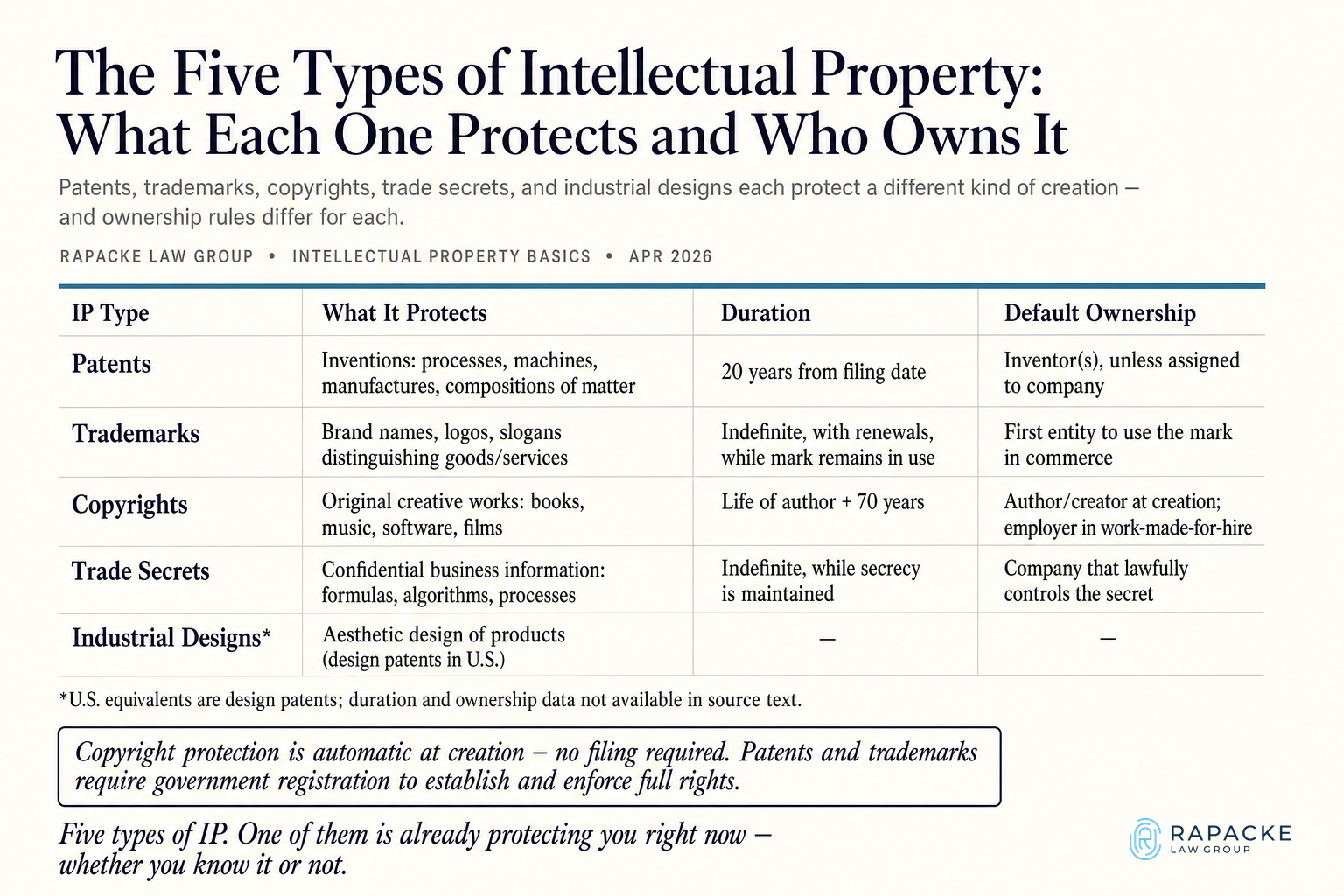 The Five Types of Intellectual Property: What Each One Protects and Who Owns It — Source: WIPO; USPTO; U.S. Copyright Office
How can you use intellectual property?
Understanding how to use intellectual property defensively and offensively is key: a patent or trademark lets you stop competitors from copying your product or brand, while licensing your IP generates royalty income or serves as proof of value when raising investment. See our guide to intellectual property for apps.
What are the 5 examples of intellectual property protection?
The four legally recognized U.S. categories are patents, trademarks, copyrights, and trade secrets. Industrial designs are sometimes cited as a fifth and are protected in the U.S. through design patents, which grant industrial design rights over a product's ornamental appearance.
What to do when someone uses your intellectual property?
Document the unauthorized use and consult an IP attorney. Intellectual property infringement of any kind should be addressed promptly to preserve your rights. A common first step is a cease and desist letter, if infringement continues, federal court action is available for patent, trademark, and copyright infringement, and trade secret claims can be pursued under the Defend Trade Secrets Act.
How do you own your IP?
Inventors are initially presumed to own patent rights, but ownership is often subject to pre-existing employment or assignment obligations to a company. Copyrights belong to the author unless created under work-for-hire. Trademarks belong to the first user in commerce, strengthened by registration. Trade secrets belong to whoever controls and protects the confidential information.
What is the difference between a patent and a trade secret?
A patent grants a 20-year exclusive right in exchange for public disclosure. A trade secret lasts indefinitely but requires you to actively maintain confidentiality, and offers no protection if a competitor independently develops the same innovation.
Start Building Your IP Strategy Before a Competitor Forces You To
Businesses that delay IP protection often discover the window has closed when a competitor files first or a brand dispute surfaces. You now understand the four types of intellectual property, when each applies, how licensing turns IP into revenue, and how to align protection with your business stage.
The bottom line: a weak IP position leaves your best ideas exposed to copycats, while a strong portfolio blocks imitators, attracts investors, and generates licensing revenue. Every month you wait is a month a competitor can file first.
The Rapacke Law Group makes that first move simple with a Free IP Strategy Call backed by the RLG Guarantee and a flat-fee model, so you know the cost before you commit. Depending on the service, that guarantee means a full refund if the USPTO denies your provisional patent application, and 100% back if a patentability search finds your invention is not novel.
Your next steps:
- Schedule a Free IP Strategy Call to map out which IP assets to protect first
- Run a prior art or trademark clearance search before your next launch
- File provisional patents and trademark applications to lock in your priority dates
Book the call and protect what you build.
To Your Success,
Andrew Rapacke Managing Partner, Registered Patent Attorney Rapacke Law Group
Connect on LinkedIn (Andrew Rapacke), X (@rapackelaw), and Instagram (@rapackelaw).
Andrew Rapacke Managing Partner, Registered Patent Attorney Rapacke Law Group