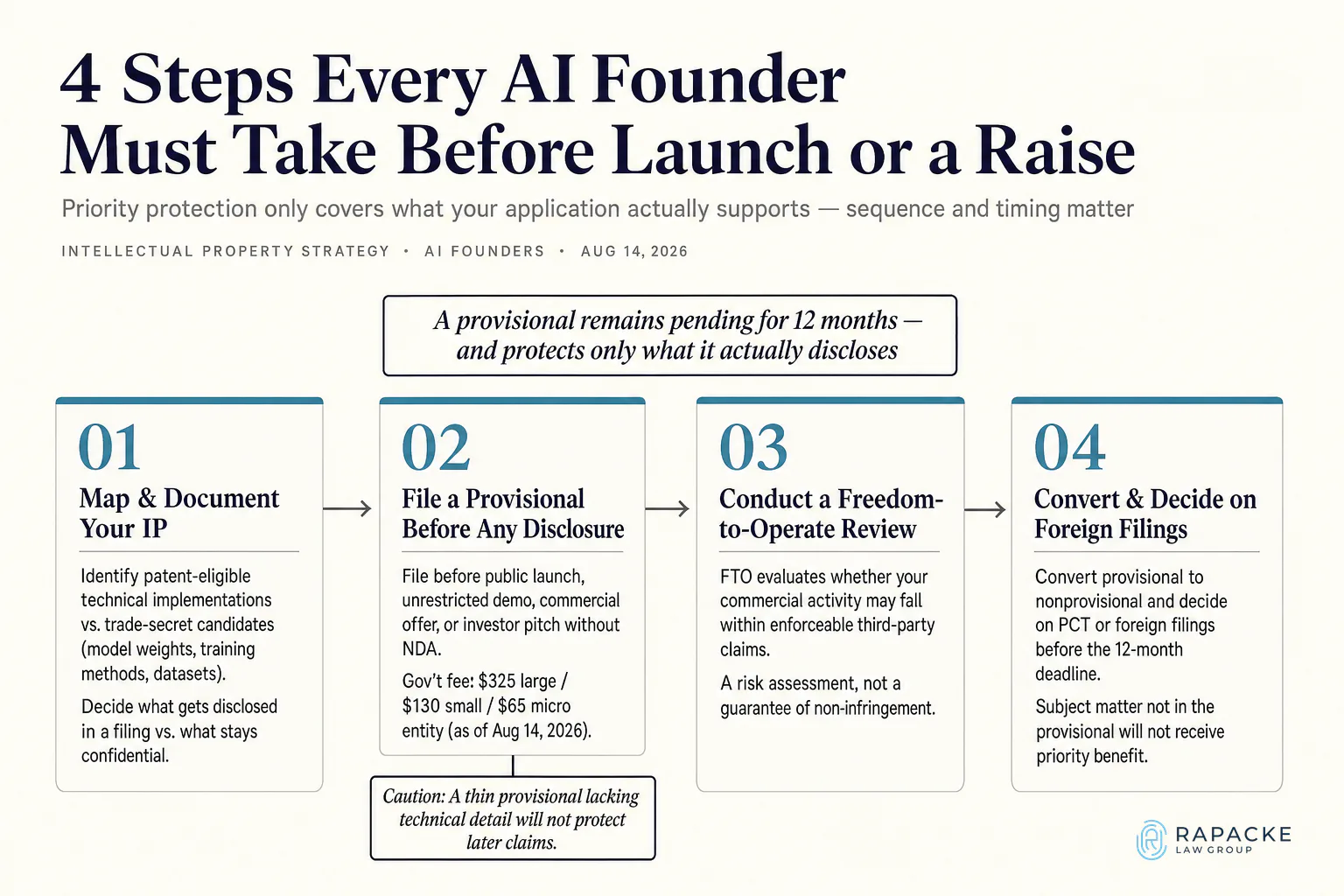


Key Takeaways
- AI patentability turns on 35 U.S.C. §101 and *Alice/Mayo*: claims must recite the technical mechanism, not the result.
- *Ex parte Desjardins* (September 26, 2025, precedential) and the USPTO's December 2025 memoranda require specifications to detail the technological problem and improvement in more than conclusory terms, with claims reciting the components or steps that provide that improvement.
- Patents, trade secrets, and copyright protect different layers; model weights and training data belong in trade secrets.
- File a detailed provisional before any public disclosure; the 12-month window is non-extendable.
- Vet counsel on who drafts, machine learning prosecution history, and flat-fee scope.
*Written by Andrew Rapacke, Managing Partner, Registered Patent Attorney.* Andrew Rapacke is a registered patent attorney and the Managing Partner of The Rapacke Law Group, a full-service intellectual property law firm. He helps individuals and corporations across industries with the protection, prosecution, licensing, and enforcement of their intellectual property, with deep experience in patent, trademark, and copyright matters spanning software, AI and machine learning, blockchain, medical devices, and autonomous vehicle technology. A graduate of the United States Naval Academy, Andrew served as a Naval Engineering Officer before pursuing law and remains active in the startup and inventor communities throughout Florida.
Annual AI patent applications at the USPTO grew from 30,000 in 2002 to more than 60,000 in 2018, with AI's share of all patent applications rising from about 9% to nearly 16% over that period, according to the USPTO's Inventing AI report. Your competitors are filing. Hiring an artificial intelligence law firm is not the same as hiring any patent firm, because "it uses AI" has never made anything patentable. The legal landscape for ai technologies shifts with every USPTO guidance update. Eligibility turns on how claims are written and how the specification documents a technical improvement. Here is how to evaluate counsel before your next launch or raise.
Why Patentability of AI Is Genuinely Hard and a General Practitioner Will Cost You
AI patents live or die on §101 subject matter eligibility, not on technical sophistication. Counsel who rarely prosecute software claims draft around outputs, not implementation, and that reads as an abstract idea. The federal trade commission and other regulators are also scrutinizing ai technologies for fairness and transparency, adding regulatory compliance pressure to legal ai work. The USPTO's 2019 guidance cut first-office-action §101 rejections in Alice-affected technologies 25% and examination uncertainty 44% (2024 guidance update). AI and patent law is now its own discipline.
What the Alice/Mayo Framework Actually Means for Your AI Product
Examiners ask whether a claim recites a judicial exception, then whether it integrates that into a practical application, such as improved computer functionality. Understanding the legal implications of each step is essential before drafting claims. If counsel can't explain how your claims clear both steps, keep interviewing.
Why "It Uses AI" Is Not Enough to Get a Patent
Prediction or classification claims alone carry substantial eligibility risk, and ai use of generic architectures compounds that risk further. In USPTO Example 47, generic backpropagation training with anomaly detection was ineligible. The same network blocking malicious packets in real time was eligible. Technical implementation is the patentable element, machine learning algorithms still need novelty, nonobviousness, and written description.
What Can Actually Be Protected in an AI Product
Three regimes cover an AI stack, patents for eligible technical implementations, trade secrets for confidential model assets, copyright for human-written code expression only. Choosing correctly across ai products requires mapping each layer to the right regime. Misallocation is the most common intellectual property mistake AI developers make.
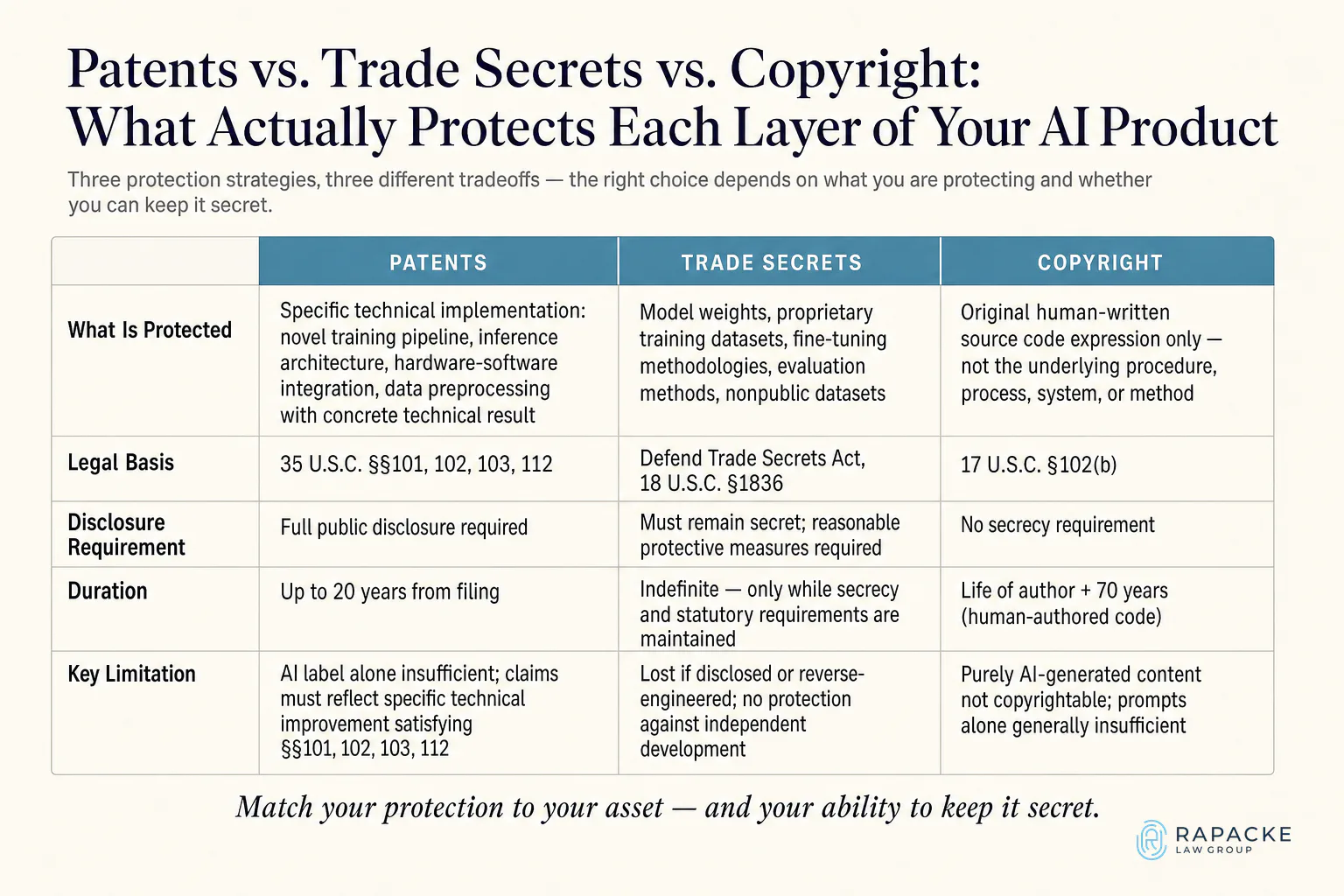
Which Parts of Your AI Stack Are Patent-Eligible
Patent-eligible candidates include novel training pipelines, inference optimization, and hardware-software integration across a wide range of ai technologies including digital health and ai deployment contexts. The USPTO's Artificial Intelligence Patent Dataset found AI had spread into more than 42% of all patent technology subclasses by 2018.
When Trade Secrets Beat Patents for AI Protection
Model weights, training data, and fine-tuning methodology — including those embedded in large language models — often stay stronger as trade secrets, because a patent publishes them. 18 U.S.C. §1839 protects information only while it derives value from secrecy and reasonable measures guard it, central to IP planning for AI makers.
Why Copyright Has Narrow Value for AI Algorithms
17 U.S.C. §102(b) excludes any procedure, process, or method of operation, so your algorithm's functional logic is unprotected even when the code text is. These legal issues affect how founders treat digital assets in their IP stack. Purely AI-generated material is also uncopyrightable (Thaler v. Perlmutter, 130 F.4th 1039 (D.C. Cir. 2025)).
Why Claim Drafting Determines Whether Your Patent Holds or Collapses
Broad claims fail §101, narrow ones get designed around. In Ex parte Desjardins (September 26, 2025, precedential), an Appeals Review Panel vacated a §101 rejection. The USPTO's Desjardins memorandum credits a specification documenting how the training process solved catastrophic forgetting.
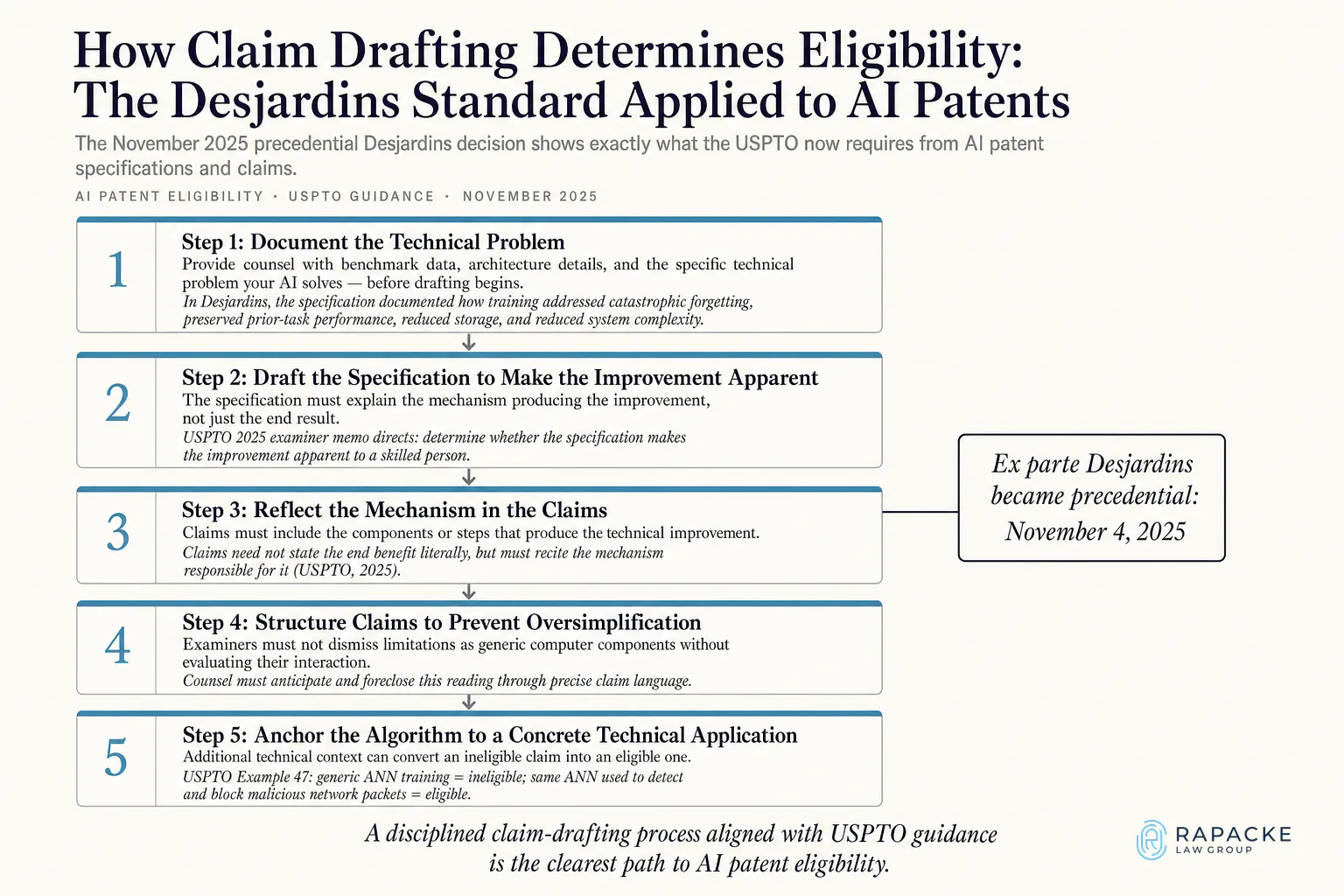
How Broad Claims Fail and How Narrow Claims Get Designed Around
Result language fails, mechanism wins. Recite the architecture and ordered steps that cut latency, as our software patents checklist details.
How Dependent Claims Build a Defensive Moat
One independent claim is one point of failure, layered dependents make software patents are enforceable. Current USPTO fees: large entities pay $600 per independent claim over three, $200 per claim over 20.
The Four Steps AI Founders Should Take Before Launch or a Raise
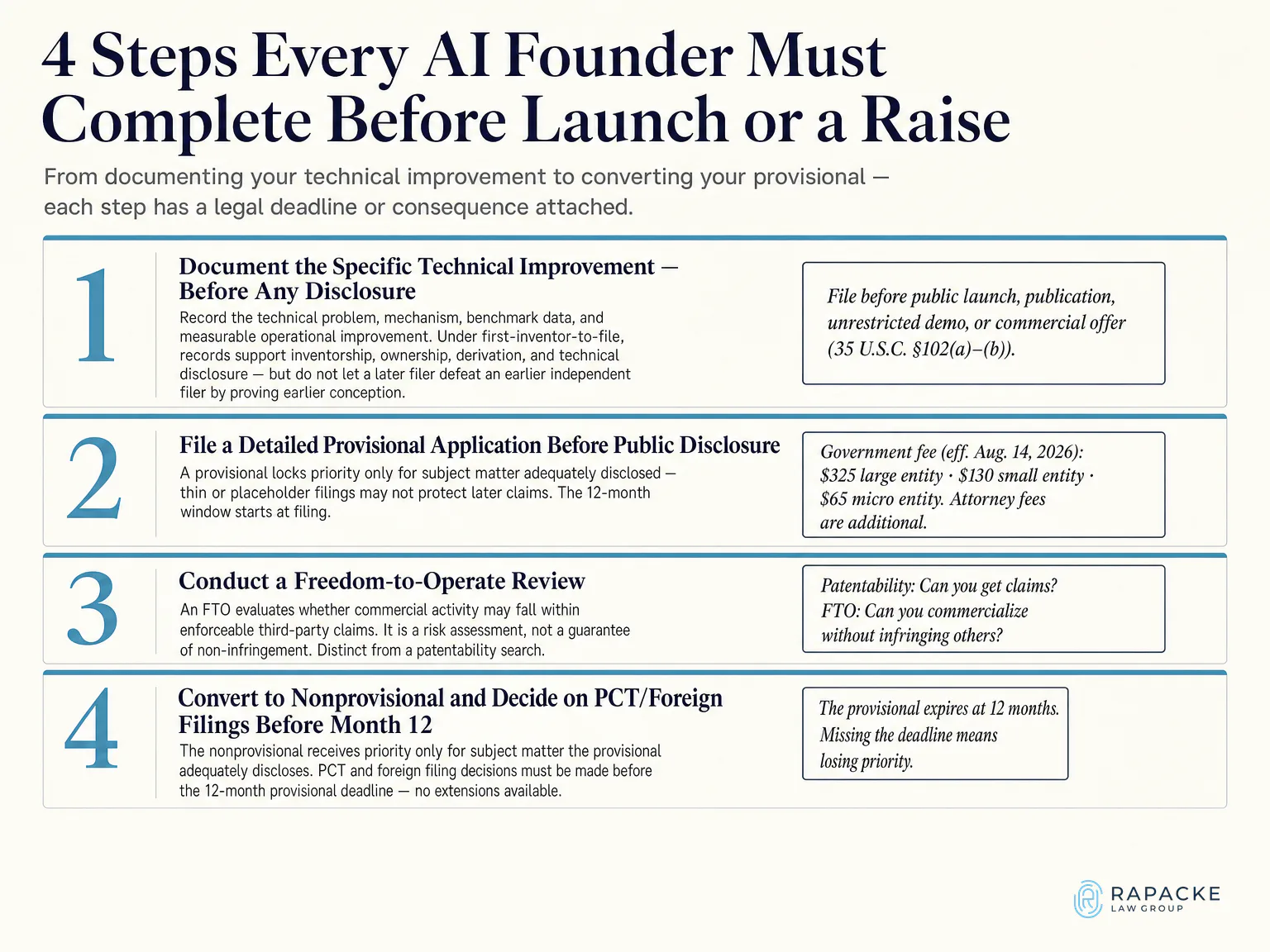
Step 1. File a Detailed Provisional Application
Provisional applications pend 12 non-extendable months, covering only disclosed subject matter (35 U.S.C. §§111(b), 119(e)). Fees: $325 large, $130 small, $65 micro. File before public disclosure.
Step 2. Run a Freedom-to-Operate Review
Freedom-to-operate tests infringement risk, not patentability. Run patent office search tools early, before the most valuable AI patents box you in. Legal research at this stage also surfaces regulatory compliance obligations tied to your ai technology.
Step 3. Document the Specific Technical Improvement
Architecture diagrams, training logs, and benchmarks support a Desjardins-grade specification and inventorship. Thorough documentation of ai models used during ai development strengthens both the specification and trade-secret records.
Step 4. Decide on the Nonprovisional and Foreign Filings
Convert before the 12-month deadline, weigh a PCT filing. Miss it and the provisional is abandoned, no revival. Human resources and legal teams managing portfolios across multiple founders should calendar every deadline at filing.
What to Look for in an Artificial Intelligence Law Firm Before You Hire
Judge firms on drafting capability, not marketing copy. Ask who personally drafts your application, how many machine learning applications that person has prosecuted, and how §101, §103, and §112 issues will be handled. Legal teams at specialist firms bring focused ai technology expertise that generalists cannot match.
The Questions That Separate AI Patent Specialists from Generalists
Verify registration in the USPTO's official register rather than trusting a biography. In the legal profession, credentials are verifiable facts, not marketing claims. Under the USPTO's enrollment bulletin, practitioners qualify through Category A degrees, Category B coursework, or Category C other acceptable scientific and technical training, with Category D limited to design patent practice, so ask what the technical background actually is. Our guide to choosing an AI patent attorney lists the rest.
Why Flat Fees and Transparent Pricing Matter for Founders
Hourly prosecution creates unpredictable burn. Transparent pricing is one of the legal risks founders accept when choosing hourly billing. Get the flat fee in writing with claim counts, drawings, inventor calls, office action responses, and filing fees defined.
How Rapacke Law Group Approaches AI Patent Work Differently
I am a registered patent attorney focused on software and AI. Across the legal industry, few firms combine flat-fee legal services with deep ai technologies prosecution experience. Engagements are flat-fee, scoped in writing before drafting — which means you know the full cost before work begins, with no hourly billing surprises eating into your runway. For founders managing tight budgets and investor scrutiny, predictable legal spend is itself a competitive advantage.
The RLG Guarantee is service-specific: 100% refund if a patentability search shows your invention is not novel, full refund if the USPTO denies a provisional filing. No firm can promise issuance or §101 survival. The legal work involved in prosecuting ai models through the USPTO requires ongoing judgment, not guarantees.
Read AI Patent Mastery and The Must-Have SaaS Patent Guide 2.0 before your call.
Frequently Asked Questions About AI Patent Attorneys
What does a patent attorney for AI inventions do?
Translates your innovation into a specification and claims addressing eligibility, novelty, nonobviousness, and disclosure, structures claims under Alice/Mayo, prosecutes through the USPTO, and flags trade-secret material. Legal ai tools can assist with legal research and legal workflows, but the attorney signs every filing.
How much does an AI lawyer cost?
Fixed government fees start at $325 for a large-entity provisional and $65 for a micro entity, attorney fees vary with complexity and scope.
Is AI taking over law firms?
No. The Bureau of Labor Statistics projects lawyer employment to grow 5% from 2025 to 2035 with about 28,700 annual openings, firms using AI agents for patent work still sign filings. Legal tech and agentic ai tools support legal workflows but do not replace attorney judgment.
Can I patent a generative AI feature?
Sometimes. Claiming a model by its output is high-risk, a specific training method or architecture with documented technical benefits can qualify. The ai revolution in generative ai has made these distinctions more important than ever for founders navigating ai deployment decisions.
Your Next Steps to AI Patent Success
AI patent applications at the USPTO more than doubled between 2002 and 2018, and vague claims earn a certificate with no enforceable scope. A strong patent names the mechanism, layers dependent claims around it, and explains what problem your architecture solved. The legal landscape surrounding ai technologies continues to evolve, making early ai adoption of rigorous documentation practices essential.
The bottom line: Weak patents claim a result — "the system predicts X" — and collapse under §101 or get designed around in months. Strong patents recite the specific architecture, ordered steps, and technical improvement that produce the result, then layer dependent claims around every implementation variant. That combination is what creates enforceable scope and real competitive value.
Every week you ship without a filed priority date, the risks compound: investors doing IP due diligence find the gap first and may walk away from the deal, a competitor filing even one day earlier can establish prior art that bars your application under 35 U.S.C. §102, and any public disclosure you make before filing permanently closes the door on foreign patent rights. Sectors such as digital health and technology transactions face compounded exposure because ai adoption moves faster than legal frameworks. Delay is not a neutral choice, but is a decision to hand those advantages to someone else.
- Schedule a Free IP Strategy Call
- Start a dated invention record: architecture, training process, benchmarks
- Request a flat-fee quote for provisional and nonprovisional filings
- Decide which components stay trade secrets
To Your Success,