

What Are the 4 Types of Intellectual Property? Empower Your Ideas With Legal Protection
While it typically does not get the same level of attention as marketing or the designing of a product, intellectual property is central to most businesses. The…
[ARTICLE]Intellectual Property
*Written by Andrew Rapacke, Managing Partner, Registered Patent Attorney.* Andrew Rapacke is a registered patent attorney and the Managing Partner of The Rapacke Law Group, a full-service intellectual property law firm. He helps individuals and corporations across industries with the protection, prosecution, licensing, and enforcement of their intellectual property, with deep experience in patent, trademark, and copyright matters spanning software, AI and machine learning, blockchain, medical devices, and autonomous vehicle technology. A graduate of the United States Naval Academy, Andrew served as a Naval Engineering Officer before pursuing law and remains active in the startup and inventor communities throughout Florida.
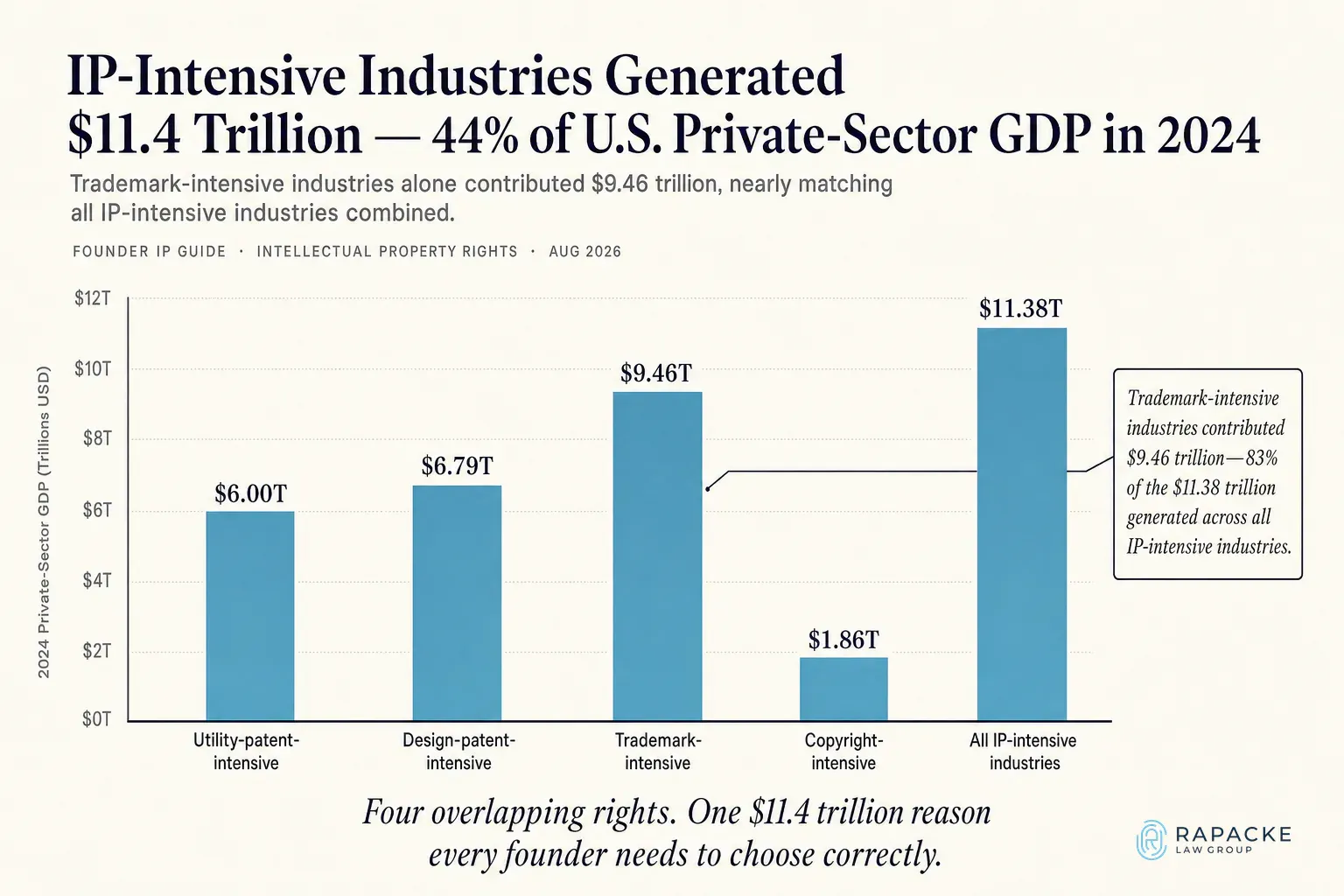
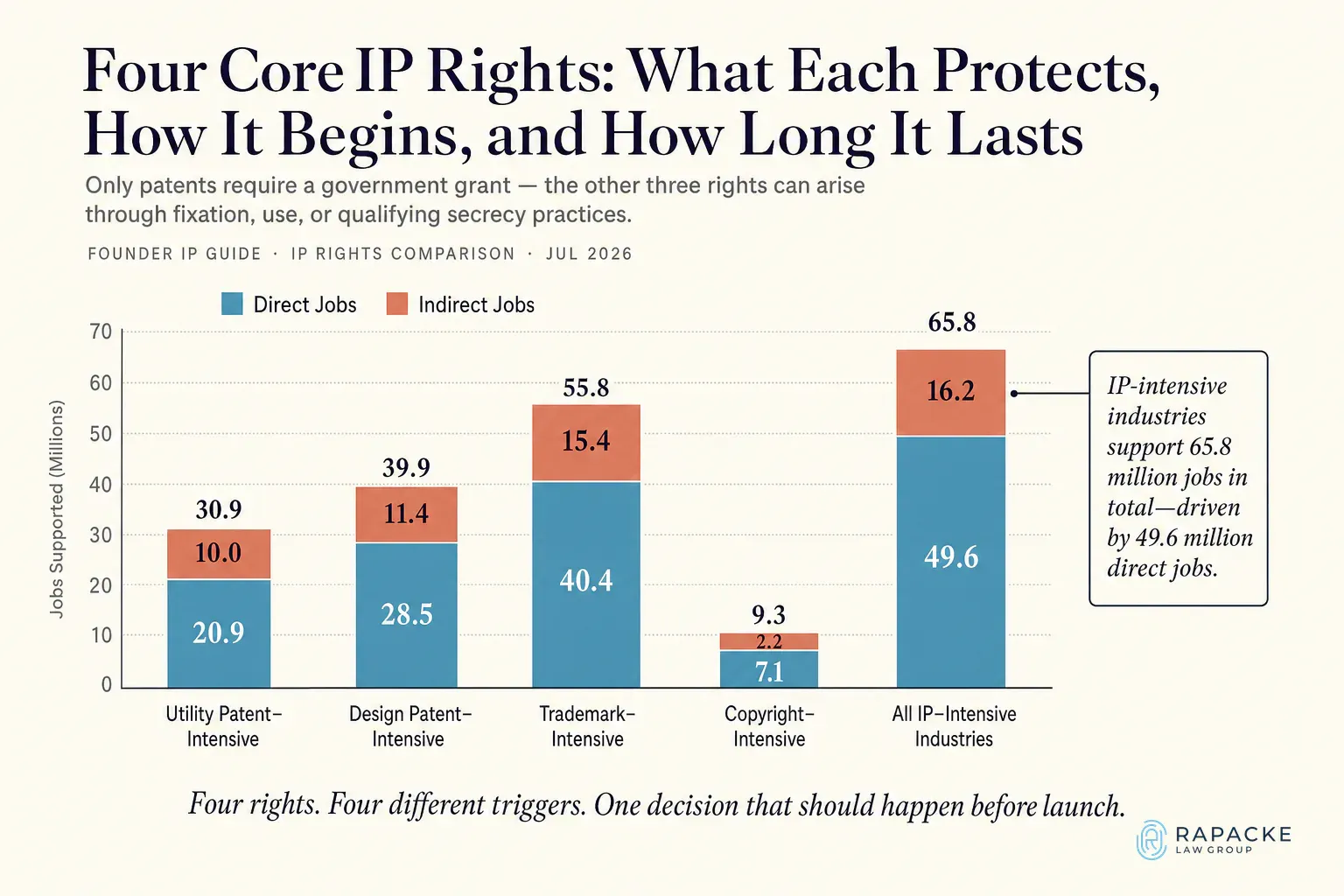
IP-intensive industries generated $11.4 trillion in 2024, equal to 44% of U.S. private-sector GDP, according to the USPTO's economic report. Almost all of that value sits in assets you cannot physically hold, source code, brand names, algorithms, and product designs. If you are asking what are the intellectual property rights that actually protect those assets, the answer comes down to four categories, each with its own filing requirements, timelines, and costs. This article defines each one in plain English, shows which ones apply to software, brand identity, and proprietary methods, and helps you decide what to file before your next launch or funding round.
Intellectual property rights are legal protections that let an owner stop others from copying, using, or selling a specific intangible creation. The USPTO recognizes four basic categories in the United States, patents, trademarks, copyrights, and trade secrets, each mapping to a different role in your business.
Patents and federal trademarks fall under federal law, copyrights under the Copyright Act and copyright law, and trade secrets under state statutes and the federal Defend Trade Secrets Act of 2016. Internationally, the TRIPS Agreement has set minimum standards since 1995, and the World Intellectual Property Organization administers the global treaty framework.
Physical property protects itself, a competitor must physically take your server rack. Code and brand names can be duplicated at essentially zero cost, which is the entire purpose of intellectual property law. Trademark-intensive industries alone accounted for roughly $9.5 trillion, or 36% of U.S. private-sector GDP, in 2024, the USPTO cautions that the individual IP categories overlap and do not sum to the overall IP-intensive total.
Two of the four rights begin without paperwork. Copyright attaches on creation, and trademark rights can arise from use in commerce. Patents differ, no rights of a patent exist until the USPTO grants the application. Without the right filings and written ownership agreements, key product features stay lawful for someone else to copy.
A utility patent excludes others from making, using, selling, or importing the claimed invention, generally for 20 years from the nonprovisional filing date, subject to maintenance fees, a right to say no, not a license to operate.
Software can qualify, but eligibility turns on claim drafting under 35 U.S.C. §101 and the Alice/Mayo framework, so have counsel review your architecture before filing.
Utility patents cover new inventions and useful processes, machines, articles of manufacture, and compositions of matter, plus improvements to them (how something works) while design patents cover only ornamental appearance. SaaS and platform companies need utility patents for patent protection under patent law, though a design patent can protect a distinctive interface element.
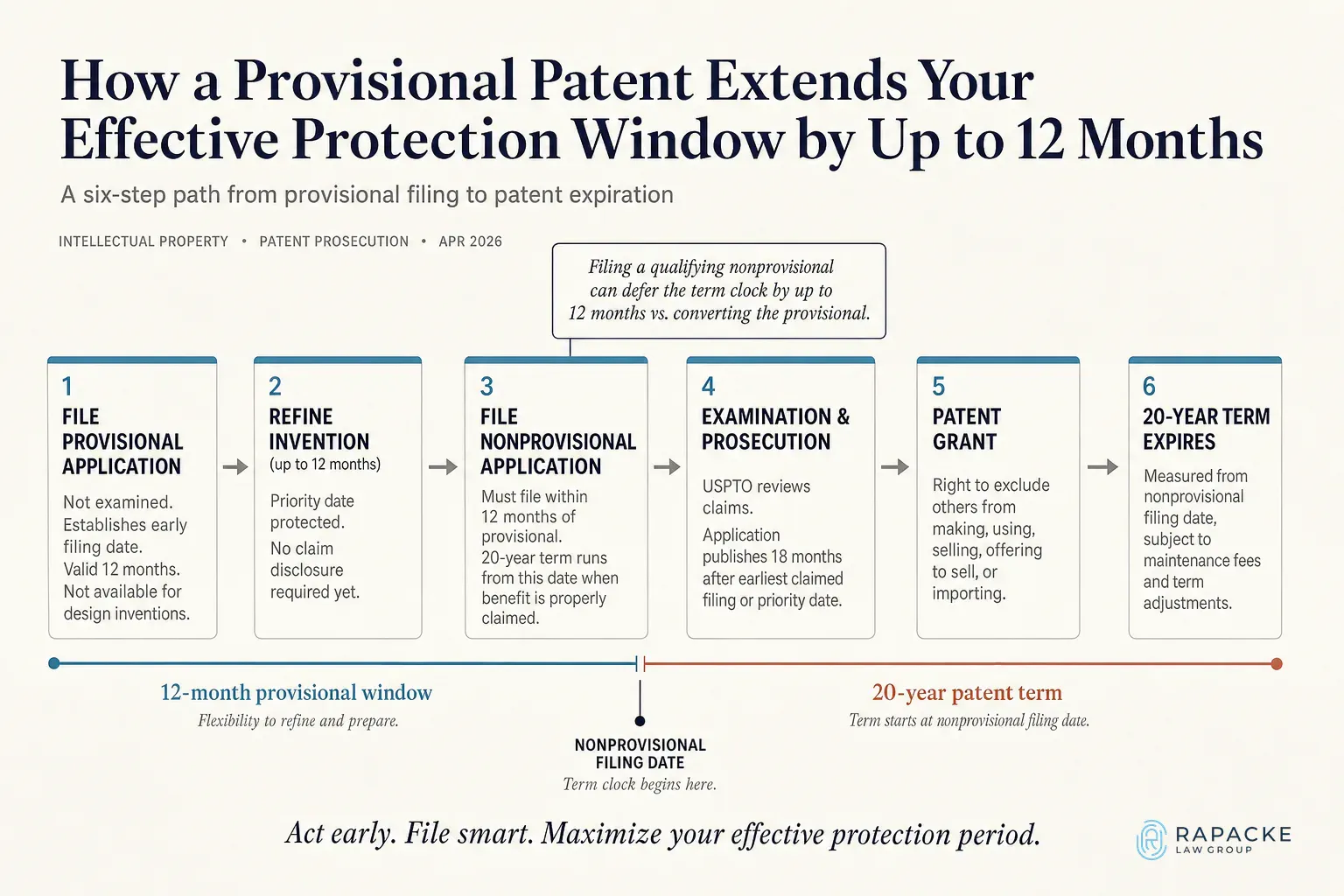
A provisional application is never examined, stays pending 12 months, and locks in an early effective filing date, pushing the start of your 20-year term back by up to 12 months. Examination itself typically takes two to three years, longer for software-heavy technology areas such as complex computer software, so working with an intellectual property lawyer early in the patent application process helps avoid costly delays. Our provisional filings carry the RLG Guarantee, a full refund if the USPTO denies the provisional application, at a fixed fee quoted before we start.
Trademark rights cover names, logos, and slogans identifying a product's source. Protection lasts indefinitely with continued use and maintenance filings between years five and six, again between years nine and ten, then every ten years, miss one and registration is cancelled or expires. Base federal fee: $350 per class.
Unregistered use creates common-law rights only where the mark is actually used, federal registration gives presumptive nationwide rights, a USPTO public record, and use of ®, providing patent owners and brand holders with technical storage of registration records in the USPTO database. Top brands, including Google's portfolio, layer marks with patents.
Search the USPTO database before committing to a name, filed marks put later applicants on notice. Taking legal action against infringers is far easier with a registered trademark. Trademark work here comes with the RLG Guarantee, your trademark approved, or you get your money back, with a 100% refund if rejected.
The standard is likelihood of confusion, not identical spelling. Owners police their own marks. Recording a Principal Register mark with Customs enables seizure of infringing imports.
Copyright attaches the moment an original work is fixed in a tangible medium, including code, computer programs, documentation, marketing copy, and UI graphics, granting copyright protection and exclusive reproduction, distribution, and derivative rights for the author's life plus 70 years, or, for works made for hire and anonymous or pseudonymous works, the shorter of 95 years from first publication or 120 years from creation.
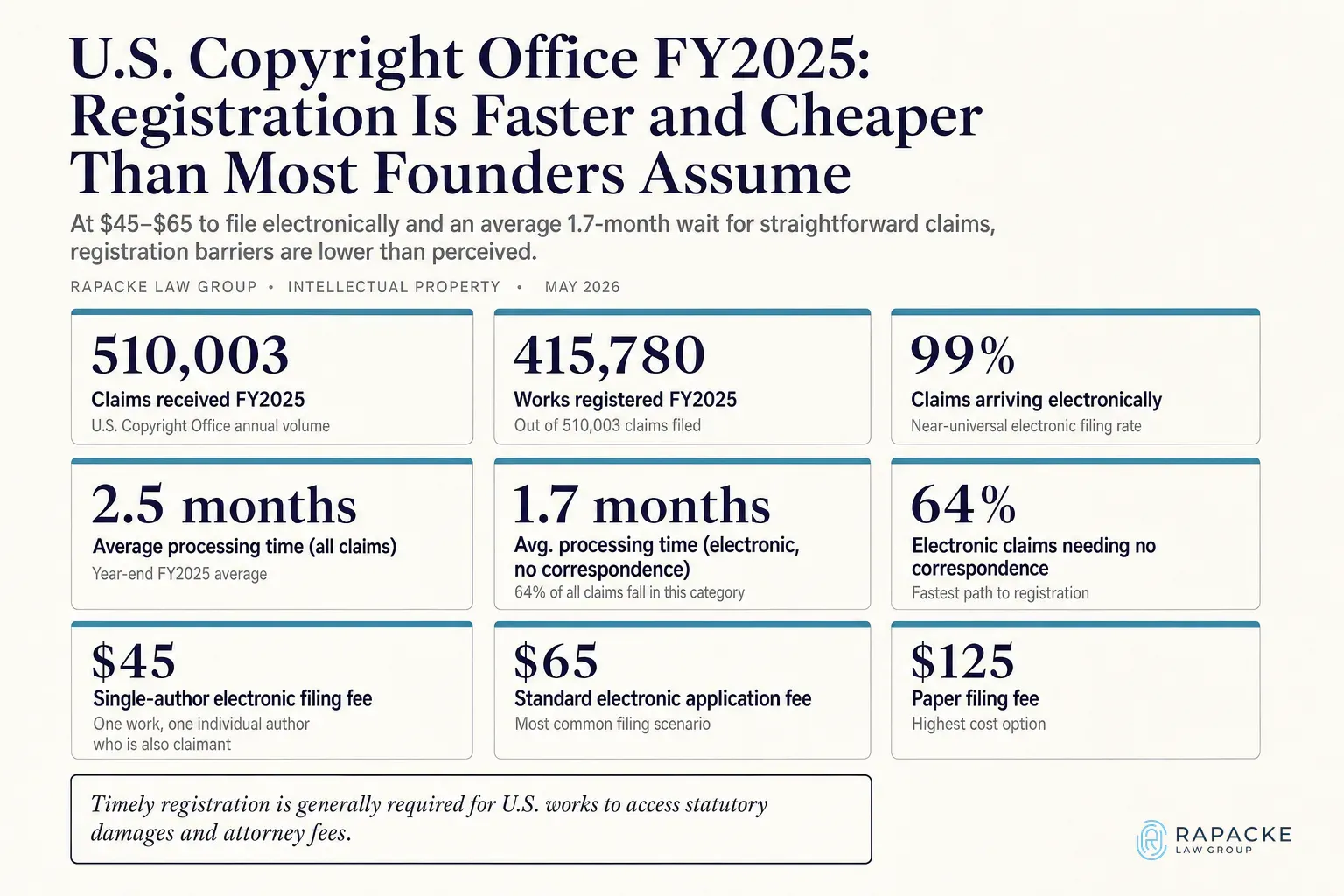
For U.S. works, registration precedes suit, and 17 U.S.C. §412 bars statutory damages and attorney fees unless you register before infringement or within three months of publication. The [U.S.
Per Circular 61, copyright covers code expression, not algorithms, functions, logic, or system design. It stops literal copying, not a competitor rebuilding the same functionality, so software intellectual property rights also need patents and trade secrets.
Trade secrets cover confidential information valued for its secrecy and protected by reasonable measures, ranking algorithms, model weights, customer lists. No registration exists, protection can last indefinitely. The Defend Trade Secrets Act of 2016 allows federal trade secret misappropriation suits in federal court.
NDAs are one secrecy measure alongside access restrictions, markings, and training, and intellectual property laws require courts to weigh the whole program. Require IP assignment before anyone sees proprietary technical information.
WIPO favors secrecy when information can stay secret beyond 20 years and resists reverse engineering. Server-side processes qualify, inspectable products rarely do, see proprietary versus patented.
Most companies need several rights at once, match each asset to the right covering its risk, and consider technology transfer agreements to monetize IP beyond your core market. Consulting intellectual property lawyers early ensures the right legal mechanisms are in place.
| Right | Protects | Begins | Lasts |
|---|---|---|---|
| Utility patent | Functionality, processes | USPTO grant | 20 years from filing |
| Trademark | Names, logos, slogans | Use in commerce | Indefinite with renewals |
| Copyright | Code, content, UI, docs | On fixation | Life plus 70 years; for works made for hire and anonymous or pseudonymous works, the shorter of 95 years from publication or 120 years from creation |
| Trade secret | Confidential information | Reasonable secrecy measures | While secret is kept |
A Journal of Finance study found first-time applicants with granted patents had 55% higher employment growth and 80% higher sales growth five years later, largely through better access to venture capital and bank financing. Filing does not prove validity or ownership, clear ownership, patentability, and trademarks before fundraising; patent protection across all eligible assets gives investors confidence in your defensible IP position.
Patents (inventions), trademarks (commercial source), copyrights (expression). trade secrets (confidential information). Patents and trademarks are also considered industrial property under international treaty frameworks.
General ideas, procedures, methods, principles, discoveries, and bare factual listings are not protected by copyright, per U.S. Copyright Office Circular 33, though expressive descriptions of them may be. Only the specific expression can be copyrighted.
Not all. Copyright arises on fixation, trade secret status depends on facts, not filings. Patents need a grant, federal trademarks need USPTO registration for nationwide scope.
Utility patents: 20 years from the nonprovisional filing date, trademarks, renewable indefinitely every ten years, copyright, the author's life plus 70 years (or, for works made for hire and anonymous or pseudonymous works, the shorter of 95 years from first publication or 120 years from creation), trade secrets, as long as secrecy holds.
Not automatically. Employee copyrights within the scope of employment may be work made for hire, but patents vest in named inventors, meaning the patent holder must obtain written assignment, and contractor work stays with the contractor absent written assignment.
Knowing what are the intellectual property rights only helps once each asset is matched to a right and an owner, patents on eligible functionality, trademarks on your name, copyrights in your code, documented secrecy measures, and the application process completed before a competitor files first. Trade secrets require the same structured approach to remain enforceable.
Every day you delay filing is a day a competitor can file first, a contractor can walk out with your core code, or an investor can pass because your cap table shows no defensible IP, and intellectual property infringement becomes harder to address without early filings in place. Seeking legal advice from an intellectual property lawyer at the outset is the sole purpose of our free strategy call. The cost of acting late, lost priority dates, unassigned inventions, and unregistered marks, almost always exceeds the cost of acting now, and the legal consequences of delay compound quickly.
Wait, and a competitor files first or a contractor leaves holding your core code:
The bottom line: a weak patent strategy leaves your most valuable assets exposed. Competitors can copy your core functionality, patent owners lose the leverage patents provide in licensing and litigation, and investors see nothing defensible. A strong patent strategy, by contrast, turns your inventions into enforceable rights that block patent infringement, attract venture capital, and create durable competitive moats. Beyond patents, strong intellectual property protection across trademarks, copyrights, and trade secrets, backed by legal support from qualified counsel, turns your code, brand, and methods into defensible, fundable assets. Fixed fees, backed by the RLG Guarantee: 100% refund if a patentability search finds your patented invention is not novel, a full refund for patentability issues on a provisional, and your trademark approved or your money back.
To Your Success,
Andrew Rapacke Managing Partner, Registered Patent Attorney
Andrew Rapacke Managing Partner, Registered Patent Attorney Rapacke Law Group
[RLG]Free strategy call

Talk it through with a registered patent attorney.
[01]Keep reading
While it typically does not get the same level of attention as marketing or the designing of a product, intellectual property is central to most businesses. The…

Learn how to protect software intellectual property with patents, copyrights, trade secrets, and trademarks. Book a free IP strategy call to start today.
Copyright or trademark? Compare what each protects, real 2026 costs, USPTO timelines, and when you need both. Book a free IP strategy call to file the right one.
The #1 top reviewed IP law firm.* Talk to a registered patent attorney, free.
*#1 top reviewed means the most public client reviews on Google, Trustpilot and Avvo of any US patent or trademark firm.