

Key Takeaways
- File a provisional patent application before any pitch. At just $60 for micro-entities under current USPTO fee schedules, it locks in your priority date and lets you legally mark your idea "patent pending" during every negotiation.
- Licensing almost always beats an outright sale for first-time inventors. Royalties of 3% to 6% of net sales compound over a product's lifetime, while a lump sum trades away all future upside.
- A company that refuses to sign an NDA and wants technical details before any agreement is a red flag, not a fast track.
- Audit rights and a reversion clause are the two most commonly omitted and most valuable protections in any licensing agreement.
- Invention submission services are not a substitute for a registered patent attorney. The FTC has taken enforcement action against several for charging thousands upfront with near-zero licensing results.
*Written by Andrew Rapacke, Managing Partner, Registered Patent Attorney.*
Procter & Gamble receives roughly 300 unsolicited product idea pitches per month through its Connect+Develop portal, according to The Street, and most of those inventors walk away with nothing, not because their ideas were bad, but because they shared protected details before establishing any legal claim. Understanding how do you sell ideas to companies starts with a counterintuitive rule, the pitch comes last, not first. The moment you disclose an unprotected invention, you may create prior art, start a filing clock, or hand a well-resourced company enough detail to develop the concept independently.
Why Most Inventors Give Away Their Best Ideas for Free (And How Do You Sell Ideas to Companies the Right Way)
The most common way inventors lose their intellectual property is not through obvious theft, and this applies equally to new business ideas at the concept stage as it does to fully developed inventions. It happens through a simple misunderstanding, they believe sharing an idea is safe until someone pays for it. In reality, pitching an unprotected invention can create prior art, trigger a 12-month filing deadline under U.S. patent law, or give a company enough detail to build independently without any legal obligation to compensate you.
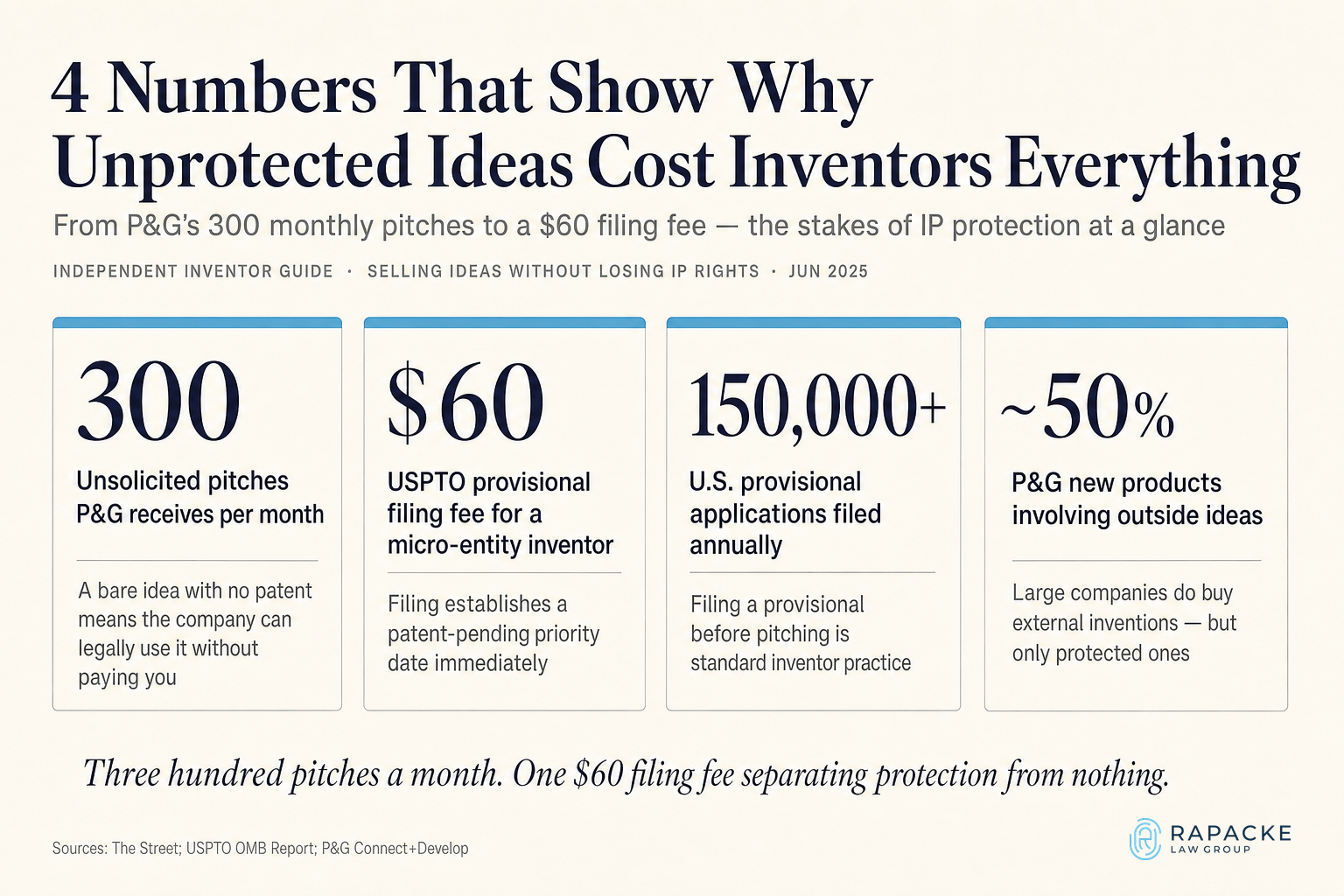
Over 150,000 provisional patent applications are filed each year in the United States, according to USPTO filing data, reflecting how seriously experienced inventors treat early protection. Yet many first-timers skip this step entirely when bringing their invention ideas to market, assuming a handshake or a verbal promise is enough. It is not. A bare idea with no patent filing and no NDA provides no legal basis for enforcing your rights, regardless of who thought of it first. If you are serious about protecting new ideas before they become someone else's product, the provisional application is your first move, not your last.
For a deeper look at intellectual property rights in business and what legal protections apply at each stage, the founder's playbook covers the full spectrum from trade secrets to patent portfolios.
What Selling an Idea Actually Means and Which Path Fits Your Goal
Outright Sale vs. Licensing
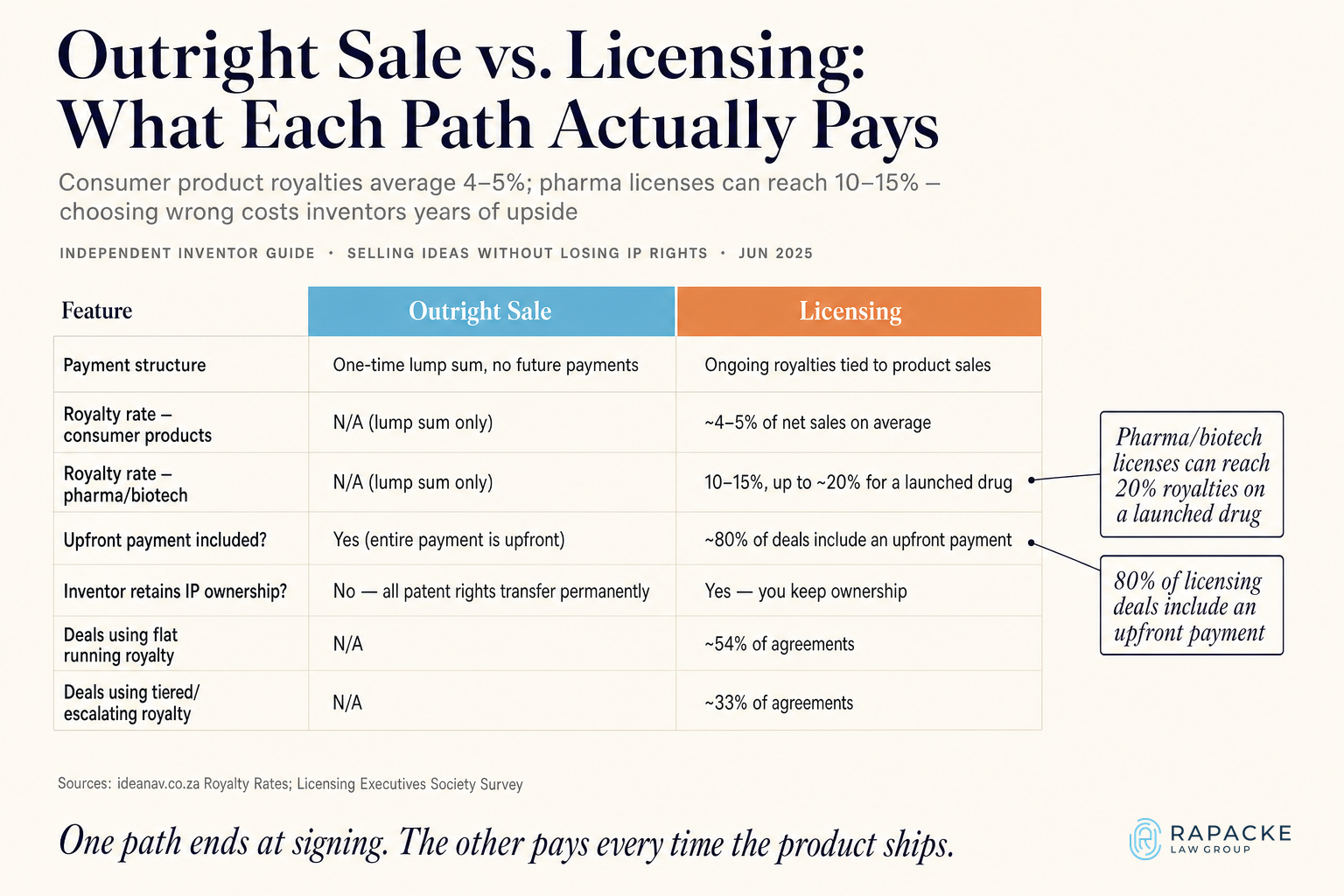
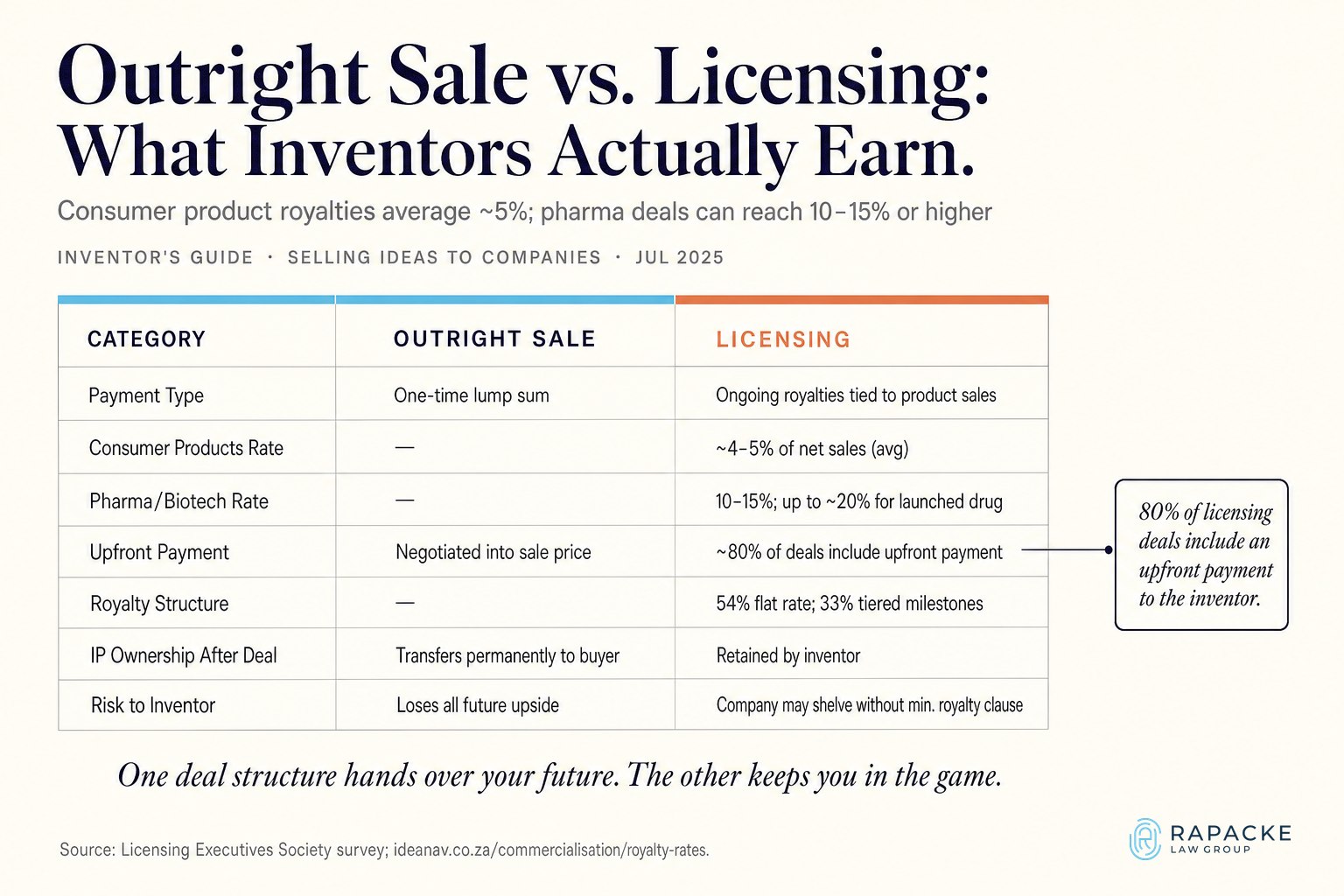
An outright assignment transfers all patent rights permanently to a buyer in exchange for a lump sum. Licensing keeps ownership with you and generates ongoing royalties tied to product sales. Consumer product inventions typically yield royalty rates of 3% to 6% of net sales, while pharmaceutical licenses can reach 10% to 15% or higher, according to benchmarks from the Licensing Executives Society. For most first-time inventors without the capital to walk away from future upside, licensing is the financially stronger choice. The right structure depends on your risk tolerance, how involved you want to remain, and your confidence in the invention's long-term market value.
If you want to understand the full economics of selling patent rights outright, see the comprehensive guide to how to sell your patent and what deal structures actually maximize earnings.
When Selling Without a Patent Is Possible
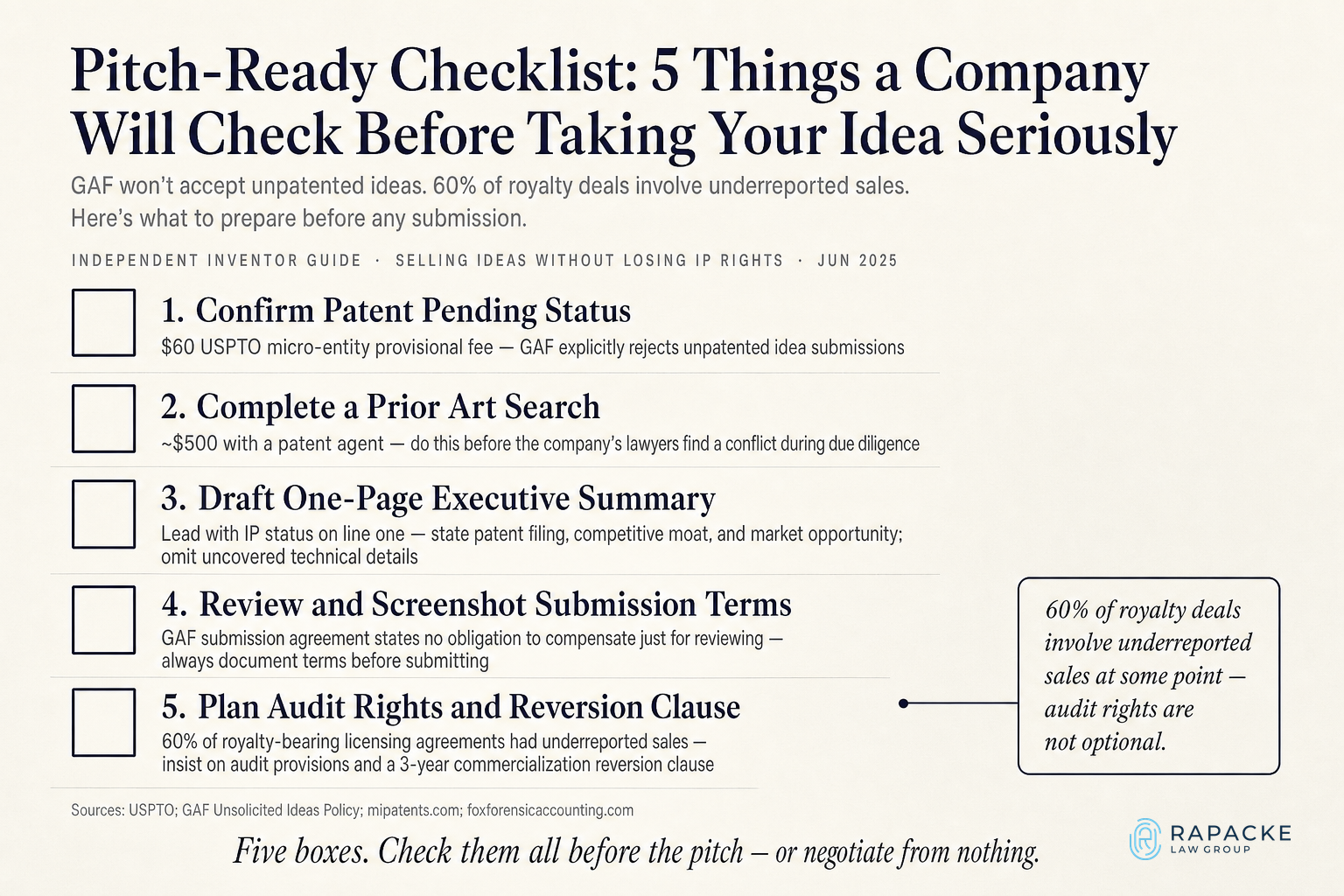
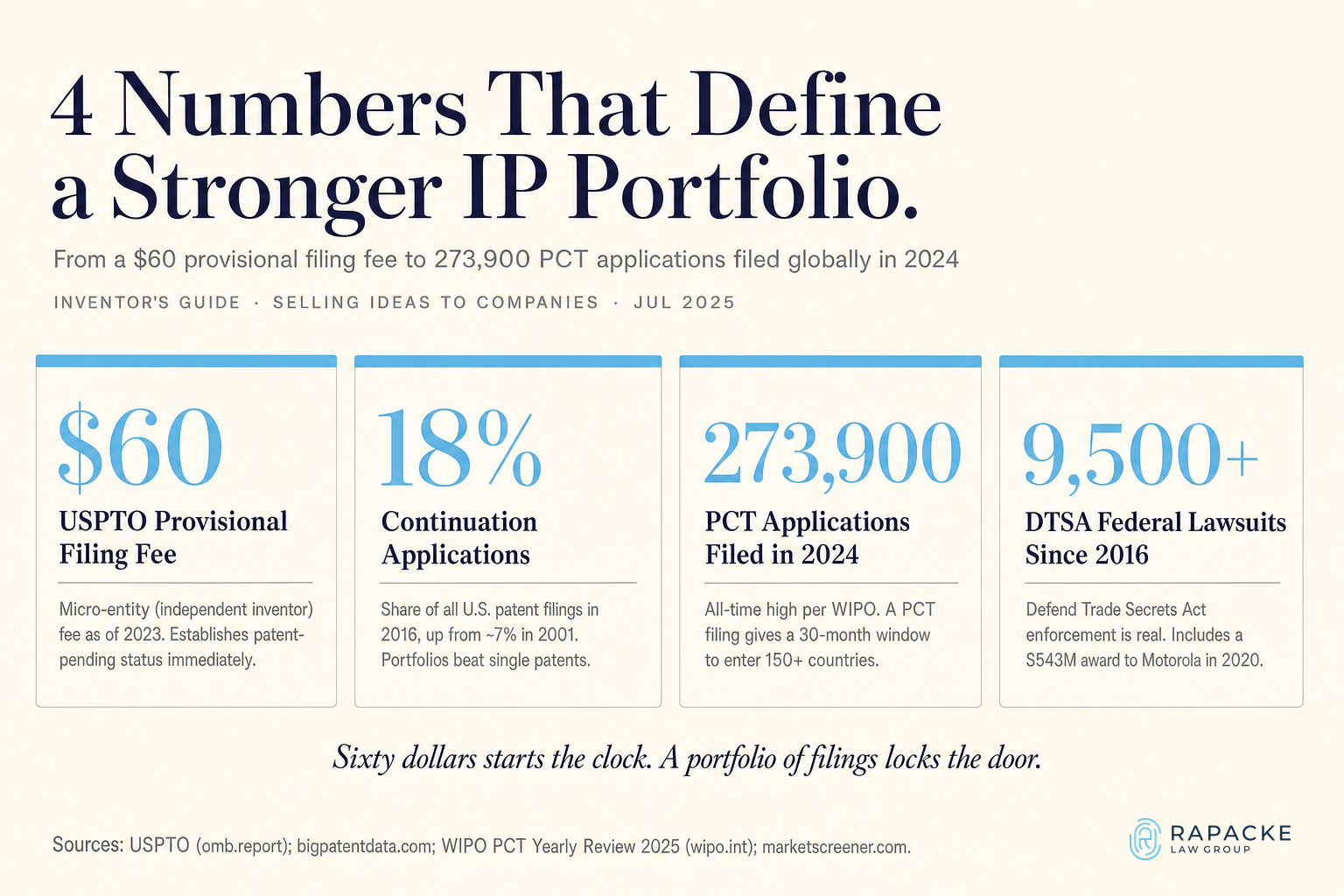
When asking how do you sell ideas to companies without a granted patent, the answer is that companies can and do pay, but they require documented protection, a filed application, a trade secret structure backed by a signed NDA, or a working prototype that demonstrates proprietary know-how. The USPTO provisional patent application fee is just $60 for a micro-entity under current schedules, making this the lowest-cost way to establish a legal priority date before any pitch conversation. Filing immediately lets you mark your invention "patent pending" during every negotiation, which changes how seriously companies treat your submission.
One question inventors frequently ask at this stage: can you patent an idea without a prototype? The answer matters because it affects both your filing timeline and what you can legally disclose before the prototype exists.
What Companies Actually Buy
Companies are not buying inspiration. They are buying a reduced risk of a competitor getting there first, documented claims they can enforce, and a credible inventor they can rely on during commercialization. A compelling business model that shows how the invention generates revenue makes your submission even more attractive. Research from the University of Warwick on biotech startups shows that patent filings significantly increase first-round venture investment, reflecting a dynamic that applies equally to inventor-to-company licensing, documentation converts a pitch into an asset, and an unprotected idea is just information.
Understanding why patents are important to investors explains exactly why documented IP protection changes the conversation from a favor to a business transaction.
The IP Protection Steps You Must Complete Before Any Pitch
Filing a Provisional Patent Application to Lock In Your Priority Date
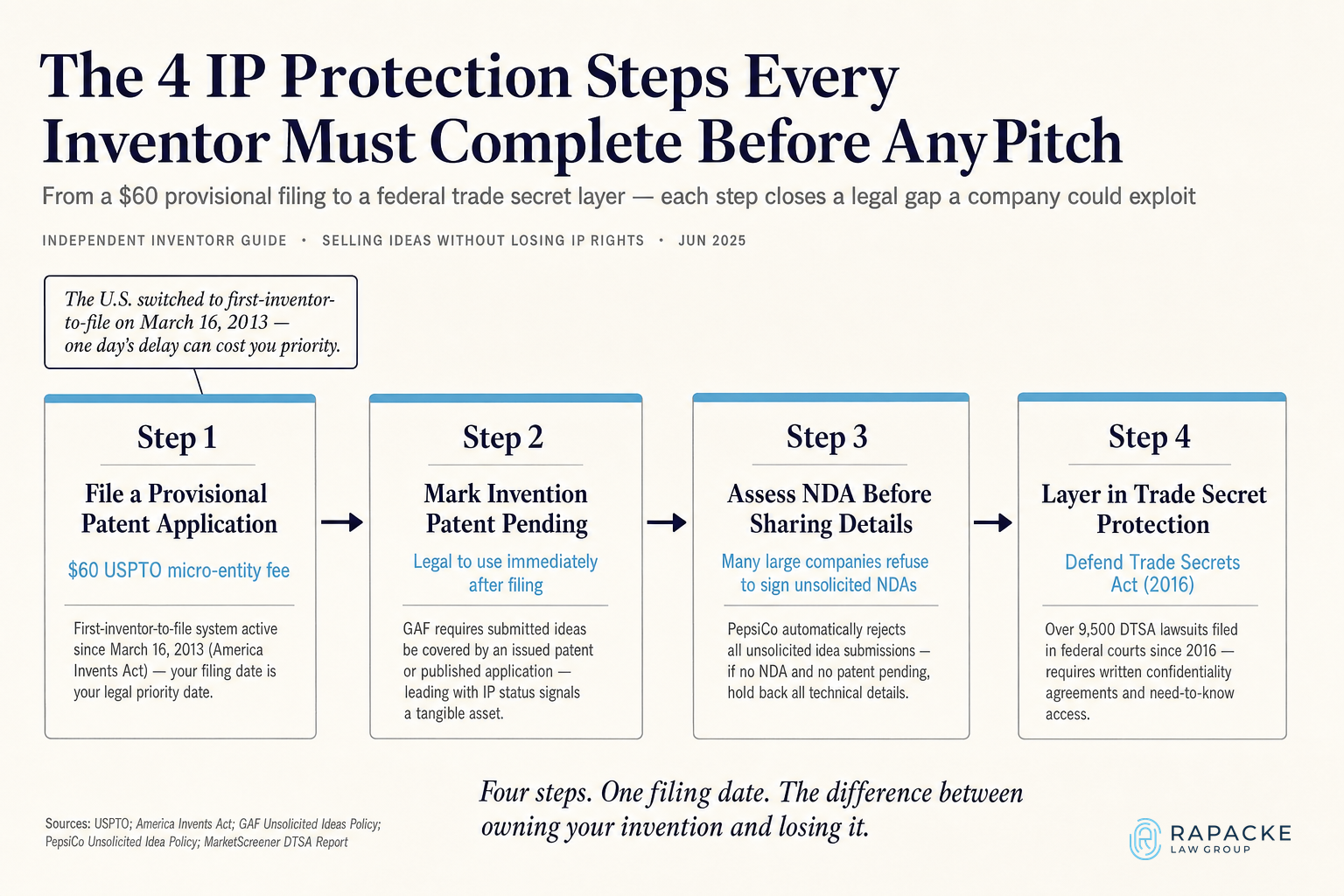
A provisional patent application does not become a patent on its own, but it establishes your filing date as the legal priority date under the first-inventor-to-file system created by the America Invents Act, which took effect on March 16, 2013. It is one of the most important early milestones in the invention process. If a competitor files for the same invention one day after your provisional, your earlier date prevails. The provisional must describe the invention with enough technical detail to support your non-provisional claims. According to Big Patent Data, continuing applications including those building on provisionals represented about 18% of all U.S. patent filings by 2016, up from just 7% in 2001, which reflects how systematically sophisticated inventors use the provisional-to-continuation pipeline. File a thin provisional and you risk losing the priority date that makes the whole strategy work.
When to Use an NDA Before Sharing Details
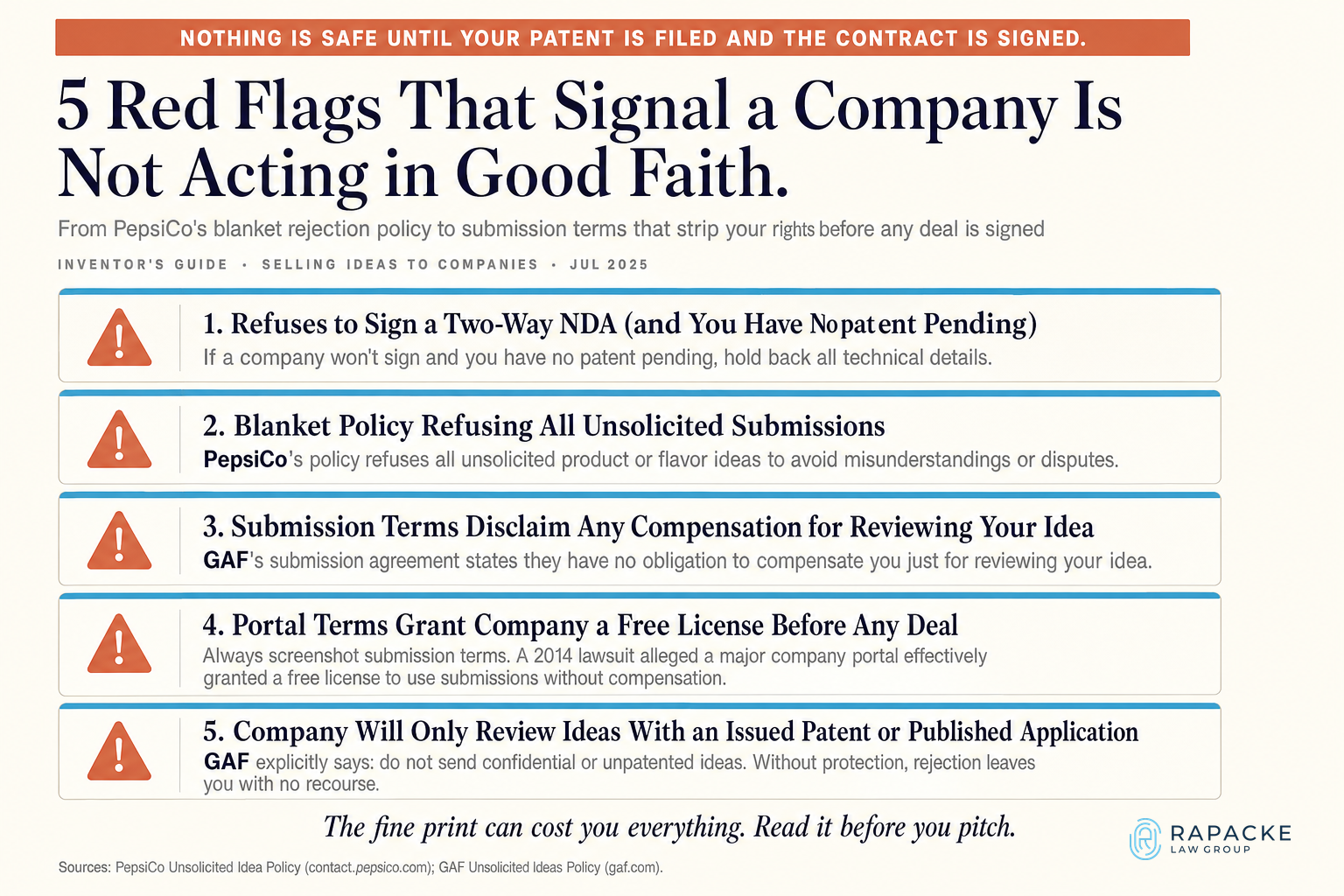
An NDA is a necessary companion to a filed application during the pitch process, not a substitute for one. Many large corporations refuse to sign NDAs for unsolicited idea submissions. PepsiCo, for example, maintains an explicit policy of accepting no unsolicited ideas at all, according to its published submission policy, specifically to avoid any implied obligation. If a company will not sign an NDA and you have no patent pending status, sharing technical specifics exposes you with no legal recourse. An NDA is most enforceable when it is mutual, specific about what qualifies as confidential information, and reviewed by a patent attorney before you present it.
Trade Secret Protection as a Complementary Layer
The Defend Trade Secrets Act of 2016 created a federal civil cause of action for trade secret theft. In the decade since its passage, over 9,500 DTSA lawsuits have been filed in U.S. federal courts, including a $543 million award to Motorola in 2020, according to Market Screener. To qualify for protection, you must take "reasonable measures" to keep the information secret, which means documented access controls, confidentiality agreements with everyone who touches the idea, and records showing the information was treated as proprietary. Trade secret status disappears permanently the moment the information becomes publicly known without your authorization.
To understand how trade secrets fit alongside patents, trademarks, and copyrights in a complete protection strategy, the guide to the four types of intellectual property is a useful starting point.
How to Prepare Your Idea for a Credible Company Pitch
Building a One-Page Executive Summary That Opens Doors
Companies receiving unsolicited invention submissions process hundreds per year. A strong one-page executive summary, which functions as a professional presentation of your invention, leads with the problem the idea solves, quantifies the target market with a credible source, and states the IP status immediately. Roofing manufacturer GAF, for instance, explicitly requires that any submitted idea be covered by an issued patent or published application, and its submission policy states it will not treat unpatented submissions as confidential. Leading with your legal status as a patent-pending inventor signals that there is a protected asset to evaluate, not just a pitch. The summary's job is to generate a meeting, not replace a full technical disclosure.
Prototypes and Production Drawings
Understanding how do you sell ideas to companies often comes down to presentation: a working prototype or a professional 3D CAD rendering transforms an abstract concept into a tangible asset a company can evaluate without relying on your verbal description. Professional 3D CAD modeling can cost as little as $500 for a simple product rendering, according to industry pricing data, making it one of the most cost-effective credibility investments an inventor can make. Companies evaluating concept-only submissions face significantly more perceived risk than those reviewing a model or drawing, which is why prototypes correlate with higher licensing conversion rates.
Identifying the Right Companies and Submission Paths
Submitting a new product idea to a company with no relevant product line wastes time and creates unnecessary prior art exposure. Research your target company's existing patent portfolio using USPTO public search tools to confirm they operate in the same technology space. Many companies including Henkel, Under Armour, and Dorman Products maintain formal open innovation portals with specific submission terms. Read every word before uploading anything. Some portal agreements include language granting the company a royalty-free right to evaluate your idea, which may conflict with your IP position and is easy to miss in the fine print.
If your idea builds on or improves an existing product category, understanding improvement patents can help you define the exact scope of protection worth pursuing before you approach any company.
How to Structure a Deal That Pays You Fairly
Royalty Rates, Upfront Payments, and Milestone Terms
Royalty rates vary by industry and patent strength. Consumer products typically yield 3% to 6% of net sales, while pharmaceutical inventions can reach 15% or more, according to Licensing Executives Society benchmarks. Surveys show that roughly 80% of licensing deals include an up front payment as an advance against royalties, and about 54% use a flat running royalty while 33% use tiered rates that escalate at sales milestones. A minimum annual royalty clause is essential, without one, a company can license your patent, shelve the product, and block competitors from licensing it while paying you nothing meaningful.
What Licensing Agreements Must Include to Protect You
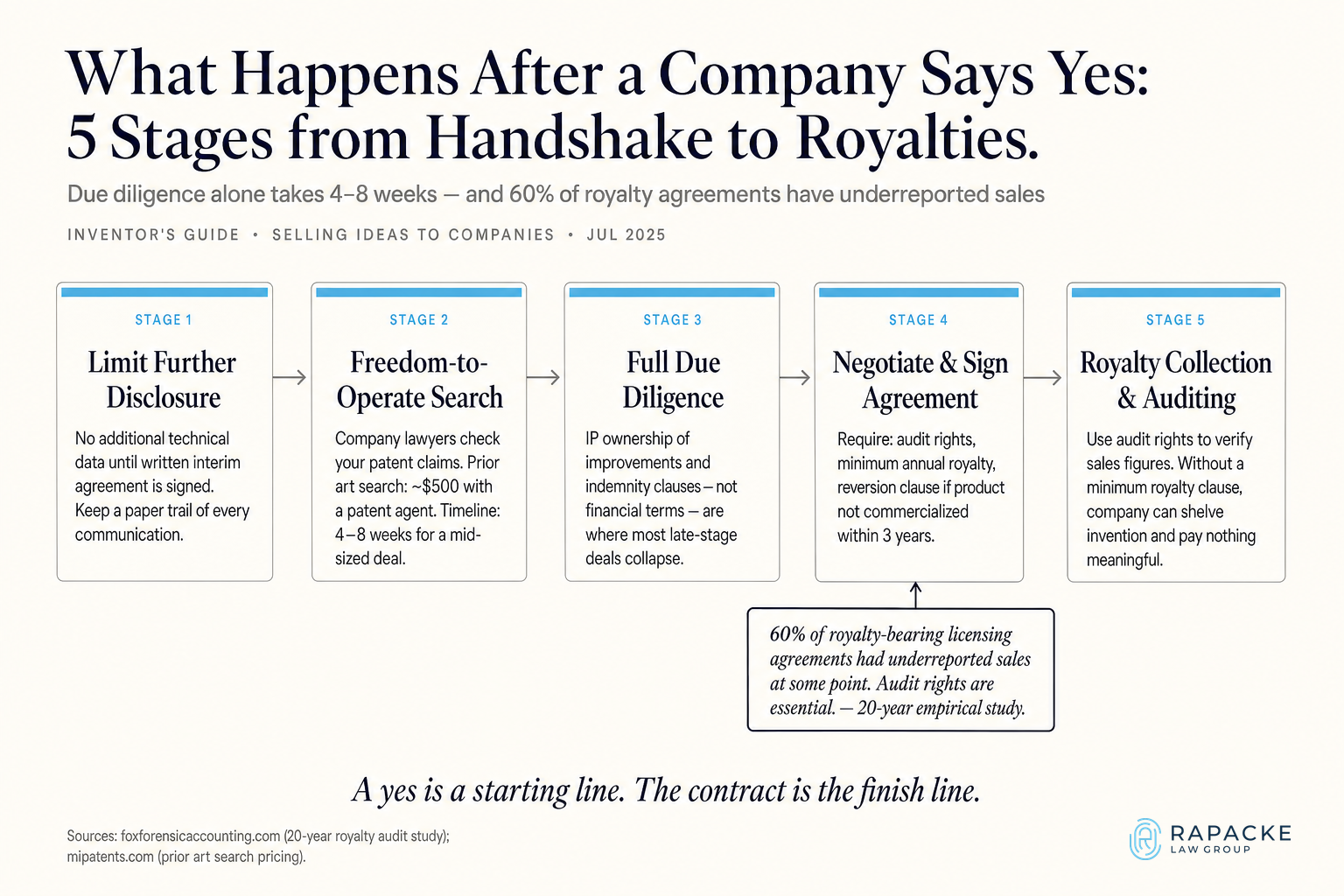
A patent licensing agreement should specify whether the license is exclusive or non-exclusive, the geographic territory, the royalty calculation method, a payment schedule, and audit rights that let you verify reported sales. Research by InvotexIP found that 60% of examined royalty-bearing licensing agreements contained underreported sales, according to data cited by Fox Forensic Accounting, making audit provisions one of the most financially important clauses you can negotiate. A reversion clause that returns rights to you if the company fails to commercialize within a defined window, typically two to three years, prevents your patent from being used as a blocking tool rather than a product.
Negotiating with Large Companies as an Individual Inventor
Large corporations have in-house IP counsel whose job is to minimize what they pay. One of the most important things to know about how do you sell ideas to companies is that entering that negotiation without a patent attorney or, qualified legal advice, is the equivalent of representing yourself against a team of experienced legal professionals. Having at least a patent application on file makes companies far more receptive to licensing conversations, because it signals the inventor has taken concrete steps to secure their intellectual property rights. Your real leverage comes from the strength of your patent claims, the market size your invention addresses, and your credibility as someone willing to walk away and license to a competitor.
With the RLG Guarantee, Rapacke Law Group offers flat-fee, transparent pricing on patent prosecution so independent inventors know their costs before committing. Every application is backed by a defined outcome guarantee: if your patent is not granted, you receive a full refund or Rapacke Law Group will continue prosecuting your application at no additional charge. That commitment replaces the open billing cycle that leaves most inventors uncertain about what they will ultimately pay.
Red Flags That Signal a Company May Not Be Acting in Good Faith
Submission Terms That Claim Rights Before Any Deal
Some company submission portals include language stating that by submitting an idea, you grant the company a royalty-free, perpetual license to use the concept. This is not a theoretical risk. GAF's published submission agreement states it has no obligation to compensate you simply for reviewing your idea. Read every word of a portal's terms before uploading materials. A great idea deserves more protection than a checkbox acknowledgment. Screenshot and save the submission terms at the exact time you submit, because companies update their portals and you may need to prove what the terms said when you first disclosed your invention.
Invention Submission Services That Promise More Than They Deliver
The FTC has repeatedly taken enforcement action against invention promotion companies, and directories like Invention City that vet such services confirm how rare legitimate operators are. In one documented case involving World Patent Marketing, the FTC found that customers "ended up in debt or lost their life savings with nothing to show for it," according to the FTC's own press release. Under the American Inventors Protection Act, any invention service company must disclose the number of clients who received a net financial benefit versus total clients served. Request that disclosure before paying anything. The success percentage is typically in the low single digits, if disclosed at all. A registered patent attorney provides privileged communications, accountable representation, and defined legal work with predictable outcomes that no invention submission service can match.
What Happens After You Pitch and a Company Says Yes
Due Diligence: What Companies Will Verify
When a company expresses genuine interest, their IP counsel will conduct a freedom-to-operate analysis and a prior art search to verify your patent claims are defensible. This typically takes four to eight weeks. Commissioning your own prior art search before your first pitch means you enter due diligence without surprises. A clean search result reduces the company's risk assessment, which accelerates their decision timeline and strengthens your negotiating position.
If you are unsure whether prior art could undermine your claims, the guide to whether you can patent something that already exists explains how to use prior art strategically to strengthen rather than abandon your application.
Managing the Transition from Handshake to Signed Agreement
The period between a company's verbal interest and a signed licensing agreement is one of the highest-risk moments for inventors who are navigating how do you sell ideas to companies successfully. Companies often request additional technical disclosure, prototype access, or engineering meetings during this window. Each interaction is an opportunity for accidental disclosure of details not yet covered by your filed application. Require a signed NDA or a term sheet that acknowledges your invention as your proprietary asset before sharing anything new. Most late-stage deal collapses happen over IP ownership of improvements and indemnity clauses, not financial terms, so staying protected through the finish line matters as much as the initial filing.
Building an IP Portfolio That Makes Future Deals Easier
Continuation Applications That Expand Your Protection Over Time
A continuation application lets you pursue additional patent claims based on your original application's priority date, expanding protection as the market develops around your invention. According to Big Patent Data, continuing applications represented about 18% of all U.S. patent filings by 2016, up from just 7% in 2001, reflecting how systematically sophisticated inventors use them. A portfolio covering the core invention, design variants, and manufacturing methods creates a much higher barrier to designing around your rights than a single patent, which translates directly into stronger deal terms.
The purpose of building this kind of portfolio goes beyond defensive protection. Understanding the real purpose of intellectual property and how IP assets have come to represent 90% of corporate value explains why a portfolio approach matters for licensing leverage, not just litigation defense.
International Protection Through PCT Applications
If your target company operates globally, a PCT (Patent Cooperation Treaty) application filed within 12 months of your provisional application date preserves your right to enter up to 150 member countries. Without a PCT filing, your international patent rights are permanently lost after that 12-month window. According to WIPO, PCT filings from independent inventors have grown year-over-year in recent reporting periods, reflecting increasing awareness of global licensing opportunities. If any company you are pitching has international operations, discuss PCT filing with your patent attorney before your provisional window closes, because that deadline cannot be extended.
Frequently Asked Questions
Can I sell my ideas to companies?
Yes, but the practical answer depends on what protection you have in place. A bare idea with no patent filing and no NDA provides no legal basis for enforcing your rights if a company uses your concept without paying you. Whether you have a business idea or a fully developed invention, the same rules apply. The path that works starts with a provisional patent application, which establishes a priority date and allows you to legally mark the idea "patent pending" during every pitch. Most successful inventor-to-company transactions involve licensing a protected invention rather than selling the idea outright, preserving ongoing royalty rights over the product's commercial life.
How much do companies pay for an idea?
Payment varies based on the industry, patent claim strength, market size, and deal structure. Licensing Executives Society benchmarks show royalty rates of 3% to 6% of net sales for consumer products and up to 15% or more for pharmaceutical inventions. Upfront advances against royalties for strong consumer product inventions with granted patents can range from several thousand to six figures. Concept-only ideas without any patent protection typically generate no payment, because companies have no legal obligation to compensate you for information you voluntarily disclosed without documented confidentiality protections.
Can I sell an idea to a big company?
A large company actively licenses technology from independent inventors, and many including Bosch, Under Armour, and Dorman Products maintain formal open innovation programs. The inventors who successfully license to large corporations typically have at minimum a provisional patent application on file, a concise professional one-page submission, and realistic expectations about the 12- to 24-month timeline from initial contact to a signed agreement. Walking in with only an idea and no IP documentation puts you at a structural disadvantage against a company's in-house legal team.
Do companies pay you for ideas without a patent?
Some do, under narrow circumstances. Trade secrets with documented confidentiality measures, proprietary software with copyright protection, and ideas disclosed only under enforceable NDAs can form the basis of a compensated deal. In practice, the vast majority of successful inventor-to-company transactions involve at least a patent-pending filing. Without it, you have no priority date, no enforceable claim, and no leverage if the company proceeds with a similar product after your conversation. Filing a provisional costs as little as $60 for micro-entities under current USPTO fee schedules.
What is a realistic timeline for selling an invention idea to a company?
From provisional patent filing to a signed licensing agreement, most inventors should expect 12 to 24 months, though deals can close faster when the company has an immediate product need and your IP documentation is in order. The USPTO's average examination period for a non-provisional application runs over 23 months, meaning many licensing agreements are executed while the patent is still pending. Companies licensing "patent pending" inventions typically include provisions that formalize royalty terms once the patent issues.
Should I use an invention submission service to find companies?
The data is not favorable. Under the American Inventors Protection Act, invention promotion firms must disclose the ratio of clients who received a net financial benefit versus total clients served. Request that number before paying anything. The FTC's enforcement actions, including the World Patent Marketing case, document a consistent pattern of large upfront fees with minimal results. A registered patent attorney who handles patent prosecution and licensing provides legal protection, attorney-client privilege, and accountable representation that no invention submission service can replicate.
Your Next Steps to Selling Your Idea Successfully
Every week you spend refining your pitch without a patent filing is a week your priority date is unprotected, and a critical moment in your invention journey is lost. The steps that separate inventors who license successfully from those who lose their intellectual property are not complicated, but they must happen in the right order.
The bottom line, a weak submission is an idea without documentation. A strong submission is a protected asset with a priority date, a clean prior art search, and a one-page summary that leads with IP status. Companies respond to the second, not the first.
Waiting costs you real leverage. Every day without a filed application is a day a competitor could file first, a company could develop a similar product independently, or a portal submission could expose details you cannot take back. The first step is the cheapest and fastest one available.
Action items to move forward:
- Schedule a Free IP Strategy Call with a registered patent attorney to assess your invention and map the right protection structure before your next pitch
- Download the SaaS Patent Guide 2.0 if your invention involves software or a technology platform
- Review the AI Patent Mastery resource if your idea incorporates machine learning or AI-driven functionality
- File your provisional application before approaching any company, portal, or open innovation program
Andrew Rapacke is a Registered Patent Attorney and Managing Partner at Rapacke Law Group, focused on helping SaaS founders and independent inventors protect new ideas through provisional and non-provisional patent applications, prior art searches, and IP licensing agreement review.
With the RLG Guarantee, you get flat-fee, transparent pricing backed by a defined outcome guarantee: if your patent is not granted, Rapacke Law Group will refund your fees or continue prosecuting your application at no additional cost. You know exactly what you are paying for before work begins, with no open billing cycles and no surprise invoices.
To Your Success, Andrew Rapacke
Andrew Rapacke Managing Partner, Registered Patent Attorney Rapacke Law Group