

Key Takeaways
- U.S. utility patent applications take 24 to 32 months on average from filing date to grant under standard examination, with design patents running roughly 6 to 10 months faster.
- Over 90% of patent applications receive at least one rejection before allowance, so budget for multiple office action rounds in both your timeline and cost estimates.
- Track One prioritized examination can compress total pendency to 12 months and delivers a first office action in approximately three months, for an additional government fee.
- A provisional patent application gives you 12 months and "patent pending" status, but it is never examined and never becomes a granted patent on its own.
- Prior art searched and addressed before filing is the single most effective way to shorten prosecution, reducing the number of rejection rounds you will face.
The average U.S. utility patent applicant waits more than two years from filing date to final disposition, according to United States Patent and Trademark Office pendency data, and that number is climbing as the backlog grows. Most inventors and founders filing their first patent application expect something closer to a year. That gap between expectation and reality creates missed funding windows, premature product launches, and IP strategies built on a false timeline. Understanding what actually drives patent prosecution length, and which levers you can pull to compress it, is the most practical thing you can do before you file.
The Honest Answer to Patent Timeline Questions Most Articles Get Wrong
The USPTO received 598,085 patent applications in 2023, according to WIPO's World Intellectual Property Indicators 2024. At the end of fiscal year 2023, over 1.14 million patent applications were pending examination or awaiting allowance at the agency. Average total pendency for utility patent applications was approximately 25.7 months in 2022, and current United States Patent and Trademark Office data places average total pendency in the range of 24 to 32 months depending on technology area and examination track. More than 90% of patent applications receive an initial rejection before any allowance is issued. These numbers define the realistic U.S. patent timeline, and none of them appear in the optimistic summaries most applicants read before filing.
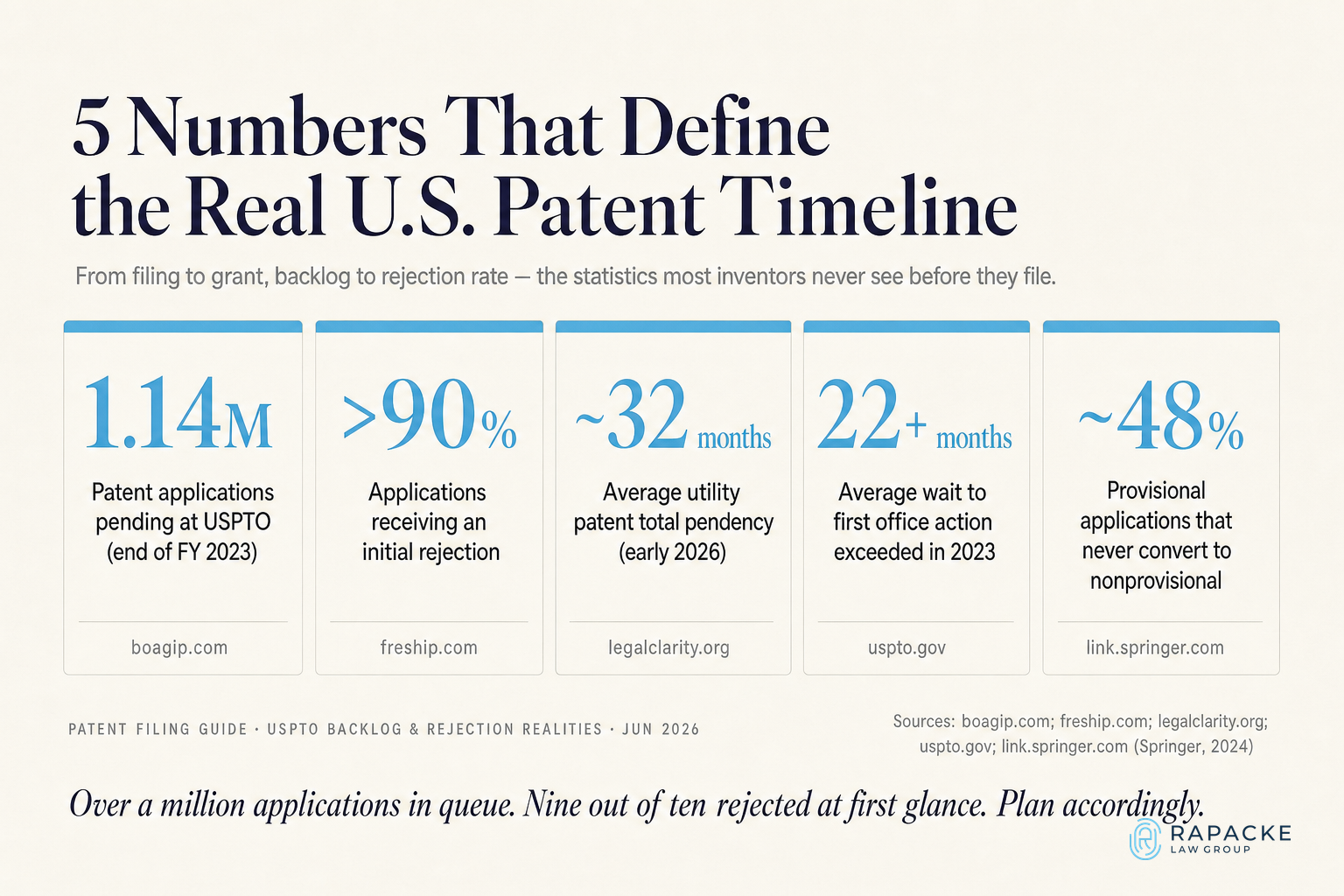 5 Numbers That Define the Real U.S. Patent Timeline/Source: USPTO; WIPO World Intellectual Property Indicators 2024; Springer (link.springer.com), 2024
The honest baseline: filing a nonprovisional utility patent application today puts you roughly two to two and a half years from a granted patent under standard examination. That window shrinks significantly if you use accelerated options, and it stretches further if prosecution gets complicated. Every section below explains a specific variable you can control.
What the Average Patent Timeline Actually Looks Like by Application Type
Not all patent applications move at the same pace. The type of application you file determines your baseline before external factors enter the picture. As the chart below shows, utility and design patent total pendency differ by nearly 10 months on average. For a deeper look at how application type affects long-term IP value, see How Long Do Software Patents Last? The Definitive Timeline for Tech Startups.
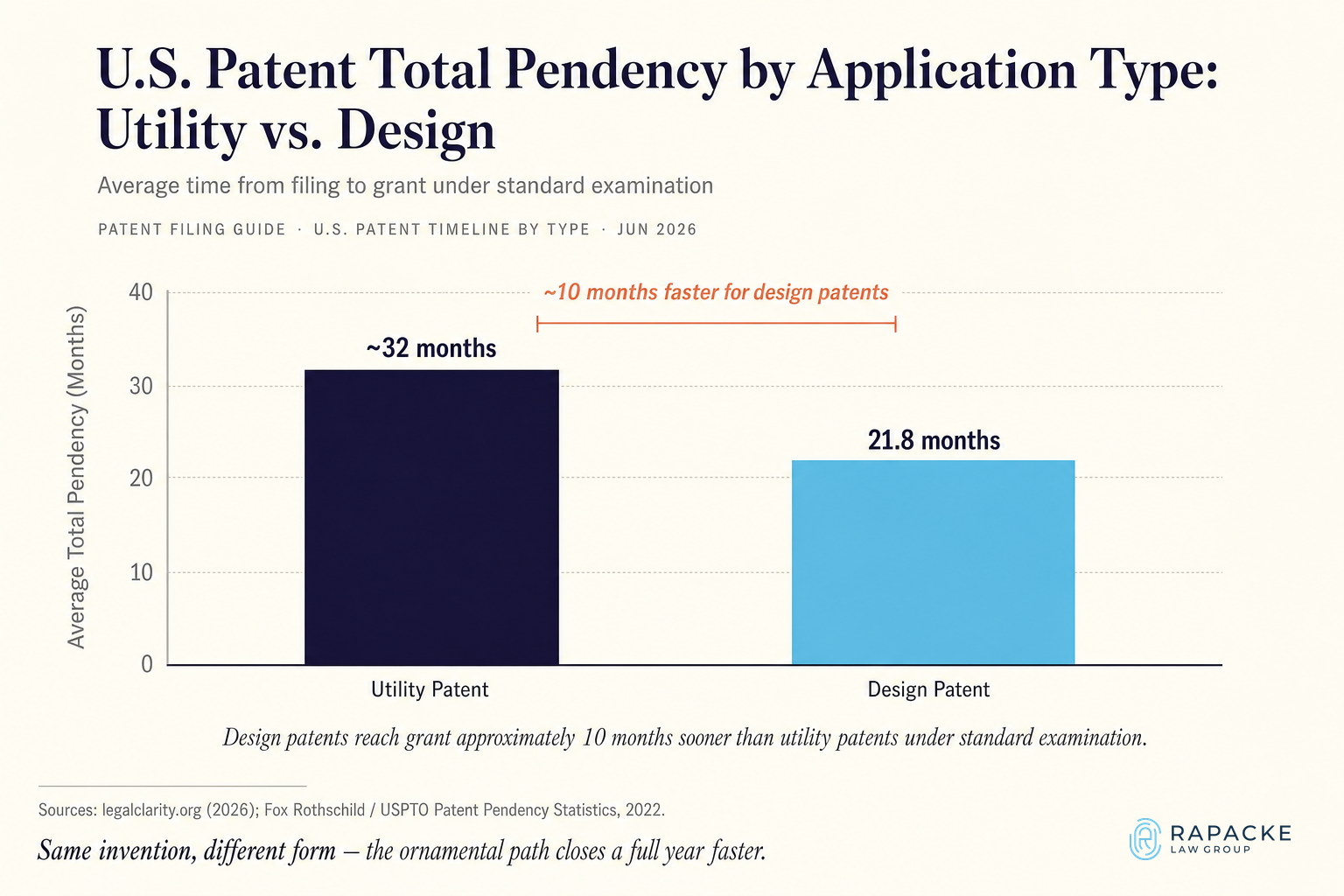 U.S. Patent Total Pendency by Application Type: Utility vs. Design/Source: USPTO Patent Pendency Statistics, FY 2022
Provisional Patent Applications Buy You 12 Months, Not Protection
A provisional patent application establishes your filing date and gives you 12 months to file a corresponding nonprovisional application. The United States Patent and Trademark Office does not examine provisional applications, which means there is no first office action, no examiner review, and no path to a granted patent through the provisional alone. What you gain is time: to refine your invention, test market fit, and secure funding while legally using the "patent pending" designation.
About 149,000 provisional applications were filed in fiscal year 2023, according to USPTO workload data. Roughly only 52% are ever converted to a nonprovisional within the 12-month window, according to research published in World Patent Information, meaning nearly half expire abandoned. A provisional patent application is a strategic delay tool, not a shortcut to protection. For more on how the provisional filing window intersects with startup funding milestones, see How the Provisional Patent Timeline Impacts Startup Funding and Investor Confidence.
Utility Patent Applications Take Two to Three Years on Average
Average first office action pendency for utility patent applications was approximately 16.9 months in fiscal year 2022, per USPTO pendency statistics. Total pendency, from filing date to final disposition, ran approximately 25.7 months in 2022, with current estimates ranging from 24 to 32 months depending on art unit and examination track. Software, AI, and business method patent applications in crowded art units often sit at the longer end of that range. Plan your IP strategy around a 24 to 30 month window for utility patents unless you use an accelerated examination track. If you are evaluating whether to file now or wait, When to Get a Patent: Strategic Timing for Maximum Protection covers the key timing considerations in detail.
Design Patents Move Significantly Faster Than Utility Applications
Design patents protect the ornamental appearance of a product rather than its functional features. Average total pendency for design patents runs approximately 21.8 months, with first office actions typically arriving closer to the 12-month mark, according to USPTO pendency data. For founders and product companies that need visual brand protection quickly, a design patent application can deliver a granted patent roughly six to ten months faster than a comparable utility application.
What Happens Inside the USPTO After You File Your Patent Application
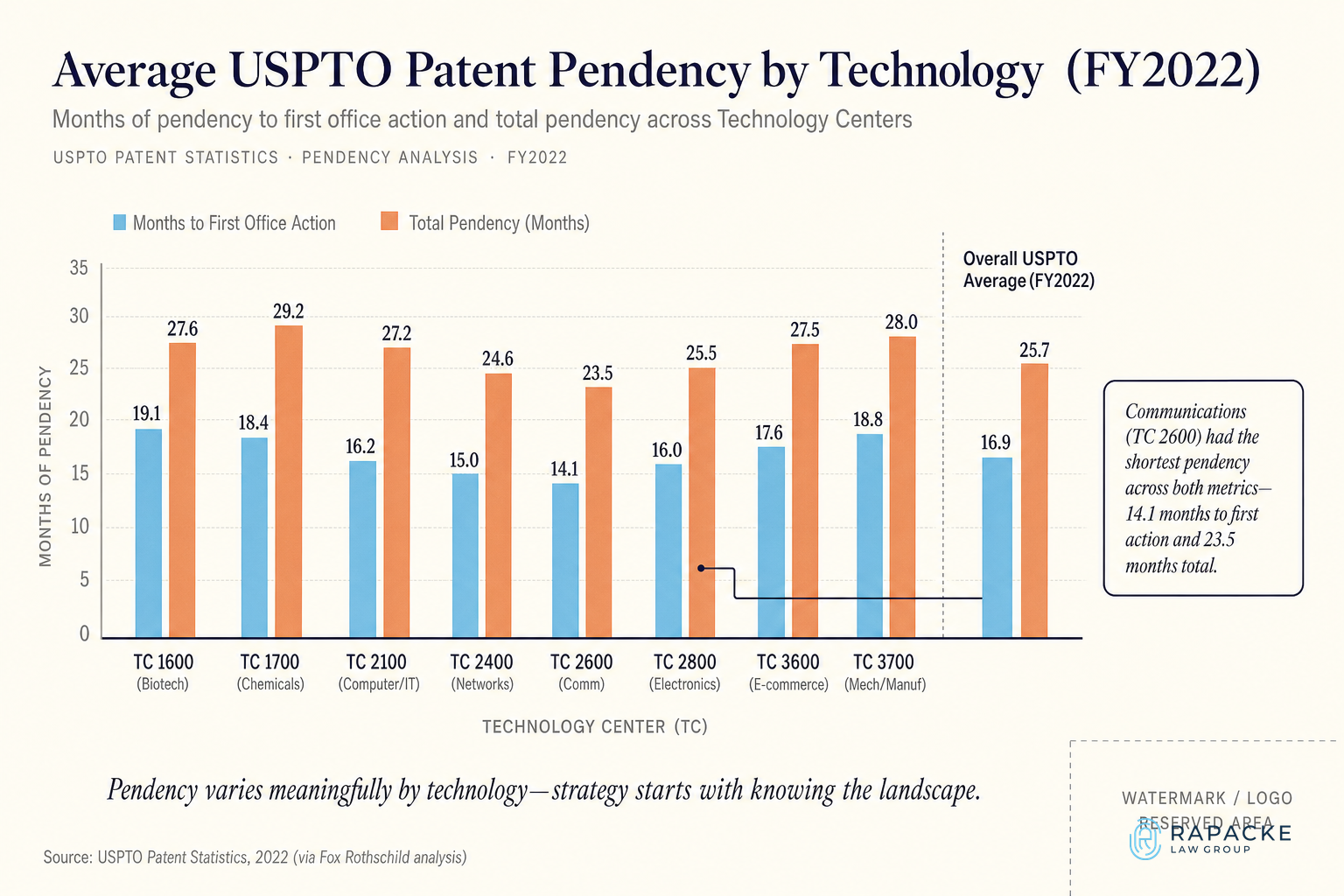
Most inventors experience patent prosecution as long silences broken by urgent deadlines. Understanding what happens internally explains the waiting and helps you respond strategically at each stage. Technology center data shows first office action pendency ranging from approximately 14 months for electronics and communications to over 19 months for biotechnology, illustrating how much your art unit assignment matters.
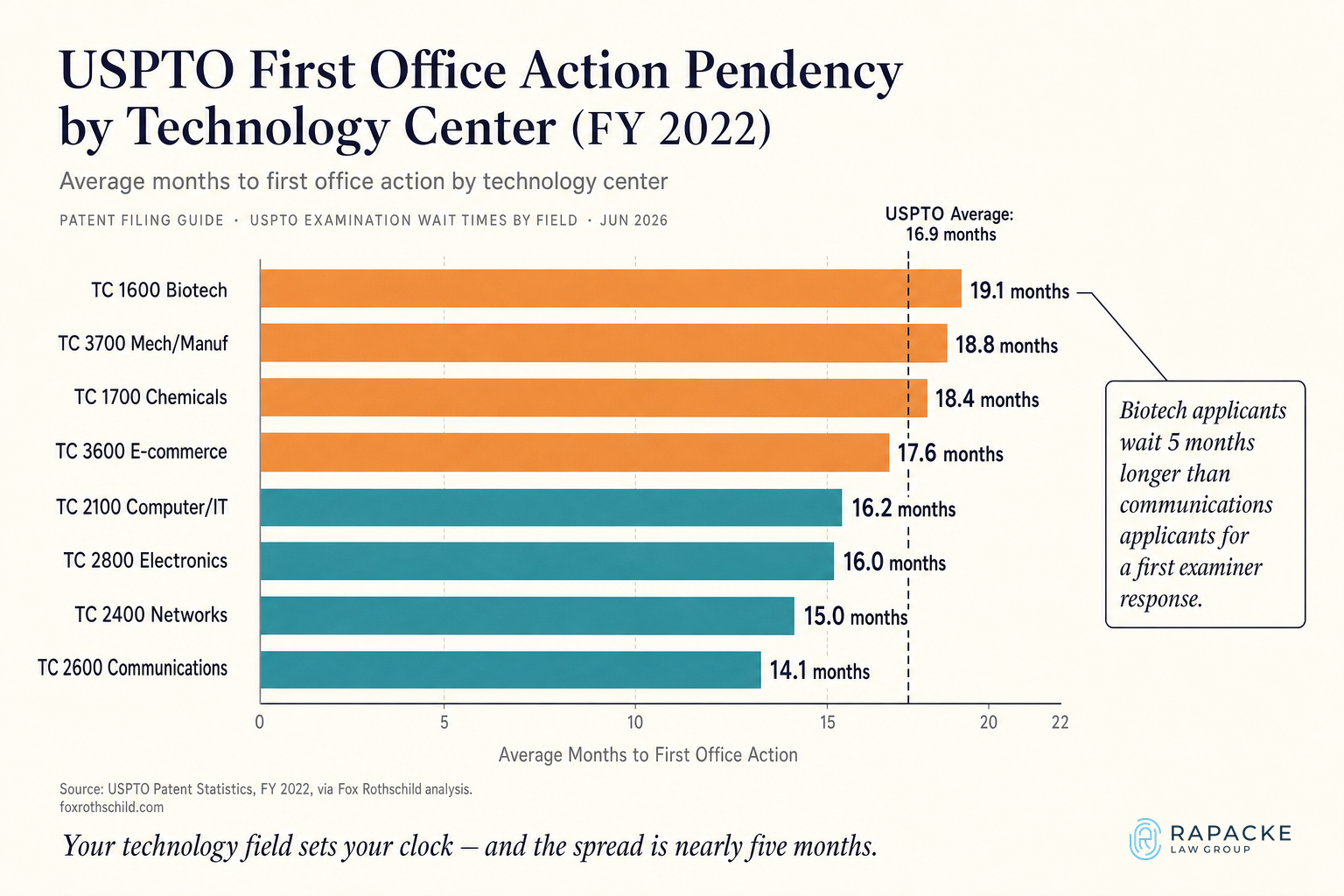 USPTO First Office Action Pendency by Technology Center (FY 2022)/Source: USPTO Patent Statistics, FY 2022
The Filing Queue and Art Unit Assignment Control Your Initial Wait
After you file a nonprovisional patent application, it enters a queue before assignment to an examiner in the relevant art unit. Art units are technology-specific examination groups inside the United States Patent and Trademark Office, and wait times vary significantly across them. Biotechnology and chemical arts waited approximately 18 to 19 months to a first office action in fiscal year 2022, while electronics and communications technology art units averaged closer to 14 to 15 months, per USPTO pendency data. The art unit your application lands in can add or subtract six or more months before examination even begins.
The First Office Action Starts the Real Examination Clock
The first office action is the patent examiner's initial written response, and it almost always includes rejections. Over 90% of patent applications receive an initial rejection, according to USPTO examination data. The most common rejections cite prior art under 35 U.S.C. 102 and 103. Applicants have three months to respond, extendable to six months for increasing fees. Each round of office action and response adds roughly three to six months to total pendency. For a full walkthrough of how the examination process works from an investor perspective, see Why Investors Care About IP: The Patent Process Explained for High-Growth Startups.
Final Office Actions and After-Final Practice Add Additional Time
If the examiner issues a final office action after your first response, your options narrow: file an after-final amendment, submit a Request for Continued Examination (RCE), or appeal to the Patent Trial and Appeal Board (PTAB). An RCE restarts prosecution and historically adds a year or more of additional pendency. PTAB appeal pendency has improved in recent years, dropping to just under 12 months for ex parte appeals according to USPTO PTAB statistics, which has made appeals a more viable option than in prior years. The prosecution path you choose after a final office action has the largest single impact on your total timeline.
How to Legally Compress Your Patent Timeline With Accelerated Examination Options
Waiting 30 months is not mandatory. The USPTO offers formal programs that can reduce examination time to 12 months or less. The comparison table below shows how standard examination, Track One, and the Patent Prosecution Highway each affect your timeline from filing date to grant.
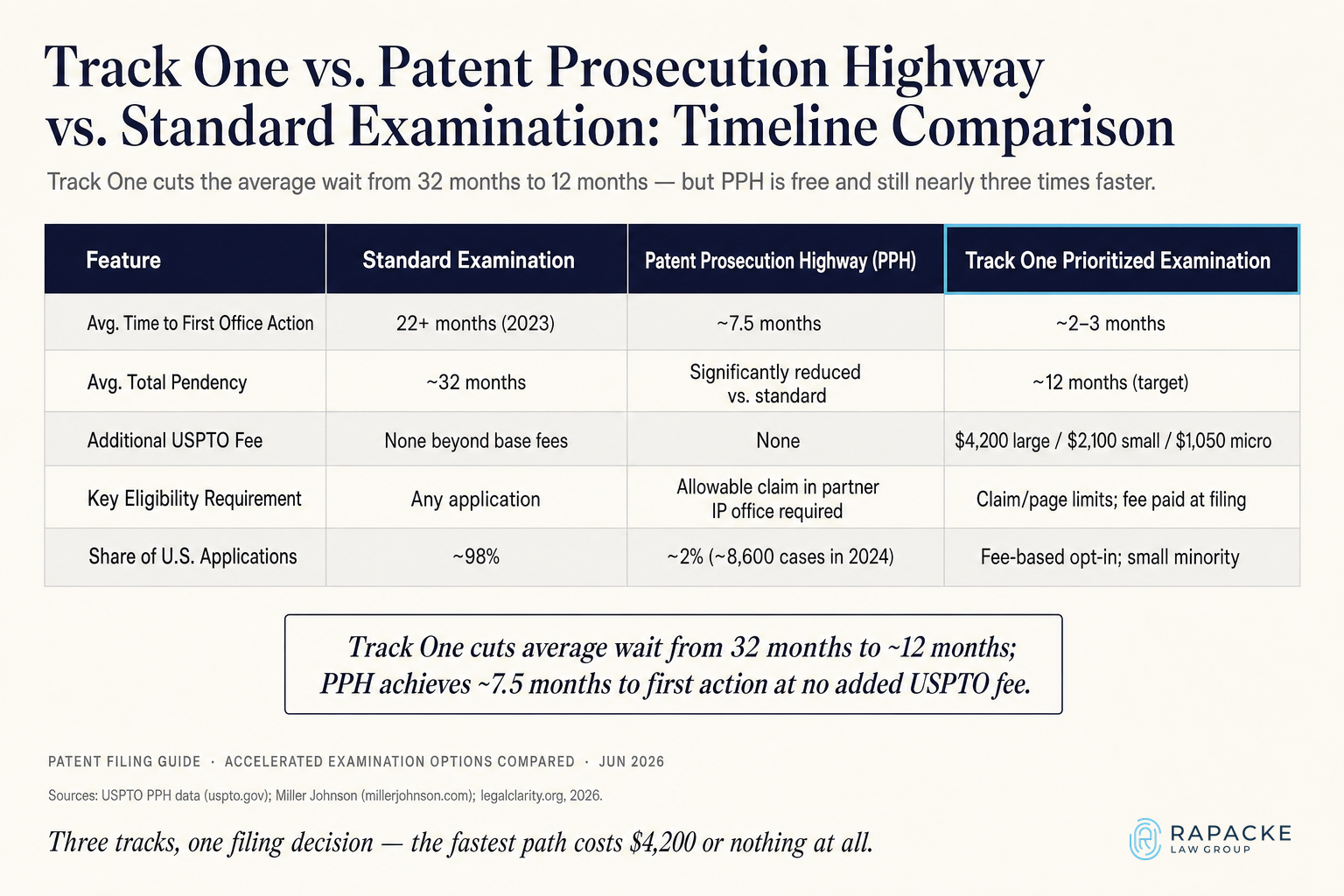 Track One vs. Patent Prosecution Highway vs. Standard Examination: Timeline Comparison/Source: USPTO PPH program data (uspto.gov)
Prioritized Examination (Track One) Gets You to First Office Action Fast
The USPTO's Track One prioritized examination program, established under the America Invents Act, targets 12-month total pendency from filing to final disposition. In practice, Track One applications receive a first office action in approximately three months. The program requires an additional government fee currently set at $4,200 for large entities, $2,100 for small entities, and $1,050 for micro entities, per the USPTO fee schedule. It also limits claims and caps annual acceptance volume, so timing your filing matters. For founders approaching a funding round, product launch, or competitive filing threat, Track One's additional cost is often the most efficient IP investment available. See How Long Does It Take To Get A Software Patent? for how these acceleration options apply specifically to software and AI inventions.
The Patent Prosecution Highway Accelerates International Applications
The Patent Prosecution Highway (PPH) allows applicants who receive favorable examination results in one participating patent office to request accelerated examination in another. USPTO PPH data shows PPH applications wait approximately 7.5 months to a first office action compared to 22-plus months for standard filings, without the additional fees charged for Track One. The program covers the European Patent Office, Japan Patent Office, Korean Intellectual Property Office, and China National Intellectual Property Administration, among others. If you are filing internationally, sequencing your filings strategically to leverage PPH can save both time and prosecution cost across multiple jurisdictions.
Micro Entity and Small Entity Status Reduce Cost But Not Timeline
Small entity status reduces most USPTO fees by 40% and micro entity status by 60%, but neither accelerates examination on its own. Total maintenance fees over a utility patent's life reach approximately $13,460 for large entities, $6,730 for small entities, and $3,365 for micro entities under current USPTO fee schedule rates. About 24% of new U.S. applications in fiscal year 2023 came from small or micro entities, per USPTO statistics. Combining micro entity status with a Track One request captures both cost and timeline benefits simultaneously.
How Patent Timelines Compare Across Major International Patent Offices
If your market extends beyond the United States, timeline differences across patent offices affect your go-to-market sequencing and licensing strategy directly.
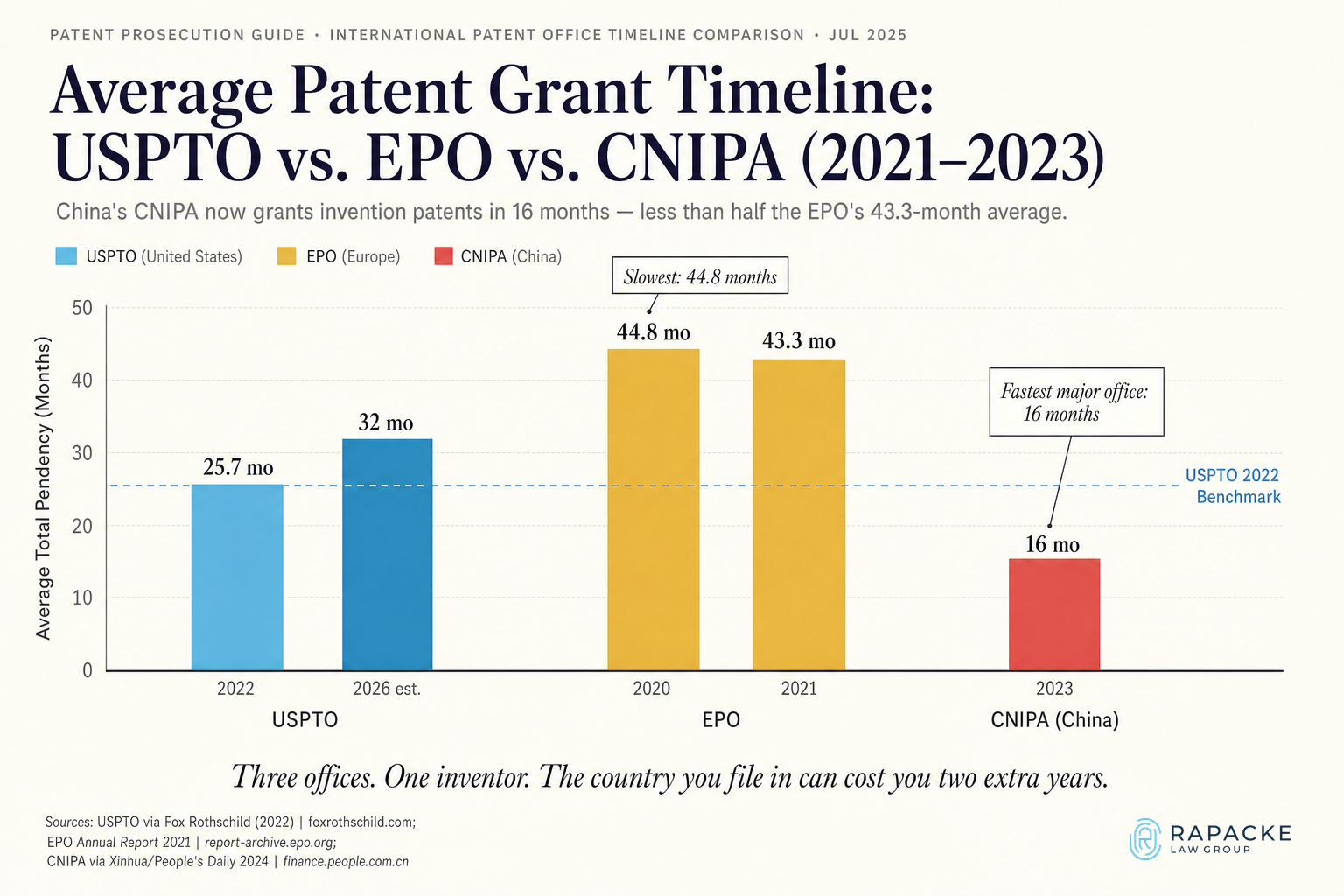 Average Patent Grant Timeline: USPTO vs. EPO vs. CNIPA (2021–2023)/Source: USPTO Patent Pendency Statistics FY 2022; EPO Annual Report 2021; CNIPA via Xinhua/People's Daily 2024
European Patent Office Applications Take Three to Five Years on Average
The European Patent Office handles patent applications for 39 member states under a centralized examination process. According to the EPO's 2021 Annual Report, average end-to-end time from filing to grant was approximately 43.3 months. The EPO examination process includes a mandatory search phase followed by substantive examination, and opposition proceedings after grant add further complexity. Applicants who receive favorable United States Patent and Trademark Office results can use PPH to request accelerated examination at the European Patent Office, often reducing the standard queue meaningfully. Plan for a longer runway on European protection and use PCT application filing strategically to preserve your options before committing to national phase entry fees.
China National Intellectual Property Administration Timelines Have Improved
The China National Intellectual Property Administration has made significant investments in examination capacity. By the end of 2023, the average examination cycle for invention patents in China had been reduced to 16 months, according to People's Daily financial reporting. Utility model applications in China typically receive grant within 12 months, since they are not substantively examined for prior art the way invention patents are. For technology companies with significant China market exposure, early CNIPA filing and understanding the utility model versus invention patent tradeoff can provide faster protection in that jurisdiction.
PCT International Applications Preserve Options for 30 Months
A PCT application does not produce a granted patent directly, but it preserves your right to enter over 150 national and regional patent offices for up to 30 months from your earliest priority date, according to WIPO's PCT time limits guidance. The PCT process delivers an international search report and written opinion within approximately 16 months of filing, giving you early signal on claim strength before committing to expensive national phase fees. The PCT currently has 158 contracting states. Use it as a 30-month option window, not a shortcut to faster international patents. For guidance on whether to extend your domestic filing internationally, see Provisional Patent Extension: How to Get More Time After 12 Months.
The Role of Prior Art in Determining How Long Your Prosecution Will Take
Prior art is the single most controllable variable in patent prosecution length, yet most applicants do not account for it before filing. Understanding how it affects examination length gives you a realistic forecast and a defensible prosecution strategy.
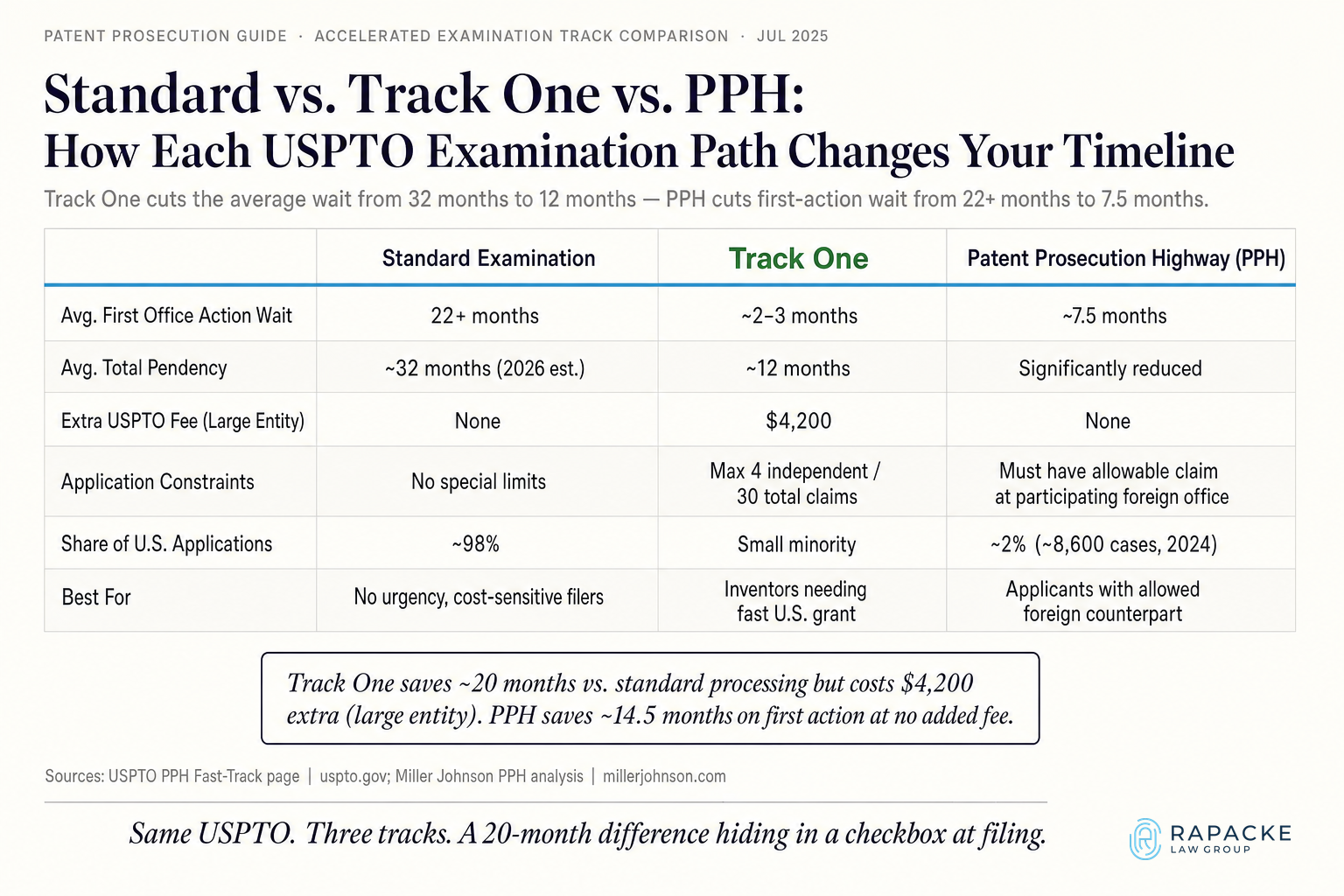 Standard vs. Track One vs. PPH: How Each USPTO Examination Path Changes Your Timeline/Source: USPTO PPH Fast-Track page
A Professional Prior Art Search Before Filing Shapes Realistic Claim Expectations
A thorough prior art search conducted before filing your nonprovisional patent application lets you draft claims that distinguish your invention from existing patents and publications from the start. When claims are well-differentiated from prior art at filing, examiners have fewer grounds for rejection and prosecution rounds decrease. When claims are filed without prior art context, examiner rejections frequently require substantive amendments that can extend prosecution by six to eighteen months. Investing in a prior art search before filing is a time investment that typically returns more time than it costs. You can review the baseline requirements that shape a strong application in How to Meet the Requirements for a Patent: A Step-by-Step Guide.
How Examiner-Cited Prior Art References Affect Your Response Strategy
When a patent examiner cites prior art references in a first office action rejection, the quality and relevance of those references determines your response options. A close 35 U.S.C. 102 anticipation reference that reads directly on your claims may force substantive amendments, typically adding one to two additional prosecution rounds. A 35 U.S.C. 103 obviousness rejection based on a combination of weaker references may be overcome with a well-crafted argument in a single response. Understanding the strength of the cited prior art is the most important diagnostic in estimating how much longer your prosecution will take.
Common Mistakes That Add Months to Your Patent Application Timeline
Applicants consistently make predictable errors that extend prosecution timelines unnecessarily. The checklist below captures the mistakes that account for the majority of avoidable delays.
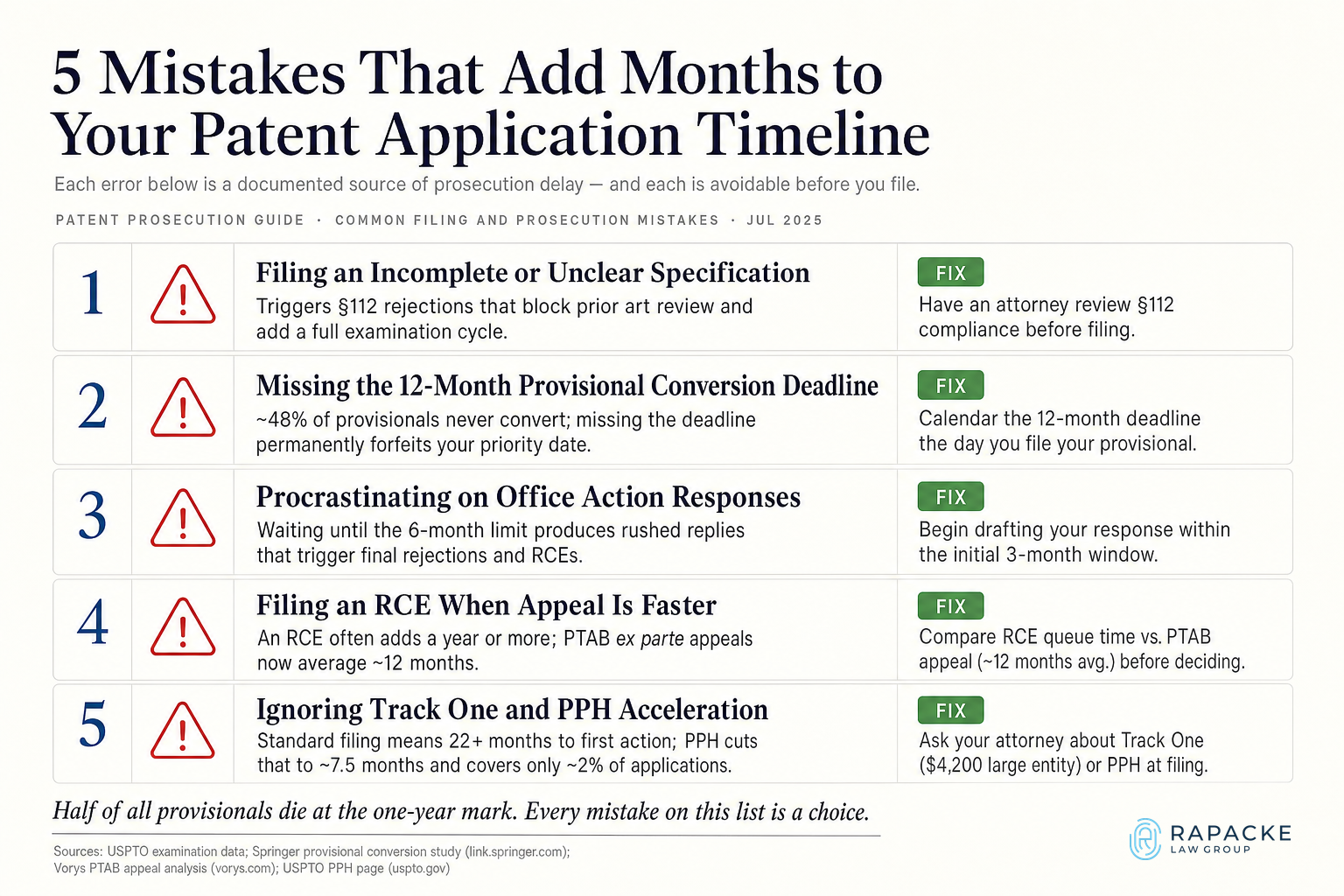 5 Mistakes That Add Months to Your Patent Application Timeline/Source: USPTO examination data; Springer provisional conversion study, 2024; USPTO PTAB statistics; USPTO PPH Fast-Track page
Filing Incomplete Specifications Triggers Formal Rejections Early
A patent application's specification must enable a person of ordinary skill in the relevant field to make and use the invention. If the specification lacks sufficient detail, the examiner issues written description or enablement rejections under 35 U.S.C. 112 before prior art analysis even begins. These formal objections require responses and often amendments that push back your timeline before substantive prosecution starts. Tech founders who draft their own specifications without attorney involvement most commonly encounter this problem.
Missing the 12-Month Provisional Conversion Deadline Forfeits Your Priority Date
If you file a provisional patent application and miss the 12-month deadline to convert it to a nonprovisional, your provisional goes abandoned and you lose your original filing date permanently. Any public disclosure made after the provisional filing date becomes prior art against your own new application. This is one of the most consequential and irreversible mistakes in patent prosecution. Treat the 12-month deadline as a hard business milestone, not a legal formality. The strategic implications of that deadline are covered in detail at When Is The Right Time To Patent Your Invention?
Responding to Office Actions Without Strategic Review Costs Extra Rounds
Applicants have up to six months to respond to most office actions, with the base three-month deadline extendable in monthly increments. Filing a rushed response without strategic review of the examiner's prior art rejections frequently produces inadequate amendments, triggering a final office action and adding another prosecution round. A thorough, strategically considered response filed in the second or third month produces better outcomes and shorter total prosecution timelines.
Frequently Asked Questions
How quickly can you get a patent? The fastest path to a granted U.S. utility patent is a nonprovisional application filed under the United States Patent and Trademark Office's Track One prioritized examination program, which targets 12-month total pendency and delivers a first office action in approximately three months. Design patents without Track One take roughly 18 to 22 months. No legal mechanism produces a granted utility patent in less than several months even under the most accelerated conditions. For answers to other common filing questions, visit the Rapacke Law Group FAQ page.
How much does a 20-year patent cost? A U.S. utility patent provides protection for 20 years from the application filing date. Total cost over that term includes USPTO filing fees, attorney drafting and prosecution fees, and maintenance fees due at 3.5, 7.5, and 11.5 years after grant. Government maintenance fees alone reach approximately $13,460 for large entities over the patent's life, per current USPTO fee schedule rates. Total all-in costs including professional fees commonly range from $15,000 to $30,000 or more for a complex utility application taken through prosecution and maintained to full term.
Can a provisional patent application get rejected? The USPTO does not examine provisional patent applications for patentability, so they are not rejected on prior art or eligibility grounds. However, a provisional application can be found formally defective if it lacks sufficient drawings or disclosure to support the claims included in your later nonprovisional application. A defective provisional cannot support your priority date claim, which is functionally equivalent to losing your filing date for purposes of protecting your invention.
Does filing a patent application in one country protect you internationally? No. Patents are territorial rights, and a USPTO filing provides no automatic protection outside the United States. The Patent Cooperation Treaty (PCT) application preserves your right to enter most major patent offices worldwide for up to 30 months from your earliest priority date, giving you time to evaluate which markets justify the national phase investment before committing to individual country fees.
Your Next Steps to Patent Timeline Success
The gap between a 12-month Track One grant and a four-year prosecution marathon is not luck. It is the product of filing decisions: which application type, which examination track, how thoroughly prior art was searched before filing, and how carefully claims were drafted. Inventors and founders who treat patent filing as a one-time administrative step consistently face the longest timelines and the most expensive prosecution. Those who enter the process with a clear strategy reach grant faster and with stronger claims.
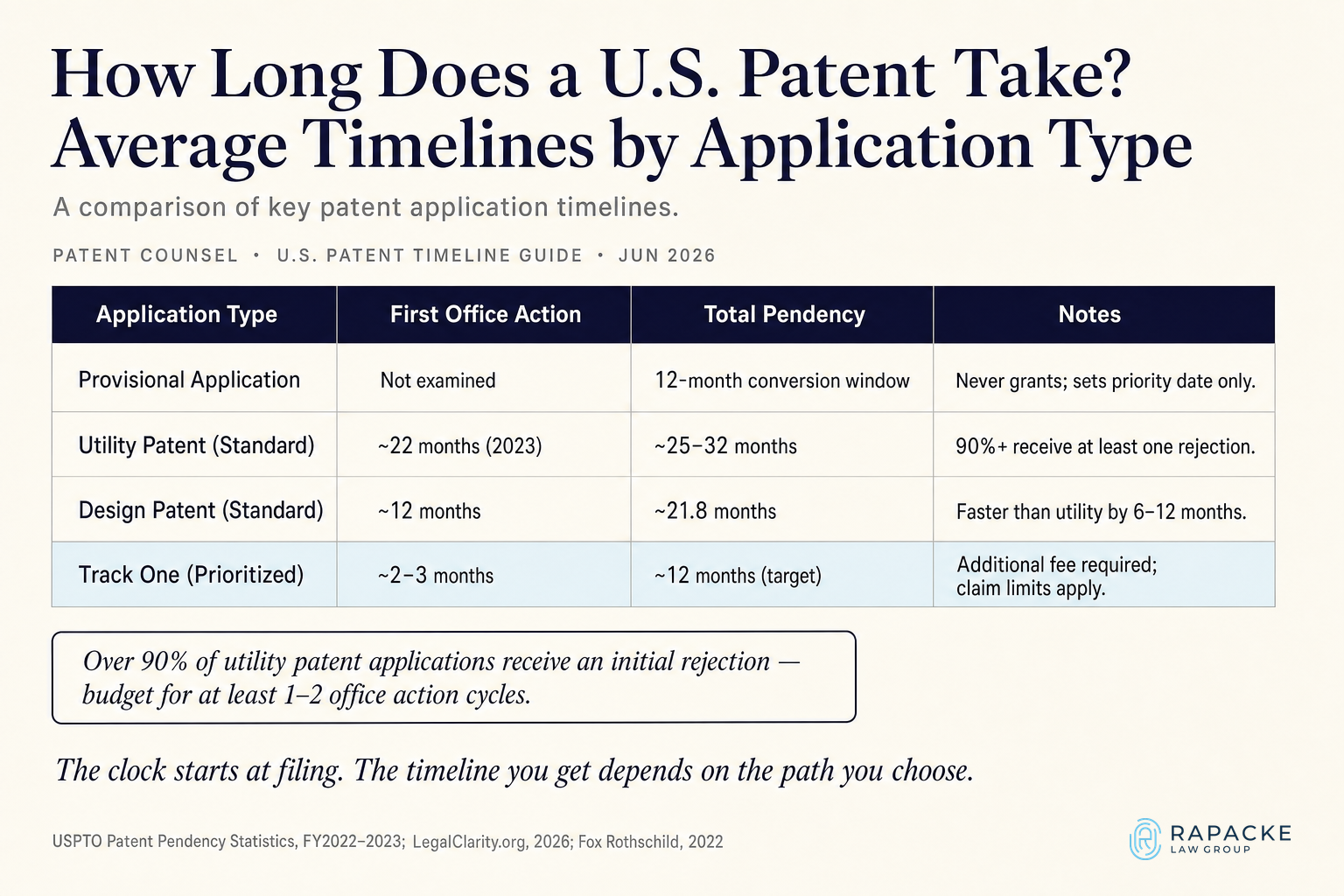 How Long Does a U.S. Patent Take? Average Timelines by Application Type/Source: USPTO Patent Pendency Statistics, FY2022–2023
The bottom line: a weak filing strategy means years of prosecution, mounting fees, and narrowed claims that may not protect your core innovation. A strong strategy, built around the right application type, accurate prior art context, and the appropriate examination track, compresses your timeline and produces issued patents that actually hold up.
Every month without granted patent protection is a month competitors can design around you, investors can question your IP moat, and your priority date sits exposed. The United States Patent and Trademark Office examination queue does not slow down once your application is inside it; the only moment you can meaningfully control your timeline is before you file.
To move forward with a clear picture of your path to protection:
- Schedule a Free IP Strategy Call to review your invention, identify the right application type, and map your prosecution timeline
- Download the SaaS Patent Guide 2.0 if you are building a software or AI product and need a framework for IP strategy at each funding stage
- Explore the AI Patent Mastery resource for guidance on protecting AI-driven inventions under current USPTO examination guidelines
According to Rapacke Law Group, its flat-fee model and the RLG Guarantee mean you know exactly what the process costs before it starts, with a full refund if the USPTO denies your provisional patent application. The right IP strategy is not just a legal expense; it is a competitive asset that compounds in value as your business grows.
To Your Success,
Andrew Rapacke Managing Partner,
Registered Patent Attorney Rapacke Law Group