

Key Takeaways
- Google's 2012 Motorola Mobility acquisition transferred approximately 17,000 patents in a single transaction, demonstrating that portfolio scale can be built through acquisition, not just R&D.
- The PageRank patent expired in 2019, but Google had already built hundreds of overlapping search patents. Proof that layered patent protection matters more than any single filing.
- Google leads all companies in U.S. AI patent applications as of 2025, with approximately 880 filings, ahead of Microsoft at 701 and IBM at 684.
- Android powers approximately 67% of global smartphones as of mid-2025, and Google licenses the Android trademark to device manufacturers under strict compatibility requirements, making it both a brand asset and a revenue mechanism.
- Founders can use the same tools Google relies on, PCT applications, continuation filings, CPC-based prior art searches, and federal trademark registration, at a fraction of the cost.
Google acquired roughly 17,000 patents in a single transaction when it purchased Motorola Mobility for $12.5 billion in 2012, a deal widely understood as the largest defensive patent move in tech history. That purchase illustrated something fundamental about how Google thinks: intellectual property is not paperwork filed after innovation happens , it is the strategic architecture that makes market dominance durable. This article walks through which patents drive the most value in Google's portfolio, how its trademark holdings protect billions in brand equity, and what the structure of its IP strategy reveals about protecting tech innovation at any scale.
How Google Built One of the Most Valuable Patent Portfolios in History
Google's Patent Count and Portfolio Scale Compared to Competitors
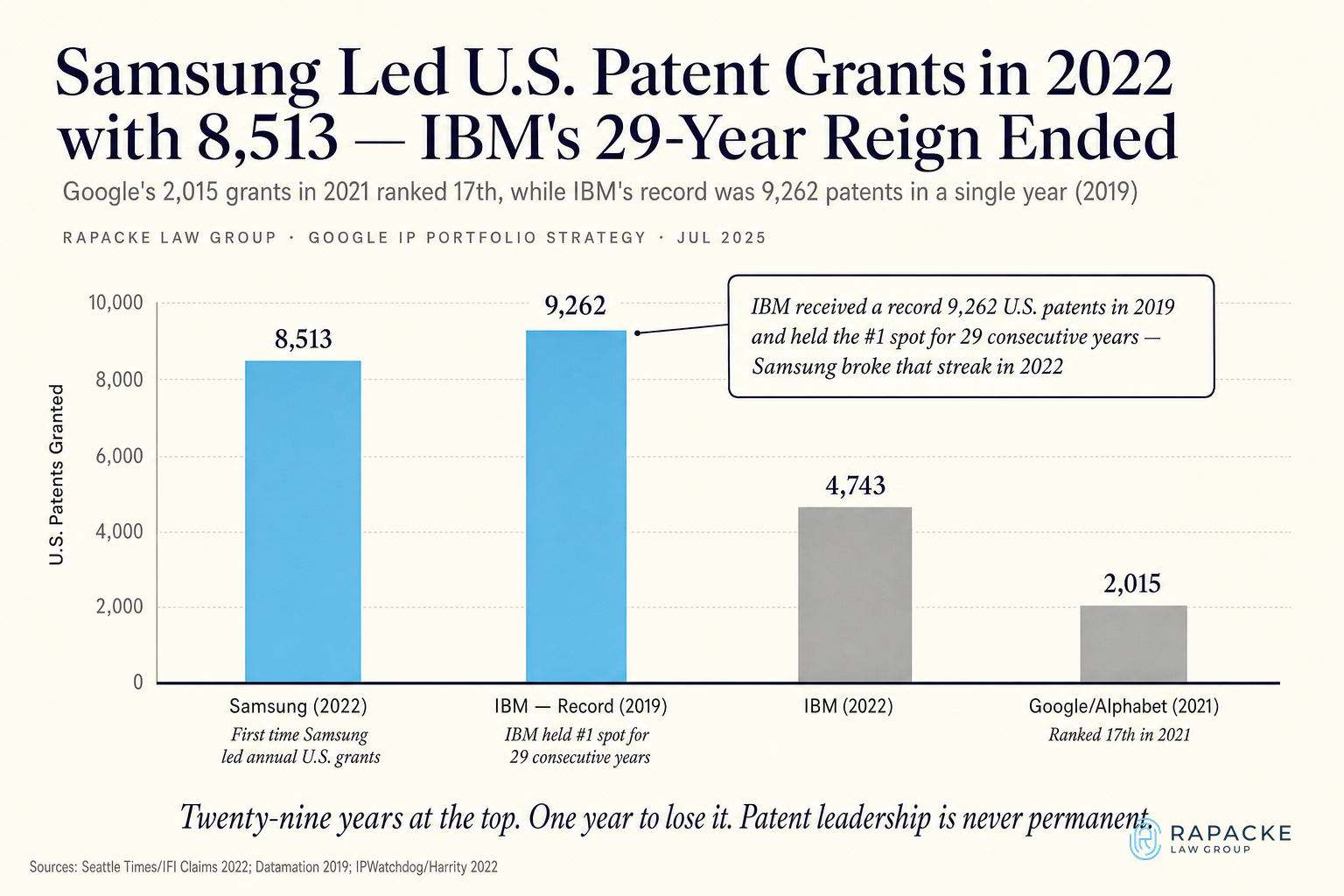
Alphabet (Google's parent company) received 2,015 U.S. patents in 2021, placing it 17th among top patent grant recipients, according to IPWatchdog's Harrity Patent Analytics 2022 Patent 300 List. That ranking understates the total portfolio size, which spans tens of thousands of active patents across U.S. and international jurisdictions. For context, Samsung Electronics led all U.S. patent recipients in 2022 with 8,513 grants, while IBM, which held the top spot for 29 consecutive years and set a record of 9,262 patents in 2019, fell to 4,743 grants that same year, according to The Seattle Times. The data showing Samsung's 8,513 patents versus IBM's 4,743 in 2022 marks a historic shift in who dominates U.S. patent output.
The Motorola Mobility acquisition in 2012 was a turning point. Google paid $12.5 billion primarily to obtain roughly 17,000 patents covering wireless communication, smartphone hardware, and mobile software, according to Time. The deal was explicitly a patent rights play designed to shield Android from the wave of smartphone litigation that characterized that era. For a deeper look at how software intellectual property rights function as both offensive and defensive tools, the strategic logic behind the Motorola deal becomes even clearer.
How Google Uses Continuation Applications to Extend Patent Families
Google does not file patents in isolation. Continuation applications allow a company to pursue additional claims on the same underlying invention, preserving the original priority date while extending and broadening protection as the technology evolves. Over half of patents filed by large tech companies are often continuations, and Google's key innovations routinely spawn patent families with five or more continuation patents protecting variations of the core invention. The average Google patent carries approximately 18 claims, reflecting significant investment in claim depth. A competitor who designs around one claim in a family may still infringe on several continuation patents covering related approaches. This is the same strategic layering that makes source code intellectual property so difficult for competitors to engineer around when it is properly protected through patent families rather than a single filing.
Google's Use of PCT International Applications for Global Patent Coverage
Google files international patent applications through the Patent Cooperation Treaty (PCT) system, which now covers more than 158 member countries, according to WIPO. A single PCT application preserves patent rights across nearly all major commercial markets and defers country-specific filing costs for approximately 30 months, giving the applicant time to assess which markets justify full national phase entry. For technologies like federated learning and AI infrastructure, where commercial deployment is inherently global, PCT coverage is essential rather than optional. Any tech company expecting international revenue should file PCT applications before public disclosure, not after.
The Patents That Actually Drive Google's Core Business Value
Search Algorithm Patents and the PageRank Foundation
The original PageRank patent, U.S. Patent No. 6,285,999, was filed in January 1998 by Larry Page and assigned to Stanford University, which licensed it to Google. The patent expired on June 4, 2019 after its full 20-year term, as documented in the USPTO patent record for US6285999B1. During that period, Google's daily search queries grew from roughly 30 million to 5.6 billion. By expiration, Google had built hundreds of overlapping patents covering query interpretation, indexing methods, spam detection, and the graphical user interface of search results pages. The expiration of any single patent did not expose the business because no single patent protected it.
Google Search now generates the majority of Alphabet's revenue, and its patent protection is distributed across dozens of Cooperative Patent Classifications, making the portfolio far more difficult to circumvent than a single foundational filing. Understanding how to search pending patent applications is one way founders can map the competitive patent landscape before filing their own claims.
Machine Learning and AI Patents as Google's Highest-Growth Category
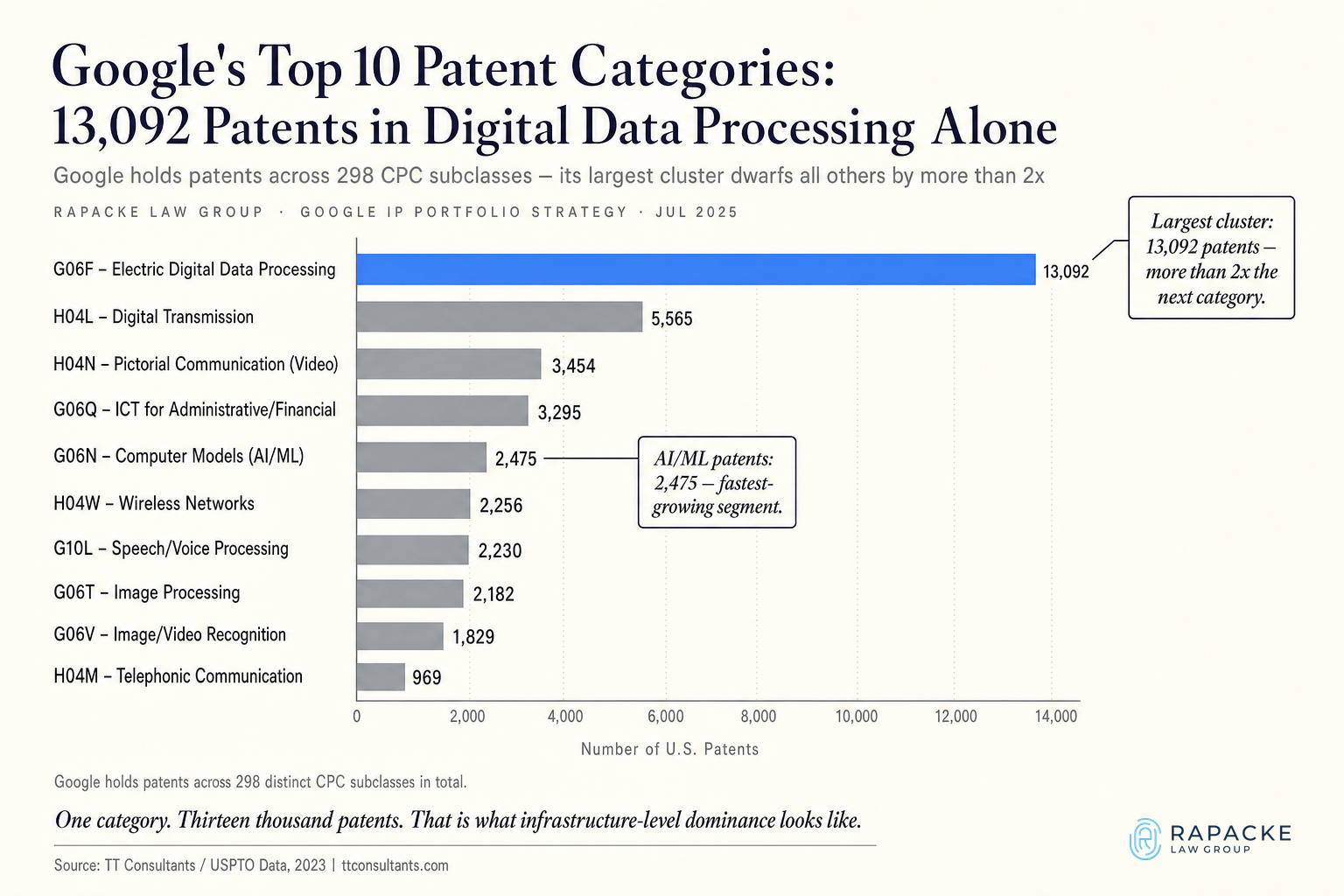
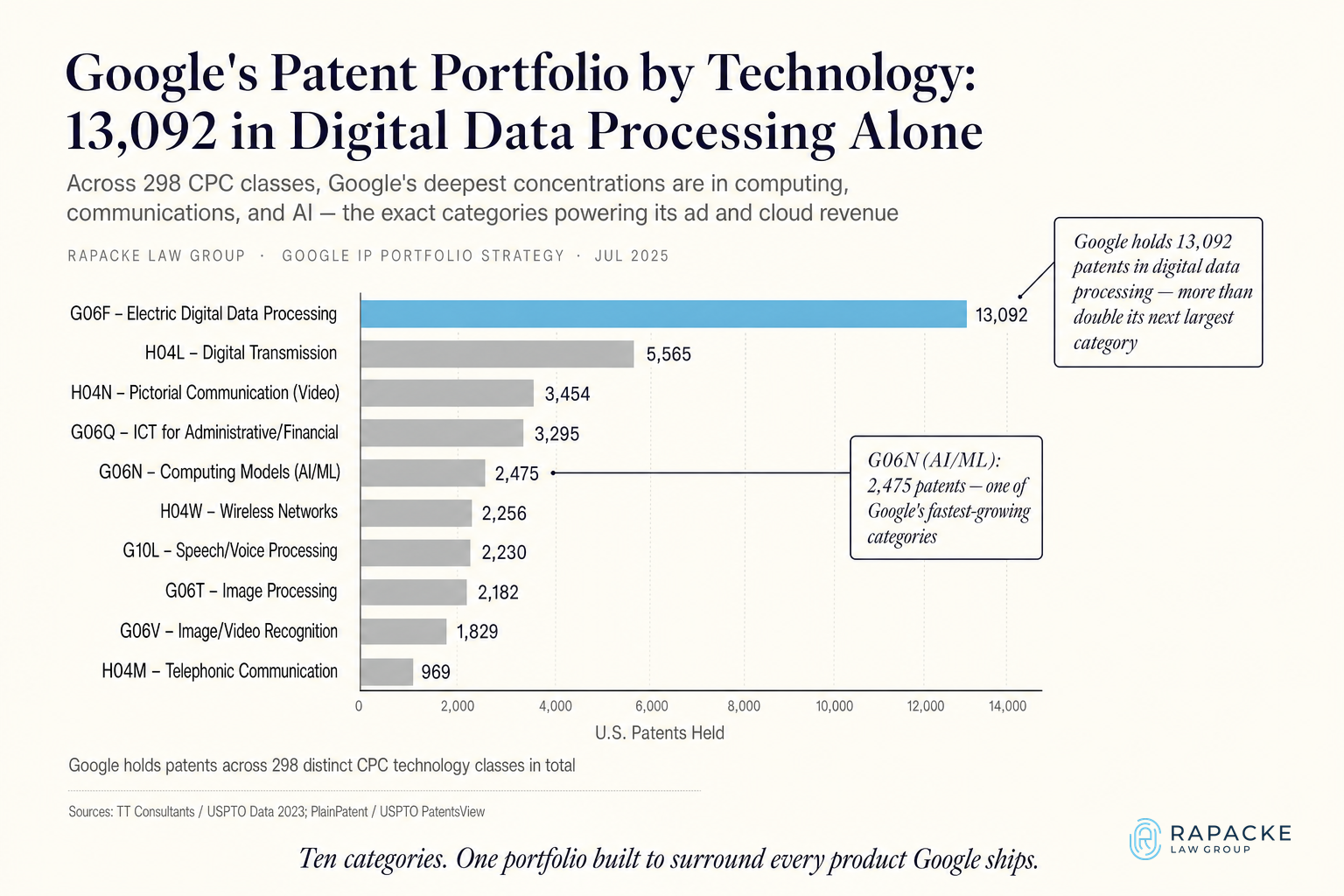
Google has emerged as the top AI patent filer in the United States. According to the Economic Times, Google held approximately 880 AI-related U.S. patent applications as of 2025, ahead of Microsoft at 701 and IBM at 684. Globally, Google also leads in generative AI patent filings with 563 applications. Google holds approximately 2,475 U.S. patents classified under G06N (computing arrangements based on specific computational models) and 2,230 under G10L (speech and audio processing). Patented technologies include TensorFlow architecture, transformer model training methods, and federated learning techniques, and the privacy-preserving machine learning approach Google has specifically protected through patent filings. Google's digital data processing patents alone number 13,092 under CPC class G06F, making it the single largest technology category in the portfolio.
The most valuable AI patents across the industry share a common trait: they were filed early in a contested technology field, before competitors could establish prior art. In a first-to-file patent system, filing early is not optional. It determines who owns the territory. For a broader view of which company holds the most AI patents and what that means for cross-licensing dynamics, the competitive stakes in this category are substantial.
Android, Hardware, and CPC Classification as a Research Tool
Google's Android portfolio spans thousands of patents across wireless protocols, device management, and application interfaces, many acquired through the Motorola transaction. Google holds approximately 5,565 U.S. patents under H04L (digital transmission) and 2,256 under H04W (wireless networking), both core to Android and Pixel device functionality. Google's portfolio spans 298 distinct technology classes under the Cooperative Patent Classifications system.
The CPC system contains roughly 260,000 finely divided technology categories, compared to approximately 70,000 in the older International Patent Classification system. To illustrate how patent classification systems organize distinct technology sectors: CPC B60R22 low matches documents classify vehicle seat belt innovations, a category entirely unrelated to Google's business, but one that demonstrates precisely how granular and sector-specific these classifications become. A patent searcher who inadvertently searches CPC B60R22 low matches documents when researching mobile interface technology would retrieve seat belt filings, not smartphone patents. This is why identifying the correct classification code before searching is critical. Understanding the correct CPC codes for your technology turns a general keyword search in Google Patents into a precise competitive landscape analysis. A SaaS founder developing document automation tools, for instance, would search under G06F40 (natural language processing) to locate all competitor filings and identify white space before filing. You can explore practical applications of this approach in our guide to software patents and protecting key features.
Google's Trademark Portfolio and What Protects Billions in Brand Equity
The Google Wordmark as a Registered Trademark
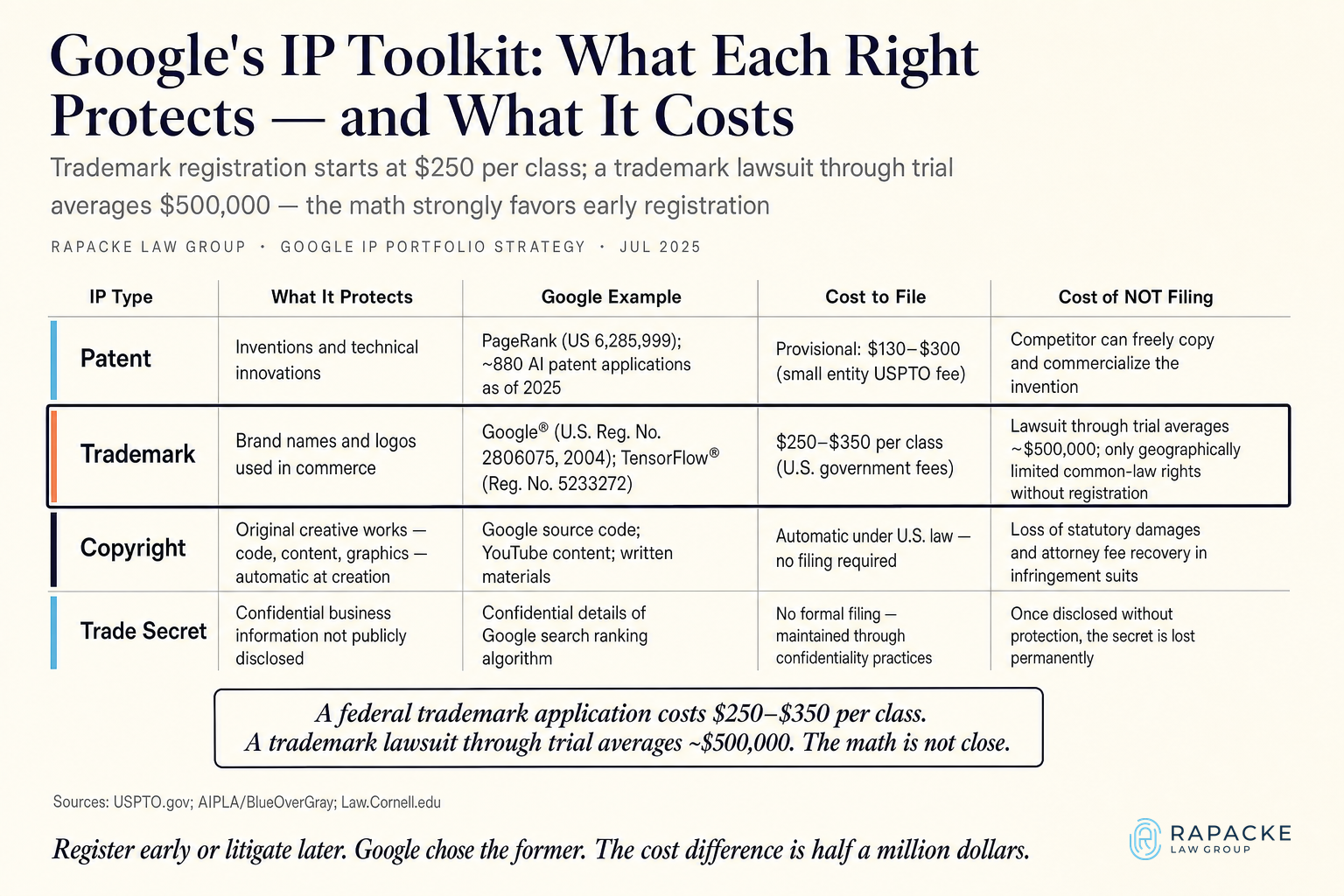
"Google" is a federally registered trademark in the United States (USPTO Registration No. 2806075), first registered in 2004, as recorded in the USPTO's official trademark database. The registration covers software, internet services, communication services, and online advertising. Google LLC holds hundreds of active trademark registrations across multiple international classes, covering not just the core "Google" mark but separately registered marks for Gmail, Chrome, Google Cloud, Google Maps, Google Ads, and dozens of other products. Unlike patent rights, which expire after 20 years, trademark rights can last indefinitely with proper maintenance and renewal, giving Google permanent brand protection for assets that took decades to build. International coverage is maintained through the Madrid Protocol system administered by WIPO, allowing a single international application to seek registration across member countries simultaneously.
A comparison of Google's core IP tools (what each right protects and its associated cost structure) is shown in the chart above. Founders managing their own brand presence should also understand how to stop competitors from using your trademark in Google Ads, since search advertising is one of the most common channels for trademark misuse.
YouTube and Android as Independent High-Value Trademark Assets
Google acquired YouTube in 2006 for $1.65 billion, according to the Associated Press, and the brand has grown into one of the most recognized media properties globally. Android's trademark value is inseparable from its market dominance: as of mid-2025, Android powers approximately 67% of smartphones globally, according to Statcounter GlobalStats. Google licenses the Android trademark and Google Mobile Services to device manufacturers under strict compatibility requirements managed through the Open Handset Alliance. Partners must meet defined technical standards to legally use the Android name on their devices, making the trademark both a brand asset and a platform-control mechanism. Trademark licensing of this kind generates commercial leverage far beyond simple brand recognition. This same principle applies across product categories, including sporting goods brands where platform-level trademark control drives licensing revenue at scale.
How the Google Patents Search Tool Works and Why It Matters for IP Research
Searching by Patent Number, Assignee, and Prior Art Finder
Google Patents (patents.google.com) indexes more than 120 million patent publications from over 100 patent offices worldwide, according to Google's support documentation. Coverage includes the USPTO, European Patent Office, WIPO PCT applications, and major national offices including China, Japan, Germany, and South Korea, with machine-translated abstracts for non-English patents. The prior art finder feature uses machine learning models to surface semantically similar patents beyond exact keyword matches, which is particularly useful during early patentability analysis. Users can search by patent number directly, by assignee name (for example, "Google LLC"), or through natural-language queries. Google Patents is a powerful free resource for general informational purposes and initial landscape research, but it does not replace a formal prior art search conducted by a registered patent attorney and does not create an attorney-client relationship.
Using Advanced Search and Cooperative Patent Classifications Effectively
The Google Patents advanced search interface filters results by filing date, patent office, CPC classification, inventor, and assignee, producing far more targeted search results than keyword queries alone. Knowing the relevant CPC subclass for your technology is the single highest-leverage step a founder can take before an initial patent consultation. It converts a broad search into a precise competitive map, identifies prior art that might otherwise be missed, and makes the initial attorney consultation more efficient and less expensive. Learning two or three relevant CPC codes before engaging counsel is one of the most practical things a tech founder can do. This is especially relevant for AI-driven software, where understanding whether you can patent an algorithm often depends on how precisely the claims are scoped relative to existing CPC-classified prior art.
What Google's IP Enforcement Strategy Reveals About Protecting Tech Innovation
Patent Litigation and Defensive Patent Aggregation
Google has been a party to some of the most significant patent disputes in technology history. The Oracle America v. Google case, decided by the U.S. Supreme Court in 2021, centered on whether Google's use of Java APIs in Android constituted copyright infringement. The Court ruled in Google's favor on fair use grounds, preserving Android's technical foundation and setting an important precedent for software interoperability.
Google has also participated in defensive patent aggregation through the License on Transfer (LOT) Network, which limits the ability of patent assertion entities to weaponize patents transferred in commercial transactions. According to the American Intellectual Property Law Association, patent litigation in the technology sector can cost between $2 million and $4 million per case through trial, a figure that makes defensive portfolio strategy economically rational before any lawsuit is filed. Understanding the importance of intellectual property for AI makers is essential context for any founder building in a category where Google is an active patent filer and litigant.
Google's Open Source Strategy as an IP Decision
Google has open-sourced major technologies including TensorFlow, the Android Open Source Project (AOSP), and Chromium, while retaining patent rights and trademark control over the commercial versions. This is a deliberate intellectual property strategy. Open-sourcing accelerates ecosystem adoption, which entrenches the platform, while trademark registration on commercial versions (Google Chrome, Google Android) preserves brand control and licensing leverage. Google has also published an Open Source Patent Grant covering specific contributions, with defined conditions. Open-sourcing technology and protecting IP are not mutually exclusive positions. Selective patenting of core innovations can coexist with an open-source distribution model, and Google's approach demonstrates this at scale.
What Startups and Founders Can Learn from Google's IP Playbook 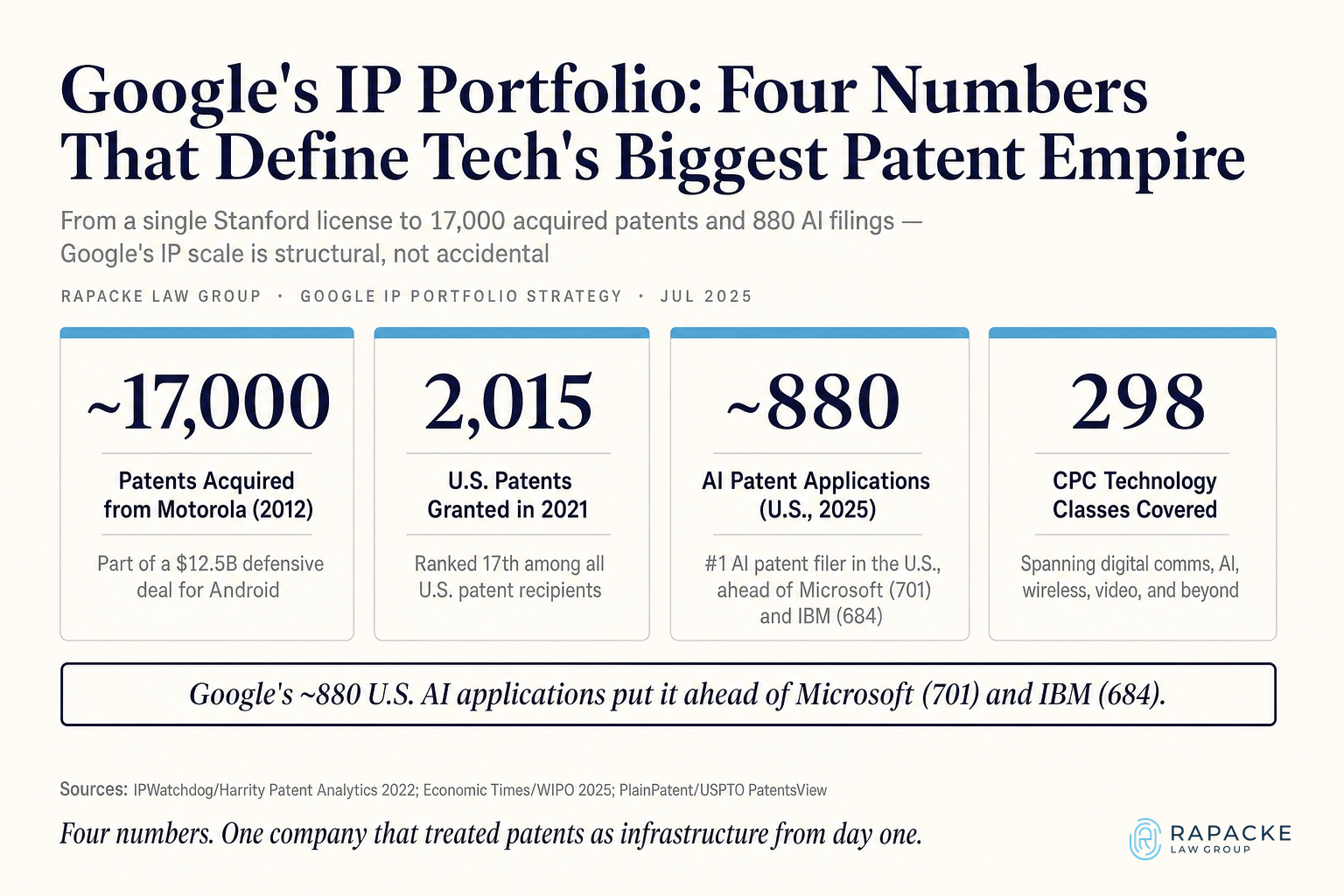
Google's IP Portfolio: Four Numbers That Define Tech's Biggest Patent Empire. Source: IPWatchdog / Harrity Patent Analytics, 2022; Economic Times / WIPO, 2025; PlainPatent / USPTO PatentsView
Building a Patent Portfolio That Scales With Your Product Roadmap
Google initially relied on licensing the PageRank patent from Stanford before building its own portfolio aggressively after achieving commercial success. The lesson is not to wait. Under 35 U.S.C. § 102, U.S. patent applicants have a one-year statutory bar from the date of first public disclosure. A founder who presents at a demo day, launches a product, or publishes a blog post without first filing a patent application may permanently forfeit patent rights on that invention. A provisional patent application establishes a priority date at a fraction of the cost of a non-provisional filing and provides 12 months to validate product-market fit before committing to full prosecution. Rapacke Law Group backs every provisional patent application with the RLG Guarantee: if the USPTO denies your application, you receive a full refund, removing the financial risk from that first critical filing step. Filing before any public disclosure is not cautious behavior; it is the minimum standard for founders who want to preserve their options.
If you are building in an AI or SaaS category, the SaaS Patent Guide 2.0 and AI Patent Mastery resource walk through exactly how to structure a patent strategy that scales with your product roadmap.
Trademark Registration as the First Line of Brand Protection
Google's trademark strategy of registering the core brand and every major product name separately across all relevant goods-and-services classes is directly applicable at the startup stage. A founder who builds brand recognition without a federal trademark registration has no presumptive rights against a later filer who registers the same mark first. According to the USPTO's current fee schedule, a federal trademark application costs between $250 and $350 per class of goods or services. According to AIPLA survey data, trademark infringement litigation costs an average of $375,000 to $500,000 per side through trial. Proactive registration is not an overhead expense; it is insurance against a far larger cost. Rapacke Law Group's trademark registration comes with the RLG Guarantee: get your trademark approved or pay nothing, with a 100% refund if your application is rejected.
If you are approaching a funding round, product launch, or public demo, your IP position deserves a professional review before you step into the spotlight. Rapacke Law Group offers a free IP strategy call with transparent flat-fee pricing so founders can understand exactly what patent and trademark protection will cost before problems arise, not after.
Frequently Asked Questions About Google Intellectual Property
Is Google an LLC or Inc? Google LLC is a wholly owned subsidiary of Alphabet Inc., the publicly traded parent company formed in 2015 through a corporate restructuring. For patent and trademark purposes, most intellectual property is held directly by Google LLC as the assignee, though some assets are held by specific subsidiaries such as DeepMind Technologies Limited. Google was originally incorporated as a California corporation before restructuring under Delaware law prior to the Alphabet reorganization.
Can I get a patent through Google? Google does not grant patents. Patents are issued exclusively by national patent offices such as the United States Patent and Trademark Office (USPTO) or the European Patent Office. Google operates Google Patents (patents.google.com), a free public database that indexes patent documents from over 100 international patent offices, but it is a research tool only. Filing a U.S. patent application requires submitting directly to the USPTO, ideally with the assistance of a registered patent attorney or agent. Nothing in Google Patents creates an attorney-client relationship or constitutes legal advice.
Who owns the most patents in the US? IBM held the record for most U.S. patents granted annually for 29 consecutive years, setting a single-year record of 9,262 grants in 2019 according to Datamation. In 2022, Samsung Electronics displaced IBM with 8,513 grants. Google and Alphabet have risen significantly in the rankings since the Motorola acquisition and the acceleration of AI patent filings. IFI Claims Patent Services publishes the most reliable annual ranking of top U.S. patent recipients.
Is Google copyrighted or trademarked? Both protections apply. "Google" is a federally registered trademark (USPTO Reg. No. 2806075), protecting the brand name and logo from unauthorized commercial use. Google's software code and written content are protected by copyright automatically upon creation under U.S. copyright law. The Oracle America v. Google case, decided by the Supreme Court in 2021, involved copyright specifically: whether Google's use of Java APIs in Android constituted infringement. The Court ruled in Google's favor on fair use grounds.
Why is Elon Musk against patents? Musk has argued publicly that patents primarily impede innovation and favor large incumbents over startups. In 2014, Tesla announced it would not initiate lawsuits against companies using its technology in good faith. This view is a minority position among IP professionals and economists, most of whom point to patent protection as a critical mechanism for incentivizing R&D investment, particularly in capital-intensive industries where competitors could otherwise copy innovations immediately after launch.
What is Google Patents and is it reliable for prior art searches? Google Patents indexes more than 120 million patent publications from over 100 patent offices and uses machine learning models to power a prior art finder that surfaces semantically similar patents beyond keyword matches. It also translates non-English patents from offices including China, Japan, Germany, and South Korea. While Google Patents is excellent for general informational purposes and initial landscape research, it does not replace a formal prior art search conducted by a registered patent attorney, which applies legal judgment to relevance and produces a documented opinion suitable for filing strategy decisions.
Your Next Steps to Google-Level IP Strategy Success
Google's intellectual property portfolio is one of the primary drivers of its market position, not a byproduct of it. From the layered search algorithm patents that outlasted PageRank's expiration, to 880 AI patent applications leading every competitor, to the Android trademark licensing hundreds of millions of devices globally, Google has built IP protection that is strategic, layered, and deliberately difficult to circumvent.
The bottom line: A single patent or unregistered trademark leaves your business exposed. A layered portfolio combining continuation filings, PCT international applications, CPC-guided prior art searches, and federal trademark registration across every relevant class is what creates durable competitive protection.
The tools behind Google's portfolio are available to any founder: PCT applications for international coverage, continuation filings to extend patent families, CPC-based searches to map competitive landscapes, and federal trademark registration to protect brand equity before it is challenged. The difference between Google's approach and most startups is timing. Google files before disclosure. Most startups file after a problem arises, and the cost of reactive enforcement dwarfs the cost of proactive filing.
If your next product launch, demo day, or funding round is on the calendar, your intellectual property position should be reviewed before that event, not after. Here is how to get started:
- Schedule a Free IP Strategy Call to identify which elements of your technology and brand qualify for patent and trademark protection
- Review the AI Patent Mastery resource if you are building in an AI-driven category
- Download the SaaS Patent Guide 2.0 for a structured approach to software patent strategy
- Use the SaaS Agreement Checklist to ensure your IP assignments and licensing terms are airtight before you scale
Rapacke Law Group offers flat-fee pricing with no billable-hour surprises, backed by the RLG Guarantee on both provisional patents and trademark registrations. Your IP position is a competitive asset. Protect it before a competitor forces you to defend it.
To Your Success,
Andrew Rapacke Managing Partner, Registered Patent Attorney Rapacke Law Group