


Key Takeaways
- Software products generate at least four IP asset types: utility patents, design patents, copyright, and trademarks. Each carries its own deadline and renewal logic a single generic tool rarely handles well.
- Automated docketing that calculates deadlines from trigger dates can reduce the risk of the time-management errors that drive about 27% of IP malpractice claims. Calendar reminders alone do not.
- Match the tool to your stage. Seed-stage founders need lightweight docketing with attorney access. Growth-stage teams need patent analytics and multi-jurisdiction coverage.
- AI features now cut prior art search costs from $1,500 to $4,000 down to $0 to $200, changing the ROI math.
- Software manages assets you already own. It cannot draft enforceable claims or make portfolio strategy decisions. That still requires a registered patent attorney.
*Written by Andrew Rapacke, Managing Partner, Registered Patent Attorney.* Andrew Rapacke is a registered patent attorney and the Managing Partner of The Rapacke Law Group, a full-service intellectual property law firm. He helps individuals and corporations across industries with the protection, prosecution, licensing, and enforcement of their intellectual property, with deep experience in patent, trademark, and copyright matters spanning software, AI and machine learning, blockchain, medical devices, and autonomous vehicle technology. A graduate of the United States Naval Academy, Andrew served as a Naval Engineering Officer before pursuing law and remains active in the startup and inventor communities throughout Florida.
A single missed office action deadline can turn a promising software patent into abandoned property, and . That is the core reason founders evaluate ip software solutions. By the end of this article, you will know which categories of IP protection your tech stack needs, which features separate functional intellectual property management software from underperformers, and how to match a solution to your company's stage and portfolio complexity.
Why Software Patents Make IP Management More Complex Than Most Founders Expect
Software IP is not a single asset class. One product can generate patent rights on inventive functionality, copyright on source code, trade secrets on proprietary algorithms, and design patent coverage on UI. Each carries different deadlines and maintenance rules, which is why a generic document tool fails where purpose-built ip management software succeeds. If you are unsure which protections apply, our guide on software intellectual property rights breaks down each layer.
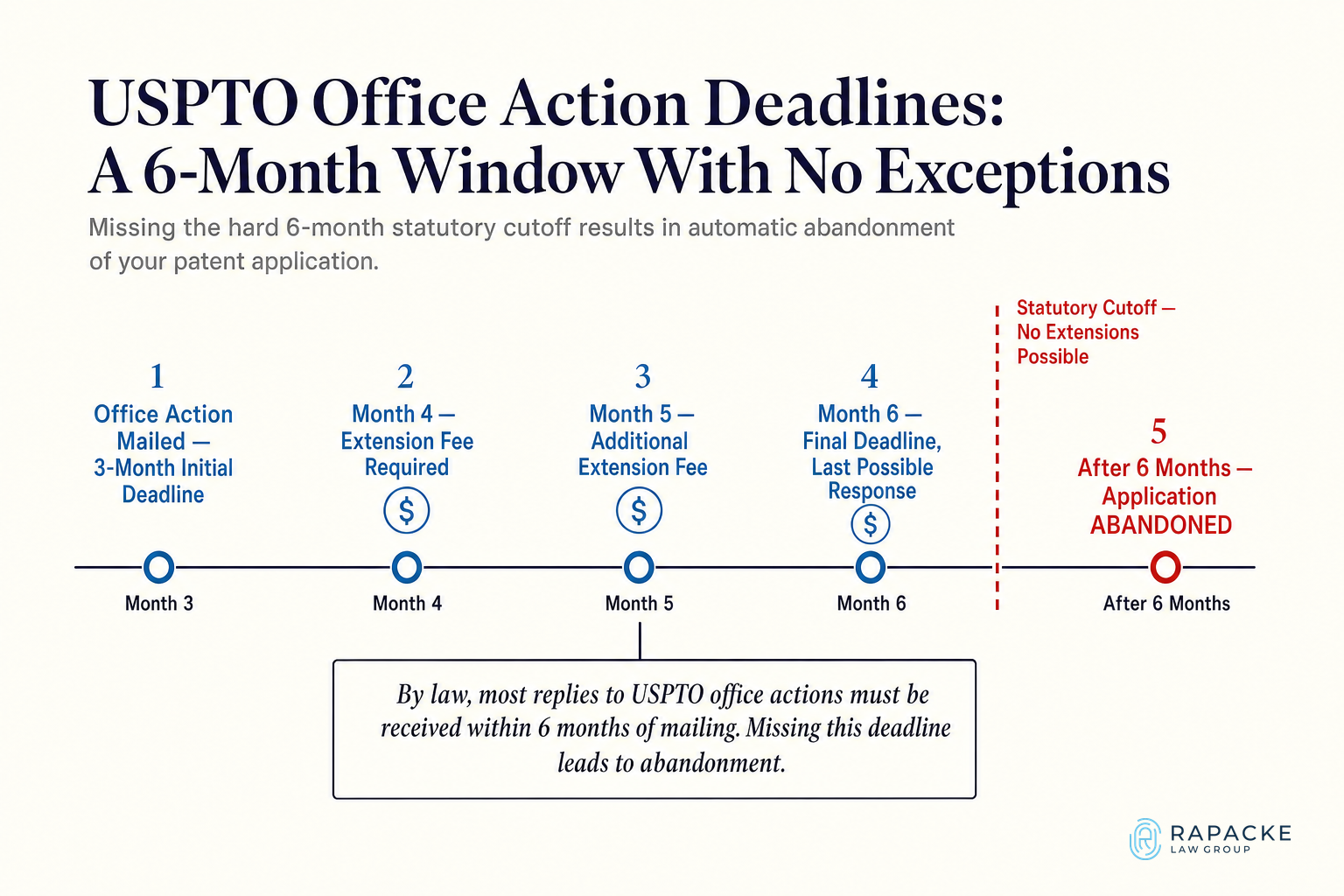 USPTO Office Action Deadlines: A 6-Month Window With No Exceptions — Source: USPTO, 2023
Software Patents Carry Strict Prosecution Deadlines That Generic Tools Miss
Under USPTO rules, most replies to a patent office action carry a shortened deadline of two or three months, with a hard six-month statutory cutoff after which the application is abandoned, per the USPTO. Extensions require fees. Any tool you evaluate needs automated deadline tracking tied to USPTO docket rules under 37 C.F.R. § 1.136, not simple calendar reminders. Founders new to this can review how to get a software patent in the US for the full timeline.
Your Codebase, UI, and Brand All Need Different IP Treatments
A SaaS product typically produces four protectable assets, utility patents for functional methods, design patents for ornamental UI, copyright for original code, and trademarks for brand identifiers. Each has a distinct registration path handled by patent offices and trademark registries worldwide. Computer technology remained the top field in published patent applications worldwide, according to WIPO. List every protectable asset before evaluating any ip management system. If you are unsure your product qualifies, is software patentable in 2024 walks through the eligibility questions.
Invention Disclosures Are the Starting Point You Cannot Skip
Invention disclosures are the internal capture mechanism that feeds your patent prosecution pipeline. NIST reported a 67% filing rate for reported inventions across fiscal years 2010 through 2014, and university rates run lower, showing how many ideas never get protected because they surface too late. Confirm any solution includes an invention disclosure submission module that handles invention submissions efficiently, not just docketing for cases already filed.
What Core Features Separate Functional IP Management Software From Overpriced Tools
Focus on capabilities that directly prevent loss of your intellectual property assets and ip assets already in your pipeline, not dashboard aesthetics.
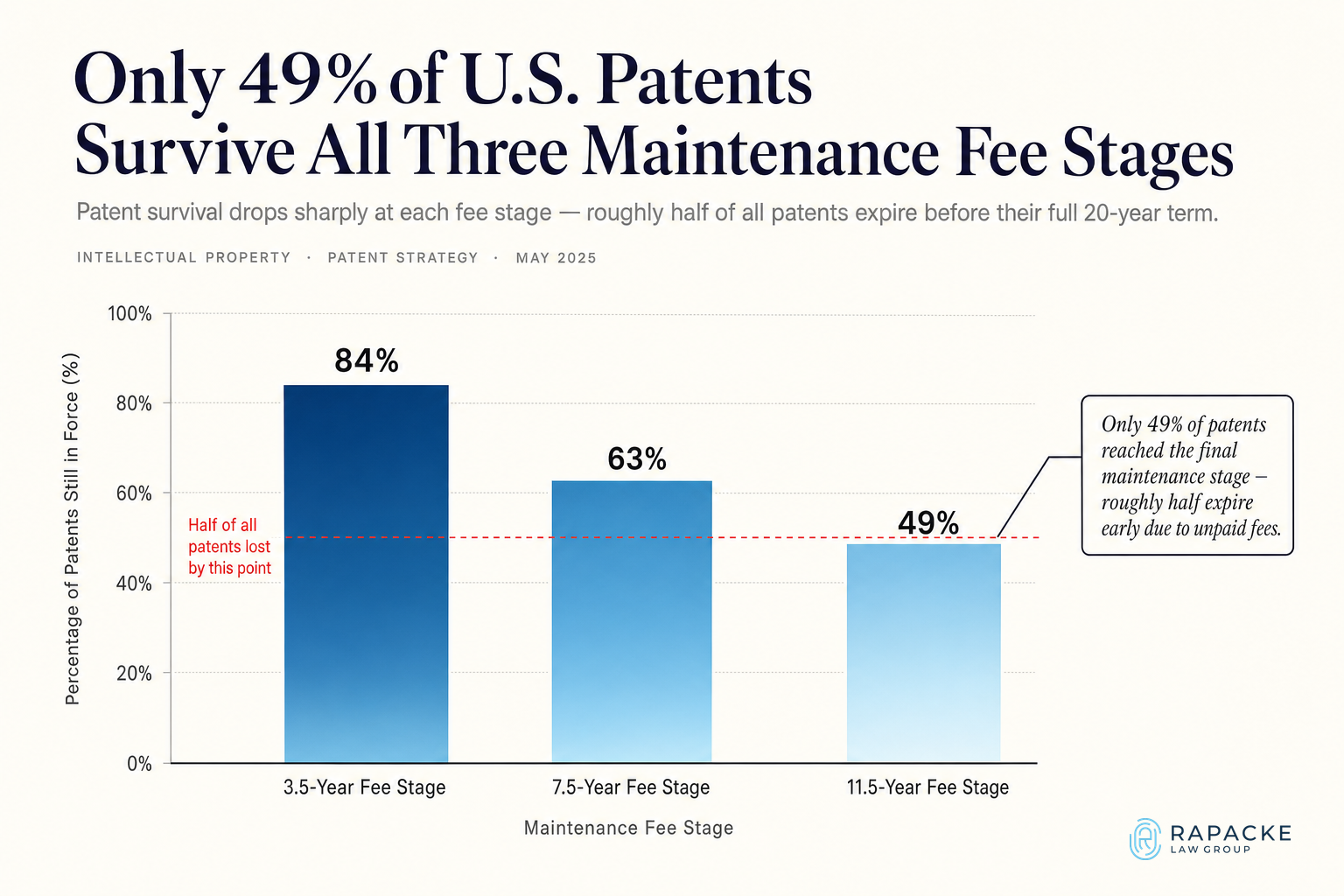 Only 49% of U.S. Patents Survive All Three Maintenance Fee Stages — Source: USPTO data analyzed by Patently-O, 2009
Deadline Tracking and Docketing Must Be Automated, Not Manual
Passive calendar alerts are not the same as active docketing that calculates a due date from a trigger event like an office action mailing date. Clerical errors, including docketing mistakes, are the most common cause of IP legal claims, per practicePRO. Ask any vendor to demonstrate how their docketing engine calculates a response deadline from an office action date.
Patent Portfolio Management Requires Analytics, Not Just Storage
Robust ip portfolio management tracks status across jurisdictions, maintenance fee schedules, and expiration forecasting. In a USPTO sample analyzed by Patently-O, 84% of utility patents paid the 3.5-year fee, 63% paid through the 7.5-year fee, and only 49% paid all three through the 11.5-year fee. Roughly half lapse early because fees went unpaid. Evaluate whether the tool shows portfolio-level analytics or just individual case files, as our patent analysis playbook explains.
Trademark Management Software Needs Renewal Alerts and Class-Level Tracking
Trademark maintenance requires a Section 8 Declaration of Use between years five and six, and a combined Section 8 and Section 9 renewal filing every ten years (starting in the ninth–tenth year window). A Section 15 declaration of incontestability is optional, not a maintenance requirement, and can be filed after five years of continuous use, often together with the Section 8 filing. Trademark management software should distinguish patent and trademark deadline logic, covering both trademark prosecution and patent docketing, since they follow different regulatory schedules, and track deadlines at the class level across multiple registrations.
How to Match IP Software Solutions to Your Company's Stage and Portfolio Size
A seed-stage startup with two provisional applications needs a different tool than a Series B company managing 40 active patents. Matching complexity to portfolio size prevents overspending and underserving, which is why effective ip management is central to sound scaling decisions.
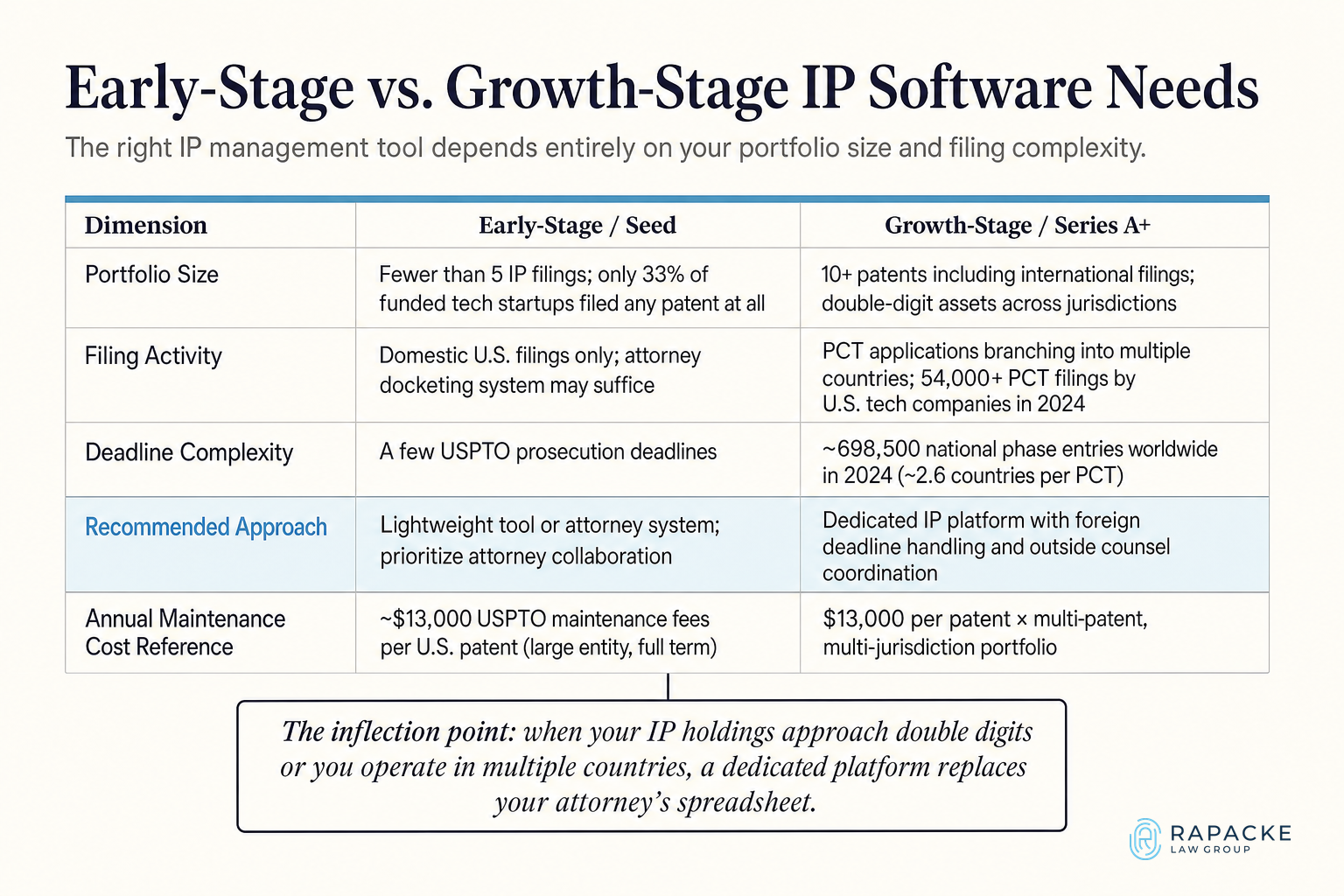 Early-Stage vs. Growth-Stage IP Software Needs — Source: TechCrunch/Menlo Ventures, 2012; WIPO PCT Yearly Review, 2025; schellip.com
Early-Stage Startups Typically Need Lightweight Docketing With Attorney Integration
At the earliest stage, the priority is organized case tracking and easy collaboration with outside counsel, including third party service providers like outside patent firms. Heavy enterprise platforms create a learning curve that consumes founder time without proportional value. Prioritize tools with clean external-sharing so your patent attorney can update dockets without manual handoffs. For a broader view, see our 5 essential IP protection strategies for tech startups.
Growth-Stage Companies Need Patent Analytics and Multi-Jurisdiction Coverage
Once a portfolio scales past 10 to 20 active matters, manual tracking breaks down. U.S.-resident applicants filed a large share of the roughly 273,900 PCT applications recorded in 2024, which led to about 698,500 national phase entries worldwide, per WIPO. Companies filing PCT applications need ip software solutions that handle foreign associate management. Test whether the platform manages both U.S. and foreign jurisdiction deadlines from a single docket.
Why Artificial Intelligence Features Are Changing IP Software Decisions Right Now
AI is now a functional capability that changes the ROI math, reflecting broader digital transformation across the legal technology landscape. AI-assisted patent searching, claim-drafting support, and prior art analysis are now embedded features. Our AI Patent Mastery resource goes deeper on protecting AI inventions themselves.
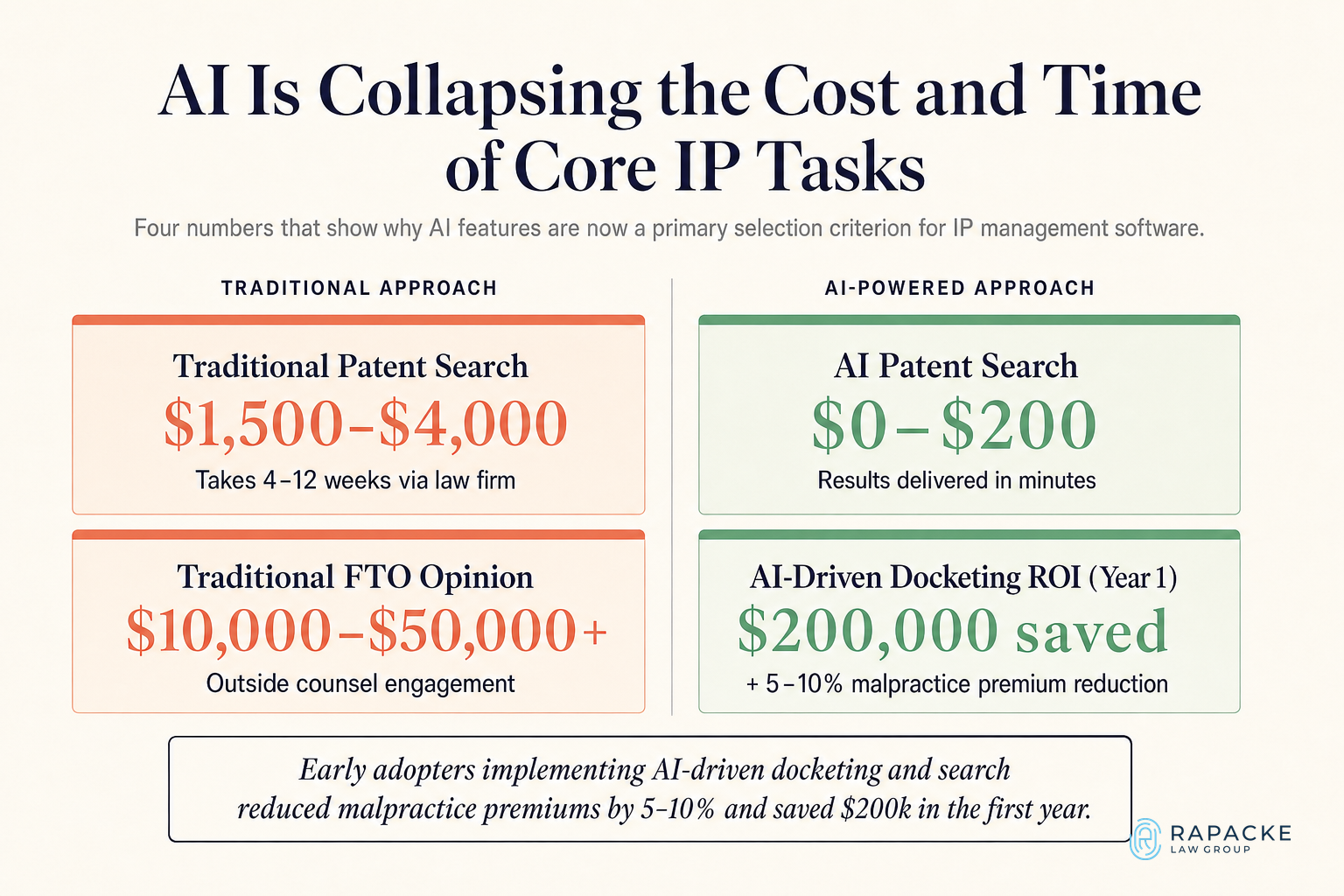 AI Is Collapsing the Cost and Time of Core IP Tasks — Source: patentia.online patent search cost data; leanlaw.co FTO and malpractice data
AI-Assisted Patent Searching Reduces Prior Art Blind Spots Before Filing
Traditional patentability searches through outside counsel run roughly $1,500 to $4,000 and take four to twelve weeks, while AI-driven tools range from $0 to about $200 and return results in minutes, per a Patentia vendor estimate. That collapse in cost and time lets founders vet inventions during the disclosure stage and stay current with technology trends in prior art. Ask vendors whether their AI search covers non-patent literature and patent data from international patent offices, not just USPTO and EPO databases.
Patent Analytics Powered by AI Help Founders Make Build vs. Buy Decisions
A formal freedom-to-operate opinion from outside counsel can cost $10,000 to $50,000 or more, based on LeanLaw advisory estimates, so AI-assisted preliminary screening gives founders early data to support informed decision making about whether to design around existing patents. Confirm the tool's analytics outputs are citation-sourced and traceable, not black-box risk scores.
The Questions You Must Ask Any IP Software Vendor Before Signing a Contract
A handful of specific questions reveal whether ip software solutions will serve your portfolio or create new problems.
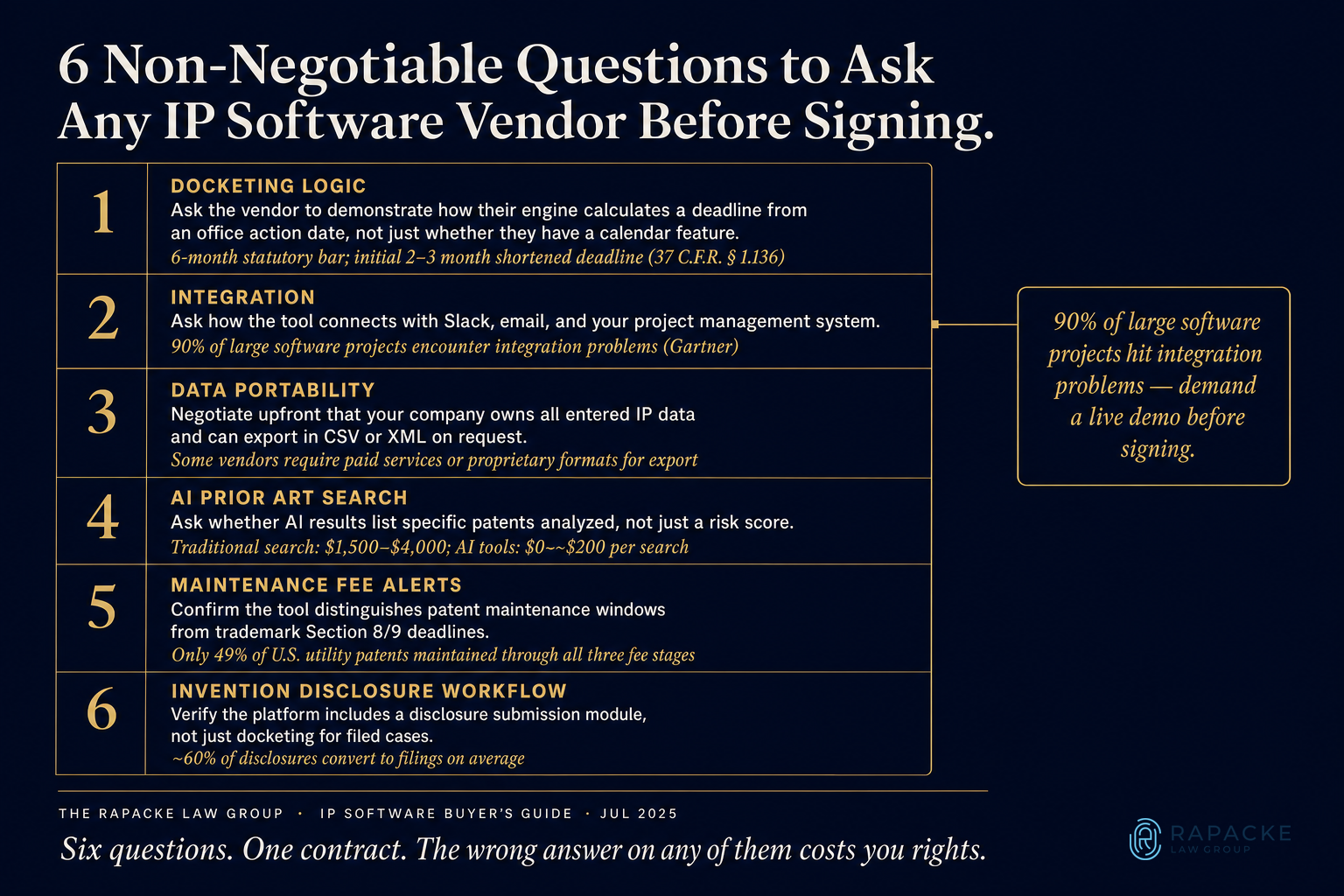 6 Non-Negotiable Questions to Ask Any IP Software Vendor Before Signing — Source: USPTO; Gartner via CRN; itnegotiationservices.com; patentia.online; Patently-O/USPTO; NIST
Integration With Your Existing Tech Stack Determines Real-World Adoption
Tools that do not connect to platforms your team already uses get abandoned within months. Gartner has warned that enterprise software integration problems commonly add cost and complexity to large projects, as reported by ChannelWeb. API availability and integrations with Slack, Google Workspace, and legal billing software determine whether the tool becomes a workflow hub or an expensive repository; vendors should also provide technical support to ease onboarding. Require a live integration demonstration with at least two platforms your team already uses.
Data Ownership and Export Rights Protect You If You Switch Platforms
Some IP SaaS contracts make migration painful through proprietary formats, paid export services, or partial exports, as IT Negotiation Services documents. Confirm in writing that your organization owns all entered data, including any patent assets captured in the system, and can export full docket records in standard formats like CSV or XML. Request a sample export before signing.
When IP Management Software Is Not Enough and You Need a Patent Attorney
Software manages what you already have. It does not build a defensible portfolio. That distinction separates administrative tools from legal strategy.
Software Cannot Draft Claims That Withstand USPTO Examination
Claim drafting requires legal expertise no ip management software provides. Your scope of protection is set at drafting, and poorly scoped claims either fail examination or leave gaps competitors design around. Software patents face added scrutiny under abstract-idea doctrine, which is why patent information about claim scope and prior rejections matters. Our overview of source code intellectual property explains why patents often beat copyright against copycats. Use software to manage the pipeline, engage a registered patent attorney to draft within it.
IP Portfolio Strategy Requires Human Judgment About Business Decisions
Which inventions to file, where to file abroad, and when to abandon or license are business decisions with real financial weight that must align with your broader business strategy. Maintaining a single U.S. patent through its full term costs around $13,000 in USPTO maintenance fees alone for a large entity under the current fee schedule, according to Schell IP. Software surfaces the data needed for sound decision making. Only an attorney who knows your business makes the call.
Frequently Asked Questions
What is IP software?
A purpose-built platform that helps inventors, startups, and law firms track and maintain patent, trademark, copyright, and trade secret assets by automating docketing and renewals and centralizing IP documents.
What are IP solutions?
IP solutions covers either software platforms that manage ip portfolios or professional services firms offering IP strategy and filing support. Most companies use both.
What are the 4 types of IP?
Patents, trademarks, copyrights, and trade secrets. For a tech startup, utility patents for functional innovations, design patents for UI, trademarks for your brand, copyright for source code, and trade secret protection for proprietary algorithms.
What are the 4 pillars of IP?
Creation, registration, maintenance, and enforcement. Software mainly supports maintenance, while an attorney supports creation and enforcement.
Your Next Steps to IP Software Success
Choosing the wrong ip software solution, or skipping one entirely, creates the exact conditions where patents lapse, trademarks go unrenewed, and enforceability gaps appear at the worst possible moment.
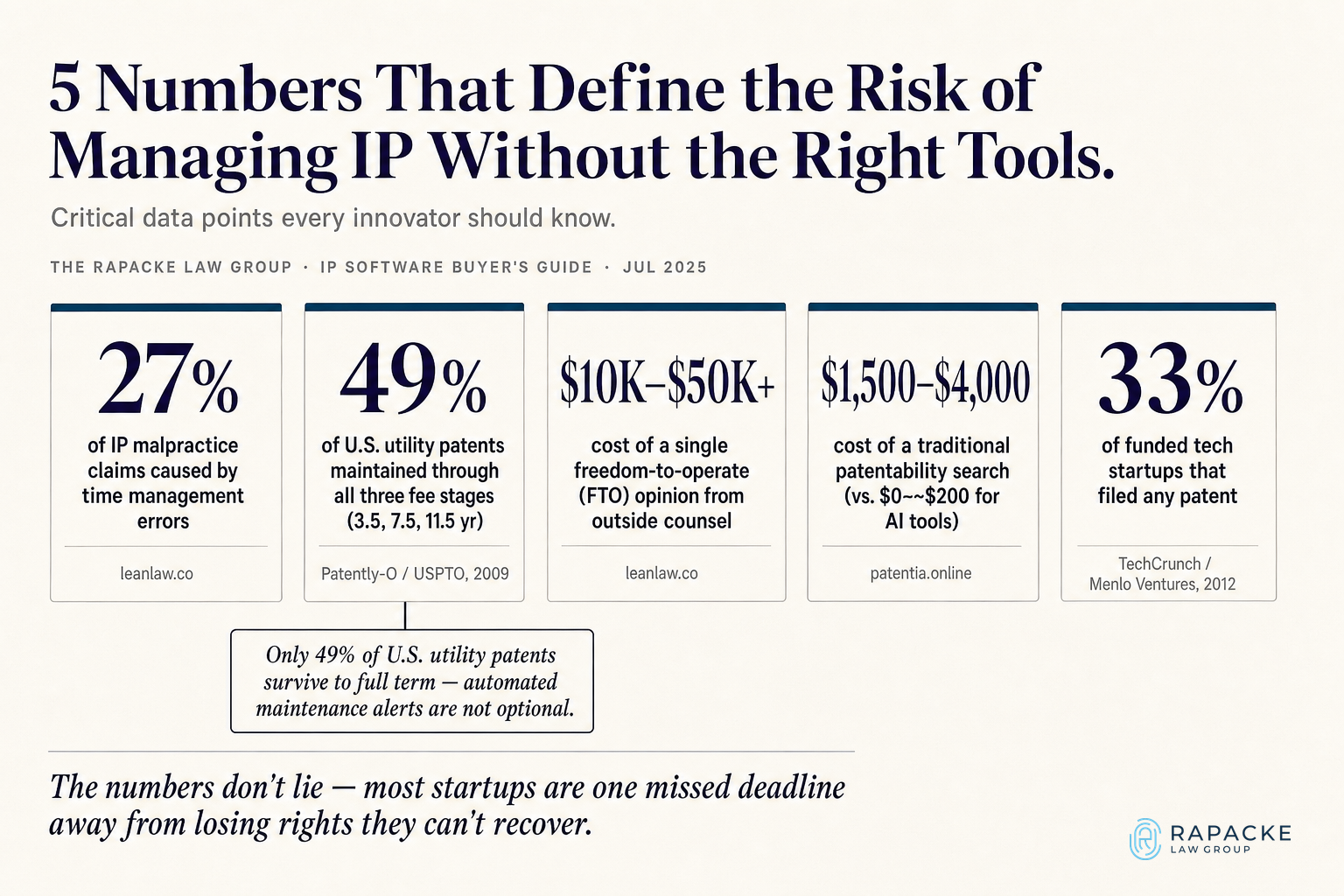 5 Numbers That Define the Risk of Managing IP Without the Right Tools — Source: leanlaw.co; Patently-O/USPTO, 2009; patentia.online; TechCrunch / Menlo Ventures, 2012
Software organizes the intellectual property assets you already hold, but a weak, narrowly scoped patent protects nothing, while a strong, well-drafted portfolio becomes a durable business asset investors reward. The tool matters. What goes into it matters more.
Every quarter you manage IP in a spreadsheet is a quarter where a missed deadline can quietly kill enforceable rights, and those losses tend to surface during due diligence or an infringement fight, often involving new software deployments or product launches. For a deeper build-out plan, see our SaaS Patent Guide 2.0.
Your action items:
- Schedule a Free IP Strategy Call to map your protection plan before buying any platform.
- Inventory every protectable asset your product generates: functional methods, UI, code, and brand.
- Confirm which deadlines are already running so nothing lapses during your evaluation.
Rapacke Law Group helps SaaS founders and tech startups build patent portfolios from the ground up with transparent, flat-fee pricing backed by the RLG Guarantee. A right-sized tool paired with sound strategy turns your IP from an administrative chore into a competitive advantage.
To Your Success,
Andrew Rapacke
Managing Partner, Registered Patent Attorney
Rapacke Law Group