
Key Takeaways
- Under 35 U.S.C. § 284, a patent owner is guaranteed at least a reasonable royalty the moment infringement is proven, even without evidence of lost sales.
- Lost profits produce larger awards but require meeting the four-part *Panduit* test. From 2008 to 2017, only about 19% of patent damages awards for practicing companies used lost profits alone.
- Willful infringement can triple your compensatory award under § 284. Empirical work by Tripathi suggests willfulness findings rose from about 23% of district court decisions before *Halo* to roughly 56% afterward.
- Apportionment limits your royalty to the value of the patented feature, not the entire product, unless the rare entire market value rule applies.
- Document your patent notice, licensing history, and market position before filing. That evidence drives both your damages theory and your settlement leverage.
*Written by Andrew Rapacke, Managing Partner, Registered Patent Attorney.* Andrew Rapacke is a registered patent attorney and the Managing Partner of The Rapacke Law Group, a full-service intellectual property law firm. He helps individuals and corporations across industries with the protection, prosecution, licensing, and enforcement of their intellectual property, with deep experience in patent, trademark, and copyright matters spanning software, AI and machine learning, blockchain, medical devices, and autonomous vehicle technology. A graduate of the United States Naval Academy, Andrew served as a Naval Engineering Officer before pursuing law and remains active in the startup and inventor communities throughout Florida.
A startup founder discovers that a competitor has been selling a product built on their patented technology for three years, raising immediate questions about patent validity, existing patents in the space, and the strength of their patent application. The first question is almost always the same, how much can I actually recover? Patent infringement damages are the financial remedy the law provides, and the numbers can be staggering. In April 2023, Netlist, a memory technology company, won a $303.15 million verdict against Samsung for infringing its DRAM patents, according to a Netlist SEC filing. The memory patent wars have only escalated since, with a Texas jury ordering Kioxia to pay $229 million to Viasat in 2026. Nine-figure awards are rare, but they show what is at stake.
This article breaks down the two primary damage types, how courts calculate each, what can multiply or limit your award, and what a realistic outcome looks like for an inventor or growing tech company seeking legal advice. Along the way, it covers the IP strategy and patent protection decisions that determine whether you are in a position to enforce your rights at all — from claim drafting and documentation to licensing programs and portfolio building.
What Patent Infringement Damages Actually Are Under U.S. Law
Under patent law and the Patent Act, patent damages are primarily compensatory, meant to make the inventor whole, though enhanced damages for willful infringement serve a punitive purpose, and the statute sets a firm floor for every case. If you are still working through the earlier stages of protection, our guide on how to patent a product walks through the steps that put you in a position to enforce later.
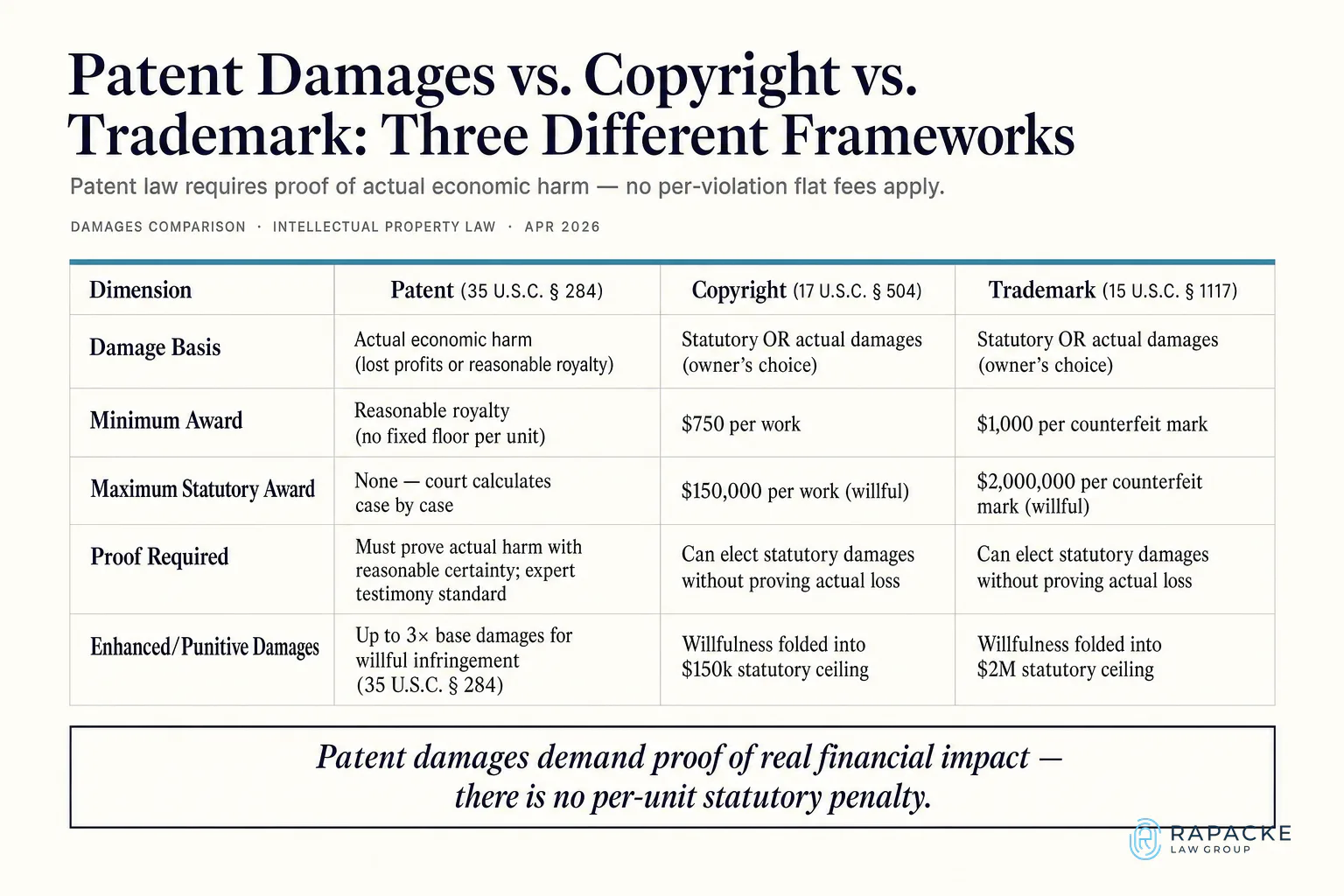 Patent Damages vs. Copyright vs. Trademark: Three Different Frameworks (Source: 35 U.S.C. § 284; 17 U.S.C. § 504; 15 U.S.C. § 1117, law.cornell.edu)
The Statutory Foundation of 35 U.S.C. § 284
The core rule comes from 35 U.S.C. § 284, enacted as part of the Patent Act, which requires courts to award damages "adequate to compensate for the infringement, but in no event less than a reasonable royalty." That last phrase is the legal floor, not a ceiling. Even without financial records showing lost revenue, you are legally entitled to at least a royalty-based recovery the moment infringement is proven, whether through direct infringement or contributory infringement.
How Patent Damages Differ From Other Intellectual Property Damages
Copyright law lets owners elect statutory damages for copyright infringement up to $150,000 per work for willful cases under 17 U.S.C. § 504, and trademark law permits up to $2 million per counterfeit mark per type of goods for willful counterfeiting under 15 U.S.C. § 1117(c). Patent damages carry no such preset figures. They are purely compensatory, calculated case by case around proven economic harm. Budget your expectations around real financial impact, not per-unit statutory penalties. For the trademark side, our overview of legal remedies for trademark infringement breaks down how those numbers play out.
What the Patent Owner Must Prove
To recover, a patent holder must show a valid patent exists and that it has been infringed, protecting their intellectual property rights, then prove damages with reasonable certainty. Courts reject speculation, which is why economic expert witnesses are standard. Patent owners should document their revenue, licensing activity, and market position before they file. Understanding your rights of a patent early makes that recordkeeping far easier.
The Two Main Types of Patent Infringement Damages and When Each Applies
Every damages case runs on one of two theories, and the difference determines how much evidence you need.
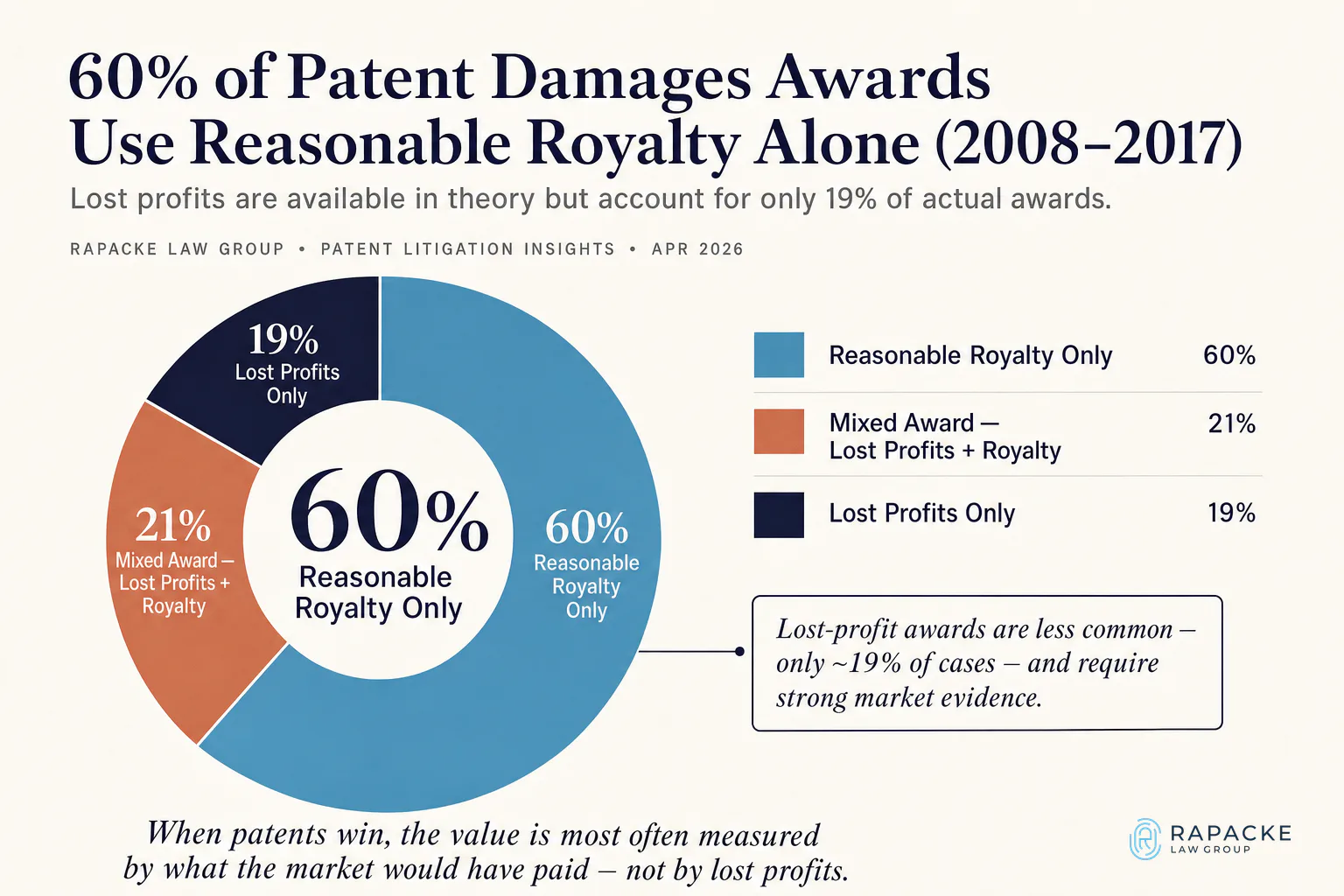 60% of Patent Damages Awards Use Reasonable Royalty Alone (2008–2017) (Source: PwC 2018 Patent Litigation Study, comparativepatentremedies.blogspot.com)
Lost Profits and Recovering What Infringement Actually Cost You
Lost profits compensate the patent owner for sales the infringer diverted through direct infringement tied to a patented invention. Courts apply the four-part test from Panduit Corp. v. Stahlin Bros. Fibre Works, demand for the patented product, no acceptable non-infringing alternatives, the capacity to meet that demand, and the profit the patent holder would have earned. Lost profits produce the higher-value claim, but they demand real proof. From 2008 to 2017, only about 19% of patent damages awards for practicing companies were based on lost profits alone, according to the PwC 2017 Patent Litigation Study. The stakes justify the effort, since lost-profits awards have historically produced substantially higher median damages than reasonable-royalty-only awards. Start building sales and market share records now.
Reasonable Royalty and the Fallback That Applies in Almost Every Case
When lost profits cannot be established in patent infringement cases, courts award a reasonable royalty. During that same window, roughly 60% of awards for practicing companies used reasonable royalty alone and about 21% mixed both. The rate comes from the hypothetical negotiation framework in Georgia-Pacific Corp. v. U.S. Plywood Corp., which lays out 15 factors including prior licensing deals, patent licensing history, commercial success, and the profit attributable to the patented feature. Reasonable royalties are calculated from market data even if you never licensed your invention.
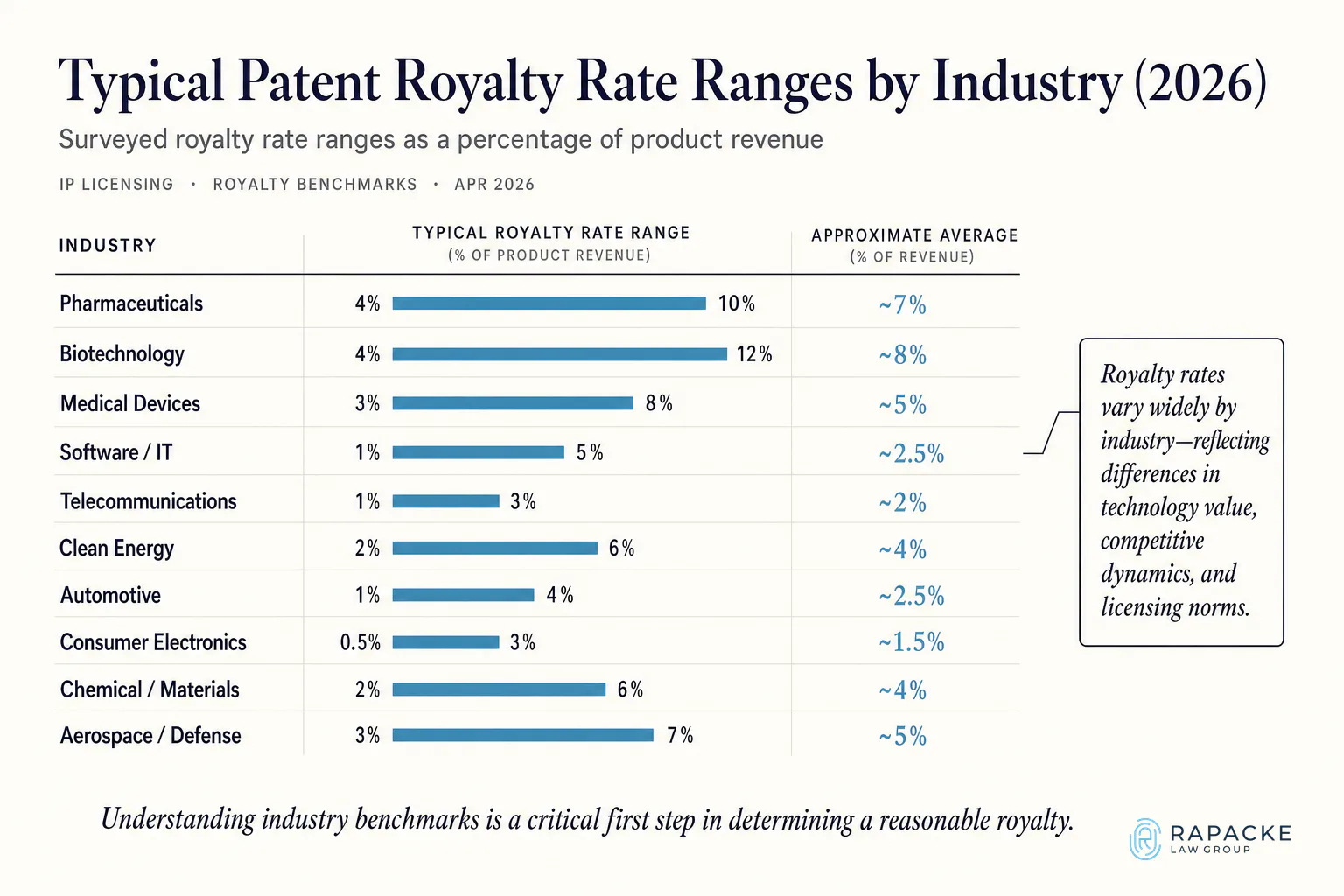 Typical Patent Royalty Rate Ranges by Industry (2026) – This table shows surveyed royalty rate ranges (as % of product revenue) in different sectors, with approximate industry-aver — Source: PatentAuditor, 2026
Can You Recover Both
Yes. Courts may award lost profits on sales you would have made and a reasonable royalty on the remaining infringing units. Work with a damages expert to segment which sales categories support which theory, and to identify whether similar patents in your space have been licensed under comparable terms.
How Courts Calculate the Reasonable Royalty Rate in Practice
The reasonable royalty is a legal fiction that drives real dollars. If your invention is software or AI based, our guide on whether you can patent an algorithm explains how the Alice/Mayo two-step test and claim-drafting choices determine whether your software invention can qualify for patent protection.
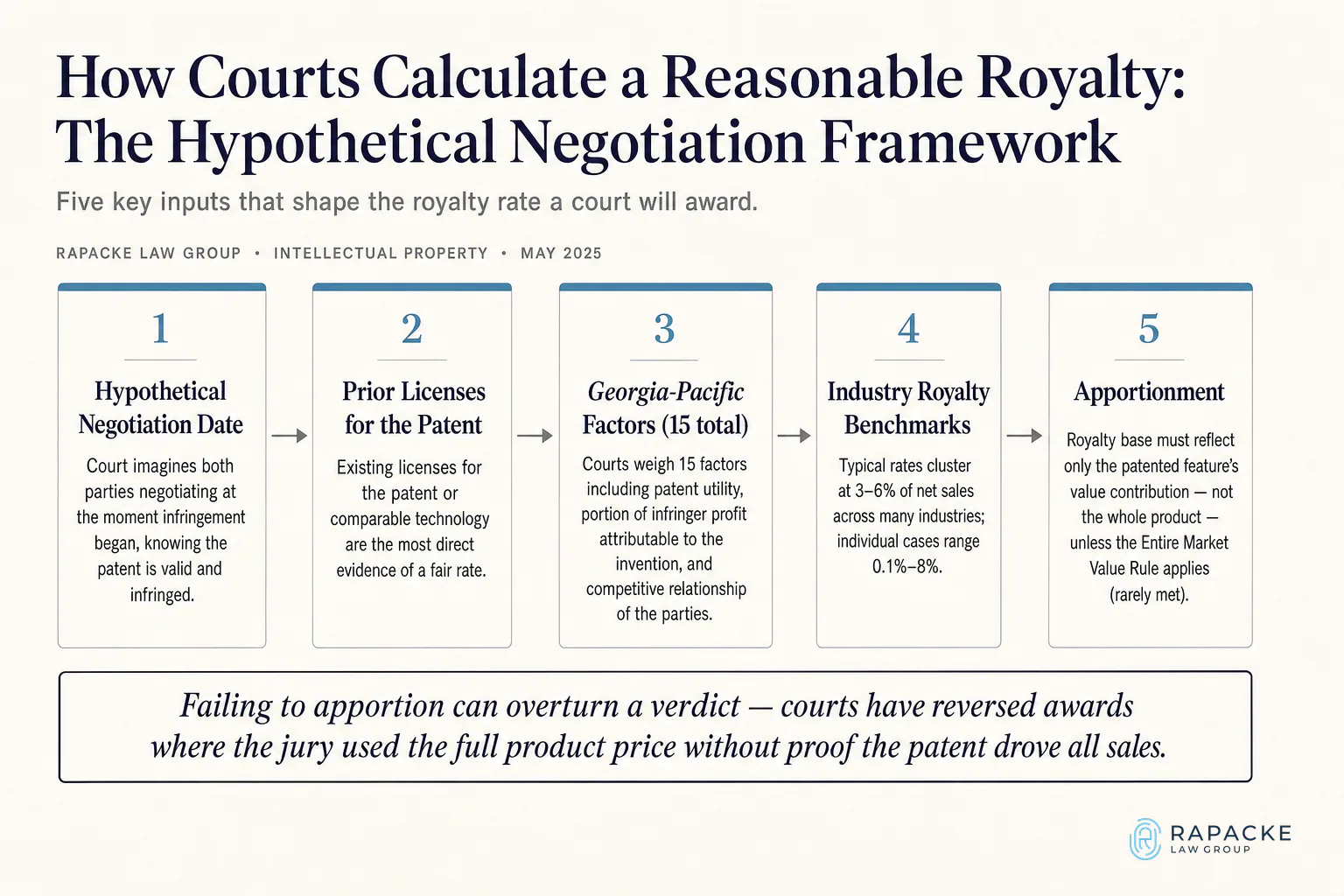 How Courts Calculate a Reasonable Royalty: The Hypothetical Negotiation Framework (Source: Georgia-Pacific Corp. v. U.S. Plywood Corp., 318 F. Supp. 1116 (S.D.N.Y. 1970); ipcg.com; law.justia.com)
The Hypothetical Negotiation Framework
Courts ask what royalty a willing licensor and willing licensee would have agreed to on the date infringement began, assuming both knew the patent was valid and infringed. This standard traces back to Georgia-Pacific Corp. v. United States Plywood Corp. and later Federal Circuit decisions. The 15 Georgia-Pacific factors guide the math, weighing comparable licenses, the parties' commercial relationship, and expected profits. Prior licensing deals become critical evidence, so document every licensing conversation.
Apportionment and Why You Usually Cannot Claim the Whole Product
Under the apportionment doctrine, the royalty base must be limited to the value of the patented feature, one of the significant features, found in the accused product, not the entire product. If your patent covers one chip inside a smartphone, the royalty base is not the phone's retail price. The Federal Circuit requires damages experts to isolate the incremental value of the invention. Expect the infringer to fight hard here.
When the Entire Market Value Rule Applies
The entire market value rule is a narrow exception that allows reasonable royalty damages on the full product price only when the patented feature drives substantially all demand. Courts apply it rarely. Do not build your damages case around it unless your feature is clearly the sole purchase driver.
When Courts Can Triple the Damages for Willful Infringement
Willful infringement is where a compensatory case becomes a punitive one, and the shift changes both the payout and the negotiation.
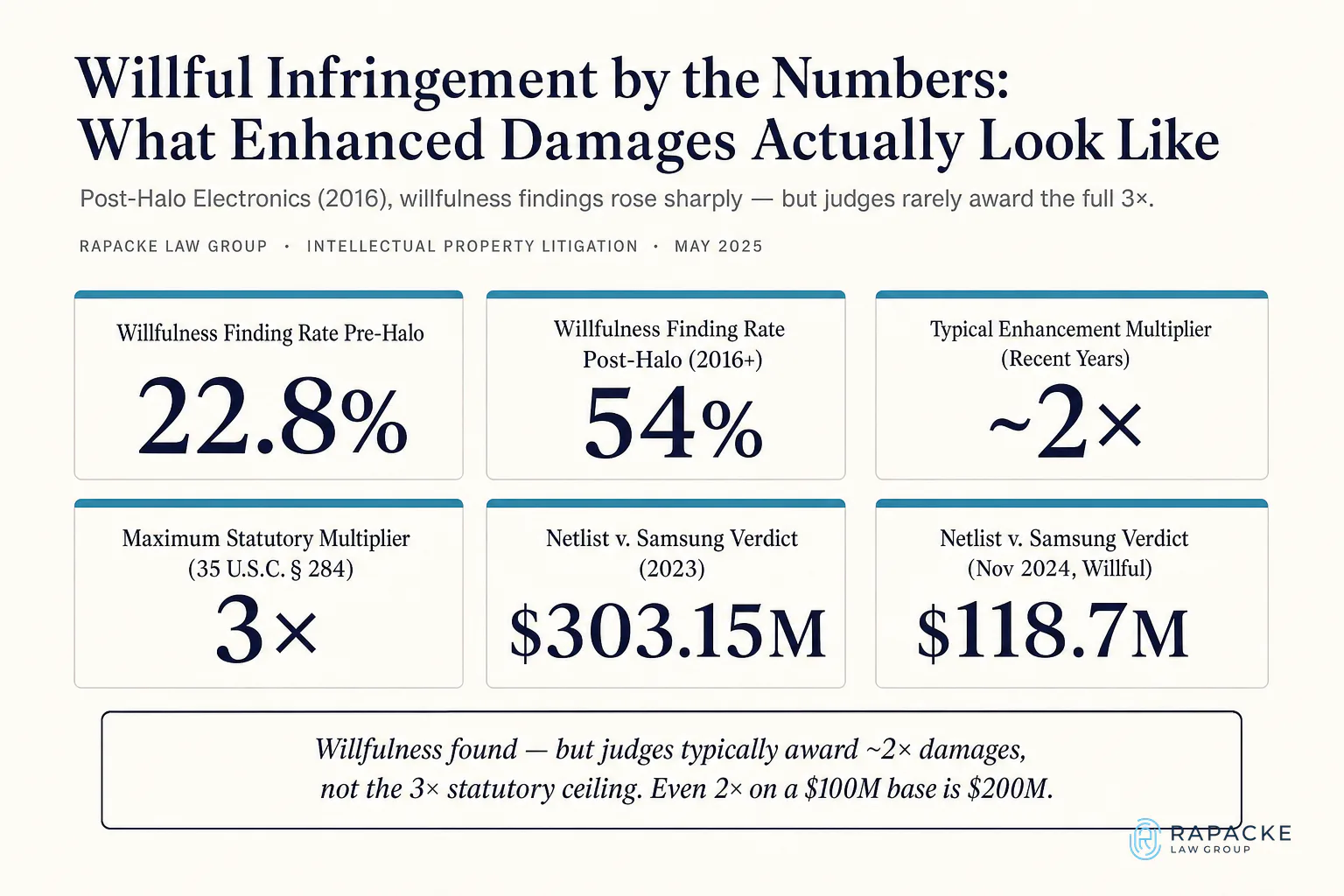 Willful Infringement by the Numbers: What Enhanced Damages Actually Look Like (Source: PwC 2018 Patent Litigation Study, comparativepatentremedies.blogspot.com; Halo Electronics v. Pulse, 579 U.S. (2016); SEC filing sec.gov; ThePrint/Reuters theprint.in)
What Willful Infringement Requires
Under § 284, courts may enhance damages up to three times the compensatory award for willful infringement. The Supreme Court's 2016 ruling in Halo Electronics v. Pulse Electronics held that enhanced damages are reserved for conduct that is willful, wanton, malicious, or flagrant, proven by a preponderance of the evidence. Empirical studies show willfulness findings increasing from roughly 23% before Halo to about 56% afterward. Enhanced damages remain far from automatic even when willfulness is found. Sandrik's 2021 study reported courts awarded enhanced damages in fewer than half of cases where willfulness was established, and the average multiplier hovered near 2x rather than the statutory ceiling of 3x. Copying a patented invention after receiving a cease-and-desist letter is the clearest example of willful infringement in a patent infringement action. Send written notice of your patent rights before filing a patent infringement lawsuit to create a record the infringer knew about your patent.
Attorney's Fees in Exceptional Cases
Under 35 U.S.C. § 285, courts may award attorney's fees in "exceptional" cases. The Supreme Court in Octane Fitness v. ICON Health & Fitness defined an exceptional case as one that stands out in the weakness of a party's position or the unreasonableness of its conduct. Fee awards in major patent cases can reach seven figures.
How Willfulness Affects Settlement Leverage
The combined threat of enhanced damages and fee-shifting shifts negotiation dynamics fast. Defendants who know they copied usually have far more incentive to settle. Still, because courts often award less than treble damages, calibrate your expectations around a likely 1.5x to 2.5x range. Documented copying evidence is some of the most powerful leverage an inventor can hold.
Injunctive Relief and Non-Monetary Remedies Available to Patent Holders
Money is only half the picture. Stopping the infringer can matter just as much as getting paid.
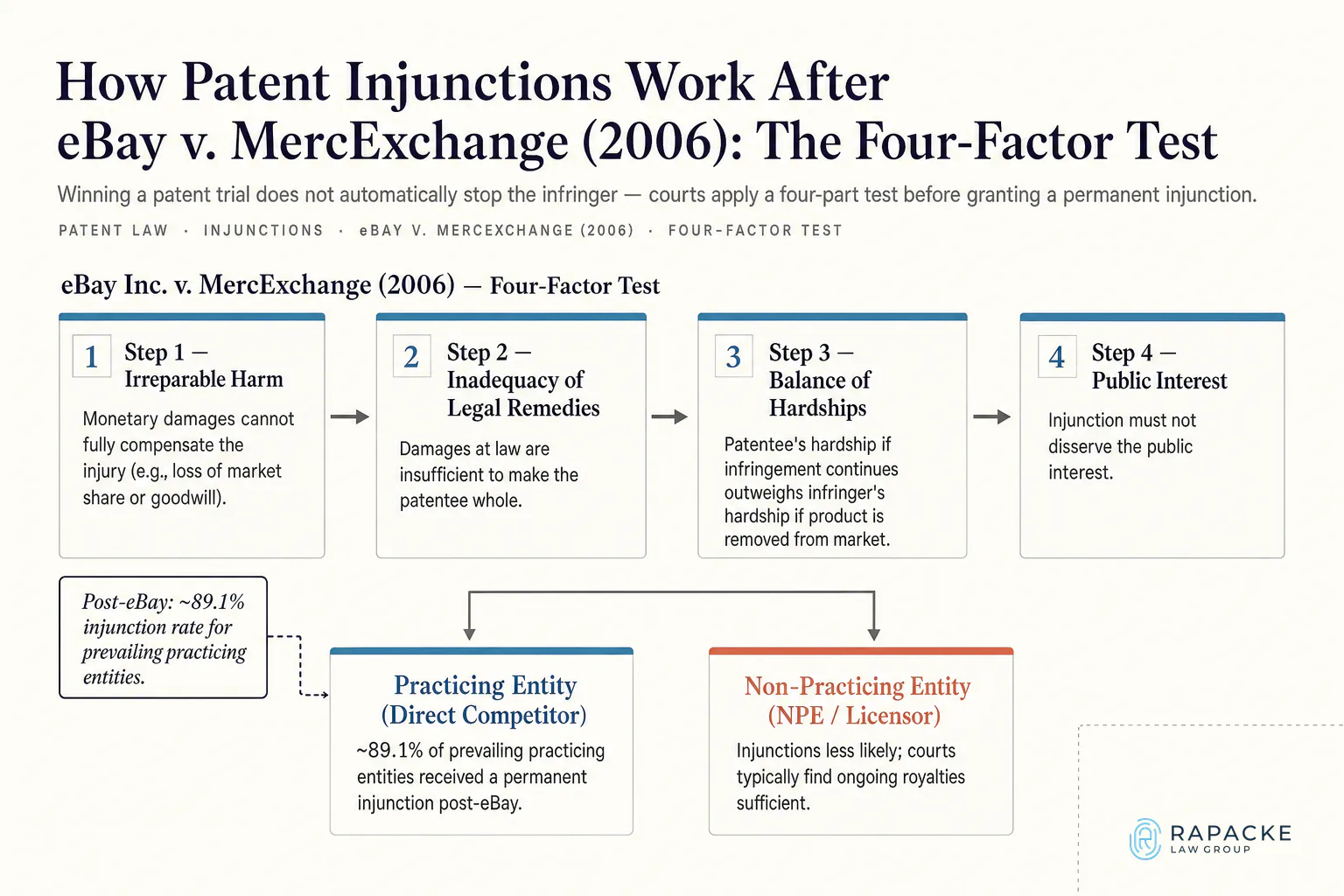 How Patent Injunctions Work After eBay v. MercExchange (2006): The Four-Factor Test (Source: patentprogress.org analysis of post-eBay patent injunction data)
Permanent Injunctions and Stopping the Infringement
A patent owner can seek a permanent injunction in federal court ordering the infringer to stop making, using, or selling the infringing product. Courts apply the four-factor test from eBay Inc. v. MercExchange, irreparable harm, inadequacy of monetary damages, the balance of hardships, and the public interest. According to Patent Progress, courts still granted permanent injunctions in roughly 85% of cases where the plaintiff won on the merits. Practicing companies fare better than non-practicing entities, which generally struggle to get injunctions because ongoing royalties can make them whole. For more information on patent infringement remedies, discuss the eBay factors with your attorney early. The design-patent battle covered in our analysis of Apple v. Samsung shows how high the stakes climb when injunctive relief is in play.
ITC Import Bans as an Alternative Enforcement Tool
The U.S. International Trade Commission can issue exclusion orders blocking importation of infringing products, a powerful tool when the infringer manufactures overseas. ITC proceedings also move faster. As of fiscal year 2025, the average investigation on the merits finished in about 16.3 months, and over the past decade that merits average has run between roughly 15 and 19 months, well under a typical district court timeline. If your infringer builds abroad and sells in the United States, an ITC action may deliver faster relief.
Prejudgment Interest and Ongoing Royalties
Courts routinely add prejudgment interest to compensate for the time value of money lost during the period of patent infringement actions. They may also order ongoing royalties for infringement that continues after judgment. The longer infringement runs before resolution, the larger the interest component grows.
What the Netlist Samsung Lawsuit Reveals About Real World Patent Damages
The Netlist Samsung lawsuit is one of the most instructive patent damages cases in the memory chip industry, and it shows how large awards accumulate over time.
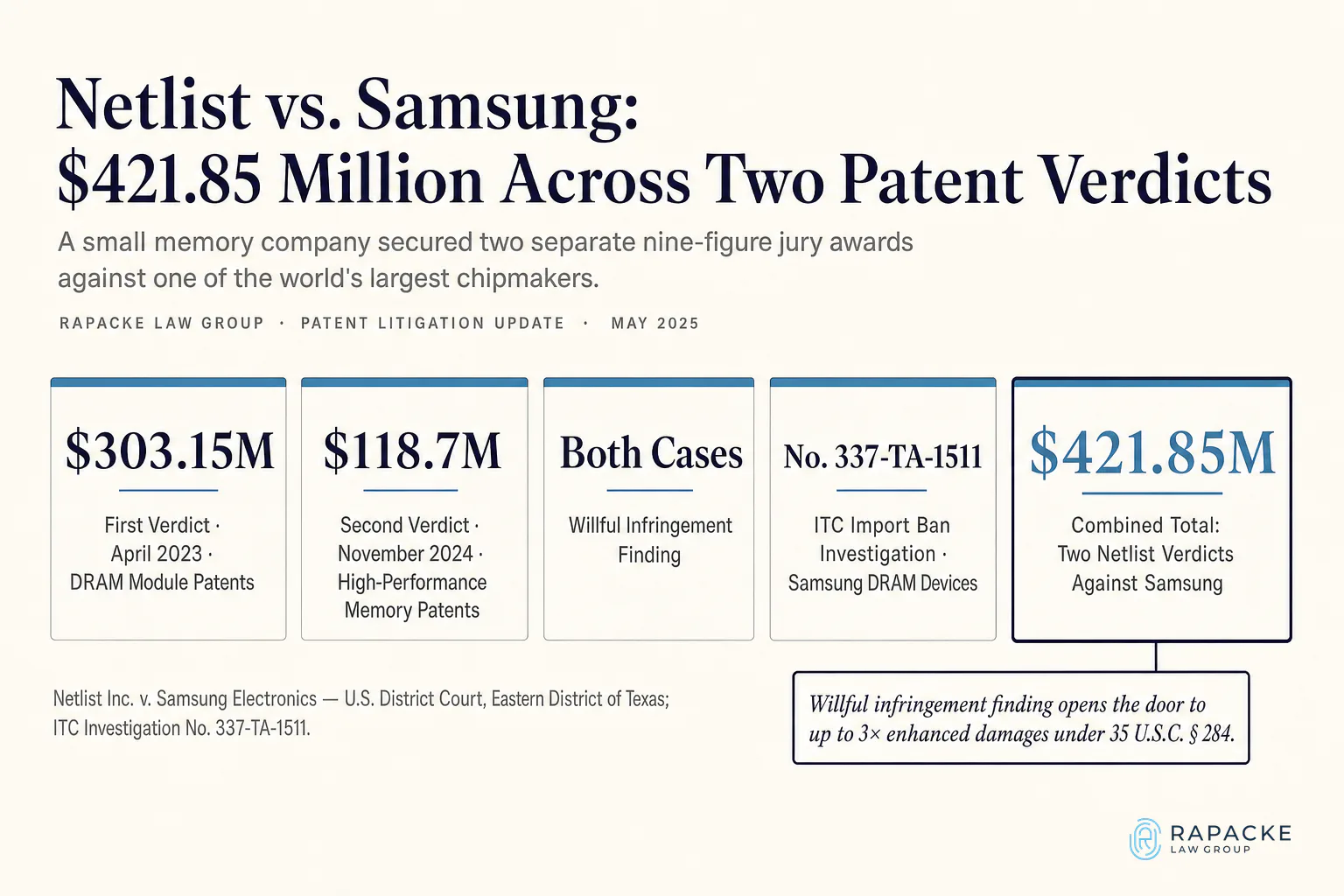 Netlist vs. Samsung: $421.85 Million Across Two Patent Verdicts (Source: SEC Filing, Netlist Inc., 2023 (sec.gov); ThePrint, 2024 (theprint.in); USITC via ithome.com)
How Netlist Built a Multi-Verdict Enforcement Campaign
Netlist, which holds patents on DRAM module technology, including patents on technical storage architectures, pursued Samsung through multiple rounds with escalating results. A jury awarded $303.15 million in April 2023, and a second jury awarded about $118 million in November 2024 after finding willful infringement, as Reuters reporting via ThePrint documented. The two verdicts total $421 million, before interest and costs, and together represent a leading example of a patent infringement case built on layered enforcement. Each case involved different patent claims covering different periods, letting Netlist layer recoveries across separate proceedings, a model that shows how patent protection can be sustained over time. A single patent portfolio, alongside other patents covering related innovations, can support multiple damages periods if infringement continues after an earlier judgment. This sustained campaign sits at the intersection of enforcement and patent infringement strategy that even smaller holders can learn from.
What the ITC Investigation Adds to the Samsung Netlist Lawsuit
After the jury verdicts on the netlist patents, Netlist filed a complaint with the ITC seeking to block Samsung's DRAM imports into the United States, and the ITC opened a formal Section 337 investigation, illustrating how the patent system enables parallel enforcement tracks. This parallel track is a hallmark of sophisticated patent enforcement. Jury verdicts generate compensation by addressing the infringing activity directly, while an ITC exclusion order creates market leverage that can disrupt a supply chain. Monetary damages and import exclusion are not mutually exclusive. Serious patent holders pursue both at once.
Frequently Asked Questions About Patent Infringement Damages
What are the damages for patent infringement?
A winning patent holder is entitled to no less than a reasonable royalty, and lost profits if they can prove diverted sales. If the infringement was willful, a court can increase the award up to three times the compensatory amount under 35 U.S.C. § 284.
What is the damage period for patent infringement?
Under 35 U.S.C. § 286, you can only recover damages for infringement in the six years before you file suit. Continuing infringement that began earlier can still be litigated, but only the six-year window is recoverable. Once suit is filed, continued infringement keeps accruing damages through trial, and courts can add ongoing royalties for post-judgment activity.
How do you calculate damages in patent infringement?
Courts use one of two methods. If you prove you lost sales of your patented invention, you recover the profits on those sales under the Panduit factors. If lost profits are too speculative or you do not compete directly, the fallback is a reasonable royalty built from comparable licenses and the value the patent contributes. Industry royalty rates commonly land in the low single digits of net sales, though standard essential patents can command different rate structures due to FRAND obligations.
How much does it cost to sue for patent infringement?
It is expensive. A survey by the American Intellectual Property Law Association reported median costs can approach $4 million to take a high-stakes case through trial, with smaller cases often running $1 to $2 million (AIPLA Report of the Economic Survey, 2019). Many inventors work with contingency-fee firms that share the risk, and if you win and the case is exceptional, the court may order the losing side to pay your fees.
Your Next Steps to Maximizing Patent Damages
Patent infringement damages are not guaranteed simply because infringement happened. What you recover depends on the damages theory you can prove, the quality of your economic evidence, and whether willfulness enhances the award. Lost profits require documentation of lost market share. A reasonable royalty requires a defensible rate model. Both require expert testimony.
Tools like patent portfolio strategy, licensing programs, patent infringement claims, and ITC enforcement are not reserved for large companies. Inventors who build strong patents, invest in patent prosecution from day one, and document their market position put themselves in the best position to recover meaningful damages.
The bottom line: a weak patent with vague claims and no enforcement record leaves you fighting over a small royalty on a fraction of the product. A strong patent, backed by documented notice, licensing history, and clean market data, supports lost profits, willfulness enhancement, and real settlement leverage. The gap can be tens of millions of dollars.
Every month you wait, infringing sales accumulate outside the six-year damages window, prior art defenses grow stronger, evidence of copying grows colder, and a competitor entrenches its position. Delay quietly shrinks the award you could have recovered.
If you have discovered potential infringement, including indirect infringement by a third party in a patent infringement case, or want to build a strategy that maximizes your enforcement position, here is where to start:
- Schedule a Free IP Strategy Call to review your patent, the suspected infringement, and your realistic recovery options.
- Gather your patent notice records, licensing correspondence, and sales or market share data before your call.
- Ask about our flat-fee, fixed-price approach so you know your costs up front instead of watching hourly bills climb.
With the Rapacke Law Group fixed-fee model, you get a clear plan and predictable pricing, so the economics of protecting your invention work in your favor from day one. And with our RLG Guarantee, if you move forward with a patentability search and our search finds your invention is not novel, you receive a 100% refund — so you never pay for bad news.
To Your Success,
Andrew Rapacke Managing Partner, Registered Patent Attorney Rapacke Law Group