
Key Takeaways
- A DMCA takedown notice is a demand sent to an online service provider, not the infringer, and it removes infringing content but does not award damages.
- Your notice must contain all six statutory elements under 17 U.S.C. § 512(c)(3) or it will likely be rejected. In one WordPress.com report for the first half of 2023, 86% of notices were rejected.
- The DMCA only covers copyright. Trademark and patent problems require separate tools like Amazon Brand Registry or federal litigation.
- Register your copyright before disputes escalate. For most works you generally must obtain or be denied registration before filing an infringement lawsuit in the U.S., subject to limited exceptions.
- Consider fair use before filing. Bad-faith takedown notices can expose you to real financial liability.
*Written by Andrew Rapacke, Managing Partner, Registered Patent Attorney.* Andrew Rapacke is a registered patent attorney and the Managing Partner of The Rapacke Law Group, a full-service intellectual property law firm. He helps individuals and corporations across industries with the protection, prosecution, licensing, and enforcement of their intellectual property, with deep experience in patent, trademark, and copyright matters spanning software, AI and machine learning, blockchain, medical devices, and autonomous vehicle technology. A graduate of the United States Naval Academy, Andrew served as a Naval Engineering Officer before pursuing law and remains active in the startup and inventor communities throughout Florida.
You discover your product screenshots, marketing copy, or brand assets republished on a competitor's site or a YouTube channel with hundreds of thousands of views. The fastest legal tool to get that content offline is not a lawsuit. Takedown requests let a copyright owner demand removal of copyrighted material directly from the platform hosting it, often within days. This guide walks you through the DMCA takedown process, including how to file a DMCA takedown request, the six elements your notice must include, where to send it, and what to do when a notice fails or triggers a counter-notice.
What a Takedown Request Actually Does (and What It Doesn't)
A DMCA takedown notice is a formal legal demand sent to an online service provider, not to the infringer directly, requiring removal of infringing content under the Digital Millennium Copyright Act (17 U.S.C. § 512). Google now handles over 1.6 billion copyright removal requests per year, roughly 30 million per week, according to TorrentFreak reporting on the company's Transparency Report.
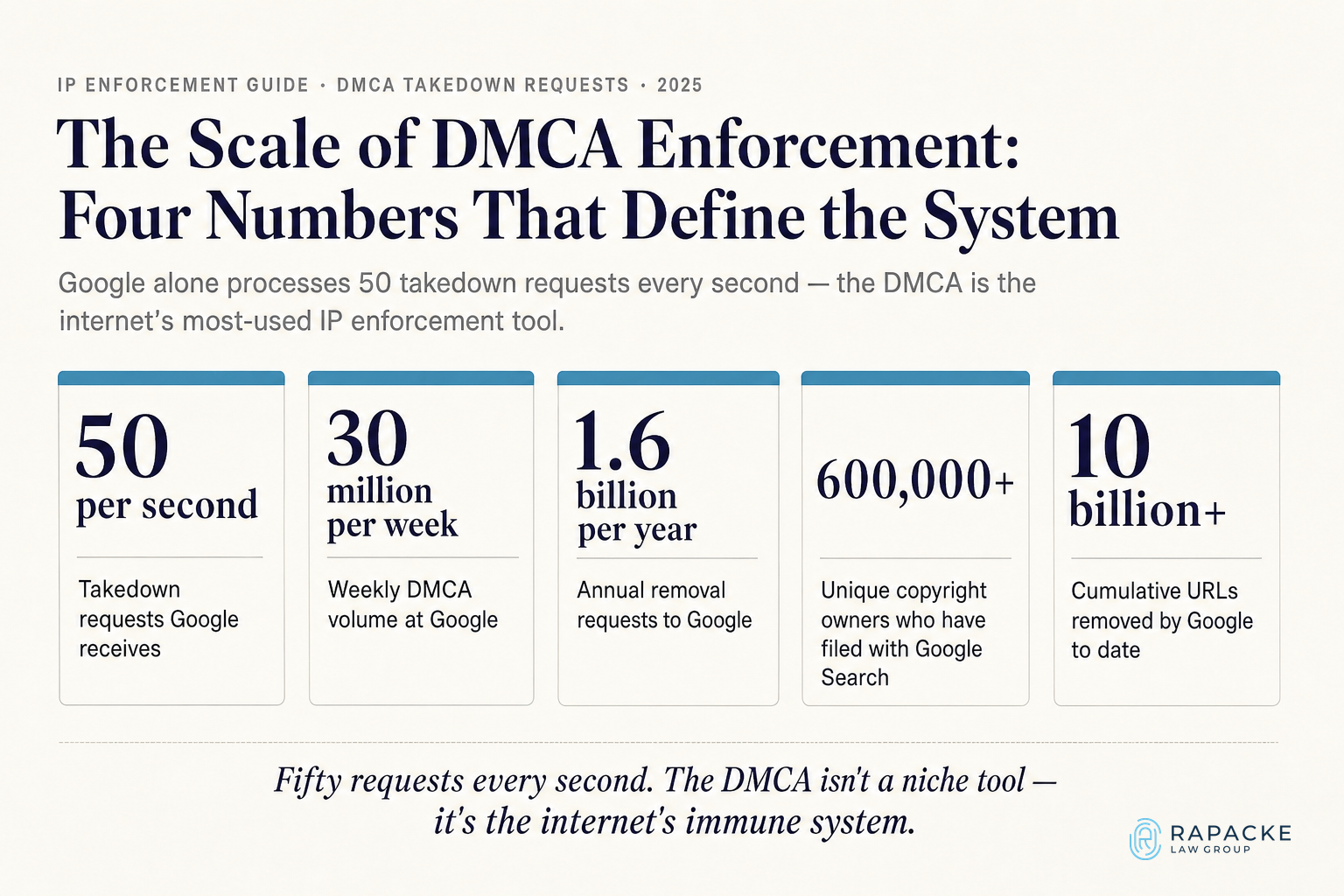 The Scale of DMCA Enforcement: Four Numbers That Define the System — Source: Google Transparency Report; TorrentFreak, January 2024; Gigazine, November 2024
The Legal Foundation of DMCA Safe Harbor Provisions
Section 512 provides safe-harbor limitations on monetary liability for qualifying online service providers for user-uploaded infringing material, if they meet the statutory conditions, per the U.S. Copyright Office. Key ones include:
- Designating an agent with the Copyright Office to receive infringement notices
- Adopting and reasonably implementing a repeat-infringer termination policy
- Accommodating standard technical measures used by copyright owners
- Acting expeditiously on compliant notices
Confirm the platform you are targeting qualifies as an online service provider before filing.
Copyright Ownership Is the Gating Requirement
A takedown notice is only available to the copyright owner or an authorized agent. Copyright attaches at creation, but for most works you generally must register with the U.S. Copyright Office, or be refused registration, before you can sue for infringement, subject to limited exceptions. The Supreme Court confirmed this in Fourth Estate v. Wall-Street.com.
What Takedown Requests Cannot Fix
The DMCA covers copyright infringement only; it does not address patent infringement or trademark misuse. Founders facing a competitor copying patented technology or a stolen brand name need cease and desist letters or platform trademark complaints instead. If a rival is cloning your product's code, source code intellectual property protection and software patents are stronger long-term tools.
The Six Required Elements Every Valid Takedown Notice Must Include
A DMCA takedown notice that omits any statutory element is defective and will be rejected. In one WordPress.com transparency report for the first half of 2023, 86% of notices were rejected as incomplete or abusive, leaving only 14% that led to removals, according to TorrentFreak and the underlying Automattic transparency report.
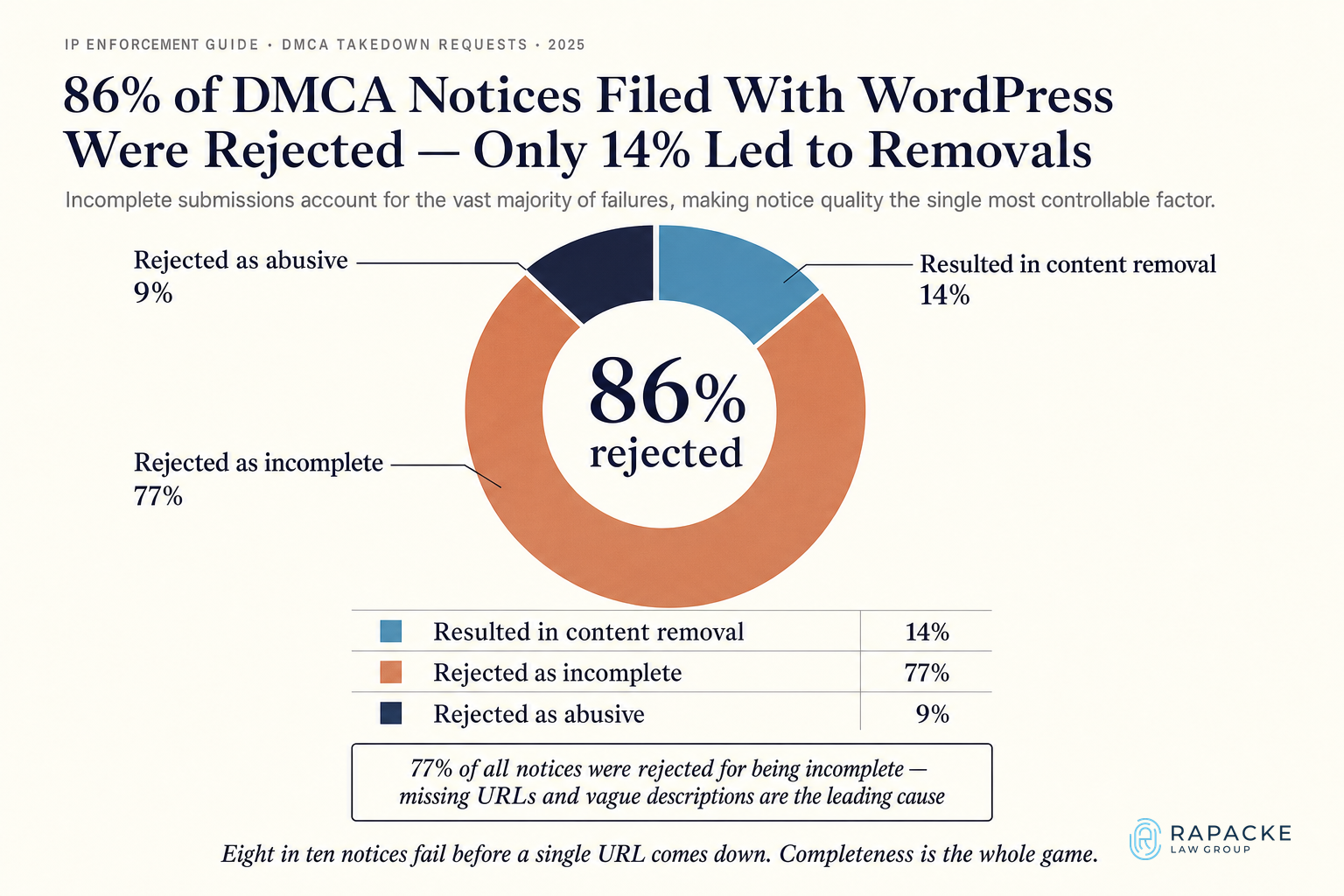 86% of DMCA Notices Filed With WordPress Were Rejected — Only 14% Led to Removals — Source: Automattic (WordPress.com) Transparency Report, 2023
Identification, Signature, and Contact Information
Your notice needs a physical or electronic signature of the copyright owner or agent, identification of the copyrighted work, and full contact information including name, address, telephone number, and email. A typed name can qualify as a valid electronic signature under the E-SIGN Act if adopted with intent to sign. Use your full legal name and a business email, not a username.
Location of the Infringing Material
You must give the service provider enough detail to find the infringing content, typically the exact URL. Vague descriptions get notices thrown out. In that same WordPress.com period, 77% of notices were rejected as incomplete, largely for missing detail. Screenshot and document every infringing URL before filing.
The Two Required Statements of Good Faith
The notice must state that you have a good faith belief the use is unauthorized, and a statement under penalty of perjury that your information is accurate and you are authorized to act. In Lenz v. Universal Music Corp., the Ninth Circuit held that copyright holders must consider fair use before sending a notice. If parody, commentary, or education is plausible, consult a copyright lawyer first.
Where to Send Takedown Requests Depending on Where Infringing Content Lives
The destination determines how fast your notice gets processed. Platforms, hosting companies, and internet service providers each maintain separate designated agents and submission portals, so matching the target to the right channel matters.
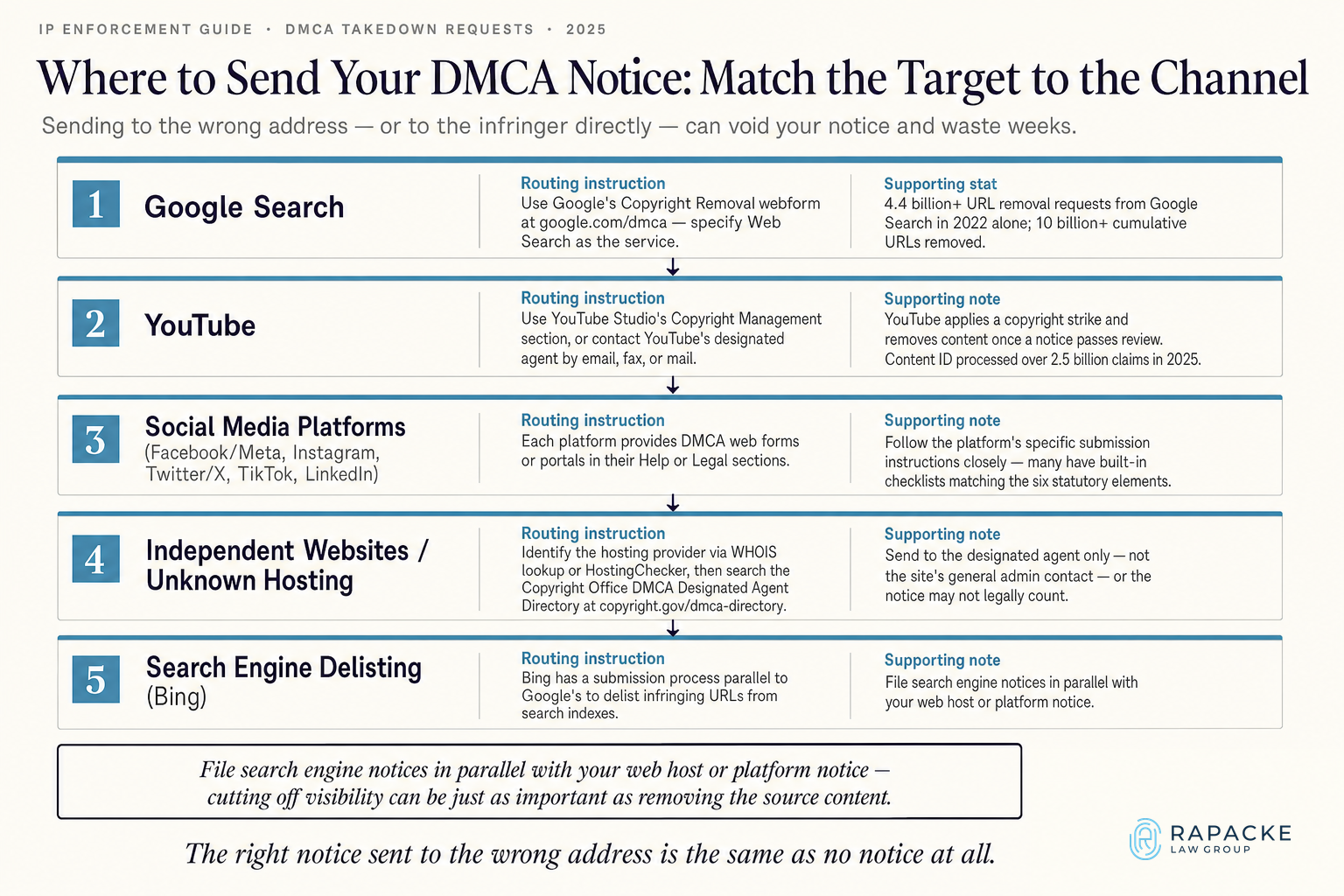 Where to Send Your DMCA Notice: Match the Target to the Channel — Source: Google Transparency Report; TorrentFreak, 2024; U.S. Copyright Office DMCA Agent Directory; YouTube Support, support.google.com
Sending Takedowns to Major Platforms
Google maintains a public DMCA report form at google.com/dmca, and YouTube offers a copyright removal tool inside YouTube Studio. Rights holders requested removal of billions of URLs from Google Search in a single year, per the Google Transparency Report. Meta, TikTok, and LinkedIn each run their own IP reporting tools. Always use the official designated agent portal, not a generic contact form.
Targeting the Hosting Company When the Platform Is Unknown
When infringing material sits on an independent website, identify the host with a WHOIS lookup, then find their registered agent through the U.S. Copyright Office's DMCA Designated Agent Directory. A notice sent to the wrong party restarts your clock.
Targeting Search Engines to Suppress Infringing URLs
Even after a host removes a page, cached copies linger in search results. Google and Bing both honor DMCA notices to delist URLs. File with the host and the search engines simultaneously to cut off both the source and the visibility.
What Happens After You File and How to Handle a Counter-Notice
Filing is step one. The DMCA requires online service providers to act expeditiously, which courts treat as a flexible standard ranging from same-day removal to several days or even weeks depending on the circumstances. Major platforms often act within 24 to 72 hours.
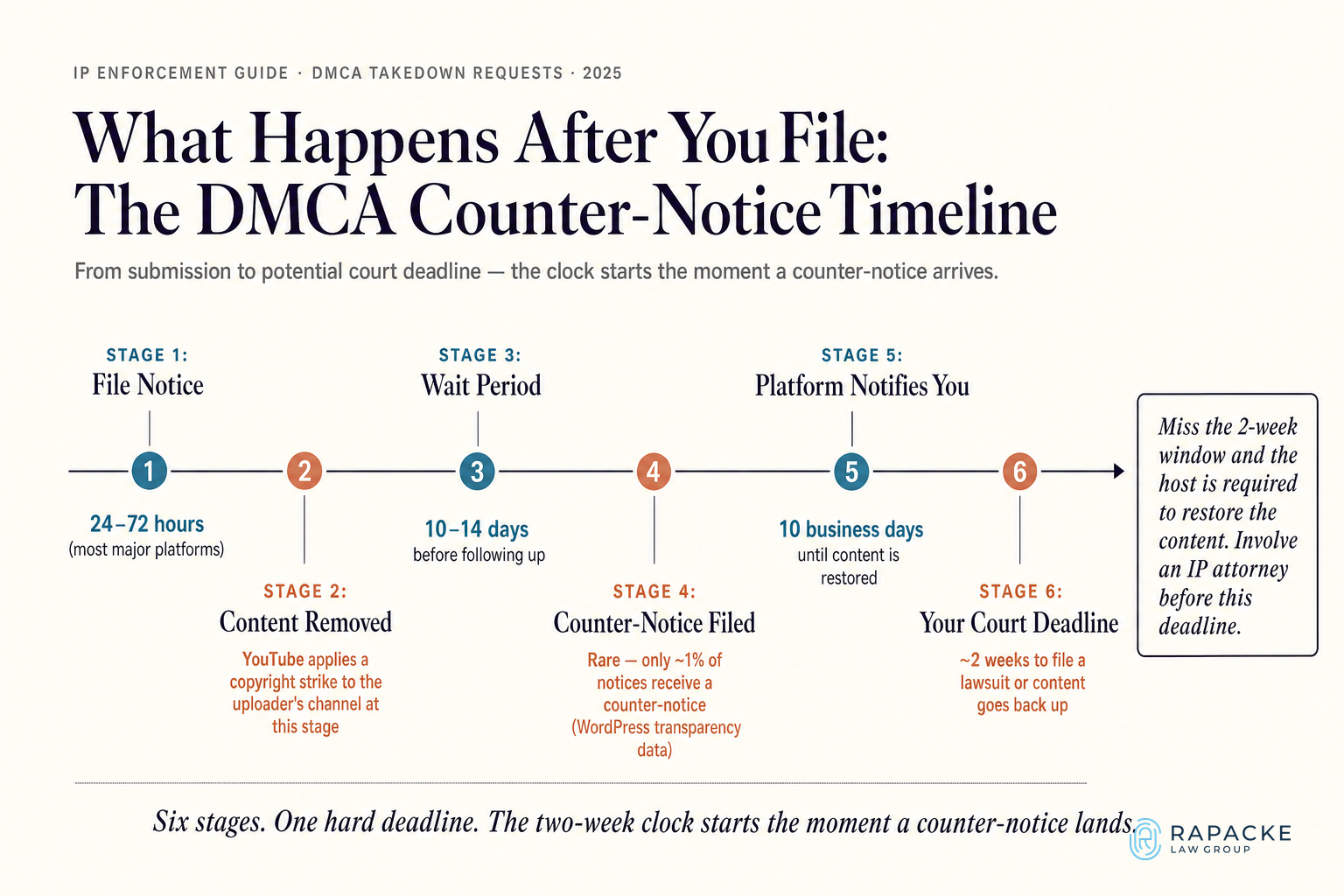 What Happens After You File: The DMCA Counter-Notice Timeline — Source: 17 U.S.C. § 512; WordPress (Automattic) Transparency Report; YouTube Support, support.google.com; TorrentFreak
Platform Response Timelines and What Expeditious Means
YouTube applies a copyright strike and removes content once a notice passes review, per YouTube Help. Its automated Content ID system accounts for the vast majority of copyright claims, numbering in the billions per year. Set a calendar reminder for 14 days after filing. If nothing happens, escalate or consult an IP attorney.
The Counter-Notice Process and What It Means for You
The alleged infringer can file a counter-notice claiming mistake or fair use. If they do, the platform must restore the content after about 10 business days unless you file a federal copyright lawsuit, which can create legal uncertainty about the outcome. If you receive a counter-notice, consult an IP attorney immediately.
When Takedown Requests Fail and What Comes Next
Repeat infringers and offshore hosts often ignore notices or repost within hours, and court orders may be necessary to compel compliance. At that point, further legal action such as cease and desist letters, federal lawsuits, or a preliminary injunction come into play. If the problem is a knock-off product on a marketplace, an Amazon trademark complaint may work better than a DMCA notice. A pattern of failed takedown requests signals you need a formal intellectual property rights enforcement strategy, not more self-filed notices.
How Takedown Requests Work for Trademarks and Patents Differently
The DMCA is a copyright tool. Founders protecting brand names, logos, or software patents need to know where copyright enforcement ends and other paths begin, as Legal Clarity explains.
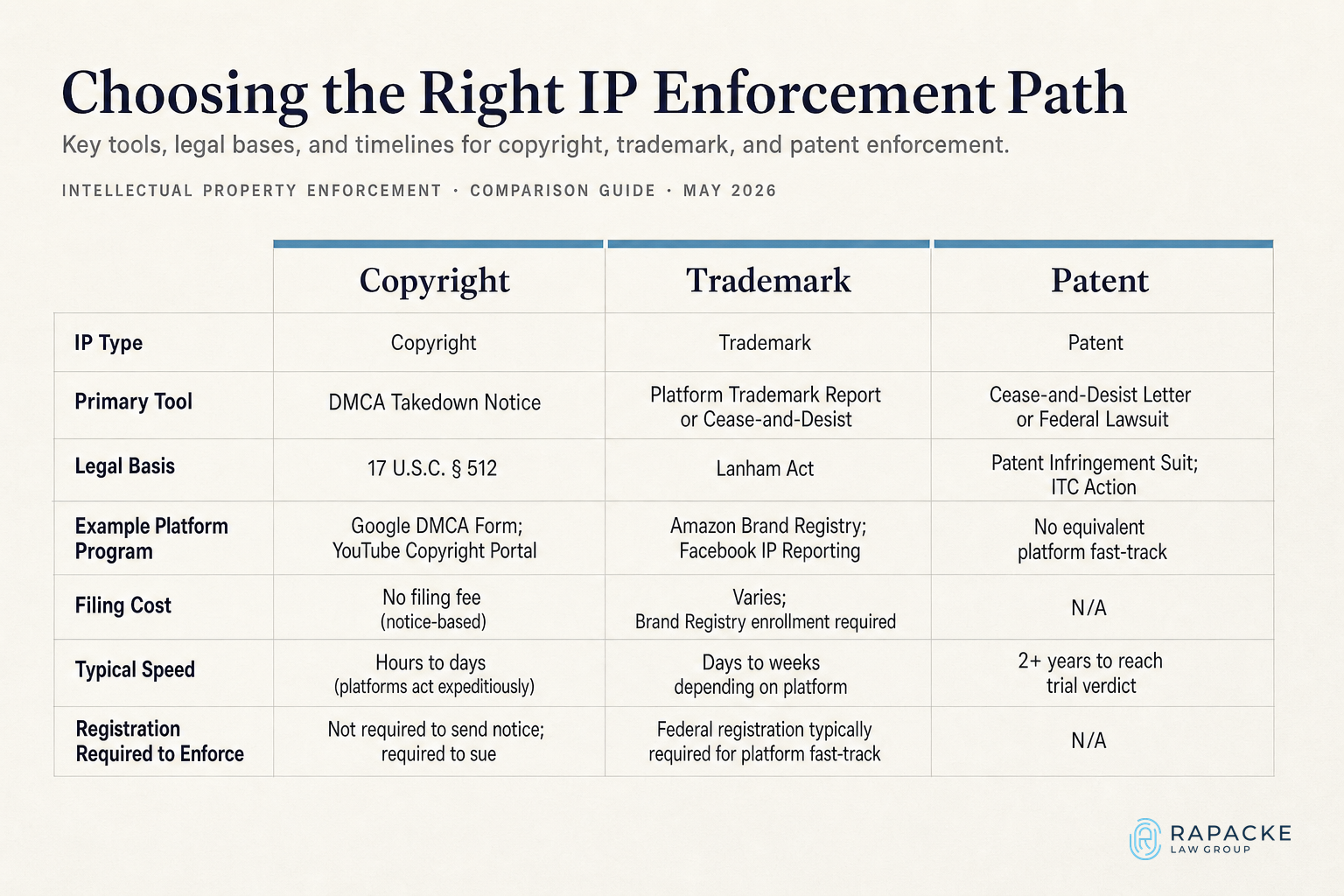 DMCA Takedown vs. Trademark Report vs. Patent Enforcement: Three Tools, Three Different Fights — Source: Thomson Reuters, Patent Litigation 101; legalclarity.org; U.S. Copyright Office
Trademark Takedowns Through Platform Brand Protection Programs
Amazon Brand Registry, Meta's IP Report Center, and Etsy's IP policy each run trademark-based takedown tools outside the DMCA framework. Over 700,000 brands were enrolled in Amazon Brand Registry as of 2021, and in 2023 Amazon seized more than 7 million counterfeit products, per its Brand Protection Report. These tools require a registered trademark, though filing early through an intent to use trademark application starts the clock and protects your name before launch. Understanding how a trademark and its logo work together also strengthens what you can enforce.
Patent Infringement and Why It Requires a Different Path
There is no takedown portal for patents. Stopping patent infringement runs through cease and desist letters, licensing negotiations, or federal litigation, and that path is expensive. If infringement involves patented functionality rather than copied creative work, contact a registered patent attorney before acting. A clear grasp of what patent pending means helps you enforce with confidence.

Common Mistakes That Get Takedown Requests Rejected or Misused
Two mistakes cause the most damage.
Filing Without Confirming Ownership or Authorization
Submitting a notice for content you do not own, or for work created by an employee whose work-for-hire agreement was never documented, invalidates the notice and can expose you to a misrepresentation claim under Section 512(f), as well as potential legal action against you. Before filing, pull your copyright registration or work-for-hire agreement and confirm it covers the specific work at issue.
Misusing the DMCA to Silence Criticism or Competition
Using DMCA takedown notices to remove negative reviews or content that legitimately quotes your work is DMCA abuse. Section 512(f) creates liability for anyone who knowingly and materially misrepresents that material is infringing. In Automattic Inc. v. Steiner, a sender who filed a false notice to silence a critic was ordered to pay over $25,000 in damages and fees, according to case records. If there is any realistic fair use argument, consult an attorney before filing.
Frequently Asked Questions About Takedown Requests
What is a takedown request?
A formal notice sent to an online service provider asking it to remove infringing content, most commonly a DMCA takedown notice. Providers must act on valid notices to keep their safe harbor under U.S. copyright law.
What is a copyright takedown request?
It invokes the copyright owner's exclusive rights and demands removal of infringing material such as copied text, images, video, or software code, unlike a trademark or patent complaint.
How do I submit a takedown request?
Locate the platform or host's designated DMCA agent through the Copyright Office directory, draft a notice with all six required elements under 17 U.S.C. § 512(c)(3), and submit it through the official portal.
How do I submit a takedown request on YouTube?
Use YouTube's copyright removal tool in YouTube Studio under the Copyright menu, or Google's DMCA report form. YouTube typically processes valid notices within 24 to 72 hours and applies a copyright strike.
Can I file a takedown request for trademark infringement?
No. The DMCA is copyright-specific. For brand name or logo misuse, use the platform's trademark reporting tool, such as Amazon Brand Registry or Meta's IP Report Center, which require a registered trademark.
Your Next Steps to IP Enforcement Success
Every day infringing content stays live, it dilutes your brand, misleads your customers, and chips away at your search rankings and revenue. The DMCA gives copyright owners a fast, low-cost enforcement tool, but only when the notice is filed correctly and sent to the right party.
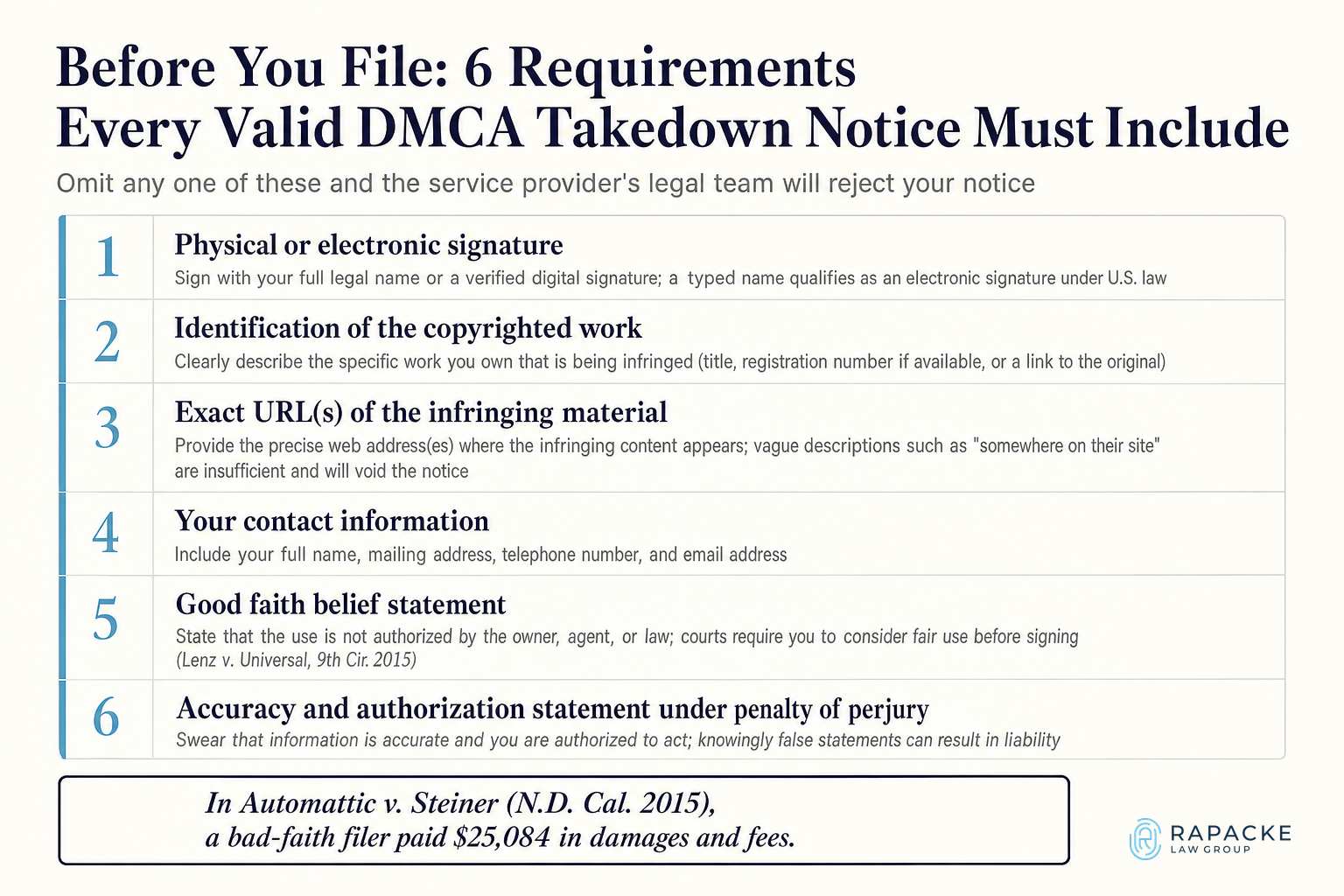 Before You File: 6 Requirements Every Valid DMCA Takedown Notice Must Include — Source: U.S. Copyright Office, 17 U.S.C. § 512(c)(3); Lenz v. Universal Music Corp., 9th Cir. 2015; Automattic Inc. v. Steiner, N.D. Cal. 2015
The bottom line: a weak, incomplete notice gets ignored, while a precise, well-documented one backed by a registered copyright gets content removed fast. The difference is preparation, not luck. For tech founders, takedown requests are most powerful when paired with registered software patents and trademarks that give you enforceable rights across every channel.
The Rapacke Law Group helps tech founders and IP owners build enforcement strategies that go beyond a single takedown notice, from DMCA filings to trademark brand protection and patent portfolio strategy. Andrew Rapacke is a Managing Partner and Registered Patent Attorney, and the firm works on a fixed-fee model so you know your cost up front.
Your next steps:
- Schedule a Free IP Strategy Call to map your enforcement plan
- Confirm you hold registered rights in the work before filing
- Document every infringing URL and the correct designated agent
Enforced correctly, your IP is a competitive moat. Left unprotected, it becomes a free resource for everyone who copies faster than you defend.
To Your Success,
Andrew Rapacke Managing Partner, Registered Patent Attorney Rapacke Law Group