


In 1975, tangible assets (factories, equipment, inventory) accounted for 83% of the S&P 500’s market value. By 2020, that figure had flipped entirely: intangible assets now account for roughly 90% of corporate value. Apple, Microsoft, Pfizer, and Disney aren’t valued for their buildings or raw materials. They’re valued for their patents, copyrights, trademarks, and proprietary knowledge: creations of the mind that generate trillions in economic value. These intangible assets are the result of human intellect, arising from creativity, innovation, and mental effort.
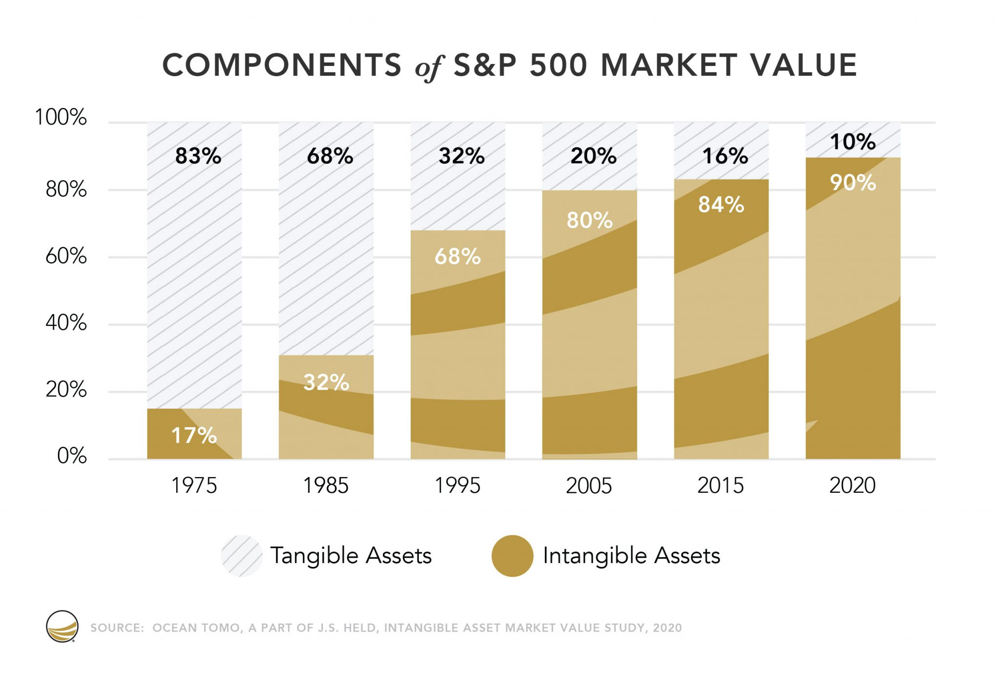
Figure 1: Over the past several decades, the balance of corporate value has shifted dramatically from physical to intangible assets. In 1975, intangible assets were estimated to account for only 17% of the S&P 500’s market capitalization; by 2020, intangibles made up roughly 90%.This rise of intellectual capital highlights why IP rights have become central to modern business strategy.
This shift reveals something most business owners and creators miss: intellectual property isn’t just a legal concept for attorneys. It’s the foundation of modern wealth creation. Understanding why IP systems exist and how to leverage them directly impacts your ability to protect such property, attract investment, build competitive advantages, and capture the full value of what you create.
Whether you’re filing your first patent application for a SaaS platform, protecting an AI algorithm, building a recognizable brand, or simply trying to understand how IP affects your industry, grasping the core purposes behind these legal frameworks will help you make strategic decisions that protect and grow your business.
What Is Intellectual Property and Why Its Purpose Matters
The World Intellectual Property Organization (WIPO) defines intellectual property (IP) as “creations of the mind, such as inventions; literary and artistic works; designs; and symbols, names and images used in commerce” that “enable people to earn recognition or financial benefit from what they invent or create.” This definition highlights a critical component: IP protection isn’t simply about legal standing or exclusive control. It’s about creating economic conditions that enable innovation and creativity to flourish.
Unlike tangible assets such as real estate or machinery, intellectual property (IP) is intangible: value that exists in ideas, expressions, and information. This includes inventions, literary and artistic works, computer programs, designs, brand names, and trade secrets. For tech founders, this is particularly relevant: your software architecture, machine learning models, user interface designs, and proprietary algorithms are all valuable IP assets. In the business world, intellectual property plays a crucial role in shaping the success of startups, influencing mergers and acquisitions, enabling licensing opportunities, and guiding strategic decisions that impact competitiveness and growth.
At its core, the purpose of intellectual property balances two fundamental goals:
Rewarding creators: IP rights grant inventors and authors exclusive rights over their creations for a specified period, enabling them to recoup research and development investments and earn financial returns that justify the risks and costs of innovation.
Spreading knowledge: Because IP protection is time-limited, inventions and creative works eventually enter the public domain. This ensures that others can freely use, build upon, and distribute those creations, expanding the shared knowledge base once the creator’s exclusivity ends.
The two primary purposes of intellectual property law are to encourage creativity and investment in research and development by rewarding innovation and to protect inventors from improper competitive activities.
Why This Balance Matters in Modern Economies
In advanced economies like the United States, EU member states, and Japan, intellectual property rights are central to:
Innovation ecosystems: Venture capitalists and investors rely on patents and trade secrets when evaluating startups. Research shows that European startups owning patents and trademarks are 10 times more likely to secure early-stage funding than those without IP protection. For SaaS founders raising a Series A, a well-constructed patent portfolio covering your core technology can be the difference between closing the round and being passed over.
International trade: IP-intensive goods and services account for a significant share of economic output. In the United States alone, IP-intensive industries contributed approximately $7.8 trillion to GDP in 2019, roughly 41% of the entire economy.
Economic growth: IP protection encourages long-term investment in R&D-heavy sectors. Global R&D spending reached approximately $2.4 trillion by 2019, having more than tripled since 2000. According to the National Science Foundation, U.S. R&D expenditure totaled $892 billion in 2022, with preliminary estimates indicating further growth to $940 billion in 2023, reflecting the critical role of IP in driving innovation, particularly in AI, machine learning, and software development.
Consumer protection: Trademarks, certification marks, and design patents help buyers identify authentic, safe products and avoid counterfeits, a significant concern given that counterfeit and pirated goods accounted for roughly 2.3% of global trade (about $467 billion) in 2021.
The temporary nature of most IP rights is intentional. Society grants creators a limited monopoly in exchange for the eventual enrichment of public knowledge. This social bargain underpins everything from the streaming service where you watch movies to the pharmaceutical company developing your medications.
Historical Origins: How the Purpose of IP Developed
Early IP systems weren’t accidents of legal evolution; they were deliberate policy choices designed to incentivize invention and authorship while advancing national economic interests. The historical rationale was never simply about rewarding individuals. From the beginning, IP law aimed to drive broader economic and cultural development by creating conditions in which inventors and authors would share their knowledge publicly rather than keep it secret.
Key Milestones in IP History
1474 – Venetian Patent Statute: One of the first formal patent laws, this statute aimed to attract skilled artisans to Venice by granting them exclusive rights to their inventions for 10 years. The explicit purpose was economic development through innovation.
1624 – English Statute of Monopolies: This law limited general monopolies but carved out exceptions for “new manufactures,” focusing patent protection specifically on genuine inventions rather than royal favors.
1710 – Statute of Anne (England): Considered the first modern copyright statute, it was enacted “for the Encouragement of Learned Men to Compose and Write useful Books.” This law explicitly tied copyright protection to the public interest in promoting learning.
1788 – U.S. Constitution, Article I, Section 8, Clause 8: The Founding Fathers embedded IP’s purpose directly into the Constitution, granting Congress power to “promote the Progress of Science and useful Arts, by securing for limited Times to Authors and Inventors the exclusive Right to their Respective Writings and Discoveries.”
1883 – Paris Convention for the Protection of Industrial Property: Internationalized patent and trademark protection across borders, establishing the principle of national treatment so foreign inventors receive the same rights as domestic ones.
1886 – Berne Convention: Extended international protection to literary and artistic works, ensuring authors received recognition and exclusive rights globally without needing separate national registrations.
These historical developments share a common thread: IP systems were designed to create a social bargain. Creators receive temporary exclusive rights; in exchange, society gains access to new knowledge, innovations, and cultural works.
Core Purposes of Intellectual Property Rights Today
The purpose of intellectual property has evolved since those early statutes, but the fundamental goals remain consistent. Modern IP systems serve multiple interconnected purposes that benefit creators, businesses, and society at large.
Economic Incentive
Intellectual property rights allow inventors and creators to earn returns on their investments. Without IP protection, competitors could simply copy innovations without bearing the upfront research and development costs, eliminating any incentive for risky or expensive research.
Consider the pharmaceutical industry as a case study:
- Bringing a new drug to market often requires 10–15 years of research and clinical trials.
- Global R&D spending has more than tripled since 2000, reaching around $2.4 trillion by 2019.
- A utility patent typically provides about 20 years of exclusive rights from the application date, a crucial period for recouping these substantial investments.
Intellectual property rights enable owners to prevent others from reproducing, imitating, or exploiting their work, which is crucial to maintaining a competitive edge.
The scale of global R&D competition is staggering. The United States and China together perform nearly half of the world’s R&D, reflecting intense international competition to innovate. Without patent protection, pharmaceutical companies would struggle to justify billion-dollar R&D expenditures when generic manufacturers could copy their formulas immediately.
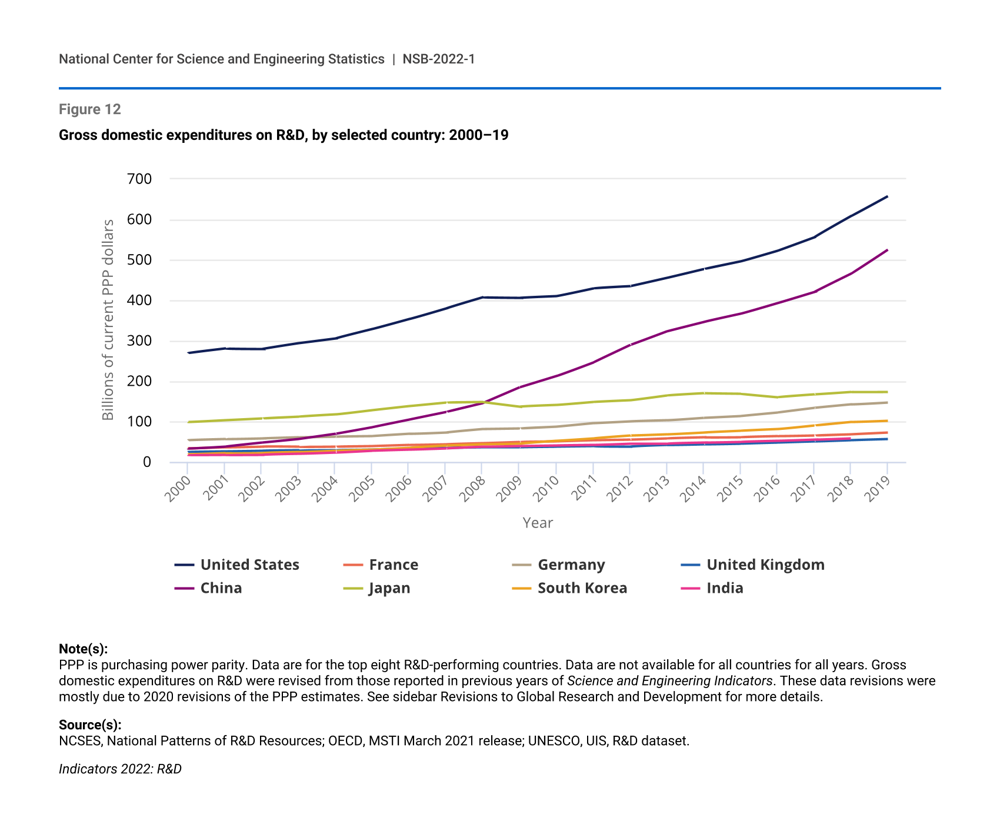
Figure 2: Gross domestic R&D spending by country (2000–2019), showing the rapid rise of China’s investment (pink) relative to the U.S. (blue).
The same principle applies to software and AI development. A SaaS company that has spent years developing a novel natural language processing algorithm needs patent protection to prevent competitors from reverse-engineering and copying its core technology. This is why patents are critical in industries with high upfront costs and long development timelines: they make risky, long-term investments worthwhile by providing a path to recoup costs.
Innovation and Progress
Temporary exclusivity encourages long-term, high-risk research in sectors such as:
- Renewable energy and clean technology.
- Artificial intelligence and machine learning.
- Biotechnology and gene therapies.
- Advanced materials and nanotechnology.
The patent system is designed to ensure that knowledge eventually enters the public domain. After expiration, anyone can use, manufacture, and improve upon a patented invention, accelerating cumulative innovation.
Computer technology has emerged as the largest field in new patent filings worldwide, accounting for over 11% of all patent applications published in 2021, underscoring how IP rights incentivize progress at the technological frontier. This includes everything from cloud computing architectures to AI training methodologies to novel user interface designs.
For tech founders, understanding how to protect AI innovations is becoming as critical as understanding how to code. The intersection of patent law and emerging technology creates both opportunities and challenges that require specialized legal guidance.
Competition and Market Structure
IP protection levels the playing field so that smaller businesses can compete with industry giants:
- Startups use patents to protect unique technology and attract investors.
- Small and medium-sized enterprises (SMEs) leverage trademarks to build brand recognition even against established competitors.
- Inventors in tech hubs (Silicon Valley, Cambridge, Shenzhen) rely on patents and other IP to secure venture funding.
The data backs this up powerfully. A European study found that startups with patents and trademarks were 10 times more likely to secure early-stage funding than those without IP. This illustrates how a strong IP portfolio can help new entrants attract investors and compete with larger firms.
Without adequate intellectual property protection, smaller players would be at the mercy of well-resourced incumbents who could simply replicate successful innovations. Strong IP rights give innovators a fighting chance to bring new products to market and challenge entrenched players. For SaaS founders, a strategic patent-filing approach can protect your competitive moat as you scale.
Cultural and Educational Development
Copyright law encourages the creation of books, films, music, video games, and educational materials by giving creators control over the reproduction and distribution of their works. Copyright protects original works of authorship, such as music, books, and software, and provides the owner with the right to control reproduction, distribution, and derivative works.
The global creative industries (including film studios, streaming platforms, game developers, and publishers) depend on copyright protection to:
- Fund production of new content.
- Enable licensing agreements across platforms and territories.
- Support millions of creative professionals worldwide.
Sound recordings, computer programs, and literary and artistic works all fall under this umbrella of protection. The economic impact is substantial: in the United States, the core copyright industries added about $1.8 trillion to GDP in 2021, approximately 7.8% of the entire economy, and employed over 5.6 million workers. These figures underscore how copyright law helps fuel a thriving creative economy. A copyright gives the owner exclusive rights to control how their original work is used, reproduced, and distributed.
Consumer Protection
Trademarks, service marks, and design patents serve a consumer-facing purpose: helping buyers identify authentic products and avoid counterfeits. This matters for safety and trust:
- Counterfeit medicines can be ineffective or dangerous.
- Fake electronics may pose fire or electrical hazards.
- Knockoff automotive parts can compromise vehicle safety.
Trademark protection and related laws ensure that when you see a brand you recognize, you can trust that the product meets expected quality standards. The problem is massive: counterfeit and pirated goods accounted for roughly 2.3% of global trade (about $467 billion) in 2021, underscoring the scale of the challenge that trademark and anti-counterfeiting laws seek to address.
Knowledge Dissemination
Patents require detailed public disclosure of inventions as a condition of protection. This is a fundamental feature, not a bug: a patent application must describe an invention with enough detail that someone skilled in the art could replicate it. This disclosure requirement serves multiple purposes:
- Expands the stock of publicly available technical knowledge.
- Allows competitors to design around existing patents.
- Enables others to learn, improve, and innovate once patents expire.
- Prevents permanent secrecy that would slow cumulative progress.
Today’s patent system has created an unprecedented library of technical knowledge. WIPO’s PATENTSCOPE database allows anyone to search over 125 million patent documents worldwide. By 2022, roughly 17.3 million patents were in force globally: each one is eventually destined for the public domain, where others can freely use its information.
Protection and Enforcement of Intellectual Property
Intellectual property protection is a critical component of any successful business strategy, empowering companies to safeguard their innovative ideas, creative works, and proprietary knowledge from unauthorized use. The United States Patent and Trademark Office (USPTO) plays a central role in granting and maintaining IP rights, examining hundreds of thousands of patent and trademark applications each year. Patents, trademarks, and copyrights issued by the USPTO are essential for protecting intellectual property in today’s competitive marketplace.
To enforce intellectual property rights, businesses have a range of legal tools at their disposal. Sending a cease-and-desist letter is often the first step in addressing potential infringement, signaling to an infringer that legal action may follow if the unauthorized use continues. When necessary, companies can pursue lawsuits to seek injunctions, statutory damages, and, in some cases, attorneys’ fees, helping to deter violations and recover losses. Penalties for intellectual property infringement can range from fines to prison sentences. Monitoring the marketplace for potential abuses is crucial for effective intellectual property management.
Working with experienced IP counsel makes a significant difference in enforcement outcomes. At Rapacke Law Group, we help tech founders and inventors strategically navigate IP enforcement, from initial cease-and-desist letters through litigation when necessary. Our fixed-fee approach means you know precisely what enforcement will cost, with no surprise hourly billing that can spiral out of control during complex disputes.
Adequate IP protection goes beyond registration. Companies must understand the different types of intellectual property (such as utility patents, design patents, plant patents, and trade secrets) and implement reasonable measures to maintain confidentiality. Non-disclosure agreements (NDAs) and other contractual safeguards are essential for protecting trade secrets and sensitive know-how, especially when collaborating with partners or employees. Intellectual property rights can be transferred through assignment or licensing agreements. When entering into licensing agreements, it is essential to respect other intellectual property rights to prevent infringement and ensure proper licensing terms. By prioritizing these protective measures, businesses not only secure their own competitive edge but also contribute to economic growth and innovation, benefiting society as a whole.
In the global economy, protecting intellectual property is more important than ever. International treaties, such as the Patent Cooperation Treaty (PCT), and organizations, such as the World Trade Organization (WTO) and WIPO, help harmonize IP laws and facilitate cross-border enforcement. These frameworks enable businesses to expand internationally while ensuring their intellectual property rights are respected worldwide.
Different IP Types and Their Specific Purposes
While all types of intellectual property share the overarching goal of balancing creator incentives with public benefit, each IP right is tailored to serve a specific policy objective.
Patents: Rewarding Technical Innovation
A patent grants an inventor exclusive rights (also referred to as the inventor’s exclusive rights) to make, use, sell, and import their invention for a limited period (typically 20 years from the filing date under the PCT and national laws). A patent grants the inventor the exclusive right to prevent others from making, using, or selling an invention for a specific period. Patents are intended to:
- Incentivize technical invention by offering a temporary monopoly.
- Require novelty, an inventive step (non-obviousness), and usefulness for eligibility.
- Mandate public disclosure to enable society to gain technical knowledge from the invention.
- Enable technology transfer through licensing agreements.
Types of patents:
| Patent Type | What It Protects | Duration |
| Utility Patent | New processes, machines, and compositions of matter | ~20 years from filing (U.S.) |
| Design Patent | Ornamental appearance of products or graphical user interfaces | 15 years (U.S.) |
| Plant Patent | New plant varieties are reproduced asexually | ~20 years from filing |
The USPTO examines patent applications and issues a patent grant upon approval, providing a certificate of registration. For tech innovations, utility patents are typically most relevant, covering everything from AI algorithms to software architectures to novel hardware configurations.
By granting inventors a temporary monopoly, society encourages the upfront investment needed for technical breakthroughs. In exchange, the inventor must disclose how the invention works (in the patent), and after the patent expires, everyone is free to use and build on that knowledge.
Copyrights: Incentivizing Creative Expression
Federal copyright law protects original works of authorship, including literary works, music, films, photographs, software code, artwork, and other creative expressions. Copyright gives authors exclusive rights to reproduce, distribute, perform, display, and create derivative works from their creations.
Key purposes of copyright include:
- Encourage creation and dissemination of expressive works by ensuring creators can control and monetize their work.
- Enable orderly markets through licensing (for publishing, streaming, performance rights, etc.).
- Protect moral rights, such as attribution and the integrity of the work, in some jurisdictions.
- Support independent creation without requiring novelty (every original expression can be copyrighted, unlike patents, which require new inventions).
Copyright protection in the U.S. generally lasts for the life of the author plus 70 years (for works created after 1978). At the end of this term, works enter the public domain. The U.S. Copyright Office handles registrations and maintains public records of copyrighted works. In cases of willful copyright infringement, statutory damages and attorneys’ fees may be available to the copyright owner if the work is registered, providing a strong deterrent to piracy.
By granting creators a long-term exclusive right, society incentivizes the production of cultural and educational works. At the same time, the limited term ensures that these works eventually enter the public domain (e.g., classic literature, older films, and music that anyone can use freely).
Trademarks: Protecting Brands and Consumers
Trademark law protects words, phrases, logos, symbols, colors, sounds, and other identifiers that distinguish the goods or services of one party from those of others in the marketplace. The purposes of trademarks are:
- Prevent consumer confusion by clearly identifying the source of products or services.
- Protect the goodwill and reputation that businesses build in their brands.
- Facilitate fair competition by preventing confusingly similar marks that could mislead consumers.
- Support brand investment and recognition (think of the value of names like Apple, Nike, or Coca-Cola).
Unlike patents and copyrights, trademarks can last indefinitely as long as the mark remains in use and distinctive. Companies must periodically renew their trademarks and actively police against misuse, or the mark can be lost (for example, if a brand name becomes generic). Conducting a thorough trademark search helps businesses avoid conflicts before investing in brand development. U.S. applicants alone filed more than 945,000 trademark applications in 2022, underscoring the heightened activity in brand protection.
Trademarks protect consumers and honest businesses. A trusted brand signals to consumers what they’re buying (and from whom), incentivizing companies to maintain quality and consistency. Trademark law thus promotes consumer confidence and fair competition in the marketplace.
The RLG Guarantee for Trademark Protection:
We’re so confident in our trademark registration process that we offer an unprecedented guarantee: Get your trademark approved or pay nothing. If your trademark gets rejected by the USPTO, we’ll issue a 100% refund, no questions asked.
Here’s what you get with RLG’s trademark services:
- FREE strategy call with our trademark concierge team.
- Experienced US attorneys lead your registration from start to finish.
- One transparent flat-fee covering the entire trademark application process (including office actions).
- Unlimited office action responses.
- Full refund if USPTO denies your trademark application*.
- Full refund or additional searches if your brand has registerability issues (your choice)*.
Trade Secrets: Safeguarding Confidential Know-How
Trade secret protection covers confidential business information that derives its value from secrecy. This can include formulas (e.g., the Coca-Cola recipe), algorithms, customer lists, manufacturing processes, business strategies, or any proprietary know-how. Key aspects of trade secrets:
- Encourage investment in proprietary knowledge without requiring public disclosure (unlike patents, which require disclosure).
- Provide legal remedies against misappropriation (theft, industrial espionage, or breach of confidentiality agreements).
- Support competitive advantage for companies that can maintain secrecy over key information.
- Enable protection of innovations that might not qualify for patenting (or that the owner chooses not to patent).
Trade secrets have no fixed term; protection lasts as long as the information remains secret and valuable. There is no registration system; instead, owners must implement reasonable measures to keep information confidential (e.g., NDAs and security protocols). If the secret is improperly acquired or disclosed, owners can pursue legal action under trade secret laws (like the U.S. Defend Trade Secrets Act or state laws based on the Uniform Trade Secrets Act).
Not all valuable innovations are easily patentable, and some companies prefer not to disclose their “secret sauce.” For SaaS companies, deciding whether to patent or keep it as a trade secret is a strategic decision that requires careful analysis. Trade secret laws make it illegal to steal or disclose confidential information, thereby encouraging innovation and the controlled sharing of secrets (e.g., with employees, partners) by providing a legal backstop.
Other IP Forms
Industrial designs: Design rights protect the aesthetic appearance of products (the unique look/shape of a smartphone, furniture, car body, etc.). This encourages companies to invest in product design and user experience by deterring knockoffs that copy a product’s look.
Geographical indications: These are names or signs used on products that identify a specific place of origin (e.g., “Champagne” for sparkling wine from that region, or “Parmigiano-Reggiano” cheese). They signal quality and tradition tied to origin, helping communities protect the reputation of regional goods and preventing consumer deception.
Public Domain and Copyright Office
The public domain is a vital resource for creators, businesses, and the public. It encompasses all creative works that are not (or are no longer) protected by copyright and are free for anyone to use, adapt, or share. When a work enters the public domain, it can be incorporated into new projects, educational materials, or artistic endeavors without permission or royalty payment. This open access fosters creativity and innovation by making a wealth of knowledge and culture available to all.
The U.S. Copyright Office, part of the Library of Congress, is responsible for registering copyrights and maintaining official records of copyrighted works. By registering their creations, authors and businesses establish a public record of their IP rights, which can be crucial in the event of infringement. The Copyright Office also provides guidance on copyright law, helping creators understand how to protect their work and navigate complexities such as fair use and licensing.
Determining whether a work is in the public domain can be challenging, since the duration of copyright protection varies. The Copyright Office’s online database is a valuable tool for researching the status of books, films, music, and other works. Intellectual property lawyers can offer additional guidance in close cases. Understanding the boundaries of the public domain allows businesses and individuals to make informed decisions about using existing works while respecting others’ IP rights.
Importantly, copyright protection isn’t just about giving creators exclusive rights; it’s about encouraging the creation and dissemination of new works. By registering with the Copyright Office and respecting copyright law, businesses and creators help prevent infringement, support a culture of innovation, and contribute to economic growth. When those works enter the public domain, society benefits from free access for generations to come.
Public Interest, Access, and the Limits of IP
The purpose of intellectual property is not absolute control over ideas and creations. IP laws deliberately include limits to protect public interests and prevent creators’ rights from becoming barriers to progress.
Built-In Time Limits
All IP systems impose temporal boundaries that ultimately enrich the public domain:
After expiration, patented inventions and copyrighted works become freely available for anyone to use, build upon, and distribute. This is a core part of the IP social bargain: creators receive a period of exclusivity, and society eventually gains unencumbered knowledge or culture.
Exceptions and Limitations
IP laws include carefully crafted exceptions that permit specific uses without authorization from the rights holder.
Copyright law exceptions: For information on types of patents, refer to The Rapacke Law Group.
Fair use (in the U.S.): Allows limited use of copyrighted material without permission for purposes like criticism, commentary, news reporting, teaching, scholarship, or parody. This flexible doctrine balances creators’ rights with free expression and education.
Fair dealing (in the UK, Canada, and others): Similar to fair use, with enumerated purposes.
Library, archive, and preservation exceptions: Permit copying of works for archiving, research, or replacing damaged copies.
Educational exceptions: E.g., performance or display of works in a classroom setting.
Patent law exceptions:
- Research and experimental use: In some countries, using a patented invention for purely scientific research (not commercial use) is permitted, allowing scientists to study and improve inventions.
- Interoperability and reverse engineering: To ensure compatibility between systems (especially in software), some jurisdictions allow limited reverse engineering of patented or copyrighted software interfaces.
- Bolar provisions: These allow generic pharmaceutical companies to initiate regulatory approval for a patented drug before the patent expires, enabling cheaper generics to enter the market promptly when the patent expires.
These exceptions recognize that some unauthorized uses of IP actually serve the broader progress of science and culture, and they prevent IP from being used to unreasonably stifle follow-on innovation, criticism, or access to information.
Access to Essential Goods
In exceptional circumstances, governments can override IP rights to address critical public needs:
Compulsory licensing: Allows a government to authorize the use of a patent without the owner’s consent (typically with payment of a government-set royalty), especially in areas such as medicines or technologies vital to public welfare.
COVID-19 pandemic (2022): WTO member countries agreed to a limited TRIPS waiver allowing the production of COVID-19 vaccines without patent holders’ consent for 5 years to expand vaccine access during the crisis.
National security exceptions: Many patent laws (including the U.S.) permit the government to use any patented invention without permission when national security is at stake or in other public emergencies, with compensation to the patent owner.
These mechanisms aim to balance IP incentives with urgent public interests (public health, national security, etc.), not to undermine the patent or copyright system generally, but to address its limits when lives or society’s well-being are at stake.
Open Innovation Models
Some creators deliberately choose open licensing approaches to advance science and culture:
Open-source software: Developers use open-source licenses (such as the MIT or GNU GPL) to allow anyone to use, modify, and share their code freely, ensuring software freedom and collaborative development. (Linux, which powers much of the internet, is open-source.)
Creative Commons licenses: Authors and artists can apply CC licenses to their works to permit broad public use under certain conditions (e.g., allowing non-commercial use, or requiring attribution). This expands public access to creative works while still giving creators some control.
Patent pledges and pools: Sometimes companies pledge not to enforce certain patents. For example, a group of firms might pool green technology patents and allow anyone to use them royalty-free to fight climate change.
These approaches show that IP’s purpose can also be served by sharing and collaboration. The existence of IP rights doesn’t force exclusivity; it gives creators a choice, and many choose to share their innovations widely under frameworks that still prevent misappropriation.
Global Purpose of IP: Trade, Development, and International Cooperation
Since the late 19th century, intellectual property protection has become increasingly international. As trade in IP-intensive goods expanded, nations recognized that domestic protections alone were insufficient; inventions or creative works can easily cross borders. This led to a framework of international agreements and cooperation.
Major International Agreements
Paris Convention (1883): Simplified protection of inventions, trademarks, and industrial property across borders. Established the principle of “national treatment,” meaning each member country agrees to give foreign inventors the same IP rights as its own citizens.
Berne Convention (1886): Ensured authors receive automatic copyright protection in all member countries without needing to register in each one (the basis of the international copyright system).
TRIPS Agreement (1995): As part of the WTO framework, the Agreement on Trade-Related Aspects of Intellectual Property Rights (TRIPS) establishes minimum IP protection standards that WTO members must meet. As of 2025, all 166 WTO members are parties to the TRIPS Agreement. TRIPS explicitly links IP to international trade and requires nations to enforce IP rights non-discriminately.
Patent Cooperation Treaty (PCT): Streamlines the process of seeking patent protection in multiple countries through a single international application. The PCT doesn’t grant a “world patent,” but it facilitates the filing of patent applications in its 157+ member countries.
Collectively, these agreements internationalized the purpose of IP: encouraging innovation and creative work globally by providing more uniform and predictable protection across countries. A patent or copyright is still territorial (no single right covers the whole world), but through treaties, there’s a high degree of harmonization and mutual recognition.
Development-Related Purposes
Strong IP systems can serve as tools for economic development in emerging economies by:
Attracting foreign investment: Countries such as India (pharmaceuticals, IT) and China have strengthened their patent regimes to attract multinational R&D operations. Chinese innovators now file nearly half of all patent applications worldwide.
Technology transfer: IP frameworks enable licensing agreements that bring advanced technology to emerging markets (e.g., a U.S. company licensing patented technology to a partner in Brazil). Companies are more willing to share technology if they know their IP will be respected.
Building innovation capacity: WIPO and other organizations run development programs to help countries establish effective IP institutions and train local innovators. By implementing IP laws and education, governments aim to spur domestic innovation and entrepreneurship.
The relationship between IP and development is complex, and there are debates about the optimal level of protection at different stages of development. But many countries have viewed robust IP protection as part of a strategy to move up the value chain from commodity production to innovation-driven growth.
Ongoing Debates
The global IP system remains contested on several fronts:
Access to medicines: There is persistent tension between patent protection for pharmaceutical drugs and the need for affordable medicines in low-income countries. Critics argue that high drug prices driven by patents can impede access to health care in poorer nations, while proponents note that without patents, fewer new drugs would be developed. Mechanisms such as compulsory licensing and the recent COVID-19 vaccine waiver illustrate this debate in practice.
Agricultural innovation: Debates continue over patents on plant varieties and genetically modified seeds, and how they affect farmers’ rights and food security (e.g., concerns about farmers saving patented seeds).
Educational materials: Rigid copyright enforcement can limit access to textbooks and research articles in developing countries, raising questions about how to balance creators’ rights with the right to education and knowledge.
Traditional knowledge: Indigenous communities seek ways to protect their traditional knowledge and cultural expressions from being exploited under IP systems that historically did not recognize communal, centuries-old knowledge. WIPO is engaged in ongoing discussions on the protection of traditional knowledge.
WIPO’s development agenda and various international initiatives attempt to address these tensions. The core purposes of IP (encouraging innovation and creative output) are universally relevant, but applying them fairly across countries of different income levels remains a work in progress.
Practical Business and Societal Outcomes of IP’s Purpose
The abstract purposes of intellectual property translate directly into daily business decisions and consumer experiences. From startup pitch decks to supermarket shelves, IP law shapes how products are developed, financed, marketed, and used.
How IP Underpins Business Strategy
Startups and venture funding:
Patents and trade secrets signal valuable know-how to investors, attracting funding. IP portfolios can boost a startup’s valuation and competitive edge in funding rounds. European startups owning patents and trademarks were 10 times more likely to secure early-stage funding than those without IP, demonstrating that strong IP rights make licensing deals and startup exit strategies (acquisitions, IPOs) more viable.
For tech founders raising capital, your IP strategy should be a core component of your pitch deck. Investors want to see that your technology is protectable and that you’ve taken steps to secure your competitive advantage through patents, trademarks, and trade secrets.
Established firms:
Brand-driven companies leverage intellectual property (e.g., characters, software) through franchising and licensing (e.g., Disney or McDonald’s). Software companies rely on copyright protection to enforce SaaS and subscription business models. Manufacturers utilize design patents to differentiate their products in crowded markets.
IP isn’t just a legal matter; it’s a strategic asset. A startup’s patents can be as critical as its products for attracting investors. A global brand’s trademarks and copyrights enable lucrative merchandise and licensing revenue. And a smart IP strategy (including what to patent vs. keep trade secret) is a key part of product development and go-to-market planning in tech and manufacturing alike.
Employment and Industry Growth
IP-intensive industries directly underpin significant portions of the economy, including sectors that rely on trademark service classes to protect their goods and services:
Economic output: These industries accounted for around 41% of U.S. GDP in 2019 (roughly $7.8 trillion), and similarly large shares of the production in other advanced economies.
Higher wages: Workers in IP-intensive sectors earn about 60% more, on average, than those in non-IP industries,equivalent to an annual wage premium of roughly $18,500 per worker.
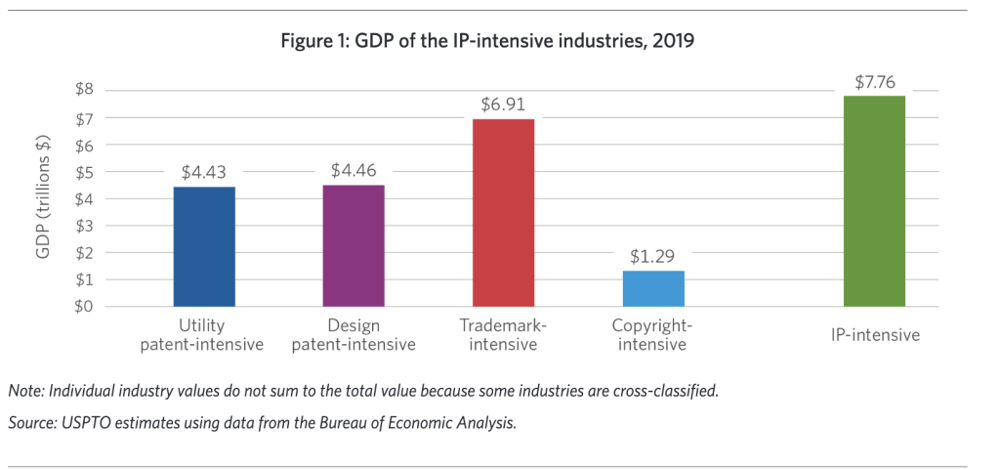
Figure 3: The contributions of different IP-intensive industry groups to U.S. GDP (2019). Trademark-intensive industries accounted for nearly $7.0 trillion of GDP, utility-patent-intensive and design-patent-intensive industries about $4.5 trillion each, and core copyright-intensive industries around $1.3 trillion (Some industries fall into multiple categories, so totals overlap.)
These figures underscore that protecting intellectual property isn’t just about individual inventors or artists; it’s about entire economic ecosystems. IP-intensive sectors (such as tech, pharmaceuticals, entertainment, and advanced manufacturing) tend to have higher productivity and wages, and they generate positive spillovers (each high-tech or creative job often supports additional jobs in other sectors).
Risk Management
Clarifying ownership, registering IP rights, and monitoring for infringement are crucial for risk management in business:
Prevent disputes: Proper IP agreements (and clear inventor/author records) help prevent costly litigation over ownership.
Enables enforcement: Registered IP rights enable timely action (cease-and-desist letters, lawsuits) against infringers, stopping damage before it escalates.
Legal remedies: Formal IP rights support claims for statutory damages and attorneys’ fees in court, which can deter would-be infringers.
Early infringement detection: Patent infringement occurs when someone uses or sells a patented invention without permission; monitoring and early action can limit damages.
IP attorneys play a critical role in helping businesses navigate these risks, from conducting due diligence in mergers (ensuring the target company owns its critical IP) to establishing programs to monitor for knockoffs or patent infringement. Losing key IP or failing to enforce it can be devastating (imagine a biotech whose unpatented formula gets copied, or a fashion brand overrun by knockoffs). Thus, IP management is integral to corporate risk management.
Connection to Consumers
IP’s purpose shapes everyday consumer choices:
Streaming music: Copyright licensing enables platforms like Spotify and Apple Music to offer millions of songs legally (and ensures that artists/songwriters are paid), highlighting one way intellectual property rights protect creators and businesses.
Buying medicine: Patent protection funded the R&D behind many life-saving drugs, and once patents expire, cheaper generics become available to patients.
Choosing products: Trademark protection ensures that the Nike sneakers or iPhone you buy are genuine, not low-quality counterfeits.
Using software: Copyright and trade secrets protect the code running on your devices, which encourages companies to invest in new features and security (while open-source licenses make other software freely available).
Strong IP systems give consumers confidence in the marketplace: confidence that products are authentic and safe, and that today’s innovative companies will be around tomorrow to support what they sell (because they can earn a return on their inventions).
Your Next Steps to IP Protection Success
Understanding the purpose of intellectual property is the first step, but protecting your innovations, brand, and creative works requires strategic action. Whether you’re developing cutting-edge AI technology, building a SaaS platform, or creating a distinctive brand identity, the right IP strategy can mean the difference between sustainable competitive advantage and watching competitors copy your hard work.
The bottom line: Weak IP protection allows competitors to build their businesses on your innovations. Strong IP protection deters copying, attracts investors, and creates defensible value that scales with your company. In today’s intangible-asset economy, where ideas drive 90% of corporate value, IP protection isn’t optional; it’s foundational.
Here’s what’s at stake: Companies that delay IP protection often discover their innovations are already being copied by the time they seek legal help. In the U.S. first-to-file patent system, waiting even a few months can mean losing your rights entirely to a competitor who files first. Every day without trademark protection is another day someone could file a trademark application for your brand name and force you into costly opposition proceedings. For tech startups, inadequate IP protection can derail funding rounds when investors discover your technology isn’t protectable or your brand isn’t defensible.
Take these immediate steps:
- Schedule a Free IP Strategy Call with Rapacke Law Group to evaluate your innovations and develop a comprehensive protection plan tailored to your business goals and budget.
- Assess your current IP assets: Inventory your patents, trademarks, copyrights, and trade secrets to identify protection gaps that leave you vulnerable.
- Review your legal agreements: Ensure employment contracts, contractor agreements, and NDAs adequately protect your IP and assign ownership correctly.
- Document your innovations: Maintain detailed records of development work, including dates, inventors, and technical details: critical evidence for patent applications and IP disputes.
- Monitor the competitive landscape: Watch for potential infringement and file applications before competitors can establish prior art or trademark rights.
Looking ahead: The companies that thrive over the next decade will be those that treat IP as a strategic asset, not an afterthought. Proper IP planning now provides ROI that compounds over time: through higher valuations, licensing revenue, competitive protection, and freedom to operate without infringement risk. Your innovations deserve protection that matches their strategic value to your business.
At Rapacke Law Group, we specialize in tech IP protection for SaaS founders, AI innovators, and solo inventors. Our fixed-fee model means you’ll never face surprise hourly billing, and The RLG Guarantee ensures you only pay for results. Don’t let competitors build their business on your ideas; protect your innovations before it’s too late.
Connect with us:
- LinkedIn: Andrew Rapacke
- Twitter/X: @rapackelaw
- Instagram: @rapackelaw
To Your Success,
Andrew Rapacke
Managing Partner, Registered Patent Attorney
Rapacke Law Group