

Key Takeaways
- IP does not automatically revert to founders. It must be formally assigned in writing before the legal entity ceases to exist.
- Creditors have first claim on a dissolved company's assets, including IP, so debts get settled before IP returns to shareholders.
- Utility patents lapse without maintenance fees, three years of trademark nonuse creates a presumption of abandonment, and trade secrets lose protection once confidentiality breaks down.
- Roughly 70% of patents from failed tech startups are eventually acquired, meaning your IP may hold real sale value.
- Start IP planning at the decision to dissolve, and retain a registered patent attorney alongside dissolution counsel.
*Written by Andrew Rapacke, Managing Partner, Registered Patent Attorney.* Andrew Rapacke is a registered patent attorney and the Managing Partner of The Rapacke Law Group, a full-service intellectual property law firm. He helps individuals and corporations across industries with the protection, prosecution, licensing, and enforcement of their intellectual property, with deep experience in patent, trademark, and copyright matters spanning software, AI and machine learning, blockchain, medical devices, and autonomous vehicle technology. A graduate of the United States Naval Academy, Andrew served as a Naval Engineering Officer before pursuing law and remains active in the startup and inventor communities throughout Florida.
A startup shuts its doors, and six months later the founders discover their patent portfolio, never formally transferred, has lapsed while a competitor snapped up their abandoned trademark. Understanding what happens to IP when a company dissolved decides whether years of innovation return value to founders or evaporate. This guide explains what happens to patents, trademarks, trade secrets, and other IP during dissolution, who ends up owning them, and how to protect value before the process closes.
IP Does Not Disappear When a Company Dissolves It Gets Reassigned or Lost
Intellectual property is treated like any other company asset during dissolution and does not simply vanish. A dissolved company's IP follows a legal chain that depends on how the wind-down is handled, whether debts are outstanding, and what the governing documents say. That matters because intangible assets now make up about 92% of S&P 500 market value by the end of 2025, up from 17% in 1975, according to Ocean Tomo's Intangible Asset Market Value Study. For a broader view, see our founder's complete playbook on intellectual property rights in business.
 Intangible Assets Grew from 17% to 90% of S&P 500 Market Value (1975–2020) — Source: Ocean Tomo, Intangible Asset Market Value Study, 2020
How Company Dissolution Triggers an IP Ownership Event
When a company formally dissolves, every asset must be accounted for and distributed. IP ownership does not transfer automatically to founders, it requires a deliberate legal step, and skipping it is where value quietly disappears. Founders weighing what happens to the IP when they dissolve a company should treat this as the first decision, not the last.
The Difference Between Voluntary and Involuntary Dissolution
In a voluntary dissolution, such as a members voluntary liquidation, founders have time to plan IP transfers. In involuntary or administrative dissolution, including creditors voluntary liquidation scenarios triggered by failing to file annual reports, IP may be seized by creditors or treated as abandoned property before founders act. Know which type you are in before assuming you have a legal right to retain IP rights.
Why Intangible Assets Are the Easiest to Lose
Unlike physical assets, IP has no physical custody. Trademarks fall vulnerable when they drop out of use, utility patents lapse when fees are missed, and trade secrets lose protection the instant confidentiality breaks. Build a complete IP inventory before dissolution begins.
Who Actually Owns the Patents and Trademarks After a Company Is Dissolved
Ownership follows a strict legal order. Creditors have first claim to satisfy outstanding debts, and only then can remaining assets flow to shareholders. Under Delaware's LLC dissolution statute, creditors are paid first, then remaining members receive what is left. Founders reclaim IP only if residual value survives and it is formally distributed, a process that typically spans five years or less from the date of dissolution filing.
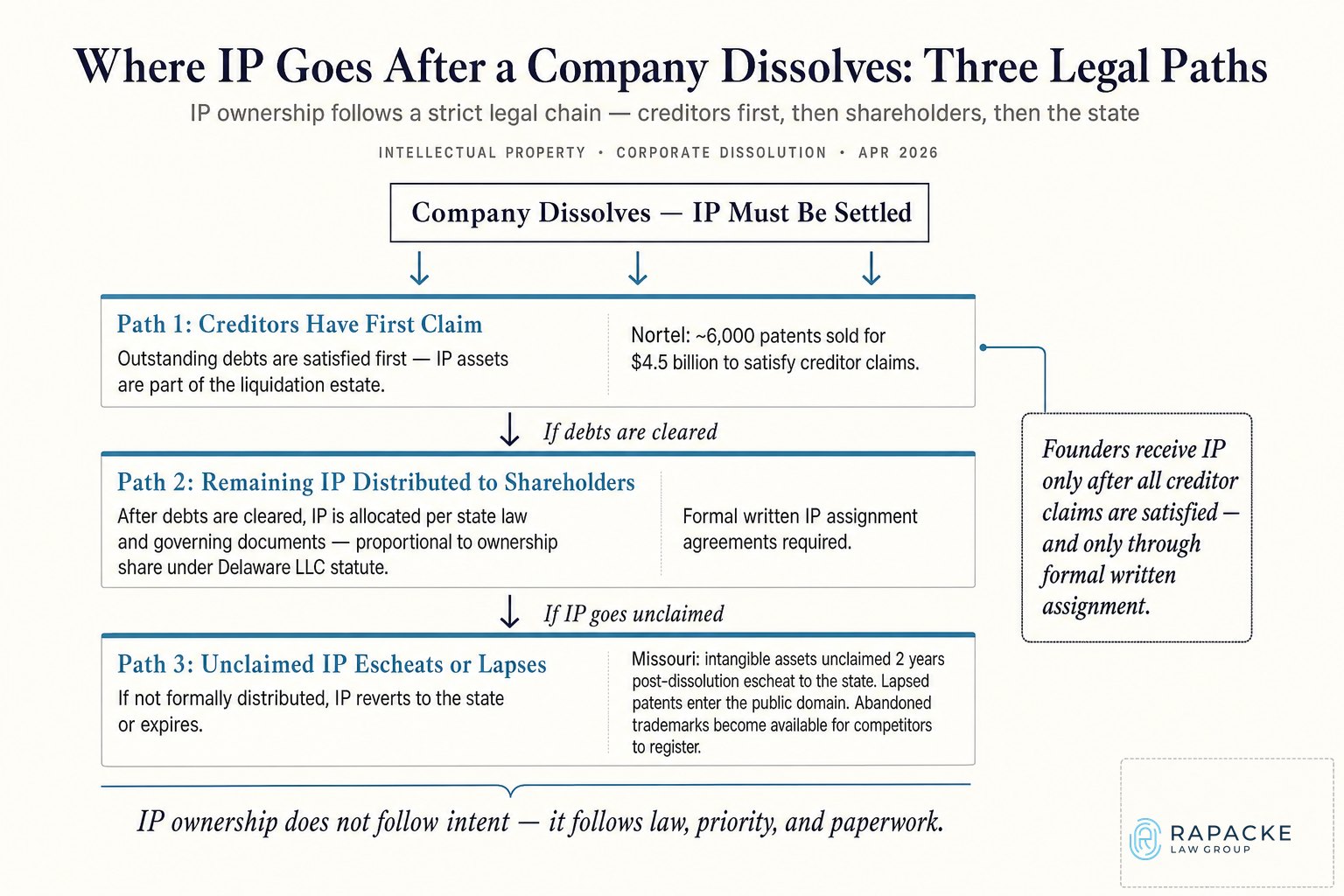 Where IP Goes After a Company Dissolves: Three Legal Paths — Source: Delaware Code Title 6 §18-804; Missouri Revised Statutes §447.527; Wikipedia — Nortel
When Creditors Have First Claim on IP Assets
If the company carries outstanding debts, IP becomes part of the estate available to creditors and can be liquidated. Nortel's bankruptcy produced a $4.5 billion sale of roughly 6,000 patents to a technology consortium, as coverage of the Rockstar Consortium auction documents. Settle or negotiate outstanding liabilities and outstanding taxes before dissolution if you want to keep your IP.
How IP Is Distributed to Company Shareholders
When remaining company assets clear after debts, IP is distributed to shareholders according to state law and the operating or partnership agreement. This demands formal IP assignment agreements, not a verbal understanding.
What Happens When No One Claims the IP
Unclaimed IP does not sit in limbo. Under Missouri's unclaimed property statute, intangible property that remains unclaimed within two years after the date set for final distribution is presumed abandoned, then handled under state unclaimed property rules. Lapsed patents enter the public domain, and abandoned trademarks become available to any competitor. Protecting a brand starts long before this point, which is why founders often move to protect a company name ahead of any wind-down.
What Happens to IP When a Company Is Dissolved: Each Asset Type Follows Different Rules
Patents, trademarks, and trade secrets each follow different rules during dissolution. Assuming one answer covers all IP is a costly error.
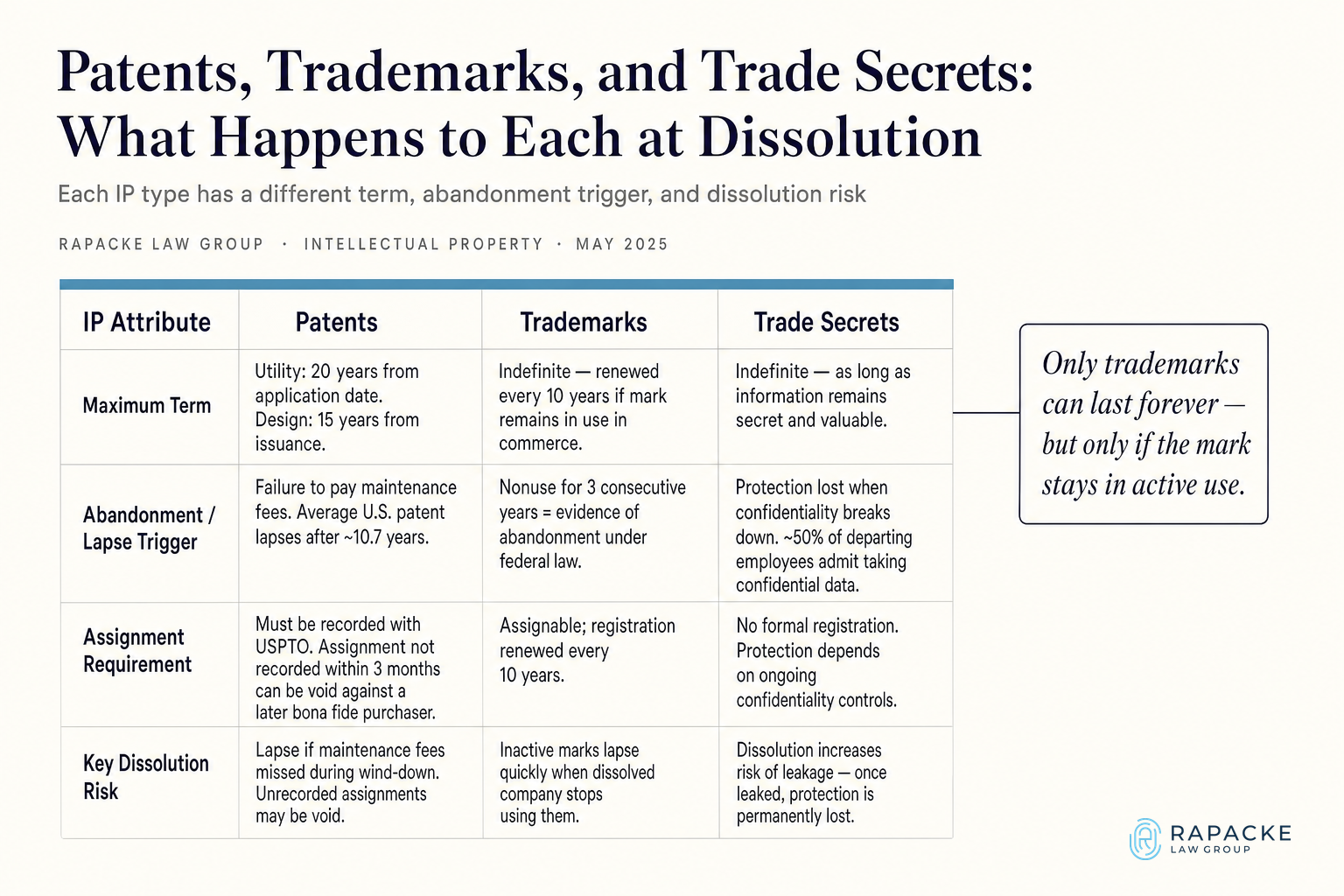 Patents, Trademarks, and Trade Secrets: What Happens to Each at Dissolution — Source: 35 U.S.C. §261; U.S. Trademark Act; JD Supra; patentrenewal.com; DLA Piper Trade Secrets Intelligence
Patents During Dissolution
Patents are transferable through written assignments, but timing is everything. Under 35 U.S.C. 261, an assignment not recorded with the USPTO within three months can be void against a later good-faith purchaser. Maintenance fees must keep flowing or a utility patent expires. Most patents never reach full term, with PatentRenewal.com's multi-jurisdiction dataset showing the average lapse at about 10.7 years. For real filings, see our roundup of patent examples every inventor should study. File a formal patent assignment before or during dissolution, not after.
Trademarks and Trade Dress During Dissolution
Trademark rights depend on active use in commerce. U.S. registrations last 10 years and renew indefinitely while the mark stays in use, but nonuse for three consecutive years is prima facie evidence of abandonment under federal law. A dissolved company that stops using its mark as a legal entity risks quick cancellation. If unsure of your rights, learn how to know if a company name is trademarked. Transfer active trademarks and continue use, or file a proper assignment, before dissolution closes.
Trade Secrets and Confidential Information
Trade secrets last only as long as confidentiality holds, including personal information protected under those agreements. When a company dissolves, employees scatter and NDAs go unenforced. About half of departing employees admit taking confidential data, Canadian Underwriter reported, citing a Symantec survey. Update or novate NDAs with departing staff as part of your dissolution checklist.
Founders Cannot Automatically Take Back IP They Built
Building a company's IP does not mean you own it personally. IP created on company time, with company resources, or assigned through agreements belongs to the business entity, not the individual founder.
Work-for-Hire and IP Assignment Clauses at Formation
The default rule under U.S. law is that invention rights start with the inventor, confirmed by the Supreme Court in Board of Trustees of Stanford University v. Roche. But nearly every startup requires founders to sign IP assignment agreements at incorporation, vesting those rights in the company. At dissolution, that IP is a company asset. Founders building software should revisit our software patents checklist, and SaaS founders in particular will find our SaaS Patent Guide 2.0 and SaaS Agreement Checklist essential reading before dissolution begins.
The Role of Co-Founders and Equity Splits in IP Distribution
With multiple co-founders, IP distribution can turn contested when equity splits do not reflect who created what. By default, Delaware statutes distribute remaining assets in proportion to share-based interests, unless an operating agreement or dissolution plan provides otherwise. Document which founder contributed which IP in a written separation agreement.
What Happens to IP When a Company Is Dissolved: Steps to Protect Value Before It's Final
A concrete pre-dissolution IP checklist preserves value that would otherwise slip away.
Conduct an IP Audit Before Filing for Dissolution
Before initiating dissolution, audit every IP asset, issued patents, pending applications, registered trademarks, trade secret documentation, domains, and software copyrights. Assign a dollar estimate to each. As WIPO explains, an IP audit identifies your rights, confirms you own them, and reveals unused assets or risks. EUIPO data shows 36% of small businesses with registered IP rights have successfully monetized those assets.
File IP Assignments and Transfer Documents Before Dissolution Closes
IP assignments, trademark transfers, and licensing agreements must be executed and filed with the USPTO before the company legally ceases to exist. Deadlines can be tight. Florida's statute for dissolved not-for-profit corporations requires assets that cannot be distributed be deposited with the Department of Financial Services within six months after the final liquidating distribution, per Florida Statutes 617.1440. File all IP transfer documents at least 30 days before submitting final dissolution paperwork.
Selling or Licensing IP During Wind-Down Can Return Capital to Stakeholders
Dissolution does not always mean abandonment. Intellectual property assets, especially patents, can be sold or licensed to raise cash that satisfies debts or returns value to shareholders. Roughly 70% of patents owned by failed tech-based startups were eventually purchased by other companies, according to ITIF's summary of research by Serrano and Ziedonis. Kodak's 2012 bankruptcy sale of about 1,100 digital imaging patents brought $525 million, the Los Angeles Times reported. These dynamics also sharpen how VCs value a company and how IP can drive real returns at exit.
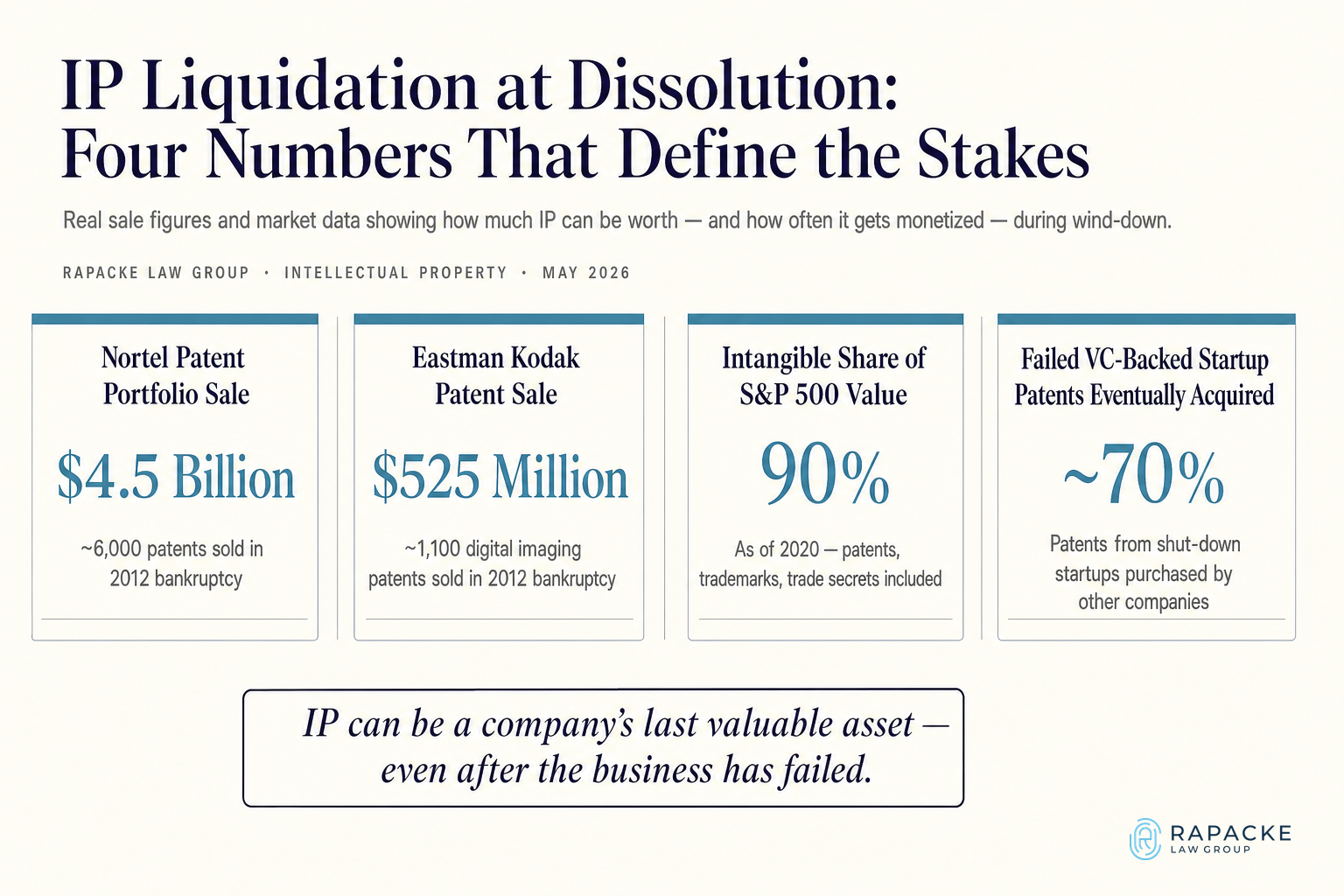 IP Liquidation at Dissolution: Four Numbers That Define the Stakes — Source: Wikipedia (Nortel); Los Angeles Times, 2012; Ocean Tomo, 2020; ITIF, 2018
How to Value IP Assets for Sale or Licensing
IP valuation turns on market comparables, licensing revenue potential, and the strength of existing claims. Patent portfolios in active sectors like AI, SaaS, and fintech often draw acquirers, and the companies holding the most AI patents are frequent buyers. Conduct due diligence and get a preliminary IP valuation before assuming your patents carry no sale value.
Structuring an IP Sale During the Dissolution Process
An IP sale requires formal assignment agreements, ownership and encumbrance representations, and possibly creditor consent if the IP secures debts. A licensing arrangement can preserve royalty income even as the company winds down. Structure sales as arms-length transactions with full title searches to avoid post-sale disputes.
What Happens to IP When a Company Is Dissolved: Common Mistakes That Cost Founders
Roughly 20% of new businesses close in year one and about 50% by year five, per SeedScope's review of startup survival statistics. Many founders lose IP value through avoidable errors during wind-down.
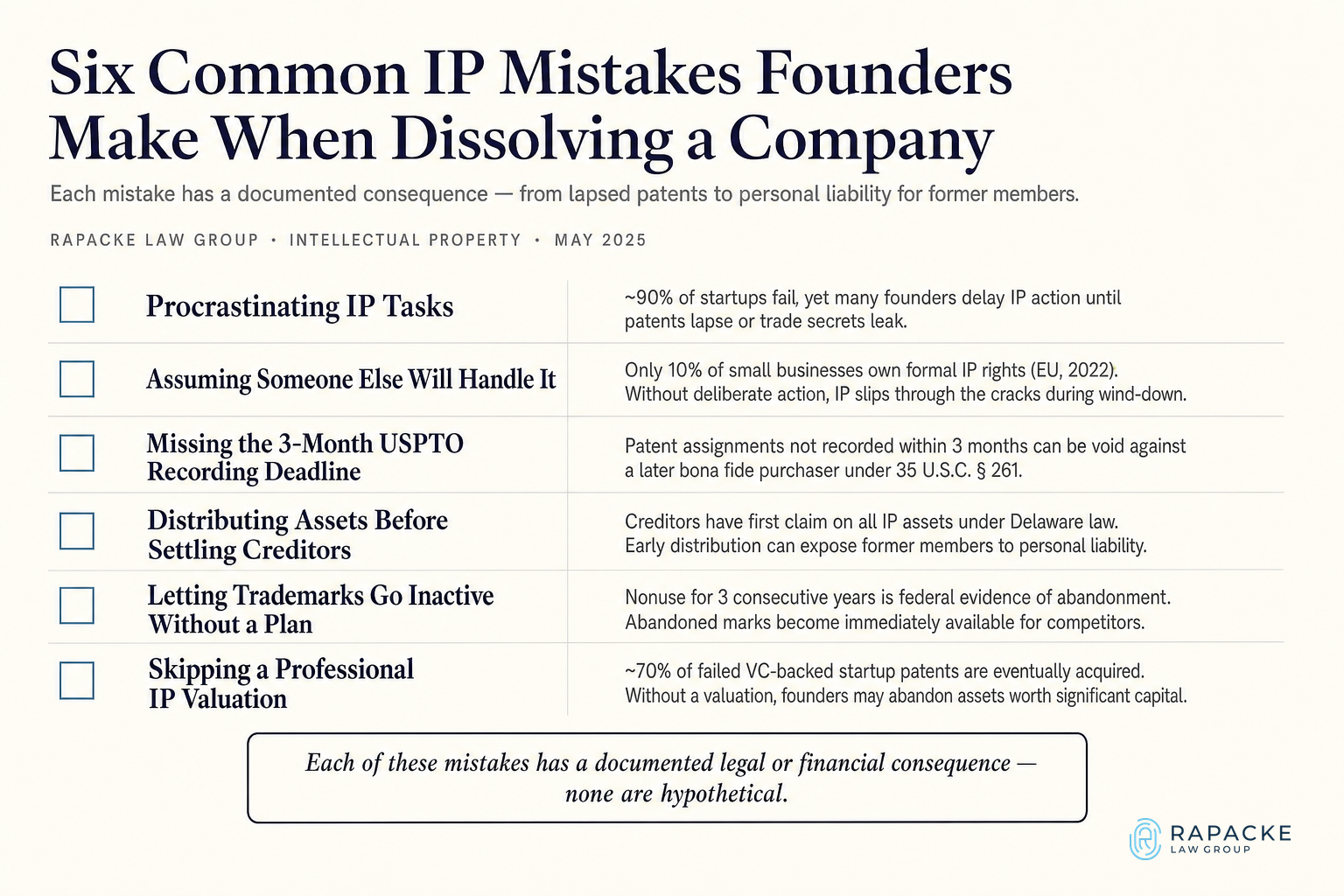 Six Common IP Mistakes Founders Make When Dissolving a Company — Source: tangibleip.biz; EUIPO IP SME Scoreboard 2022; USPTO 35 U.S.C. § 261; Delaware LLC Act § 18-804; ITIF, 2018
Waiting Too Long to Address IP During Dissolution
The most common mistake is treating IP as an afterthought until the final steps. By then patent maintenance fees may have lapsed, trademark renewals may have been missed, and assignment windows may have closed. IP planning should begin at the decision to dissolve, and seeking legal advice early can prevent these costly oversights by ensuring all legal obligations are met before the entity closes.
Assuming the Dissolution Attorney Handles IP Automatically
General business dissolution attorneys and other legal professionals often do not proactively address IP, and engaging an experienced IP lawyer specifically for this purpose is the safest approach. Only 10% of EU small businesses reported owning registered IP rights in a 2022 survey by the EUIPO, yet 93% of those that did saw a positive impact from registration. Unless you engage an IP attorney specifically, patent and trademark assignments may fall through the cracks.
Frequently Asked Questions
What happens to IP when a company dissolves?
IP becomes part of the company's estate, used to pay creditors first, then distributed to owners through formal assignment agreements. Business owners in most cases must execute written transfers to preserve any value. In most cases, dissolved companies lose IP value simply because founders delay the transfer process. If not properly transferred, patents can lapse into the public domain and trademarks can be re-registered by competitors.
Can a dissolved LLC still be sued?
Yes. A dissolved entity continues to exist solely for winding up, which includes defending lawsuits. Any judgment is generally paid from remaining assets, not from members personally unless they mishandled the wind-down.
How long can a company hold an IP?
Utility patents generally last 20 years from filing and require maintenance fees, while design patents filed on or after May 13, 2015 last 15 years from grant and do not require maintenance fees. For a sole proprietor, IP created for the business may still belong personally to the owner unless a formal business structure was established. Trademarks renew indefinitely while used in commerce, and trade secrets last as long as secrecy holds. Once a company dissolves, assets must transfer or they expire, lapse, or lose protection.
What are the cons of dissolving an LLC?
Dissolution permanently ends the entity's ability to conduct business but does not erase obligations. Debts, taxes, and liabilities must still be paid, and members can face personal liability if they distribute assets before settling them, as LegalClarity notes.
Who is responsible when a company is dissolved?
During voluntary dissolution, officers or managers handle winding up. In court-supervised dissolution, a trustee or receiver may take over. Former directors or members can be called on to address unresolved matters, depending on state law. A sole proprietorship follows different rules, as the owner and the business are legally the same person.
What to Do Right Now If You Are Dissolving a Company With IP
Every day of delay is a day patent fees can lapse, trademark registrations can go unmaintained, and trade secrets can leak. Unaddressed IP either falls into the public domain or lands in a competitor's hands. Founders who wait until dissolution paperwork is filed often discover that maintenance fee deadlines have already passed, trademark renewal windows have closed, and confidential information has spread beyond any NDA's reach, leaving them with no assets to sell, license, or carry into their next venture.
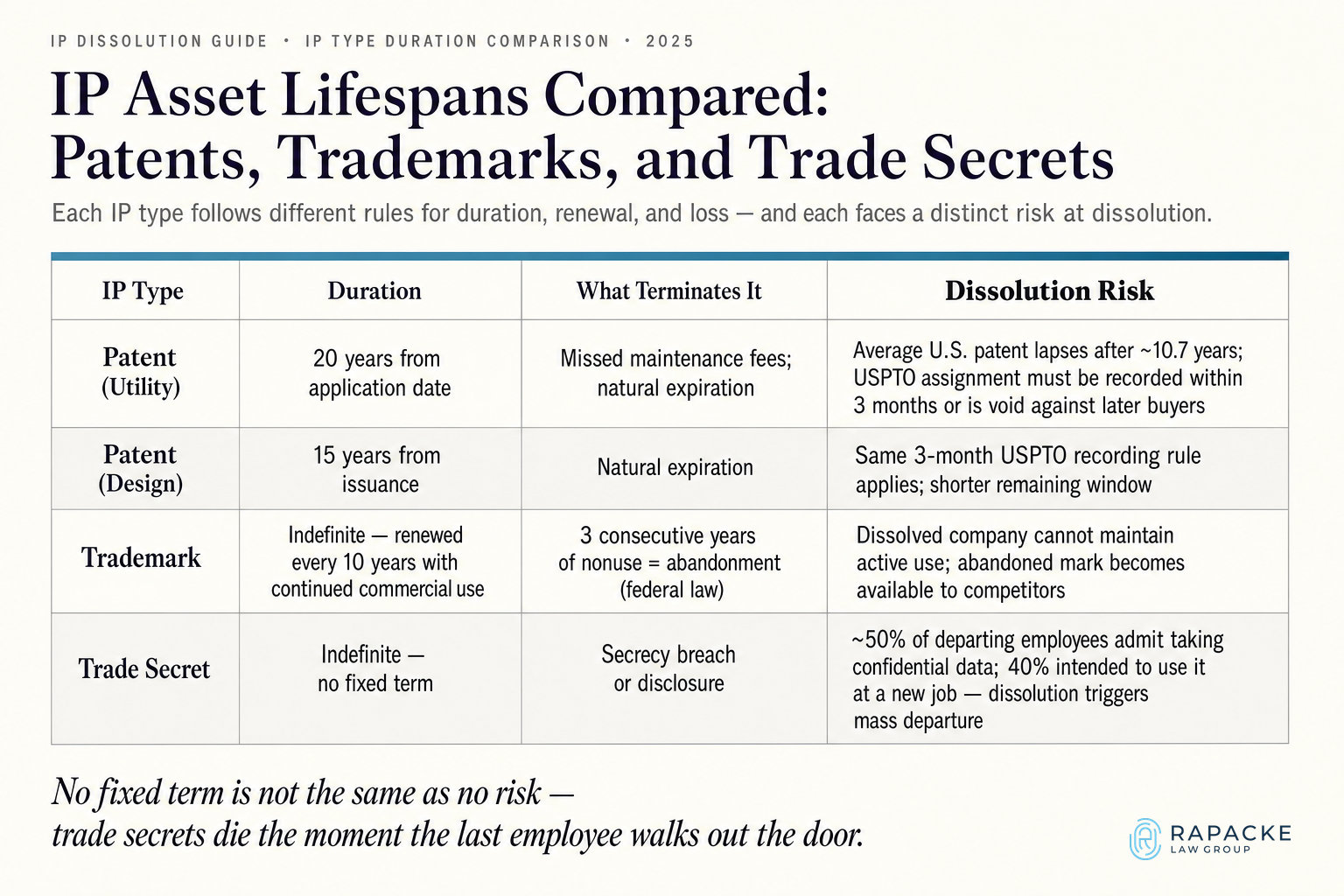 IP Asset Lifespans Compared: Patents, Trademarks, and Trade Secrets — Source: 35 U.S.C. §261 (uscode.house.gov); en.wikipedia.org/TermofpatentintheUnitedStates; en.wikipedia.org/Trademark; JDSupra; patentrenewal.com; canadianunderwriter.ca
A weak, unmanaged patent or abandoned trademark returns nothing to founders and often hands value to a competitor, while a strong, properly assigned IP portfolio can offset debts, generate a sale, or seed your next venture.
Rapacke Law Group works with founders in this position, conducting IP audits, filing USPTO assignments, and structuring IP transfers as part of a broader dissolution strategy. All engagements use flat-fee pricing under the RLG Guarantee. For provisional patent work, the RLG Guarantee means a full refund if the USPTO denies your application, and for trademarks, you pay nothing if the mark is rejected.
Your Next Steps to IP Dissolution Success:
The bottom line: Unmanaged IP at dissolution returns nothing to founders and often hands competitive advantage directly to rivals, while a properly assigned and transferred IP portfolio can offset debts, generate sale proceeds, or seed your next venture.
- Schedule a Free IP Strategy Call to learn what your IP is worth, who owns it, and how to protect or monetize it before your dissolution closes.
- Order an IP audit to inventory every patent, trademark, and trade secret asset.
- File USPTO assignments and transfer documents before the entity legally closes.
Move now, and IP that would otherwise vanish becomes a real competitive and financial asset on the way out. To Your Success,
Andrew Rapacke Managing Partner, Registered Patent Attorney Rapacke Law Group