


Using the wrong trademark symbol on your registered logo can cost you every dollar of damages in an infringement lawsuit. Under 15 U.S.C. § 1111, trademark owners who fail to properly display ® on a registered mark may be barred from recovering monetary damages unless an infringer had actual knowledge of the registration. On the other side, displaying ® before your USPTO registration certificate issues is a federal violation that courts have used to deny registration and weaken enforcement positions. The symbol is not decorative. It is a legal statement with specific requirements attached.
Key Takeaways
- The ® symbol is legally reserved for marks with an active USPTO registration certificate. Using it before registration issues violates federal law and can forfeit your right to damages.
- Use ™ (for goods) or ℠ (for services) the moment you begin using a brand identifier in commerce, even before filing. No government approval is required.
- A foreign trademark registration, including EU, UK, or Madrid Protocol registrations, does not authorize use of ® in the United States.
- The USPTO trademark process currently takes roughly 12 to 18 months on average from filing to registration for straightforward applications, so filing early matters because your filing date, not your registration date, establishes priority.
- Missing a USPTO maintenance filing deadline cancels your registration and eliminates your right to use ®, so set those calendar reminders the day your certificate arrives.
The ® Symbol Is a Legal Statement, Not Just a Design Element
Many brand owners treat the ® on a registered logo as a credibility marker, something that signals seriousness or professionalism. The legal reality is far more specific. The ® symbol communicates one thing to the public, to competitors, and to courts: this mark has been officially registered with the United States Patent and Trademark Office (USPTO) and its owner holds the full bundle of federal trademark rights under the Lanham Act.
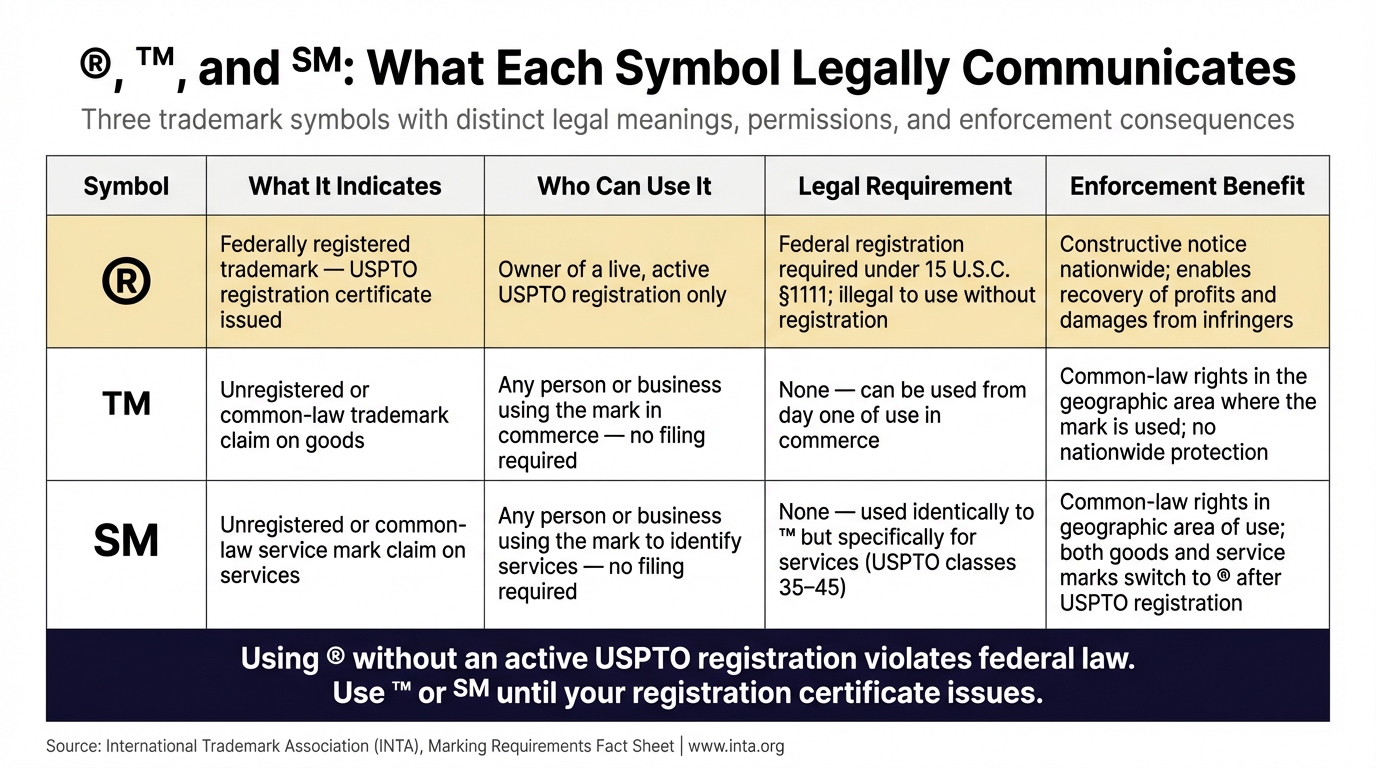
®, ™, and ℠: What Each Symbol Legally Communicates — Source: International Trademark Association (INTA), Marking Requirements Fact Sheet
According to the International Trademark Association (INTA), using ® on a mark that is not registered constitutes improper use under U.S. trademark law. Federal courts have cited unauthorized ® use as evidence of deceptive practice, and it can surface as a defense raised by infringers to weaken the original owner's position. The stakes run in both directions. A trademark owner who has a valid registration but neglects to display ® cannot recover profits or damages in an infringement case unless the infringer had actual notice of the registration through other means.
The registered symbol operates alongside two other symbols that serve different purposes: ™ for unregistered goods marks and ℠ for unregistered service marks — each distinct from the copyright symbol, which protects creative works rather than brand identifiers. Understanding the difference between all three is not a branding exercise. It is the foundation of your intellectual property protection strategy. To get a full grounding in how trademark protection works before diving into symbol rules, see our guide to what trademarking means and why it matters. As the chart above shows, each symbol has a distinct legal meaning, a different set of users who can legitimately deploy it, and different enforcement consequences.
What Each Trademark Symbol Actually Communicates to the Public
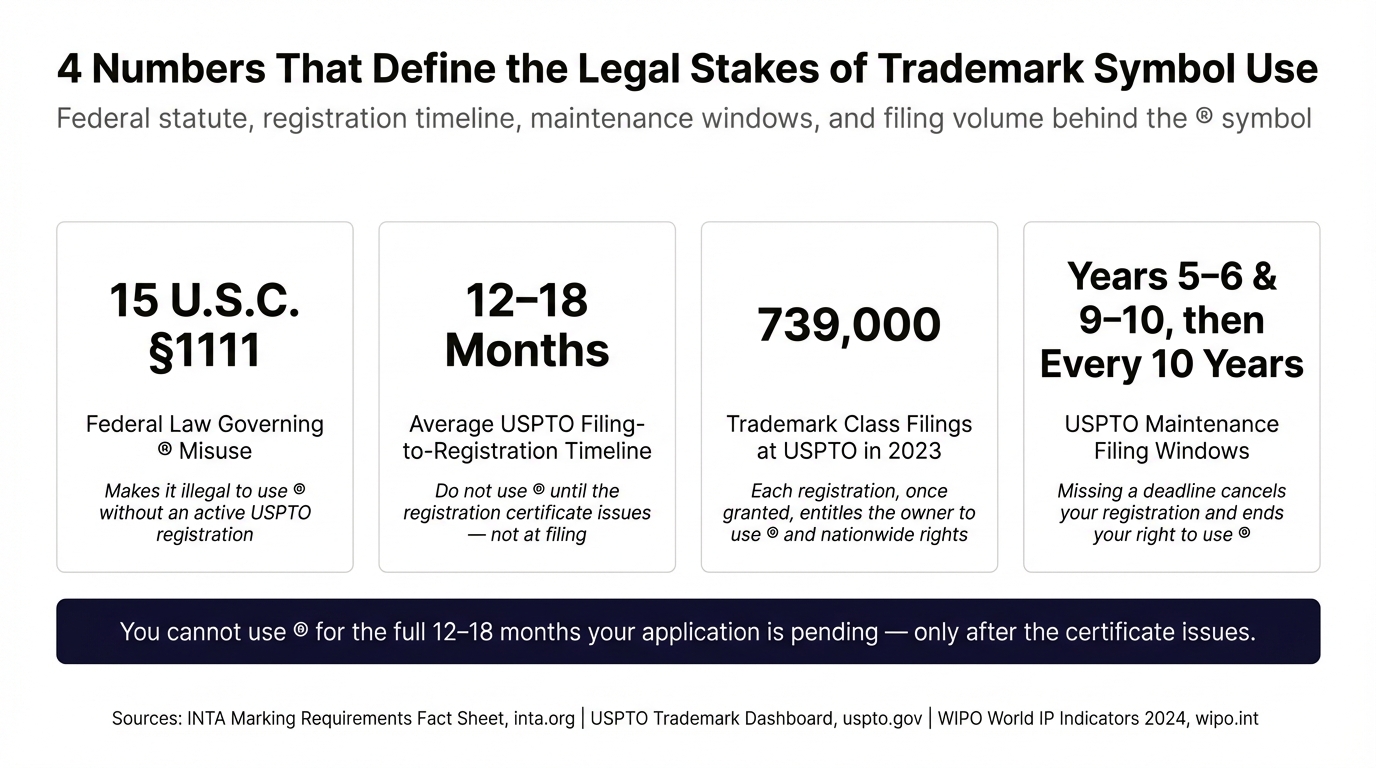
4 Numbers That Define the Legal Stakes of Trademark Symbol Use — Source: INTA Marking Requirements Fact Sheet; USPTO Trademark Dashboard; WIPO World IP Indicators 2024
The ® Symbol Signals Federal Registration
The ® is reserved exclusively for a registered logo or mark that has completed the USPTO registration process and received an official registration certificate. Per INTA's marking guidance, use of ® before registration is prohibited under the Lanham Act and can be treated as a fraudulent misrepresentation in certain circumstances. Once registered, the registered trademark symbol functions as constructive notice to the entire country. Under 15 U.S.C. § 1072, registration on the principal register constitutes constructive notice of the registrant's claim of ownership, meaning no one can later claim they were unaware the mark was protected.
According to the World Intellectual Property Organization's 2024 World IP Indicators report, approximately 739,000 trademark class filings were processed in the United States in 2023. Each of those applications, if successfully registered, grants the owner nationwide rights and the legal right to display ®. Do not use ® on any registered logo or brand material until you have received your USPTO registration certificate, not simply filed your application. For a clear explanation of what the difference between the ® symbol and the ™ symbol means in practice, that distinction starts with understanding when each registration milestone is reached.
The ™ Symbol Signals Common Law Trademark Rights
Any business or individual can place the ™ symbol next to a brand name, logo, or slogan the moment they begin using it in commerce, without a USPTO filing, without approval, and without cost. As INTA explains, the TM symbol simply indicates "this is my claimed trademark" and establishes common law rights valid in the geographic area where the mark is actually used. Those rights are real but geographically limited.
The practical limitation matters for growing brands. Common law trademark protection does not give you nationwide priority. A competitor who starts using a similar mark in a different state after you begin using yours locally may have rights in their region that you cannot easily displace without federal registration. Axios reporting on the Hudson's Detroit trademark dispute illustrates this clearly: businesses relying solely on ™ find themselves without the statutory benefits that come only with federal registration. Use ™ immediately on any brand identifier you are using in commerce, but understand its geographic ceiling. For a deeper look at avoiding common missteps, our guide to trademark icon mistakes that could cost your startup its brand covers the errors that most frequently undermine early-stage brand protection.
The ℠ Symbol Covers Services Rather Than Physical Products
The service mark symbol ℠ operates identically to ™ but applies specifically to marks used to identify services rather than goods. According to INTA, ℠ is used for service marks before federal registration, just as ™ is used for trademarks on goods. The U.S. trademark classification system assigns Classes 1 through 34 to products and Classes 35 through 45 to services.
A SaaS company branding its platform, a consulting firm protecting a methodology name, or a startup marking its onboarding process name would correctly use ℠ — not ® reserved for a registered logo or service mark — before federal registration. After USPTO registration, both goods marks and service marks use ® regardless of which category applies. ℠ and ™ are exclusively pre-registration tools.
When You Are Legally Permitted to Use Each Symbol
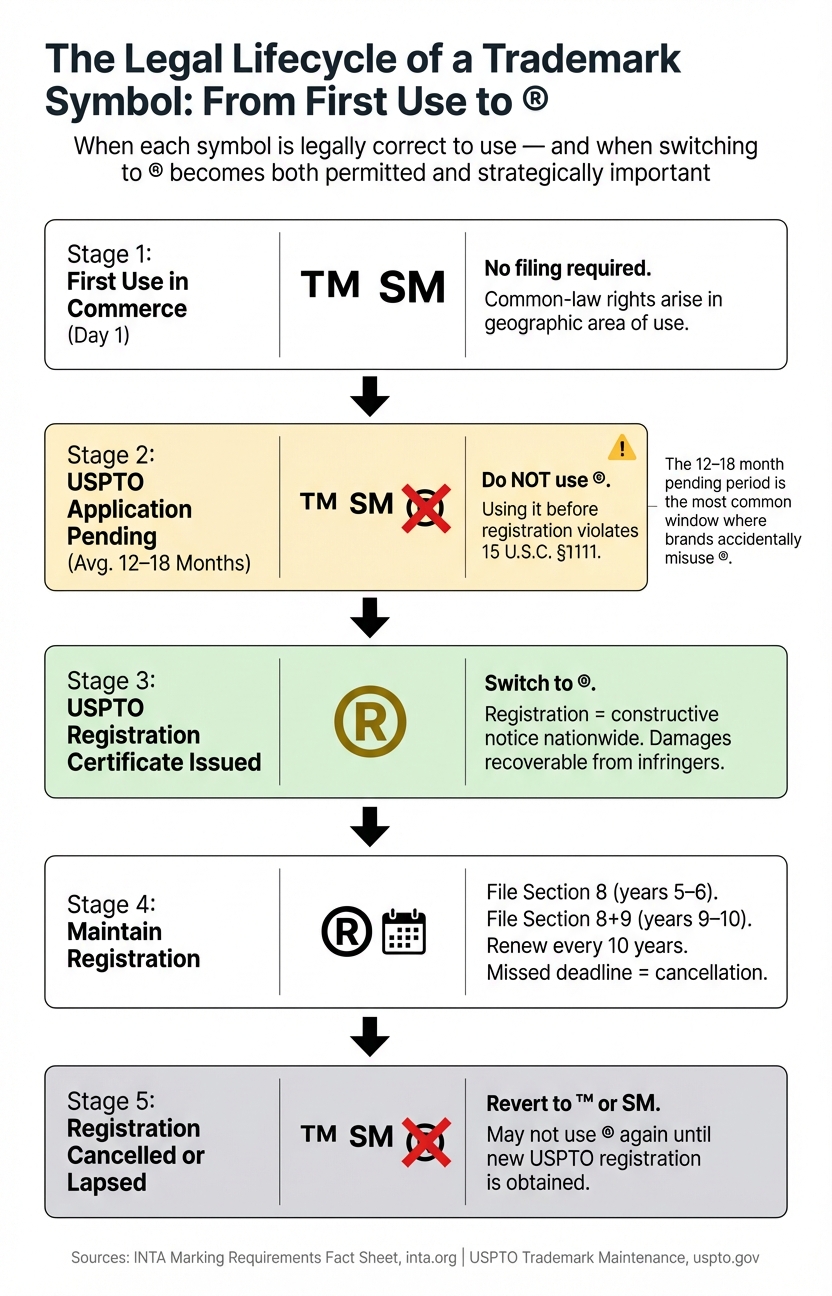
The Legal Lifecycle of a Trademark Symbol: From First Use to ® — Source: INTA Marking Requirements Fact Sheet; USPTO Trademark Maintenance
® Requires a Live, Active USPTO Registration
The right to display ® on a registered logo begins the day your USPTO registration certificate issues and ends the moment that registration is cancelled, abandoned, or allowed to lapse. The USPTO mandates a Section 8 declaration of use filed between the 5th and 6th year after registration, followed by a combined Section 8 and Section 9 renewal filed between the 9th and 10th year, with combined Section 8 and 9 renewals every 10 years thereafter, according to USPTO's maintenance guidance. Miss a filing window and the registration is cancelled. There is no grace period that restores a lapsed registration automatically once the window closes, though the USPTO does offer a six-month grace period with a surcharge for some maintenance filings, which still must be submitted before the extended deadline expires.
Trademark registration currently takes roughly 12 to 18 months from filing to registration for straightforward applications, per USPTO performance data. That timeline means the clock on your trademark protection starts when you file, not when you receive the certificate. Set calendar reminders for your USPTO maintenance filing windows on the day your registration certificate arrives. A missed deadline cannot be undone outside the grace period, and losing a registration eliminates your right to use ® until you re-register from scratch.
™ and ℠ Can Be Used Before, During, and After Filing
No permission, filing, or government approval is needed to begin using ™ or ℠. From the first day you use a brand name or logo in commerce, you can add ™ to signal that you claim rights in the mark. It is proper to continue using ™ while your USPTO application is pending, and to continue using it if your application is refused and you continue operating under the mark. INTA's marking fact sheet is explicit: using ™ after your registration issues is not illegal, but it means you are not activating the legal notice benefits of the ® designation you paid to achieve.
The only time to switch is when your registration certificate arrives. At that point, update all public-facing brand materials — including your registered logo — to reflect ® and stop using ™ on that registered mark. Continuing to use ™ on a registered mark is leaving legal protections unclaimed. If you are still deciding whether federal registration makes sense for your business, our breakdown of whether to trademark your company name walks through the pros, cons, and timing considerations.
Why Using the Wrong Symbol Creates Real Legal Risk
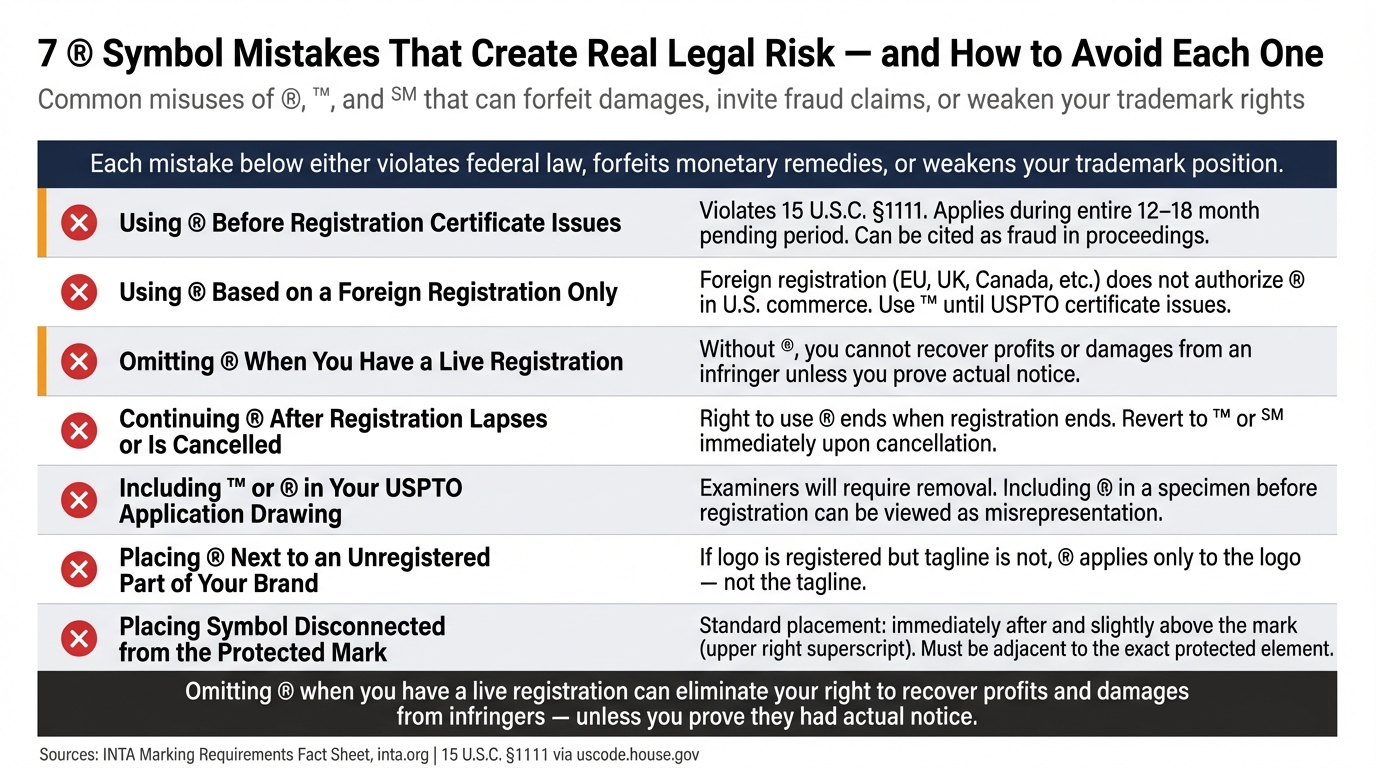
7 ® Symbol Mistakes That Create Real Legal Risk — and How to Avoid Each One — Source: INTA Marking Requirements Fact Sheet; 15 U.S.C. §1111 via uscode.house.gov
Misusing ® Can Forfeit Your Damages in Infringement Cases
The financial consequence of displaying the wrong symbol on a registered logo is direct and quantifiable. Under 15 U.S.C. § 1111, a trademark owner who holds a valid registration but fails to properly use the registered trademark symbol cannot recover monetary damages or profits in an infringement lawsuit unless the defendant had actual knowledge of the registration. In practical terms, this means that every month your registered mark appears in public without ® attached, you are building a defense for any infringer who copies it.
The reverse misuse is equally damaging. Courts have cited false use of ® on an unregistered logo as grounds to weaken or deny trademark rights entirely. According to INTA, using ® on an unregistered mark is considered a deceptive or fraudulent practice under the Lanham Act, and intentional misuse has been raised successfully as a defense in infringement proceedings. Conduct an annual audit of every public-facing brand touchpoint to confirm the ® appears only on actively registered marks. For logo-specific guidance, our article on trademarking a logo covers how registration scope affects where and how the symbol should appear on visual brand assets.
International Registration Does Not Authorize ® Use in the United States
A trademark registered in the European Union, the United Kingdom, Canada, China, or any other country does not carry the right to display ® on a registered logo in U.S. commerce. As INTA confirms, the ® symbol in the United States refers specifically to USPTO registration. Using ® based on a foreign registration while marketing in the U.S. constitutes improper use under U.S. trademark law because, from the USPTO's perspective, the mark is still unregistered in this country.
The Madrid Protocol allows brands to file for U.S. registration based on a foreign home registration, which is a common route for international businesses entering the U.S. market. But even under that route, ® cannot be displayed until the USPTO issues a U.S. registration certificate. Until then, ™ or ℠ is the correct symbol in all U.S. marketing materials.
How the Registered Logo Symbol Strengthens Your IP Position
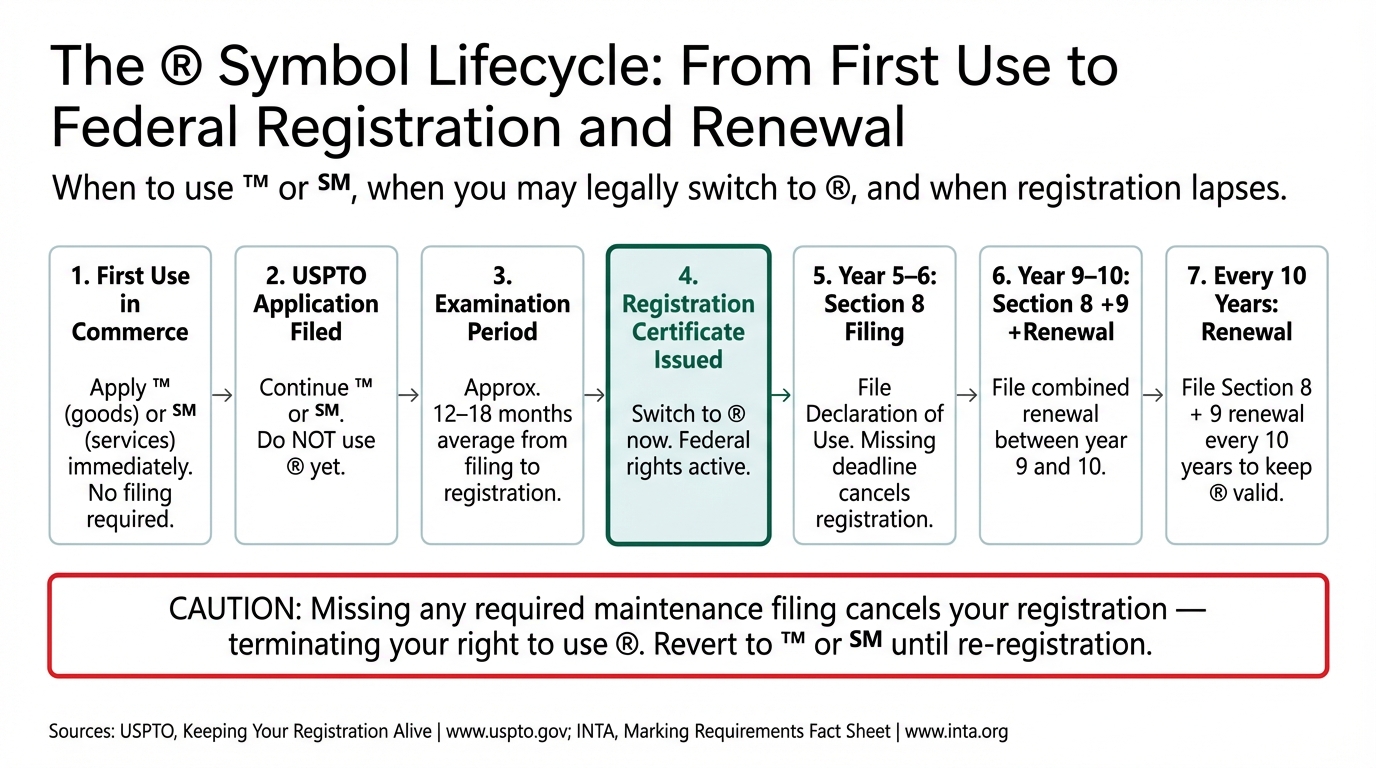
The ® Symbol Lifecycle: From First Use to Federal Registration and Renewal — Source: USPTO, Keeping Your Registration Alive; INTA, Marking Requirements Fact Sheet
Federal Registration Creates a Nationwide Priority Date
When you register a trademark with the USPTO and begin displaying ® on your registered logo, the registration establishes constructive use priority across the entire United States, regardless of where you actually conduct business today. This is codified in Lanham Act Section 7(c), under 15 U.S.C. § 1057(c): the filing date of the application, not the registration date, serves as the constructive use date for priority purposes. A competitor who begins using a similar mark anywhere in the country after your application filing date has a weaker claim, even if they were already using the mark in their local region before your certificate issued.
That nationwide priority is the core reason trademark registration matters for scaling businesses. Common law rights through ™ usage are capped by geography. Federal trademark registration through the USPTO removes that cap entirely and places all future users of similar marks on constructive notice of your rights under 15 U.S.C. § 1072. For a step-by-step walkthrough of establishing those rights, see our guide on how to own the rights to a name.
The ® Symbol Deters Infringement Before It Starts
Visible use of ® on a registered logo signals to competitors, counterfeiters, and copycats that the mark is federally registered and that the owner has standing to pursue infringement claims including monetary damages and injunctive relief under the Lanham Act. According to INTA's marking guidelines, proper marking is the mechanism that eliminates the "innocent infringer" defense and preserves the owner's right to recover damages under 15 U.S.C. § 1117. Without visible ®, even a defendant who copies a registered mark deliberately can argue no actual notice existed.
After receiving your USPTO registration certificate, update all brand assets systematically: website headers, product packaging, social media profiles, email signatures, presentation templates, and any collateral that carries the mark. The ® symbol only activates its legal notice function when it is actually visible on public-facing materials.
Where to Place the Registered Logo Symbol in Your Branding
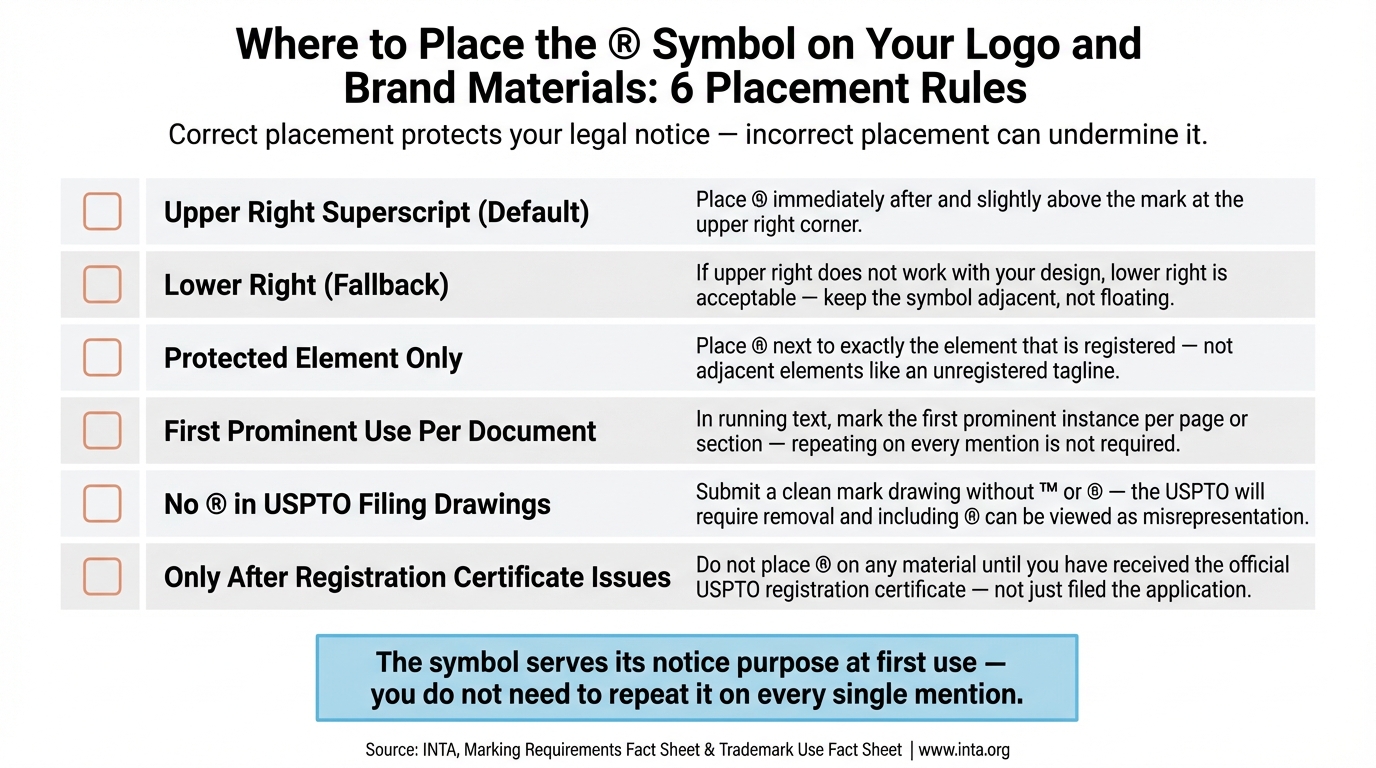
Where to Place the ® Symbol on Your Logo and Brand Materials: 6 Placement Rules — Source: INTA, Marking Requirements Fact Sheet & Trademark Use Fact Sheet
Position the Symbol at the Top Right Corner of the Mark
The standard placement for ®, ™, or ℠ on a registered logo is superscript at the upper right of the specific trademark, immediately adjacent to the protected element. INTA's trademark use guidance specifies that the symbol should appear with the trademarked element itself, not floating generically near unrelated parts of a design. If your logo includes both a registered word mark and an unregistered tagline, the ® attaches to the word mark, not to the broader design layout.
When upper right placement is not practical due to design constraints, lower right is an acceptable alternative. The critical requirement is that the symbol is visually associated with the specific element that is protected. Major brand owners including Apple, Nike, and Google consistently place the registered trademark symbol at the upper right of their specific registered marks, a practice that reflects both legal guidance and decades of brand management convention. Our resource on how to choose a trademark for long-term success includes additional guidance on how mark selection affects the scope of what you can legitimately place ® on once registration is complete.
You Do Not Need to Use the Symbol Every Time the Mark Appears
For lengthy documents, marketing copy, or web pages where a registered logo or trademark appears repeatedly, best practice is to use the symbol on the first prominent appearance and the first appearance in body text, then omit it in subsequent references. INTA's trademark use fact sheet confirms this approach: the symbol serves its legal notice function on first use, and repeating it on every mention clutters copy without adding legal benefit.
Update your brand style guide to specify symbol use on first prominent mention only. Train content creators, designers, and marketing staff on this rule to maintain consistency. Inconsistent symbol use, where some team members add ® to every instance and others omit it entirely, is one of the most common intellectual property protection gaps in growing companies.
Never Include the Symbol in the Mark Itself When Filing
One of the most common filing mistakes is submitting a registered logo application with the ® or ™ symbol embedded as part of the mark drawing. The USPTO's trademark examining attorneys require removal of any trademark symbols from the drawing before processing, because the symbol is an identifier of rights, not a component of the protected mark. Including it in the drawing can complicate both the application and the scope of what actually gets registered. When preparing USPTO application drawings or specimen images, strip all trademark symbols from the file before submission.
How to Type the Registered Trademark Symbol on Any Device
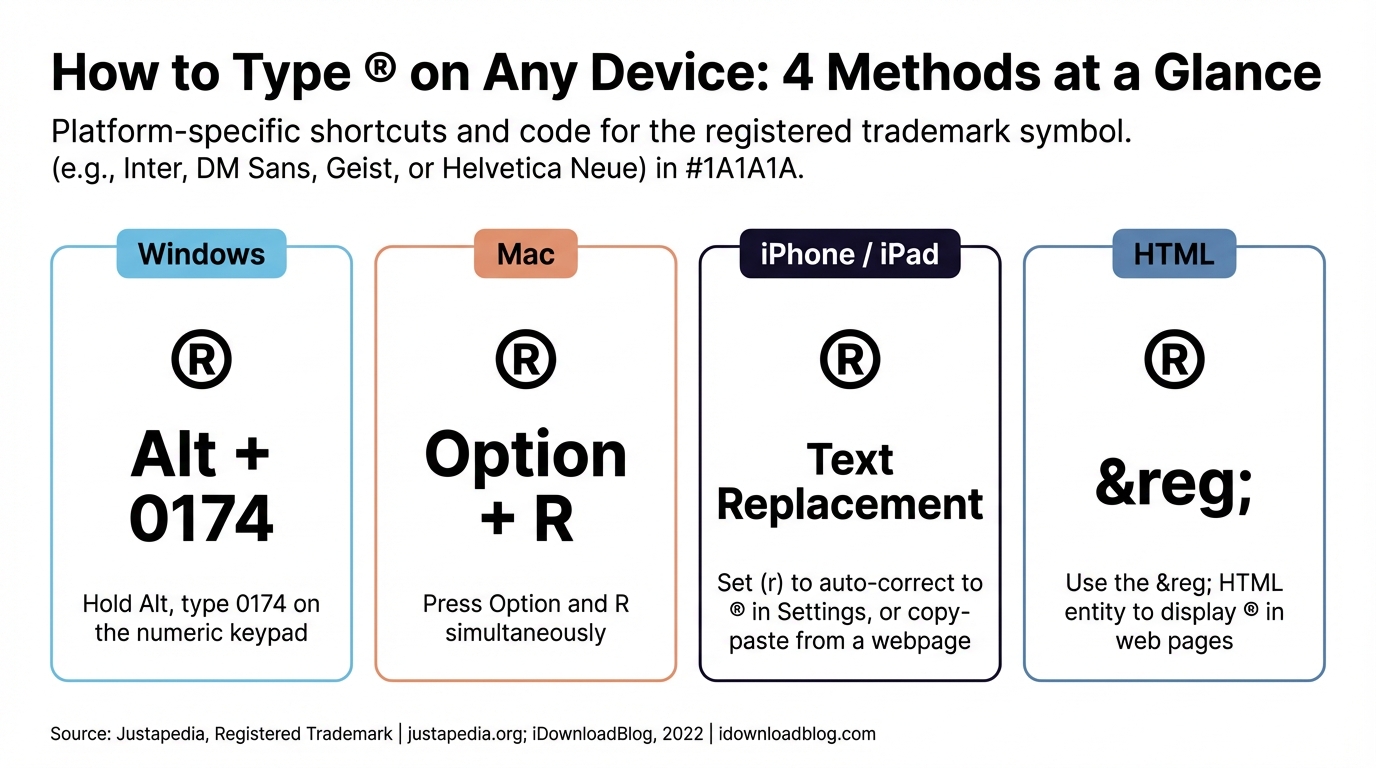
How to Type ® on Any Device: 4 Methods at a Glance — Source: Justapedia, Registered Trademark; iDownloadBlog, 2022
Keyboard Shortcuts for Windows
On Windows, the registered trademark symbol is typed using Alt + 0174: hold the Alt key, type 0174 on the numeric keypad, then release Alt. In Microsoft Office applications, typing (r) will autocorrect to ® automatically. The Character Map tool, accessible through the Windows search bar, also lets you locate and copy the symbol directly into any document or field.
Test the Alt + 0174 shortcut in your specific applications before relying on it in production, since numeric keypad behavior varies significantly on laptops that lack a dedicated numeric keypad. On those devices, the Character Map or copy-paste method is more reliable.
Keyboard Shortcuts for Mac
On a Mac, the registered trademark symbol is typed using Option + R. This shortcut works in virtually all native Mac applications and most web browsers without any configuration. For iPhone and iPad users, holding down the letter R on the on-screen keyboard brings up a pop-up menu that includes ®, which can be tapped to insert in any text field.
The Mac Character Viewer, accessible through the Edit menu or System Settings, provides a browsable interface for locating and inserting special characters when you need a visual reference rather than a shortcut. For faster access on iPhone, adding ® to your text replacement settings (Settings > General > Keyboard > Text Replacement) makes the symbol available without the long-press method.
Copy-Paste the Symbol for Any Platform or Device
For anyone who does not want to memorize keyboard shortcuts, copying ® directly and pasting it into any text field is fully functional across all modern operating systems. Unicode character U+00AE is the official encoding for the registered trademark symbol and renders correctly across virtually all browsers, operating systems, and publishing platforms.
For web developers, the HTML entity ® or the numeric code ® inserts the symbol correctly in web content. Using the HTML entity rather than pasting the character directly ensures consistent rendering across all browsers and character encoding environments, which matters for brand consistency at scale.
Getting Your Trademark Registered and Using It Correctly
Choosing the right trademark symbol for your registered logo is a legal decision, not a branding preference. Using ™ or ℠ while building your brand costs nothing and puts the market on notice of your rights. Using ® before your USPTO registration certificate issues is a federal violation that can undermine the intellectual property protection you are trying to establish. And failing to use ® after your registration is active means forfeiting your strongest enforcement tool at precisely the moment litigation would matter most.
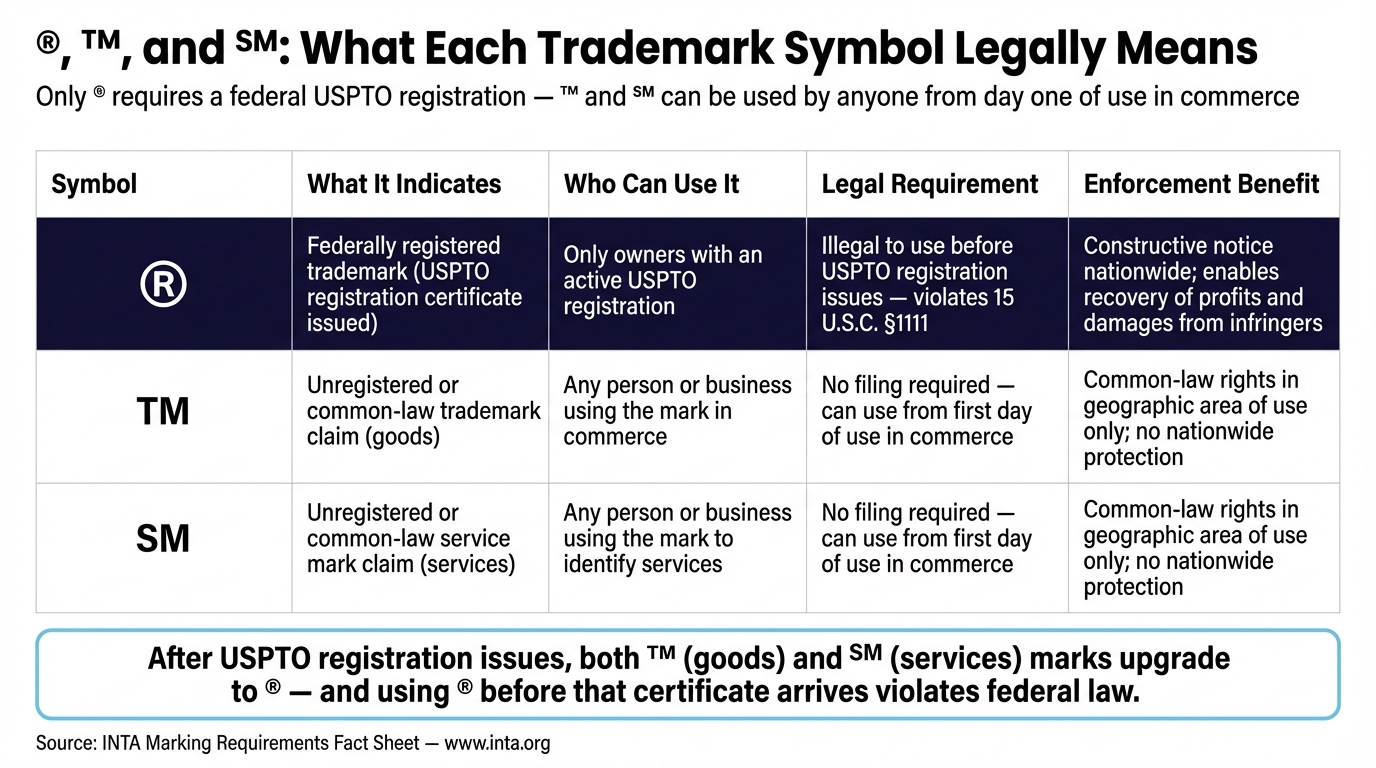
®, ™, and ℠: What Each Trademark Symbol Legally Means — Source: INTA Marking Requirements Fact Sheet
The practical path is straightforward. Verify your current trademark registration status at the USPTO's TSDR database. Use the correct symbol on every public-facing brand touchpoint starting today. If you have not yet filed for federal trademark registration, understand that common law ™ rights are capped geographically and that every day without a USPTO filing date is a day your brand's nationwide priority position remains unestablished. For a complete look at what federal trademark protection actually covers and how the process works from start to finish, our guide on how to get a trademark that protects your brand long-term is the logical next step.
Your Next Steps to Registered Logo Symbol Success
Using the right trademark symbol at the right time is one of the simplest, highest-leverage steps a brand owner can take. It costs nothing extra, requires no government approval for ™ or ℠, and immediately puts competitors and courts on notice of your rights. Once your USPTO registration issues, switching to ® and maintaining that registration is what transforms a brand name into a protected, enforceable asset with nationwide reach.
The bottom line: a brand relying solely on ™ has geographically limited common law rights and no access to the full range of federal remedies. A brand displaying ® on an active USPTO registration has constructive nationwide notice, a presumption of ownership, and the right to recover damages and profits from infringers under the Lanham Act.
Every day your registration sits unprotected by proper ® marking, or every day a pre-registration brand goes without a USPTO filing date, is a day your priority position and enforcement options are weaker than they need to be. The consequences are not theoretical: they appear in courtrooms where infringers successfully argue they had no notice of your rights, and in portfolio audits where lapsed maintenance filings have quietly cancelled registrations that took years to build.
Action items to take today:
- Schedule a Free IP Strategy Call with Rapacke Law Group to assess your current trademark status and identify any symbol or maintenance gaps
- Verify all active registrations in the USPTO TSDR database and confirm ® is displayed on every registered mark in public-facing materials
- Add ™ or ℠ to any brand identifiers currently in commerce that do not yet have federal registration
- Set calendar reminders for all Section 8 and Section 9 USPTO maintenance deadlines from the date each registration certificate was issued
- Review logo files, website headers, packaging, and social profiles to confirm symbol placement follows INTA's first-prominent-use standard
- If you have not yet filed, understand that your nationwide priority date starts at filing, not at registration
Rapacke Law Group offers fixed-fee trademark services and broader legal services with The RLG Guarantee: get your trademark approved or pay nothing, with a 100% refund if your application is rejected. Our registered patent attorneys work with SaaS founders, tech startups, and brand owners on trademark services including trademark registration, trademark search and clearance, and IP portfolio strategy. If you are unsure whether your mark qualifies for registration, which class to file under, or how to protect a logo alongside a word mark, the free strategy call is the fastest way to get answers specific to your situation.
To Your Success,
Andrew Rapacke, Managing Partner, Registered Patent Attorney
Frequently Asked Questions About the Registered Logo Symbol
How do I type the R symbol?
On Windows, use Alt + 0174 on the numeric keypad. On Mac, use Option + R. On iPhone or iPad, hold down the letter R on the keyboard and select ® from the pop-up menu. For web content, use the HTML entity ® or paste the character directly: ®. All of these methods produce the same Unicode character (U+00AE) and render identically across modern devices.
What does the registered logo mean?
The ® symbol means the registered logo or trademark immediately adjacent to it has been officially registered with the USPTO. It serves as constructive public notice under 15 U.S.C. § 1072 that the owner holds federal trademark rights, including nationwide priority and the right to pursue infringement claims with full access to monetary damages. Using ® on an unregistered mark is a violation of the Lanham Act and can expose the user to legal liability.
Should I use TM or R?
Use ™ (or ℠ for services) as soon as you begin using your brand identifier in commerce, even before filing with the USPTO. Switch to ® only after your USPTO registration certificate issues. Using ® before registration is legally prohibited. Using ™ after registration is not illegal, but it means you are not activating the legal notice function of your registered trademark symbol and may lose your right to damages in infringement litigation. For a side-by-side comparison of the two symbols and what each one signals legally, see our article on what is the difference between the ® symbol and the ™ symbol.
How can I tell if a symbol is TM or ®?
The visual difference is clear: ™ is the letters TM in small superscript, while ® is the letter R enclosed in a circle. The legal difference is what matters in practice: the TM symbol signals common law or unregistered rights, while ® signals an active federal USPTO registration. To verify a competitor's trademark registration status, search the USPTO's TSDR database using the mark name. The search is free and returns the current registration status, filing date, and class information.
Can I use ® if my trademark is registered in another country but not the U.S.?
No. In the United States, ® refers specifically to USPTO registration. A mark registered in the EU, UK, Canada, China, or through the Madrid Protocol but not yet granted U.S. registration cannot display ® in U.S. commerce. Use ™ or ℠ until your U.S. registration is active, even if the mark is fully registered in every other jurisdiction where you operate.
Is it illegal to use ® without a registered trademark?
Yes. Under 15 U.S.C. § 1111 and broader Lanham Act provisions, using ® to represent that a mark is federally registered when it is not constitutes fraudulent misrepresentation. Beyond civil liability exposure, improper use of ® can damage your ability to enforce the mark in future litigation and can be raised as a defense by infringers seeking to avoid damage awards.
Does using ™ give me any real legal protection?
Yes, though the protection is limited in scope. Using ™ signals common law trademark rights in the geographic area where you use the mark in commerce. It establishes that you are claiming the mark and puts others on constructive notice in your market. However, it does not create nationwide priority, does not establish a presumption of ownership under trademark law, and does not give you access to the full range of federal court remedies. Federal trademark registration through the USPTO is the only mechanism that secures those stronger protections, including constructive nationwide notice under 15 U.S.C. § 1072 and the right to recover damages without proving actual knowledge of your rights. For a fuller explanation of what trademark rights actually cover, see our guide to understanding trademarks and what trademark means.