


Using the ® symbol on an unregistered brand is not just a technicality violation. Under 15 U.S.C. § 1111, it can strip your ability to recover profits or damages from an infringer, and in some countries it carries civil or criminal penalties. Most founders learn this the hard way, after the fact. Understanding the difference between ™ and ® before you launch, fund-raise, or scale is one of the lowest-cost, highest-leverage IP decisions a brand owner can make.
Key Takeaways
- The ™ symbol is available immediately to any brand owner, requires no government filing, and signals a common law trademark claim. The ® symbol is legally restricted to marks that have received a federal Certificate of Registration from the U.S. Patent Office (USPTO).
- Using ® on an unregistered mark can destroy your ability to collect damages in an infringement case, because an infringer can argue they had no actual notice of a valid registration.
- Federal trademark registration takes roughly 12 to 18 months from filing. You must continue using ™ or ℠ throughout the entire application process, right up until the registration certificate arrives.
- Common law rights from ™ use are real but geographically limited. A startup that has used a mark in California holds rights only there. A competitor can federally register the same mark and use it everywhere else.
- Trademark maintenance is not a one-time task. The U.S. Patent Office requires a Section 8 Declaration of Use between years five and six, and a Section 9 renewal every decade. Missing these deadlines cancels your registration and your legal basis for using ®.
What the TM and R Trademark Symbols Actually Mean
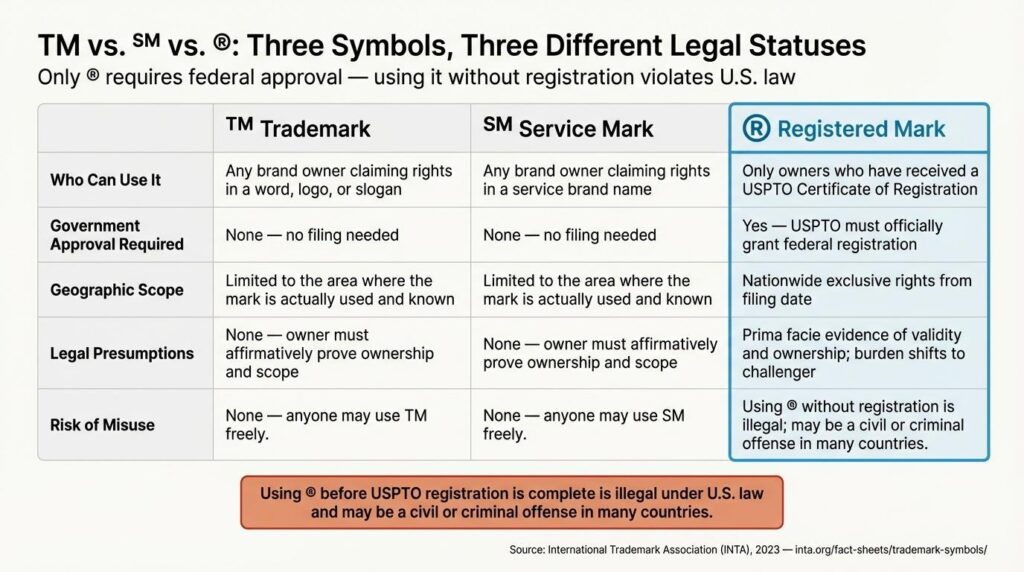
TM vs. ℠ vs. ®: Three Symbols, Three Different Legal Statuses — Source: International Trademark Association (INTA), 2023
The TM Symbol Is a Claim, Not a Guarantee
The TM symbol (™) is an unregistered trademark indicator that any brand owner can place next to a word, logo, or slogan to signal a claim of ownership under common law. No government approval is required. No application to register with the United States Patent Office needs to be filed. According to the International Trademark Association (INTA), ™ provides notice that you claim trademark rights in a mark, but it offers no guarantee of legal protection. The practical effect is public notice that you consider this mark yours, which helps establish priority in disputes but delivers limited legal protection on its own. For a deeper look at what trademarks actually are and why they matter, it helps to start with the fundamentals before deciding which symbol applies to your situation.
The geographic scope of these unregistered rights is the critical limitation. According to World Trademark Review, common law trademark rights extend only to the territory where the mark is actually used and known by customers, which is why brand owners who rely only on TM often have a weaker intellectual property rights position than those with federal registration. A startup operating in California but not nationally holds common law rights only in that region. A separate company can register the same mark federally and lawfully use it in every other state.
The actionable rule is simple: use the TM symbol the moment you start using a mark in commerce, even before you file a trademark application. It costs nothing, starts your priority clock, and places the public on notice through one of the most straightforward TM symbols available to unregistered brand owners.
The R Symbol Is a Federal Status Marker
The registered trademark symbol (®) is a legally restricted indicator that can only be placed next to a mark after the United States Patent Office has officially granted federal trademark registration for that specific mark. As INTA confirms, using ® before registration is complete is improper, and in many countries it is a civil or criminal offense. Understanding how trademarks work at the federal level clarifies exactly why this distinction carries real legal weight.
The registration process typically takes 12 to 18 months through the United States Patent and Trademark Office. According to a U.S. Department of Commerce OIG report published by the ABA, the USPTO’s first review of new applications took approximately 8.5 months on average in 2023. Add the 30-day opposition window after publication, and you have a meaningful gap between filing and the legal right to display ®. Understanding the legal implications of this timeline helps brand owners plan symbol use accurately.
Never use the ® symbol until you receive your official Certificate of Registration from the U.S. Patent Office. Filing receipt, serial number, and examiner approval are not enough. Only the certificate triggers the right, and understanding your legal position before that point is essential to avoid premature misuse.
The SM Symbol Covers a Third Category Most Brands Overlook
The service mark symbol (℠) functions identically to the TM symbol but applies specifically to services rather than physical goods. A company selling software as a service, providing consulting, or offering legal services uses ℠ to signal an unregistered claim on the brand name tied to those services. This distinction matters because the USPTO categorizes marks as either goods marks or service marks based on what the applicant actually offers in commerce. For a full explanation of what service marks are and how they differ from trademarks, the classification question is worth resolving before you file.
Once a service mark receives federal registration, the brand owner replaces ℠ with ®, exactly as a product company replaces ™ with ®. SaaS founders and tech startups offering services rather than tangible products should use ℠ instead of ™ on unregistered marks. Many tech companies default to ™ across all their marks, missing the more accurate designation entirely.
The three trademark symbols, their legal basis, and who can use them are distinct enough that most brand portfolios end up using all three simultaneously across different marks at different stages of registration.
Why Using the Wrong Symbol Carries Real Legal and Business Risk
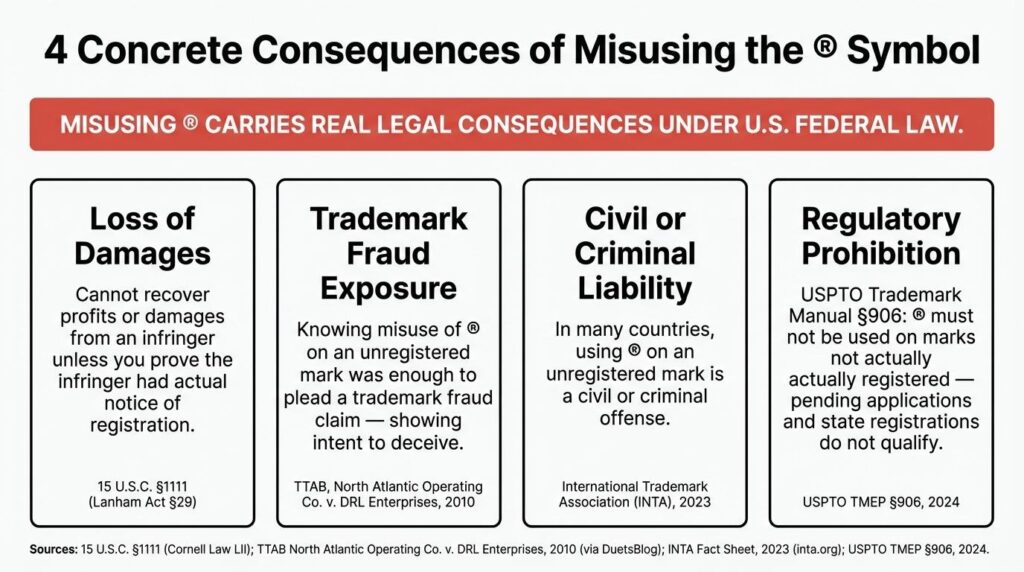
4 Concrete Consequences of Misusing the ® Symbol — Source: 15 U.S.C. §1111 (Cornell Law LII); TTAB North Atlantic Operating Co. v. DRL Enterprises, 2010 (via DuetsBlog); INTA, 2023; USPTO TMEP §906, 2024
Misusing the R Symbol Can Destroy Your Ability to Collect Damages
Under 15 U.S.C. § 1111, a trademark owner who fails to use the registered trademark symbol on a registered mark cannot recover profits or damages from an infringer unless actual notice of the registration can be proven. The inverse risk is equally serious: using ® on a mark that is not federally registered is a misuse of the trademark symbol under federal law and can compromise your u.s. patent office standing in subsequent enforcement actions.
Courts treat this seriously. In North Atlantic Operating Co. v. DRL Enterprises, the Trademark Trial and Appeal Board (TTAB) held that knowing misuse of ® on an unregistered mark was sufficient to support a trademark fraud claim and expose the owner to legal action, because the improper use showed intent to deceive consumers. The USPTO’s Trademark Manual of Examining Procedure section 906 reinforces that the ® notice must not be used on marks that are not actually registered with the U.S. Patent Office. A pending application or a state-level registration does not qualify.
For a startup that has invested in brand development, losing the ability to recover financially from an infringer because of a premature ® is a serious and avoidable risk. Audit your website, product packaging, and marketing materials to confirm you are only using ® on marks that appear on a current Certificate of Registration. Common trademark icon mistakes around premature ® use are among the most frequent and costly errors early-stage brands make.
The chart below summarizes four concrete consequences of misusing the ® symbol, with the damages forfeiture rule under 15 U.S.C. § 1111 being the most immediate financial risk most brand owners face.
Failing to Use Any Symbol Weakens Your Notice Defense
While no federal law requires brand owners to use trademark symbols, failing to display ® on registered marks undermines the constructive notice function those symbols serve. Misusing trademark symbols — or neglecting them entirely — weakens your legal position in any future infringement dispute. Under the Lanham Act, specifically 15 U.S.C. § 1111, displaying ® on a registered mark provides constructive notice to the public. This eliminates the innocent infringer defense entirely, preserving the owner’s right to recover both profits and damages.
An infringer who successfully argues they had no actual or constructive notice of a registration can escape monetary liability. Treating ® as a mandatory business practice on all registered marks, rather than an optional stylistic choice, is the straightforward way to close off that argument before litigation begins.
International Use of These Symbols Follows Different Rules
Trademark rights are territorial. The ® symbol is not universally equivalent across jurisdictions, and using a U.S.-registered ® on products sold in markets where the mark is not locally registered may violate local trademark law. According to INTA, using ® on an unregistered mark is a civil or criminal offense in many other countries.
Tech companies distributing SaaS platforms in the EU, UK, or Canada should verify local trademark registration status in each market before applying U.S. trademark symbols to globally distributed materials, since trademark regulations differ significantly across jurisdictions. The WIPO Madrid Protocol covers 116 member jurisdictions across 132 countries and facilitates international registration through a single application, but approval in each jurisdiction is still required before ® use is authorized there.
What Legal Protections You Actually Get Without Federal Registration
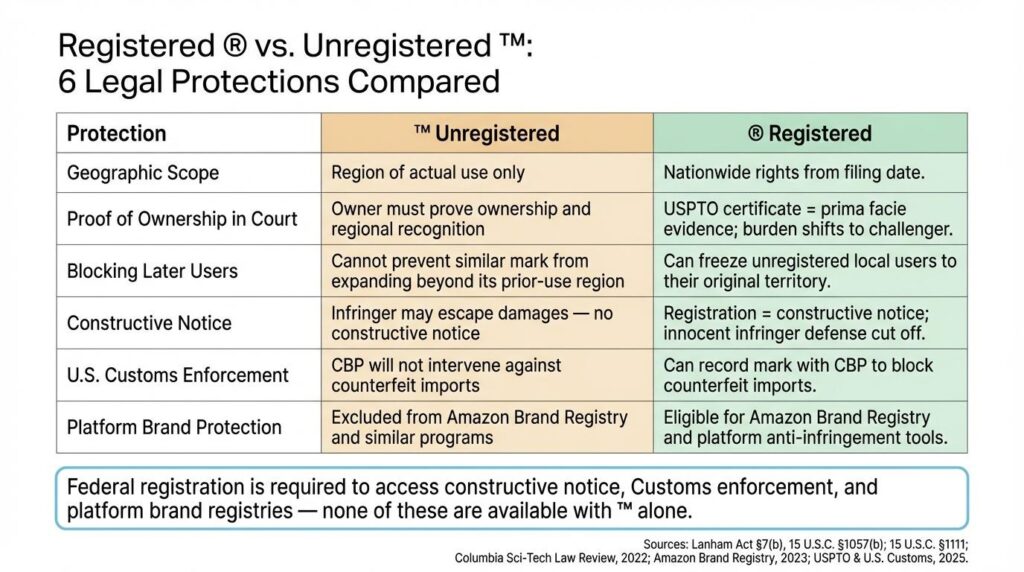
Registered ® vs. Unregistered ™: 6 Legal Protections Compared — Source: Lanham Act §7(b), 15 U.S.C. §1057(b); 15 U.S.C. §1111; Columbia Sci-Tech Law Review, 2022; Amazon Brand Registry, 2023; USPTO & U.S. Customs, 2025
Common Law Trademark Rights Are Real but Geographically Limited
Using a mark in commerce creates common law trademark rights under U.S. trademark law, even without a filing at the United States Patent Office, though unregistered trademarks carry significant geographic limitations. Those rights are enforceable in federal court under the Lanham Act, specifically 15 U.S.C. § 1125. However, as World Trademark Review notes, protection extends only to the geographic area where the mark has actually been used. If your business has only operated in California, your unregistered trademark is not automatically protected in New York or Texas.
The “Tea Rose-Rectanus” doctrine, recognized in U.S. trademark law since Hanover Star Milling Co. v. Metcalf (1916), means a company that later obtains federal registration can prevent the unregistered local user from expanding beyond the geographic territory it had already established. The unregistered user is essentially frozen in place. A Columbia Science and Technology Law Review analysis describes this dynamic clearly: a federal registrant gains nationwide priority as of the filing date, locking out later expansion by prior unregistered local users.
Common law rights from ™ use are a starting point, not a substitute for filing a trademark application with the U.S. Patent Office.
Federal Registration Creates a Legal Presumption That Unregistered Marks Cannot
Once the United States Patent Office grants federal trademark registration, the owner receives a legal presumption of ownership and the exclusive right to use the mark nationwide in connection with the registered goods or services. Under Lanham Act § 7(b), 15 U.S.C. § 1057(b), the Certificate of Registration is prima facie evidence of the mark’s validity and the owner’s exclusive right to use it. This shifts the burden of proof in any infringement case: the registered trademark owner does not need to prove ownership. An unregistered trademark owner relying on ™ carries that burden themselves, making litigation slower, more expensive, and less predictable.
The comparison between registered and unregistered marks across six key legal protections is significant enough that the visual below breaks them down side by side. The two trademark symbols represent fundamentally different legal statuses, and the differences in geographic scope, platform enforcement access, and legal presumptions represent concrete business advantages, not just legal formalities.
The most cost-effective long-term investment in trademark protection is federal registration, even after accounting for USPTO filing fees and attorney costs, because the litigation cost differential between enforcing a registered versus unregistered trademark claim is substantial. If you are weighing state trademark registration versus federal registration, the nationwide presumption of ownership alone typically tips the analysis toward federal filing for any brand with growth ambitions.
When to Switch From TM to R and What Triggers That Change
The Switch Happens at Registration, Not at Application
Many brand owners make the mistake of switching to ® when they receive their USPTO filing receipt or serial number. The correct trigger is the issuance of the Certificate of Registration, which arrives only after the examining attorney approves the application, it is published for opposition in the Official Gazette, and the 30-day opposition period closes without challenge or after a successful opposition defense. Consulting an experienced trademark attorney at this stage ensures you apply the appropriate symbol at each milestone.
According to the U.S. Department of Commerce OIG report, total pendency from filing to registration averaged 12 to 18 months during 2022 and 2023, with the first USPTO review taking approximately 8.5 months. Set a calendar reminder for your application’s expected registration date and update all branded materials only after the certificate arrives.
Maintaining Registration Requires Ongoing Filings That Keep the R Valid
Federal trademark registration is not a one-time achievement. Under 15 U.S.C. §§ 1058 to 1059, the U.S. Patent Office requires a Section 8 Declaration of Use between the fifth and sixth year after registration, then a combined Section 8 and Section 9 renewal every 10 years thereafter, along with proof that the mark is still in active commercial use. Failing to file these maintenance documents results in cancellation of the registration. When that happens, the legal basis for using ® disappears and the brand owner must revert to ™ or refile entirely.
Thousands of trademark registrations are canceled each year because owners overlook these deadlines. Work with a trademark attorney to calendar all USPTO maintenance deadlines at the moment of registration, not as the deadlines approach.
International Registrations Follow Separate Timelines and Symbol Rules
If you have filed through the Madrid Protocol or obtained registrations in individual foreign countries, each registration is independent of your U.S. status. Your U.S. ® authorization does not extend to the EU, UK, or Canada unless the mark is also registered in each of those jurisdictions separately. For SaaS companies managing trademark filings across multiple markets, this requires a coordinated IP portfolio strategy and a jurisdiction-by-jurisdiction compliance matrix to ensure the appropriate symbol is displayed in each market at each stage of that market’s registration process.
The four stages from USPTO application to the legal right to use ® are mapped in the process chart below, showing where in the timeline each key legal status change occurs.
Where and How to Place Trademark Symbols Correctly on Your Brand Materials
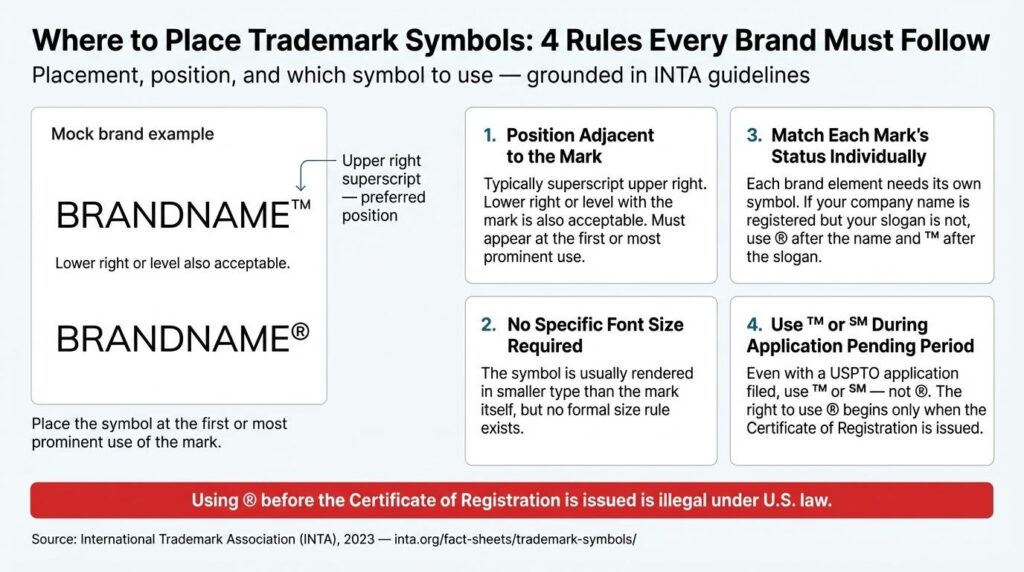
Where to Place Trademark Symbols: 4 Rules Every Brand Must Follow — Source: International Trademark Association (INTA), 2023
Symbol Placement Rules Are Consistent Across Mediums
Trademark symbols are traditionally placed immediately adjacent to the mark they modify, typically as a superscript at the upper right corner. Unlike a copyright symbol, which attaches to creative works, TM symbols attach to brand identifiers in commerce. According to INTA, lower right placement is also acceptable. The critical rule is that the symbol appears with the first or most prominent use of the mark on any given page, document, or screen, and does not need to be repeated on every subsequent mention.
On websites, this typically means placing the symbol on the logo in the header and the first prominent use of the brand name in body copy. On product packaging, it appears with the first or most prominent display of the mark. The USPTO’s Trademark Manual of Examining Procedure (TMEP) does not prescribe a specific font size for trademark symbols, but they are conventionally rendered in smaller type to distinguish them from the mark itself.
Create a brand usage guide that specifies exactly where trademark symbols appear on your logo, website, product packaging, and marketing templates. Leaving symbol placement to individual designers or marketing team members produces inconsistency that can create legal complications. Understanding the precise difference between the ® symbol and the TM symbol at every stage of the registration process keeps that guide accurate as your portfolio evolves.
Logos, Taglines, and Product Names Each Need Individual Symbol Assessment
A company typically holds multiple trademark registrations covering different marks. A word trademark such as a company name, for example, is registered separately from a logo or tagline, and each registration carries its own status. The correct trademark symbol must be applied to each mark independently based on its individual registration state.
A SaaS company whose brand name has a registered trademark but whose tagline is still pending should display ® after the brand name and ™ after the tagline. Using different trademark symbols for different marks within the same portfolio is not inconsistency — it is accuracy. Applying ® across all brand elements because the company name is registered is a misuse of the registered trademark symbol for any element that has not yet achieved its own registration. Trademark symbols in a portfolio with multiple marks at different stages commonly include all three symbols simultaneously on the same page or screen.
Conduct a trademark symbol audit across all brand touchpoints at least annually, matching each mark to its current USPTO registration status. The four rules for correct placement are summarized in the visual below.
How Federal Trademark Registration Through the USPTO Actually Works
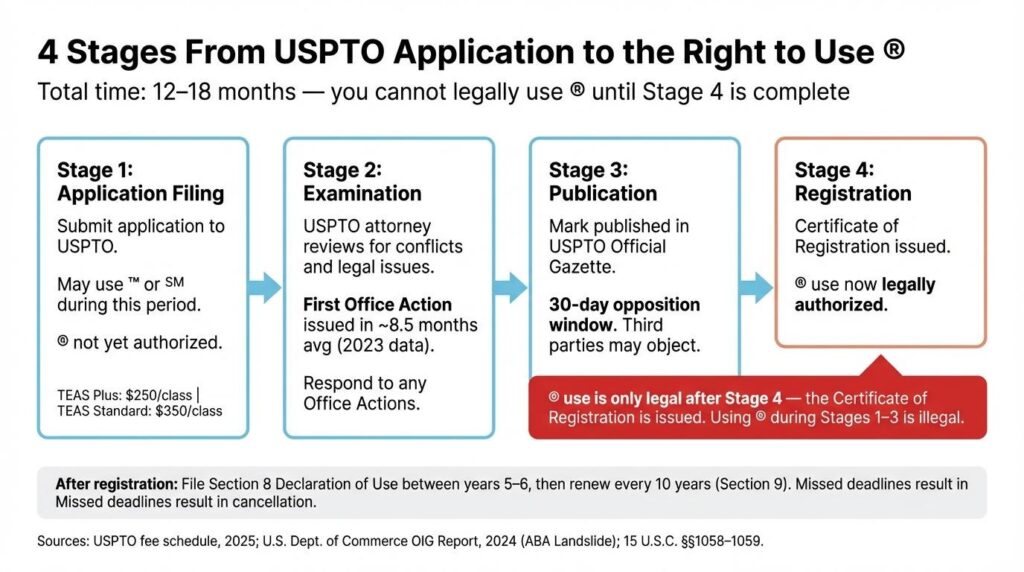
4 Stages From USPTO Application to the Right to Use ® — Source: USPTO fee schedule, 2025; U.S. Dept. of Commerce OIG Report, 2024; 15 U.S.C. §§1058–1059
The Trademark Application Process Has Four Core Stages
Filing a trademark application with the United States Patent and Trademark Office initiates a process with four primary stages: initial examination by a USPTO examining attorney, potential office action responses, publication for opposition in the Official Gazette, and final issuance of the Certificate of Registration. The entire process takes approximately 12 to 18 months under normal conditions, according to current USPTO processing benchmarks, though applications that attract office actions or oppositions take longer.
Current filing fees are $250 per class for TEAS Plus applications and $350 per class for TEAS Standard applications, according to the USPTO 2025 fee schedule. Understanding this timeline is what helps brand owners plan when the ® symbol will actually become available for use, and why filing early in the brand development cycle matters. For international filings, each intellectual property office processes applications on its own timeline and fee schedule. Before you invest in the full process, reviewing what trademarking actually involves helps set realistic expectations about cost, timing, and the rights you receive at the end.
A Prior Art Search Reduces the Risk of Application Rejection
Before filing, conducting a trademark clearance search through the USPTO’s TESS database and common law sources identifies conflicting marks that could block registration or support a trademark infringement claim. The patent office examiner will independently search for conflicts, but applicants who file without a prior clearance search are more likely to receive office actions for likelihood of confusion under Lanham Act § 2(d), which delays the path to ® and increases total legal costs.
Trademark application filings surged 28% in fiscal year 2021 compared to the prior year, according to the ABA’s coverage of USPTO OIG reporting, contributing to a backlog that continued into subsequent years. With hundreds of thousands of applications filed annually, likelihood-of-confusion refusals are among the most common roadblocks. A professional trademark clearance search examines not just identical marks but phonetically similar, visually similar, and conceptually related marks across live registrations, pending applications, and common law use. Knowing what questions to ask a trademark attorney before filing helps you get the most from that clearance process and avoid predictable rejection scenarios.
Invest in a professional trademark search before filing, not after receiving an office action. Seeking legal advice at this stage from a qualified attorney can help you interpret search results and evaluate your options. The cost of a clearance search is typically far less than the cost of responding to a § 2(d) refusal or refiling an application.
The Business Case for Federal Registration Beyond Just the R Symbol
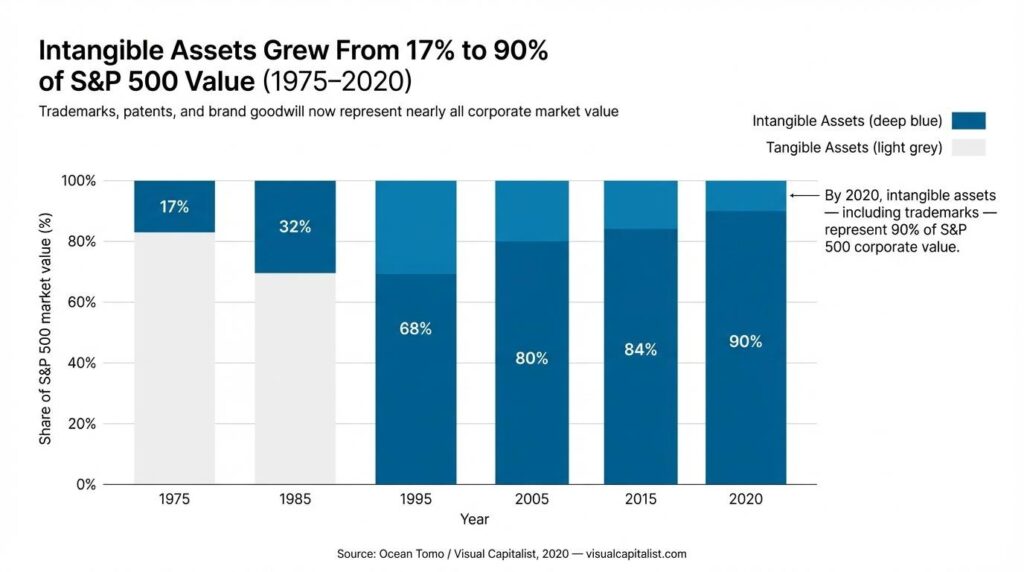
Intangible Assets Grew From 17% to 90% of S&P 500 Value (1975–2020) — Source: Ocean Tomo / Visual Capitalist, 2020
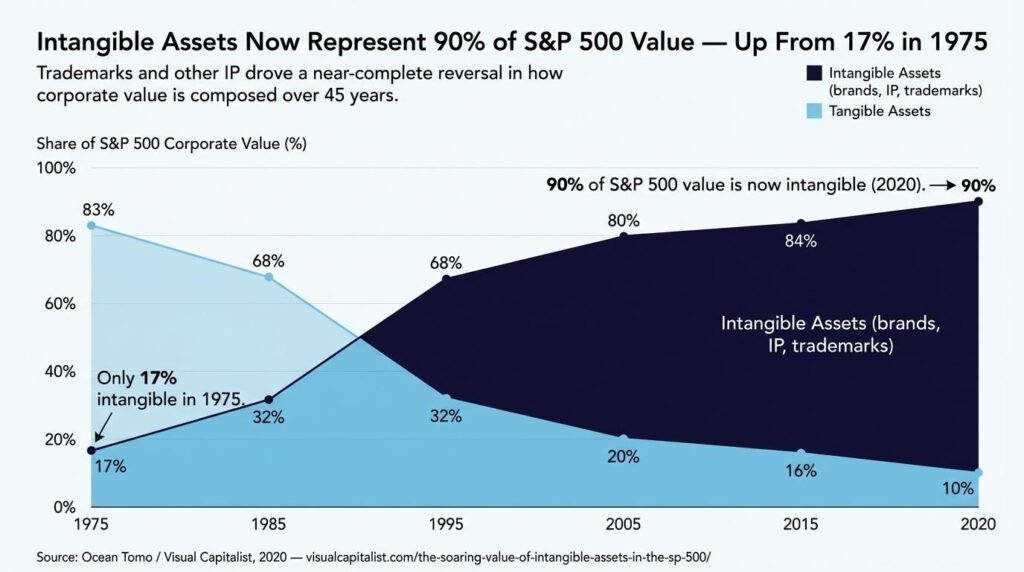
Intangible Assets Now Represent 90% of S&P 500 Value — Up From 17% in 1975
Intangible Assets Now Represent 90% of S&P 500 Value — Up From 17% in 1975 — Source: Ocean Tomo / Visual Capitalist, 2020
Registered Trademarks Strengthen Startup Valuations and VC Due Diligence
Intangible assets including trademarks, patents, and brand goodwill now represent approximately 90% of the market value of S&P 500 companies, according to data cited by Visual Capitalist tracking Ocean Tomo research. That figure was 17% in 1975. The shift reflects how fundamentally brand equity has become a driver of enterprise value across technology-driven markets. The bar chart above illustrates this trajectory from 1975 to 2020, with intangible assets now constituting the overwhelming majority of company valuations in public markets.
Investors and acquirers conducting IP due diligence treat registered trademarks as measurable assets. A startup with federally registered trademarks demonstrates that its brand is defensible and that management has been deliberate about intellectual property rights, including securing registered trademark rights before investor scrutiny begins. A company relying solely on common law TM rights signals that its brand protection is narrow in scope and potentially vulnerable, which can affect valuation, deal terms, or investor confidence during due diligence. Registering core marks before a Series A process means trademark registrations are in place when investors start asking about IP. Trademarks represent one of the four main types of intellectual property that investors examine during due diligence, and a federally registered mark is the strongest form a brand owner can present.
Registered Trademarks Unlock Platform Enforcement Tools
Major online platforms including Amazon, Meta, and Google provide registered trademark owners with brand protection enforcement tools that are unavailable to owners of unregistered marks. Amazon Brand Registry requires a federally registered trademark to enroll. Enrollment gives brand owners access to proactive infringement detection, counterfeit reporting tools, and enhanced listing control that directly protects revenue for eCommerce sellers and SaaS companies running product advertising.
Meta and Google also offer verified trademark programs that provide additional oversight of how a brand’s marks appear in advertising and search results. These enforcement tools are not accessible through ™ use alone. If you sell on Amazon or run brand advertising on major platforms, federal trademark registration with the United States Patent Office unlocks enforcement infrastructure that the TM symbol on its own cannot access.
Frequently Asked Questions About TM vs R Trademark Symbols
Should I use TM or R?
Use the TM symbol (™) if your mark has not yet received federal registration from the U.S. Patent Office. Use the registered trademark symbol (®) only after the USPTO issues your Certificate of Registration. If you are currently in the application process, ™ remains the correct symbol until registration is officially granted. Using ® prematurely is a misuse of the trademark symbol under federal law and can have direct legal consequences, including the forfeiture of damages in an infringement case under 15 U.S.C. § 1111.
When should I use R instead of TM?
Switch to the ® symbol immediately upon receiving your Certificate of Registration from the United States Patent and Trademark Office. This typically occurs 12 to 18 months after filing, assuming no significant office actions or oppositions arise. Continue displaying ™ or ℠ on any marks that are still pending or not yet filed, even if other marks in your portfolio have already achieved registered trademark status.
Why use R instead of TM?
The ® symbol provides significantly stronger legal protections than ™. A registered trademark gives you a nationwide legal presumption of ownership under Lanham Act § 7(b), constructive notice that eliminates the innocent infringer defense under 15 U.S.C. § 1111, access to federal court jurisdiction under the Lanham Act, the ability to record the mark with U.S. Customs to block infringing imports, and the path to incontestability after five years of continuous use. These protections are simply not available to unregistered marks displaying only the TM symbol.
Is registered better than TM?
Yes, in almost every material sense. Federal trademark registration through the United States Patent Office gives brand owners legal tools and presumptions that common law TM rights cannot replicate. The ® symbol represents a mark that has passed government examination, is legally presumed valid, and is enforceable nationwide. The primary trade-off is cost and timing: TEAS Plus filing fees start at $250 per class, and the 12-to-18-month registration timeline means you cannot switch from ™ to ® immediately. But the long-term legal and business return on registration far exceeds the upfront investment for any brand with real commercial value.
Can I use ® for a trademark registered in another country but not in the United States?
No. In the United States, the registered trademark symbol is restricted to marks registered with the U.S. Patent Office. Foreign registrations do not authorize ® use on goods or services sold in the U.S. market. The reverse is equally true: your U.S. ® status does not authorize ® use in countries where your mark is not locally registered. Trademark law is territorial, and each jurisdiction’s registration status independently determines which symbol is legally appropriate in that market.
What is the SM symbol and when do I use it?
The SM or service mark symbol (℠) is the service industry equivalent of ™. It signals an unregistered claim to a mark used in connection with services rather than physical goods. A SaaS company, law firm, or consulting brand uses ℠ on an unregistered mark the same way a product company uses ™. Once the service mark receives federal registration from the U.S. patent office, the owner replaces ℠ with ®, just as a product mark owner replaces ™ with ®.
Do I have to use a trademark symbol at all?
No federal law requires use of any trademark symbol. However, failing to display ® on registered marks forfeits the constructive notice benefit under 15 U.S.C. § 1111 and limits your ability to recover damages from infringers who claim they were unaware of your registration. For unregistered marks, using ™ or ℠ is entirely voluntary but strategically valuable as public notice of your ownership claim and as evidence to help establish priority in a future dispute.
Conclusion
The difference between ™ and ® is not cosmetic. It reflects two fundamentally different legal statuses, and using the wrong trademark symbol at the wrong time creates real exposure. The TM symbol is a legitimate first step and the most accessible way to claim trademark rights on an unregistered mark. The registered trademark symbol (®) is a federally granted status that requires completing the full USPTO registration process, and it delivers nationwide legal presumptions, platform enforcement access, and litigation advantages that ™ simply cannot provide.
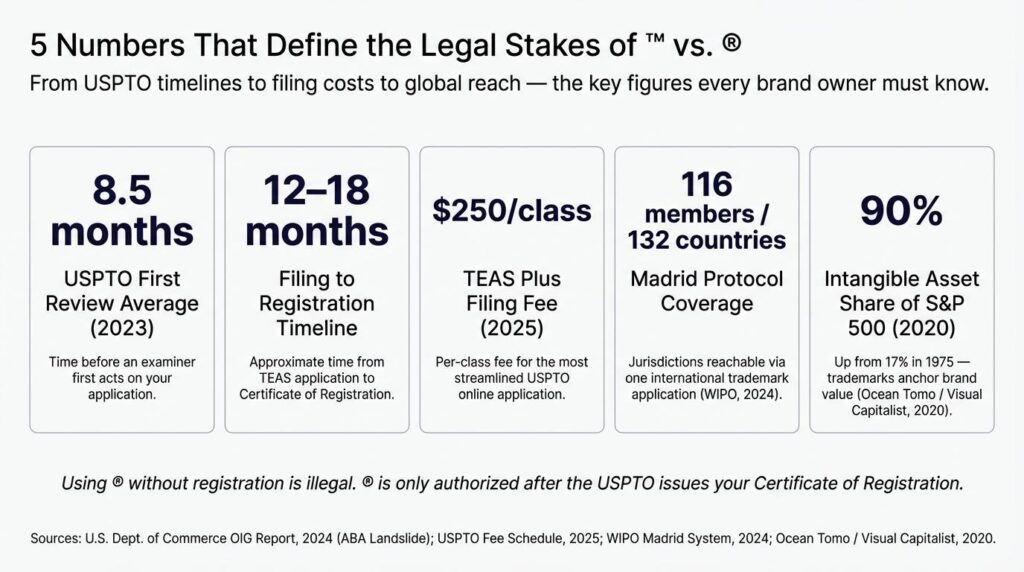
5 Numbers That Define the Legal Stakes of ™ vs. ® — Source: U.S. Dept. of Commerce OIG Report, 2024; USPTO Fee Schedule, 2025; WIPO Madrid System, 2024; Ocean Tomo / Visual Capitalist, 2020
For SaaS founders and tech startups building brand equity alongside their technology, federal trademark registration is not a back-burner task. It is an IP infrastructure decision that affects fundraising conversations, platform enforcement, and litigation outcomes. The five numbers that define the legal stakes of this decision are summarized above: an 8.5-month average first review window at the U.S. patent office, a 12-to-18-month total filing-to-registration timeline, TEAS Plus filing fees starting at $250 per class, and the difference between recovering full damages and recovering nothing if you get the symbol wrong.
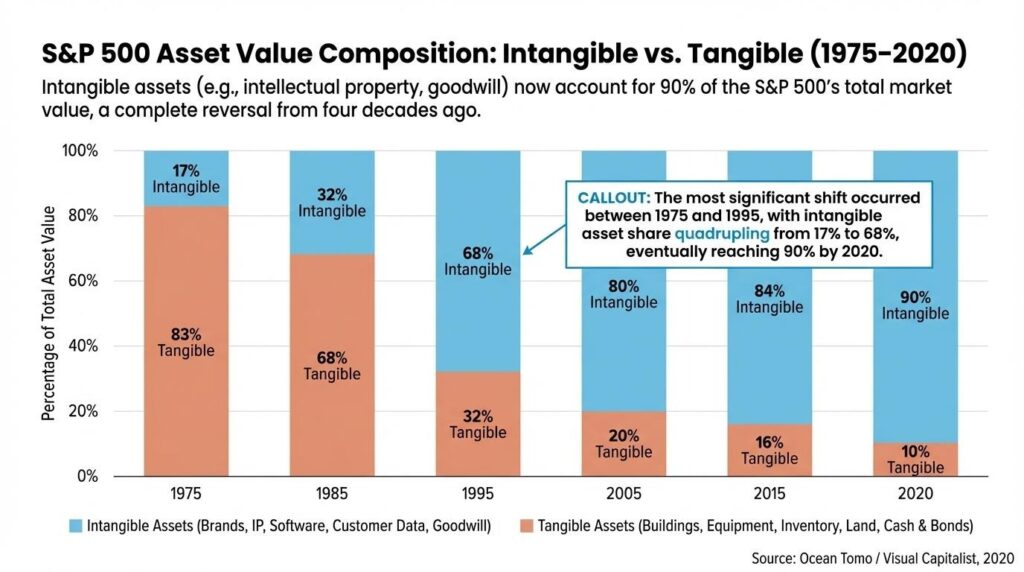
**Intangible vs. Tangible Asset Breakdown (S&P 500)** – In 1975, only **17%** of the S&P 500’s value was in intangible assets (brands, IP, etc.) versus **83%** tangible assets. By 1995 this flipped to **68%** intangible vs **32%** tangible, and as of 2020, a record **90%** of S&P 500 corporate value is intangible (only **10%** tangible). The chart highlights the dramatic rise of intangible asset importance over the past four decades.
Your Next Steps to Trademark Symbol Compliance
Getting your trademark symbols right is one of the most cost-effective brand protection decisions you can make, and it starts with knowing exactly where each mark in your portfolio stands with the United States Patent Office.
The bottom line: A ™ on an unregistered mark signals your intent but delivers limited legal firepower. A ® on a properly registered mark provides nationwide presumption of ownership, eliminates the innocent infringer defense, and unlocks platform enforcement tools that protect real revenue. Using the wrong symbol at the wrong time does not just undermine those protections; it can actively destroy your ability to recover damages in court.
Every day you operate on unregistered marks or delay filing with the U.S. Patent Office is a day a competitor can file first and lock you out of markets you plan to enter. With registration timelines running 12 to 18 months through the United States Patent and Trademark Office, the brands that file early are the ones that hold ® when it matters most.
Here is how to move forward:
- Schedule a Free IP Strategy Call with Rapacke Law Group to assess which marks in your portfolio are ready to file, which symbols you should be using right now, and what a complete trademark strategy looks like for your stage of growth.
- Audit every branded asset — website, packaging, social profiles, pitch decks — and verify that each mark displays the symbol that matches its current USPTO registration status.
- If you are pre-filing, place ™ or ℠ immediately on every mark you are actively using in commerce to start your priority clock.
- If you are post-filing, calendar your Section 8 and Section 9 maintenance deadlines from day one so a missed filing never voids your ® rights.
- Consider what questions to ask your trademark attorney before filing to maximize the value of your clearance search and minimize the risk of office actions.
Rapacke Law Group offers flat-fee trademark services with the RLG Guarantee: get your trademark approved or pay nothing, with a 100% refund if your mark is rejected. You know exactly what registration costs before you commit, and you carry none of the financial risk if the USPTO disagrees. That is the competitive advantage of working with a firm that structures its fees around your outcome, not its billable hours.
To Your Success,
Andrew Rapacke
Managing Partner, Registered Patent Attorney
Rapacke Law Group