


By Andrew Rapacke, Managing Partner, Registered Patent Attorney
In a 2024 analysis of hundreds of startup outcomes, researchers found something striking: having any patents raised the probability of a successful exit by a measurable margin, and startups with large patent portfolios (30+ patents) had over 80% chance of achieving an exit. More revealing: the size of a startup’s patent portfolio correlates directly with exit value; companies with extensive IP portfolios command dramatically higher valuation multiples when they exit. A separate 2025 report confirmed that venture-backed startups with patents were valued nearly 2× as much as those without patents and were 47% more likely to successfully raise VC funding. A strong patent portfolio can help attract investment by signaling to investors that the startup has innovative technology and significant growth potential.
For startups raising capital between 2024 and 2026, patents represent one of the only defensible assets you can point to before meaningful revenue. This is especially critical in AI, biotech, climate tech, and hardware: sectors where the underlying technology is the product. Venture funds and corporate investors routinely review patent status during due diligence before extending term sheets. Angel investors, like venture capitalists, also value patents as indicators of a startup’s innovation and defensibility. A strong patent portfolio can signal to investors that a startup has created something innovative and defensible, which can lead to increased investment opportunities.
In this comprehensive guide, you’ll learn exactly how patents work for early-stage companies, what they actually cost, how to avoid the most common mistakes, and how to build an IP strategy that supports your fundraising and growth objectives.
Why Patents Matter So Much for Startups
Multiple recent studies reveal a strong link between patents and startup success. The Tech Coast Angels portfolio analysis showed that startups with more than 30 patents had over an 80% chance of achieving an exit and tended to achieve significantly higher return multiples. Companies with extensive IP portfolios commanded exit valuation multiples averaging 38.7×, compared to just 1.4× for startups with no patents. Building a robust patent portfolio enables startups to maximize value at exit by leveraging strategic advantages and optimizing IP protection.
This data isn’t just correlational: it reflects fundamental investor psychology. As one patent industry expert put it, investors “hate uncertainty,” and a startup with no defensible IP is inherently riskier. Patents signal three critical things: you’re solving a real technical problem, your innovation can’t be easily copied, and you’re serious enough to protect your upside.
Consider concrete examples. An AI startup filing a utility patent on its model architecture in 2024 immediately signals technical depth and a potential moat to investors. (If you’re developing AI technology, our AI Patent Mastery guide walks through specific strategies for protecting machine learning innovations, neural network architectures, and training methodologies. A medical device company that secured its first patent in 2023 closed its Series A at a significantly higher valuation because acquirers and partners saw defensible intellectual property rights on the cap table. A 2022 European study found that startups with any patent or trademark filings were more than twice as likely to achieve a successful exit for their investors compared to startups with no registered IP.
Patents create leverage. They give you something unique to offer strategic partners or, at a minimum, a legal basis to stop others from offering the same thing. In fields like pharmaceuticals or advanced materials, patents are often the only way to prevent a competitor from simply copying your discovery after you’ve proven it works. Intellectual property can be among the most important assets that a startup owns.
One clarification: a “startup patent” isn’t a special legal category. It’s simply a patent strategically pursued and structured for an early-stage, cash-constrained business. The patent law is the same whether you’re a two-person garage operation or a Fortune 500 company. What differs is how you approach the process, what you prioritize, and how you align filings with your business milestones.
Do You Actually Own Your Startup’s IP?
Many startups between 2022 and 2025 discovered uncomfortable truths about their IP only when investors or acquirers ran diligence. The pattern is painfully common: a term sheet is on the table, lawyers start reviewing, and suddenly everyone realizes that the company doesn’t actually own its core technology. Inventors, as the original creators of the invention, must assign their rights to the company to ensure the startup owns the patent.
Here’s the fundamental issue: patent rights don’t automatically belong to your startup just because you paid someone to build something. All founders, early employees, and contractors must sign invention assignment agreements that explicitly transfer intellectual property to the company, not to individuals. Patents usually must be assigned to startups by the inventors. Failing to obtain proper ownership rights from inventors can have severe consequences for a startup, such as blocking exits or triggering legal disputes.
Under U.S. law, the default rule for freelancers and contractors is that they own what they create unless there’s a written agreement saying otherwise. The “work made for hire” doctrine has narrow limits and doesn’t cover most software, hardware designs, or technical innovations. Even tech giants have faced this issue. Stanford University, not Google, owned Google’s PageRank patent. The company had to negotiate an exclusive license and eventually gave Stanford 1.8 million shares of Google stock to secure the rights, which sold for $336 million in 2005.
Think about scenarios that regularly derail deals:
- In 2021, a contractor developed the core code for your MVP. There’s an invoice, there’s a Slack history, but there’s no assignment agreement. Legally, that contractor may still own the patent rights to your foundational technology.
- A co-founder left in 2020 after a dispute. They never signed an IP assignment deed. They may still have claims to inventions they contributed to, and those claims could block your exit.
- A technical advisor contributed key algorithm ideas early on without a contract. If you try to patent those ideas later, that advisor could be named an inventor and have rights unless there’s an agreement in place. Ownership disputes can arise years after a patent is filed, especially in startups where roles and contributions may be fluid.
Here’s a quick checklist of documents you should have in place for every person who has touched your technology:
- Employment agreements with IP assignment clauses
- Contractor agreements with explicit IP transfer language
- Standalone IP assignment deeds for any gaps in historical coverage
- Cap table alignment, ensuring the company (not individuals) is listed as the assignee on all filed patents
Properly executed assignment agreements ensure the startup company owns the patent rights rather than individual inventors.
Clean IP ownership isn’t just good hygiene: it’s mandatory for enforceable patents and for exits. M&A buyers in the U.S., UK, and EU will walk away from deals or demand massive escrows if they can’t verify clear ownership chains. VC investors will insist on reps and warranties that the company owns all IP. Fix this early, or pay for it later.
In late 2024, the USPTO launched a free “Startup Certification Training” course and IP management tools to help founders get these basics right. The USPTO Director stressed the goal is to equip startups with the knowledge to protect their IP and secure funding opportunities. The U.S. government itself is pushing founders to pay attention to IP ownership from day one.
IP Basics for Startups: Where a Startup Patent Fit In
Before diving into the specifics of patents, it helps to understand where they fit within the broader landscape of intellectual property protections. Before pursuing patenting or seeking legal protections, startups should develop a comprehensive business plan to guide strategic planning, market research, and informed IP decisions. Early-stage tech companies have a suite of IP tools at their disposal, each serving different purposes.
The four main categories of IP are:
- Copyrights protect original creative works: software code, documentation, marketing materials, and content. Protection is automatic upon creation, though formal registration strengthens enforcement.
- Trademarks protect brand identifiers, such as your company name, logo, and product names. You’d file with the Patent and Trademark Office (USPTO in the U.S.) to secure exclusive rights to use these identifiers in commerce.
- Trade secrets protect confidential business information: algorithms, formulas, manufacturing processes, customer lists, which derive value from being secret. Unlike patents, trade secrets have no expiration date but offer no protection if someone independently discovers or reverse-engineers the same information. For effective legal protection, startups should have appropriate non-disclosure agreements in place with both employees and third parties who need to know the information.
- Patents protect inventions: novel functional solutions, processes, machines, compositions of matter, and certain designs. A granted patent gives you the legal right to exclude others from making, using, selling, or importing the patented invention for approximately 20 years from the filing date (for utility patents in most countries). Patents and other IP rights provide legal protection for a startup’s innovations, helping to establish market barriers and deter competitors.
Critically, a patent doesn’t guarantee you can practice your invention. It only gives you the right to stop others. If your technology builds on someone else’s patented innovation, your new patent doesn’t let you use the underlying technology without a license from that patent holder.
Not every startup needs patents. A 2024 consumer mobile app startup might focus primarily on trademarks (for brand) and trade secrets (for proprietary algorithms) rather than patent filings. But a 2024 battery-tech or biotech startup developing novel technical solutions absolutely needs a patent-heavy strategy; its core value lies in the patented invention itself. For SaaS companies, the decision often comes down to whether your competitive advantage lies in the underlying technology or execution, such as identifying patentable software features. Our SaaS Patent Guide 2.0 helps you make that determination.
Patents are particularly valuable in fields where innovations are easily copied, such as semiconductor designs, medical diagnostics, industrial AI control systems, novel chemical compounds, and mechanical devices. If competitors can quickly reverse-engineer your product and replicate it, patents may be your only moat. Patents can also help startups secure and defend market share by creating legal barriers around their innovations and establishing a strong market presence.
The choice between a trade secret and a patent is often strategic. Patents require full public disclosure of how your invention works (the patent is published for all to read) in exchange for a 20-year monopoly, while trade secrets can offer indefinite protection if properly guarded. Startups should consider whether a patent is necessary or if trade secrets might be a more effective form of protection for certain innovations. Trade secrets keep information hidden indefinitely, which can be beneficial for things like recipes or algorithms. Coca-Cola’s formula has remained a trade secret for over a century; if it had been patented in 1890, it would have expired by 1910.
One reality: federal trade secret case filings reached an all-time high of over 1,500 cases in 2025 (up approximately 25% versus a decade earlier). This reflects how critical proprietary know-how is. Patents and trade secrets are complementary; many companies patent one aspect of their technology and treat implementation details as secrets.
Bottom line: patents are just one piece of the IP puzzle, but an essential piece if your technology is what sets you apart. They create tangible assets on your balance sheet that investors value. Use copyrights to protect code and content, trademarks for brand, trade secrets for the “secret sauce,” and patents for the novel inventions at the heart of your product.
Types of Patents Relevant to Startups
When founders talk about “filing a patent,” they’re usually referring to one of several distinct types. Here’s what startups actually filed between 2023 and 2026:
Utility patents are the workhorses of patent protection. They cover functional inventions: how something works, not how it looks. This includes software methods, hardware architectures, biotech processes, chemical compounds, and mechanical devices. Utility patents protect for 20 years from the earliest non-provisional filing date. Most technology startups developing proprietary functionality will pursue at least one utility patent.
Design patents (called “registered designs” in the EU and UK) protect the unique appearance of a product: its ornamental design, not its function. Think of a 2023 consumer IoT device with a distinctive housing shape or a new smartphone GUI layout. In the U.S., design patents last 15 years from the grant date (no maintenance fees are required). They’re faster and cheaper to obtain than utility patents but offer narrower protection. Startups often overlook design patents, but they can be valuable for hardware, wearables, or consumer products where look and feel matter. Apple’s design patents on the iPhone’s rounded-corner icon grid were part of its $539 million verdict against Samsung. Design patents cover the ornamental design of functional items, protecting the unique appearance rather than the functionality.
Plant patents protect certain asexually reproducible plant varieties. While plant patents are less relevant for most tech startups, they are crucial for agricultural innovation, providing legal protection for new plant varieties developed through asexual reproduction.
Provisional patent applications are a special, informal type of U.S. filing. A provisional application establishes a priority date (essentially a timestamp in the Patent Office) and gives you up to 12 months to file a full (non-provisional) application. Provisionals are not examined or published by default; they serve as placeholders. Many startups file provisionals before a big demo day, product launch, or investor pitch. They’re relatively inexpensive (USPTO provisional filing fees are around $150 for a small entity, and attorney costs are lower since claims and formalities aren’t required). However, a provisional alone never turns into an enforceable patent; you must follow up with a non-provisional within 12 months, or the provisional date is lost.
PCT applications (PCT stands for Patent Cooperation Treaty) provide a pathway to international patent protection. Rather than filing separate patent applications in the US, Europe, Japan, etc., all at once (which is very costly upfront), you can file a single PCT application. The PCT application doesn’t itself issue as a patent. Still, it preserves your right to later file national patent applications in any of the 150+ member countries for up to 30 months from your priority date. The key benefit is deferral: you delay the high costs of foreign filing while signaling to investors and partners that you have a global IP strategy.
The right combination of filings depends on your technology, market strategy, and budget. Most tech startups start with a provisional application, then within a year convert to a non-provisional utility patent (often in the U.S. first). If international markets or competitors are a concern, they’ll file a PCT to keep those options open. Design patents are granted when there’s something unique about the product’s appearance. Building a comprehensive patent portfolio may also involve other types of patents, such as design or plant patents, to provide layered protection around your core technology and strengthen your overall IP position.
Can You Patent a “Startup Idea”?
Let’s address a question founders ask all the time: “Can I patent my idea?” The short answer: probably not if it’s just an idea, but you may be able to patent a specific implementation or technology underlying that idea.
To qualify for a patent, an invention must satisfy three core criteria under patent law:
- Novelty means your invention must be new. It cannot have been described or demonstrated anywhere in the prior art before your filing date. Prior art is any public disclosure: existing patents and published applications worldwide, academic papers, products on the market, public websites, presentations, etc.
- Non-obviousness (or “inventive step” abroad) means that even if no single prior art reference anticipates your invention, it still must not have been an obvious combination or trivial extension of what existed before. A patent examiner will review your application and ask: Would a person of ordinary skill in the relevant field, knowing the prior art, find your invention obvious?
- Utility (or usefulness) means the invention must have a specific, real-world use. You can’t patent something purely abstract or theoretical (like a mathematical formula by itself).
Here’s where many founders go wrong: vague business concepts are not patentable. You cannot patent “a marketplace for sustainable goods” or “an AI that helps people schedule meetings.” Those are broad ideas, not specific inventions. Patents aren’t about what you want to do, but how you specifically do it. To be patentable, you need to drill down to the concrete technical solution: e.g., a particular algorithm that matches buyers and sellers in a new way to reduce transaction friction, or a specific neural network architecture that coordinates meeting schedules with improved efficiency.
Another common misunderstanding: You can’t patent something that’s already public, including your own public disclosures. If you pitched your idea openly at a hackathon, published a preprint, or even posted details on a forum before filing a patent, you may have destroyed your ability to patent it later (especially outside the U.S.). Most countries require absolute novelty, meaning any public disclosure anywhere in the world before your filing date is fatal to the application. Startups need to be aware of patent law deadlines to protect their inventions effectively.
A 2025 law firm guide bluntly listed “Early Public Disclosure” as one of the top patent filing mistakes: “Sharing your invention too soon can void patent rights, especially internationally.” This cannot be overstated: even a well-intentioned Demo Day pitch or a non-confidential discussion with a potential partner can count as public disclosure. The safest practice is to file first, then disclose.
Prior art is the biggest hurdle for most startups. Before you file, it’s wise to do some searching. Start with Google Patents, USPTO databases, or free tools to see if your idea (or similar ones) have been published. Patent examiners will search thoroughly: statistically, the vast majority of patent applications receive at least one novelty or obviousness rejection on first examination because the examiner finds relevant prior art.
The takeaway: you can patent implementations of your startup’s innovation if they meet these criteria, but you need to ensure the invention is truly novel and non-obvious. Move quickly; being the first to file is crucial under today’s laws. File a provisional if you’re in the early stages to lock in a date, then refine your application. Keep your own disclosures under wraps until filings are in place.
The Startup Patent Process Step-By-Step
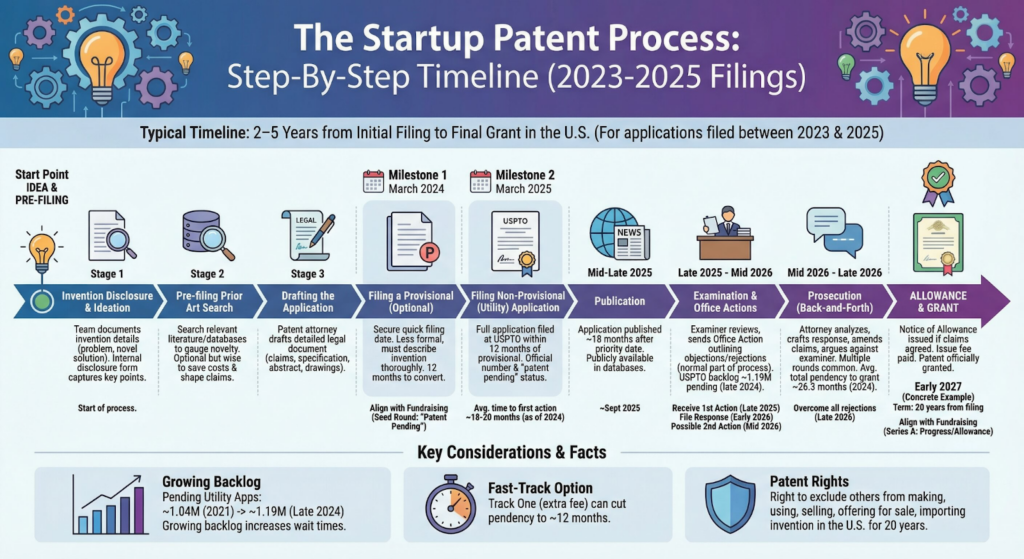
Understanding the patent application process helps you plan around fundraising milestones and product launches. The patent system is the legal framework that governs the protection of intellectual property and outlines the procedures and requirements for securing patent rights for your startup’s innovations. For applications filed between 2023 and 2025, expect a typical timeline of 2–5 years from initial filing to final grant in the U.S. Here’s the sequence most startups follow:
The first step in patenting a new product or service is to file an application with the Patent Office, which must accompany a complete or provisional specification.
Invention disclosure and ideation: Your team (engineers, scientists) documents the invention in detail. This could be as simple as a write-up and drawings describing the problem and your novel solution. Many companies use an internal invention disclosure form to ensure key points are captured.
Pre-filing prior art search: Before investing thousands in filing, it’s wise to do a patent search. You (and/or your patent counsel) search relevant literature and patent databases to gauge whether your invention is novel. While not legally required, this can save you from pursuing a hopeless case or help shape the patent claims to avoid known prior art.
Drafting the application: You engage a patent attorney (or agent) to draft the patent application. This is a detailed legal document with several parts: claims (the legal definitions of your invention), a specification (written description and drawings that explain the embodiments), an abstract, etc. Drafting strong claims that are broad enough to be valuable but narrow enough to be novel over prior art is something of an art form.
Filing a provisional (optional, common): Many startups first file a provisional application to quickly secure a filing date. The provisional can be less formal (no claims required), but it should still describe the invention thoroughly. You then have 12 months to “convert” it by filing a non-provisional.
Filing the non-provisional (utility) application: This is the real deal: the full patent application filed at the USPTO (or other patent office). If you did a provisional, you must do it within 12 months of the provisional’s date to get the benefit of that date. Once filed, you’ll get an official application number and “patent pending” status. Obtaining a United States patent involves specific procedures, including examination by the USPTO, and offers strategic advantages such as exclusive rights in the US market.
Publication: In most jurisdictions, patent applications are published 18 months after the earliest priority date. So if you filed a provisional in March 2024 and a non-provisional in March 2025, around September 2025, your application will be published and become publicly available in patent databases.
Examination and office actions: After filing, there is usually a waiting period until an examiner at the patent office picks up your case. As of 2024, the average time to first examination action in the U.S. is about 18–20 months (it rose to 20.5 in 2023 and was approximately 19.9 by 2024 as the USPTO hired more examiners to tackle a growing backlog). When the examiner reviews your application, they will almost always send an office action outlining any objections or rejections. Don’t panic; getting a rejection is normal.
The U.S. patent application backlog has been growing. Total pending utility patent applications rose from approximately 1.04 million in 2021 to approximately 1.19 million by late 2024. This backlog contributes to longer wait times for startups to have their patents examined. The patent application process can take 2–5 years.
Prosecution (back-and-forth): Your patent attorney will analyze the office action and craft a response. This might involve amending the claims to overcome prior art or arguing why the examiner is wrong. This correspondence with the examiner is called patent prosecution. It may take multiple rounds; it’s not uncommon to have 2–3 office actions over a year or two. Average total pendency to grant has climbed to approximately 26.3 months by 2024, and if a second round (RCE) is needed, it is often approximately 30 months.
Allowance and grant (or abandonment): If you and the examiner eventually agree on allowable claims, the examiner issues a Notice of Allowance. You pay an issue fee, and the patent is granted, typically within a few weeks. From initial idea to granted patent, think in terms of years. Even with a fast-track program (the USPTO offers Track One prioritized examination for an extra fee, which can cut pendency to approximately 12 months), you’re still looking at many months.
Patents provide a right to exclude others from making, using, selling, offering for sale, and importing a product or service embodying the invention. Patents in the United States have a term of 20 years from the filing date, but the term may be extended under certain conditions.
Here’s a concrete timeline example:
- March 2024: File U.S. provisional application before product launch
- March 2025: File non-provisional U.S. utility application (and possibly a PCT) before the provisional expires
- Late 2025: Receive first Office Action from the USPTO
- Early 2026: File a response to the Office Action
- Mid 2026: Possibly receive a second Office Action
- Late 2026: Overcome all rejections; Notice of Allowance issued
- Early 2027: Patent officially granted
Align your filings with fundraising milestones. Having at least a “patent pending” (application filed) by your seed round can satisfy many investors that you’re on top of IP. By Series A, investors will look for progress, such as favorable examination reports for one of your applications or even an allowance.
Costs: What a Startup Patent Really Costs in 2024–2026
Let’s talk money. Patent costs fall into two categories: government fees (paid to patent offices) and professional fees, most notably attorney fees (paid to attorneys/agents). Both vary by region and complexity. The costs involved in patenting a new product or technology can quickly add up, often reaching several thousand dollars within a year. It’s an investment, often one of the first major cash outlays for a deep-tech startup after salaries. Obtaining and maintaining patents is expensive and requires significant investment in legal fees.
USPTO fees (U.S. Patent Office): The USPTO has a tiered fee structure based on entity size. Micro entities (very small outfits) receive approximately a 75% discount; small entities (companies with fewer than 500 employees) receive approximately a 50% discount. A provisional application filing fee is approximately $60–$150 for a small/micro entity. A non-provisional utility patent filing fee (including examination and search fees) is typically $400–$800 for a small entity. These USPTO fees are relatively minor. The bigger fees come after the grant: U.S. utility patents have maintenance fees due at 3.5, 7.5, and 11.5 years to keep them in force.
Attorney (legal) fees: This is usually the lion’s share, and it is where traditional hourly billing creates the most uncertainty for cash-strapped startups. Many large firms charge $700+/hour, making it nearly impossible to budget accurately. For a relatively straightforward mechanical or simple software invention, drafting a quality utility application might cost approximately $7,000–$12,000 in attorney time with traditional billing. For a cutting-edge biotech or AI algorithm with lots of detail, it could be $15,000–$25,000. One law school clinic article noted “[the average cost of a patent [in the US] ranges between $10,000–$20,000](LINK 2).” Another 2023 patent law resource bluntly advised startups to “budget around $15,000 to $20,000 for full patenting” of a single invention.
Why so much? Drafting a solid patent is labor-intensive: understanding the technology, writing dozens of pages of description, crafting claims, and making professional drawings. Then there’s back-and-forth with the prosecution: each substantive Office Action response might cost $2,000–$5,000 under hourly billing.
The fixed-fee advantage: At Rapacke Law Group, we’ve eliminated this billing uncertainty. Our transparent flat-fee structure means you know the total investment upfront: no surprise invoices, no meter running during phone calls, no anxiety about asking questions. This startup-friendly approach lets you budget accurately and focus on building your business rather than watching the clock during strategic discussions with your patent attorney.
International costs: This is where startups can really burn cash if they’re not careful. Filing a PCT application itself might cost around $4,000–$8,000 in attorney and international fees. But the big expense comes approximately 2.5 years later when you enter the national phases. At that point, if you want patents in, say, Europe, the U.S., China, and Japan, you’ll be hiring local firms in each region, paying translation costs, and covering each office’s fees. As a ballpark estimate, initiating in each major country could cost $5k-$10k, including filing and legal fees. A European patent often costs $20k-$50k at grant, including everything.
Given these costs, startups need strategies to manage IP spend:
- Focus on core inventions first: Identify the 1–3 technological innovations that are central to your competitive advantage. Prioritize those for patent filings. Don’t try to patent every minor feature.
- Use provisionals to stage expenses: Filing a provisional (for a few thousand dollars) can secure a date while deferring the higher cost of a full application.
- Leverage investor funding rounds: Align major patent filings with fundraising. It’s common to see startups spend a chunk of their seed or Series A capital to beef up IP.
- Choose law firms wisely: Look for firms that specialize in tech IP and offer fixed-fee arrangements tailored to startups. This eliminates billing surprises and aligns incentives; your attorney’s goal becomes getting you the strongest possible patent, not maximizing billable hours.
One more tip: patent valuation is not immediate. A patent is an asset that (if well-crafted) can pay off big in the long term by enabling a lucrative exit or licensing deal. But in the short term, it’s a cost center. Be mindful if your runway is short; patents are rarely more important than keeping the lights on or achieving product-market fit.
Strategic Patent Approaches for Startups
Filing patents reactively (scrambling to submit something right before a launch or investor meeting) is better than nothing, but it’s a missed opportunity to extract real value. The startups that derive the most value from their IP treat patents as strategic assets, not mere checkboxes. A well-crafted patent strategy can be the difference between a startup that thrives and one that struggles to succeed.
Build a “picket fence” around your core technology: Instead of a single patent on your main innovation, consider filing multiple patent applications covering different novel aspects of it. This approach, often called the ‘picket fence’ strategy, involves securing multiple overlapping patents around your core technology, strengthening and making your intellectual property position more resilient. A competitor trying to copy you can’t just invent around one patent; they’d hit the next one, and the next.
Know when to keep secrets instead: Patents require full disclosure of how your invention works, and after approximately 18 months, that information becomes public. If your innovation would be hard for others to figure out from your product alone, you might consider trade secret protection instead. Trade secrets don’t expire as long as you maintain secrecy. Google’s search algorithm is a classic example: they patented the PageRank core early on, but many aspects of their ranking algorithms remain closely guarded trade secrets.
Use patents offensively and defensively: A startup’s patents can serve multiple strategic purposes. Defensively, they deter larger competitors from simply cloning your product. Offensively, patents can generate revenue via licensing. Patents can also serve as bargaining chips in partnerships; if you and a large company have overlapping IP, you can cross-license. Patents can create licensing opportunities that turn intellectual property into a revenue-generating assetand allow startups to monetize their innovations without needing to manufacture or distribute products themselves.
Think from the investor’s perspective: To a VC or acquirer, patents signal technical depth, defensibility, and potential asset value. In 2020–2024, studies of VC-backed companies showed that those with strong patent portfolios often commanded higher valuations and were more likely to get acquired. The Tech Coast Angels found that companies with more than 30 patents had over an 80% chance of a successful exit and tended to achieve higher return multiples. Investors know that, in a downside scenario, a portfolio of patents can sometimes be sold to recover some value.
Ensure you’re patenting what really matters: Patents should support your long-term strategy and pricing power. Ask: Will this invention still be part of our product/service in 5–10 years? Does it affect a key performance metric or cost advantage that we market? Is it something a competitor would need to copy to compete effectively? Patents provide a right to exclude others from making, using, selling, or importing a product or service embodying the invention, which can create a significant competitive advantage.
Strategic timing is also crucial; aligning your patent filings with product development and fundraising milestones can maximize protection while managing costs and risks. Properly timing provisional and non-provisional applications, as well as coordinating international filings, ensures your startup gets the most value from its patent portfolio.
Common Startup Patent Mistakes to Avoid
Most IP problems for startups can be traced to things that went wrong (or weren’t done) in the first 1–2 years of the company’s life. By the time you’re facing due diligence for a big investment or acquisition, it can be too late in the game to fix these issues. Here are the classic mistakes early-stage companies should actively avoid:
Disclosing your invention before filing: If you publicly disclose an invention before filing at least a provisional application, you risk losing patentability in most countries. This includes pitching at competitions, publishing academic papers, launching a product website with technical specs, and speaking at conferences. Under European and Asian patent laws, there is zero grace period; yesterday’s hackathon demo can kill tomorrow’s patent in Europe. The U.S. has a 1-year grace period for inventor disclosures, but relying on it is risky. The simple rule: File first, talk second.
Ownership gaps and errors: Failing to have every inventor and contributor under proper IP assignment to the company. A common mistake is filing a patent listing the individual founders as the applicants/assignees instead of the company. If a co-founder leaves and you never got their signature assigning the patent to the startup, you now have a potentially toxic situation. Investors will check the chain of ownership for each patent application.
Provisional application pitfalls: A bad provisional can haunt you. The mistake is filing a rushed, overly broad provisional that doesn’t actually enable the invention. If, 12 months later, your full application claims a specific algorithm, but your provisional never described that algorithm, any prior art that emerged in the interim year could be used against you. Treat a provisional like a real application when it comes to technical content: include detailed descriptions, examples, diagrams.
Over-spending on low-value patents: Startups sometimes go patent-crazy, filing patents on minor features or ideas that aren’t aligned with the business. Each patent could cost tens of thousands through its life; that’s money you could have used to hire engineers or acquire customers.
To avoid these pitfalls, here’s a quick IP self-audit every startup founder should conduct:
- Do we have signed invention assignment agreements from every founder, employee, intern, advisor, and contractor who contributed to our technology?
- Are all our patent filings in the company’s name?
- Did we file before any major public disclosures?
- Do our provisional applications contain sufficient detail?
- Are we focusing our IP on what truly matters to our business?
If you find any “no” answers or concerns, address them now, not later. Many issues can be fixed or mitigated if caught early, but become much harder and more costly under the pressure of an acquisition or lawsuit.
Working with a Patent Attorney
Navigating the patent process can be daunting for startups, but working with a skilled patent attorney can make all the difference. A patent attorney brings deep expertise in intellectual property law and a practical understanding of how to secure and enforce patent rights in your relevant field. From the earliest stages, your attorney can help you develop a tailored patent strategy that aligns with your business goals and market ambitions.
One of the first steps a patent attorney will guide you through is conducting a thorough patent search to identify existing patents and prior art that could impact your application. This step is crucial to avoid wasting resources on inventions that may not be patentable. Your attorney will also draft and file your patent application, ensuring it meets all legal requirements and is robust enough to withstand scrutiny from the patent office and potential competitors.
A good patent attorney does more than just file paperwork; they help you avoid common pitfalls, such as making a public disclosure before filing a patent application, which could jeopardize your rights. They also advise on the best timing for filing a patent to maximize your competitive advantage and protect your innovations as your startup grows.
When choosing a patent attorney, look for someone with a proven track record in your industry and a reputation for working with startups. The right attorney will not only help you secure your patent rights but will also become a strategic partner in building your intellectual property portfolio and defending your position in the market. By investing in expert legal guidance, startups can confidently navigate the patent process and unlock the full value of their intellectual property.
Patent Portfolio Management for Startups
For startups, building and managing a strong patent portfolio is essential for protecting intellectual property, attracting investors, and maintaining a competitive edge. Effective patent portfolio management goes beyond simply filing patents; it requires a strategic approach that aligns with your business objectives and adapts as your company evolves.
A well-balanced patent portfolio typically includes a mix of utility patents for core technologies, design patents for unique product appearances, and trade secrets for proprietary know-how that is best kept confidential. Startups should regularly review their existing patents to ensure they remain relevant to current products and business plans, and identify opportunities to file new patent applications as new features or innovations are developed.
Monitoring your patent portfolio also means staying vigilant about potential patent infringement and being prepared to enforce your patent rights when necessary. This proactive approach not only protects your innovations but also signals to investors that your intellectual property is well-managed and valuable.
As your startup grows, your patent portfolio can become a key asset in negotiations with partners, acquirers, and investors. By strategically managing your intellectual property, including utility patents, design patents, and trade secrets, you can maximize your company’s value, protect your market position, and achieve your long-term business goals.
Patent and Trademark Office Requirements Every Founder Should Know
Successfully filing a patent application with the Patent and Trademark Office (PTO) requires founders to understand and meet several important requirements. The process begins with a thorough patent search to identify any prior art or existing patents that could affect the novelty of your invention. This step is essential to ensure your application stands a strong chance of approval and to avoid costly rejections down the line.
When preparing your patent application, you’ll need to decide whether to file a provisional patent application, which secures an early filing date and allows you to use the “patent pending” designation, or a non-provisional application, which starts the formal examination process. Each type has its own requirements and strategic advantages, so it’s important to choose the right path for your startup’s needs.
The PTO also requires that your application be comprehensive and clearly describe your invention, including any drawings or diagrams necessary to understand it. You’ll need to pay the appropriate filing fees and ensure all documentation is complete and accurate. Missing details or errors can delay the process or jeopardize your intellectual property rights.
Understanding these requirements and following the correct procedures when filing a patent application with the U.S. Patent and Trademark Office is critical to protecting your innovation. By taking these steps seriously, founders can secure patent-pending status, safeguard their intellectual property, and position their startup for future growth and investment.
Enforcement and Litigation: Defending Your Startup’s Patents
Securing a patent is only the first step. Enforcing your patent rights is just as important to maintain your competitive advantage in the market. Startups must be prepared to defend their intellectual property against potential infringers, whether established competitors or new entrants seeking to capitalize on their innovation.
Patent protection gives you the legal right to take action against unauthorized use of your patented technology. This can include sending cease-and-desist letters, initiating patent litigation, or negotiating settlements to stop infringement and recover damages. While patent litigation can be time-consuming and costly, it is sometimes necessary to protect your market position and the value of your intellectual property.
Startups should also consider alternative dispute resolution methods, such as mediation or arbitration, which can resolve patent disputes more efficiently and at lower cost than traditional court proceedings. Proactively monitoring the market for potential infringement and acting quickly when issues arise can deter would-be infringers and demonstrate to investors that your patent rights are actively protected.
By enforcing your patents and defending your intellectual property, your startup not only safeguards its innovations but also reinforces its reputation as a serious player in the industry. This commitment to patent protection can be a powerful signal to investors, partners, and customers that your company is built on a foundation of strong, enforceable intellectual property rights.
Global Considerations: International Protection and Timing
Even early-stage startups increasingly think globally. Under international conventions, once you file in one country (e.g., a US provisional or utility application), you generally have 12 months to file elsewhere and claim that priority date. In practice, most startups use the 12-month window to file a PCT application rather than filing separate national applications right away.
The PCT, filed within 12 months of your first filing, keeps your options open in approximately 153 countries for another 18-19 months (30 months total from first filing, in most cases). This is hugely beneficial; it lets a startup raise a round or gauge interest before dropping tens of thousands on foreign national fees.
Key regions to consider and why:
- United States: The US is often the largest single market for tech products and has a robust enforcement regime.
- Europe (EPO): A single European patent application filed with the EPO can later be validated in 30+ European countries. Critical for industries like pharma, medical devices, automotive, and enterprise software.
- China: The manufacturing hub of the world and a massive consumer market. If you have hardware or any product that could be easily replicated, not patenting in China means you might see clones pop up quickly. By 2024, China will be the #1 origin for PCT filings globally.
- Japan & South Korea: Innovation-heavy markets, important in electronics, semiconductors, automobiles, and chemicals.
- Canada, Australia, others: Secondary but can be worthwhile if you have traction in these markets.
Startups must apply to the government in each jurisdiction where they seek patent protection and comply with that jurisdiction’s legal criteria.
A realistic strategy for a US startup might be: file the PCT, then, at 30 months, enter the US (if not already), the EPO (covering key European countries), China, and maybe one or two others, such as Canada or Japan. That could easily cost $ 30k to $50k+ in filing and translation fees.
Another crucial consideration: foreign public disclosures. Remember, outside the US, there’s no second chance; any public disclosure before your first filing (wherever that is) voids patent rights in most countries. For example, demonstrating your invention at a trade show can constitute a public disclosure and jeopardize your patent rights if you have not filed first. Publicly revealing an invention before filing a patent application can permanently destroy international rights. That 12-month “grace” essentially only applies in the US. That means your initial provisional or utility filing should happen before any public disclosure if you think you might eventually want non-US patents.
Using AI and Tools in the Startup Patent Workflow
Since 2023, the buzz in the patent world has been about AI assistance. Startups, being tech-savvy and resource-constrained, are well-positioned to leverage these tools, but there are caveats.
Here’s how AI and software tools are entering the patent workflow:
Prior art searching with AI: AI-based search tools (using natural language processing or machine learning on patent databases) can sometimes surface relevant prior art more quickly or identify non-obvious connections. Some startups use these tools internally before spending on a lawyer’s search.
AI-assisted drafting: Large Language Models have been tested on writing patent claims or summarizing invention disclosures. There are startups building products specifically for patent drafting assistance. In 2024, one startup reported using an AI tool to generate an initial draft of its patent application, which its attorney then refined, significantly reducing drafting time and costs. By late 2025, surveys showed about 85% of IP professionals were using AI in some part of their workflow, up from 57% in 2023. However, be cautious: AI might introduce inaccuracies. You cannot trust an AI to write perfect claims that will sail through the patent office.
Confidentiality concerns: In early 2023, there were reports of people pasting proprietary code or text into ChatGPT without realizing it might be used to train the model further or stored externally. For patents, this is especially critical; entering detailed invention information into an AI service could arguably constitute a disclosure if that data isn’t kept confidential. The European Patent Office reminded practitioners in 2025 that uploading invention details to unsecure AI tools could violate confidentiality and potentially jeopardize the novelty of inventions. Make sure it’s either a local tool or a trusted service with a clear privacy policy.
Note that USPTO examiners are starting to use AI; by mid-2024, nearly 80% had tried the USPTO’s AI search tools in their examination work. This means the bar for finding prior art is getting higher (the examiner might catch things that were hard to find before).
In sum, embrace AI tools carefully: they can save time and money, which is huge for startups. Just don’t cut the human out entirely; think of AI as an assistant, not a replacement for a qualified patent professional.
Your Next Steps to Startup Patent Success
You now understand how patents drive startup valuations, what they cost, and how to avoid the mistakes that derail funding rounds. But understanding isn’t enough; the founders who secure the strongest competitive positions are the ones who act decisively while their technology is still under wraps.
The bottom line: Weak patents invite competitors to design around your claims, challenge your IP in court, or simply ignore your rights and force costly litigation. Strong patents backed by strategic filing decisions deter copycats before they start, create acquisition leverage, and give investors confidence that your technology moat is real.
Every month you delay filing is a month your competitors can establish prior art that blocks your claims, in our first-to-file system, being second means being shut out entirely, even if you invented the technology independently. Meanwhile, an accidental public disclosure at a demo day, in a Medium post, or during a customer pitch can destroy your international patent rights permanently. These aren’t hypothetical risks; they’re the reality we see in due diligence calls every week.
Here’s your immediate action plan:
- Schedule a Free IP Strategy Call with our team to evaluate your invention’s patentability, identify which innovations deserve protection, and develop a strategic filing timeline that aligns with your fundraising and product milestones.
- Audit your IP ownership documentation today, not when investors ask for it. Make sure every founder, employee, contractor, and advisor who touched your technology has signed proper assignment agreements.
- Conduct a preliminary prior art search using Google Patents or USPTO databases before investing in professional filing. This 4-hour investment can save you $15,000 on a patent application that would never survive examination.
- File a provisional application if you’re within 60 days of any public demo, pitch competition, product launch, or detailed customer presentation. The $3,000-$5,000 investment buys you 12 months to refine your claims while protecting your priority date.
Your patent decisions in the next 90 days will determine whether competitors can freely copy your innovation or whether you control valuable IP that drives your acquisition price. The startups that treat IP as a strategic asset from day one are the ones that close Series A rounds at strong valuations, attract acquisition interest from strategics, and build defensible market positions that withstand competitive pressure.
At Rapacke Law Group, we’ve built our entire practice around eliminating the uncertainty that keeps founders up at night.** Our fixed-fee model means you know the total investment upfront: no surprise invoices, no hourly billing anxiety, no watching the clock during strategic calls. We specialize in tech IP, especially AI and SaaS patents, because we understand that your patent attorney should speak your language and understand your technology at a deep level.
Ready to protect your competitive advantage? Connect with me on LinkedIn or follow @rapackelaw on Twitter/X and @rapackelaw on Instagram for ongoing IP strategy insights.
To Your Success,
Andrew Rapacke
Managing Partner, Registered Patent Attorney
Rapacke Law Group