


Key Takeaways
- The 20-year patent term starts from the non-provisional filing date, not the grant date, meaning prosecution time eats into enforceable life before you can even assert the patent.
- Patent term adjustment (PTA) extends the term of 63.6% of U.S. patents to compensate for USPTO examination delays, adding an average of 411 days beyond the baseline.
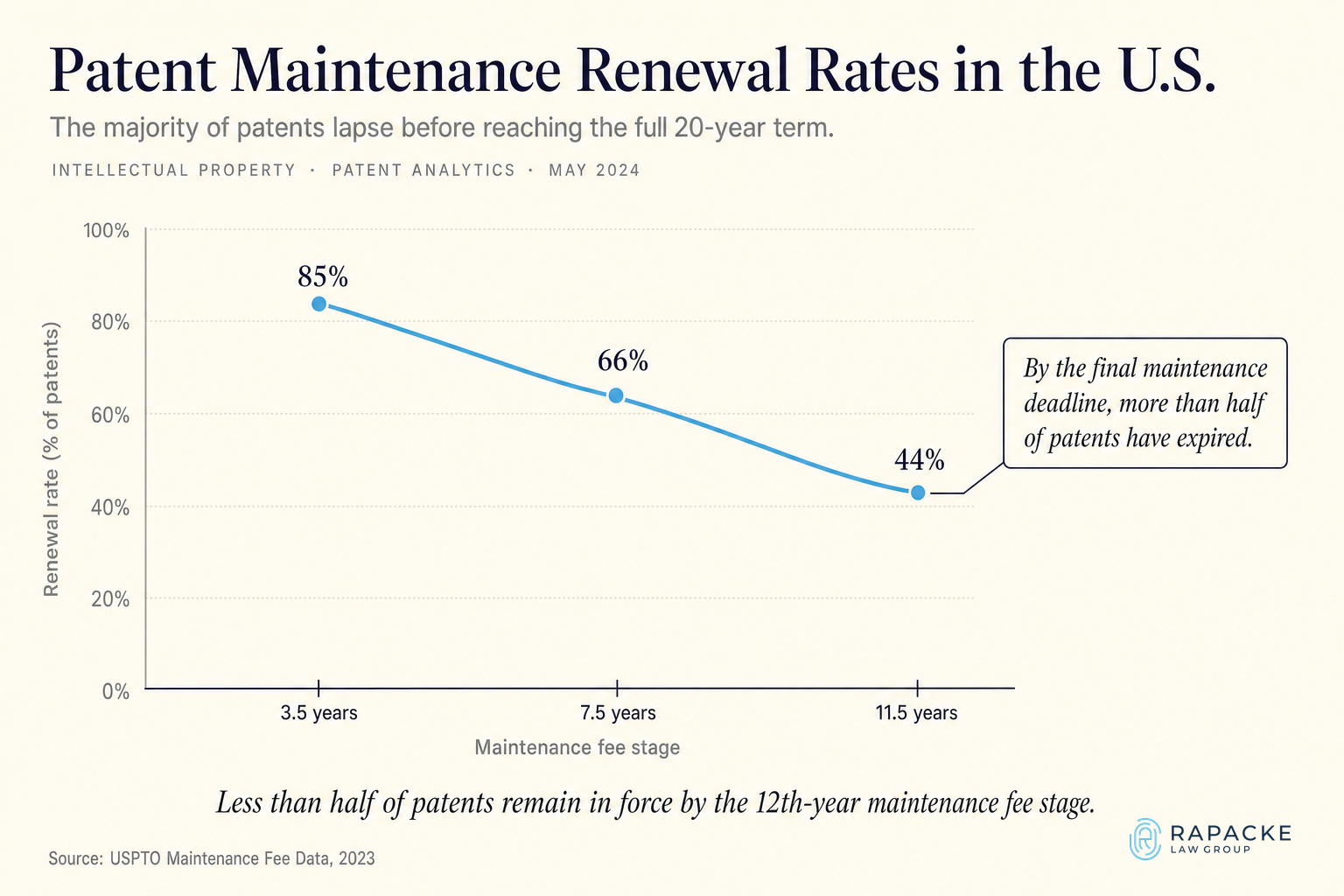
- Only about 44% of U.S. patents survive to the final 11.5-year maintenance fee, meaning more than half expire early due to nonpayment rather than reaching the full 20-year term.
- Design patents follow a separate 15-year-from-grant rule and require no maintenance fees, while continuation applications expire on the parent's original 20-year date regardless of when the continuation was filed.
- You can verify any patent's actual expiration date for free using the USPTO Patent Center, which shows PTA, terminal disclaimers, and maintenance fee payment history in one place.
More than 63% of U.S. patents expire on a date that is not the filing date plus 20 years, according to a 2023 empirical study published on SSRN. That single fact dismantles the assumption most inventors make when they file. The default rule under 35 U.S.C. § 154(a)(2) sets the patent term at 20 years from the earliest effective filing date, but patent term adjustment, patent term extension, terminal disclaimers, maintenance fee failures, and the type of application in your priority chain all move that date forward or backward by months or years.
Why the 20-Year Patent Term Is Only the Starting Point
The phrase "patents last 20 years" is accurate as a baseline and misleading as a planning tool. The 20-year patent term under 35 U.S.C. § 154(a)(2) applies to utility patents and plant patents filed in the United States on or after June 8, 1995. But the actual expiration date for any specific patent depends on at least five additional variables.
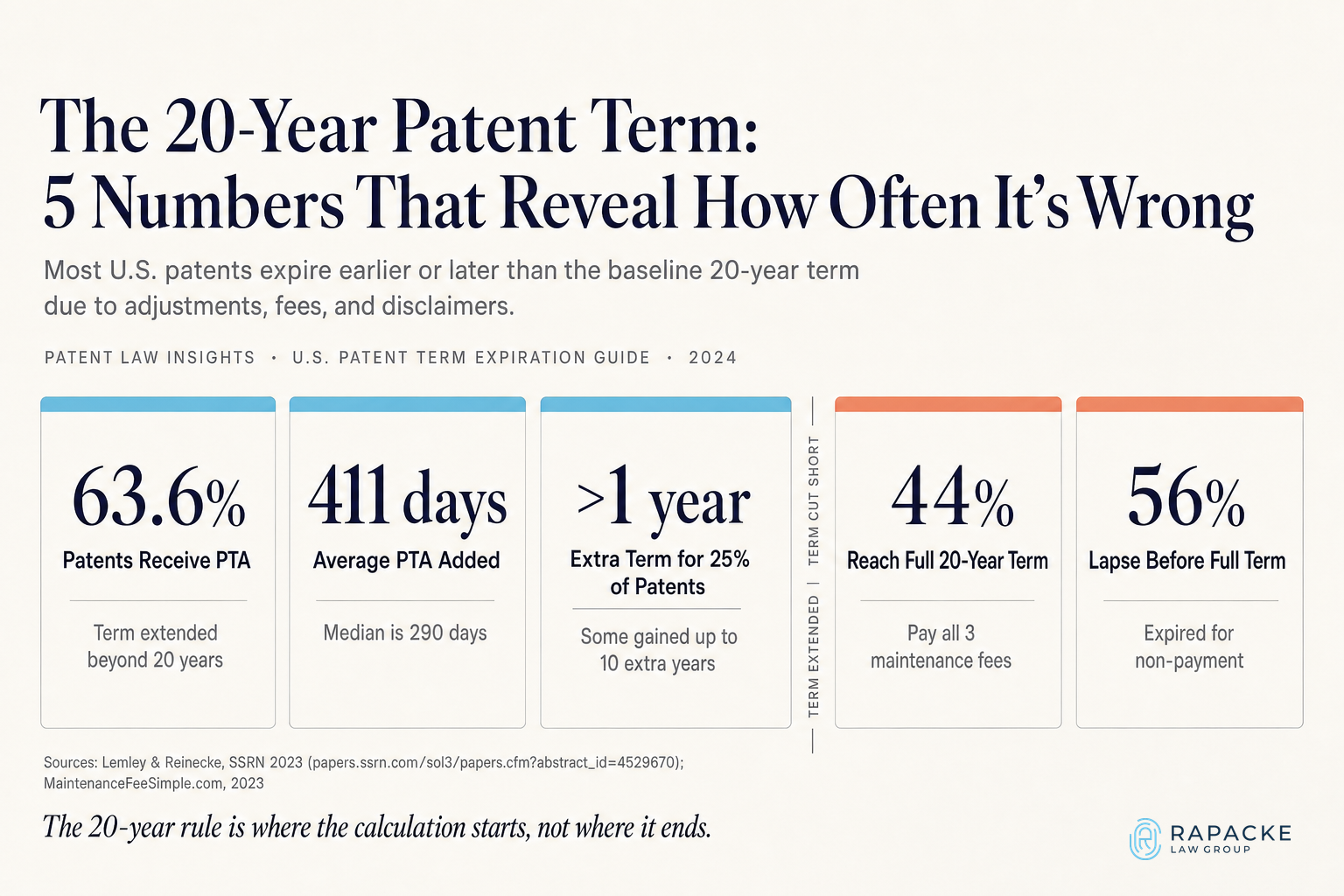 The 20-Year Patent Term: 5 Numbers That Reveal How Often It's Wrong /Source: Lemley & Reinecke, SSRN 2023; MaintenanceFeeSimple.com, 2023
According to the 2023 SSRN empirical study, 63.6% of U.S. patents receive some Patent Term Adjustment, with an average of 411 days added (median of 290 days) beyond the standard 20-year term. Some outliers gained up to several extra years due to lengthy appeals or interference proceedings. On the other end, only about 44% of patents are maintained through the final 11.5-year maintenance fee deadline, meaning over half expire before reaching their full term due to nonpayment. The "20-year rule" describes a starting point, not a destination. Understanding how to maximize your lifespan of patent rights starts with knowing exactly which variables move that expiration date.
What the Filing Date Actually Controls in U.S. Patent Law
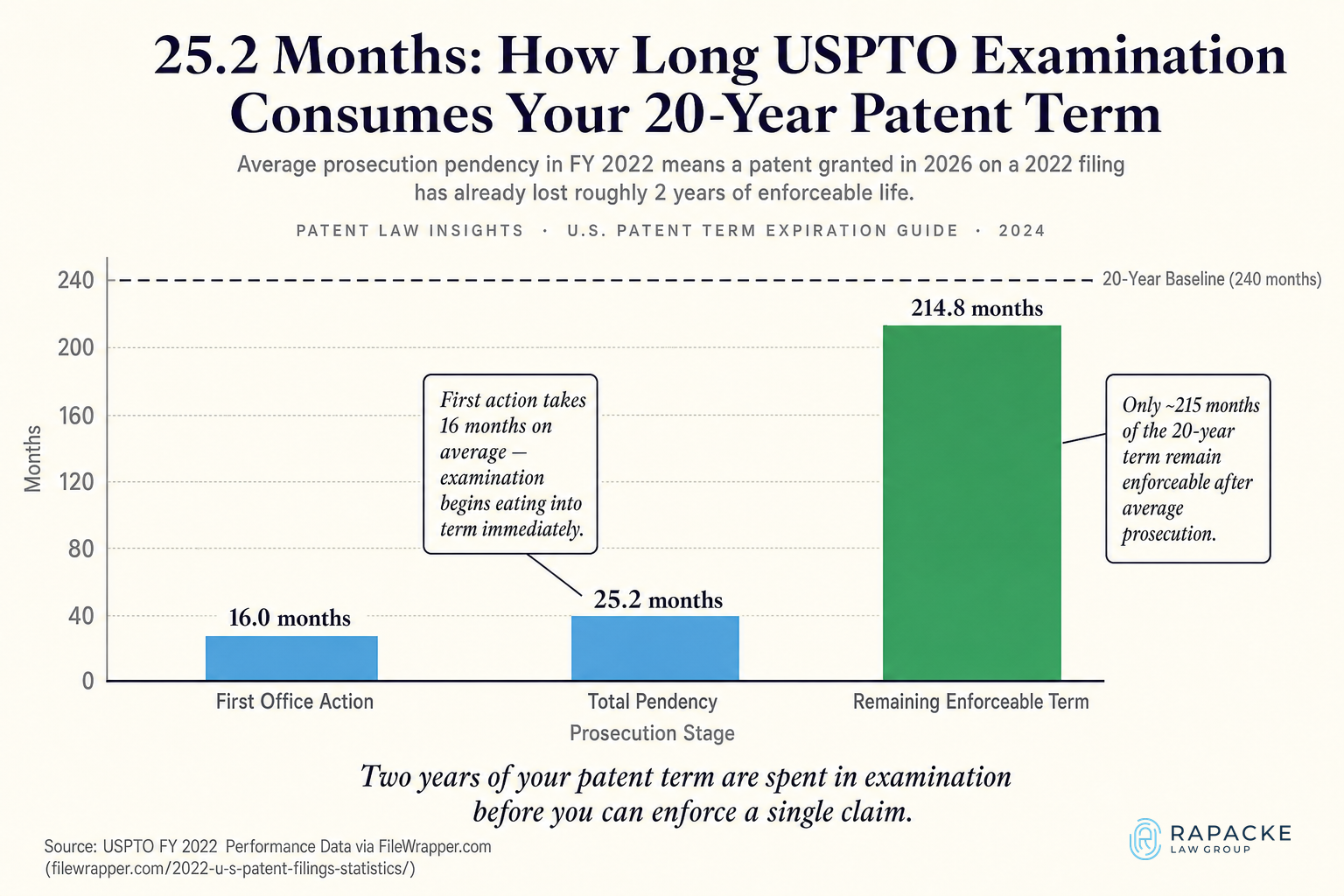 25.2 Months: How Long USPTO Examination Consumes Your 20-Year Patent Term/Source: USPTO FY 2022 Performance Data via FileWrapper.com, 2023
Why "Filing Date" Means the Non-Provisional Application Date
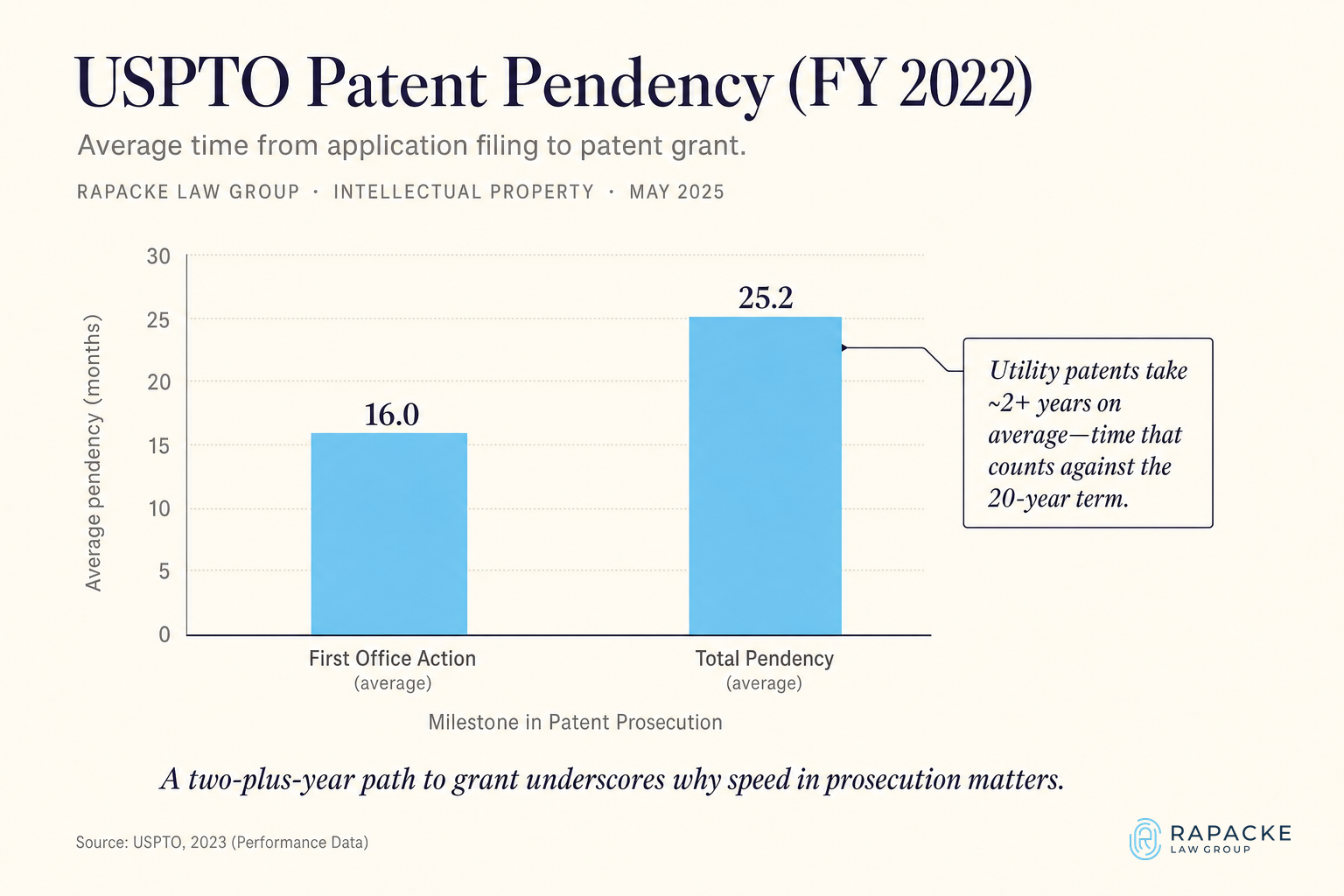
The 20-year clock starts from the earliest effective filing date of the non-provisional patent application, not from the date the United States Patent and Trademark Office grants the patent. According to USPTO performance data compiled by FileWrapper, average total pendency from filing to grant was 25.2 months in FY 2022, with first office action pendency averaging 16.0 months in the same period. A patent granted in 2026 on an application filed in 2022 already has roughly two to three years consumed before the owner can enforce a single claim.
This is why strategic timing matters when you file: file your non-provisional as early as the disclosure is defensible, because every month of prosecution reduces the enforceable window. Applicant-caused delays, including late responses to office actions, extensions of time, and deferred examination requests, also reduce any patent term adjustment the United States patent office would otherwise award, compounding the loss.
How a Provisional Patent Application Affects the Expiration Date
A provisional patent application establishes a priority date but does not itself start the 20-year clock. Under 35 U.S.C. § 111(b), the applicant must file a non-provisional application within 12 months of the provisional filing to preserve priority. In FY 2022, inventors filed 147,339 provisional patent applications with the United States patent office. Most are followed by a non-provisional within the 12-month window. The practical benefit is clear: a provisional gives an inventor up to a year to develop the technology, seek funding, or evaluate commercial viability without shortening the patent's eventual term. The expiration date is set entirely by the non-provisional filing date.
For founders who need more time before committing to the non-provisional, it is worth understanding both how the provisional patent timeline impacts startup funding and whether a provisional patent extension is a viable option in your situation, though extensions have strict limits and are not routinely granted.
Continuing Applications, Continuations, and the Uruguay Round Agreements Act
Continuing applications, continuations, continuations-in-part, and divisional applications, expire on the same date as the parent application. Under the Uruguay Round Agreements Act (URAA), which shifted U.S. patent law from 17-years-from-grant to 20-years-from-filing in 1995, the earliest effective filing date of the priority chain controls the expiration date. A continuation filed eight years after the parent still expires when the parent's 20-year term ends. Continuations have grown in frequency: research from Big Patent Data found that about 18% of U.S. patent applications in 2016 were continuations, up from roughly 7% in 2001. Before filing a continuation, calculate the remaining term on the parent, because the continuation may issue with only a few enforceable years left. For a detailed comparison of how provisional and non-provisional applications differ in scope, timing, and strategic purpose, that framing matters before you commit to a continuation strategy.
How International and Foreign Priority Applications Change the Expiration Calculation
For a patent that enters the United States through the Patent Cooperation Treaty (PCT), the 20-year term runs from the international filing date of the PCT application under 35 U.S.C. § 371, not from the national stage entry date. The comparison table below summarizes how three different filing routes set different expiration clocks, but the key point is that PCT applicants can delay U.S. national stage entry up to 30 months from the earliest priority date, effectively shortening the enforceable life of the U.S. patent. According to WIPO's 2022 PCT statistics, U.S. applicants filed 59,056 PCT applications in 2022, and many use the full 30-month delay window for strategic reasons without realizing the term consequence.
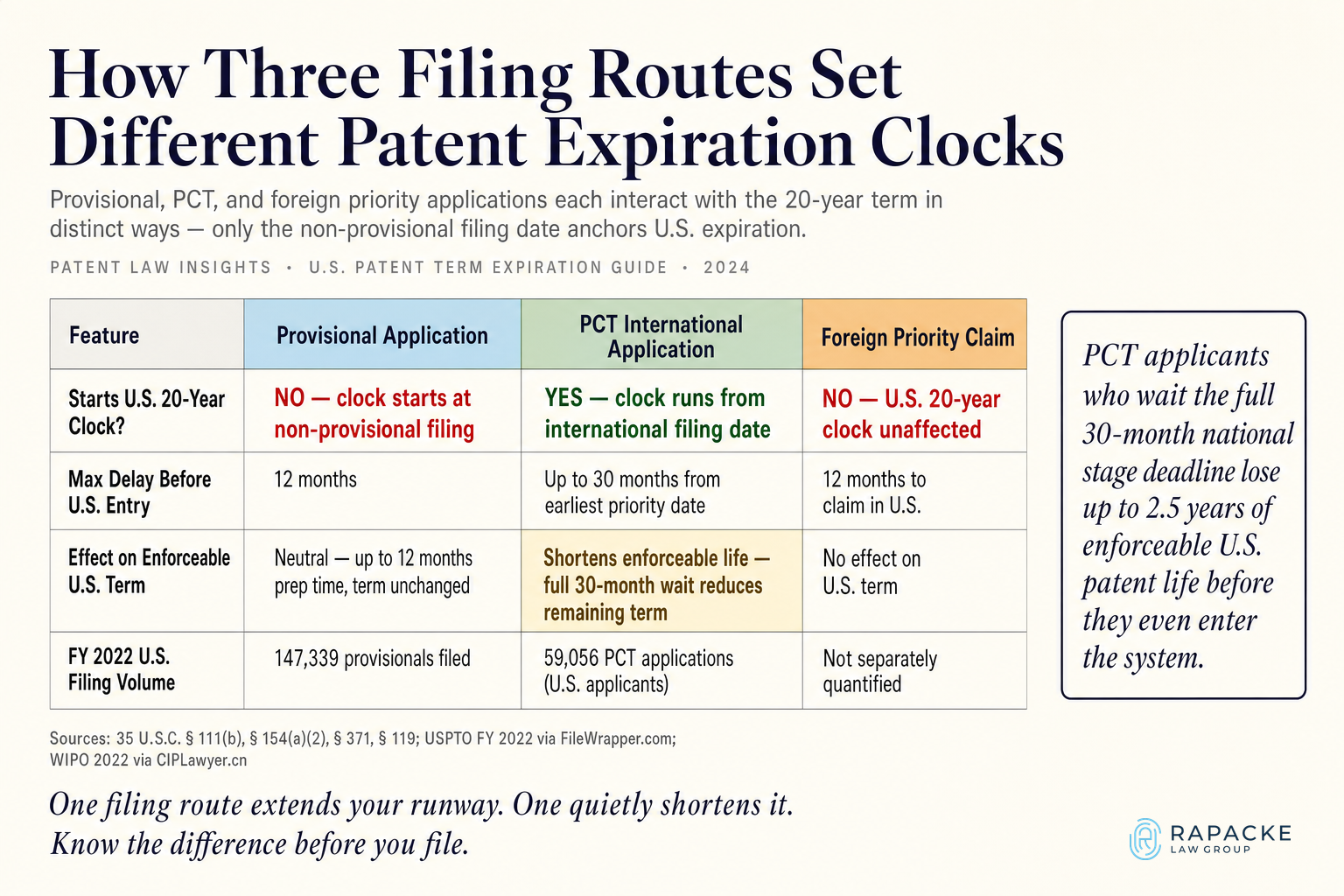 How Three Filing Routes Set Different Patent Expiration Clocks/Source: 35 U.S.C. §§ 111(b), 154(a)(2), 371, 119; USPTO FY 2022 via FileWrapper.com; WIPO 2022
When a U.S. application instead claims priority to a foreign patent application under 35 U.S.C. § 119, for example, a European Patent Office filing, the 20-year term still runs from the U.S. filing date, not the foreign priority date. This contrasts directly with the PCT route under § 371. An inventor who filed in Germany in January 2023 and filed a U.S. non-provisional in December 2023 under § 119 holds a U.S. term running from December 2023, not January 2023. If you are pursuing parallel protection in multiple jurisdictions, confirm whether your U.S. application enters under § 119 or § 365, because only the latter ties your term to the international filing date.
Design Patents and Plant Patents Follow Different Expiration Rules
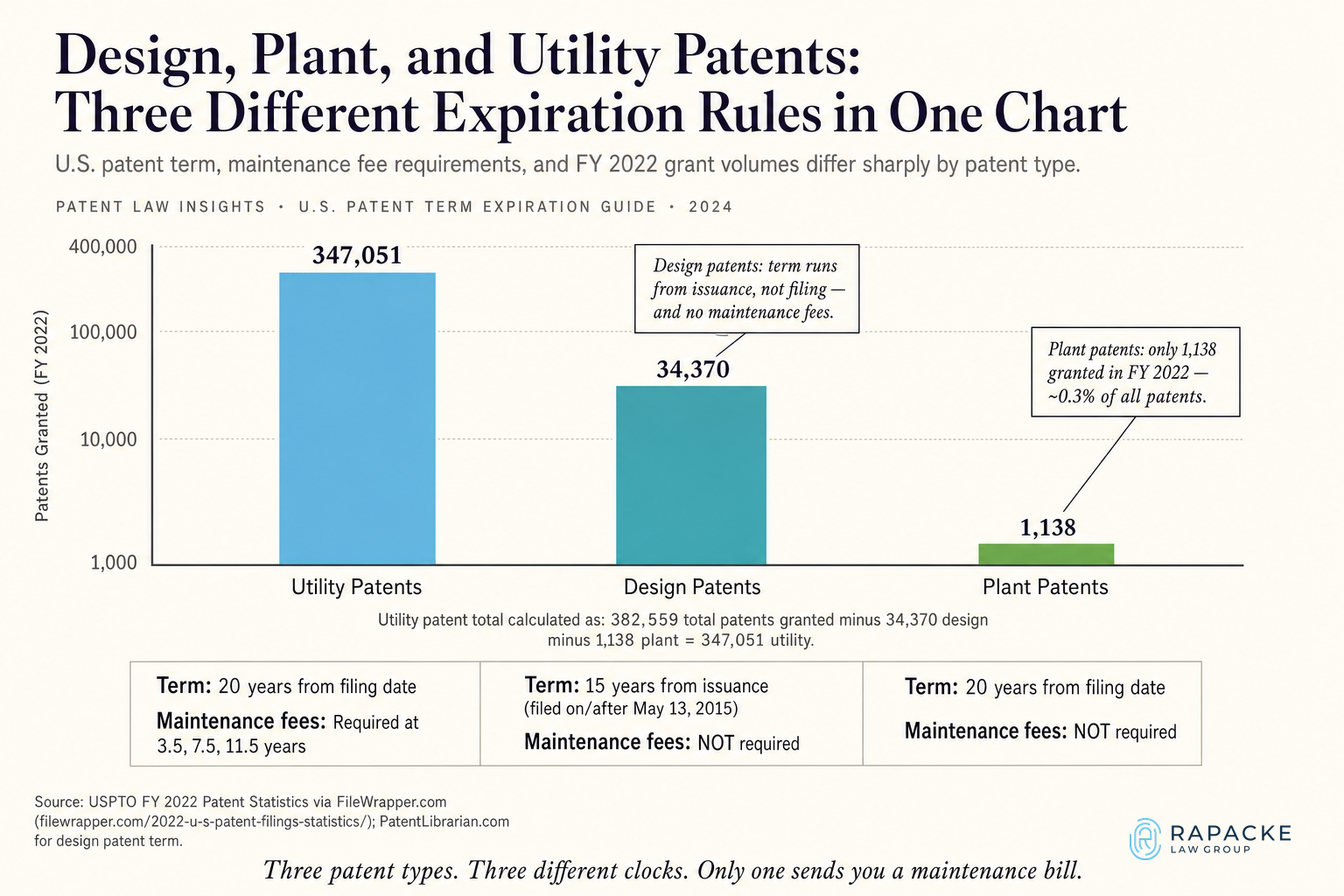 Design, Plant, and Utility Patents: Three Different Expiration Rules in One Chart/Source: USPTO FY 2022 Patent Statistics via FileWrapper.com, 2023; PatentLibrarian.com
The 15-Year Term for Design Patents Filed After May 2015
Design patents protect the ornamental appearance of a product and follow a separate expiration framework. Under the Patent Law Treaties Implementation Act of 2012, design patents filed on or after May 13, 2015, have a term of 15 years from the date of grant, not from the filing date. Design patents filed before that date retain the older 14-year-from-grant term. Design patents require no maintenance fees to stay in force. In FY 2022, the USPTO granted 34,370 design patents from 54,476 applications. Because the term runs from grant rather than filing, slow prosecution does not eat into the enforceable window the way it does for utility patents. This is a meaningful structural advantage for product companies that incorporate ornamental design into their IP strategy alongside utility filings.
Plant Patents and Their 20-Year Term
Plant patents protect asexually reproduced plant varieties under 35 U.S.C. § 163 and share the same 20-year-from-filing term as utility patents. Like design patents, they require no maintenance fees. The USPTO granted 1,138 plant patents in FY 2022, representing about 0.3% of all patents granted. Plant patents are distinct from plant variety protection certificates administered by the USDA under the Plant Variety Protection Act, which carry their own 20- to 25-year terms and are not issued by the United States patent office. Inventors in agricultural biotech and horticulture should confirm which protection route fits their innovation before filing, since the strategic and expiration implications differ.
Patent Term Adjustment and Patent Term Extension Can Push Expiration Later
The baseline 20-year patent term can be extended in two legally distinct ways: patent term adjustment for USPTO delays and patent term extension for FDA regulatory review. Both appear on the issued patent or in USPTO records, and both must be factored into any accurate expiration calculation. Failing to account for either when assessing a competitor's patent, or your own, leads to costly errors in competitive entry analysis and licensing negotiations.
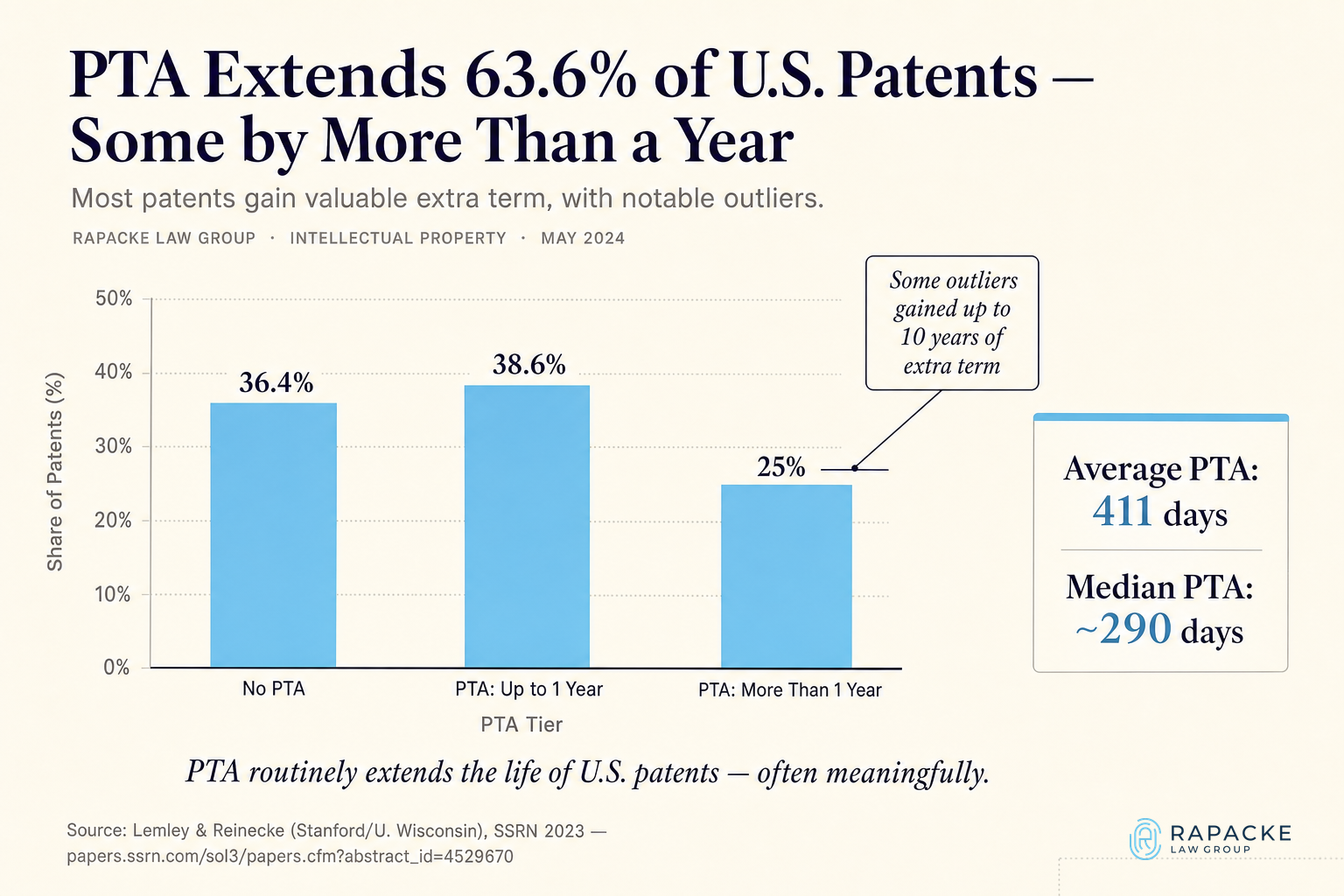 PTA Extends 63.6% of U.S. Patents, Some by More Than a Year/Source: Lemley & Reinecke (Stanford/U. Wisconsin), SSRN, 2023
How Patent Term Adjustment Works for USPTO Delays
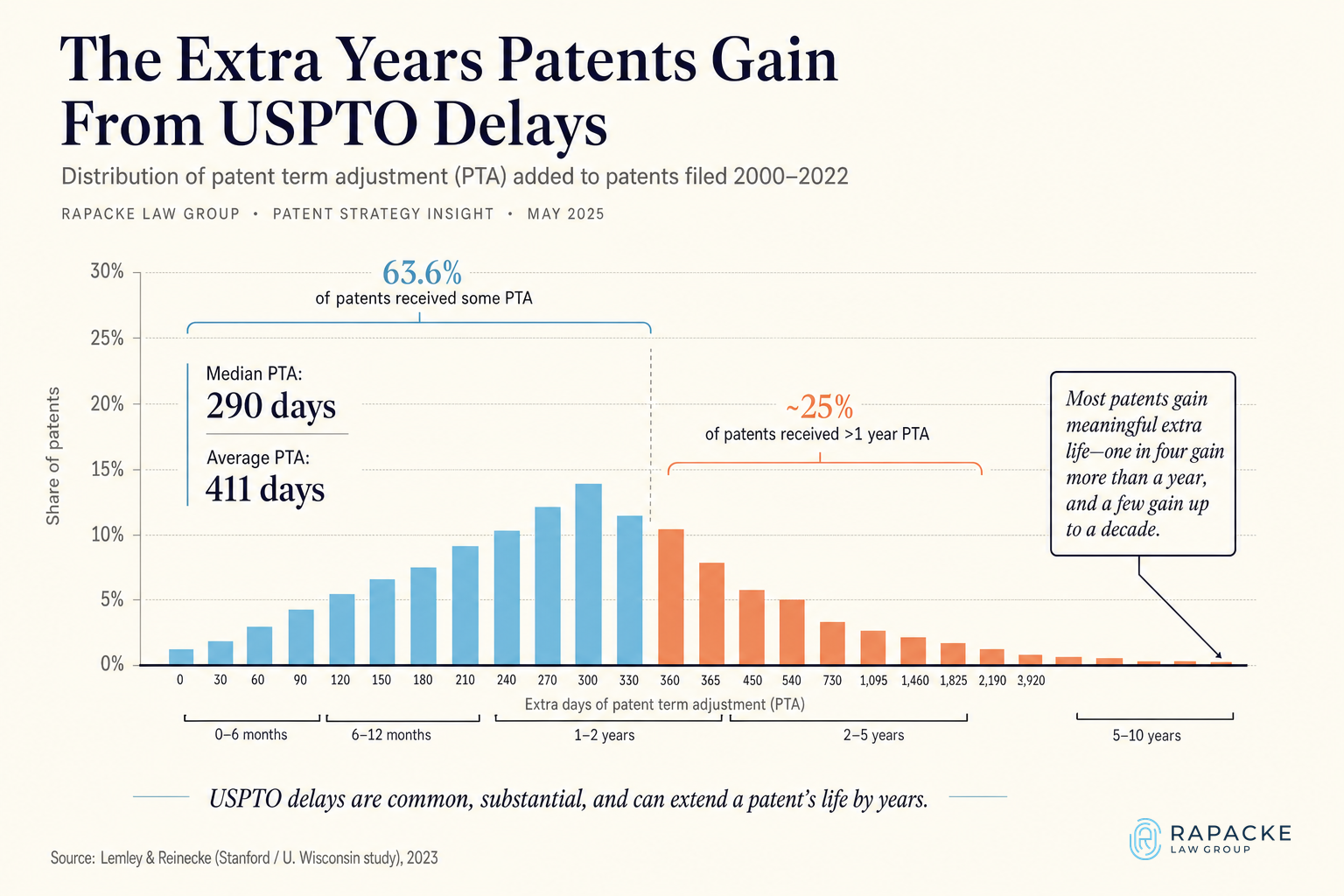
Under 35 U.S.C. § 154(b), the United States patent office adds days to the patent term when it fails to meet specific examination deadlines. For example, if the first office action takes longer than 14 months, or if total prosecution exceeds three years. PTA is printed on the face of the issued patent. According to the 2023 SSRN empirical study, 63.6% of patents filed since 2000 received patent term adjustment, averaging 411 added days, and more than 25% gained over one year of extra term. The Federal Circuit's decision in Wyeth v. Kappos, 591 F.3d 1364 (Fed. Cir. 2010), required the USPTO to correct how it counted overlapping delays, increasing PTA for many already-issued patents. Check your patent's front page for "Patent Term Adjustment = __ days" and add that figure to the 20-year base date. Note that applicant-caused delays, including late responses, extensions of time, and requests for continued examination, reduce PTA on a day-for-day basis, so minimizing prosecution delays preserves both term and adjustment credit.
How Patent Term Extension Works for FDA-Regulated Products
Patent term extension (PTE) under the Hatch-Waxman Act, codified at 35 U.S.C. § 156, compensates pharmaceutical and medical device patent owners for time consumed during FDA regulatory review. A qualifying patent can recover up to five years of patent term, with the total post-approval term capped at 14 years. As of May 2023, the USPTO had granted 982 patent term extensions in total since the Hatch-Waxman Act took effect in 1984, with an average extension on drug patents of approximately 2.8 years. To qualify, the patent must cover an FDA-approved human drug, biological product, medical device, food additive, or color additive, and the PTE application must be filed within 60 days of FDA approval. Missing that window forfeits the extension entirely. A patent can receive both PTA and PTE if it qualifies for both, potentially pushing the expiration date several years beyond the 20-year baseline.
Terminal Disclaimers and How They Shorten Patent Terms
A terminal disclaimer is a filing that limits a patent's term so it expires no later than an earlier-expiring related patent. The United States patent office requires terminal disclaimers to overcome obviousness-type double patenting rejections, where two patents owned by the same entity have claims that are obvious variants of each other. Terminal disclaimers are common in portfolio-intensive sectors: research published in JAMA found that 45% of small-molecule drug patents involved obviousness-type double patenting rejections requiring terminal disclaimers, with roughly 33% of biologic drug patents in the same position. The practical effect is that the later-filed patent cannot outlive the earlier one. The Federal Circuit's 2023 decision in In re Cellect, 81 F.4th 1216 (Fed. Cir. 2023), added a significant complication: where a patent subject to a terminal disclaimer also received PTA, the court held that the PTA does not extend the term beyond the terminal disclaimer date. Patent owners building continuation-heavy portfolios must map all terminal disclaimers carefully, because losing common ownership of linked patents can also trigger invalidity exposure across the entire family.
Maintenance Fees Are the Most Common Way Patents Expire Early
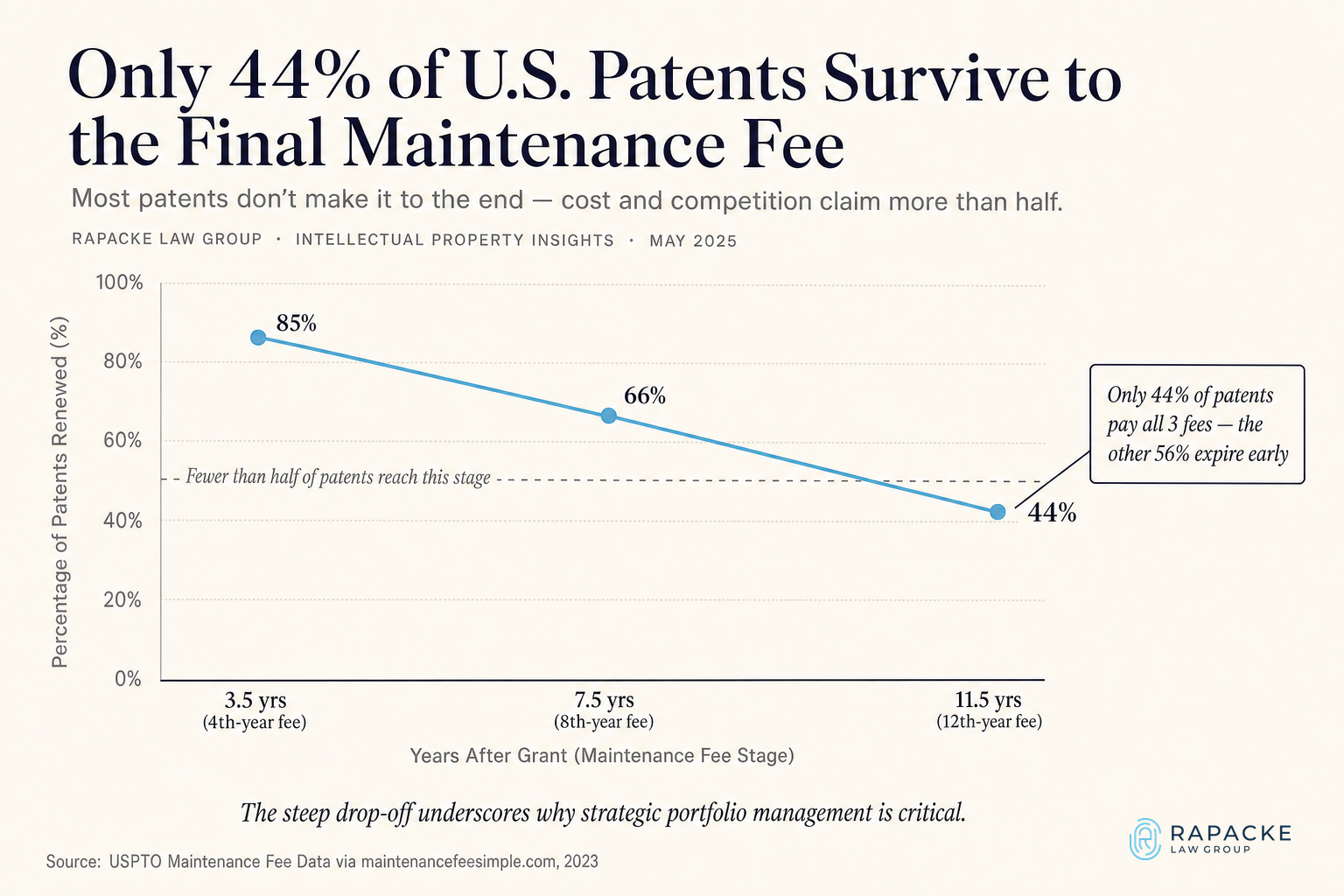 Only 44% of U.S. Patents Survive to the Final Maintenance Fee/Source: USPTO Maintenance Fee Data via maintenancefeesimple.com, 2023
The Three USPTO Maintenance Fee Deadlines for Utility Patents
Utility patents require maintenance fee payments at three intervals after grant to remain in force: at 3.5 years, 7.5 years, and 11.5 years from the grant date under 35 U.S.C. § 41. If a fee is missed, a six-month grace period follows during which the fee can be paid with a surcharge. After that grace period, the patent lapses and enters the public domain. The survival data is stark: according to Maintenance Fee Simple, approximately 85% of patents survive the 3.5-year fee, 66% survive the 7.5-year fee, and only 44% survive to pay the final 11.5-year fee. More than half of all issued utility patents expire early because their owners stop paying. Design patents and plant patents are exempt from maintenance fees entirely.
Current USPTO maintenance fees vary by entity size. Large entities pay the highest rates, while small entities, generally those with fewer than 500 employees, pay reduced fees, and micro entities qualifying under 37 C.F.R. § 1.29 pay the lowest rates. Because the USPTO adjusts the fee schedule periodically, always confirm current amounts at USPTO.gov before each payment. Other third party features of patent management software and docketing platforms can automate deadline tracking and fee reminders across a portfolio, reducing the risk of accidental lapse.
How to Reinstate a Lapsed Patent and the Limits of Revival
A patent that lapses for nonpayment of a maintenance fee can sometimes be revived. The patent owner must file a petition for revival under 37 C.F.R. § 1.378, pay the overdue maintenance fee plus surcharge, and certify that the delay was unintentional. Revival is possible but not guaranteed, and it carries a significant enforcement limitation. Intervening rights may have accrued during the lapse period under 35 U.S.C. § 41(c)(2), limiting infringement claims against third parties who relied on the patent being expired. The only reliable approach is docketing all three maintenance fee deadlines at grant and treating the six-month grace period as an emergency backstop, not a routine payment schedule. For patent owners who want to understand what rights a granted patent actually confers before those rights lapse, that analysis should happen well before the first fee deadline arrives.
What Happens to Technology After a Patent Expires
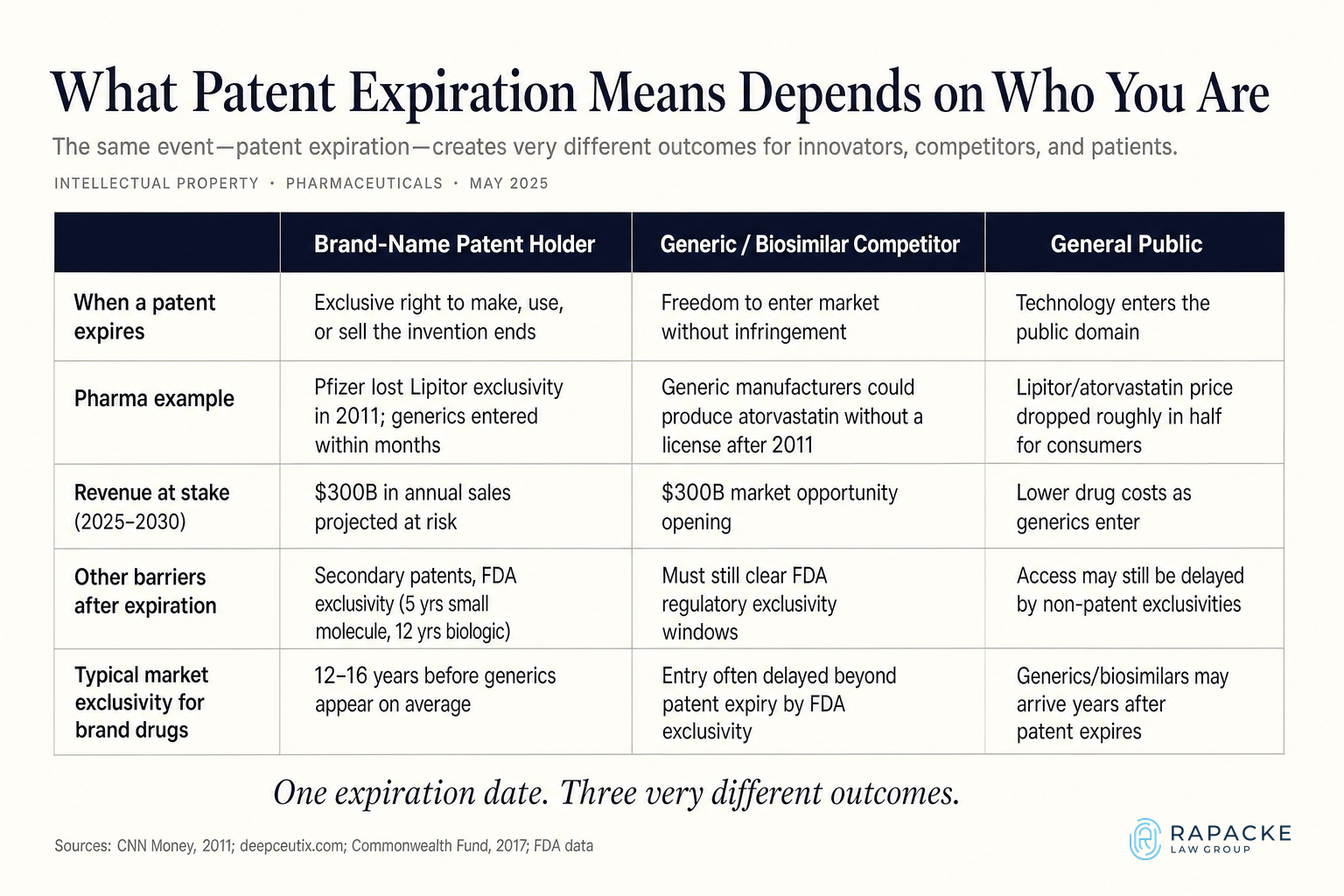 What Patent Expiration Means Depends on Who You Are/Source: CNN Money 2011; deepceutix.com; Commonwealth Fund, 2017
The Technology Enters the Public Domain and Competitors Can Use It Freely
When a patent expires, whether at the end of its full term, by lapse for unpaid maintenance fees, or under a terminal disclaimer that pulls forward the expiration date, the claimed invention enters the public domain. Any person or company can then make, use, sell, and import the technology without a license, without paying royalties, and without infringing any patent rights. This is the core bargain of the patent system: temporary exclusivity in exchange for public disclosure. For technology companies, this creates both a threat (when your own patents expire) and an opportunity (when competitor patents expire and you can build on their publicly disclosed inventions). Founders who understand the full benefits of patent protection, including the strategic use of disclosed prior art once competitor patents expire, are better positioned to time product development around the competitive landscape.
Other third party features of competitor patent portfolios, including secondary patents and continuation families, often extend effective exclusivity past the original expiration date. Mapping those layers before entering a market is part of a thorough freedom-to-operate analysis.
Secondary Patents and Regulatory Exclusivity Can Extend Market Protection
In pharmaceutical markets, brand-name manufacturers often hold multiple layers of protection beyond the original compound patent. Secondary patents covering formulations, dosing methods, or delivery mechanisms can extend effective market exclusivity past the primary patent's expiration. Separately, FDA regulatory exclusivity runs independently of patent term. This includes five years for new chemical entities, three years for new clinical investigations, and 12 years for biologics under the Biologics Price Competition and Innovation Act. Research published by the Commonwealth Fund found that the median effective market exclusivity for new prescription drugs is approximately 13 to 14 years after accounting for patent term extensions and regulatory exclusivities. When all patents and exclusivities expire, generic manufacturers can file an abbreviated new drug application (ANDA) with the FDA to bring lower-cost alternatives to market.
How to Look Up Any Patent's Expiration Date
The USPTO provides free tools to verify a patent's status. The Patent Center at USPTO.gov allows users to search by patent number and view the prosecution history, maintenance fee payment status, PTA data, and any terminal disclaimers on file. For pharmaceutical patents, the FDA Orange Book lists patents covering approved drug products along with their expiration dates and any applicable regulatory exclusivity end dates. Google Patents also displays estimated expiration dates, but users should verify against USPTO Patent Center records for any patent carrying PTA, PTE, or terminal disclaimers, since third-party databases do not always reflect those adjustments accurately. For critical business decisions, including licensing negotiations, competitive entry analysis, and IP due diligence during a financing round, USPTO Patent Center is the authoritative source.
FAQ: Patent Expiration Questions Answered Directly
Do patents expire after 20 years? U.S. utility patents and plant patents have a base term of 20 years from the earliest effective filing date of the non-provisional application under 35 U.S.C. § 154(a)(2). However, the actual expiration date often differs. Patent term adjustment can extend the term beyond 20 years to compensate for examination delays caused by the United States patent office. Patent term extension under the Hatch-Waxman Act can add up to five years for patents covering FDA-approved products. A terminal disclaimer can shorten a patent's term to match an earlier-expiring related patent. And a patent can expire before 20 years if maintenance fees go unpaid.
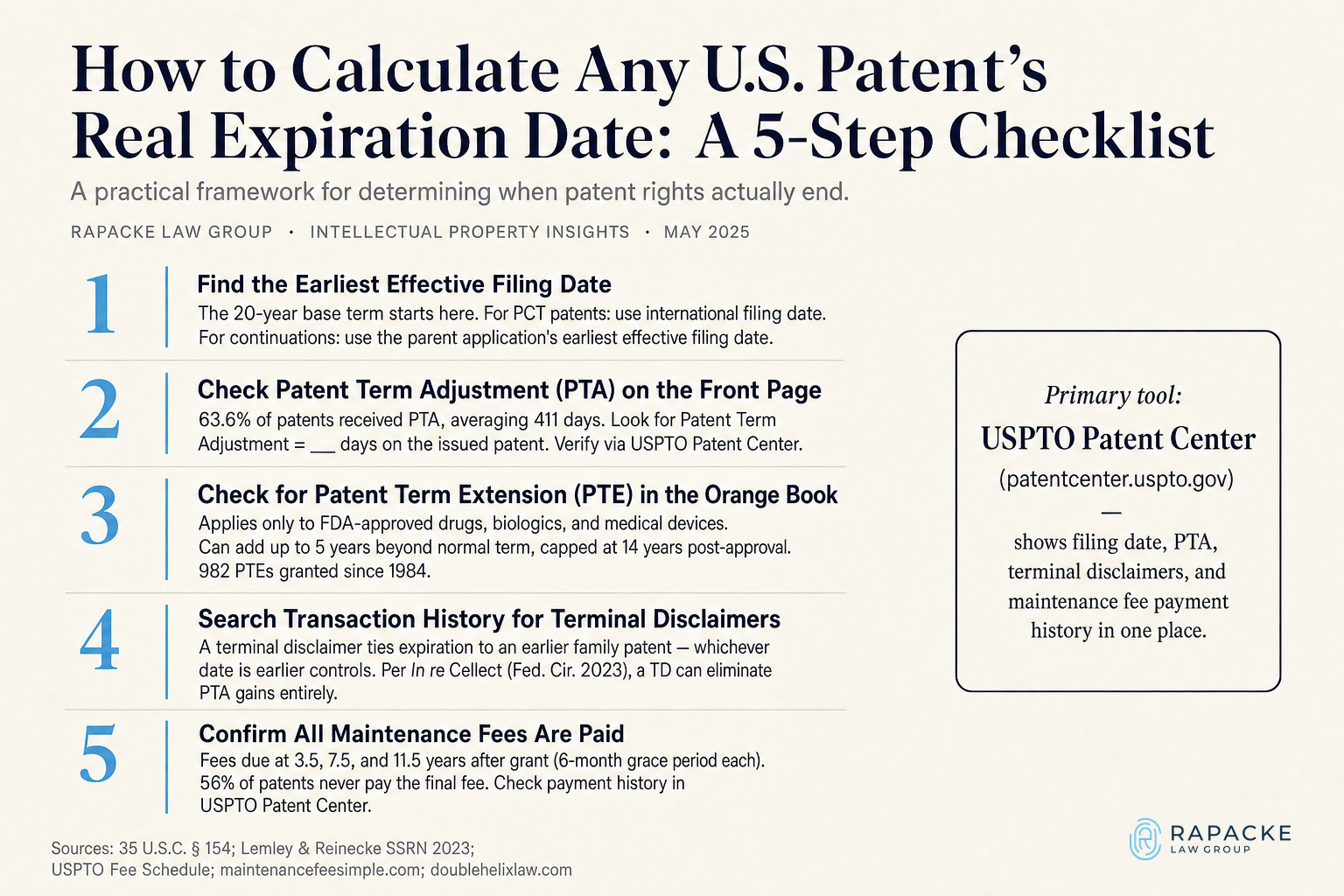 How to Calculate Any U.S. Patent's Real Expiration Date: A 5-Step Checklist/Source: 35 U.S.C. § 154; Lemley & Reinecke SSRN 2023; USPTO Fee Schedule; maintenancefeesimple.com; doublehelixlaw.com
How do I find out when a specific patent expires? Start with the USPTO Patent Center at USPTO.gov. Search by patent number to view the prosecution history, any patent term adjustment printed on the patent, maintenance fee payment status, and any terminal disclaimers on file. For drug patents, the FDA Orange Book lists expiration dates for patents covering approved products. Google Patents displays estimated expiration dates but should be verified against USPTO records for any patent with PTA, PTE, or a terminal disclaimer.
Can a patent be extended beyond 20 years? Yes, in two specific circumstances. Patent term adjustment under 35 U.S.C. § 154(b) adds days equal to unreasonable delays caused by the United States patent office during examination. Patent term extension under 35 U.S.C. § 156 adds up to five years for patents covering FDA-regulated products. A patent can receive both if it qualifies, and the resulting expiration date may be several years beyond the baseline 20-year date.
What happens when a patent expires or lapses? Once a patent expires or lapses, the invention enters the public domain. Anyone can make, use, sell, and import the formerly patented technology without a license. In pharmaceutical markets, patent expiration typically triggers generic drug entry under an abbreviated new drug application (ANDA). If a patent lapsed early due to unpaid maintenance fees and is later revived, intervening rights under 35 U.S.C. § 41(c)(2) may limit the owner's ability to assert infringement against parties who relied on the patent being expired during the lapse period.
Is there a difference between patent expiration and patent invalidation? Yes. Patent expiration is the natural or fee-based end of the patent term after the authorized period has elapsed. Patent invalidation is a legal determination, through post-grant review, inter partes review (IPR), or litigation, that the patent should never have been granted because it lacks novelty, non-obviousness, or another patentability requirement. An invalidated patent never had valid legal effect; an expired patent had full effect during its term. Both outcomes leave the technology available for public use, but the legal path and retroactive consequences differ significantly.
Do continuation patents have their own 20-year term? No. Continuation applications, continuation-in-part applications, and divisional applications all expire on the same date as the earliest parent application in their priority chain under the Uruguay Round Agreements Act. The 20-year term runs from the original parent's filing date regardless of when the continuation was filed. A continuation filed late in prosecution may issue with only a few enforceable years remaining.
What is a terminal disclaimer and why does it matter for expiration? A terminal disclaimer limits a patent's term so it expires no later than an earlier-expiring related patent. The United States patent office requires terminal disclaimers when two patents owned by the same entity have claims that are obvious variants of each other. The practical effect is that the later patent cannot outlive the earlier one. After In re Cellect, 81 F.4th 1216 (Fed. Cir. 2023), the Federal Circuit clarified that PTA does not extend a patent's term beyond a terminal disclaimer date, meaning patent owners cannot rely on USPTO-caused delays to reclaim term that a terminal disclaimer has already surrendered. Patent owners with continuation-heavy portfolios should also understand that applications sharing a terminal disclaimer must maintain common ownership throughout their terms, or risk invalidity exposure across the entire family.
Understanding Your Patent's Actual Expiration Date Matters More Than the Default Rule
The 20-year patent term from the non-provisional filing date is the correct starting point and an unreliable endpoint. Patent term adjustment for USPTO delays, patent term extension for FDA-regulated products, terminal disclaimers filed to overcome double patenting rejections, maintenance fee payment history, and the specific application type in your priority chain all move the real expiration date away from the simple calculation. Getting this right is not administrative housekeeping; it determines how long you can exclude competitors, when licensing windows close, and when your technology enters the public domain.
If you are building a patent portfolio for a technology startup, preparing for a financing round that requires IP due diligence, or managing related applications that carry terminal disclaimers, a precise expiration analysis is the foundation of every strategic decision that follows. For SaaS founders and software companies, understanding how long software patents last and how prosecution decisions affect that window is especially critical given how quickly competitive landscapes shift. Founders who want to see how leading tech companies have structured their patent portfolios can also study software patent examples that illustrate both filing strategy and term management in practice.
Your Next Steps to Patent Expiration Clarity
A patent's expiration date is not a fixed number. It is the result of filing type, prosecution timeline, USPTO delays, maintenance fee decisions, and any terminal disclaimers that tie related applications together.
Most founders and inventors underestimate how much these variables can shift the actual date, and some discover the problem only when a competitor enters the market or a licensing negotiation goes sideways.
The bottom line: A weak expiration analysis leaves enforcement windows undefined and licensing timelines guesswork. A precise expiration calculation, done before strategic decisions are made, tells you exactly how long your competitive moat holds and when you need continuation filings, secondary protection, or a new generation of innovation to replace expiring assets.
Every month of uncertainty carries a cost. Competitors who understand your patent term better than you do will time their entry accordingly. Investors conducting IP due diligence will surface gaps that you should have identified first. And maintenance fee deadlines do not pause while strategy is being sorted out.
To protect your protection window before time works against you:
- Schedule a Free IP Strategy Call to get a precise expiration analysis for your patent portfolio
- Review your issued patents for PTA values printed on the face of each patent and add those days to your base expiration dates
- Audit all terminal disclaimers across related applications to confirm common ownership is maintained throughout
- Docket all three maintenance fee deadlines at grant (3.5, 7.5, and 11.5 years from the grant date), and calendar the six-month grace period as a hard backup, not a payment window
- Confirm whether any PCT applications in your portfolio entered the U.S. under § 371, since the international filing date controls the term, not the national stage entry date
- For pharmaceutical or medical device patents, verify whether a patent term extension application was filed within 60 days of FDA approval
Rapacke Law Group works with SaaS founders, hardware companies, and technology startups on patent portfolio strategy, continuation planning, and prosecution management designed to maximize the enforceable life of their innovations. Fixed-fee engagements mean no billing surprises, and Rapacke Law Group's Full Refund Guarantee on provisional applications means you take on less risk at the earliest and most critical stage of the filing process. Our guarantee is our commitment: if we don't deliver, you don't pay.
To Your Success,
Andrew Rapacke Managing Partner,
Registered Patent Attorney Rapacke Law Group