

Key Takeaways
- A U.S. utility patent grants exclusive rights for 20 years from the filing date, while a design patent lasts 15 years from issuance. Both only protect you inside the United States.
- File a provisional patent application before any public disclosure. It costs as little as $65 for a micro entity and locks in your priority date for 12 months.
- Obviousness is the biggest hurdle, so a thorough prior art search before filing is essential.
- You can file yourself, but 76 percent of self-filed applications are abandoned without a patent.
- Budget for the full lifecycle. Government fees, attorney fees, and maintenance fees at 3.5, 7.5, and 11.5 years can push a utility patent into tens of thousands of dollars.
*Written by Andrew Rapacke, Managing Partner, Registered Patent Attorney.* Andrew Rapacke is a registered patent attorney and the Managing Partner of The Rapacke Law Group, a full-service intellectual property law firm. He helps individuals and corporations across industries with the protection, prosecution, licensing, and enforcement of their intellectual property, with deep experience in patent, trademark, and copyright matters spanning software, AI and machine learning, blockchain, medical devices, and autonomous vehicle technology. A graduate of the United States Naval Academy, Andrew served as a Naval Engineering Officer before pursuing law and remains active in the startup and inventor communities throughout Florida.
You launch a product, sales climb, and within months a competitor releases a near-identical version at a lower price. Without a patent, you have no legal recourse to stop them for patent infringement. That single scenario is why the question "how do I patent a product" matters so much for inventors and founders building something people actually want.
If you've been asking yourself how do I patent a product, this guide walks through the patent application process in the order you will experience it, from confirming your product qualifies to filing with the United States Patent Office and responding to office actions. A patent gives you exclusive rights for up to 20 years. Most inventors choose between two paths, a utility patent protects how a product works, and a design patent protects how it looks. You will learn which one fits, what it costs, and what to do next.
How Do I Patent a Product and What Does It Actually Mean
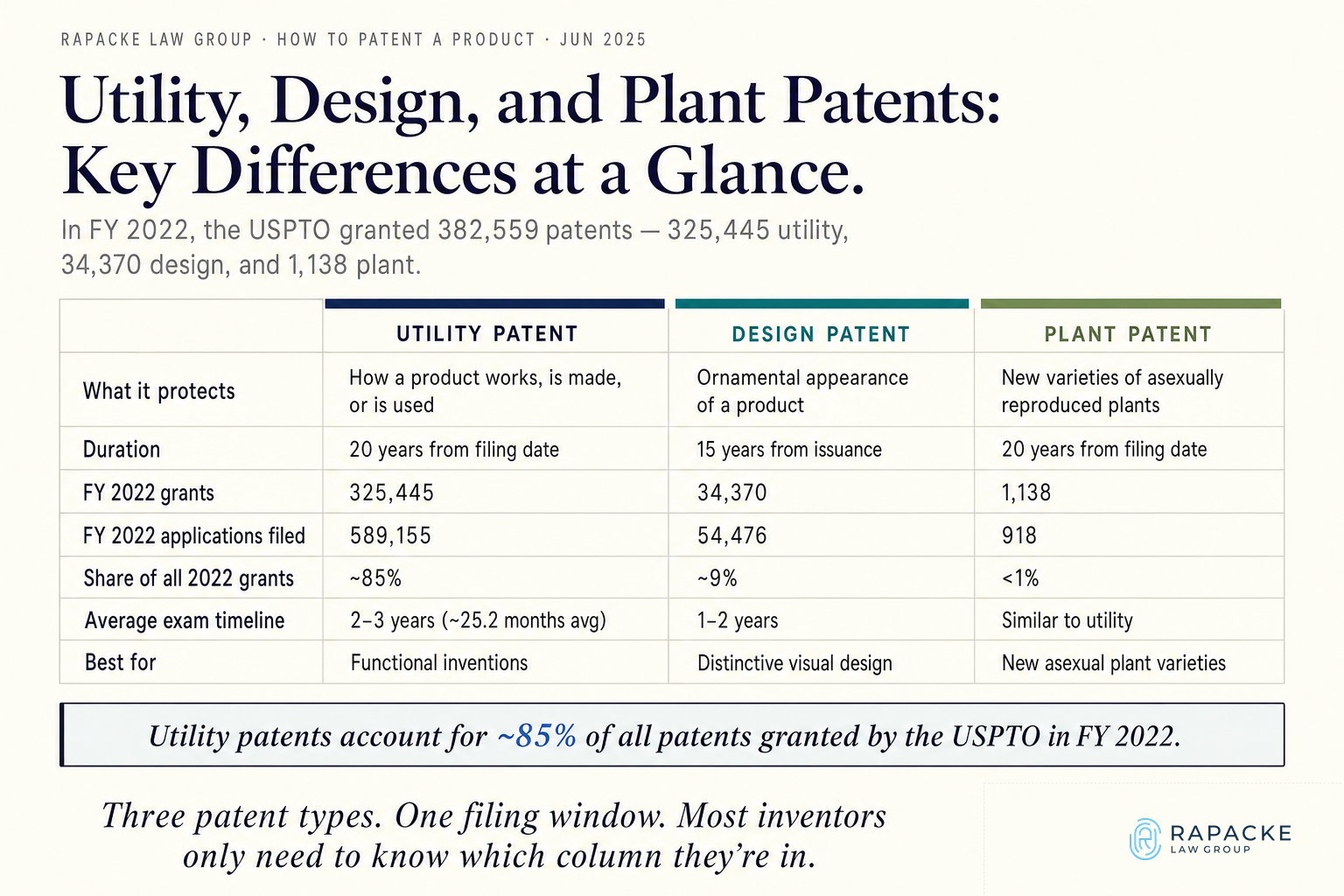 Utility, Design, and Plant Patents: Key Differences at a Glance — Source: USPTO / Lexology FY 2022 Patent Statistics; howlongfor.com
What a Patent Grants You
A patent is a legal grant of exclusive rights from the U.S. government that stops others from making, using, selling, or importing your invention without permission. In fiscal year 2022, the USPTO granted 382,559 patents, including 325,445 utility patents, 34,370 design patents, and 1,138 plant patents, according to Lexology. A utility patent term is 20 years from its filing date but begins running at issuance, and a design patent lasts 15 years from issuance. For a deeper look at what those rights of patent let you do, exclusivity is the core asset. A patent is a time-limited exclusive right, not permanent ownership of an idea.
What Can and Cannot Be Patented
Patentable subject matter covers any new and useful process, machine, manufacture, or composition of matter under 35 U.S.C. 101. Natural discoveries, abstract ideas, and laws of nature are excluded, a line the Supreme Court has reinforced across cases such as Mayo Collaborative Services v. Prometheus, Association for Molecular Pathology v. Myriad Genetics, and Alice Corp. v. CLS Bank. If you are unsure whether a similar product blocks you, learn how to patent something that already exists by using prior art strategically. Confirm your product falls into a patentable category before spending money.
Why Patents Matter for Inventors and Small Businesses
Patents attract investors, support licensing deals, and create defensible intellectual property rights. Patent pending status alone can discourage competitors. Founders often overlook the wider benefits of patent protection, from premium pricing to competitive moats, and may also benefit from seeking legal help early. Treat a patent as a business asset, not just a legal formality.
How to Know Whether Your Product Qualifies for a Patent
The Three Core Patentability Requirements
Your product must meet the legal requirements of being novel, non-obvious, and useful. Novelty means it is not already found in the prior art. Non-obviousness means it is an inventive step beyond an obvious tweak of what exists. Utility means it works and has a real use. Obviousness, rooted in the inventive concept behind your product, is the toughest bar. Even a small refinement can qualify, which is why improvement patents are a common path. Run each requirement as a checklist against your product before filing.
What Counts as Prior Art
Prior art includes existing patents, published applications, academic papers, products on the market, and public disclosures. The U.S. patent system operates under a first-to-file system, so timing controls priority. There is a one year grace period for your own disclosures under 35 U.S.C. 102. If you have already disclosed your product publicly, you may have less than a year to file before you lose patent rights.
The Role of a Prior Art Search
A patent search using Google Patents, USPTO Patent Public Search, or Patent Center helps you find existing patents and other patents early. You can also search pending patent applications to see whether your new invention is already claimed. A professional prior art search surfaces obstacles before you invest in a full application. Run a preliminary patent search yourself first, then consider a professional search before filing.
Utility Patent vs. Design Patent Choosing the Right Protection
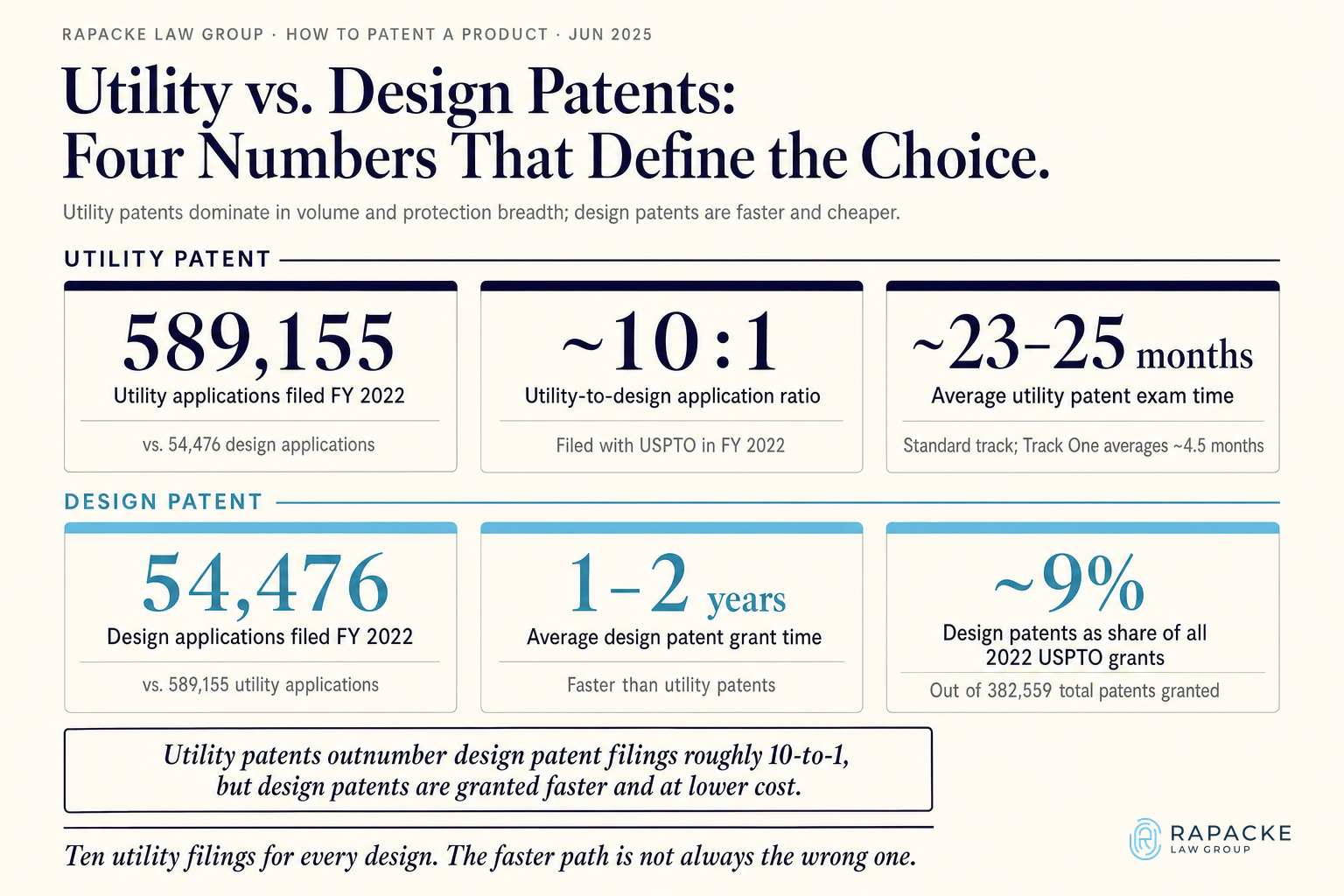 Utility vs. Design Patents: Four Numbers That Define the Choice — Source: USPTO / Lexology FY 2022 Patent Statistics; howlongfor.com
When a Utility Patent Is the Right Choice
Utility patents protect the functional aspects of an invention, how it works, how it is made, or how it is used. In fiscal year 2022, inventors filed 589,155 utility applications versus 54,476 design applications, a ratio near 10 to 1, according to Lexology. Utility patents carry broader, more durable protection. If your advantage is what your product does, file for a utility patent.
When a Design Patent Makes More Sense
Design patents protect the ornamental appearance of a product, not its function. They are faster and cheaper to obtain, with design patents averaging approximately 21.5 months total pendency compared with approximately 26.3 months for utility patents, according to USPTO data. Design patents made up only about nine percent of U.S. patents granted in 2022. If your product's shape or visual design is what competitors would copy, a design patent is worth filing.
Can You File Both?
Yes. Utility and design patents can protect the same product, one covering function and one covering appearance. Some inventors also layer in trade secrets protection for internal features, which raises the classic proprietary vs patented decision, while trademark registration covers brand identity separately. Consider a combined IP strategy from the start.
Why a Provisional Patent Application Changes Your Timeline
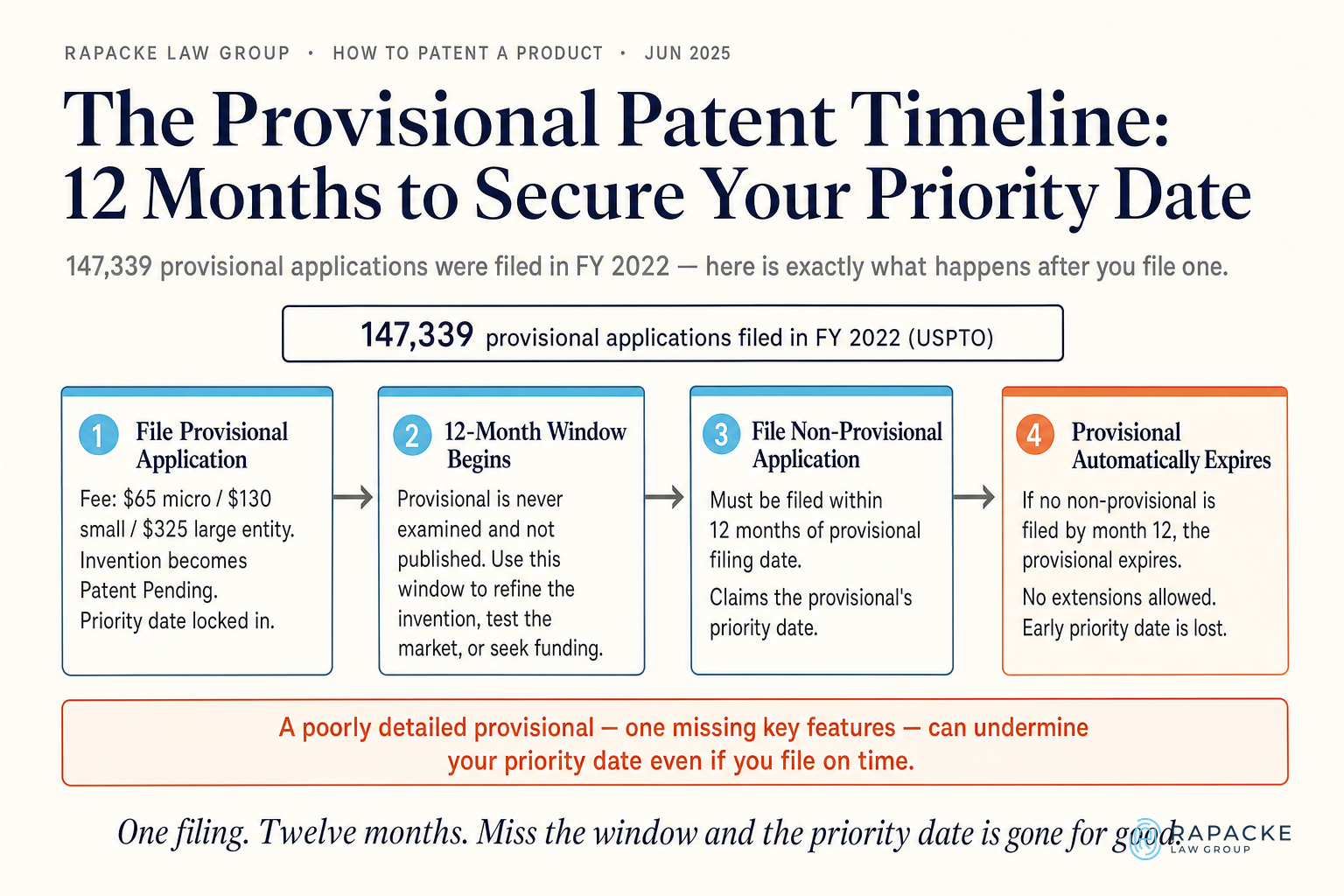 The Provisional Patent Timeline: 12 Months to Secure Your Priority Date — Source: USPTO Fee Schedule 2025; Lexology FY 2022 Patent Statistics
What a Provisional Patent Application Actually Does
A provisional patent application establishes a filing date without full claims, buying 12 months of patent pending status while you refine the product, build a prototype, or raise funding. The filing fee is only $65 for a micro entity, $130 for a small entity, and $325 for a large entity, per the USPTO fee schedule. U.S. inventors filed 147,339 provisional applications in fiscal year 2022. You do not even need a working model, since you can patent an idea without a prototype as long as your description enables the invention. File a provisional application before any public disclosure to lock in your priority date.
What Must Be Included in a Provisional
A provisional has fewer formal requirements, but the written description must fully support whatever claims appear later. A thin provisional that omits key features can destroy the priority benefit. Include clear drawings, a full description of the invention, and how the product works. Write the provisional as if it were the final application.
The 12-Month Window and What to Do With It
After filing, you have 12 months to file a corresponding non-provisional patent application or a PCT international application. Use the window to build a prototype, test demand, and consult a patent attorney. The provisional automatically abandons if no nonprovisional is filed in time, with no extensions. Mark the 12-month deadline the day you file.
How to Conduct a Patent Search Before You File
Using USPTO and Google Patents Tools
Start with free tools, USPTO Patent Public Search, Patent Center, and Google Patents. Boolean search combines keywords with "and," "or," and "not" to narrow results. WIPO reports millions of patent documents in force globally across 142 jurisdictions, and the United States Patent Office received 646,855 applications in fiscal year 2022, according to WIPO. Start with Google Patents, then move to USPTO Patent Public Search for comprehensive coverage.
What to Look for in Search Results
Learn to read a patent. The claims define the legal protection, the specification describes the invention, and the drawings give visual reference. Independent claims stand alone, while dependent claims add limitations. Finding a similar patent does not automatically bar your application if your inventive differences are meaningful. Studying real software patent examples shows how claim language shapes scope. Focus your patent search on the claims section, not the abstract or title.
When to Hire a Patent Attorney for the Search
A registered patent attorney can run a formal freedom to operate analysis and provide an opinion of counsel, which matters most before manufacturing or fundraising. An experienced patent lawyer or practitioner interprets prior art differently than a raw database search does. Consider professional search services with patent lawyers before you raise capital or launch production.
How to Prepare and File Your Patent Application
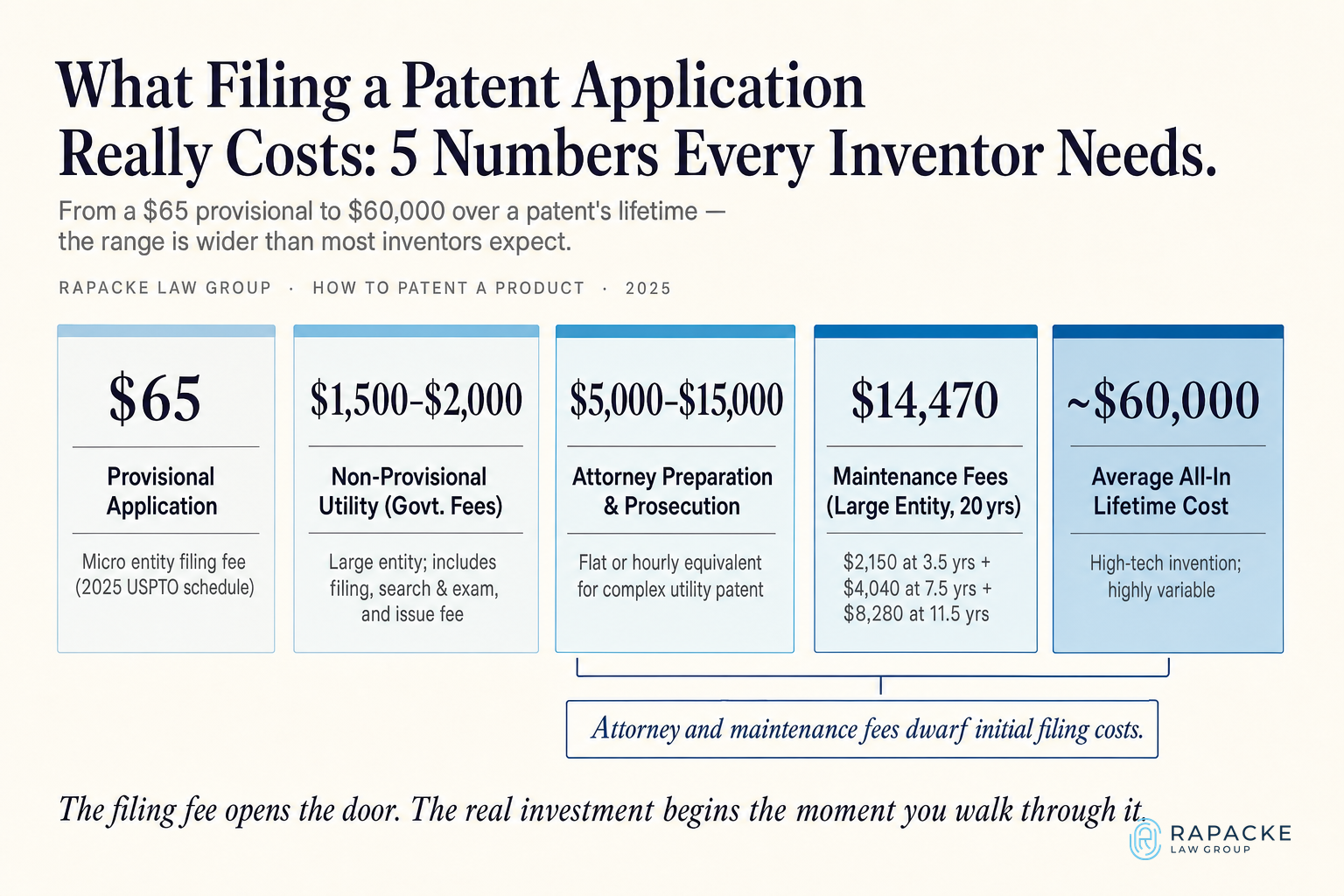 What Filing a Patent Application Really Costs: 5 Numbers Every Inventor Needs — Source: USPTO Fee Schedule 2025; legalclarity.org; blueironip.com
The Core Components of a Nonprovisional Patent Application
A complete nonprovisional application includes a written specification, patent claims, an abstract, and drawings. The claims are the most legally significant part because they define the scope of protection. The USPTO base filing fee covers up to 3 independent claims and 20 total claims, after which excess claim fees apply, per the USPTO fee schedule. Draft claims as broad as the prior art allows.
Filing Through the USPTO Electronic Filing System
Filing electronically through Patent Center is standard for the application process. A paper filing of a utility application at the u.s. patent office triggers a non-electronic filing surcharge. You will select forms, pay filing fees by entity size, and receive a filing receipt. Save the official filing receipt, because that date is your legal priority date.
Working With a Patent Attorney on the Application
Most inventors work with registered patent attorneys to draft the application, especially the claims. Poorly drafted claims can leave a patented invention weak or force significant narrowing during prosecution. Flat-fee firms, including Rapacke Law Group, offer predictable pricing. If budget allows, invest in professional legal services for claim drafting.
What Happens After You File The USPTO Examination Process
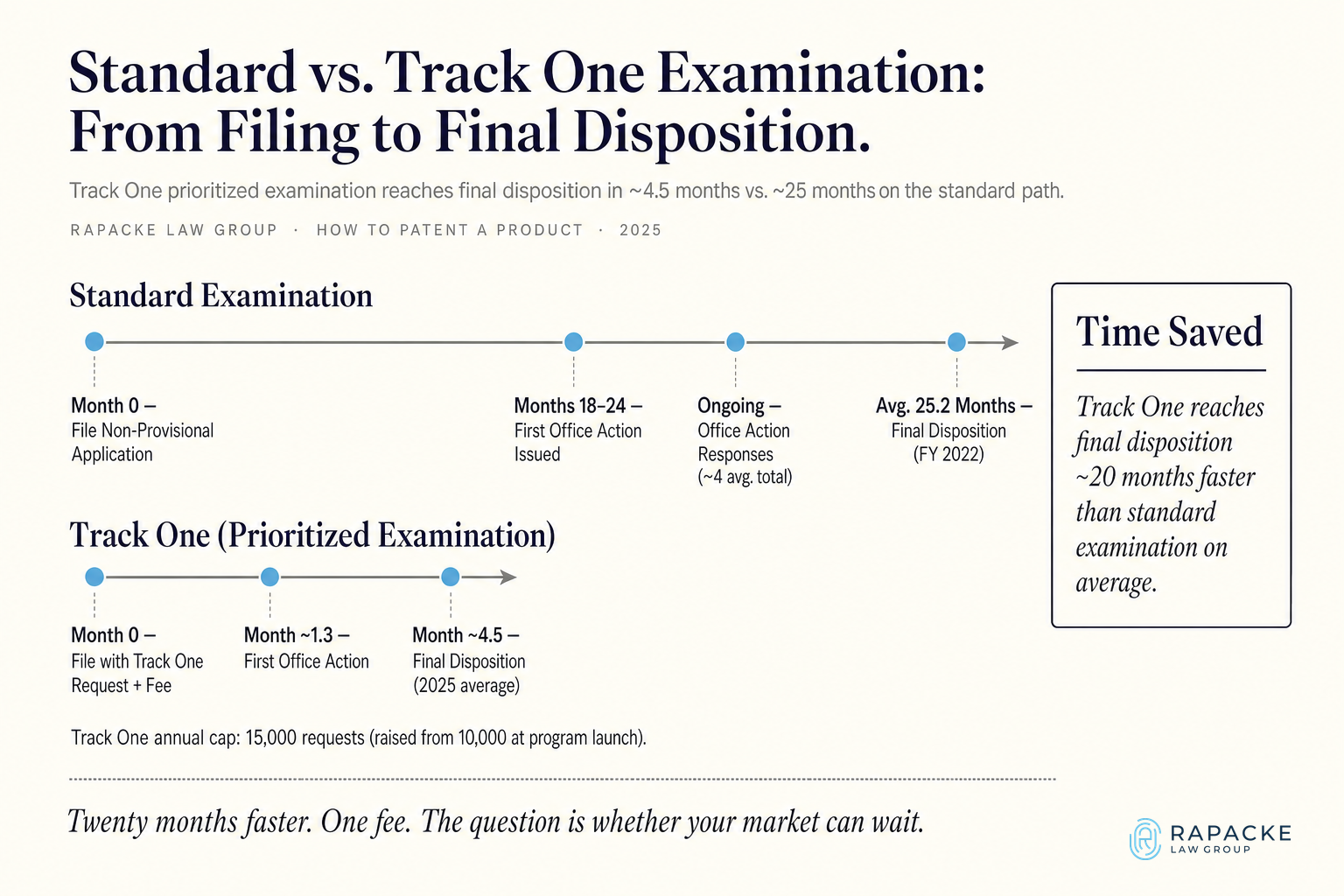 Standard vs. Track One Examination: From Filing to Final Disposition — Source: Lexology / USPTO FY 2022; saegusa-pat.co.jp (Track One 2025); blueironip.com
How Long the Patent Process Takes
Average total pendency for a utility patent was 25.2 months in fiscal year 2022, according to Lexology, so plan for roughly two to three years. Track One prioritized examination is faster, reaching a first office action within a few months of filing. Plan your business timeline around a two to three year window unless you pay for expedited examination.
Understanding Office Actions
An office action is a written response from the patent examiner citing objections or rejections based on prior art, claim scope, or formalities. Most applications receive at least one. A restriction requirement asks you to elect among inventions, a non-final rejection opens the argument, and a final rejection tightens your options. An office action is not a denial. It is the start of a negotiation over claim scope.
Responding to Office Actions
You must respond within the USPTO deadline, usually three months and extendable to six for a fee. Responses may include claim amendments, arguments, or both. Skilled patent prosecution here prevents unnecessary claim narrowing. Miss the deadline and the application becomes abandoned, though an unintentionally abandoned application can sometimes be revived by the patent owner by petition under 37 C.F.R. § 1.137 on payment of a fee. Never let an office action deadline pass, because revival is not guaranteed.
International Patent Protection and the Patent Cooperation Treaty
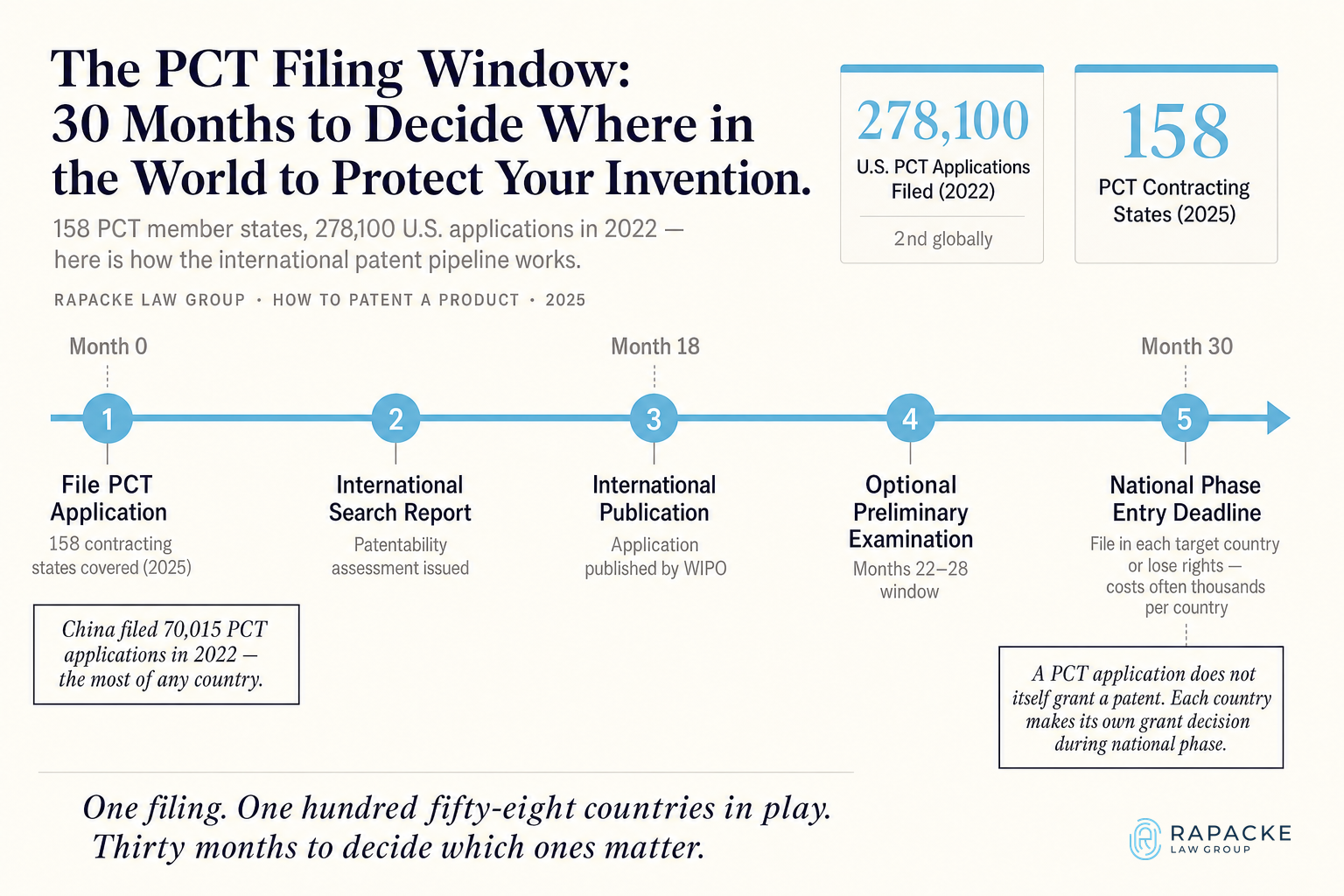 The PCT Filing Window: 30 Months to Decide Where in the World to Protect Your Invention — Source: www.ciplawyer.cn (2022 PCT filing data); www.wipo.int (PCT contracting states, 2025)
Why U.S. Patent Protection Has Geographic Limits
A United States patent only protects against infringement inside the U.S. If competitors manufacture or sell abroad, you need separate filings. WIPO data shows the U.S. among the top origins of international applications, second only to China in 2022, as summarized by CIP Lawyer. If your product will sell internationally, factor foreign filing into your strategy from day one.
How the Patent Cooperation Treaty Works
The Patent Cooperation Treaty lets you file one application that establishes a priority date across member countries. National phase entry is generally due 30 months from the priority date in most designated states, though some offices, such as the European Patent Office, allow entry up to 31 months and certain jurisdictions permit late entry or restoration of rights in limited circumstances, giving you time to evaluate which markets justify the cost. The PCT covered 158 contracting states as of 2025, according to WIPO. Use a PCT application to preserve your international options without committing to individual countries immediately.
Cost and Strategic Considerations for International Filing
A PCT application defers cost, but direct national filings and potential patent litigation abroad can run thousands of dollars per country. European Patent Office filings and Madrid Protocol trademark filings should be coordinated under one IP strategy. Many startups file in the U.S. first, then expand after product-market fit. Discuss international IP strategy with a patent attorney before the 30-month window closes.
What Patent Protection Costs and How to Budget for It
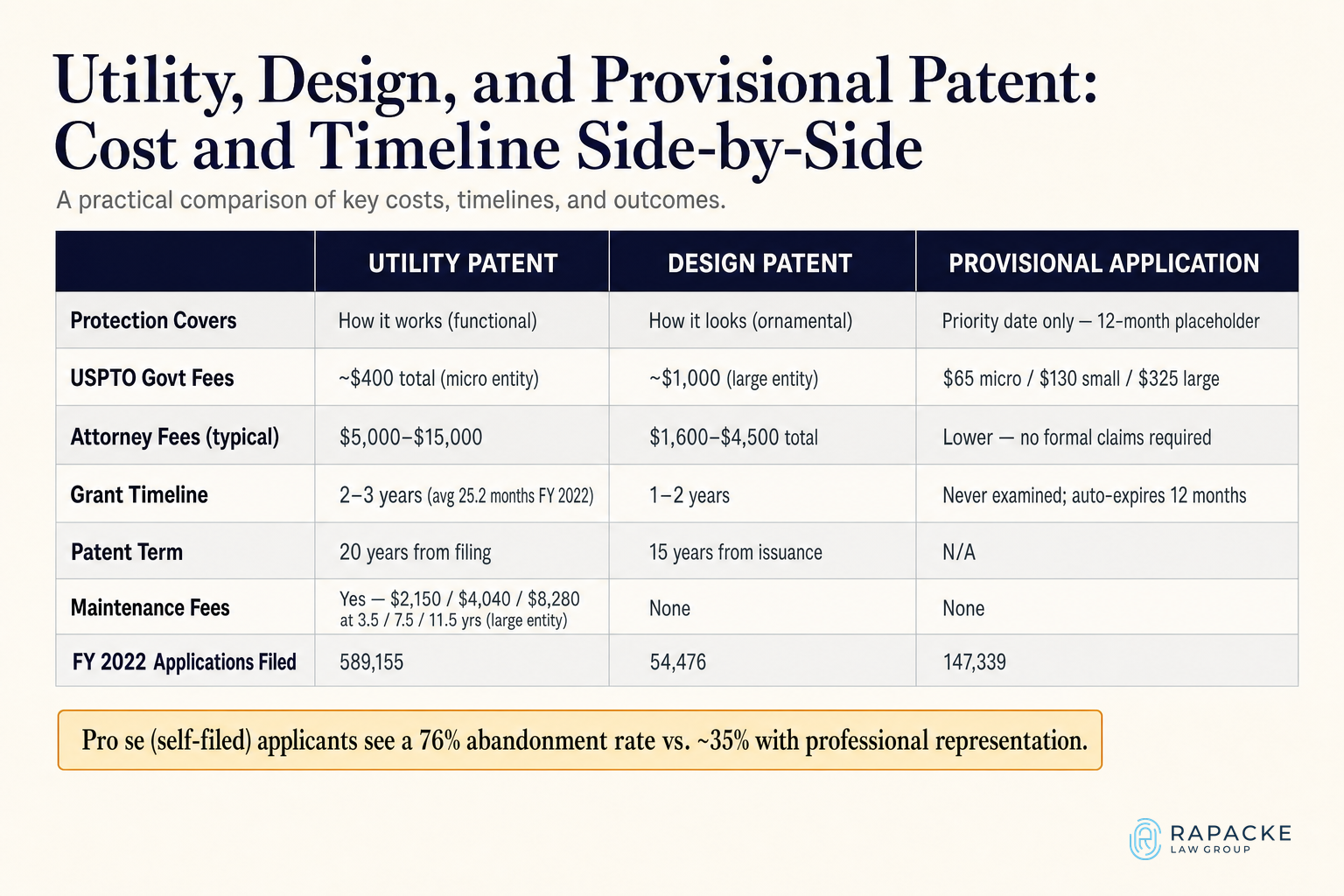 Utility, Design, and Provisional Patent: Cost and Timeline Side-by-Side — Source: USPTO Fee Schedule 2025; USPTO FY 2022 Performance Data via Lexology; legalclarity.org; howlongfor.com; PMC/NCBI
USPTO Filing Fees by Application Type and Entity Size
Government fees scale with entity size. A large-entity utility application combines a base filing fee plus search and examination fees, totaling roughly $1,500 to $2,000, while a micro entity pays far less after the 80 percent reduction, per Legal Clarity. A granted utility patent also owes an issue fee at allowance and maintenance fees at 3.5, 7.5, and 11.5 years, which climb into the thousands, per the USPTO fee schedule. Budget for the full lifecycle, not just the filing fee.
Patent Attorney Fees What to Expect
Attorney fees usually exceed government fees. Preparing and prosecuting a complex utility patent typically costs $8,000 to $15,000 or more, while design patents commonly run $1,600 to $4,500 all in, per Legal Clarity. Flat-fee structures give you cost predictability. Get a flat-fee engagement letter upfront to confirm the scope of legal representation.
Can You Patent a Product Yourself?
The USPTO allows pro se filing, but the risks are real. Claim drafting errors, missed office action deadlines, and prosecution missteps can permanently narrow or kill intellectual property protection. One study found 76 percent of self-filed applications were abandoned, per NIH PMC. For a fuller walkthrough of what it means to own a patented product, see our complete guide on how to patent my product. You can file yourself, but savings often disappear into weaker claims or costly errors.
Frequently Asked Questions
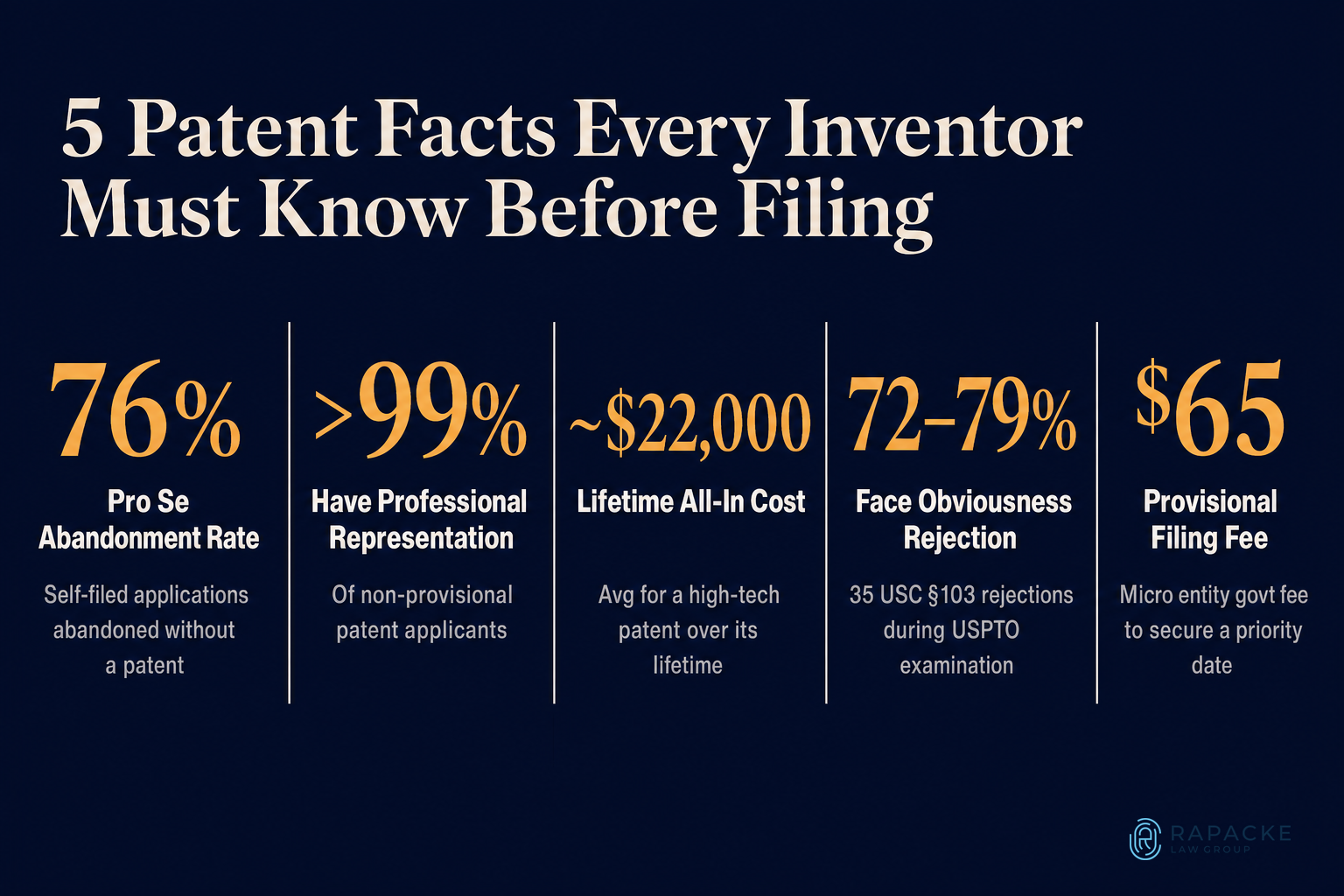 5 Patent Facts Every Inventor Must Know Before Filing — Source: PMC/NCBI; patents.stackexchange.com; blueironip.com; mriplaw.com; USPTO Fee Schedule 2025
How much would it cost to patent a product?
For a utility patent, USPTO fees for a small entity run roughly $800 to $1,500, and professional drafting adds $8,000 to $15,000 or more, per Legal Clarity. Maintenance fees add several thousand over 20 years, design patents cost far less.
Can you patent a product yourself?
Yes. The risk sits in the claims, where poor drafting causes rejections that are hard to overcome.
Can you still do a poor man's patent?
The poor man's patent, mailing yourself a sealed description, has no legal standing under U.S. patent law, according to McLane Middleton. Since the U.S. moved to first-to-file in 2013, only a filed application establishes priority. A provisional application is the affordable, legally valid alternative; for more information, consult the USPTO fee schedule or a registered patent attorney.
How much does it cost to patent an item?
A provisional filing fee starts near $65 to $325 depending on entity size. Check the current USPTO fee schedule for exact figures.
Can you patent a yeast?
A naturally occurring yeast strain cannot be patented, but a genetically engineered or selectively bred strain with novel, non-obvious traits can. The Supreme Court in Diamond v. Chakrabarty held that a human-made microorganism is patentable subject matter, per Justia.
Your Next Step in the Patent Process
Every day your product is public without patent protection is a day a competitor can freely copy it. The path forward is clear, confirm your product is patentable, choose between a utility patent and a design patent, file a provisional application to secure your priority date, run a thorough patent search, draft a nonprovisional application with strong claims, and respond to office actions strategically.
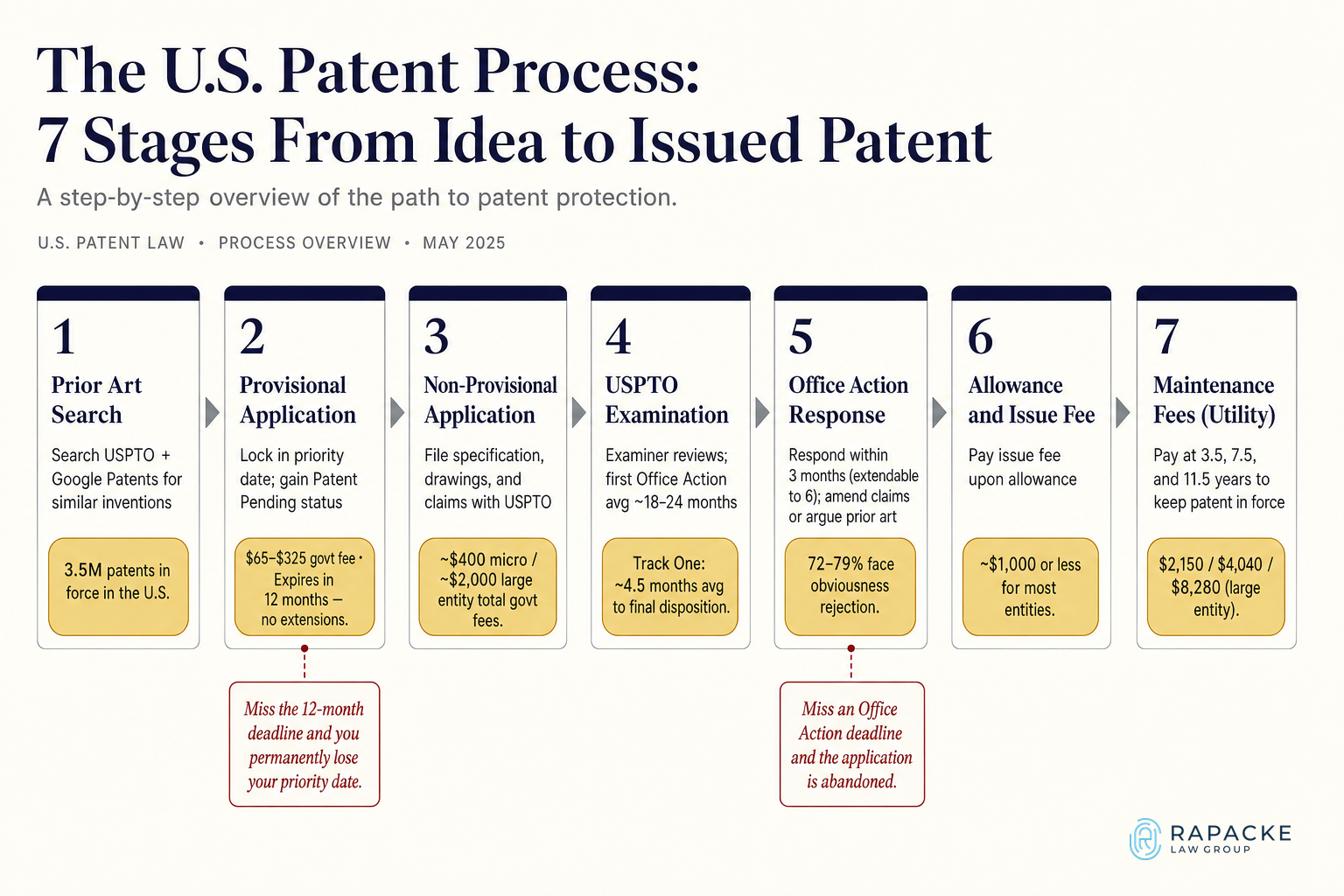 The U.S. Patent Process: 7 Stages From Idea to Issued Patent — Source: USPTO Fee Schedule 2025; USPTO FY 2022 Data via Lexology; mriplaw.com; saegusa-pat.co.jp; wipo.int
A weak patent with poorly drafted claims collapses the moment a competitor designs around it, while a strong patent built on a solid prior art search and broad, defensible claims becomes a real business asset that blocks copycats and attracts funding. The difference is almost always in the claims and the preparation behind them.
Tech-forward inventors will find our AI Patent Mastery resource useful, and software builders should review the Must-Have SaaS Patent Guide 2.0 for SaaS-specific filing strategy.
Your action items are simple. First, Schedule a Free IP Strategy Call with Rapacke Law Group. Second, gather your prior art and a plain description of what makes your product different. Third, decide whether to lock in a priority date with a provisional now. Through the RLG Guarantee, every engagement is backed by our commitment to transparent, flat-fee pricing with no hidden costs. Our patentability searches come with a 100 percent refund if the search finds your invention is not novel. Our provisional patent application filings are backed by a full refund if the USPTO denies the filing. All services are delivered under one transparent flat fee, so you always know exactly what you are paying before we begin.
A registered patent attorney will review your invention, provide patent information, identify the right patent strategy, and give you fixed-fee pricing. A modest investment now can secure a 20-year competitive advantage worth far more.
To Your Success,
Andrew Rapacke
Managing Partner, Registered Patent Attorney
Rapacke Law Group