

Key Takeaways
- Many AI-related § 101 rejections turn on the "abstract idea" exception, so your claim must show a specific technical improvement, not just a useful result produced by machine learning.
- After *Recentive Analytics v. Fox Corp.* (Fed. Cir. 2025), applying a generic machine learning technique to a new data environment without improving the AI technology itself is patent ineligible.
- Only a natural person can be a named inventor. The USPTO's February 2024 inventorship guidance requires a human to make a significant contribution to the conception of at least one claim.
- Structural specificity beats functional language. Claim the architecture, training methodology, and data pipeline, not just the result the AI produces.
- There is no "30% rule" in patent law. Inventorship is qualitative under the *Pannu* factors, not a percentage of human work.
*Written by Andrew Rapacke, Managing Partner, Registered Patent Attorney.* Andrew Rapacke is a registered patent attorney and the Managing Partner of The Rapacke Law Group, a full-service intellectual property law firm serving clients before the united states patent office and related tribunals. He helps individuals and corporations across industries with the protection, prosecution, licensing, and enforcement of their intellectual property, with deep experience in patent, trademark, and copyright matters spanning software, AI and machine learning, blockchain, medical devices, and autonomous vehicle technology, including neural networks and related inventions. A graduate of the United States Naval Academy, Andrew served as a Naval Engineering Officer before pursuing law and remains active in the startup and human inventors communities throughout Florida.
Before an examiner ever looks at whether your AI invention is new or non-obvious, it has to clear an earlier gate, and that gate rejects a large share of software and AI filings. The USPTO's Office of the Chief Economist found that, for Alice-affected technologies, the likelihood of a first-action rejection under 35 U.S.C. § 101 dropped by 25% after the agency's 2019 guidance, and uncertainty in eligibility determinations fell by 44%. Section 101 defines patent-eligible subject matter, and it is the reality of patent eligibility for AI inventions today. AI sits at an awkward intersection between abstract mathematical processes, which are not patentable, and specific technical applications, which are. A founder who does not understand that line can spend months and thousands of dollars on an application headed for rejection, jeopardizing patent subject matter eligibility before examination of the merits even begins.
Why So Many AI Patent Applications Get Rejected at the First Hurdle
The § 101 problem is measurable, not theoretical. According to the USPTO Office of the Chief Economist, one year after the 2019 guidance the likelihood of a first-action § 101 rejection in Alice-affected technologies had decreased by about 25%, and uncertainty in eligibility determinations decreased by 44%. Those numbers tell inventors two things. AI and software applications draw subject matter eligibility rejections at a high rate, and clearer claim drafting measurably moves the needle on patent subject matter eligibility outcomes. For a broader view of what the agency allows, see our breakdown of what the USPTO actually grants for AI in 2026.
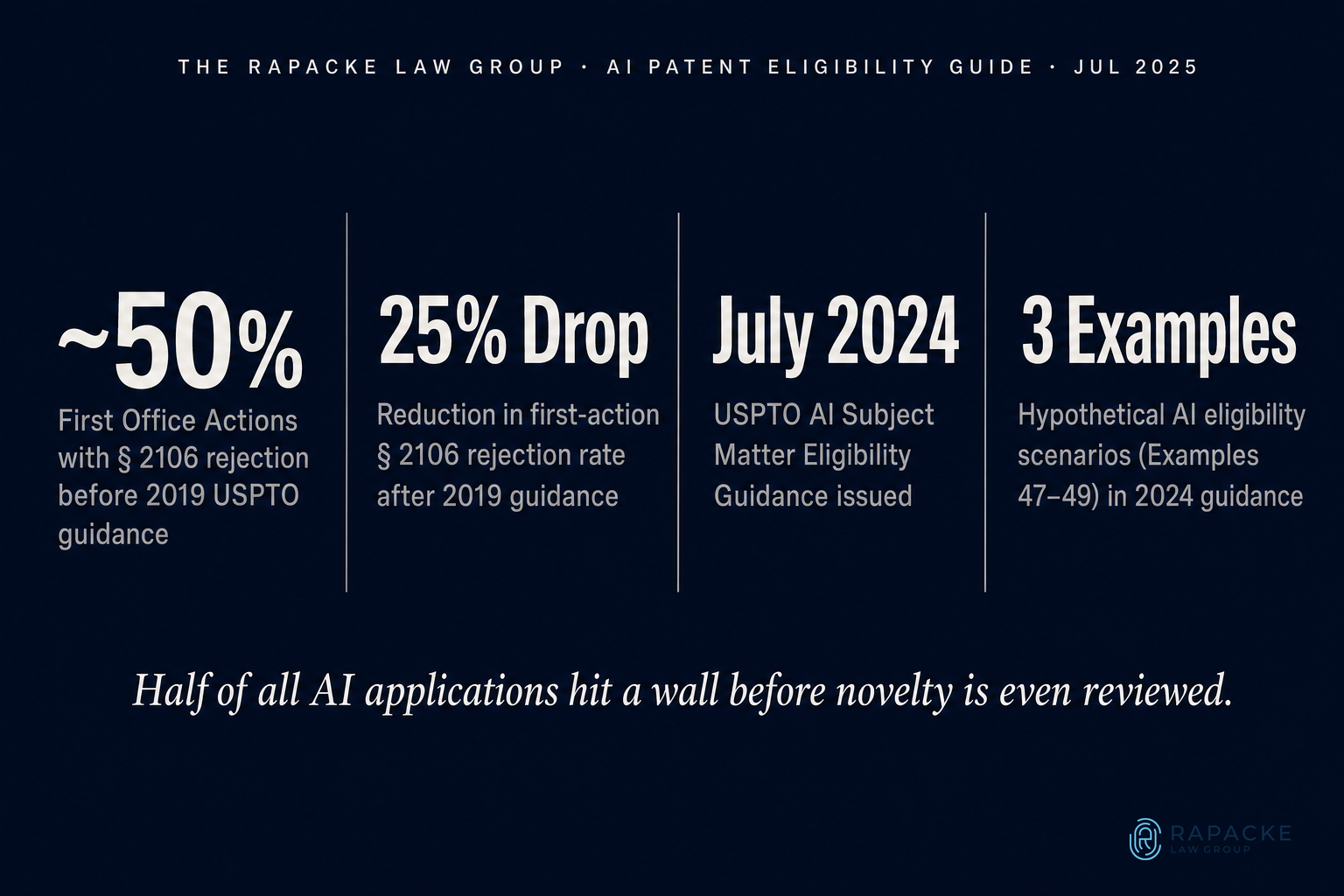 The § 2106 Rejection Problem: Key Numbers Every AI Patent Applicant Must Know — Source: USPTO Chief Economist Report, 2020; USPTO 2024 AI Subject Matter Eligibility Guidance
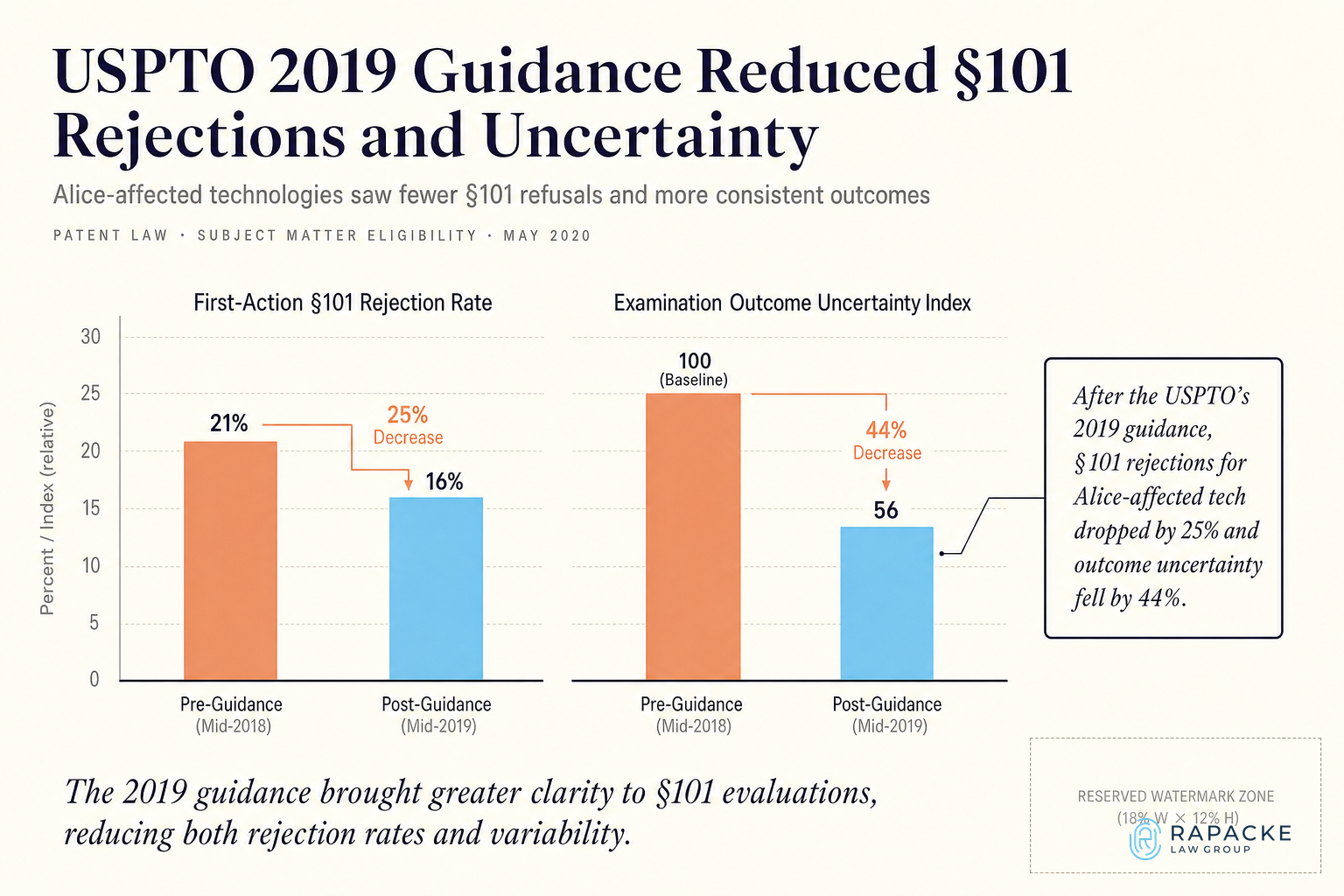 Bar chart comparing first-action Section 101 rejection rates before and after the USPTO’s 2019 guidance. For Alice-affected technologies, the first-action §101 rejection probability — Source: USPTO Office of Chief Economist, 2020
The core question an examiner asks never changes. Does the claimed invention do more than apply an abstract idea on a generic computer? A patent application that recites a mathematical algorithm or a data relationship, then instructs a computer to run it, almost always triggers a rejection. This is a threshold issue about subject matter, separate from novelty or non-obviousness.
For AI inventions, this framing matters because machine learning is, at its foundation, applied mathematics. An examiner who reads your claim as "use math to reach a result" will reach for the abstract idea exception. For a deeper primer, our ultimate cheat sheet for patents on artificial intelligence covers the full landscape.
The Legal Framework That Controls Patent Eligibility for AI Inventions
You cannot draft around a rule you do not understand. Most AI patent eligibility disputes center on one statute and two Supreme Court cases, though other statutes and Federal Circuit decisions also shape outcomes.
What 35 U.S.C. § 101 Actually Requires
Under 35 U.S.C. § 101, a patent may be granted for any new and useful process, machine, manufacture, or composition of matter. The Supreme Court carved out three judicial exceptions, laws of nature, natural phenomena, and abstract ideas. Most AI rejections hinge on the abstract idea exception, which encompasses abstract ideas spanning mathematical concepts, mental processes, and certain methods of organizing human activity. This § 101 question is distinct from novelty under § 102 and obviousness under § 103. Section 101 is a threshold about the type of subject matter, not the quality of the invention, so protecting your intellectual property in AI and all related inventions starts here.
The controlling authority is Alice Corp. v. CLS Bank International, 573 U.S. 208 (2014), which built on Mayo Collaborative Services v. Prometheus Laboratories, 566 U.S. 66 (2012). As the Cornell Legal Information Institute records, the Alice Court held that "the mere recitation of a generic computer cannot transform a patent-ineligible abstract idea into a patent-eligible invention." A claim that recites a mathematical algorithm fails § 101 no matter how novel the underlying AI model is.
The Alice/Mayo Two-Step Test Explained for AI
The Alice/Mayo framework runs in two steps and applies to all patent act claims touching software and AI. Step 1 asks whether the claim is directed to a judicial exception such as an abstract idea. Step 2, which the USPTO breaks into Prong Two of Step 2A and Step 2B, asks whether the claim integrates that exception into a practical application or adds an inventive concept beyond well-understood, routine activity.
Claiming "use a neural network to predict outcomes" is like claiming "use math to solve a problem." The neural network is the abstract tool, not the patentable solution. Contrast that with Enfish, LLC v. Microsoft Corp., 822 F.3d 1327 (Fed. Cir. 2016), where claims to a self-referential database table were held eligible at Step 1 because they were directed to a specific improvement in computer capabilities. Map every claim element against the two steps before filing. Our guide to the conditions of patentability for AI explains how § 101 fits with the other requirements.
How Abstract Idea Gets Applied to Machine Learning Claims
Two subcategories of abstract ideas matter most for AI, mental processes performable by the human mind and mathematical concepts. A machine learning model that finds patterns in training data and produces a mathematical output encoding mathematical relationships is a strong candidate for an abstract idea rejection. The escape route is showing a specific technical improvement in computer functionality, not just a useful result. In Thales Visionix Inc. v. United States (Fed. Cir. 2017), claims tied to a specific configuration of inertial sensors survived because they improved a physical tracking system. Generic language such as "train a model" or "apply an algorithm," without a defined specific problem and solution, almost always draws a rejection. The same abstract idea trap catches other fields, as our review of common patent eligibility rejections for medical device inventions shows.
What the USPTO's 2024 Guidance Changed for AI-Related Inventions
The legal test has been stable since Alice, but in July 2024 the USPTO issued a subject matter eligibility guidance update focused on AI inventions. It does not change the law. It changes how examiners apply the existing test, and that shift matters for both pending and new applications.
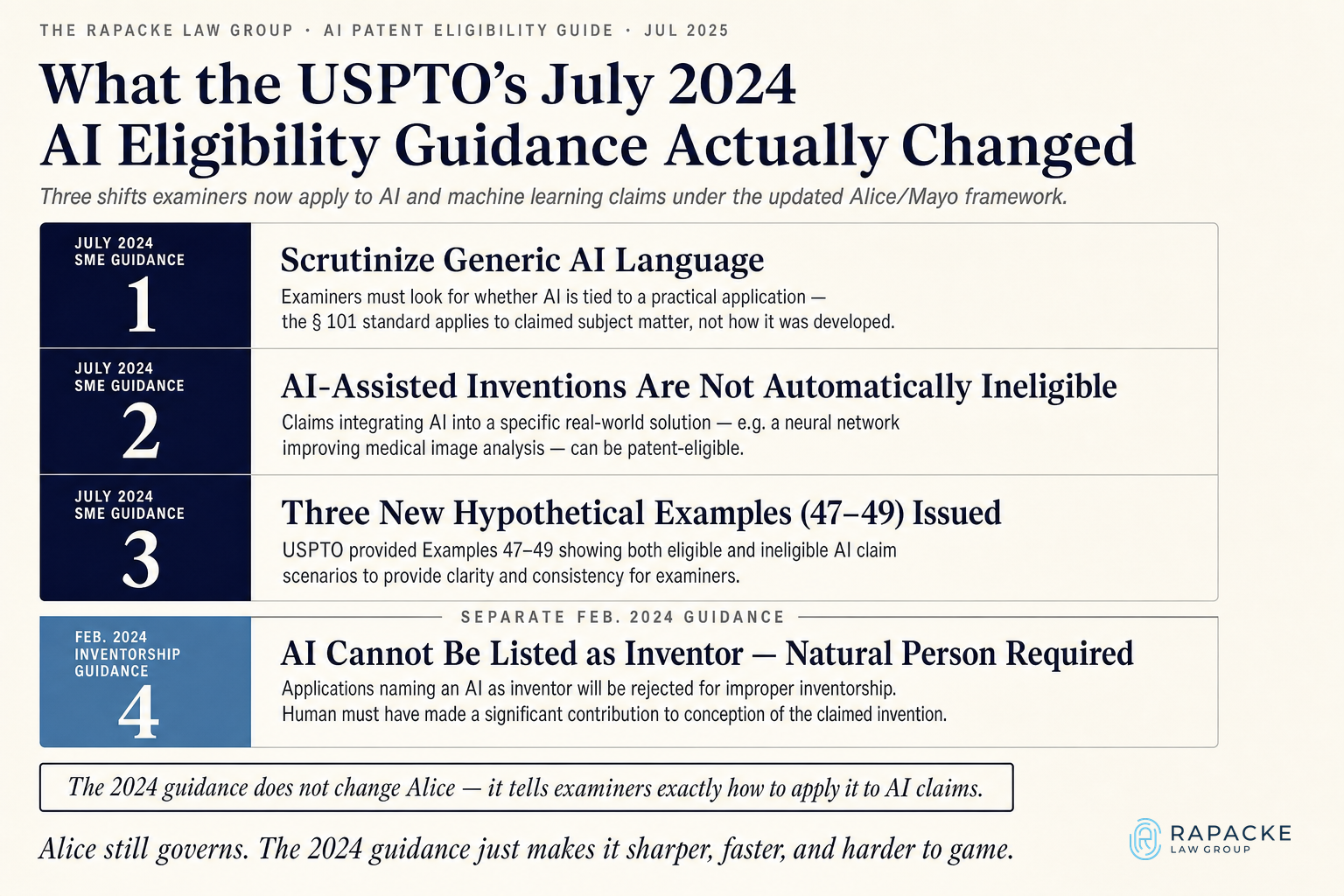 What the USPTO's July 2024 AI Eligibility Guidance Actually Changed — Source: USPTO 2024 AI Subject Matter Eligibility Guidance, July 2024; USPTO Inventorship Guidance for AI-Assisted Inventions, February 2024
The Core Shift in How Examiners Evaluate AI Claims
The 2024 USPTO guidance instructs examiners to scrutinize claims that recite a general-purpose AI or machine learning model without structural specificity. Examiners now look at whether the claim as a whole integrates the AI system into a practical application that delivers a concrete benefit beyond abstract ideas like the abstract process itself. The guidance added three new hypothetical examples, numbered 47 through 49, to assist examiners evaluating AI-assisted inventions. The message is blunt, an invention does not get a free pass just because it involves artificial intelligence. Applications filed or amended after 2024 should tie AI system components to specific technical outcomes in the claims, not only in the specification.
AI-Assisted Inventions Versus AI-Generated Inventions
The guidance separates two scenarios. In the first, a human uses AI as a tool to develop an invention they conceived, that is eligible if the human made a significant contribution. In the second, an AI system autonomously generates an invention with no meaningful human creative contribution, that is not patentable in the United States today. The Federal Circuit settled the point in Thaler v. Vidal, 43 F.4th 1207 (Fed. Cir. 2022), holding that under the Patent Act only natural persons, not AI systems, can be named inventors. As Ars Technica reported, the USPTO confirmed that AI systems cannot hold patents in the United States. Document every stage of human decision-making. This distinction becomes especially important for autonomous systems, which we cover in our analysis of whether AI agents are patentable.
What Significant Contribution by a Human Inventor Actually Means
The 2024 guidance evaluates human contribution using the Pannu factors from Pannu v. Iolab Corp., 155 F.3d 1344 (Fed. Cir. 1998). A named inventor must contribute to conception of a particular solution, the contribution must not be insignificant in quality, and it cannot be merely explaining well-known prior art. As legal analysts noted in coverage on JD Supra, even prompt engineering can rise to inventorship when a specific prompt, framed against a technical problem, was crucial to conceiving the solution. Merely asking an AI to generate options and picking one likely does not qualify. Keep a detailed invention log of each human's technical decisions.
The Five Eligibility Checkpoints for AI Patent Claims
Run every AI patent claim through these five checkpoints before you file.
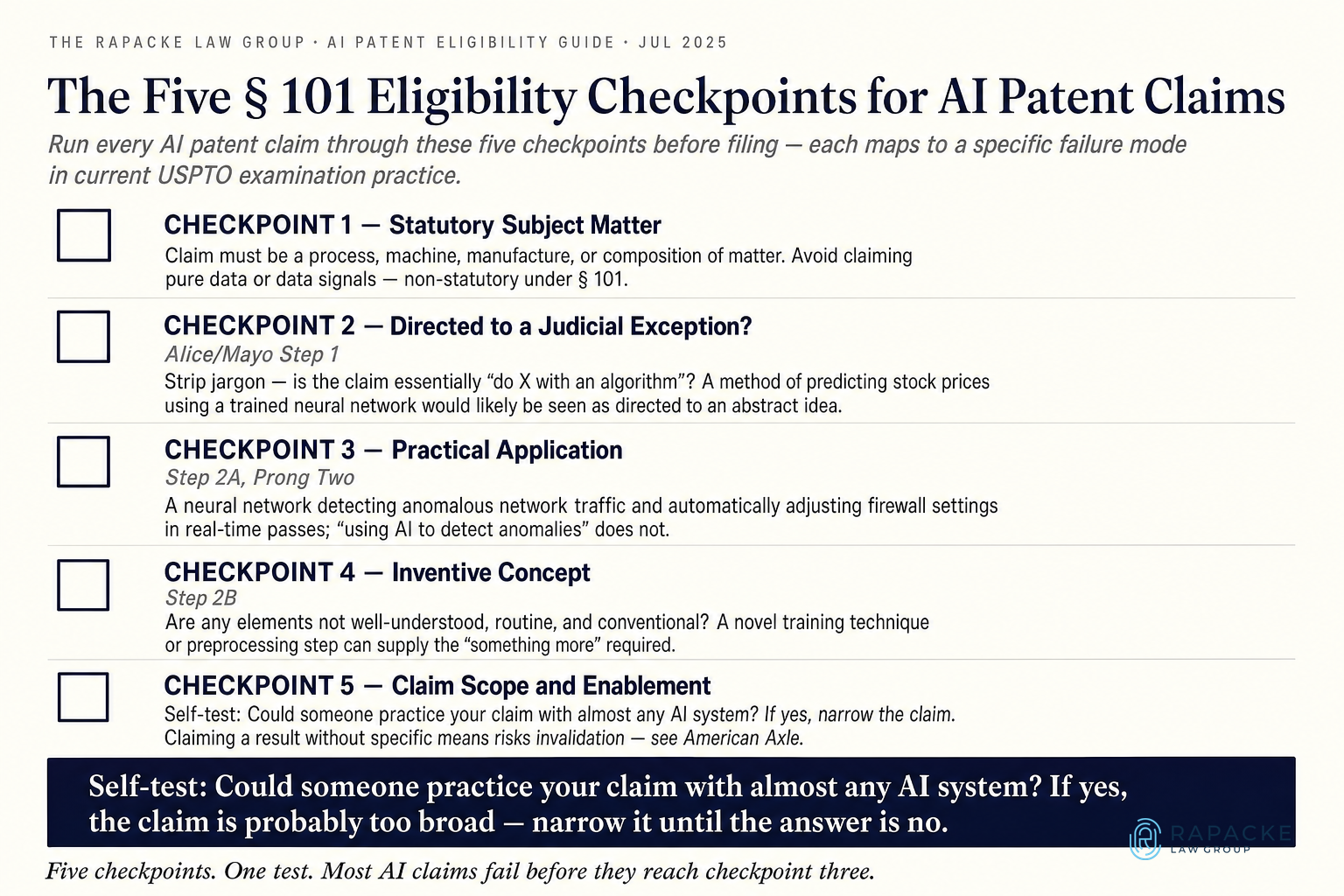 The Five § 101 Eligibility Checkpoints for AI Patent Claims — Source: Alice Corp. v. CLS Bank International, 573 U.S. 208 (2014); USPTO 2024 AI Subject Matter Eligibility Guidance; American Axle & Manufacturing v. Neapco Holdings (Fed. Cir.)
Checkpoints 1 Through 3 Cover Subject Matter, Practical Application, and Technical Improvement
Checkpoint 1, statutory subject matter. Is the claim directed to a process, machine, manufacture, or composition of matter? Most AI inventions claim a method or system, so this is usually met. Confirm you are not claiming pure data or a signal, which are non-statutory.
Checkpoint 2, practical application. Does the claim integrate any abstract idea into a practical application? The claim must recite how the AI system reaches a real-world result. "A method for improving network security comprising training a neural network on packet data" fails. "A method for detecting anomalous network intrusions by applying a convolutional neural network to classify packet sequences against a learned baseline, wherein the classification triggers an automated firewall rule update" is far closer to passing.
Checkpoint 3, technical improvement. Does the claim reflect a specific improvement to the functioning of a computer or the AI technology itself, rather than a better business result? Enfish (self-referential table) and McRO, Inc. v. Bandai Namco Games America (specific rules for automated lip-sync animation) both passed § 101 on technical improvement grounds. Write claims around what the AI system does differently at a technical level.
Checkpoints 4 and 5 Cover Inventive Concept and Claim Scope
Checkpoint 4, inventive concept. Even if a claim clears Step 2A, it fails Step 2B if the only addition is generic computer implementation. In ChargePoint Inc. v. SemaConnect (Fed. Cir. 2019), adding internet connectivity to a known device was an abstract idea implemented conventionally, with no inventive concept.
Checkpoint 5, claim scope. Overbroad claims that try to capture every AI approach to a goal face double trouble, § 101 for abstractness and § 112 for lack of enablement. American Axle & Manufacturing v. Neapco Holdings invalidated claims that recited a desired result without specific means. Studying real software patent examples is a fast way to calibrate the right claim scope.
How to Draft AI Patent Claims That Actually Survive § 101
Drafting choices made before filing decide whether your application passes the Alice/Mayo two-step test or stalls in a rejection.
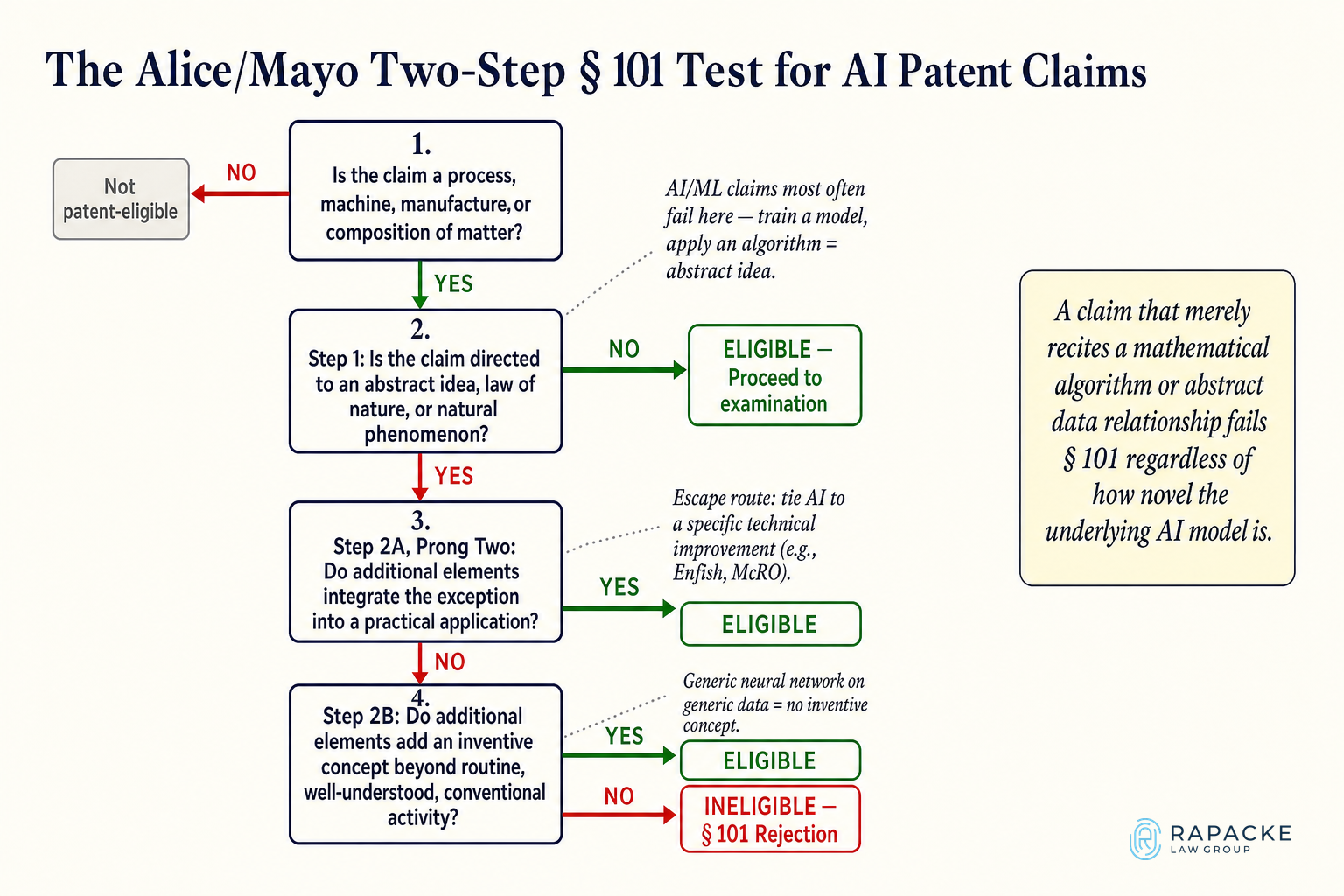 The Alice/Mayo Two-Step § 101 Test for AI Patent Claims — Source: Alice Corp. v. CLS Bank International, 573 U.S. 208 (2014); USPTO 2024 AI Subject Matter Eligibility Guidance
Lead With the Technical Problem, Not the AI Tool
The most common drafting mistake is opening claim language with the AI system, such as "A system comprising a machine learning model configured to," without anchoring the claim in a specific technical problem. Examiners read a claim as directed to whatever it emphasizes. Instead of "predict user preferences with an AI model," draft "a method for dynamically allocating server resources by detecting workload fluctuations, predicting resource needs using a model trained on historical usage, and reallocating resources in real time, thereby reducing latency." That format sets up a concrete technical problem and shows how the AI system solves it. Draft the specification first with an explicit section on the technical problem, then write claims that mirror it.
Use Structural Specificity, Not Functional Language Alone
Functional phrasing like "configured to" is not fatal, but it must be backed by structure in the claim or supported through means-plus-function claiming under 35 U.S.C. § 112(f). Describe the architecture of the neural network, the layer types, the training methodology, and the input-output transformations. Include at least one independent claim that recites specific structural elements of the AI system rather than relying entirely on functional description. This is the same discipline that decides whether an AI wrapper is patentable, where thin functional layers rarely survive.
Protect the Training Data Pipeline as a Separate Invention
Sophisticated AI patents protect multiple layers, the model architecture, the training methodology including how ai models process input data, the training data pipeline, and the deployment system. Each layer can support a separate claim or patent application covering these related inventions. Training data selection and preprocessing methods can be eligible subject matter when claimed as specific technical processes that measurably improve how ai models perform. File at multiple levels so a competitor who copies your training pipeline but not your architecture still faces infringement risk. This layered approach is central to the broader intellectual property strategy for AI makers.
Real-World Examples of AI Inventions That Passed and Failed § 101
Case outcomes turn abstract rules into recognizable patterns. The clearest recent line runs through the Federal Circuit.
Federal Circuit Cases That Set the Current Eligibility Bar
Recentive Analytics, Inc. v. Fox Corp., decided April 18, 2025, tightened eligibility for AI inventions. The court struck down claims related to those AI-assisted inventions that applied generic machine learning to optimize TV broadcast schedules. As reported by FindLaw's case record, the court held that patents doing no more than claiming the application of generic machine learning to new data environments, without disclosing improvements to the models themselves, are patent ineligible under § 101. The court added that features like iterative training and real-time data updates are inherent to machine learning and not inventive by themselves. Contrast that with Enfish and McRO, where the claimed technology improved the technical process itself. If your AI invention applies a known architecture to a new business problem, expect a § 101 rejection unless the claims show how the AI system operates differently. This is also why the question of whether software patents are enforceable turns heavily on eligibility.
Claim Structures That Have Earned Allowance
AI patents that survive § 101 tend to share three traits. They identify a specific technical deficiency in prior art AI systems, they claim a specific architectural modification or training methodology, and they tie the result to a measurable technical improvement such as faster inference or a lower false-positive rate. Generative AI inventions face the same analysis. A specific improvement to a transformer's attention mechanism is more defensible than a claim to using generative AI to produce content. OpenAI's own approach illustrates the point. Rather than patenting the whole system, Patentext's analysis shows OpenAI obtained a patent covering the specific way its model edits and refines text outputs. File two or three claim sets at different levels of specificity so a narrower claim can issue while you pursue broader ones.
Why Inventorship Documentation Is as Critical as Claim Drafting
A valid patent on an eligible invention can still be invalidated if inventorship is wrong.
The Natural Person Requirement and What It Means for AI-Assisted Teams
Under 35 U.S.C. § 100(f) and Thaler v. Vidal, every named inventor must be one of the natural persons who made a significant contribution to the conception of at least one claim. In AI-assisted development, several human inventors touch the process, engineers who design the model architecture, data scientists who curate training data, product leads who define the problem. Each person whose contribution touches a specific claim should be evaluated for inventorship. Section 116 allows joint inventorship, and collaboration is not required, but each joint inventor must contribute to the conception of at least one claim. Improper inventorship can render a united states patent invalid, a lesson from Gemstar-TV Guide International v. ITC. Run a claim-by-claim inventorship analysis before filing with the United States Patent Office rather than defaulting to the founding team.
How to Build an Invention Record That Survives Scrutiny
An invention record documents who contributed what and when, contemporaneously. For AI projects, capture problem-definition decisions, AI system design choices, training data selection rationale, evaluation criteria for AI outputs, and iterative human refinements. Lab notebooks, design review records, annotated commit logs, and internal technical memos all serve this purpose. The U.S. Patent Office has signaled it will look at contemporaneous documents to assess inventorship in close cases. Start the record before filing, not after. A patent attorney can help structure a documentation protocol that holds up if the patent is later challenged. If you are new to the process, our guide on how to patent your product walks through the full timeline.
Frequently Asked Questions About AI Patent Eligibility
Can AI-generated inventions be patented?
Not if an AI is the only inventor. U.S. patent law requires a human inventor who conceived the claimed invention, and Thaler v. Vidal (2022) confirmed an inventor must be a natural person, not a machine, under the Patent Act. Inventions where humans used AI as a tool and made significant technical decisions can be patented, provided the application names the human contributors.
Can AI be listed as an inventor on a patent application?
No. The USPTO's February 2024 guidance states that inventorship requires significant contribution by a natural person, as human beings who conceived the invention must be named, and applications naming a machine are treated as having improper inventorship. Name every human who significantly contributed to the conception of the claimed invention.
What is the 30% rule for AI?
The "30% rule" is not a USPTO or statutory standard. It is an informal idea from AI management contexts unrelated to united states patent law. In patent law there is no percentage threshold. The actual standard is the Pannu factors, a qualitative test asking whether a human's contribution to conception was significant, not what fraction of the work a person performed.
Is ChatGPT patented?
The ChatGPT model itself is not covered by a single patent. OpenAI keeps much of the technology as trade secrets and holds patents on specific techniques, such as a method for editing and refining generated text. The underlying transformer architecture was published by Google researchers in 2017. Using ChatGPT to help develop your invention does not give OpenAI any inventorship rights, only human contributions count.
What types of AI inventions have the best chance of passing § 101?
The strongest profiles address a specific technical problem in a prior art AI system across any relevant technical field, claim a specific architectural or methodological improvement to the AI system itself rather than a new application domain, and demonstrate a concrete technical improvement measurable in system performance. Claims that apply generic machine learning or artificial neural network techniques to new data domains face the highest rejection risk under the current Recentive standard.
How does prior art affect AI patent eligibility?
Prior art under § 102 and § 103 and patent subject matter eligibility under § 101 are separate questions. An AI invention can be novel and non-obvious yet still fail § 101 if it is directed to an abstract idea without a practical application. It can also be eligible subject matter yet rejected because prior art already disclosed the technical approach. Both must be cleared.
Your Next Steps to AI Patent Eligibility Success
The line between an allowed AI patent and a § 101 rejection usually comes down to claim language chosen before filing. After Recentive, examiners apply a higher bar to AI innovations that simply apply machine learning to new domains. Getting the claim structure right from the start is worth more than any number of office action responses after a rejection lands.
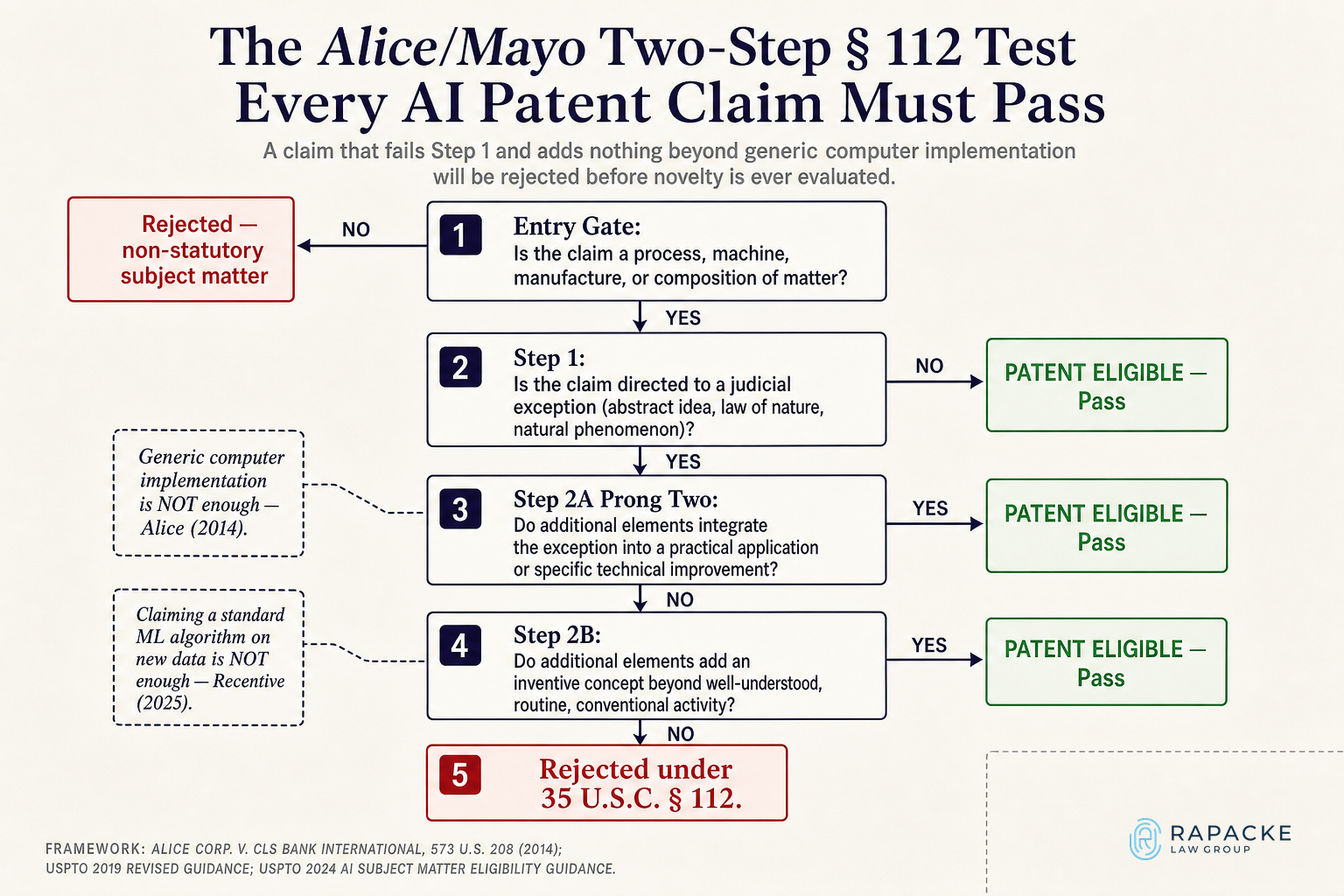 The Alice/Mayo Two-Step § 112 Test Every AI Patent Claim Must Pass — Source: Alice Corp. v. CLS Bank International, 573 U.S. 208 (2014); USPTO 2024 AI Subject Matter Eligibility Guidance
The bottom line: a weak AI patent claims a useful result on a generic computer and collapses at the first § 101 review. A strong claim shows a specific technical improvement to the AI system itself, is backed by structural specificity in the inventive process, and rests on documented human inventorship. That difference is a strategy choice, not luck.
Every month spent chasing the wrong claim structure is a month a competitor can file first, and a lost priority date can mean a lost market. The eligibility rules are only getting sharper for all AI technologies, and applications drafted before the 2024 guidance may already be exposed. Reviewing your invention now protects the intellectual property that funds your growth.
Here is how to move forward.
- Schedule a Free IP Strategy Call to review your AI invention's eligibility profile and map a filing approach around what your system does differently.
- Read the AI Patent Mastery resource for a deeper walkthrough of drafting eligible AI claims.
- Founders raising capital should review The Must-Have SaaS Patent Guide 2.0 to align trademark office, patent, and other intellectual property rights with funding milestones.
Rapacke Law Group works with tech founders and inventors on a fixed-fee model, so you know your investment before the work starts. Andrew Rapacke, our Managing Partner and a Registered Patent Attorney, and the team build AI patent strategies from the technical core of the invention outward to defensible, scope-appropriate claims. Every engagement is backed by the RLG Guarantee, our commitment that you receive the full value of your patent investment or we make it right. A well-drafted portfolio is not a cost center. It is the competitive moat that turns your engineering advantage into an enforceable, fundable asset.
To Your Success,
Andrew Rapacke Managing Partner, Registered Patent Attorney Rapacke Law Group
Connect on LinkedIn (Andrew Rapacke), X (@rapackelaw), and Instagram (@rapackelaw).
Andrew Rapacke Managing Partner, Registered Patent Attorney Rapacke Law Group