

Key Takeaways
- Patent protection is defined by the words in your claims, not by the cultural reputation of your invention, so write claims around the specific technical solution.
- Design patents grant faster and at a higher rate than utility patents, making a design patent application a practical first layer of protection for physical products.
- Software and AI patent claims must describe a specific technical improvement to survive eligibility review under the *Alice* test.
- A provisional patent application only protects features it actually discloses, so thin disclosure now means unprotected features later.
- Run a preliminary prior art search using CPC classification codes before consulting an attorney to make your strategy session far more productive.
*Written by Andrew Rapacke, Managing Partner, Registered Patent Attorney.* Andrew Rapacke is a registered patent attorney and the Managing Partner of The Rapacke Law Group, a full-service intellectual property law firm. He helps individuals and corporations across industries with the protection, prosecution, licensing, and enforcement of their intellectual property, with deep experience in patent, trademark, and copyright matters spanning software, AI and machine learning, blockchain, medical devices, and autonomous vehicle technology. A graduate of the United States Naval Academy, Andrew served as a Naval Engineering Officer before pursuing law and remains active in the startup and inventor communities throughout Florida.
An inventor with a genuinely novel product can still walk away with nothing if the application claims a broad concept instead of a specific technical solution. That mistake gets claims rejected as obvious or unsupported, and patent examiners issue an initial rejection on the large majority of applications according to USPTO first action allowance data. The fastest way to avoid that outcome is to study real patent examples before you file. This article walks you through 10 patent examples spanning utility patents, design patents, software and AI patents, and provisional applications. For each one, you will learn what the claims actually protected, why the drafting choices mattered, and what those decisions reveal about the filing decision in front of you. Studying granted patents is the most reliable way to calibrate what the USPTO will and will not protect before you spend money on a patent application.
Why Studying Real Patent Examples Shapes a Stronger Application
The USPTO granted 323,015 patents in 2022, the lowest annual total since 2018, even as published patent applications reached a record 417,922 that year according to Newswise. That gap between filings and grants reflects a hard truth. Many applications stall because the claims were written without reference to how approved patents are actually structured. Studying patent examples teaches claim architecture, drawing requirements, and scope strategy in a way no checklist alone can match. If you are new to the underlying document, the structure of a patent is the first thing worth learning.
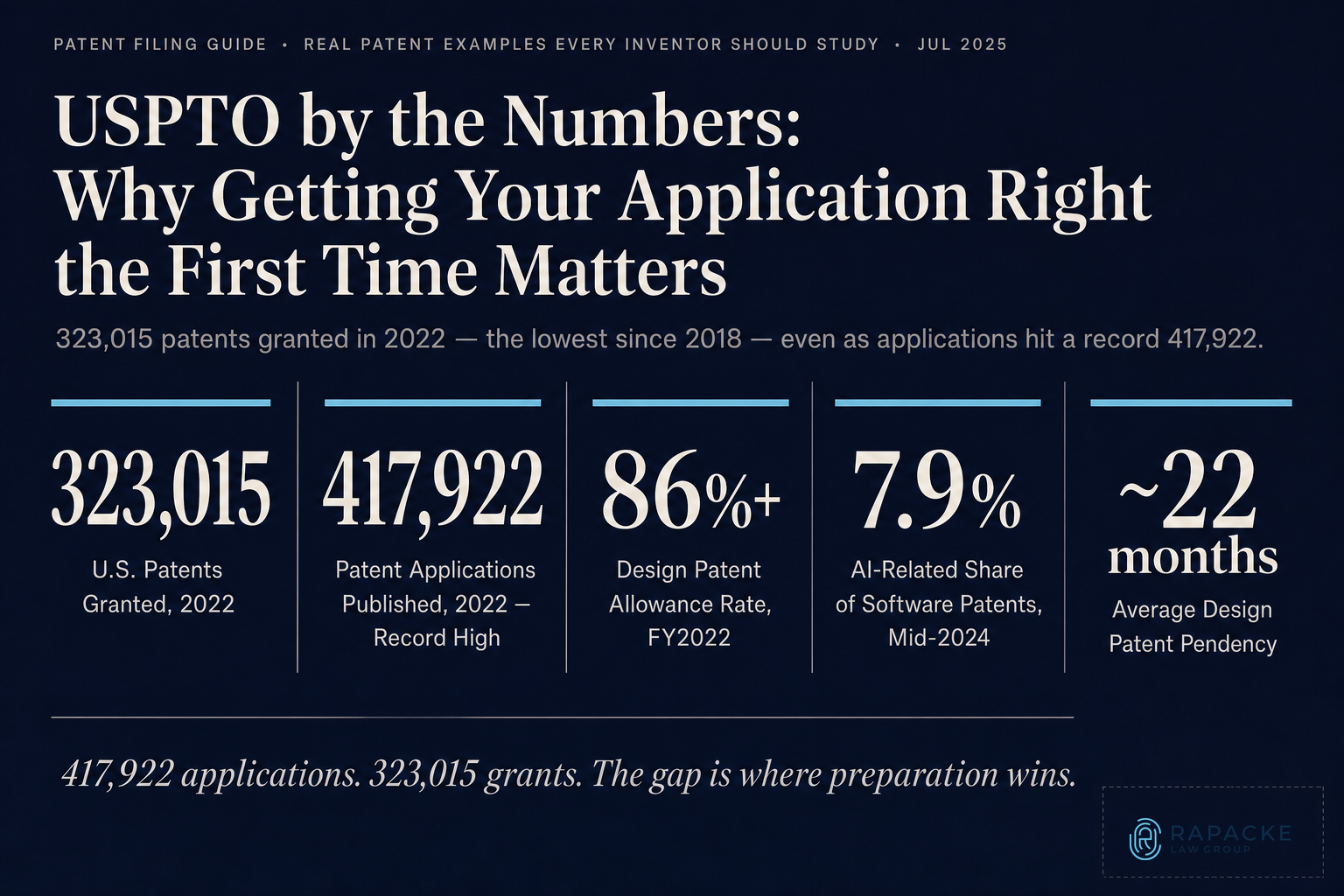 USPTO by the Numbers: Why Getting Your Application Right the First Time Matters — Source: Newswise / IFI CLAIMS Patent Services, 2022; PatentTrademarkBlog, FY2022; IPWatchdog, 2024
What a Granted Patent Actually Teaches You
A granted patent has four parts, the abstract, the specification, the drawings, and the claims. Each serves a distinct legal function. The claims are a negotiated document, reflecting what the examiner accepted after rounds of back-and-forth. Before drafting your own claims, read at least three granted patents in your technology class on Google Patents to see what survived examination. For a closer walkthrough of each section, see this guide to the structure of a patent.
How Prior Art Searches Connect to Real Patent Examples
A prior art search does double duty. It maps the competitive landscape and reveals how examiners have drawn claim boundaries in your field. The USPTO's public search tools let you filter granted patents by classification code for free. Use the Cooperative Patent Classification system to find the patents closest to your technology before writing a single claim.
The Difference Between Reading a Patent and Understanding It
Many inventors skim the abstract and stop. Independent claim 1 is the only part that defines legal protection. Focus on independent claims first. Dependent claims show how competitors narrow or expand their scope.
Utility Patent Examples That Redefined What "Functional" Means
Utility patents cover processes, machines, manufactures, and compositions of matter, and they account for the vast majority of patents granted in the United States. Utility patent protection generally lasts 20 years from the earliest non-provisional filing date under 35 U.S.C. § 154. Two historic examples show how functional claims are framed and why scope decisions carry lasting consequences. If you want the full picture of this category, this overview of utility patents is a useful companion.
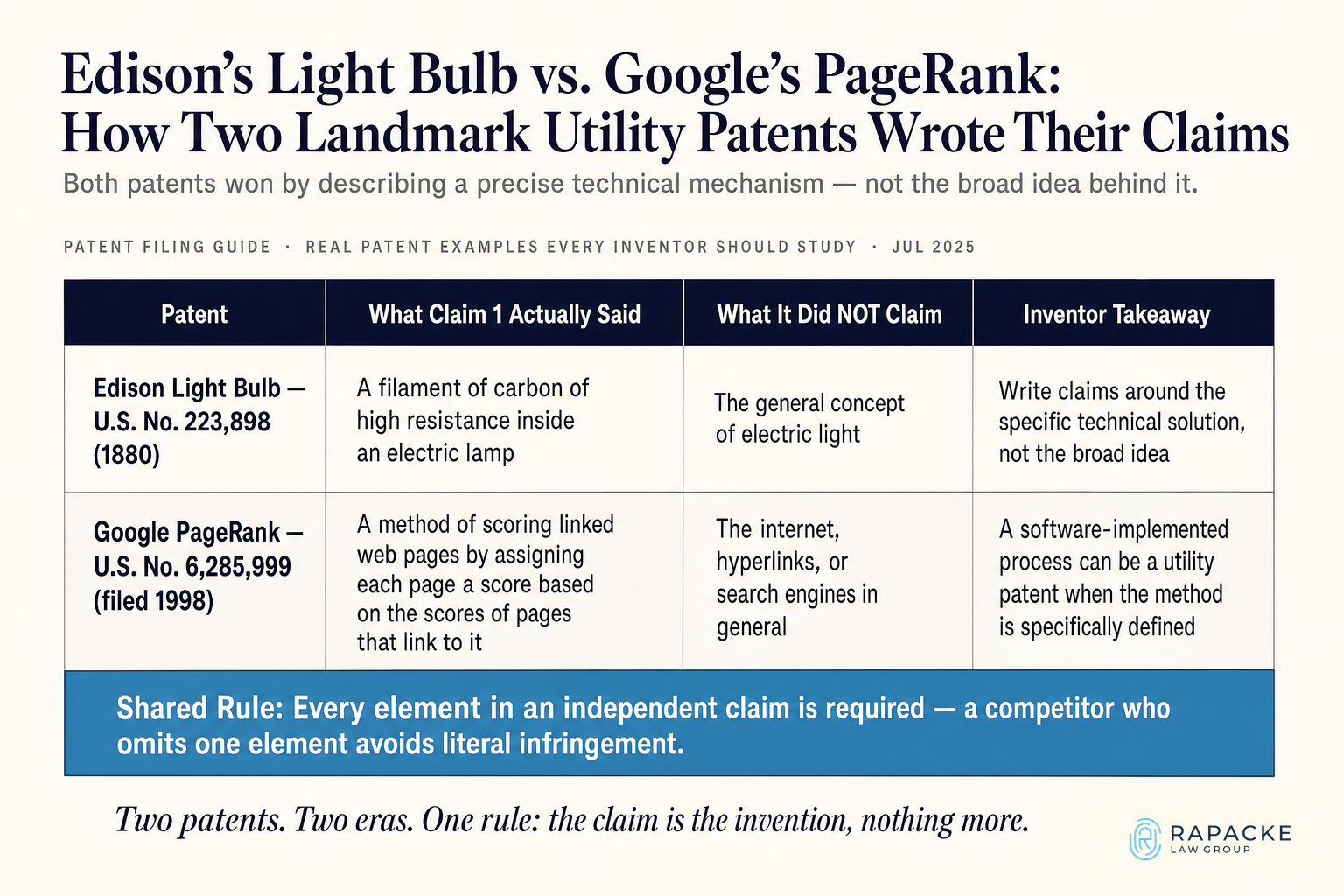 Edison's Light Bulb vs. Google's PageRank: How Two Landmark Utility Patents Wrote Their Claims — Source: Google Patents (US223898A); patents.searchlight.law (US6285999)
The Edison Light Bulb Patent and What Its Claims Really Said
Thomas Edison's light bulb patent, U.S. No. 223,898, is one of the most-studied utility patent examples ever issued. Edison did not claim the light bulb as a concept. He claimed a filament of carbon of high resistance inside an electric lamp, a narrow technical detail rather than the broad idea popular history credits him with. The lesson holds today. Write claims that describe the specific technical solution, not the broad concept you hope to own.
Google's PageRank Patent as a Software-Adjacent Utility Example
Google's original PageRank patent, U.S. No. 6,285,999, filed in 1998 by Larry Page, claimed a method of scoring linked documents by assigning each page a score based on the scores of pages that link to it. This example matters for SaaS founders because it shows a process implemented in software claimed as a utility patent without claiming the software itself. If your invention is a method or process, utility patent claims can protect it even when software is the implementation layer. For more in the same vein, study these software patent examples from established companies and startups.
A Modern Utility Example for Contrast
Claim structure follows the same rules across domains. In 2022, U.S. patent activity in self-driving vehicles, fossil fuel drilling, and artificial intelligence was among the hottest and fastest-growing areas, according to IFI CLAIMS, yet each still required a specification that supports every element of independent claim 1. Your specification must describe every element recited in your claims, or the USPTO will issue a written description rejection. Sometimes a fresh application of an existing product qualifies as well, as this look at the new use patent explains.
Design Patent Examples That Protect How Something Looks
Design patents protect the ornamental appearance of a functional item, and they are dramatically underused by product-based inventors. A design patent application contains only one claim, and the drawings are the claim. These design patent examples reveal what visual scope the patent office has historically protected.
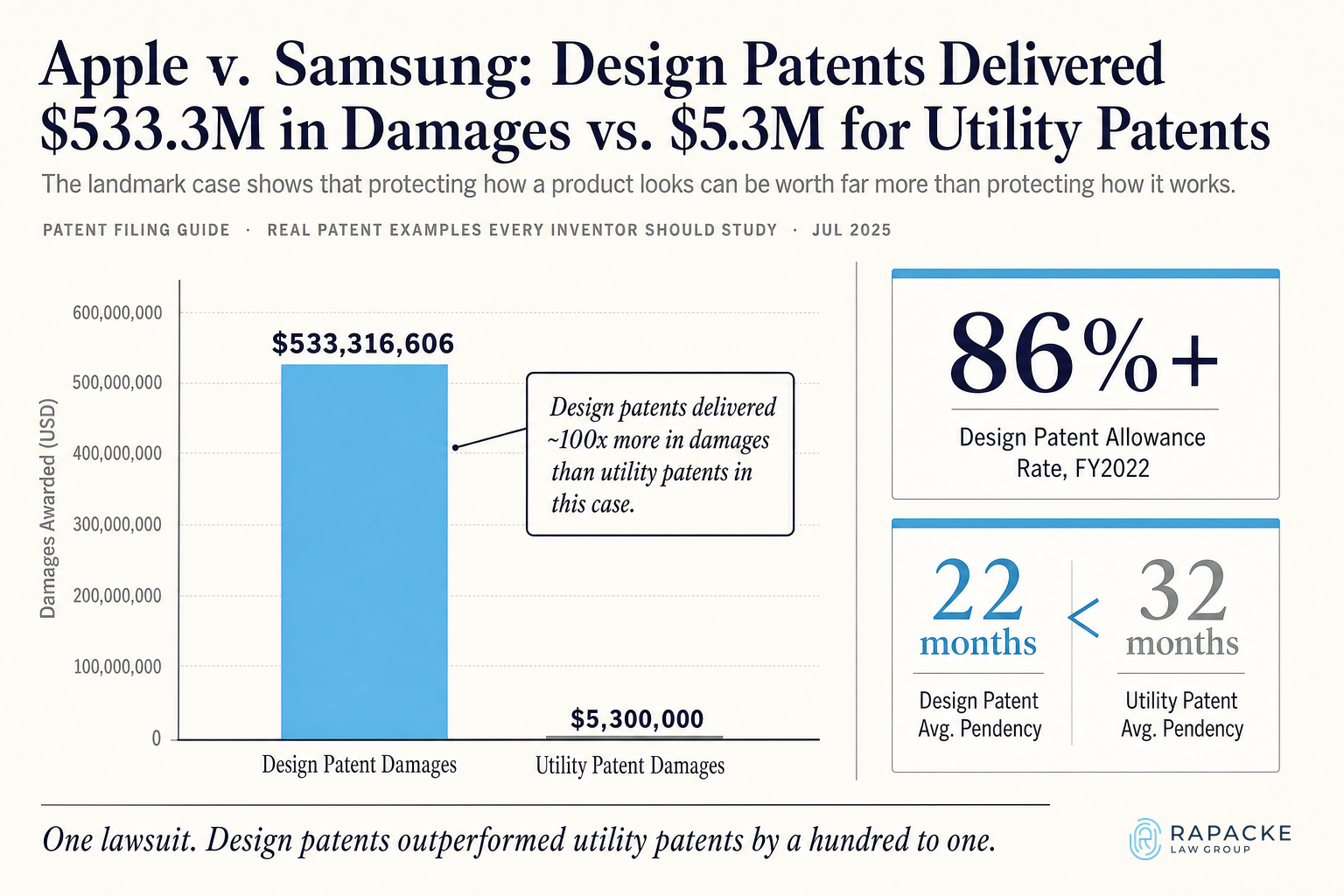 Apple v. Samsung: Design Patents Delivered $533.3M in Damages vs. $5.3M for Utility Patents — Source: AppleInsider, 2018; PatentTrademarkBlog, FY2022; LegalClarity
The Apple iPhone Design Patents and the Samsung Litigation
Apple Inc. v. Samsung Electronics Co. remains the most commercially significant design patent dispute in recent history. A jury initially awarded Apple $1.049 billion for infringement according to TechCrunch. After appeals, roughly $533.3 million of the final damages came specifically from Apple's design patents on the iPhone's appearance, compared with only $5.3 million tied to utility patent infringement, as Telecompaper reported. If your product's appearance drives purchase decisions, a design patent application is worth filing alongside a utility application.
Everyday Product Design Patents You Would Recognize
Design patent protection is not reserved for high-tech products. Shoe soles, beverage containers, and user interface icons are all routinely covered by design patents. The breadth of subject matter surprises most inventors. Design patents also grant faster and cost less than utility patents, which makes them a practical first layer of intellectual property protection for physical products. To see where a design patent fits among the types of patents, it helps to compare them side by side.
What Design Patent Drawings Must Show
The USPTO enforces strict drawing requirements for design patent applications. You need multiple views, with solid lines for claimed features and broken lines for unclaimed context. A single improper drawing can delay or sink the application. Hire a professional patent illustrator. Drawing errors are a leading cause of design patent application office actions.
Software and AI Patent Examples Relevant to SaaS Founders
Software and AI patents must navigate eligibility rules under 35 U.S.C. § 101 after the Supreme Court's ruling in Alice Corp. v. CLS Bank International. These granted patent examples show how successful applications were written to survive eligibility scrutiny. Tech founders worried about durability should also review whether software patents are enforceable in practice.
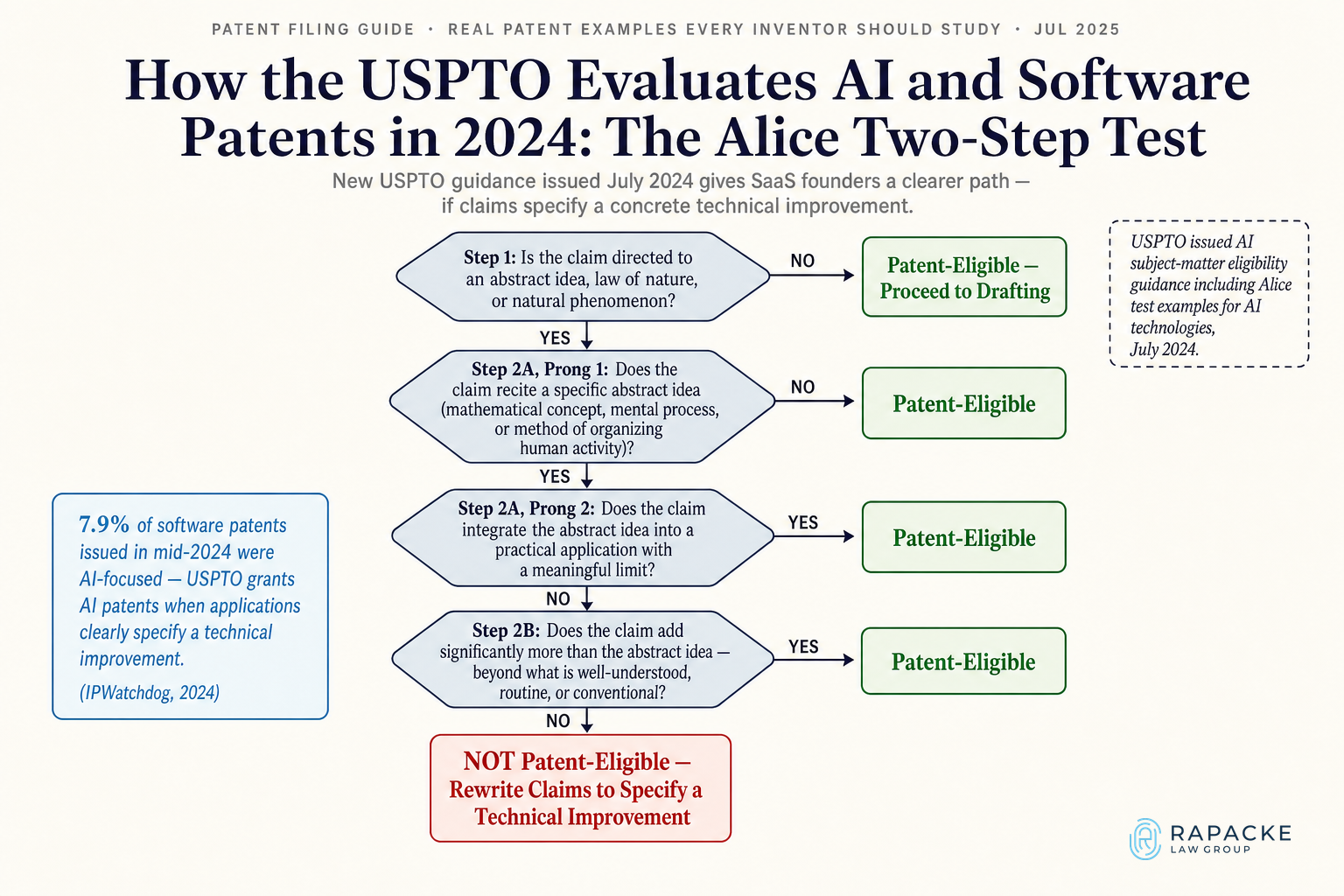 How the USPTO Evaluates AI and Software Patents in 2024: The Alice Two-Step Test — Source: USPTO AI Subject-Matter Eligibility Guidance, July 2024; IPWatchdog, 2024
How Amazon's 1-Click Patent Survived Eligibility Challenges
Amazon's one-click ordering patent, U.S. No. 5,960,411, was filed in 1997 and issued in 1999. Its claims described a specific technical implementation, a client-side identifier paired with single-action ordering, rather than an abstract business method. That specificity is exactly what examiners look for. Software patent claims must describe a specific technical improvement to a computer system, not just a business method implemented on a computer. For a broader set of mobile app patent examples, the same drafting principle holds.
A Recent Generative AI Patent Example
The USPTO issued new guidance in July 2024 to clarify subject-matter eligibility for AI inventions, including detailed examples for applying the two-step Alice test, according to the USPTO. The examiners are granting AI software patents when the claims tie to a specific technical improvement. About 7.9% of issued software patents in mid-2024 were AI-focused per IPWatchdog. Vague references to "using AI" or generative AI will not survive examination. These AI patent examples show what passing claims look like, and if you are unsure whether your model qualifies, this breakdown of whether machine learning algorithms are patentable is a good starting point.
What SaaS Founders Can Learn
The same framework applies to recommendation engines, API architectures, and workflow automation tools. Map your software innovation to a specific technical problem and a specific technical solution. That mapping becomes the backbone of your claims and the difference between an allowance and a § 101 rejection. Several recent software patent examples from top companies illustrate how that mapping reads on the page.
Provisional Patent Examples and What They Do and Don't Protect
A provisional patent application is not a patent. It is a 12-month placeholder that secures a filing date, and it is never examined or granted on its own according to the USPTO. Studying provisional patent examples reveals how much technical detail you actually need to get value from one.
What a Strong Provisional Patent Application Looks Like
A well-drafted provisional includes a full written description, detailed drawings, and enough technical disclosure to support the claims you intend to file later. Provisionals do not require formal claims or an oath, but they do require a thorough description. Any feature not disclosed in the provisional loses the benefit of its early date. Treat your provisional patent application like a real patent specification.
The Consequences of a Weak Provisional Filing
Picture an inventor who files a bare slide deck as a provisional, then spends 12 months improving the product. When the full non-provisional patent application is drafted, the new claims are not supported by the original disclosure. The effective priority date for those features slips to the non-provisional filing date, potentially after a public disclosure that becomes prior art. If you disclose your invention publicly before filing, your own disclosure can become prior art unless you file within the limited one-year grace period under 35 U.S.C. § 102(b)(1), and that grace period does not exist in most foreign countries. The safest course is to file your provisional the same day as any public disclosure or earlier.
How a Provisional Compares to a PCT International Application
Some inventors need protection beyond the United States from day one. A Patent Cooperation Treaty application filed through WIPO can cover 158 countries and gives up to 30 months before national-phase costs begin, according to WIPO. If international markets matter to your business, weigh PCT strategy at the same time you plan your provisional filing.
How to Read a Patent Example the Way a Patent Attorney Does
Studying examples only pays off if you read them the way a patent attorney does. The skill translates patent examples into filing intelligence.
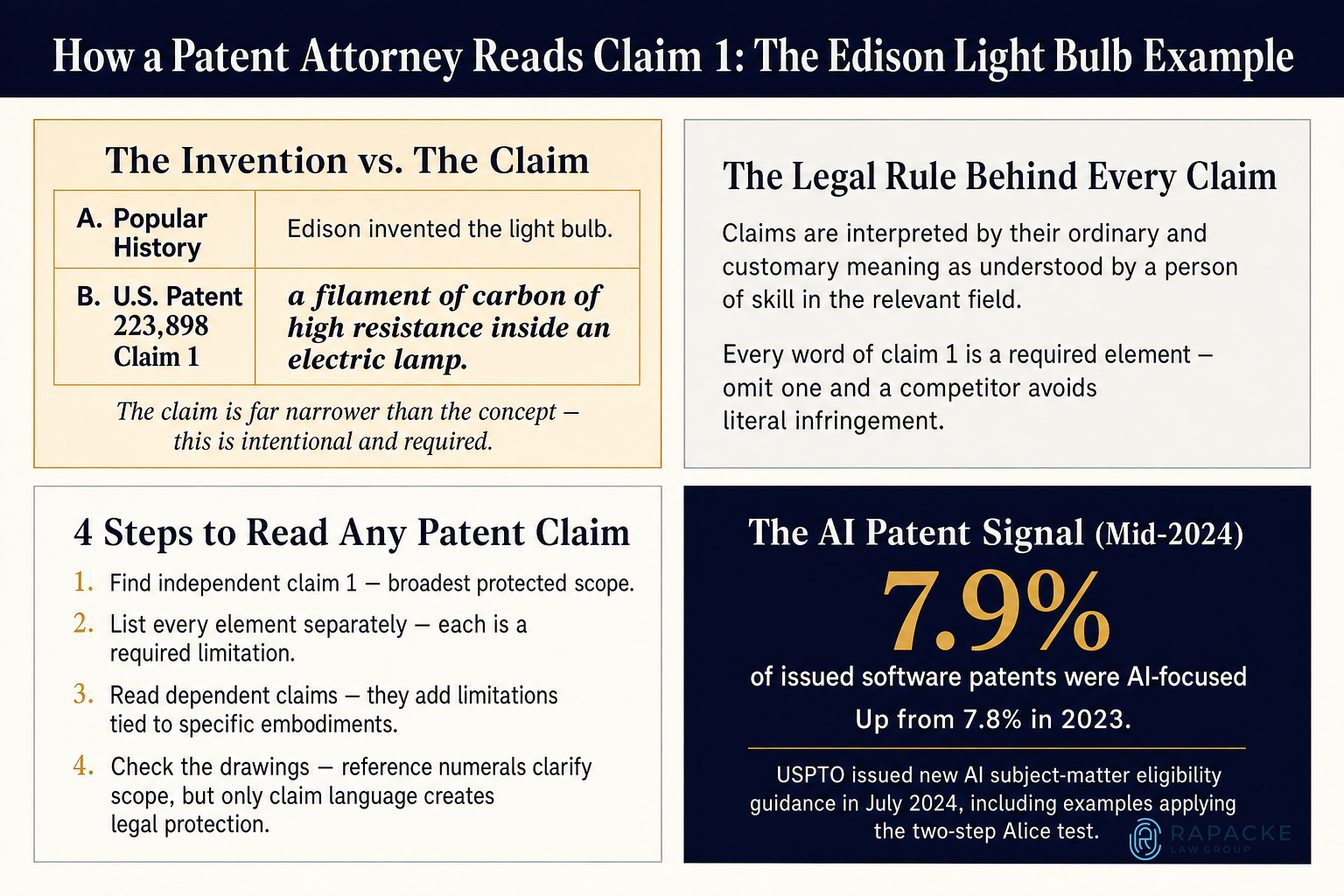 How a Patent Attorney Reads Claim 1: The Edison Light Bulb Example — Source: patents.google.com (U.S. Patent 223,898); Federal Circuit; IPWatchdog, Aug 2024; USPTO, July 2024
Start With Independent Claim 1 and Work Backward
Independent claim 1 defines the broadest scope the patent holder owns. Every word is a limitation and a potential workaround for competitors. Courts interpret claims by their ordinary and customary meaning as understood by a person of skill in the field, a standard the Federal Circuit applies in claim construction. If you can remove one element from claim 1 and still describe your invention, the claim is broader than it needs to be, and broader is almost always better.
Use Dependent Claims to Understand Scope Strategy
Dependent claims add limitations to an independent claim, creating a nested structure. When an independent claim is invalidated, dependent claims can still survive. Counting and analyzing them in a sample patent lets you reverse-engineer the patentee's scope strategy. A strong patent application includes multiple dependent claims that protect specific embodiments. Those are your fallback positions if claim 1 is challenged.
What Patent Drawings Tell You About the Claimed Invention
Figures in a utility patent are referenced throughout the specification and claims using reference numerals. Cross-referencing figures with claim language lets you visualize exactly what is and is not claimed. Drawings cannot substitute for written claim language, but they clarify ambiguous terms. Map each claim element to its corresponding figure reference to see how much the patent actually covers.
What These Patent Examples Reveal About Your Own Patentability
These examples become useful only when you turn them into a self-assessment. Here is how to apply what you have learned to your own invention before filing.
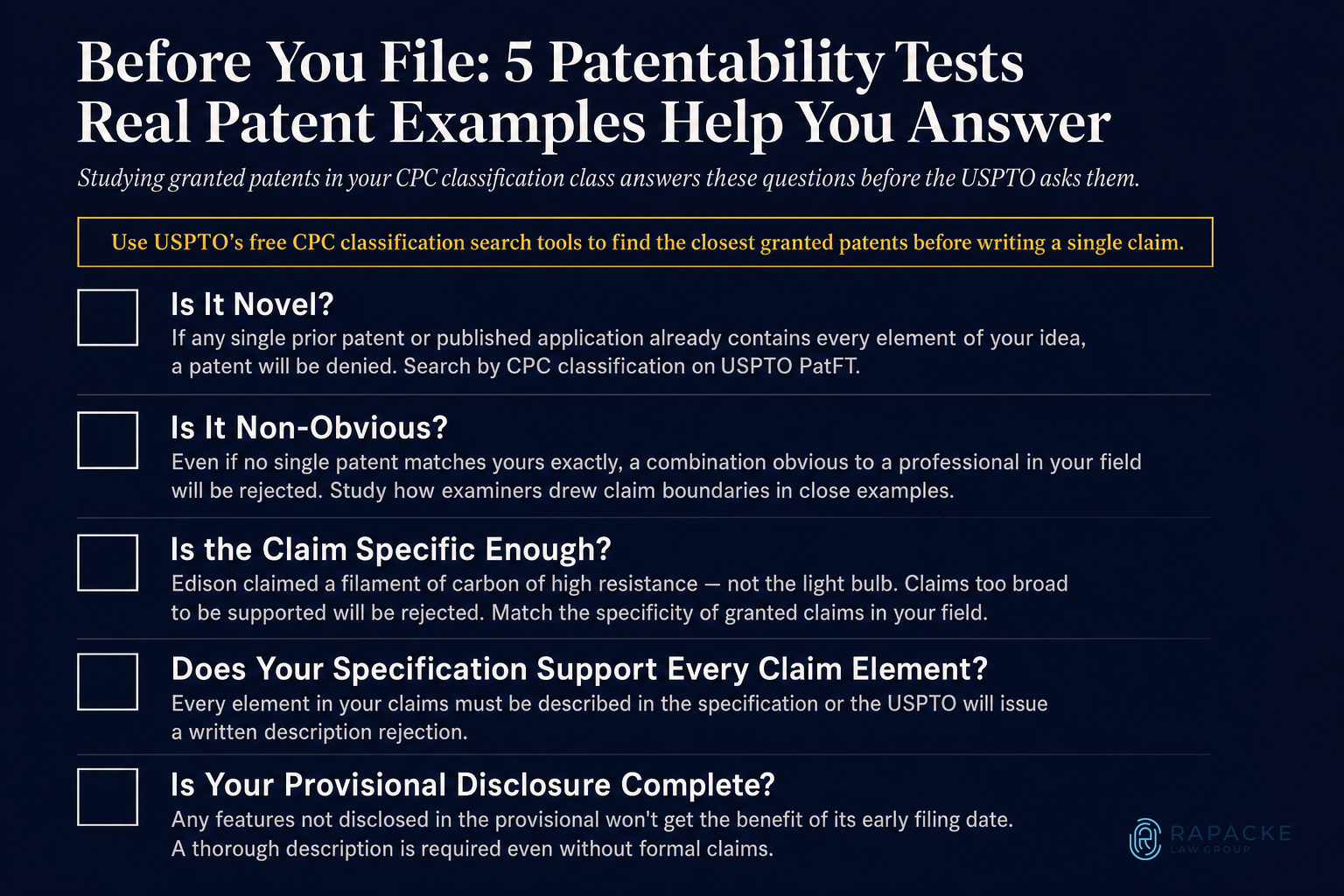 Before You File: 5 Patentability Tests Real Patent Examples Help You Answer — Source: 35 U.S.C. § 102; USPTO CPC classification search; USPTO Provisional Application for Patent; patents.google.com
The Three Questions Every Inventor Should Ask
Ask three diagnostic questions that map to the statutory requirements. First, is my invention novel compared to the prior art I found? If a single prior patent discloses every element of your idea, it is not new and the application will be denied under 35 U.S.C. § 102. Second, is it non-obvious to someone skilled in my field under § 103? Third, is the utility clear and specific under § 101? Run a preliminary prior art search before you spend money on filing.
How Patent Examples in Your Technology Class Reveal Claim Strategy
Reading five to ten granted patents in your exact USPTO technology classification reveals how examiners in that art unit have drawn claim boundaries. This is the fastest way to gauge whether your invention has patentable scope and what claim language has survived. Identify your invention's primary CPC classification code on Google Patents, then filter by that code to study the most relevant examples.
When to Move From Studying Examples to Filing
Self-study ends and professional filing begins when you have identified patentable subject matter, run a preliminary prior art search, and can articulate the specific technical problem your invention solves. At that point a registered patent attorney adds the most value by drafting claims that hold up through examination. Book a strategy session once you can answer the three patentability questions above.
Frequently Asked Questions About Patent Examples
What are patent examples?
Patent examples are real granted patents or published patent applications that inventors and attorneys study to understand how claims are written, what subject matter the USPTO protects, and how different inventions are described in a legally enforceable format. They span utility patents, design patents, plant patents, and software-related patents, and they are publicly searchable on Google Patents and the USPTO databases.
What is a famous example of a patent?
Several patents had outsized commercial and legal impact. Thomas Edison's light bulb patent, U.S. No. 223,898, Alexander Graham Bell's telephone patent, U.S. No. 174,465, and Amazon's one-click patent, U.S. No. 5,960,411, are among the most studied. In the design space, Apple's iPhone design patents became globally significant after Apple Inc. v. Samsung Electronics Co. produced a jury award exceeding $1 billion.
What are the 4 types of patents?
United States law recognizes three primary types, utility patents for functional inventions, design patents for ornamental appearance, and plant patents for asexually reproduced plant varieties. A fourth category often referenced in practice is the provisional patent application, which is not a patent itself but establishes a priority date for up to 12 months before a non-provisional utility patent application must be filed.
What is a real life example of a patent?
The swipe-to-unlock gesture on smartphones is one everyday example, covered by Apple's slide-to-unlock patent. While that patent was in force, no competitor could legally use an identical unlocking mechanism. For SaaS founders, Amazon's 1-click patent is the most instructive example of how a software method can be protected and monetized through licensing.
Can I search for patent examples myself before hiring an attorney?
Yes. Google Patents and the USPTO's public search tools are free and let you filter by keyword and CPC classification code to return the most relevant granted patents in your technology area. A self-directed prior art search before your first consultation helps you arrive with a clearer picture of the landscape, which makes your filing strategy sharper.
Start With the Right Examples and File With Confidence
Studying patent examples before filing is not optional research. It is the difference between claims that hold up and claims that get rejected, narrowed, or invalidated. The examples here span utility patents, design patents, software and AI patents, and provisional applications because each protects a different aspect of what you have built, and most inventors need more than one form of patent protection.
The bottom line is simple. A weak patent claims a broad idea it cannot defend and collapses under the first prior art reference an examiner finds. A strong patent claims a specific technical solution, supports every element in the specification, and gives you fallback positions through dependent claims. The examples above show which side of that line successful inventors land on.
The next step is not filing. The next step is running a preliminary prior art search using the classification codes you identified, then walking into a strategy conversation with a clear picture of your invention's patentable scope. Every month you wait is a month a competitor can file ahead of you under the first-inventor-to-file system, and a single public disclosure can quietly start a clock that erases your rights abroad. Move before that happens.
Rapacke Law Group works with inventors and SaaS founders on flat-fee patent filings with transparent pricing and no billing surprises, and our patentability work carries the RLG Guarantee, a 100% refund if our search finds your invention is not novel. Once you can answer the three patentability questions above, take these steps:
- Schedule a Free IP Strategy Call to map the right protection path for your invention.
- Run your CPC-coded prior art search and bring the closest examples to your session.
- Decide whether a provisional, a full utility filing, or a design application fits your timeline and budget.
The right filing strategy is one of the highest-return investments a founder or inventor can make. A well-drafted patent built on real examples becomes a durable competitive advantage, the kind that protects market share and strengthens your position with investors and acquirers.
To Your Success,
Andrew Rapacke
Managing Partner, Registered Patent Attorney
Rapacke Law Group
Andrew Rapacke Managing Partner, Registered Patent Attorney Connect on LinkedIn (Andrew Rapacke) or follow @rapackelaw on Twitter/X and Instagram.