

Key Takeaways
- AI agents reliably handle high-volume, repetitive tasks like prior art search and first-draft patent applications, but a registered patent attorney must review and sign every USPTO filing.
- Before piloting any platform, require written confirmation that invention disclosures are never used to train the underlying AI model.
- Cybersecurity is the top AI concern for in-house legal teams at roughly 42%, so demand SOC 2 Type II and ISO 27001 documentation up front.
- Standardize your invention disclosure template before integrating an AI agent. Structured inputs produce more accurate first drafts with less attorney rework.
- Run a structured pilot of 10 to 20 patent applications with defined success metrics before signing a full contract.
By Andrew Rapacke, Managing Partner, Registered Patent Attorney, Rapacke Law Group.
*Written by Andrew Rapacke, Managing Partner, Registered Patent Attorney.* Andrew Rapacke is a registered patent attorney and the Managing Partner of The Rapacke Law Group, a full-service intellectual property law firm. He helps individuals and corporations across industries with the protection, prosecution, licensing, and enforcement of their intellectual property, with deep experience in patent, trademark, and copyright matters spanning software, AI and machine learning, blockchain, medical devices, and autonomous vehicle technology. A graduate of the United States Naval Academy, Andrew served as a Naval Engineering Officer before pursuing law and remains active in the startup and inventor communities throughout Florida.
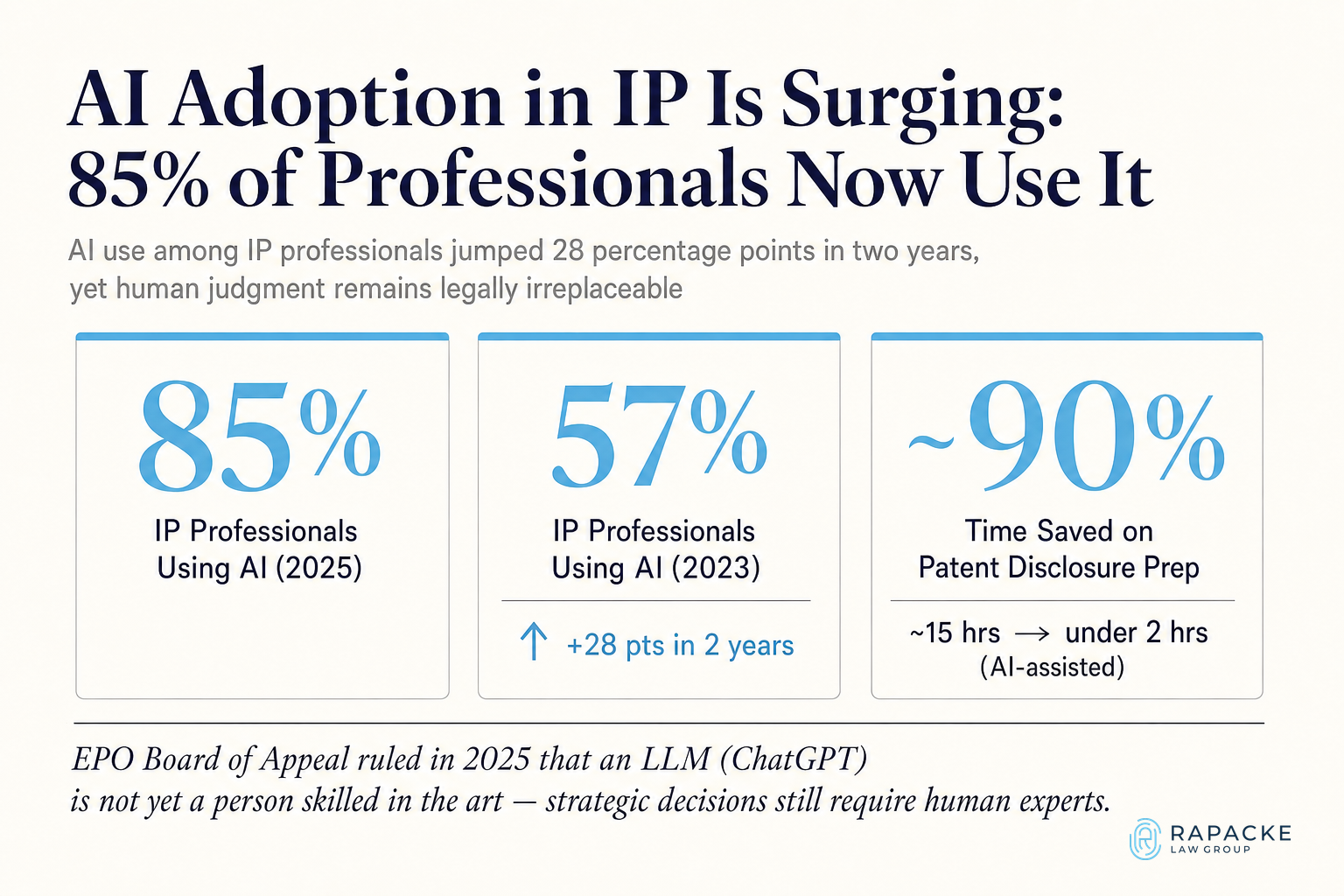
Corporate IP teams that manually process prior art searches and office action responses still spend hours on tasks that AI agents now complete in minutes. One corporate IP department in 2024 cut a patent disclosure prep from roughly 15 hours to under 2 using a generative AI assistant, according to Digital Shift. That single case study points to real upside and a real risk: the wrong AI agents for patents corporate IP teams adopt can expose sensitive invention disclosures to model training pipelines. This article walks through what AI agents do in a patent workflow, where they deliver value, the data security obligations corporate teams must verify, and the questions to ask before committing to any platform.
What AI Agents Actually Do Inside a Patent Workflow (and What They Don't)
 AI Adoption in IP Is Surging: 85% of Professionals Now Use It — Source: Clarivate IP Evolution Survey, 2025
AI Agents vs. Traditional Patent Software
Traditional patent management software stores and organizes data. AI agents, powered by large language models and agentic AI architectures (AI systems that can independently plan and execute sequences of tasks), actively execute multi-step tasks like drafting patent claims, running a prior art search, and generating claim charts with limited human prompting. Multiple ai agents can be chained together to handle different stages of the patent lifecycle in a single workflow. The difference is task chaining: an agent can move from reading a disclosure to searching prior art to drafting claims in one sequence. Verify whether a tool is truly agentic or just AI-assisted search before evaluating it for prosecution. For a deeper look at how these systems qualify as intellectual property, see our guide on whether AI agents are patentable.
The Patent Tasks AI Agents Handle Reliably Today
AI adoption in IP is surging. A 2025 Clarivate survey found 85% of IP professionals now use AI in some capacity, up from 57% in 2023. AI agents handle patent drafting, prior art search, invention disclosure processing, office action response drafts, and claim amendments. Map AI agent capabilities to the tasks consuming the most attorney hours first. Our patent analysis playbook breaks down where IP data delivers the most leverage. Tech founders and SaaS teams building a patent strategy from the ground up should also review the SaaS Patent Guide 2.0 and the SaaS Agreement Checklist before selecting an AI platform. For early-stage startups, the same AI agent tools that help large corporate IP departments process hundreds of disclosures can be applied at startup scale: a single founder can use AI-assisted prior art search to validate patentability before spending on a full application, and AI-drafted office action responses can stretch a lean IP budget further without sacrificing quality.
Where AI Agents Still Fall Short
Nuanced judgment calls remain human work. In 2025, the EPO's Board of Appeal in T 1193/23 held that ChatGPT outputs cannot be treated as evidence of how the person skilled in the art interprets a claim without supporting expert evidence, per the EPO case law index. Claim breadth strategy, invention scope, multi-jurisdictional prosecution across different jurisdictions, and case law interpretation still require expert input. Treat AI agents as force multipliers for repetitive tasks, not substitutes for legal professionals' strategic judgment. For more, see our overview of artificial intelligence and intellectual property.
How AI Agents Handle Prior Art Search and Why It Changes Your Process
 Manual Prior Art Search vs. AI Agent-Assisted: How the Process Changes — Source: MDPI NLP Patent Search Review; National Law Review USPTO AI Guidance
From Keyword Search to Semantic Prior Art Analysis
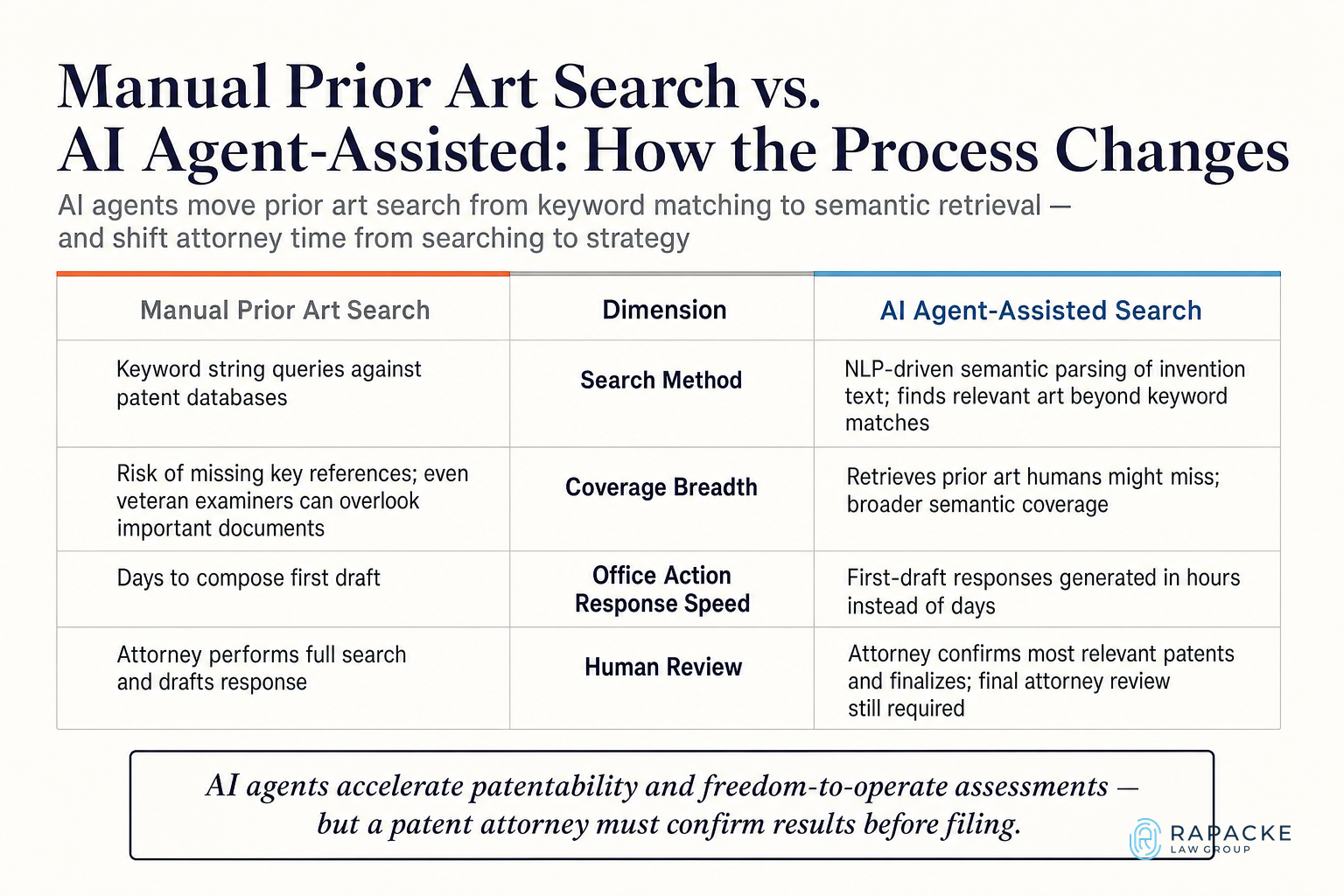
AI agents use natural language processing and machine learning to conduct a prior art search against massive patent databases, encompassing millions of legal documents, identifying relevant prior art well beyond simple keyword matching. Think of it like upgrading from a library card catalog to a smart search engine that understands context, not just keywords. Academic reviews note that semantic, NLP-driven patent search improves both the precision and breadth of results. Traditional manual searching is labor-intensive, and even veteran examiners can overlook important references. This affects both patentability assessments and freedom-to-operate analysis, which evaluates whether a product can be commercialized without infringing existing patents. The best artificial intelligence patent search tools pair speed with attorney oversight. Use AI-driven results as a first-pass layer, then have an attorney confirm the most relevant patents before filing.
Prior Art Search in Office Action Response Workflows
AI agents can pull known prior art cited by the USPTO, analyze examiner arguments, and suggest claim amendments that distinguish the cited references. Corporate case studies show first-draft office action responses generated in hours instead of days, though final patent attorneys' review remains required. Evaluate whether a platform's office action response tool integrates directly with USPTO data feeds before relying on it.
What Enterprise-Grade Security Really Means for Corporate IP Teams
The Model Training Risk Corporate Teams Cannot Ignore
Enterprise grade security means more than encryption, and the critical question is whether client data and invention disclosures feed the underlying AI model's training. Roughly 40% of attorneys cite data security and a similar share cite accuracy as key concerns with AI tools, according to Legal Dive. Some clients ban outside counsel from using AI that might expose invention data, which is why protecting IP at the disclosure stage matters. Before signing any contract, require written confirmation that invention disclosures are never used for model training. Our breakdown of the importance of intellectual property for AI makers explains why this exposure is so costly.
Certifications and Compliance Standards to Require
Use SOC 2 Type II and ISO 27001 (industry-standard security certifications that verify how vendors protect your data), along with EU AI Act compliance and applicable legal requirements, as benchmarks for enterprise grade security. Corporate IP teams in life sciences and tech, including those handling sensitive inventions involving chemical structures or biological sequences, face heightened confidentiality obligations around pre-filing disclosures. Request a vendor's current certifications and data processing agreements before a pilot begins.
On-Premise vs. Cloud Processing for Sensitive Patent Data
Distinguish platforms where all data is stored and processed locally from those relying on third-party cloud infrastructure. Trade secret protection matters when patent applications involve pre-filing invention disclosures. Match the platform's data residency model to your organization's IP governance policy before deploying.
How AI Agents Accelerate Invention Harvesting and Disclosure Processing
 Samsung Filed 8,513 U.S. Patents in 2023 — Scale That Demands AI-Assisted Disclosure Processing — Source: IFI CLAIMS Patent Services, 2024
What Invention Harvesting Looks Like With AI Agents
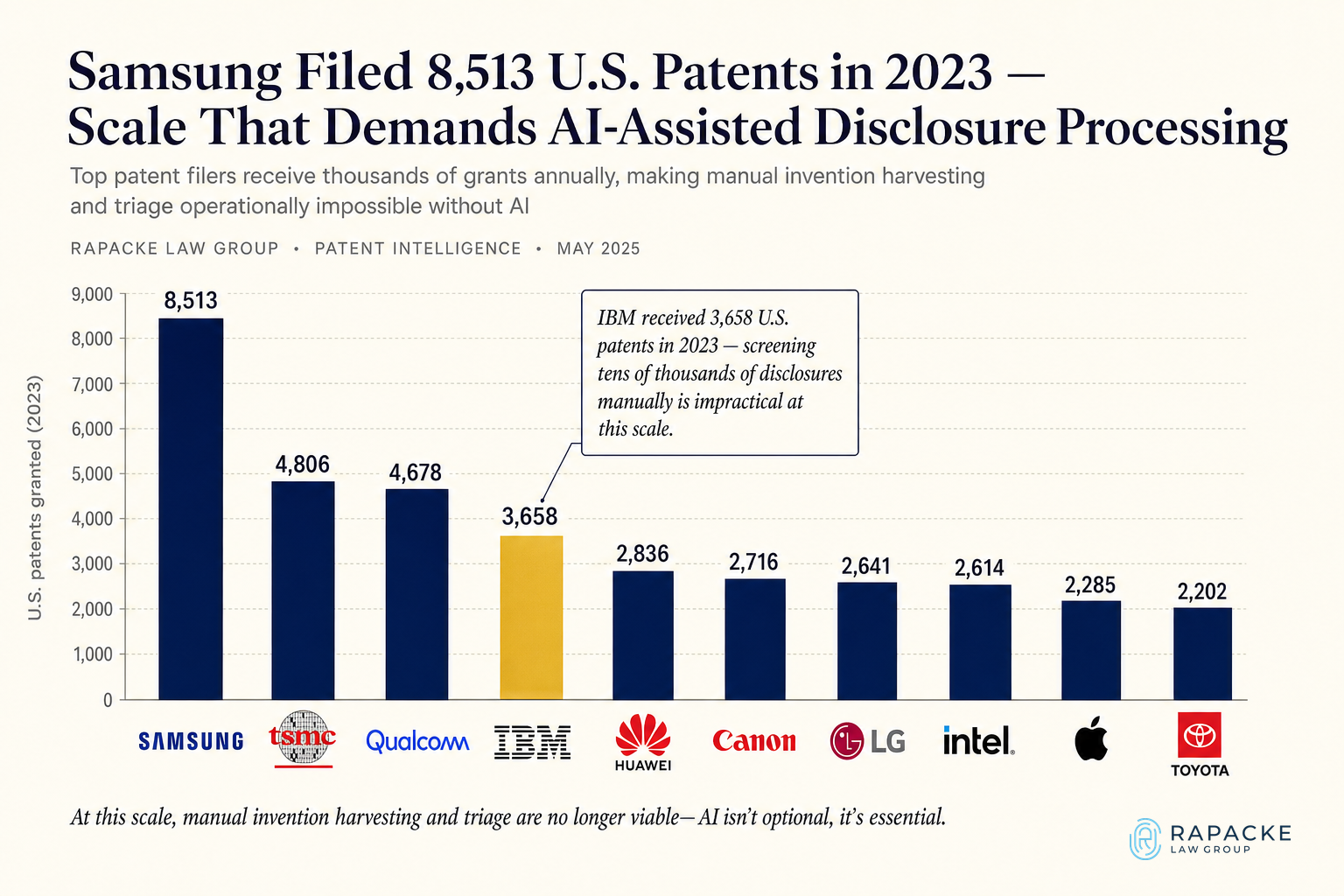
Invention harvesting, the work of systematically surfacing patentable ideas from engineering teams, is labor-intensive without automation. The largest filers operate at staggering scale. Samsung alone received 8,513 U.S. patents in 2023, with TSMC at 4,806, Qualcomm at 4,678, and IBM at 3,658, per IFI CLAIMS. Screening that volume means processing tens of thousands of disclosures. AI agents can analyze disclosures, flag technically novel elements, and compare them against prior art before a legal professional reviews the findings. Pilot AI-assisted invention harvesting on a single product line before rolling out to the full portfolio.
Structuring Invention Disclosures for AI Agent Input
AI agents perform best when invention disclosures use consistent technical descriptions and structured fields. The same GPT-4 based tool, an example of advanced ai agent generative ai technology, that generated a complete disclosure memo in 1 to 2 hours versus roughly 15 manually, reported by Digital Shift, depends on clean input. Teams that standardize disclosure templates see faster, more accurate AI outputs with less rework. Standardize your invention disclosure template before integrating any AI agent.
What Corporate IP Portfolio Management Gains From Agentic AI
Patent Portfolio Analysis and Landscape Mapping
AI agents analyze large patent portfolios to identify coverage gaps, flag expiring patents, and generate landscape analyses across technology areas, giving intellectual property teams a clearer picture of their competitive position. IBM, consistently one of the largest patent holders worldwide, maintains a portfolio so vast that manual audits are impractical. Use AI-driven portfolio intelligence to prioritize continuation applications and identify white space for new filings. The companies behind the most valuable AI patents lean heavily on this kind of landscape intelligence.
Claim Charts, Validity Analysis, and IP Due Diligence
For M&A IP due diligence or licensing negotiations, AI agents generate claim charts, support patent valuation, and run prior art analysis against target portfolios at scale, compressing timelines that once took months. Identify which workstreams are your highest-volume bottlenecks before selecting a tool. Investors scrutinize this work closely, which is one reason why investors care about IP during diligence.
Trademark Monitoring as an Adjacent AI Use Case
Some AI platforms extend to trademark monitoring alongside patent prosecution workflows. If your team manages trademark applications alongside patents, verify whether a single platform covers both before juggling two separate tools.
The Real Workflow Integration Questions Before You Commit to a Platform
How AI Patent Platforms Connect to Existing IP Management Systems
Seamless integration with docketing systems, document management platforms, and USPTO filing is non-negotiable. In a 2024 survey, roughly 39% of legal departments pointed to implementation cost and time and 38% to a lack of IT infrastructure as hurdles, according to Axiom's 2024 survey of in-house legal teams. Gaps create duplicate data entry and compliance risk. Map the platform's API and integration capabilities against your existing IP management stack before a pilot begins.
Evaluating AI Output Quality for Patent Claims and Technical Accuracy
Legal precision and technical accuracy in AI-generated patent claims cannot be assumed. Early law firm tests and assessments from legal ai platforms show AI can produce a complete draft, but attorneys still substantially revise claims and specifications. Run a structured pilot with 10 to 20 patent applications before committing, and have attorneys rate each draft's accuracy and required edits. This structured approach supports sound patent application drafting standards across the team.
How Patent Prosecution Workflows Change When AI Agents Are Involved
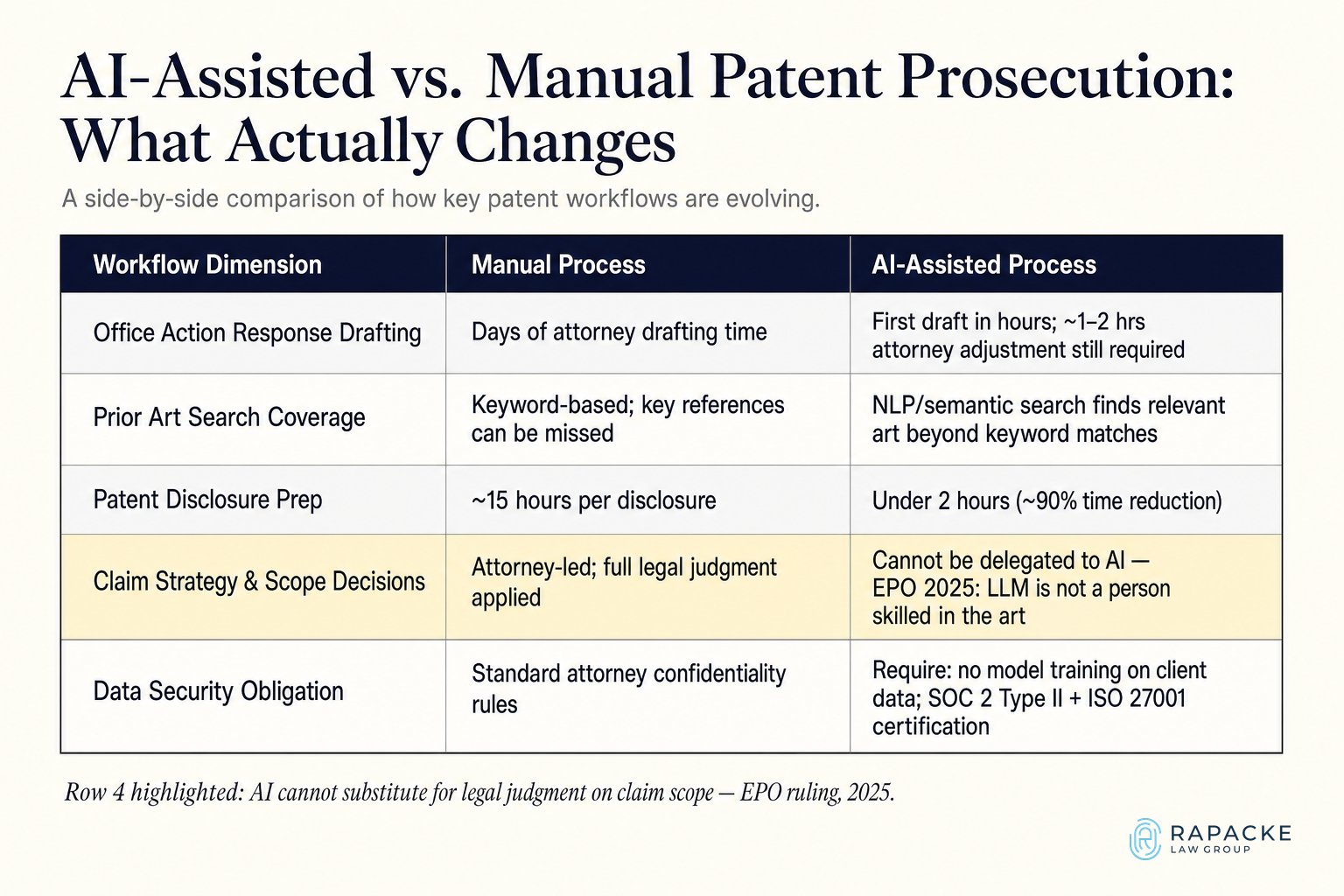 AI-Assisted vs. Manual Patent Prosecution: What Actually Changes — Source: USPTO AI Guidance (National Law Review, 2024); EPO Board of Appeal ruling, 2025; corporate case study (digital-shift.jp, 2024); MDPI semantic patent search review
Office Action Response Drafting and Examiner Argument Analysis
AI agents analyze examiner rejections, compare them to the patent claims, identify the closest prior art, and generate a first draft of claim amendments and arguments, managing each stage of the patent lifecycle from filing through response. This gives attorneys more time for the strategic portions of prosecution, improving decision making on claim scope and amendment strategy. The USPTO's 2024 guidance makes clear that AI-assisted work still requires meaningful human review before filing, per the Federal Register notice. Use AI-drafted office actions as a first draft attorneys refine, not a finished product.
PCT International Applications and Multi-Jurisdictional Prosecution
For teams filing PCT (Patent Cooperation Treaty) international applications, which allow a single filing to seek patent protection in multiple countries, AI agents that understand jurisdiction-specific formats and patent law requirements reduce the coordination burden and reliance on local counsel for initial drafts. Costs do not vanish, though. Human oversight and local legal knowledge remain non-negotiable for final filings. Verify that any AI platform covers the specific jurisdictions your team files in regularly before investing in integration.
AI Agents for Patents Corporate IP Teams: Questions to Ask Vendors Before Signing a Contract
Security and Data Handling Questions
Ask the hard questions first. Does the platform use client data for model training? Where is data stored and processed? What certifications does the vendor hold? What happens to your data when the contract ends? Nearly 42% of in-house lawyers cite cybersecurity as their top concern with AI tools, according to Axiom's 2024 survey. Do not proceed past a demo without written answers and a contractual clause stating no client data will be used for training.
Capability and Accuracy Validation Questions
Ask vendors for documented accuracy metrics on prior art searches, claim drafting benchmarks, and prosecution outcome data from existing clients, including law firms and corporate IP departments. Request case studies from IP teams in your industry. Then ask for a structured pilot agreement with defined success metrics before any full contract commitment. If you are weighing outside help, our guide to choosing an AI patent attorney covers what to look for.
Frequently Asked Questions
Will AI take over patent agents?
No. AI agents automate repetitive patent work, but patent agents' core value lies in legal judgment, prosecution strategy, and client counseling, none of which AI performs independently. Surveys show only about 25% of lawyers worry about AI taking their jobs, per Legal Dive.
Can I use AI for a USPTO patent application?
Yes, with caveats. The USPTO confirmed in its 2024 Federal Register guidance that all filings must follow the rules regardless of how they are generated. A registered patent practitioner must review, take responsibility for, and sign every application, following established legal requirements throughout the application process.
Which AI is best for patent work?
There is no universal answer. The right platform depends on your team's primary workflow needs, the ai technology capabilities offered, your data security requirements, and budget. Evaluate platforms against the tasks consuming the most attorney hours, and require a structured pilot before committing.
Can we patent AI agents?
Yes. AI agents and the systems implementing them are patentable subject matter when claims meet novelty, non-obviousness, and eligibility standards. According to an analysis by IFI Claims reported by Axios, IBM topped the list of firms with the most AI-related U.S. patent applications over the last five years, with 1,591 AI-related U.S. patent applications. The application must describe a specific technical implementation, and the named inventor must be a human. See our deeper analysis of the artificial intelligence inventions driving this surge.
What is the 30% rule for AI?
This refers to informal guidance some legal teams apply, limiting AI-generated content to roughly 30% of a final document without additional human review. It is not a formal USPTO or ABA rule, but an internal risk management threshold some firms adopted while clearer regulatory guidance develops.
What to Do Before Your Team's First AI Agent Pilot
Define which patent workflow tasks consume the most attorney hours, verify security requirements with your compliance team, evaluate vendors against the checklist above, and run a structured pilot with measurable success criteria, including the key takeaways from your pilot data, before full deployment. The stakes are concrete. IP teams that adopt AI agents effectively gain capacity to handle larger portfolios without proportional headcount growth. Teams that adopt the wrong tool risk exposing pre-filing invention disclosures or generating claims that need extensive rework.
Your Next Steps to AI Agent Patent Success
Corporate IP strategy involves more than tooling decisions. The right AI agents, paired with experienced patent counsel with deep technical expertise, let your team handle larger portfolios, move faster on filings, and protect invention disclosures before competitors do.
The bottom line: Teams that adopt AI agents effectively gain capacity to handle larger portfolios without proportional headcount growth and build a stronger, more defensible IP position. Teams that adopt the wrong tool risk exposing pre-filing invention disclosures or generating claims that need extensive rework, eroding both time savings and competitive advantage.
The stakes are concrete. Every week without a structured AI agent strategy is a week competitors may be filing faster, identifying white space in your technology area, and building portfolios that are harder to design around. Define which patent workflow tasks consume the most attorney hours, verify security requirements with your compliance team, evaluate vendors against the checklist above, and run a structured pilot with measurable success criteria before full deployment.
- Schedule a Free IP Strategy Call with Rapacke Law Group to get experienced guidance on filing strategy, prior art analysis, and prosecution approach.
- Review your current patent workflow to identify the highest-volume bottlenecks AI agents can address first.
- Verify vendor security certifications and require written confirmation that your invention disclosures will never be used for model training.
- Run a structured pilot on a single product line or a set of 10 to 20 applications before committing to full deployment.
With our flat-fee pricing model, you get transparent, predictable costs with no hourly billing surprises, so your team can plan IP investment with confidence. With our Patentability Guarantee, you receive a full refund if we determine your invention does not meet the requirements for patent protection, so your team can move forward knowing there is no financial risk in getting a professional assessment.
To Your Success, Andrew Rapacke
Andrew Rapacke Managing Partner, Registered Patent Attorney Rapacke Law Group