

Key Takeaways
- A license lets others practice your patent rights while you keep ownership. A document that transfers title is an assignment.
- Pair any exclusive deal with minimum royalties or diligence milestones so a licensee cannot shelve your invention.
- List every licensed patent and application by number, and define "net sales" precisely.
- Build in cure periods, such as thirty (30) days for payment defaults and sixty (60) days for other breaches.
- Royalties for patent rights cannot accrue after the last valid claim expires, so price know-how separately.
Written by Andrew Rapacke, Managing Partner, Registered Patent Attorney. Andrew Rapacke is a registered patent attorney and the Managing Partner of The Rapacke Law Group, a full-service intellectual property law firm. He helps individuals and corporations across industries with the protection, prosecution, licensing, and enforcement of their intellectual property, with deep experience in patent, trademark, and copyright matters spanning software, AI and machine learning, blockchain, medical devices, and autonomous vehicle technology. A graduate of the United States Naval Academy, Andrew served as a Naval Engineering Officer before pursuing law and remains active in the startup and inventor communities throughout Florida.
A startup's exclusive patent license agreement with its first partner can block licensing that technology to a larger buyer later.
AUTM's FY2025 Licensing Activity Survey reports licenses at participating U.S. institutions rose about 7% and option agreements nearly 10%. This guide covers:
- What a patent licensing agreement grants
- When licensing beats selling or building
- Exclusive, sole, or non-exclusive terms
- Which clauses protect patent rights and revenue
What a Patent Licensing Agreement Actually Gives the Other Party
A patent licensing agreement lets another party make, use, sell, offer for sale, or import your patented technology while you keep title and collect fees or royalties. It is one type of intellectual property licensing agreement, and patent license agreements often bundle other intellectual property rights such as know-how.
Permission to Use Your Invention Without Transferring Ownership
Under 35 U.S.C. § 154, a patent is a right to exclude others, and the patent holder controls it, which is why patent holders can grant a license without giving up title. A license is your promise not to enforce it against one party. Think of it like leasing a building: the tenant can use the space under agreed terms, but you still hold the deed. Review the rights of a patent first.
Why a License Is Not the Same as an Assignment
An assignment transfers ownership of the patent, its patent applications, and other intellectual property rights and, under Section 261, must be in writing. A license grants rights limited by scope, time, and territory, per USPTO MPEP § 301. Under Waterman v. Mackenzie (1891), legal effect, not the document's title, controls.
| Question | License | Assignment |
|---|---|---|
| Owner | You | The assignee |
| Scope | Field, territory, and term | Ownership itself |
| Prosecution and maintenance fees | Negotiated | Usually the assignee |
When a Patent Licensing Agreement Makes Strategic Sense
License out when others reach market faster. License in when you need someone else's patent.
When Licensing Your Patent Out Beats Building It Yourself
Licensing out earns capital-light revenue, like per-unit manufacturer royalties, and supports technology transfer to partners with manufacturing scale. Learn how to sell ideas to companies without losing your IP rights.
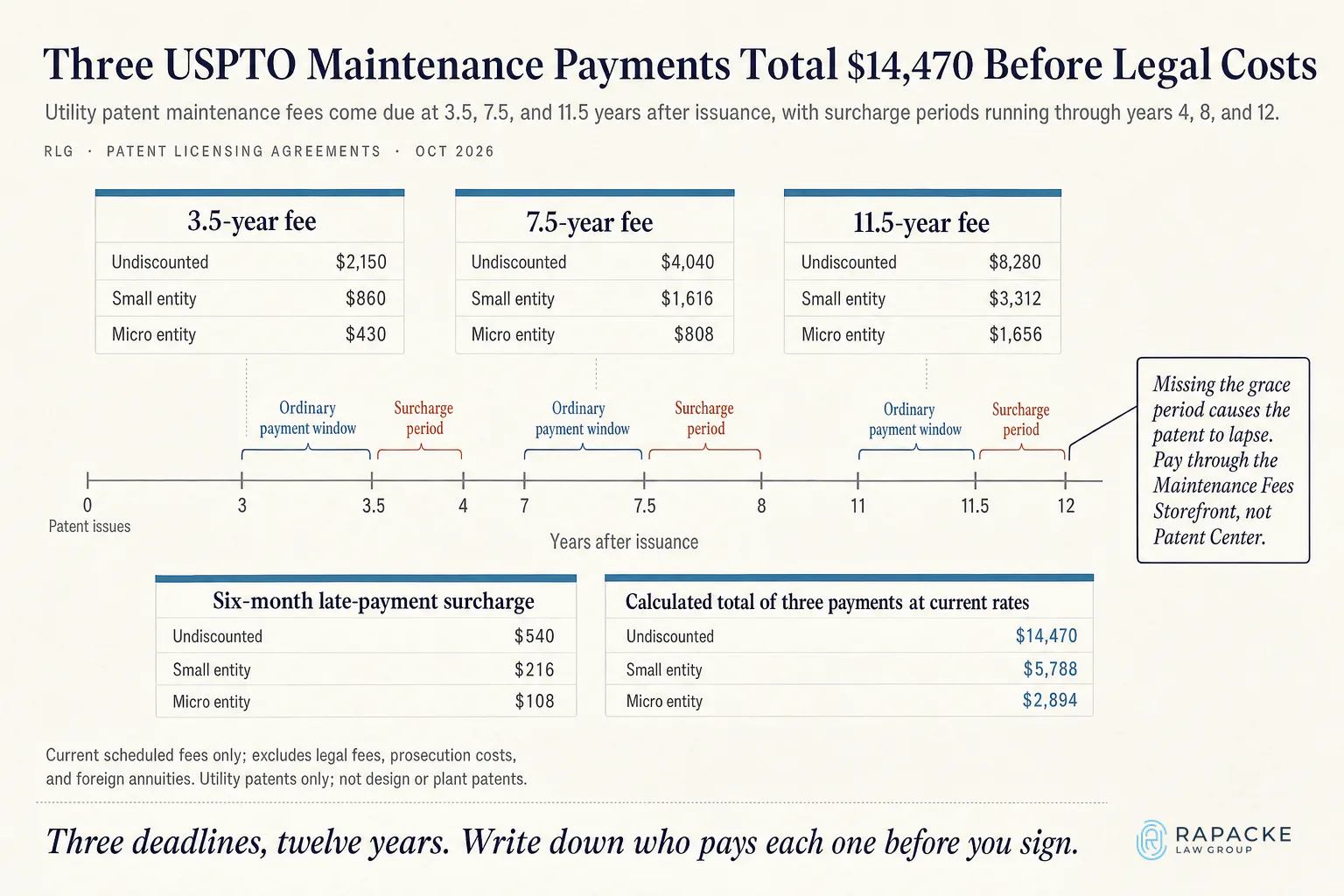
Licensing helps monetize your patent rights while offsetting the first maintenance fee, which the USPTO fee schedule sets at $2,150 for undiscounted entities at 3.5 years.
When You Need to License Someone Else's Patent In
Startups often license in after a freedom to operate analysis finds a blocking patent that creates patent infringement risk.
The Bayh-Dole Act and 37 C.F.R. § 401.14 give the government a nonexclusive, paid-up license in federally funded inventions. Under 35 U.S.C. § 204, a small business or nonprofit that holds title to a federally funded invention generally cannot grant an exclusive right to use or sell it in the United States unless the licensee agrees to manufacture substantially in the United States, though the funding agency may waive this requirement in individual cases.
Which License Type Fits Your Deal Exclusive, Sole, or Non-Exclusive
Pick the license type based on how many partners you expect per field and territory, and on the subject matter each partner will practice.
How an Exclusive Patent License Agreement Shifts Control to the Licensee
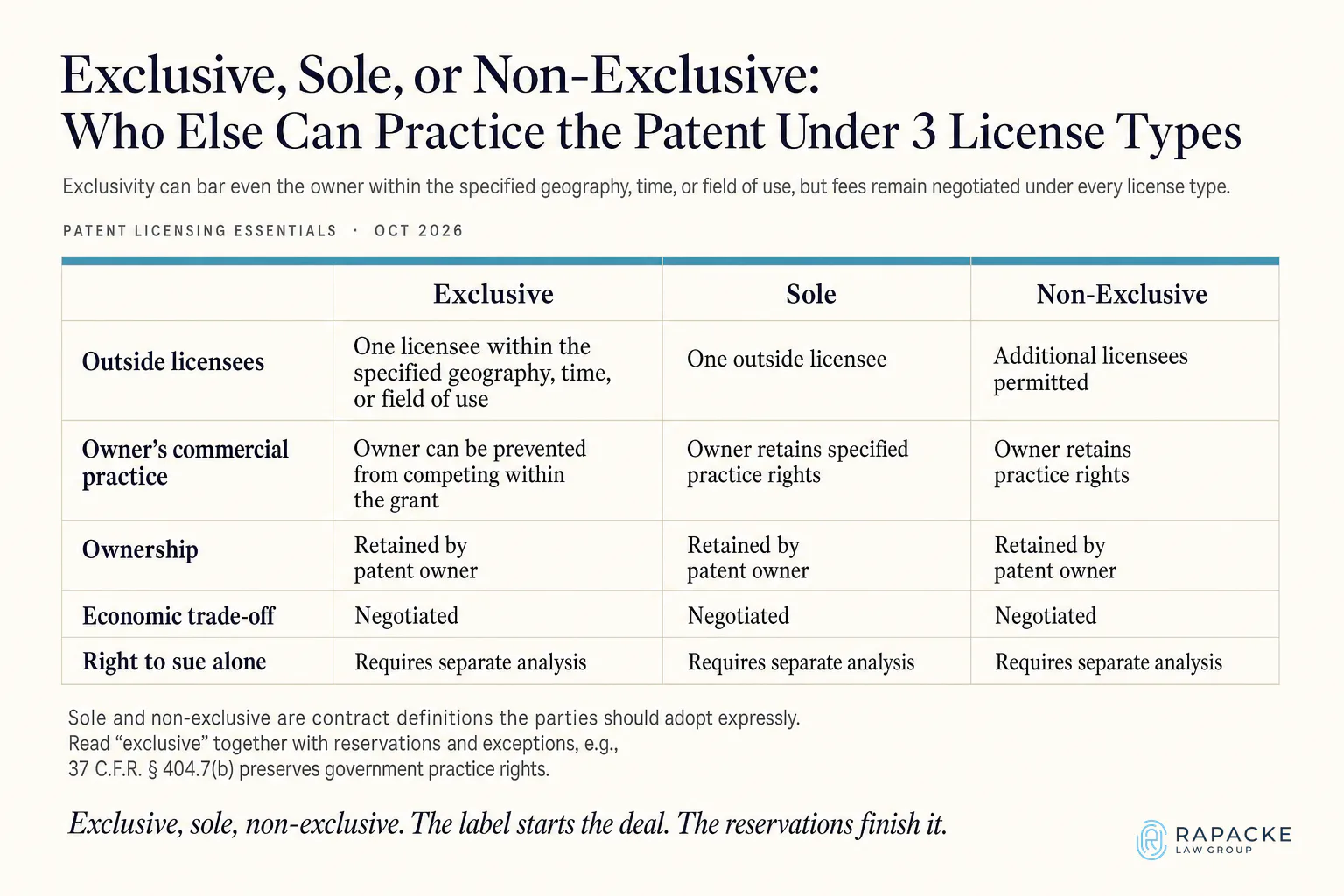
Under an exclusive patent license agreement, the licensee can bar even the patent owner from practicing within the licensed field, territory, and term. Under 37 C.F.R. Part 404, federal inventions get exclusivity only as reasonably necessary, with a development plan. Demand royalty minimums or diligence milestones, and draft enforcement rights separately so the patent owner keeps sole discretion over whether to sue and bears sole responsibility for any legal action it chooses to bring.
When Non-Exclusive or Sole Licenses Serve You Better
Non-exclusive licenses suit widely needed platform technology, where the subject matter is useful across many licensees. Define "sole" expressly, and treat all fees as negotiated.
| License Type | Who Can Practice | Best For |
|---|---|---|
| Exclusive | Licensee only | Partner funding commercialization |
| Sole | Licensee and owner | Co-marketing while you keep selling |
| Non-exclusive | Owner and any licensees | Broad industry revenue |
Which Clauses Decide Whether the Agreement Protects You
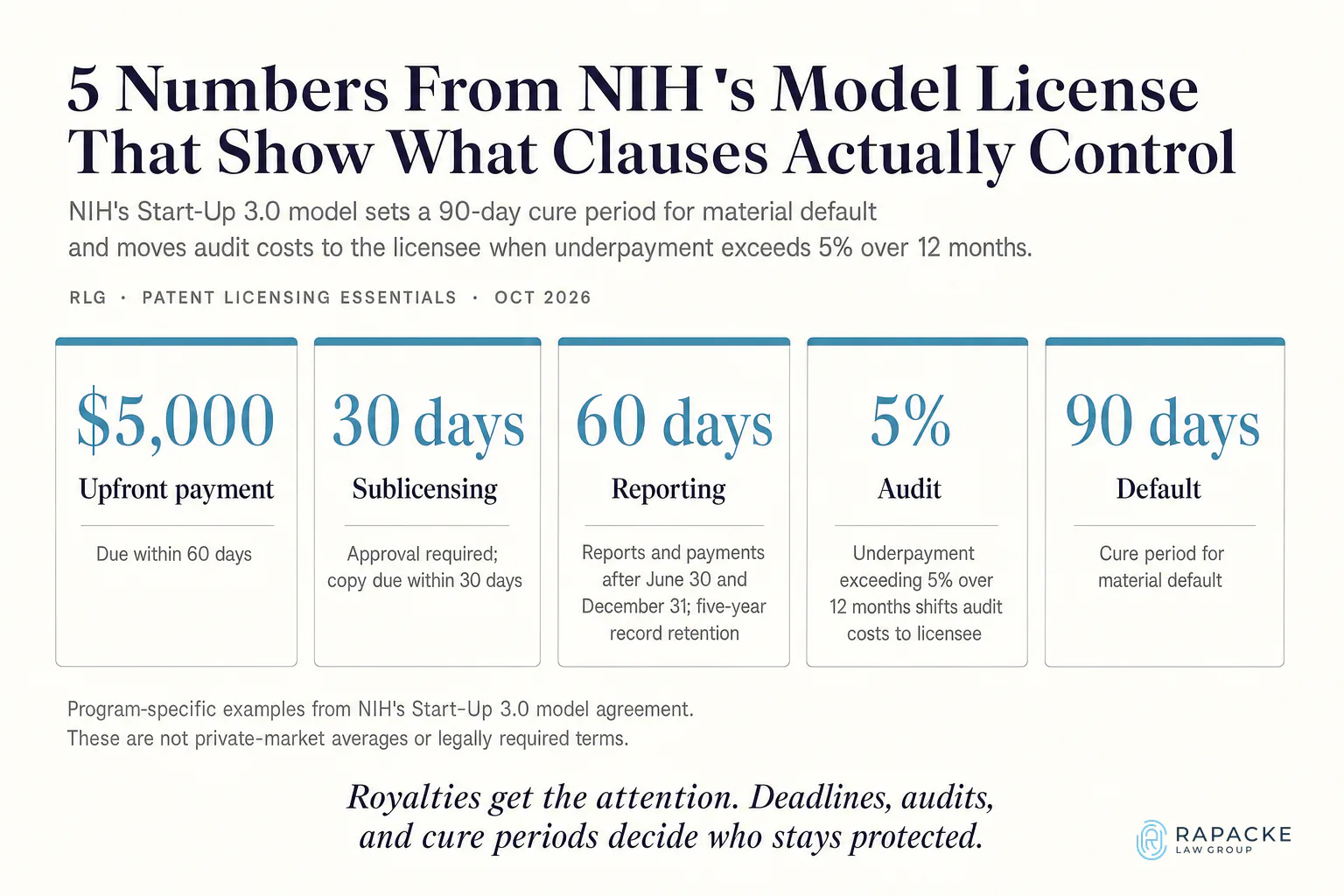
Three clause groups decide most outcomes, grant scope, payment terms, and risk and exit provisions, and patent counsel should review each one. The NIH Start-Up 3.0 model license shows how specific each should be.
Scope of the Grant Including Field of Use, Territory, and Sublicensing
Schedule licensed patents and patent applications by number, including any pending patent applications, and limit field of use and territory. Vague definitions of the subject matter invite disputes over improvements and permitted uses.
Require the licensor's prior written consent before any sublicense, assignment, or change of control, treat any joint venture as a transfer needing prior written approval, and check affiliate-transfer exceptions. NIH requires sublicense copies within thirty 30 days.
Payment Terms Including Upfront Fees, Royalties, and Milestones
Cover these, in U.S. dollars:
- Upfront fee
- Running royalties on precisely defined net sales
- Milestone payments
- Annual minimums
NIH's exclusive license templates leave upfront amounts negotiable. Many require royalty reports within sixty 60 days after June 30 and December 31, and annual progress reports within sixty 60 days after December 31. Tie royalty duration to the last valid claim, and stop royalties on any such claim once it is held invalid.
In Uniloc USA, Inc. v. Microsoft Corp. (2011), the Federal Circuit rejected the 25% rule of thumb as untied to case facts, so avoid formula pricing.
Indemnification, Warranties, and Termination Windows
Indemnification allocates product liability, property damage, and third-party infringement claims, and a licensee facing a product liability claim should carry commercial general liability insurance with broad form contractual liability coverage. Licensors usually disclaim fitness for a particular purpose.
One workable structure allows thirty 30 days to cure payment defaults and sixty 60 days for other breaches, with notice of breach given within thirty 30 days of discovery. NIH's internal-use nonexclusive model uses 90 days. Add patent challenge termination rights, and have qualified legal counsel confirm enforceability.
How to Put a Patent Licensing Agreement in Place Step by Step
Fix ownership before negotiating terms.
Prepare Before You Negotiate
- Collect inventor, employee, and contractor assignments covering each patent application and such application continuations. Under 35 U.S.C. § 262, co-owners need no consent to practice, so confirm patent ownership first.
- Verify status in USPTO Patent Center, which has required identity verification for all Patent Center users since September 11, 2025.
- Confirm maintenance fees ($14,470 total) are paid. Late payments add $540.
- Decide whether know-how, technical information, or pre-existing intellectual property is included.
- Sign a patent non-disclosure agreement before sharing technical details.
Negotiate Terms, Then Draft and Sign
Agree on exclusivity, field, territory, and economics in a term sheet, then draft and sign through authorized representatives of each party. Assign patent prosecution control and patent costs, with the licensee bearing the sole cost where it holds exclusivity. AUTM institutions reported nearly 2,000 license amendments in FY2025.
Why Software and AI Patent Licenses Need Extra Precision
Software and AI products keep changing while each pending claim and issued claim stays fixed. A vague grant invites disputes over whether new versions are covered.
Defining Licensed Technology When Code Keeps Changing
State whether improvements, new versions, and derivative models are licensed, whether such patents and such applications cover them, and where patented methods run. Code, model weights, and support need a separate proprietary software license.
Alice Corp. v. CLS Bank International (2014) held generic computer implementation insufficient for eligibility, and licensees discount for that risk. Well-drafted computer software patent claims shrink the discount (SaaS Patent Guide 2.0, AI Patent Mastery).
Export Controls and Technical Data in Cross-Border Deals
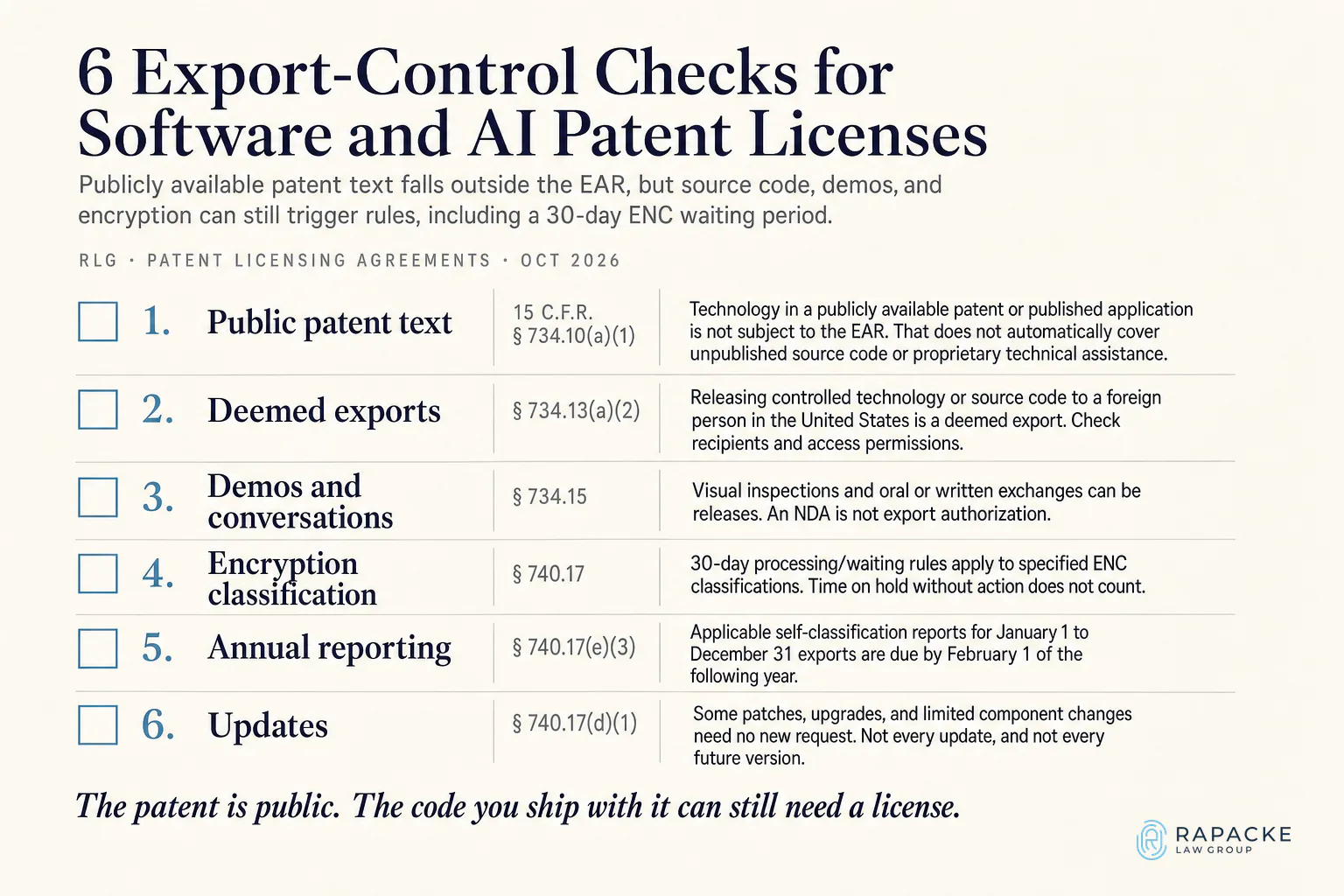
For AI and encryption technology, releasing controlled source code to a foreign person in the United States is a deemed export under 15 C.F.R. § 734.13 of the Export Administration Regulations (EAR). Published patents are excluded under 15 C.F.R. § 734.10(a)(1), but unpublished code may be controlled.
Some encryption classifications under § 740.17 carry a 30 days wait. Require U.S. law compliance, bar re-export without the licensor's prior written consent, and use the SaaS Agreement Checklist with patent counsel's legal advice.
Frequently Asked Questions About Patent Licensing Agreements
What are the disadvantages of a licensing agreement?
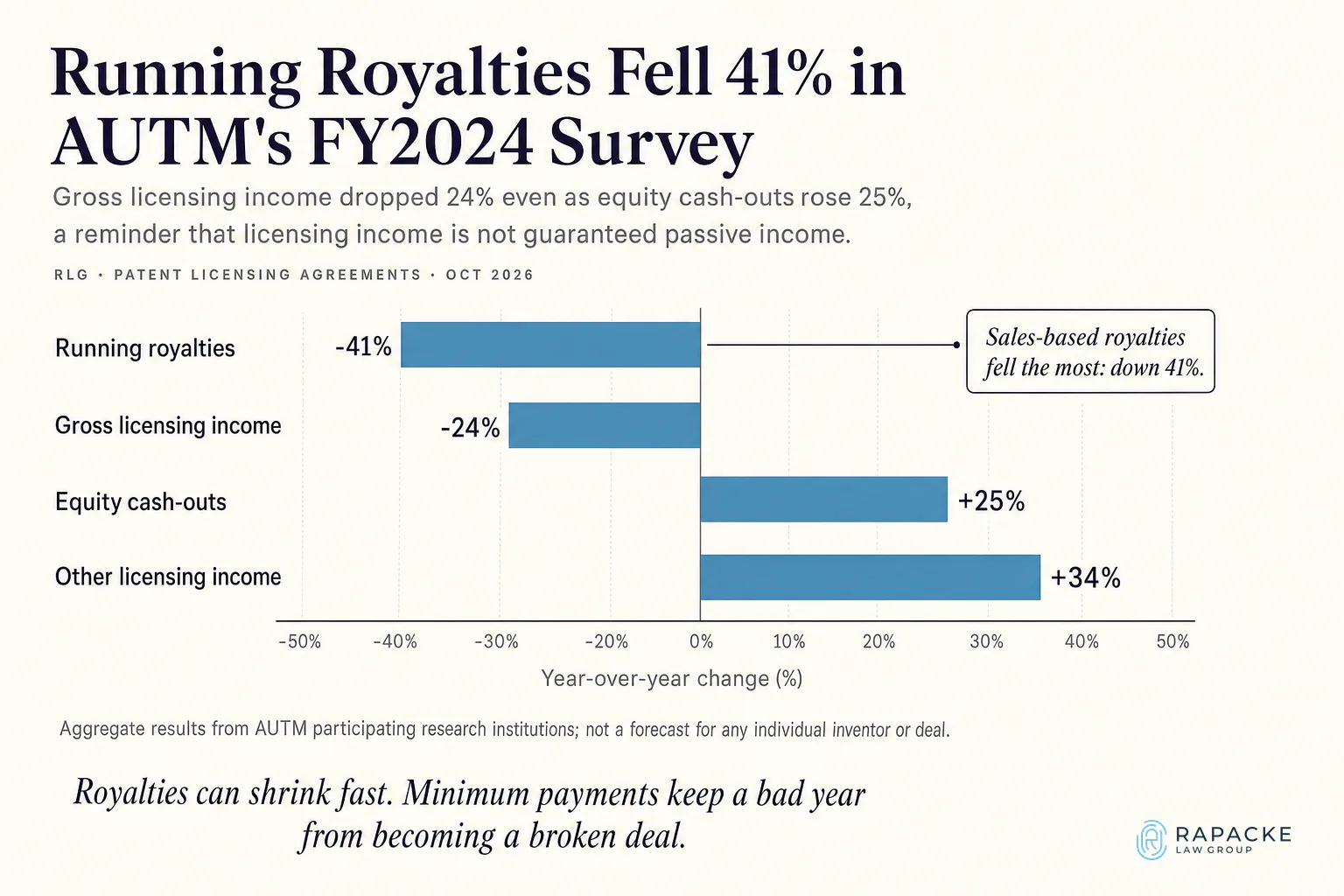
You lose control over quality and pricing. Royalties are also volatile, and AUTM's FY2024 survey reported running royalties fell 41%.
How much does a licensing agreement cost?
Cost depends on exclusivity, patent count, scope, whether a deal involves technology transfer, and negotiation. Rapacke Law Group's fixed fees set costs upfront.
Can I refuse a EULA?
Yes, but you generally cannot then use the software, per Microsoft's standard terms. Unlike most patent licenses, consumer EULAs are typically offered on a take-it-or-leave-it basis, though enterprise customers often negotiate custom terms.
Can a licensee challenge the validity of my patent?
Yes, licensees can contest patent validity. Lear, Inc. v. Adkins (1969) allowed licensee challenges, and MedImmune, Inc. v. Genentech, Inc. (2007) removed any need to breach first.
What happens to royalties after the patent expires?
Brulotte v. Thys Co. (1964), reaffirmed in Kimble v. Marvel Entertainment, LLC (2015), bars patent royalties after expiration. Deferred payments for earlier use can continue.
Do I need to record a patent license with the USPTO?
No, but recording a license with the USPTO creates public notice under MPEP § 313, and prior written consent from the patent owner may be needed to transfer it. Under 35 U.S.C. § 261, failing to record an assignment within three months can cost it priority against a later bona fide purchaser or mortgagee.
Protect Your Patent Rights Before You Sign the License
One exclusivity clause, vague royalty base, or missing termination right can cap revenue for the patent's life and weaken intellectual property rights.
Your Next Steps to Patent Licensing Success
A patent licensing agreement works when it defines what you grant, how you're paid, and how you exit.
Signing a poorly drafted license has real business costs. You can lose years of royalty revenue, block a larger buyer from acquiring the technology, or watch a licensee shelve your invention while you cannot license it to anyone else. Those problems are far cheaper to prevent before signing than to unwind afterward.
The bottom line: A weak patent licensed loosely hands a licensee the upper hand, while a strong patent licensed with clear, enforceable terms keeps you in control. Tie exclusivity to performance and define royalties clearly. Vague terms let a licensee shelve your invention or underreport sales.
- Schedule a Free IP Strategy Call with your term sheet
- Gather patent numbers, assignments, and maintenance fee records
- Map fields and territories before offering exclusivity
- Not filed yet? Start with a patentability search backed by the RLG Guarantee, a 100% refund if your invention is not novel
Rapacke Law Group charges fixed fees, so you know costs upfront.
To Your Success,
Andrew Rapacke
Managing Partner, Registered Patent Attorney
Rapacke Law Group