


Key Takeaways
- A URL alone is not enough. Your product must carry "Patent" or "Pat." plus a free public address tying each article to its patent numbers.
- Map products to patents model by model, because a bare portfolio list leaves the statutory link unresolved.
- Put marking duties in every license. In *Arctic Cat*, a licensee's unmarked sales cost the patent owner its pre-suit damages.
- Expired patents that once covered a product sit in a statutory safe harbor from false-marking liability, though that safe harbor does not address constructive notice under § 287(a). Patents that never covered it do not.
Written by Andrew Rapacke, Managing Partner, Registered Patent Attorney. Andrew Rapacke is a registered patent attorney and the Managing Partner of The Rapacke Law Group, a full-service intellectual property law firm. He helps individuals and corporations across industries with the protection, prosecution, licensing, and enforcement of their intellectual property, with deep experience in patent, trademark, and copyright matters spanning software, AI and machine learning, blockchain, medical devices, and autonomous vehicle technology. A graduate of the United States Naval Academy, Andrew served as a Naval Engineering Officer before pursuing law and remains active in the startup and inventor communities throughout Florida.
A competitor can copy your patented product for years, and a sloppy patents webpage can still leave you unable to collect for most of that time, even for patented products you launched long ago. Section 287(a) also bars pre-notice damages when a patented article made, sold, or imported for or under you goes unmarked, though it does not reach patents asserting only method claims. This guide to patent virtual marking covers what the statute requires, which mistakes cost the most, how Arctic Cat v. Bombardier allocates the burden of proof, and how to build a page that survives due diligence.
What Does Patent Virtual Marking Actually Require Under 35 U.S.C. 287(a)?
Patent virtual marking requires the word patent or "pat." plus a free public URL tying the article to its patent numbers.
The Statutory Language After the Leahy-Smith America Invents Act
Section 16 of the Leahy Smith America Invents Act (September 16, 2011) added this option for pending and later-filed cases, per the AIA text.
What Counts as a Patented Article and When Method Claims Change the Rules
Marking covers products, not processes, and the marking statute does not demand more for method-only patents. Under Hanson v. Alpine Valley Ski Area (Fed. Cir. 1983) and Crown Packaging v. Rexam (Fed. Cir. 2009), asserting only method claims avoids marking. This is common in software patents, as these software patent examples show.
Why Does Virtual Patent Marking Protect Your Revenue and Valuation?
Marking gives constructive notice, meaning the law treats the public as informed of your patent once your product is properly marked, which matters in any patent infringement suit. That preserves pre-notice damages. Otherwise, recovery starts at actual notice or suit, devaluing your patent rights.
Constructive Notice Versus Actual Notice
Amsted Industries v. Buckeye Steel Castings, 24 F.3d 178 (Fed. Cir. 1994), requires actual notice to accuse a specific product. In Belden Canada ULC v. CommScope, the District of Delaware granted CommScope's motion for summary judgment on failure to mark in October 2025. Belden's products practicing the patent were unmarked, and actual notice came only with its 2022 complaint, after the patent's 2019 expiration.
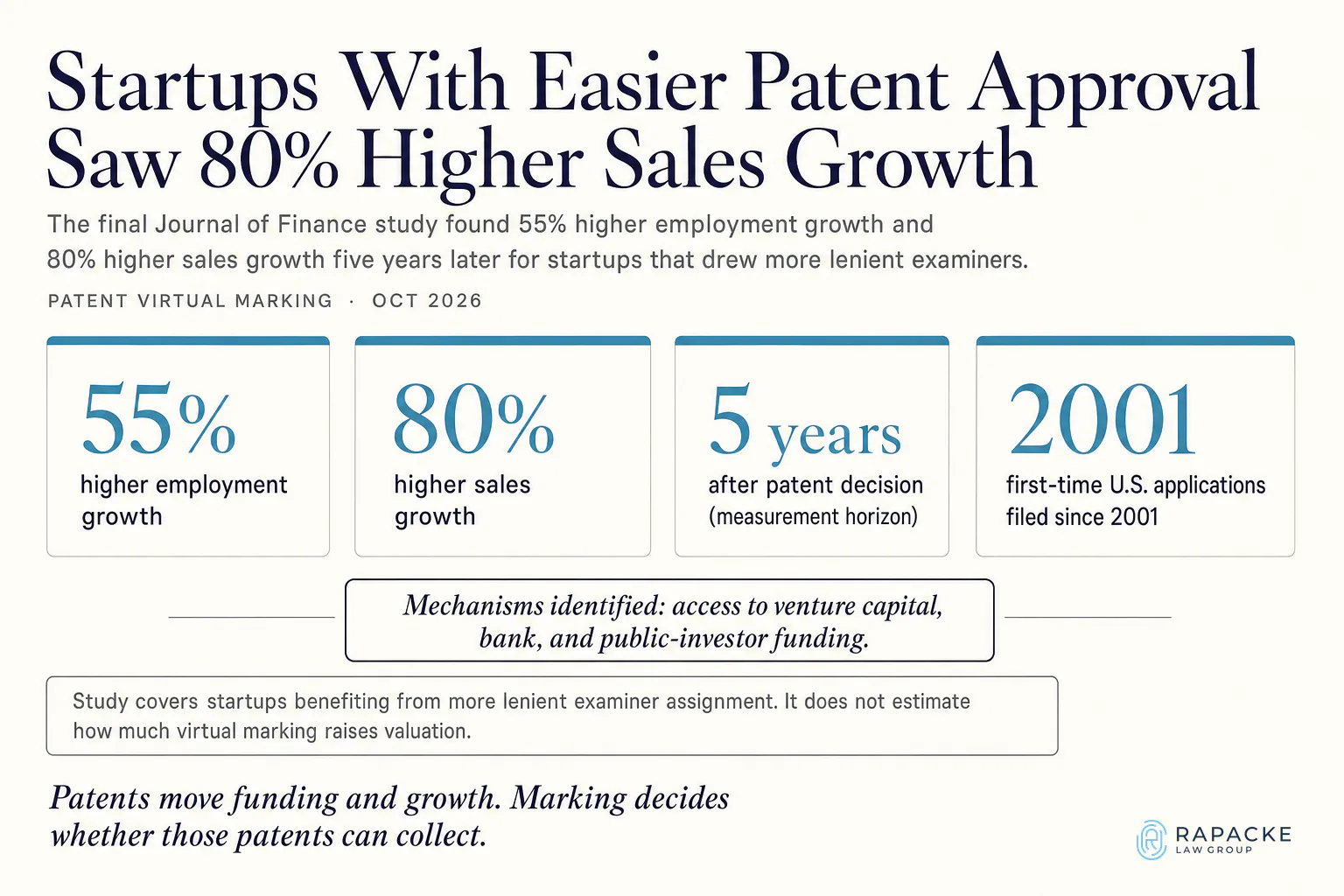
Why Investors and Acquirers Check Your Marking Page
It measured grants, not marking, yet unmarked products shrink modeled damages (SaaS Patent Guide 2.0).
Which Virtual Marking Patent Mistakes Cost Patent Owners the Most?
The costliest errors break product-patent links or let pages go stale. The Arctic Cat section covers unmarked licensee sales.
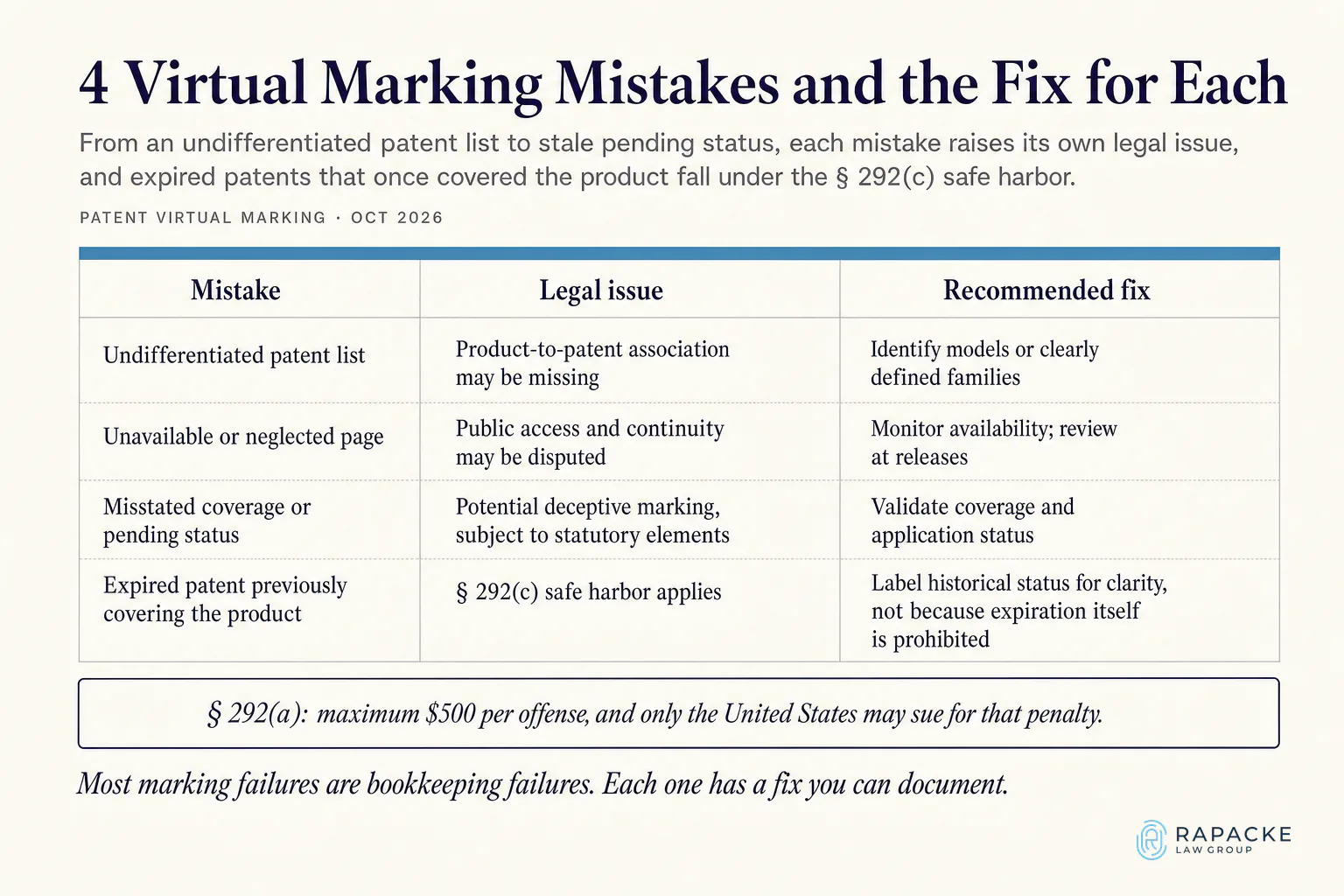
Listing Patents Without Tying Them to Specific Products
Section 287(a) requires associating each article with its patent number, including for products covered by more than one patents listing. The USPTO's 2014 Report on Virtual Marking endorses no single format, and the Patent and Trademark Office leaves layout to the owner. Map models to patents, so each product shows its associated patents.
Broken Links, Paywalls, and Stale Pages
The page must be free and public, and it should identify each patented invention it covers. Per the USPTO, prolonged downtime or infrequent updates to patent information may undermine constructive notice. Monitor uptime, and add additional patents to the page as soon as they issue.
Leaving Expired Patents on the Page
Under 35 U.S.C. § 292(c), expired patents that once covered the product are not false patent marking. That safe harbor under the false marking statute addresses false-marking liability only. It does not establish that keeping expired patents on the page preserves constructive notice under § 287(a). Patents that never covered it are the real risk, because a false marking claim can follow.
How Did Arctic Cat v. Bombardier Change the Burden on Patent Owners?
Arctic Cat Inc. v. Bombardier Recreational Products Inc., 876 F.3d 1350 (Fed. Cir. 2017), a Federal Circuit decision, shows why owners should keep marking records ready. Accused infringers need only point to unmarked products, so each patent holder must be able to show compliance or non-practice.
Keep Marking Records Ready
Arctic Cat sought royalties reaching back to October 2008. The 2020 follow-up decision held that halting unmarked sales didn't restore lost damages, so marking should start at launch.
Licensees Can Break Your Marking Chain
Arctic Cat's 2002 Honda license dropped marking, so Honda's unmarked sales undercut damages. Require marking, reporting, and audits in licenses, since patent holders remain responsible for their licensees' compliance.
Is Patent Virtual Marking Better Than Physical Marking for Your Product?
Neither method ranks higher legally for patent protection purposes. Pick whichever your team can keep accurate.
| Method | Best For | Main Risk |
|---|---|---|
| Physical | Stable products | Outdated inventory |
| Virtual | Frequent releases | Downtime or missing mapping |
| Hybrid | Redundancy | Conflicting information |
The USPTO concluded that virtual marking likely cut manufacturing costs, though it published no savings figure.
Best for SaaS, Apps, and Connected Devices
Virtual marking fits SaaS, apps, connected devices, and autonomous vehicle platforms because coverage shifts with each release and new patents issue. iRobot's patents page maps its Looj 300 series to U.S. patents 8,196,251 and 8,453,289. Pure software sellers should vet About-screen placement with counsel, since this article is not legal advice for your situation. AI Patent Mastery covers claim strategy for AI inventions.
Best for Small Products and D2C Brands
Small goods and Amazon sellers suit hybrid marking, pairing each item with its corresponding patents online. Print "Pat." plus the URL on the item, next to each listed patent. Use packaging only when that's impossible.
How Do You Build a Virtual Patent Marking Page That Holds Up?
Use a free, stable URL like company.com/patents, audited quarterly and at each status change, listing the applicable patent numbers for every product.
The Page Structure That Satisfies the Statute
The statute sets no layout. Include:
- Each product's granted U.S. patent numbers
- Separate "patent pending" listings (no constructive notice)
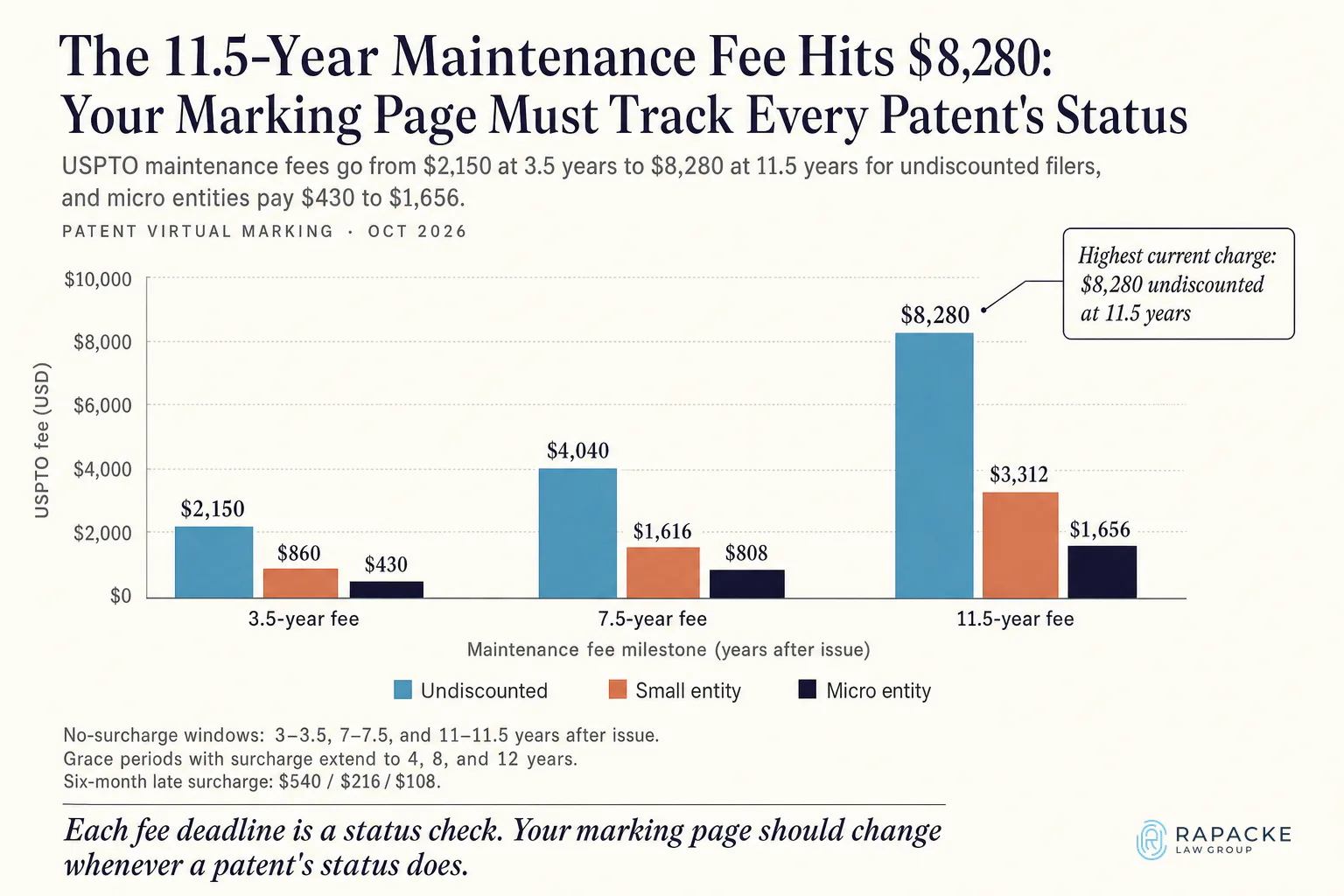
The Maintenance Calendar Most Patent Owners Skip
Fees of $2,150, $4,040, and $8,280 fall due at 3.5, 7.5, and 11.5 years (USPTO fee schedule). Micro entities pay $1,656 at 11.5 years.
Frequently Asked Questions
How much does it usually cost to get a patent?
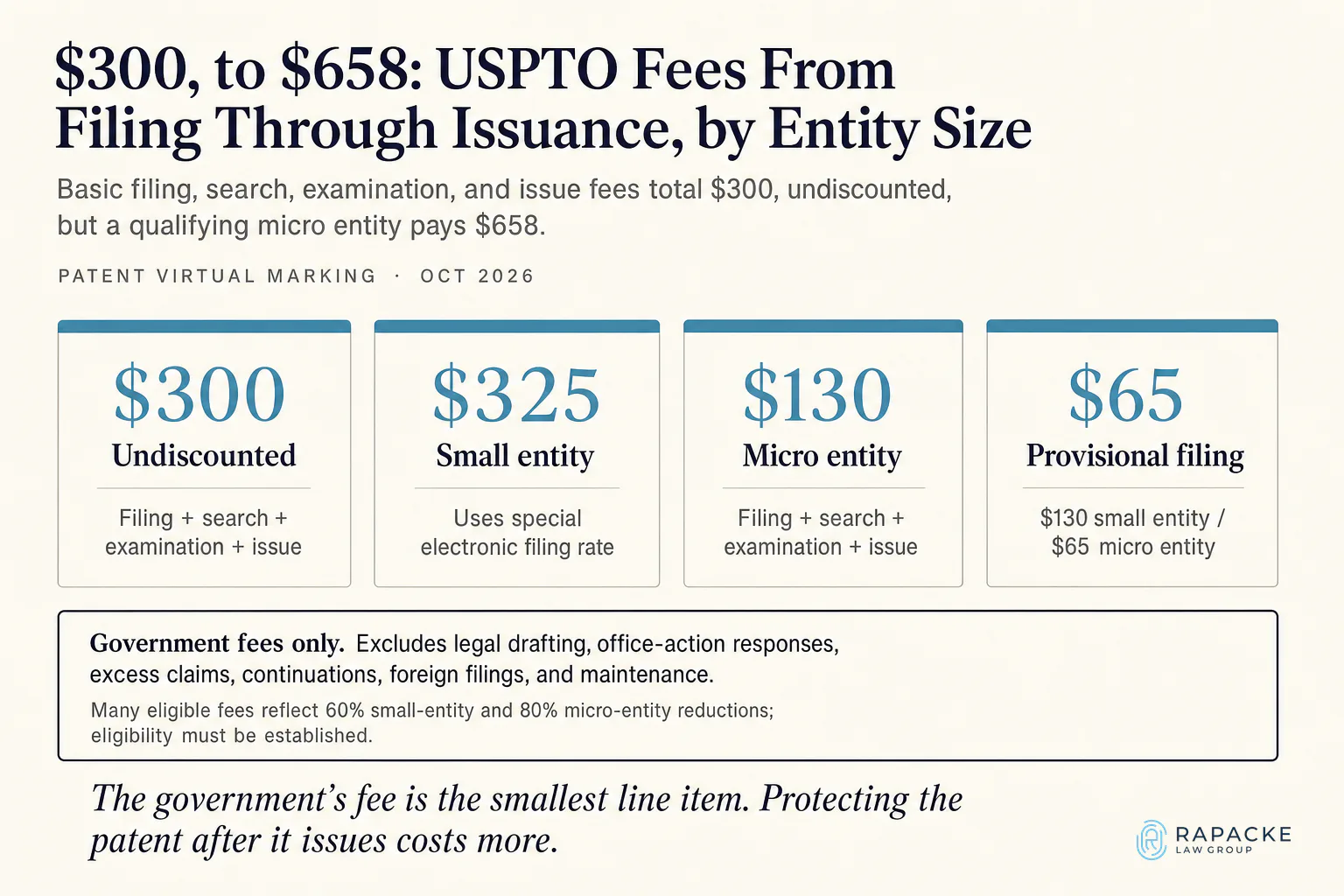
USPTO fees through issuance total $3,290 for large entities before attorney work. Small entities pay $1,316, and micro entities pay $658.
How much is a poor man's patent?
Mailing yourself a description creates no rights under the Leahy Smith America Invents Act first-inventor-to-file rule (March 16, 2013). A provisional application costs $325, or $130 for small entities.
What are the 5 requirements of a patent?
A United States patent on a utility invention requires eligible subject matter, usefulness, novelty, non-obviousness, and adequate disclosure. These come from Patent Act Sections 101, 102, 103, and 112.
What types of things cannot be patented?
Laws of nature, natural phenomena, and abstract ideas are unpatentable. Alice Corp. v. CLS Bank International (2014) held that running an abstract idea on a generic computer is not enough. That test shapes patents on artificial intelligence.
What are the differences between copyright, patent, and trademark?
Per the USPTO, patents protect inventions, trademarks identify brands, and copyrights protect expression. Patents use "Pat." or a virtual marking URL, trademarks use ®, and copyrights use ©.
Can I sell my idea for an invention?
Patents and pending applications, assignable in writing under Section 261, sell far more easily than bare ideas. Licenses should assign marking duties, as Arctic Cat shows.
Stop Losing Patent Value to a Forgotten Webpage
One unmapped product or one license without a marking clause can cut off years of pre-suit damages in patent litigation and weaken your story in funding diligence. Rapacke Law Group audits marking pages, maps products to patents, and drafts licensee marking clauses as part of patent portfolio management. RLG handles this work for a flat, transparent fee, so you get predictable costs with no hourly billing surprises.
Your Next Steps to Patent Virtual Marking Success
Patent virtual marking works only when a stable public page maps every product to its patents.
The bottom line: Proper patent marking preserves up to six years of damages. Weak marking limits recovery to the day you sue.
Unmarked launches open gaps that, per Arctic Cat, cannot be closed retroactively.
- Schedule a Free IP Strategy Call to review your marking
- Map products to patent numbers, add marking clauses to licenses, and audit quarterly
The RLG Guarantee refunds provisional applications in full if the USPTO denies them and patentability searches in full if the invention is not novel. A small flat-fee marking audit today can protect up to six years of recoverable damages and strengthen your valuation in funding diligence.
To Your Success,
Andrew Rapacke
Managing Partner, Registered Patent Attorney
Rapacke Law Group