


Key Takeaways
- A Notice of Allowance is not a trademark registration. It is a conditional approval that requires proof of commercial use before the USPTO will issue a registration certificate.
- Only intent-to-use applicants receive a Notice of Allowance. If you filed under use-in-commerce, you receive a registration certificate directly.
- You have six months from the NOA issue date to file a Statement of Use or an extension request. Missing that window abandons your application with no refund.
- Extensions cost real money per class and compound quickly. Budget for them early if your product launch is more than six months away.
- Once registered, set maintenance deadlines immediately. Missing the Section 8 Declaration between years five and six cancels the registration.
*Written by Andrew Rapacke, Managing Partner, Registered Patent Attorney.*
A significant share of trademark failures happen not during examination but after the USPTO has already approved the mark. If you just received a Notice of Allowance, you are closer to registration than most applicants get. What you do in the next six months determines whether you actually get there.
What Does It Mean to Receive a Notice of Allowance and Why It Is Not the Finish Line
The Notice of Allowance (NOA) signals that the United States Patent and Trademark Office has reviewed your intent-to-use trademark application, found no legal obstacles, and cleared the mark for registration. But the USPTO will not issue a registration certificate until you prove the mark is actually in use in commerce. Per TMEP Section 1108 and 15 U.S.C. § 1051(d), you have exactly six months from the NOA issue date to file either a Statement of Use or an extension request. Miss that deadline and the application is abandoned, filing fees included, with no automatic right of reinstatement.
If you want to understand how to get a federal trademark from start to finish, the NOA stage is one of the most consequential steps in the entire process.
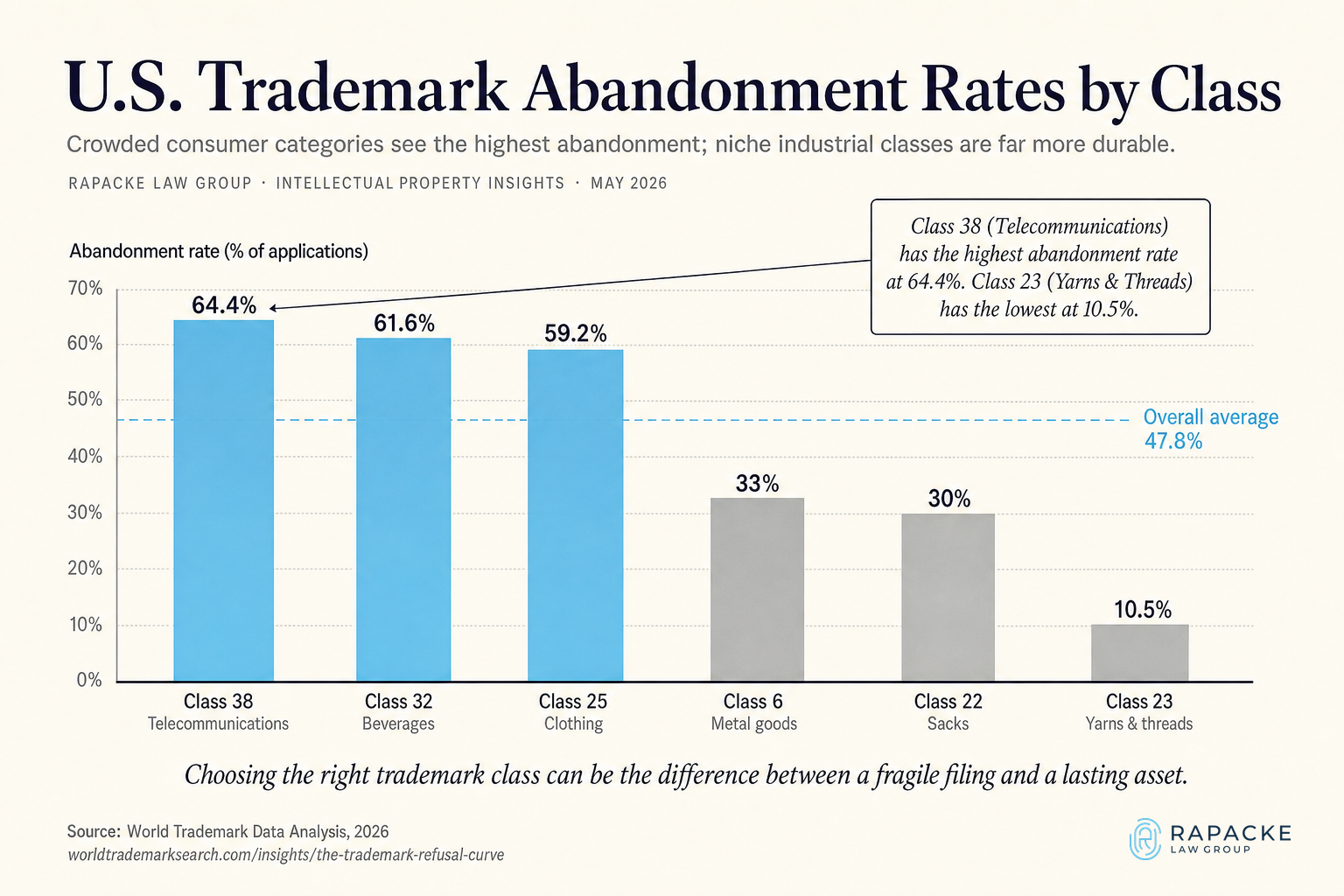 Chart of US trademark abandonment rates by class in % (nationwide average abandonment 47.8%). For example, Class 38 (Telecommunications) has the highest abandonment rate at 64.4%, Source, USPTO Trademark Statistics Dashboard, uspto.gov
Mark the NOA issue date the day it arrives and calculate every downstream deadline before taking any other action.
What the USPTO Is Actually Telling You in the Notice of Allowance
The NOA document lists the approved mark, the identified goods and services, the filing basis, and the explicit deadline for your response. It issues under 15 U.S.C. § 1051(b) after the 30-day publication period in the Official Gazette closes with no successful opposition. According to the USPTO's own guidance on the NOA process, the notice typically issues about eight weeks after publication if no opposition is filed. The USPTO examining attorney has already cleared the application of substantive legal obstacles, so this is a procedural milestone, not a new round of review.
Read the NOA carefully and confirm the goods and services description matches what you actually sell. Errors can be corrected by contacting the USPTO's ITU unit, but catching them before filing a Statement of Use saves time and fees. For a broader look at where the NOA fits, see our guide on understanding the trademark timeline.
Who Actually Receives a Notice of Allowance
Only applicants who filed under an intent-to-use basis (Section 1(b)) receive a Notice of Allowance. Per 37 C.F.R. § 2.81, applicants who filed under use-in-commerce (Section 1(a)) and survive the opposition period receive a registration certificate directly, bypassing the NOA entirely. This distinction trips up many first-time filers who assume the NOA is a universal step in every trademark application.
Confirm your filing basis in the USPTO's Trademark Status and Document Retrieval (TSDR) system before assuming an NOA deadline applies to your situation.
How Long You Have to Respond and What Happens If You Miss the Deadline
The default response window is six months from the NOA issue date. Applicants not yet using the mark can file up to five extension requests in six-month increments, for a total window of up to 36 months from the NOA date. Costs compound quickly across multiple classes. Each extension requires a fee and a sworn statement of continued bona fide intent to use the mark. The current USPTO fee for ITU-related filings is $150 per class for electronic filings and $250 per class for paper filings, as reflected in the updated USPTO fee schedule. For a full breakdown of what those changes mean for your budget, see our overview of new USPTO fee changes.
Budget for extension fees early if your product launch is more than six months away.
Filing an Extension Request vs. Filing a Statement of Use
An extension request simply buys more time. It does not register the mark and does not require proof of use. A Statement of Use (SOU) is the filing that actually triggers examination of your proof of use and, if accepted, leads directly to trademark registration. Under 15 U.S.C. § 1051, "use in commerce" means bona fide use in the ordinary course of trade, not token or internal use made solely to reserve trademark rights.
Do not file a Statement of Use until you have a genuine specimen of real commercial activity ready. A rejected SOU wastes both fees and time without stopping the underlying deadline clock. Our guide on trademark use in commerce explains what qualifies and what the USPTO will reject.
What Happens to Your Application If You Miss Every Deadline
If neither a Statement of Use nor an extension request is filed within the six-month window, the USPTO treats the trademark application as abandoned. An abandoned application cannot be revived by paying a late fee. The applicant must file a brand new application, restart the entire trademark process, lose the original priority date, and treat the entire application as a sunk cost. Per 15 U.S.C. § 1051(d), even a successful petition to revive for unintentional delay cannot extend the total period beyond the 36-month statutory maximum.
Set calendar reminders at 90, 150, and 175 days after the NOA issue date so you are never caught without a plan.
What a Proper Statement of Use Must Include to Avoid Rejection
The Statement of Use is a sworn declaration filed through the USPTO's Trademark Center confirming the mark is now in use in commerce. It requires three components, a declaration of use, a specimen showing the mark in active commercial context, and the filing fee per class (currently $100 per class for TEAS Plus filers, with updated amounts published on the USPTO fee schedule). The USPTO examining attorney reviews the SOU and may issue an office action if the specimen is defective or if the declaration does not match the goods and services description.
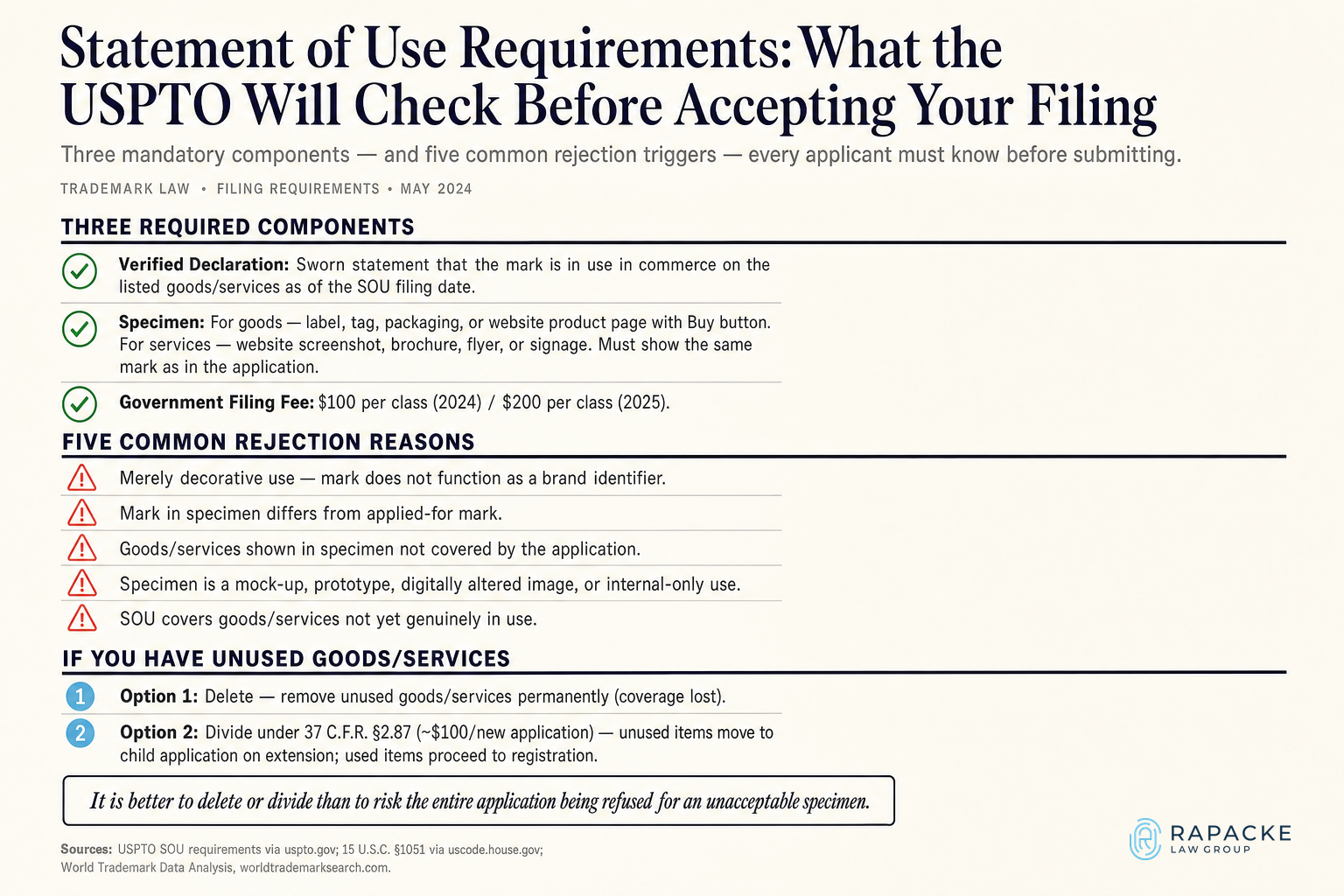 Statement of Use Requirements, What the USPTO Will Check Before Accepting Your Filing, Source, USPTO SOU requirements, uspto.gov, 15 U.S.C. §1051, uscode.house.gov
Match your specimen exactly to the goods and services listed in the original application. Scope creep between the application and the SOU is one of the most common rejection triggers.
Acceptable Specimens for Goods vs. Services
For goods, the USPTO requires the mark to appear on the product itself, its packaging, or a webpage showing the mark next to a functional buy button. For services, acceptable specimens include website pages advertising the service under the mark, brochures, or signage visible to customers. Per TMEP sections 904 through 904.07 for goods and TMEP 1301.04 for services, mock-ups, renderings, and internal-only uses do not qualify. The specimen must show the mark exactly as approved, not a modified version.
Take dated screenshots of your live website showing the mark in active commercial context at the time of filing the SOU.
How the Goods and Services Description Affects Your SOU
If you are only using the mark for some of the listed goods and services, you can delete unused items and file the SOU for what you are actually offering. Deletion is permanent and cannot be reversed, but it is far preferable to abandonment. Alternatively, under 37 C.F.R. § 2.87, you can divide the application, keeping some goods and services active on extension while filing the SOU for those already in commercial use.
Review your goods and services list before filing the SOU and remove any categories where real commercial activity has not started.
How the Trademark Registration Process Continues After Your SOU Is Accepted
Once the USPTO approves the Statement of Use, it issues the registration certificate and the mark receives full federal registration under the Lanham Act. The complete ITU trademark lifecycle typically runs 18 to 30 months from initial filing to registration certificate for an application with no office actions. Registration provides nationwide constructive notice, the right to use the ® symbol, eligibility for Amazon Brand Registry, and the legal basis for federal trademark infringement actions, including legal action against counterfeiters and infringers. For founders building long-term brand equity, our guide on how to get a trademark that protects your brand long-term covers what comes next.
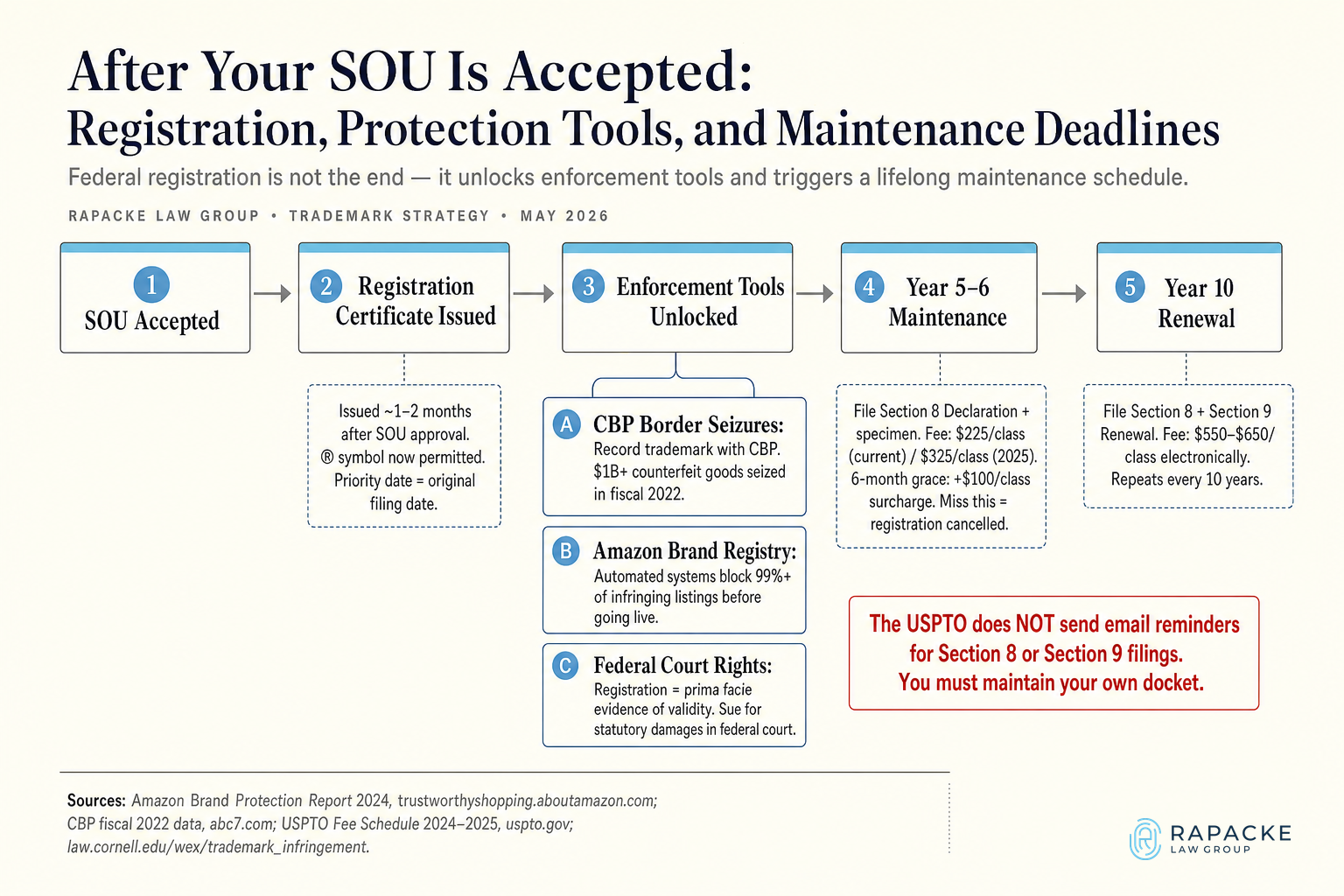 After Your SOU Is Accepted, Registration, Protection Tools, and Maintenance Deadlines, Source, Amazon Brand Protection Report, 2024, USPTO Fee Schedule 2024-2025, uspto.gov
Once registered, set a docket reminder for the Section 8 Declaration of Continued Use deadline between years five and six to keep the registration active.
What Federal Registration Unlocks for Your Brand
Federal registration gives brand owners concrete enforcement tools. The ® symbol, which cannot lawfully be used before registration, signals registered status to competitors and customers alike. Registration allows you to record the mark with U.S. Customs and Border Protection to block infringing imports. Amazon Brand Registry requires a federally registered trademark and gives enrolled brands tools to remove counterfeit listings at scale. According to Amazon's 2024 Brand Protection Report, the company's automated protections blocked over 99% of suspected infringing listings before they were ever reported by brands. Registration also creates a presumption of ownership and validity in federal court, shifting the burden of proof to any challenger.

Apply for Amazon Brand Registry the day your registration certificate issues to start protecting your product listings immediately.
Maintaining and Renewing Your Trademark Registration After It Issues
Federal trademark registration does not last automatically. The first maintenance filing is a Section 8 Declaration of Continued Use, due between years five and six after registration. Combined Section 8 and 9 Renewals are then due at year ten and every ten years after that. Missing these deadlines without curing during the grace period results in cancellation of the registration. Current USPTO maintenance fees and grace period surcharges are published on the USPTO fee schedule.
Create a long-term intellectual property calendar on the day your registration issues with every maintenance deadline mapped through the first renewal cycle, including trademark monitoring alerts for potential infringers.
Frequently Asked Questions
What does notice of allowance mean for trademarks?
A Notice of Allowance from the USPTO means your intent-to-use trademark application has cleared examination and survived the opposition period without a successful challenge. It is a conditional approval, not a registration certificate. You still must prove actual commercial use before the USPTO will register the mark.
What happens after notice of allowance?
After receiving a Notice of Allowance, you have six months to file a Statement of Use proving active commercial use, or an extension request for more time. A successful Statement of Use leads directly to trademark registration. Missing both options results in abandonment of the entire trademark application with no automatic right of reinstatement, meaning the trademark office will require you to start over from scratch.
What is a notice of allowance for USPTO trademark specifically?
The USPTO issues a Notice of Allowance after an intent-to-use trademark application passes examination, survives the 30-day publication period, and clears all procedural requirements. It is the official document from the United States Patent and Trademark Office confirming the mark can be registered once use in commerce is established and properly documented under 15 U.S.C. § 1051(b).
How long does it take to get a notice of allowance?
The USPTO typically issues a Notice of Allowance approximately eight weeks after the opposition period closes with no successful challenges. Combined with examination timelines, most applicants receive an NOA roughly 8 to 18 months after initial filing. Check the USPTO trademark processing wait times for current estimates.
How do I appeal a trademark refusal?
A trademark refusal arrives as an office action, not a Notice of Allowance. If a USPTO examining attorney refuses the mark, the applicant can respond directly within the allotted timeframe. If the refusal is maintained, the applicant can appeal to the Trademark Trial and Appeal Board (TTAB) and, if necessary, to federal court. This process is entirely separate from the NOA pathway.
How long does a trademark registration last?
A federal trademark registration remains in force indefinitely as long as the owner files required maintenance documents on schedule. The first deadline is a Section 8 Declaration filed between years five and six. Combined Section 8 and 9 Renewals are then due every ten years. Missing these deadlines without cure results in cancellation.
Your Next Steps to Trademark Registration Success
A Notice of Allowance is a real milestone, but it is not a finish line. The six-month response window is strict, extensions accumulate real costs per class, and a deficient Statement of Use can stall a registration that took over a year to reach this point. Knowing the deadlines, the specimen requirements, and the division options gives you the control to move from NOA to registration certificate without preventable setbacks.
The bottom line, a weak or untimely SOU response forfeits everything you have invested in the application. A well-prepared filing, backed by a proper specimen and a correctly scoped goods and services list, converts your NOA into a registration certificate.
Every day you wait without a plan is a day closer to an abandoned application and a lost priority date. Working with an experienced trademark attorney who offers comprehensive trademark services from the NOA stage forward costs far less than refiling from scratch and losing your competitive advantage.
Our trademark registration service is built specifically for applicants at this stage. We offer fixed-fee packages, a clear process from NOA through registration certificate, and our RLG Guarantee — get your trademark approved or pay nothing. Whether you need help filing a Statement of Use, managing extension requests, or monitoring your mark after registration, our team handles every step so you never miss a deadline.
To protect your filing before the deadline arrives:
- Schedule a Free IP Strategy Call with Andrew Rapacke to review your NOA timeline and SOU readiness
- Confirm your specimen meets USPTO requirements before filing
- Set all downstream deadlines on your calendar today
- Review our trademark registration service to see how RLG's fixed-fee model and RLG Guarantee work, Get Your Trademark approved or pay nothing
- Explore the DIY trademark cost comparison to understand why professional guidance at the SOU stage pays for itself
A registered trademark is a business asset that compounds in value. Getting it right at the NOA stage is the single highest-leverage step between you and that registration certificate, and experienced trademark attorneys can make the difference between approval and abandonment.
To Your Success,
Andrew Rapacke Managing Partner, Registered Patent Attorney Rapacke Law Group