

Key Takeaways
- The USPTO Trademark Center and patent databases are free to use, but a clean search result is not a guarantee of approval or protection.
- A significant share of trademark applications face an initial Office Action refusal, and an overlooked similar mark is among the most common triggers; making pre-filing searches essential, not optional.
- Unpublished patent applications filed within the last 18 months are invisible in every public database, creating a hidden prior art blind spot that no search tool can close.
- Common law trademark rights arise from use in commerce and never appear in the federal database, making supplemental research beyond the USPTO Trademark Center essential for any high-stakes filing.
- Search results surface data; interpreting that data against legal standards like the *DuPont* factors requires professional judgment.
Many trademark applications face at least one Office Action, and a substantial share of those rejections cite an overlooked earlier mark the applicant never found because they skipped a proper trademark and patent office search before filing. That single oversight can cost a year of delays, thousands in attorney fees, and sometimes the mark itself.
Why Running a Trademark and Patent Search Before You File Can Save You Thousands
Skipping a pre-filing search is one of the most expensive mistakes an inventor or brand owner can make. According to the USPTO Trademarks Dashboard, the USPTO received nearly 765,000 trademark applications in FY 2024, and with filings at record levels, the odds of a conflict with an existing mark are higher than ever. A likelihood-of-confusion rejection triggered by an overlooked registration can consume months of prosecution time and substantial attorney fees before it resolves. First-action trademark pendency dropped to 6.1 months in Q1 2025, down from 7.5 months in FY 2024, according to Stern & Kessler's 2024 USPTO Year in Review, but even that faster pace means a conflicting mark filed after yours could clear examination and register before your own application reaches review.
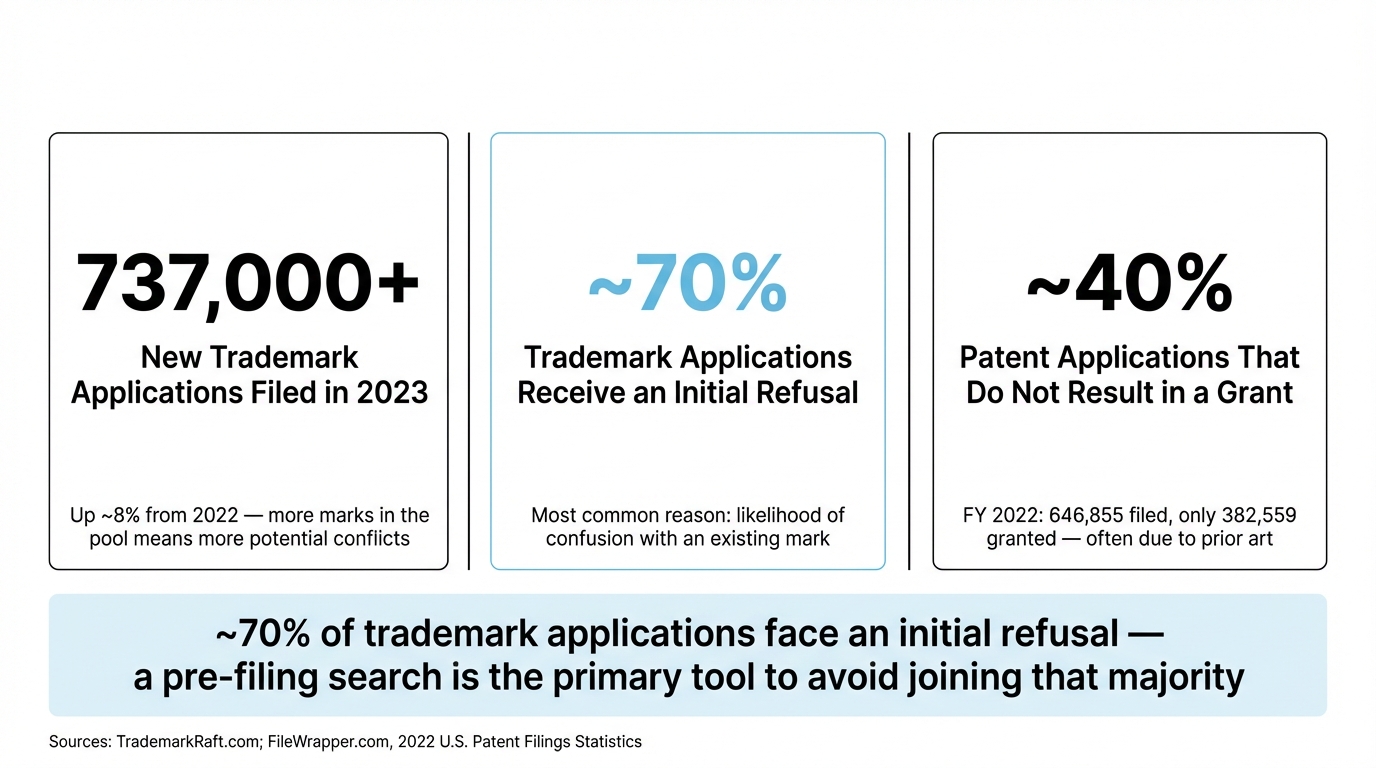
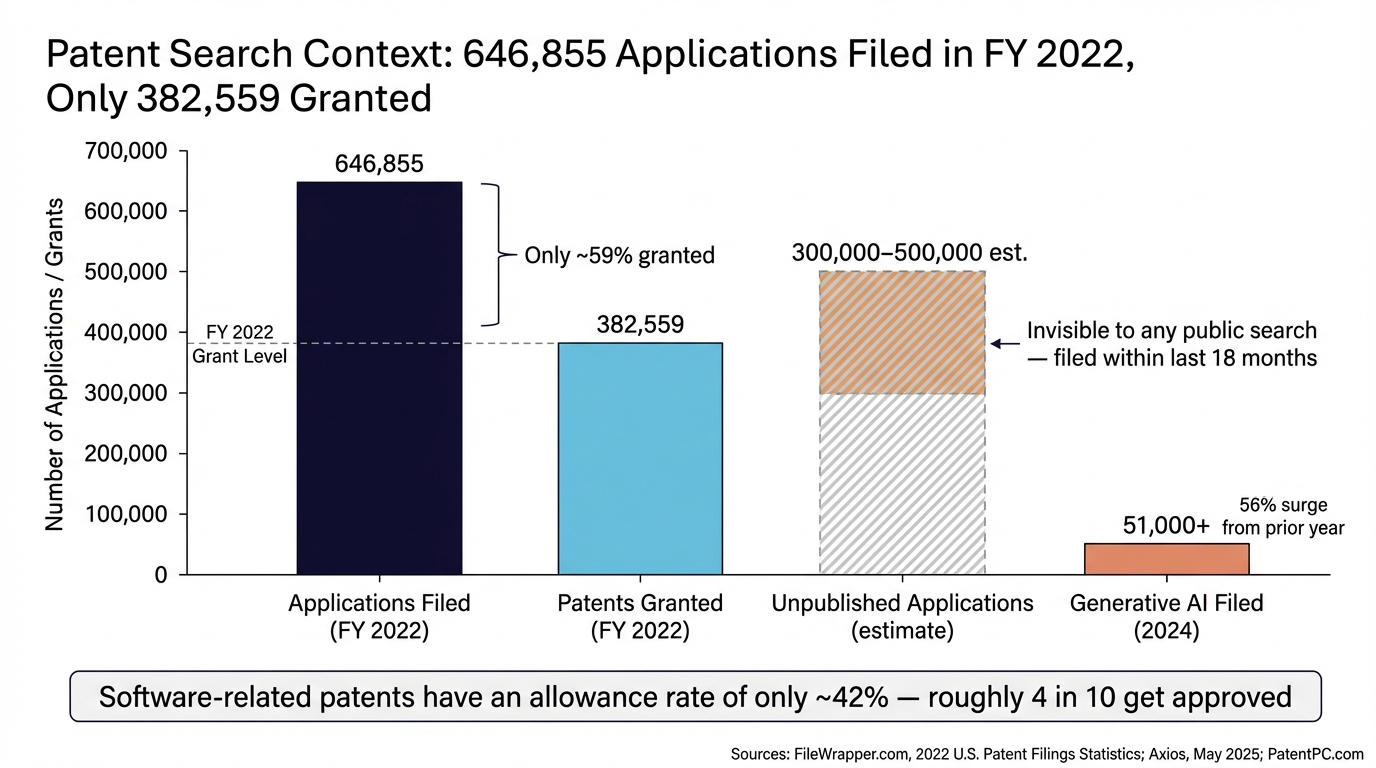
On the patent side, the United States Patent and Trademark Office received 646,855 patent applications in fiscal year 2022 and granted 382,559 patents that year, according to USPTO Patent Activity historical data. That means roughly 40% of applications did not result in an issued patent, often because prior art surfaced during examination that a pre-filing search would have caught. Investing $500 to $2,500 in a professional prior art search before spending $10,000 to $20,000 on prosecution is straightforward risk management.
This article walks through exactly how to search both the USPTO trademark database and patent records, what each result actually tells you, and where professional judgment becomes necessary. By the end, you will know how to run a meaningful search, how to read what you find, and how to decide whether your proposed trademark or invention has a clear path to federal protection.
What the USPTO Trademark and Patent Databases Actually Cover
Understanding what each database contains before you search prevents the false confidence that comes from a superficial clean result.
The Trademark Electronic Search System and the New USPTO Trademark Center
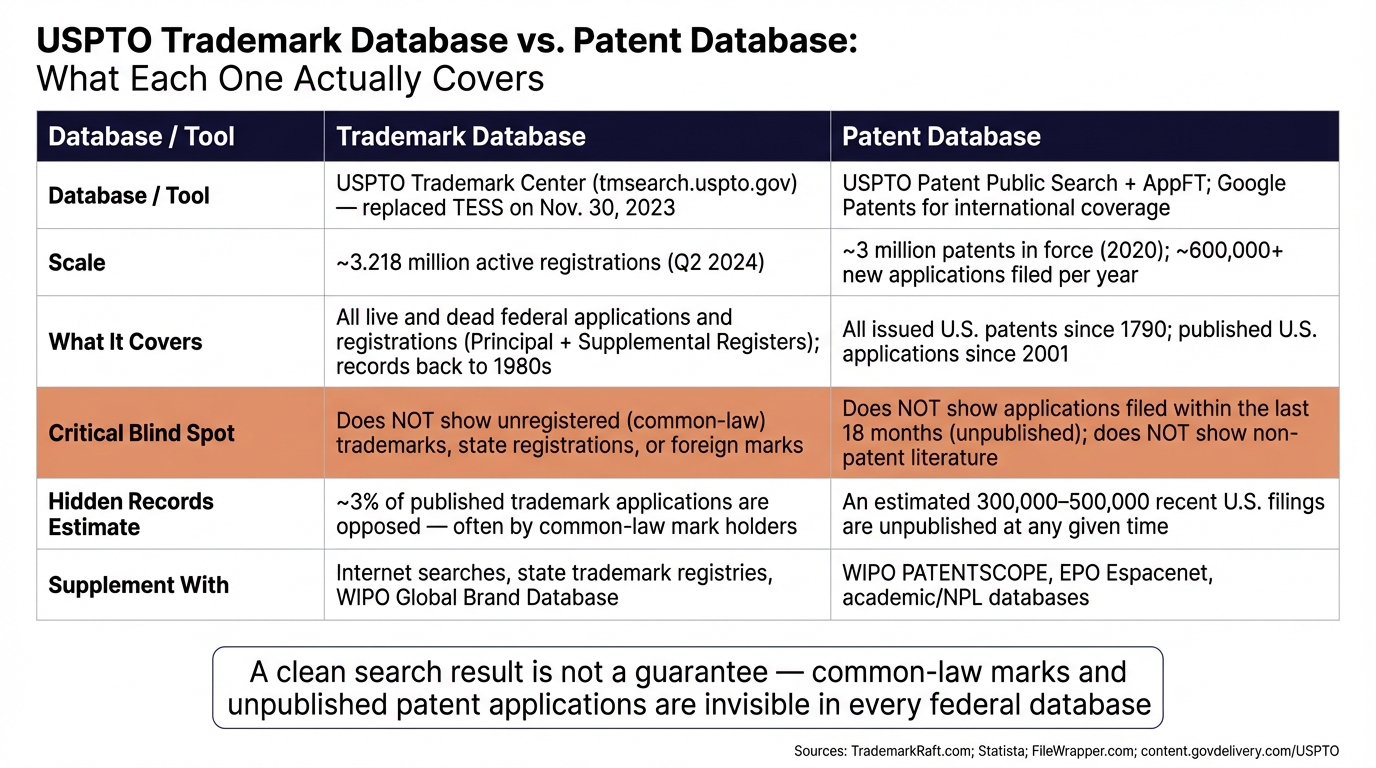
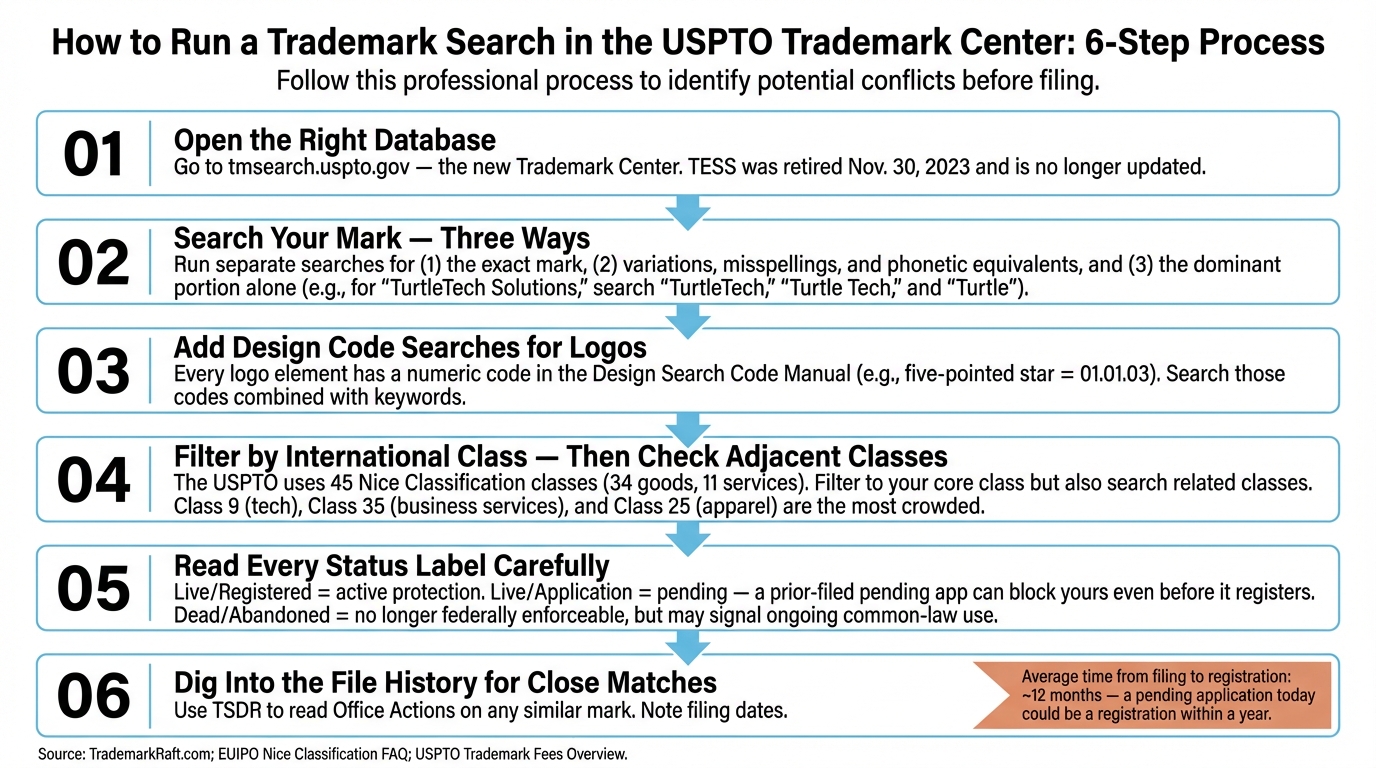
The Trademark Electronic Search System (TESS) was the standard public trademark search tool for decades. The USPTO retired TESS on November 30, 2023, and fully transitioned to the updated cloud-based USPTO Trademark Center at tmsearch.uspto.gov. If you are searching today, use the Trademark Center. The new interface supports both simplified searches and an Expert mode with Boolean logic similar to what TESS offered.
According to Sterne Kessler's 2025 year-in-review, the federal register held over 3.3 million active trademark registrations as of Q1 2025, with the Trademark Center indexing all pending applications and registered trademarks on both the Principal and Supplemental Registers going back to the 1980s in digitized form. Always search both live and dead records. A dead registration no longer blocks your application at the USPTO, but the owner may still be using the mark in commerce under common law trademark rights that the database will not show.
Before selecting your International Class, it helps to understand what trademark requirements apply to your mark and whether it qualifies for federal registration in the first place.
What the USPTO Patent Database Contains and What It Misses
The USPTO's Patent Full-Text and Image Database (PatFT) covers all issued U.S. patents since 1790. The Patent Application Full-Text Database (AppFT) covers published pending applications since 2001. Google Patents aggregates USPTO data alongside records from WIPO, the European Patent Office, and other jurisdictions, making it a practical complement for any search.
The most important limitation is the 18-month publication window. U.S. patent applications are not published until 18 months after their filing date, which means any application filed within the last 18 months is invisible in every public database. With roughly 600,000 applications filed annually, an estimated 300,000 to 500,000 recent filings are confidential at any given time. A clean USPTO patent search does not mean no prior art exists.
If you want to dig deeper into the mechanics of finding relevant applications before they publish, see our guide on how to search pending patent applications to understand the full scope of what is and is not visible.
The Critical Difference Between Federal Records and Common Law Rights
Neither database captures everything that can block your application. Common law trademark rights arise from actual use in commerce and require no federal registration. USPTO examiners do not search the internet for unregistered uses during examination, which means a business using your proposed mark in commerce for years may not appear in any database.
On the patent side, prior art under 35 U.S.C. § 102 includes academic publications, public demonstrations, and foreign patent filings, none of which necessarily appear in a USPTO search. A complete clearance search always supplements the federal database with internet searches, state trademark registries, trade publication databases, and for patents, non-patent literature sources such as academic journals and technical conference proceedings.
How to Run a Trademark Search in the USPTO Trademark Center Step by Step
Knowing the tool exists is not enough. The search logic matters far more than most first-time filers expect.
Searching by Name, Phrase, and Design Code
Start with your exact proposed mark, then expand. The Trademark Center supports both word mark searches and design code searches using the USPTO's Design Search Code Manual for logos and figurative elements. A basic exact-spelling search is only the first step because USPTO examiners evaluate trademark applications using the In re E.I. du Pont de Nemours & Co. likelihood-of-confusion standard, which weighs phonetic similarity, visual similarity, and the relatedness of goods or services across trademark classification classes. A mark that sounds like yours, even with different spelling, can block registration.
Run at least three search variations: the exact spelling, phonetic equivalents using wildcards (the * operator captures word variations), and truncated root words. For a logo or design element, identify the relevant design code in the Design Search Code Manual and run a separate search on that code. If you are unsure whether your brand name qualifies or how to structure the search, our guide on how to know if a company name is trademarked walks through practical search strategies without requiring a legal background.
Reading Trademark Status and Understanding What Each Result Means
Every record in the Trademark Center displays a status: live, dead, pending, registered, abandoned, cancelled, or expired. A live pending trademark application with an earlier filing date can block your registration before it is even approved. The USPTO's average application pendency from filing to registration currently runs approximately 12 to 18 months in non-contested cases, meaning a recently filed application may stay in prosecution for well over a year.
Treat any live pending application in a related class as a real obstacle. Do not assume it will go abandoned before your application reaches examination. If the earlier application issues, a likelihood-of-confusion refusal in your case is almost certain.
Using Trademark Classification to Narrow and Broaden Your Search
The Nice Classification system organizes trademarks into 45 classes: 34 for goods and 11 for services. You can hold a registered trademark in one class while someone else holds the same mark in a different class with no conflict, but USPTO examiners can find likelihood of confusion across classes if the goods or services are related in ways consumers might associate with a single source.
Before selecting your trademark classification, search for your proposed mark across adjacent classes where consumers might reasonably expect related products or services to originate from the same company. This cross-class search catches conflicts that a single-class search misses and is one of the most common oversights in self-conducted trademark searches. For a complete walkthrough of the federal registration process after your search is complete, see how to get a federal trademark.
How to Run a Patent Search Before Filing a New Application
A freedom-to-operate analysis and a prior art search are related but distinct. A prior art search evaluates whether your invention is novel and non-obvious enough to be patentable. A freedom-to-operate analysis evaluates whether making and selling your product infringes someone else's existing patent claims. Know which one you need before you start.
Searching by CPC Classification, Keywords, and Inventor Name
The USPTO's Classification Search tool and Google Patents both support searches by Cooperative Patent Classification (CPC) codes, which group patents by technology area. Keyword searches alone routinely miss relevant prior art because different inventors describe the same concept using different terminology. Start with CPC classification codes for your technology area, then layer in keyword searches as a supplement.
For software and AI inventions, the relevant CPC subclasses include G06N (computing based on biological models), G06F (electrical digital data processing), and G06Q (data processing systems for administrative, commercial, or managerial purposes). The USPTO's AI Patent Dataset shows AI-related patent applications have grown substantially, with tens of thousands filed annually, making classification-based searching even more important in a crowded field. For AI-specific searches, the best artificial intelligence patent search tools can meaningfully improve both speed and coverage compared to manual database searches alone.
What a Prior Art Search Result Actually Tells You About Patentability
A prior art search evaluates novelty and non-obviousness under 35 U.S.C. §§ 102 and 103. Finding a similar patent does not automatically block your application. Patent claim scope, not the abstract or title, defines the actual legal boundary of the prior art. Two patents can describe the same general concept while having completely non-overlapping claim scope.
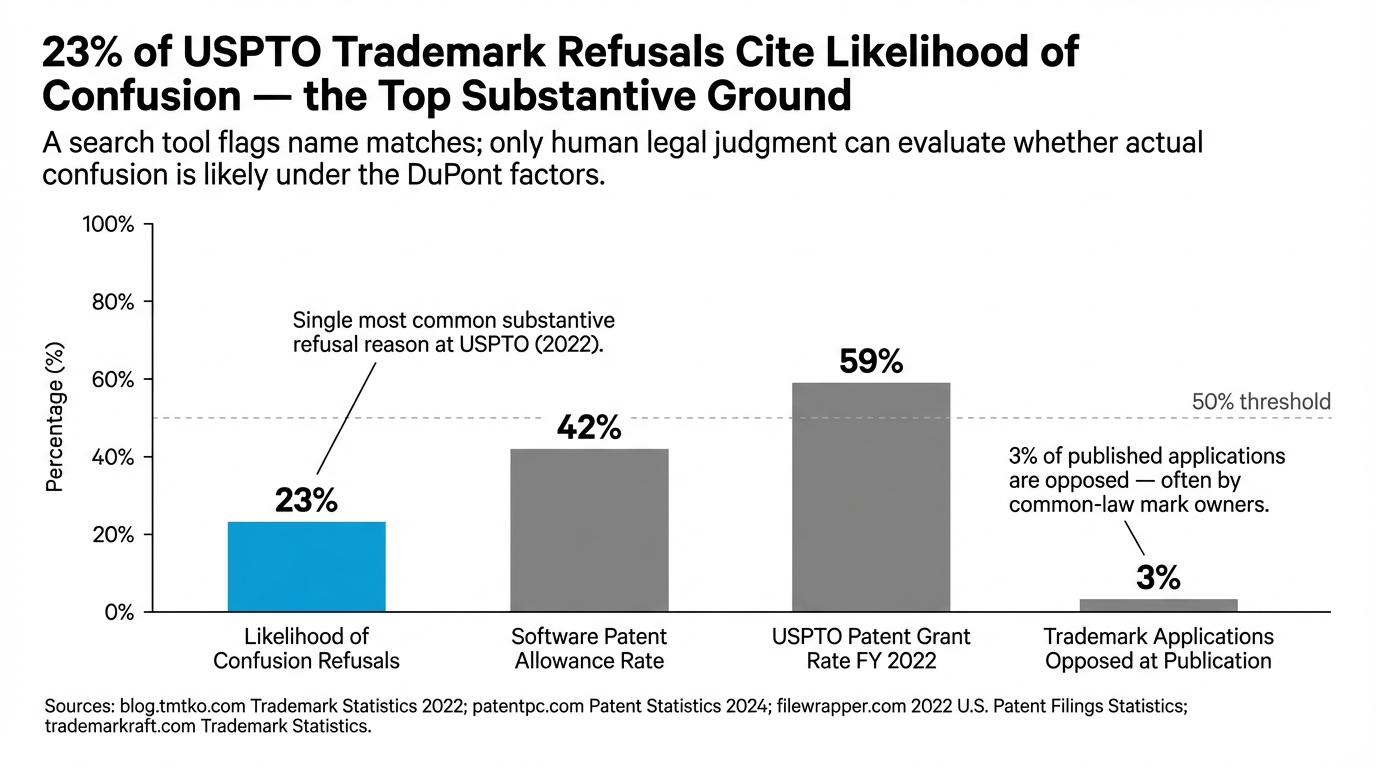
When you find a close reference, read the independent claims carefully. If your invention adds a limitation not present in those claims, you may still have patentable ground. According to USPTO Patent Technology Monitoring Team reports, the overall utility patent allowance rate is approximately 59%, and the allowance rate for software-related patents runs lower, around 42%, reflecting a dense prior art environment. That context matters when evaluating whether to proceed and how broadly to draft claims.
For software-specific inventions, conducting a focused software patent search before you draft a single claim can reveal whether the prior art landscape calls for narrow targeted claims or leaves room for broader protection.
When a Professional Patent Search Changes the Filing Decision
A professional prior art search typically costs $500 to $2,500 for a U.S.-focused utility patent search, with higher fees for international searches or complex technology areas, according to the AIPLA Report of the Economic Survey. That cost is small relative to a full utility patent prosecution budget of $10,000 to $20,000 or more through issuance.
More important, the search findings directly inform claim drafting strategy before a single word of the application is written. If the search reveals a crowded prior art landscape, a skilled patent attorney will draft narrower independent claims with multiple dependent claims that carve out defensible scope. In a relatively open field, broader independent claims may be appropriate. Share your prior art search results with your patent attorney before drafting begins, not after.
The Proper Use of Trademark Symbols and What They Signal to the Public
Using the wrong symbol or no symbol at all can undermine your trademark rights and create legal exposure that most brand owners do not anticipate.
The Difference Between TM, SM, and the Registered Trademark Symbol
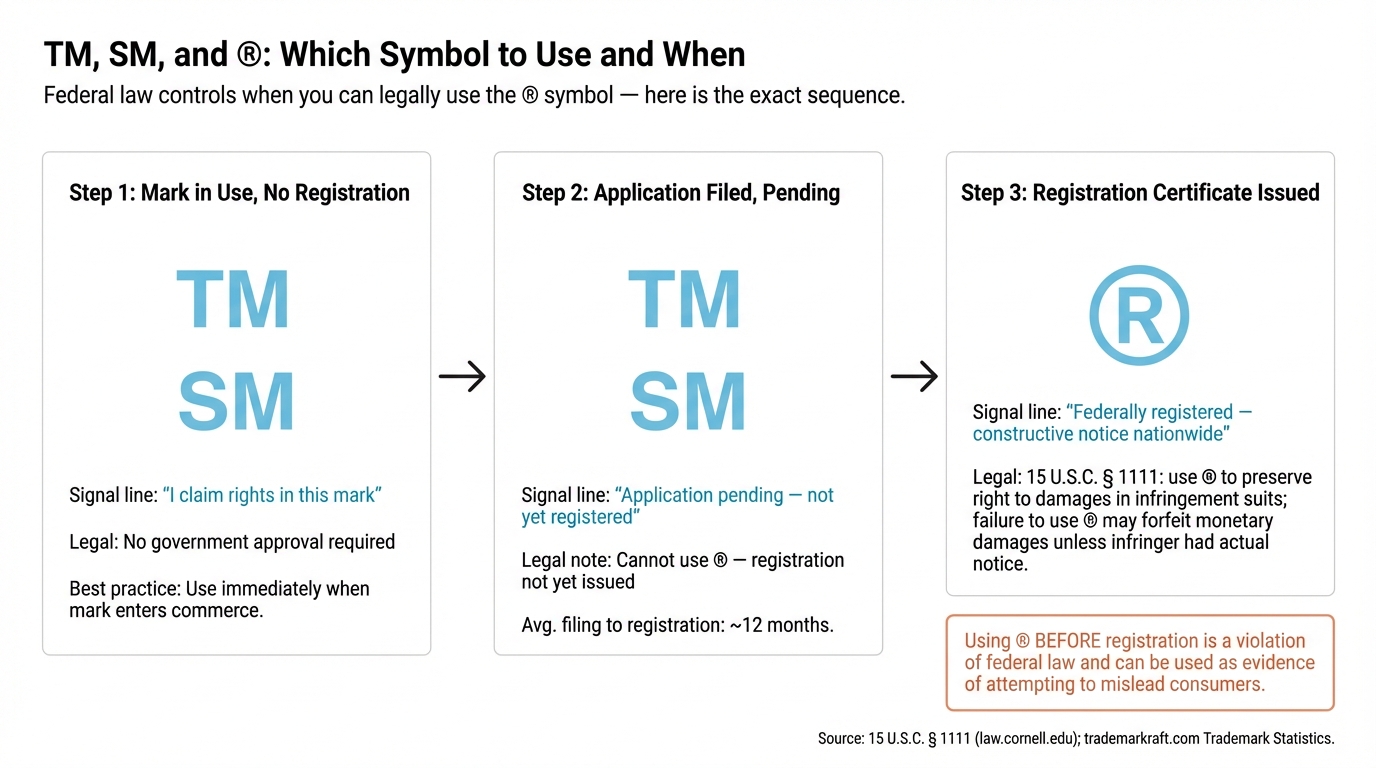
The ™ symbol signals a claim to trademark rights in a word, logo, or phrase used to identify goods, regardless of whether a federal registration exists. The ℠ symbol performs the same function for services. The ® symbol is legally restricted to marks that have received a federal registration from the USPTO. Using ® on an unregistered mark violates federal law under 15 U.S.C. § 1111 and can result in the trademark owner forfeiting the right to recover profits and damages in an infringement suit, because courts treat misuse of the ® as a bar to constructive notice claims.
Use ™ or ℠ immediately when you begin using a mark in commerce, even before filing a trademark registration application. It puts the public on notice of your claim without requiring registration. For a broader overview of how trademark protection works from brand launch through enforcement, see what is trademarking.
Where to Place Trademark Symbols and How to Use Them on Digital Platforms
Place the symbol adjacent to the mark itself, typically in superscript at the upper right. In digital contexts including websites, social media profiles, press releases, and app store listings, consistent symbol use builds a public record of your trademark rights. Courts have considered the consistency of trademark symbol use as part of the evidence establishing the strength and scope of common law trademark rights.
Establish a brand style guide that specifies exactly where and how the trademark symbol appears across every touchpoint: social media, packaging, press releases, and any other public-facing materials. Inconsistency does not strip your rights automatically, but it weakens the evidentiary record if you ever need to enforce them.
What a Search Result Cannot Tell You and Where Human Judgment Is Required
Search tools surface data. Applying that data to your specific situation requires legal analysis.
Likelihood of Confusion Is a Legal Standard, Not a Database Filter
The USPTO's likelihood-of-confusion analysis under In re E.I. du Pont de Nemours & Co. weighs 13 factors: the similarity of the marks in appearance, sound, and meaning; the relatedness of the goods or services; the channels of trade; buyer sophistication; and several others. No search tool applies these factors automatically. A search showing a similar mark does not guarantee rejection, and a clean search does not guarantee approval.
USPTO examination data confirms that likelihood-of-confusion refusals represent the leading substantive ground for trademark refusal, making it the primary risk a thorough pre-filing search is designed to catch. After running your own search, have a trademark attorney evaluate the closest results under the DuPont factors before investing in a filing. Navigating a trademark Office Action response after a likelihood-of-confusion refusal costs significantly more than upfront clearance analysis, and in some cases the refusal cannot be overcome at all.
Patent Claim Drafting Strategy Depends on What the Search Finds
Prior art search results do more than inform a go/no-go filing decision. They shape the entire claim architecture of your patent application. A dense prior art landscape signals that broad independent claims will face heavy scrutiny, so the filing strategy shifts toward narrower but still commercially meaningful claims with a robust dependent claim structure that covers multiple fallback positions.
Share your search results with your patent attorney at the outset, not after a first draft is written. Retrofitting claim strategy after the application is drafted is far more expensive than building the right strategy from the beginning. For AI and software patent prosecution in particular, where allowance rates run lower than the USPTO average, starting with a search-informed claim strategy significantly improves the odds of a commercially useful patent grant.
Frequently Asked Questions
Does the patent office handle trademarks?
Yes. In the United States, a single agency handles both. The United States Patent and Trademark Office (USPTO) administers trademark registrations under the Lanham Act and patent grants under Title 35 of the U.S. Code. Despite sharing the same agency, the two systems are entirely separate legally: trademark rights arise from use in commerce and protect brand identifiers, while patent rights arise from invention disclosure and protect functional innovations. Filing, examination, fees, and renewal processes are completely distinct within the same agency.
When you work with Rapacke Law Group, both your trademark and patent filings are backed by The RLG Guarantee. Get your trademark registered or your money back, and our patents come with a similar guarantee, so you file with confidence knowing we stand behind every application.
Can I do a TM search myself?
Yes, and you should before hiring anyone. The USPTO Trademark Center is free to access, and a basic search for your exact proposed mark takes minutes. The limitation is not access; it is interpretation. Running a thorough search that catches phonetically similar marks, design code equivalents, and related-class conflicts requires understanding the USPTO's search logic and the legal standard for likelihood of confusion. A self-conducted search is a useful first filter, but it should not replace professional trademark clearance analysis before you file a trademark registration application.
Can anyone do a patent search?
Yes. The USPTO's PatFT and AppFT databases are publicly available at no cost, and Google Patents aggregates global patent records in a more searchable interface. Any person can search by keyword, inventor name, assignee, or CPC classification code. The challenge lies in knowing which search terms and classification codes capture the relevant prior art and in reading patent claims rather than just abstracts. A professional prior art search by a registered patent attorney goes deeper and produces a formal opinion on patentability.
Can I do a trademark search for free?
Yes. The USPTO Trademark Center is entirely free and searches the full database of pending applications and registered trademarks. The WIPO Global Brand Database provides similar coverage for international trademark registrations. Free searches cover federal registrations but will not surface unregistered common law trademarks, state-registered marks, or trade names. For high-stakes filings, supplementing the free federal search with a professional trademark clearance analysis adds value the database alone cannot provide.
What cannot be trademarked?
Several categories of marks are barred from federal registration under the Lanham Act. Purely generic terms describing the product category itself cannot function as trademarks. Merely descriptive marks without acquired distinctiveness are refused. Additional bars include marks that are primarily merely a surname, geographically descriptive terms, marks found to be immoral or scandalous as defined by current case law following Iancu v. Brunetti, marks that falsely suggest a connection with a living person, and marks that are identical or confusingly similar to a registered mark covering related goods or services.
How much will it cost for a patent search?
A professional prior art search typically ranges from $500 to $2,500 for a U.S.-focused utility patent search, according to the AIPLA Report of the Economic Survey. International searches or searches in densely filed technology areas like AI and software run toward the higher end of that range. This cost is separate from patent prosecution fees. For inventions with significant commercial value, the cost of a professional search is modest compared to prosecution budgets that routinely reach $10,000 to $20,000 or more through issuance.
How can I look up a registered trademark?
Go to the USPTO Trademark Center at tmsearch.uspto.gov and search by the mark's name or owner. Each result includes the mark's current status, filing and registration dates, the International Class or classes covered, the goods and services description, and the owner of record. The WIPO Global Brand Database provides a similar lookup for international trademark registrations filed under the Madrid Protocol. Both tools are free.
Your Next Steps to Trademark and Patent Office Search Success
Running a thorough trademark and patent office search before you file is not a formality. It is the foundation of a sound intellectual property strategy. An overlooked competing trademark can trigger a likelihood-of-confusion refusal that delays your registration by a year or more and costs far more to resolve than a clearance search would have. Undiscovered prior art can invalidate patent claims you have already spent tens of thousands of dollars prosecuting.
The bottom line: a weak or skipped pre-filing search is one of the most avoidable and expensive mistakes in IP strategy. A strong search, conducted before you file and interpreted by a qualified attorney, gives you a clear picture of your risk, informs your claim or classification strategy, and positions your application for the best possible outcome from day one.
The core search tools are free, publicly accessible, and powerful enough to surface the most obvious conflicts quickly. A thorough trademark and patent office search cannot, however, apply legal judgment to what it finds. If your trademark search surfaces a mark in an adjacent class with a similar name, or your patent search reveals a dense prior art landscape in your technology area, you need a registered patent attorney to evaluate your actual risk and build a filing strategy around it. Acting without that analysis exposes you to Office Actions, oppositions, or invalidated claims that could have been avoided.
Your action items:
- Schedule a Free IP Strategy Call with Rapacke Law Group to review your search results and map out a filing strategy
- Run a preliminary search in the USPTO Trademark Center or patent databases before your call so you come prepared with specific references to discuss
- Review From Idea to IPO: How to Get a Trademark That Protects Your Brand Long-Term to understand how a clearance search fits into your broader brand protection timeline
- Ask about Rapacke Law Group's fixed-fee pricing model and The RLG Guarantee: get your trademark registered or your money back and our patents come with a similar guarantee, so you file with confidence knowing we stand behind every application
A well-executed pre-filing search is not overhead. It is the competitive advantage that separates IP strategies that hold up under scrutiny from those that collapse the moment a conflicting mark or reference surfaces.
To Your Success,
Andrew Rapacke Managing Partner, Registered Patent Attorney Rapacke Law Group