


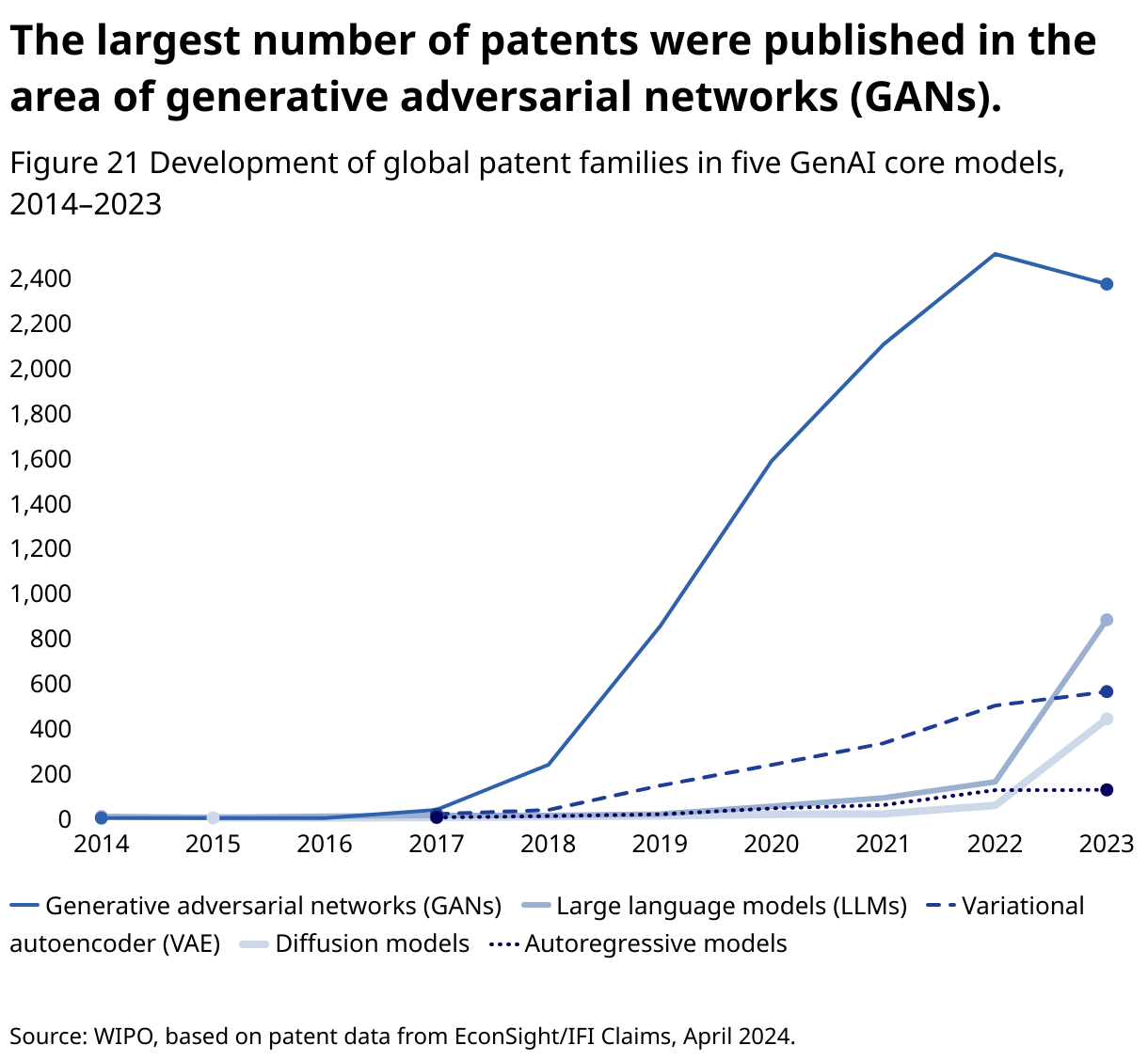
Only a small fraction of patents (under 1%) generate substantial income – but those rare intellectual property gems can be worth millions in licensing revenue and competitive advantage. The global AI patent landscape has exploded from just 733 generative AI patent families in 2014 to over 14,000 in 2023, and nearly 230,000 AI patent families overall by 2023.
Google’s Transformer architecture patent – protecting the “Attention Is All You Need” mechanism that sparked the current generative AI revolution – has been cited hundreds of times by virtually every major language model developed since 2017. This single patent family potentially influences billions in AI development investments across companies from OpenAI to Microsoft to Meta. Yet most AI patents will never generate a dollar in licensing revenue.
Modern AI-driven patent analytics can cut prior art search and due diligence time by 40–70% using machine learning, sharpening the focus on the patents that matter. The most valuable patents create billion-dollar advantages – through lucrative licensing deals, defensive positioning, and the power to exclude competitors from key technological domains.
Understanding which AI patents truly move the needle can mean the difference between market-crushing outperformance and being left behind in the rapidly evolving AI landscape.
Top Companies with the Most Valuable AI Patents
The global race for artificial intelligence dominance is being fought in patent offices worldwide. A handful of technology giants have accumulated AI patent portfolios worth billions in potential licensing revenue and strategic value. There is a contrast in approaches: U.S. tech leaders prioritize quality and broad protection of key innovations, whereas Chinese companies have pursued sheer volume of filings (often domestically).
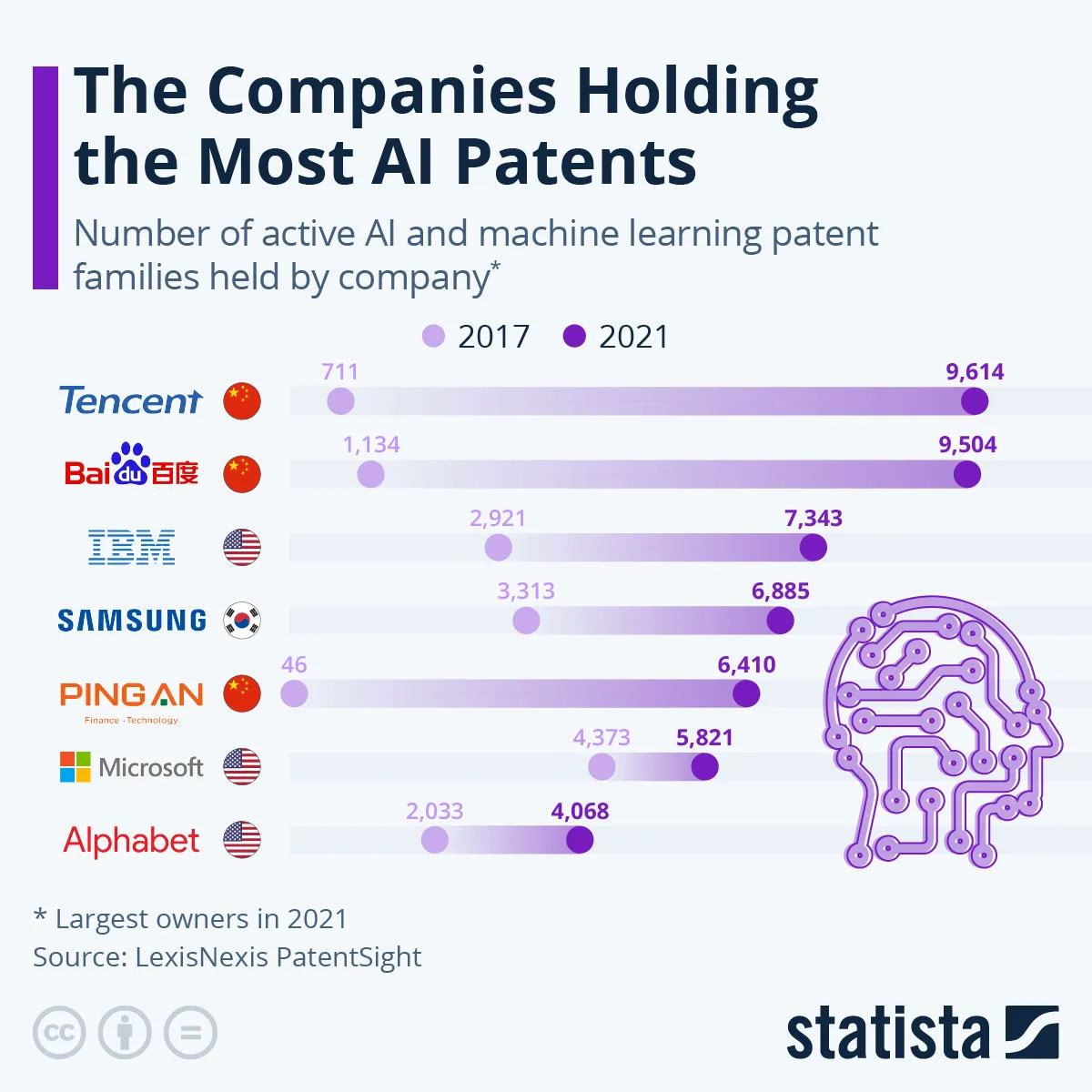
Chart showing patent families held by top companies: Tencent (9,614), Baidu (9,504), IBM (7,343), Samsung (6,885), Ping An (6,410), Microsoft (5,821), Alphabet (4,068) as of 2021. Source: LexisNexis PatentSight
American Tech Leaders: Quality Over Quantity
Google (Alphabet) has emerged as the undisputed leader in AI patent filings. As of mid-2025, Google had filed 1,837 AI-related patent applications globally, about 50% more than Microsoft and nearly double IBM’s count. In the U.S. alone, Google leads with 880 AI patent applications vs. 701 for Microsoft and 684 for IBM.
Google’s portfolio shows remarkable depth in fundamental AI technologies – notably neural network architectures and the Transformer model. Google’s patent on the Transformer architecture (“Attention Is All You Need”) underpins virtually every modern large language model. This gives Google a strong defensive position and potential royalty leverage over any competitor implementing transformer-based AI. Virtually every major LLM developer must either license Google’s transformer IP, design non-infringing alternatives, or risk litigation.
International Business Machines (IBM), a longtime patent powerhouse, also boasts an immense AI patent portfolio. IBM received 9,130 U.S. patents in 2020 alone (across all fields), marking its 28th straight year atop the patent charts. IBM’s strategy has been to patent across the entire AI “stack” – from fundamental algorithms to hardware implementations and industry-specific applications.
IBM’s life sciences AI patents (e.g. molecular data analysis, drug discovery algorithms) have been lucrative in deals with pharmaceutical firms, where an AI that cuts drug development time can be worth hundreds of millions.
Microsoft has taken a strategic, enterprise-focused approach. The company’s AI patenting emphasizes solutions tightly integrated with its Azure cloud, enterprise software, and productivity tools. Microsoft was the third-largest AI patent filer globally in recent data (with ~1,200+ AI patents in the period analyzed).
NVIDIA has built a formidable patent portfolio concentrated on the hardware and algorithms that power modern AI. NVIDIA leads in patents related to AI for image and video generation – a reflection of its dominance in graphics and vision processing. NVIDIA’s patents essentially give it both a shield and a sword: a shield against competitors building GPU-like AI accelerators, and a sword to license its technology into AI applications.
Chinese Technology Giants Leading Patent Volume
Chinese companies now account for roughly 70% of all AI patent filings worldwide, representing a massive shift in the innovation landscape since the mid-2010s. This volume-focused approach, heavily encouraged by government initiatives, has vaulted several Chinese tech giants to the top of global patent rankings.
Tencent leads globally in generative AI patent families, with 2,074 GenAI patent families filed between 2014–2023 – the #1 owner worldwide. Tencent’s filings focus on AI applications closely tied to its core businesses in social media, gaming, and content. Many Tencent patents cover real-time content generation, avatar and video synthesis, chatbot interactions in messaging apps, and AI-driven recommendation algorithms.
Baidu, often called the “Google of China,” has likewise amassed a vast AI patent portfolio – over 1,200 GenAI patent families by 2023 and thousands more AI-related patents overall. Baidu’s strength is in natural language processing and search optimization.
Perhaps most intriguingly, Ping An Insurance (a financial and insurance conglomerate) has become a prolific AI patent filer. Ping An now holds over 6,000 AI-related patent families (a jump from under 50 five years prior), making it a pioneer in applying AI to financial services and healthcare. For instance, Ping An developed patented AI that analyzes facial micro-expressions (tiny involuntary clues like blinks or twitches) in video claims to detect fraud.
It’s important to note that while Chinese companies dominate in patent filing volume, most of these filings remain in China’s domestic patent system. Only about 7% of Chinese AI patent families have been filed abroad for protection. This suggests many Chinese patent holders focus on securing their home market, often aided by government incentives.
Most Cited and Influential AI Patents
Not all patents are created equal. One key indicator of a patent’s significance is how often it is cited by subsequent patent applications. Forward citations are a proxy for technological influence – highly cited patents tend to be foundational breakthroughs that enable many follow-on innovations.
Breakthrough Patents Shaping Industries
Several AI-related patents stand out for their large number of citations and broad influence across industries:
Augmented Reality for E-Commerce (Rakshit et al.) – US20160070439A1: Invented by Sarbjit K. Rakshit (an IBM master inventor), this patent enables seamless AR overlays for shopping – essentially using smart glasses or mobile AR to visualize products in a real environment. It has become one of the most cited AI patents, with over 100 forward citations in U.S. patents alone. Companies developing everything from industrial maintenance AR to consumer furniture apps have cited Rakshit’s invention, demonstrating its broad applicability.
StradVision’s CNN Parameter Adjustment for Autonomous Vehicles – US10169679B1: This 2019 U.S. patent, assigned to StradVision (a startup in autonomous driving perception software), covers a method to adjust convolutional neural network parameters using loss augmentation for real-time object detection. It has been cited 27 times across major patent jurisdictions (US, China, Japan, South Korea), remarkable for such a recent patent.
Google’s Transformer Architecture Patents: Few inventions have reshaped AI as profoundly as the Transformer neural network (introduced in the famous 2017 paper Attention Is All You Need). Google/DeepMind moved to patent aspects of the Transformer architecture, such as the use of self-attention mechanisms in sequence modeling. These Transformer patents have quickly accrued hundreds of citations – virtually every major language model or generative AI patent filed since 2017 references them.
| Patent | Inventor/Owner | Citations | Key Application |
| US20160070439A1 – AR E-commerce | S. Rakshit (IBM) | 100+ cited patents | Augmented Reality shopping overlays |
| US10169679B1 – CNN parameter tuning | StradVision Inc. | 27 citations (4 countries) | Autonomous vehicle vision (real-time CNN) |
| “Transformer” Patents (e.g. US10452978B2) | Google/DeepMind | Hundreds (globally) | Generative AI (self-attention neural nets) |
Patents Driving Academic Research
Highly cited AI patents don’t only influence other patents – they often influence academia and R&D at large. The World Intellectual Property Organization (WIPO) has noted that certain AI patents serve as essential prior art in scientific literature, effectively becoming part of the knowledge base for researchers.
IBM’s Watson patents (covering the QA system used in IBM Watson) have been cited not just in industry patents but in thousands of academic papers on natural language processing. By that measure, IBM and Google have several patents that rank extremely high – aligning with the fact that Alphabet/Google is the top-cited institution in GenAI research publications when looking at citation impact.
Patent Categories Driving the Highest Values
While AI patents span a wide array of applications – from core algorithms to sector-specific implementations – the financial value of these patents varies dramatically. Recent analyses of generative AI patents show that about 48% of GenAI patent filings are in software or broadly applicable solutions (often not tied to a single industry).
Life Sciences: Small Volume, Massive Value
AI in the life sciences (healthcare, biotech, pharmaceuticals) represents a small portion of overall AI patents – roughly 9% of generative AI patents relate to life sciences applications. However, these patents frequently command premium licensing fees and strategic value far exceeding their numbers.
Because life sciences innovations (like new drug discovery methods or medical AI diagnostics) often require years of R&D and face high regulatory hurdles. An AI patent that can, for example, predict molecular drug candidates or analyze medical images better than a human, creates a huge competitive moat in a multi-billion-dollar industry.
IBM has been a leader in this category. IBM’s AI patents in life sciences cover things like molecular data analysis using AI, protein structure prediction algorithms, and drug repurposing via machine learning. The value of life sciences AI patents is also seen in economic estimates: McKinsey Global Institute projects that AI techniques like generative models could generate $60–$110 billion per year in value for the pharma and medical product industry through faster R&D and personalized medicine.
Autonomous Vehicles: Billion-Dollar Market Advantages
If one area of AI promises to reshape daily life and commerce on a massive scale, its autonomous vehicles (AVs). The patent portfolios protecting self-driving car technologies are among the most valuable in the AI landscape, potentially worth billions in aggregated value.
Tesla famously open-sourced some of its patents in a pledge for EV adoption, but it still maintains critical patents on neural network control of vehicles, sensor fusion algorithms, and battery management AI. Meanwhile, Waymo holds hundreds of patents on LiDAR, radar perception, motion planning AI, and ride-hailing optimization.
The market advantage conferred by strong AV patents is two-fold:
1. Defensive – They prevent competitors from easily copying the technology.
2. First-mover licensing – As traditional automakers lag in AI, those with robust AV patents can license or sell their tech to automakers for significant fees.
Estimates for the autonomous driving market size vary, but many project hundreds of billions of dollars by the 2030s. Even more conservative forecasts see $200+ billion by 2030 for autonomous vehicles and components. A telling example: in 2019, Apple settled a patent lawsuit with Qualcomm for $4.5–$4.7 billion in one-time payments, largely because Qualcomm’s wireless chip patents were essential for Apple’s phones.
Emerging High-Value Categories
Beyond the well-known areas, several AI patent categories have shown explosive growth and potential future value:
Energy Management AI: Patent filings in using AI for energy (smart grids, energy optimization) are growing ~81% annually in recent years – the highest growth of any GenAI application area. This includes AI for balancing electric grids with renewable energy, predictive maintenance for power plants, and optimizing energy storage. The International Energy Agency noted a surge of AI+grid patents globally.
Transportation and Logistics AI: Outside of passenger cars, AI is revolutionizing logistics, shipping, and public transport. Patent growth in transportation AI is around 66% annually, covering things like AI for delivery route optimization, autonomous drones, traffic flow management in smart cities, and logistics robotics.
Security AI and Cybersecurity: With cyber threats growing, AI is being applied to detect anomalies, fraud, and network intrusions. Patents in AI-powered cybersecurity and fraud detection are rising ~59% yearly.
Agriculture AI: Precision agriculture (using AI for crop management, yield prediction, pest control) is another fast-growing area (~60% annual patent growth). As food demand grows and climate impacts agriculture, these patents could become essential for future food security.
Case Studies: Patents That Changed Industries
To understand how a single patent or patent family can change an industry’s trajectory, examining concrete case studies reveals the lasting market impact and financial rewards generated by strategic intellectual property protection.
Airbnb’s Predictive Reservation System
The rise of Airbnb in the hospitality sector was fueled not just by a novel business model, but also by sophisticated AI pricing and reservation technology protected by patents. Airbnb developed machine learning algorithms to dynamically price listings and predict booking demand. These were embodied in patents that analyze hundreds of variables – local events, seasonal trends, competitor pricing, user search behavior, etc. – to recommend the optimal price for a host’s listing at any given time.
By patenting this predictive booking and dynamic pricing system, Airbnb gained a huge competitive edge over traditional hotels (which historically used simpler revenue management systems). The company’s internal analysis showed significantly higher occupancy and income for hosts who used its Smart Pricing tool versus static pricing.
From an IP standpoint, Airbnb’s patents cover not just the pricing algorithm, but also data processing methods and the user interface that allows hosts to use these AI recommendations. This comprehensive protection means competitors cannot easily replicate Airbnb’s pricing engine without infringing.
Coinbase’s Instant Exchange Technology
Cryptocurrency markets are notoriously volatile, and executing large trades without moving the market (“slippage”) is a major challenge. Coinbase, a leading crypto exchange, invested in AI and algorithmic trading patents to address this. One flagship patent covers an “instant exchange” mechanism using machine learning to break large orders into smaller chunks and execute them incrementally at the best possible prices.
This patented technology gave Coinbase a significant advantage, especially as institutional investors began trading crypto in high volumes. By reducing slippage and optimizing trade execution, Coinbase could attract large clients who might otherwise fear moving prices with their trades.
From a competitive standpoint, the patent is valuable because it covers a specific solution to a fundamental problem in financial trading. Competing exchanges would love to offer “instant” or minimal-slippage trading, but Coinbase’s IP creates a hurdle.
Google’s Transformer Patent: The Foundation of Modern AI
Google’s patents on the Transformer neural network architecture are arguably industry-changing. The Transformer (and its derivative models like BERT, GPT, etc.) is the basis of virtually all cutting-edge generative AI – from chatbots to image generators. By being the first mover and patenting key aspects, Google ensured that it owns a slice of every breakthrough that builds on the transformer idea.
Consider the timeline: Google published the Transformer research in 2017 and filed patents. By 2020-2021, startups and big tech alike were racing to build large language models (LLMs) using transformers. Companies like OpenAI (with GPT-3, GPT-4), Microsoft (with their Turing NLG), Facebook (with LLaMA), all used the core principles of the transformer.
Financially, the transformer patents’ value is also indirect but immense: they allowed Google to confidently invest in large-scale AI (like its Google Bard and PaLM models) without fear of being blocked by someone else’s IP. By protecting “Attention is All You Need,” Google ensured it will remain at the center of the AI revolution, collecting not necessarily license fees (which could happen) but certainly the strategic benefits that come with being the intellectual property leader in the space.
Patent Valuation Methodologies and Metrics
Valuing patents is a complex blend of art and science. No single metric tells the whole story of a patent’s worth. Instead, experts use multiple methodologies to triangulate the value, considering both the patent’s intrinsic quality and its contextual market potential.
Citation Analysis: Measuring Technological Influence
Forward citation analysis looks at how often a patent is cited by later patents. This is analogous to academic citation counts and speaks to a patent’s technological influence. The logic: if many subsequent inventors felt the need to cite a patent, that patent likely covers a fundamental idea or a major breakthrough that enabled follow-on innovations.
In AI, citation analysis has identified the “blockbuster” patents we discussed. Generally, AI patents have about 26% higher forward citations on average compared to non-AI patents in similar fields, indicating how quickly AI innovations propagate.
Citation analysis helps investors and companies spot which patents are likely key assets. If an AI patent is in the 99th percentile of citations in its class, it may be a must-have for any company in that space (implying high licensing or blocking value).
Market-Based Valuation: Learning from Comparable Transactions
Market-based valuation tries to derive a patent’s value from actual market data – what buyers, sellers, and licensees have paid for similar IP. For example, we know Microsoft paid an estimated $1+ billion licensing fee to a consortium (Rockstar) for a portfolio that included some AI-related patents from Nokia.
Using these data, one might observe that strong natural language processing patents have fetched $5–10 million in license fees in recent years for portfolio cross-licenses, whereas fundamental vision patents have seen deals in similar ranges.
However, adjustments are needed: not all patents in a deal are equal, and strategic value can inflate prices. Also, market-based valuation reflects past market conditions; the AI patent market is rapidly evolving.
Income-Based Models: Projecting Future Revenue Streams
The income-based approach tries to forecast the economic benefits that owning a patent will bring and then discounts that to present value. For a given AI patent, one would estimate: direct licensing income, product revenue protected, and cost savings or risk reduction.
These cash flows are then projected over the patent’s remaining life (20 years from filing, but often patents are most valuable in years 5–15 once the tech matures). They are then discounted to present value. The discount rate might be high for AI patents given the uncertainty and fast tech obsolescence (perhaps 15-30% annual discount rates).
Despite uncertainties, income models are crucial to justify investments. When Big Tech companies consider acquiring AI startups primarily for IP, they will model how that IP could add to their revenue or save costs.
Geographic Distribution and International Value
The value of a patent is intimately tied to where it is enforceable. A patent is essentially a territorial right – a U.S. patent stops competitors in the U.S., but not in Europe, China, etc. Thus, the geographic distribution of an AI patent portfolio can greatly affect its overall value.
China’s Volume Strategy vs. International Reach
As noted, China leads the world in AI patent filings by volume – accounting for about 70% of global AI patent family publications in recent years. However, the vast majority of those Chinese patent filings are only in China. In the generative AI domain, only 7.3% of Chinese GenAI patent families were also filed abroad. In other words, over 92% of Chinese AI patents remain only within Chinese jurisdiction.
This geographic concentration has several implications:
- Enforceability: Chinese companies can enforce their AI patents strongly within China, but outside China, those patents offer no protection unless they sought international patents. This limits Chinese companies’ ability to block competitors in, say, the U.S. or Europe via patents.
- Quality perception: The ease of obtaining patents in China (and government incentives like subsidies, tax breaks, and even patent-filing targets for companies) has historically led to a quantity-over-quality issue.
From a valuation perspective, a portfolio heavily skewed to Chinese patents might have a lower valuation multiple unless the buyer’s focus is the Chinese market.
US Patents: Global Reach and Higher Per-Patent Value
American AI patents, though fewer in number than China’s, tend to have broader international coverage and arguably higher average value. U.S. companies typically pursue protection in major markets (via Patent Cooperation Treaty filings leading to U.S., European, Japanese, etc. patents).
The result: an AI patent from, say, IBM or Google, is often part of a family that has counterparts filed in Europe, Japan, maybe China, etc. This global reach dramatically increases the patent’s value:
- The owner can enforce it in multiple lucrative markets
- It also means the patent survived examination in multiple patent offices, which can make it more robust
- International patents enable cross-licensing deals on a global scale
Studies have found that patents filed in more jurisdictions correlate with higher value – logically, because the owner invested more in them and expects broader protection. One study found U.S. AI patents had ~13.18 citations vs. 1.9 for Chinese, reflecting different citation practices and innovation influence.
Investment Implications and Market Opportunities
As AI patent portfolios become ever more entwined with business strategy, investors are increasingly factoring IP strength into company valuation. In fast-moving fields like AI, patents can be one of the few durable assets a company has.
Portfolio Quality as Investment Criteria
Sophisticated tech investors (venture capital, private equity, etc.) have learned from past patent wars (like smartphones) that patent portfolio quality can make or break a company’s defensibility. What do investors evaluate?
- Patent counts in AI, but more importantly patent relevance
- Breadth of claims (broad fundamental patents are more valuable than narrow ones)
- Citation metrics and international coverage
- Alignment with market trends
There’s evidence that companies with strong AI patent portfolios outperform in the market. A Harvard study found AI patents correspond to a 9% “value premium” in investors’ eyes and firms with more AI patents enjoyed higher valuations and stock performance.
On the flip side, a company in AI with weak or no patents might be viewed as vulnerable – any breakthrough they make could be copied by a competitor that might patent around them or sue them for incidental infringement.
Strategic Acquisition and Licensing Opportunities
The dynamic nature of AI means that often companies will acquire others to obtain critical patents (and talent). These strategic acquisitions can be win-win: the small company’s investors get an exit, and the big company gets freedom-to-operate and sometimes exclusivity on important tech.
On the licensing front, cross-licensing agreements have become common in AI, especially among big players. Since AI systems often integrate many technologies, Company A might infringe some of Company B’s patents and vice versa. Rather than sue, they agree to cross-license portfolios. IBM has cross-licensing with many firms, ensuring its massive portfolio is leveraged not necessarily for fees but for access to others’ IP (and IBM still earns ~$400M/year from licensing overall).
Future Trends in AI Patent Value
Looking ahead, the interplay between AI technology and patents will only intensify. Several trends are likely to shape which AI patents become most valuable in the next decade.
Generative AI: The Next Billion-Dollar Wave
Generative AI (GenAI) – encompassing large language models (LLMs), image generators, music generators, etc. – is poised to be the next major battleground for high-value patents. We have already seen an explosion of GenAI patent filings (over 14,000 families by 2023, growing rapidly).d to be the next major battleground for high-value patents. We have already seen an explosion of GenAI patent filings (over 14,000 families by 2023, growing rapidly).
Foundation model patents (like Google’s transformer or OpenAI’s possible future patents on training techniques) are particularly valuable because they enable multiple downstream applications. A single breakthrough in model efficiency or architecture can apply to chatbots, coding assistants, image creators, etc..
Generative AI is also attracting heavy investment – meaning companies have money to spend on licenses or acquisitions. It’s projected that by 2030, generative AI could add trillions to the global economy. Patents that control core aspects of this tech could be worth billions collectively.
Edge AI and Privacy-Preserving Technologies
As AI computation shifts from the cloud to the edge (on devices like smartphones, IoT sensors, automobiles) and as privacy concerns rise, new categories of AI innovation are emerging:
Edge AI: This involves running AI models locally on devices with constrained resources. Techniques like model compression, quantization, on-device learning, and efficient neural network architectures for edge are being actively patented.
Federated Learning: This is a method to train AI models across multiple devices or silos of data without sharing raw data. Federated learning patents are valuable for any application involving sensitive data (healthcare, personal devices, finance).
Privacy-Preserving AI: Techniques like differential privacy and homomorphic encryption are merging with AI. Patents in “privacy-preserving AI” ensure AI can meet regulatory demands (like GDPR) and user trust expectations.
Given governments are keen on trustworthy AI, companies that patent solutions for AI bias mitigation, explainability, and safety could see those become must-haves if regulations mandate such features.
Regulatory Impact on Patent Value
The regulatory environment around AI is evolving, and this will have significant effects on patent strategy and value. Patent eligibility debates continue about whether certain AI algorithms are patentable or fall under “abstract ideas”.
If a few companies control most key AI patents, regulators might intervene to prevent monopolies. It’s possible governments might compel some critical AI patents (especially those important for public good, like medical AI) to be licensed on FRAND (fair, reasonable, and non-discriminatory) terms.
If governments increase R&D funding for AI and encourage patenting (like offering fast-track examination for AI patents, as some patent offices have), we’ll see more filings and potentially more high-quality patents.
Conclusion: Strategic Recommendations
In the race to capitalize on artificial intelligence, the most valuable AI patents represent far more than technical novelties – they are strategic assets that can confer lasting market dominance, lucrative revenue streams, and critical negotiating leverage.
Here are key strategic recommendations:
Focus on Quality over Quantity: The patent gold rush in AI is real (with hundreds of thousands of filings), but organizations should prioritize truly innovative, broad-scope patents. A single foundational patent can be worth more than 100 narrow application patents.
Align Patents with High-Growth Areas: Ensure your patent portfolio mirrors where AI value is moving – e.g., generative AI, edge AI, health/biotech AI, energy optimization. Patents in emerging high-growth segments will likely appreciate in value.
Secure International Protection: If you invent a critical AI technique, file globally (or at least in U.S., Europe, China, Japan). The extra investment pays off by giving you rights in all major markets, increasing licensing opportunities and defensive coverage.
Use Patents Proactively in Partnerships: A robust AI patent portfolio can be a deal-maker. Companies with strong IP can form cross-licensing alliances with peers and can negotiate from strength in joint ventures or standards bodies.
Monitor the Regulatory Horizon: Stay informed on AI-related IP policy changes. Adapt your patent strategy to legal shifts – e.g., draft applications to survive any tightening of patent eligibility by emphasizing technical implementation. Consider contributing your key patents to industry standards if that allows you influence (but balance that with the loss of exclusivity possibly required).
Protect and Leverage the “Crown Jewels”: Identify which 1% of your AI patents are the true crown jewels and defend them vigorously. This might mean monitoring for infringement (with modern tools, even AI can help spot when your algorithm is used elsewhere), and being willing to enforce your rights in court or via the ITC if needed. Conversely, be open to licensing non-core patents to generate revenue.
Plan for the Long Term: Patents last 20 years – think about where AI and your industry will be a decade or two out. For instance, if you foresee quantum computing intersecting with AI, maybe start patenting in that space now. A forward-looking portfolio can yield enormous dividends as the world catches up to your vision.
In conclusion, we stand at a juncture where AI technology is advancing at breakneck speed, and the intellectual property system is striving to keep pace. Those organizations that can innovate rapidly while also maneuvering intelligently in the IP landscape will define the future – they will own the building blocks of the AI era and reap the rewards.
As annual AI patent filings potentially exceed $50 billion in combined value creation, the spoils will go to the strategic as much as the creative. The race for AI dominance is not just about who develops the best algorithms, but who controls the rights to those algorithms and their applications.
Companies should treat AI patents as critical strategic assets – identifying, developing, and protecting the “rare gems” that will empower them to lead in the age of artificial intelligence. By recognizing that only a tiny subset of patents truly move the needle, and by taking a calculated, well-informed approach to securing and leveraging those rare assets, businesses and investors can position themselves to ride the AI revolution to lasting success, rather than being left behind in its wake.