

Key Takeaways
- Flat fee IP attorneys charge a single pre-agreed price per service, giving founders budget certainty that hourly billing cannot provide.
- USPTO government filing fees are always separate from attorney flat fees; every quote should show both as distinct line items.
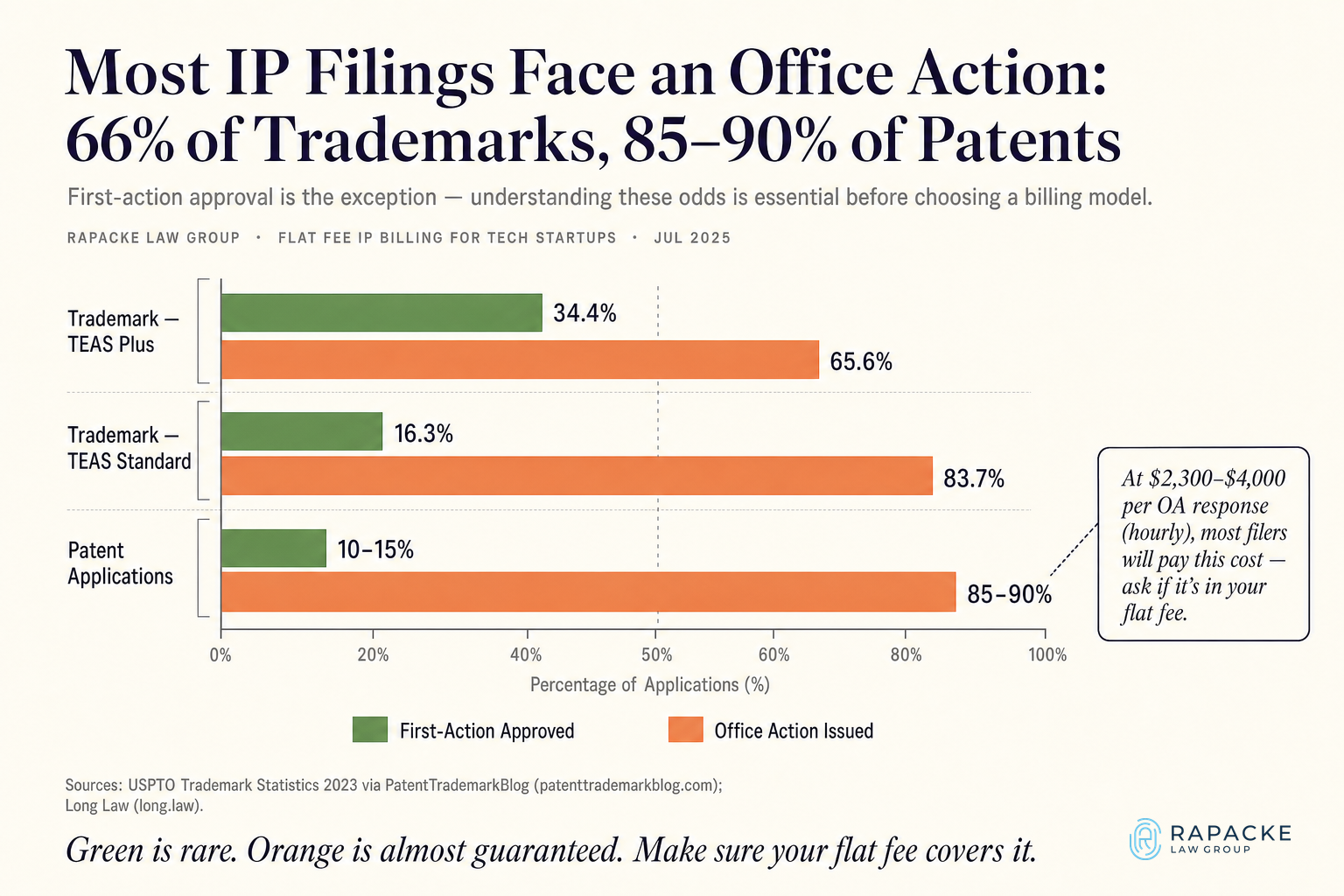
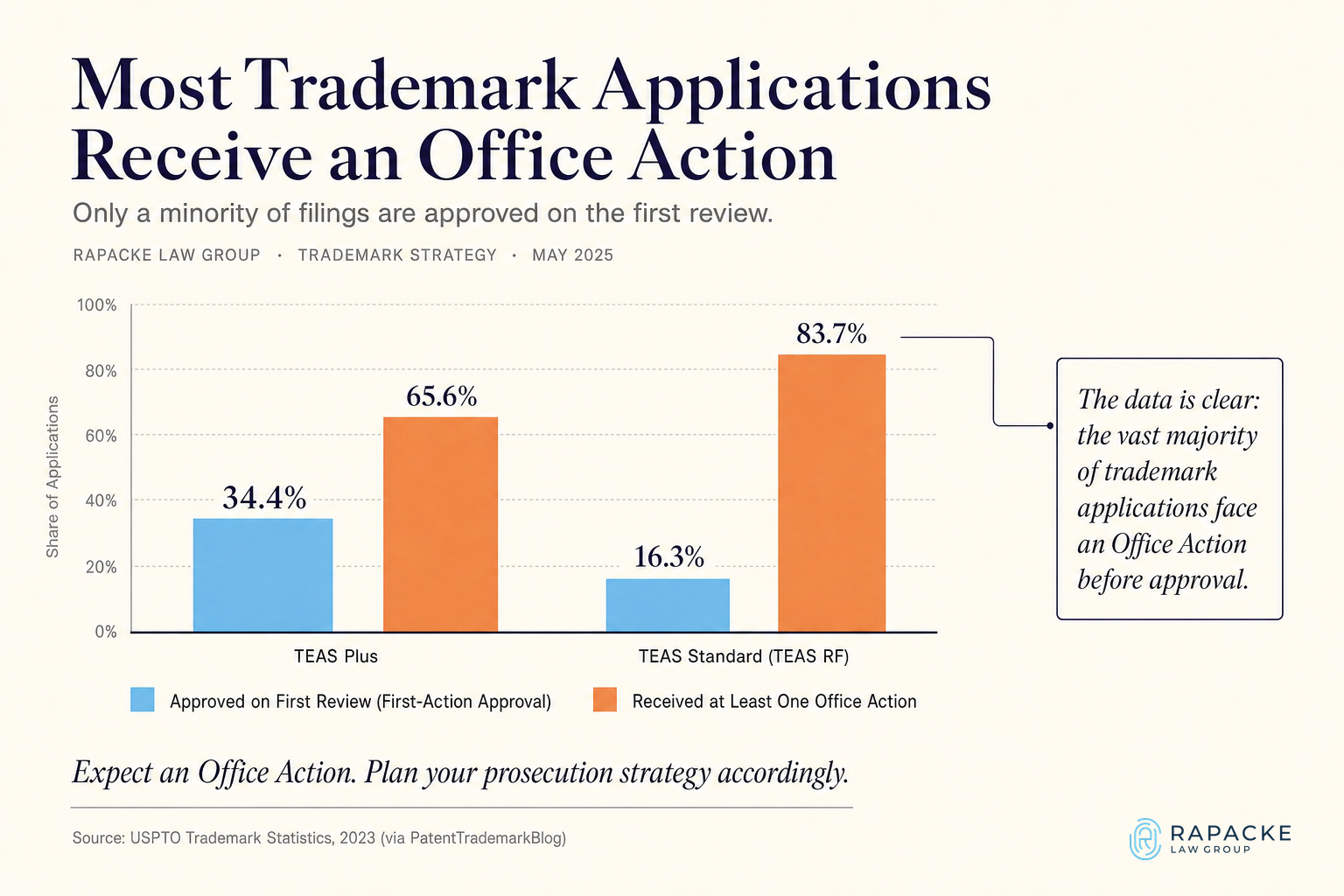
- Roughly 85-90% of patent applications and 65% of trademark applications receive at least one office action. Confirm in writing whether responses are included in your flat fee.
- Compare flat fee quotes by scope checklist, not total dollar amount. A lower quote often covers fewer deliverables.
- Red flags include “starting at” pricing, vague scope language, and engagement letters that exclude claims amendments or office action responses.
*Written by Andrew Rapacke, Managing Partner, Registered Patent Attorney.*
A founder who budgets $3,000 for a patent application and opens a $9,000 invoice three months later isn't just surprised, they're facing a cash flow problem that hourly IP billing creates routinely under intellectual property law engagements. Working with a flat fee IP attorney converts that unpredictable variable cost into a fixed line item, and according to Clio's 2024 Legal Trends Report, 71% of legal clients now prefer flat fee billing over hourly models for exactly this reason.
Why Founders Are Dropping Hourly IP Billing (and What They're Switching To)
The choice between hourly and flat fee legal billing is fundamentally a business risk decision. Hourly billing makes IP costs a variable expense that compounds unpredictably across a patent prosecution lasting two or more years. Since 2016, the percentage of law firms embracing flat fee billing has increased by 34%, and firms using flat fees are nearly twice as likely to collect payment right away as hourly firms, a structural advantage that benefits both sides of the engagement.
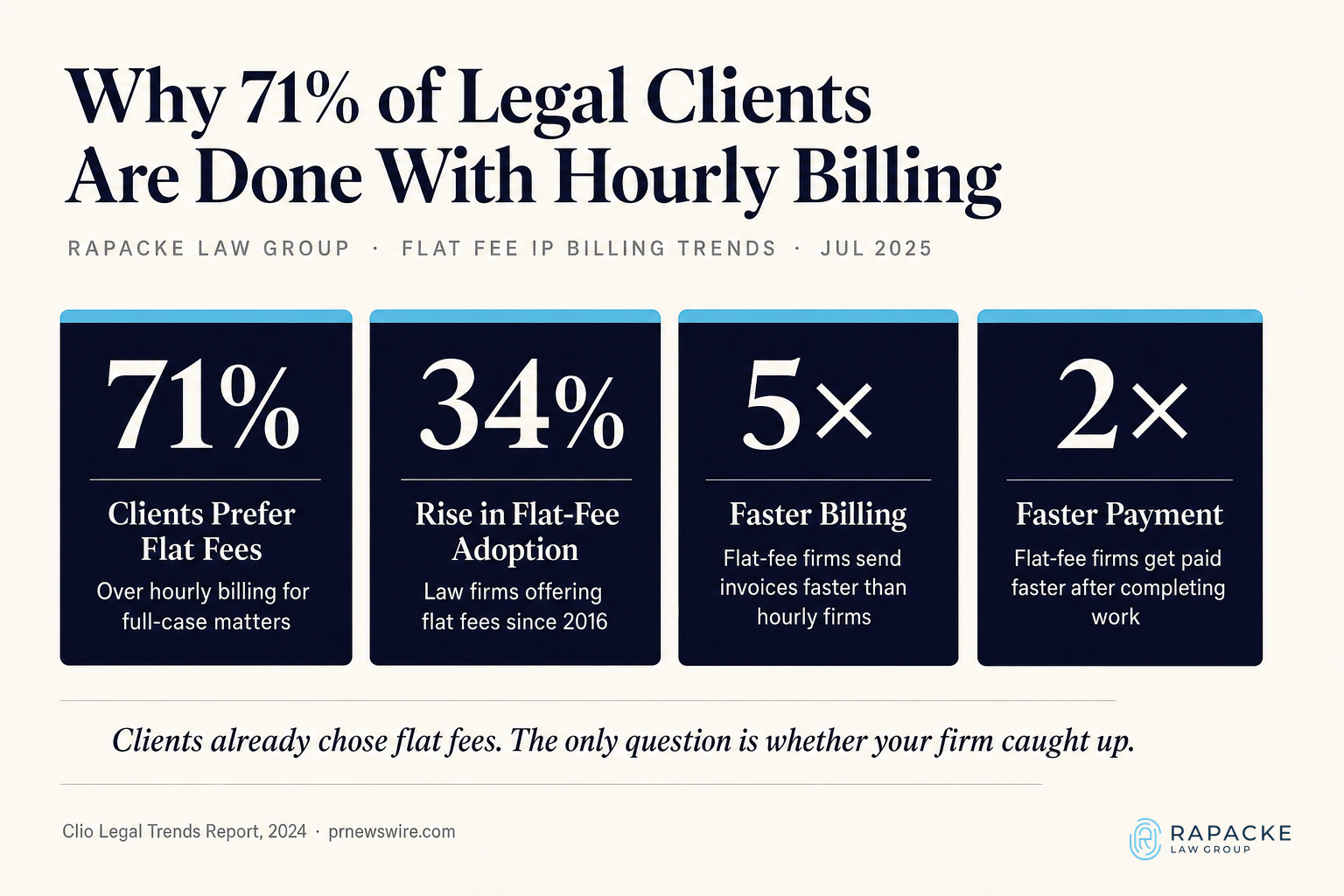 Why 71% of Legal Clients Are Done With Hourly Billing, Source, Clio Legal Trends Report, 2024
For founders managing tight operating budgets, hourly IP billing introduces a specific risk, you cannot accurately represent your total IP spend to investors, advisors, or your board when the final number depends on how many rejections the United States Patent Office issues.
The Hidden Cost of Hourly Billing in IP Work
IP attorneys at small firms command significant hourly rates nationally, placing IP work among the most expensive practice areas. The problem isn't the rate alone, it's the multiplication effect. Most patent examiners reject a utility patent application about three times before allowance, and each one generates additional billable hours for responses, amendments, and examiner interviews. Only 10% of applications receive a first action within the USPTO's 14-month goal, per Patently-O's 2026 analysis, meaning delays and rejections are the rule, not the exception.
We make protecting your intellectual property simple. The first step is understanding exactly what you'll pay before work begins.
What Flat Fee IP Attorneys Actually Charge for Core Services
The table below separates attorney flat fees from the USPTO government fees that are always billed additionally, regardless of which firm you hire. Transparent flat fee pricing means both numbers appear in your quote before you sign anything.
| Service | Attorney Flat Fee (typical range) | USPTO Government Fee |
|---|---|---|
| Provisional patent application | $4,000-$7,000 (includes attorney fees, formal patent drawings, USPTO filing fees as micro entity) | Included in flat fee |
| Utility (non-provisional) patent | $8,000-$15,000 (includes attorney fees, formal patent drawings, USPTO filing fees as micro entity) | Included in flat fee |
| Trademark application (1 class, includes conflict search, all OAs, filing fee, MBG) | $2,250 | $250-$350 (TEAS Plus/Standard) |
| Additional trademark class | $550 per class | $250-$350 per class |
| Design patent application (includes all OAs, filing fee, MBG) | $3,500 | Included in flat fee |
Software and AI patents sit at the higher end of the utility patent range due to claim drafting complexity. USPTO fees shown reflect current schedules as of 2025. Always request a quote that separates attorney fees from government fees as two distinct line items.
Why Small Businesses and Startups Benefit Most from This Model
For pre-seed and seed-stage startups, IP cost predictability directly affects investor relationships. Series A due diligence consistently prioritizes cap table, IP ownership, and revenue as the top three items VCs review. Founders who cannot show clean IP assignment and a defined legal spend raise a diligence flag before the first investor meeting; for more information on preparing for diligence, consult your IP counsel early. Research published by REPEC confirms that patent filings signal quality to investors and can help startups secure venture financing earlier. Flat fee billing converts IP from a cost center with unknown exposure into a predictable operating expense that belongs in the budget, not the contingency fund — a key legal advice every advisor gives startups.
What a Flat Fee Patent Attorney Should Include in the Scope (and What It Does Not)
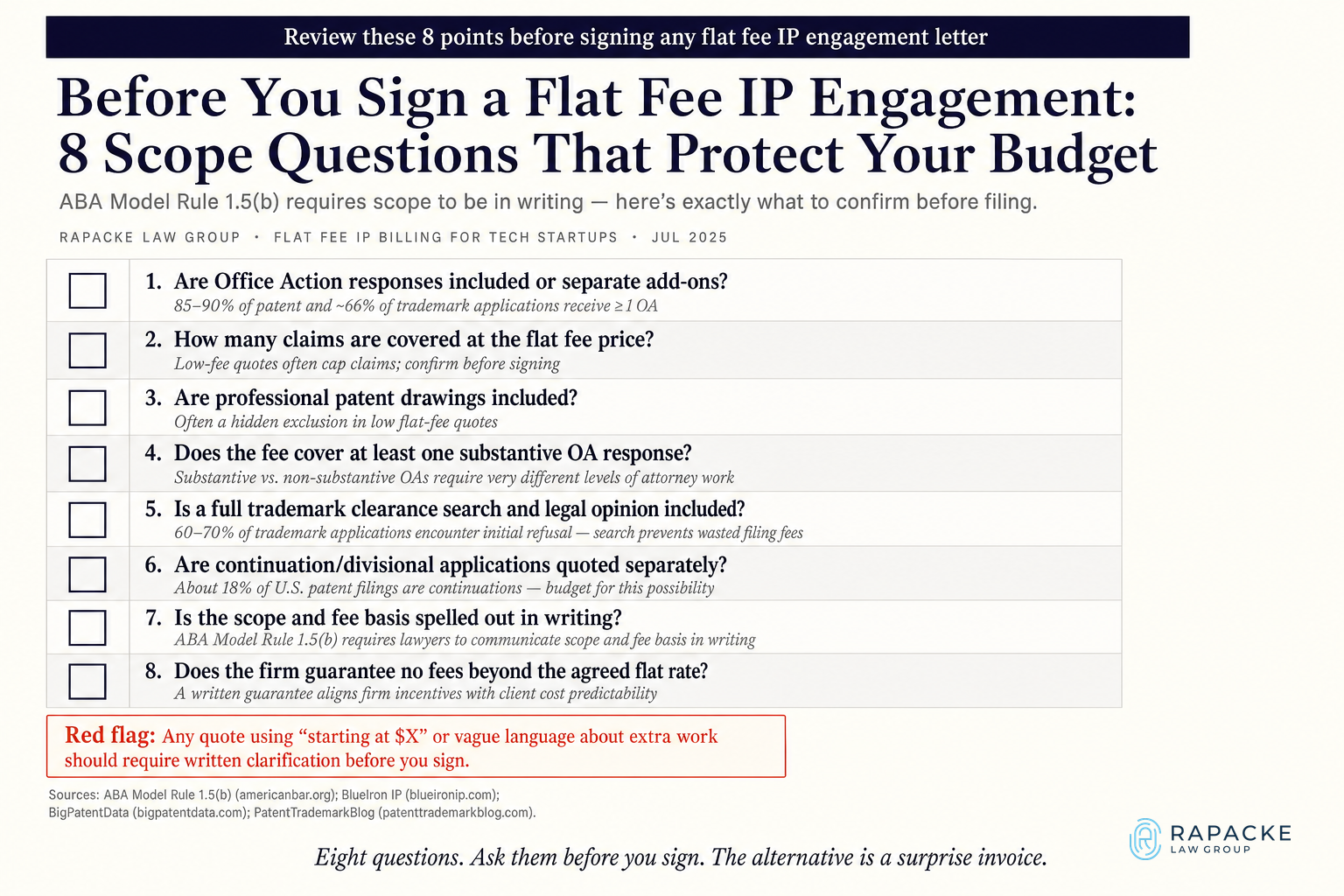
Flat fees are only as predictable as the scope language behind them. An engagement letter that excludes office action responses, professional drawings, or claims amendments is not a true flat fee, it is a partial quote with deferred billing. Because approximately 85-90% of patent applications receive at least one office action requiring a substantive response, founders who do not confirm scope upfront routinely discover their total cost is far higher than the initial quote.
Patents, without the exorbitant fees. That promise only holds when the scope is explicit and in writing.
Provisional vs. Non-Provisional Patent Applications Under a Flat Fee
A provisional patent application is a 12-month placeholder that establishes a priority date and grants "Patent Pending" status. It is not examined by the USPTO and does not result in a patent on its own. The flat fee for a provisional patent application is $4,000 to $7,000, which includes attorney fees to draft the application, prepare formal patent drawings, and USPTO filing fees as a micro entity. This is far below the cost of a full non-provisional application. To actually obtain patent protection, you must file a non-provisional application within those 12 months, a separate flat fee engagement that initiates examination.
Non-provisional applications take an average of 26.3 months to reach grant, per USPTO pendency data, and a utility patent provides protection for 20 years from the filing date. The flat fee for a non-provisional patent application is $8,000 to $15,000, which also includes attorney fees to draft, prepare formal patent drawings, and USPTO filing fees as a micro entity. Budget for both steps as distinct engagements from the start. For a deeper breakdown of total patent costs, see How Much Does a Patent Cost, An In-Depth Guide to Patent Pricing in 2025.
Office Action Responses and How Flat Fee Attorneys Handle Them
Only about 10-15% of patent applications are approved on first review without an office action, a well-known challenge in USPTO registration services. Responding to a patent office action under hourly billing runs $2,300 to $4,000 per response. Flat fee patent attorneys handle this one of two ways, either one office action response is bundled into the initial engagement, or they offer a fixed per-response rate disclosed in advance. Because roughly 65% of trademark applications and 85-90% of patent applications face at least one office action, this single scope question has a larger impact on your total cost than almost any other variable. Confirm it in writing before filing.
Design Patents and Continuation Applications as Add-On Services
Design patents protect the ornamental appearance of a product and are separate from utility patents. The flat fee for a design patent application is $3,500, which includes all office action responses, the USPTO filing fee, and the money-back guarantee. Software and SaaS founders often overlook design protection when their product has distinctive visual interfaces. Continuation applications, follow-on filings that pursue additional claims from a parent patent, represent roughly 13% of utility applications according to Big Patent Data research, and they are almost never included in an original flat fee engagement. A reputable flat fee firm will quote continuation and divisional applications transparently as separate engagements when you decide to file them.
How to Compare Flat Fee IP Attorney Pricing Without Getting Misled
An $8,000 utility patent quote and a $15,000 utility patent quote are not simply different price points — they likely cover different deliverables entirely. A lower quote may exclude professional drawings, limit claims, and charge separately for every office action response. A higher quote may include drawings, unlimited claims through a defined scope, and one full round of prosecution. Comparing dollar amounts without a scope checklist is not a comparison at all.
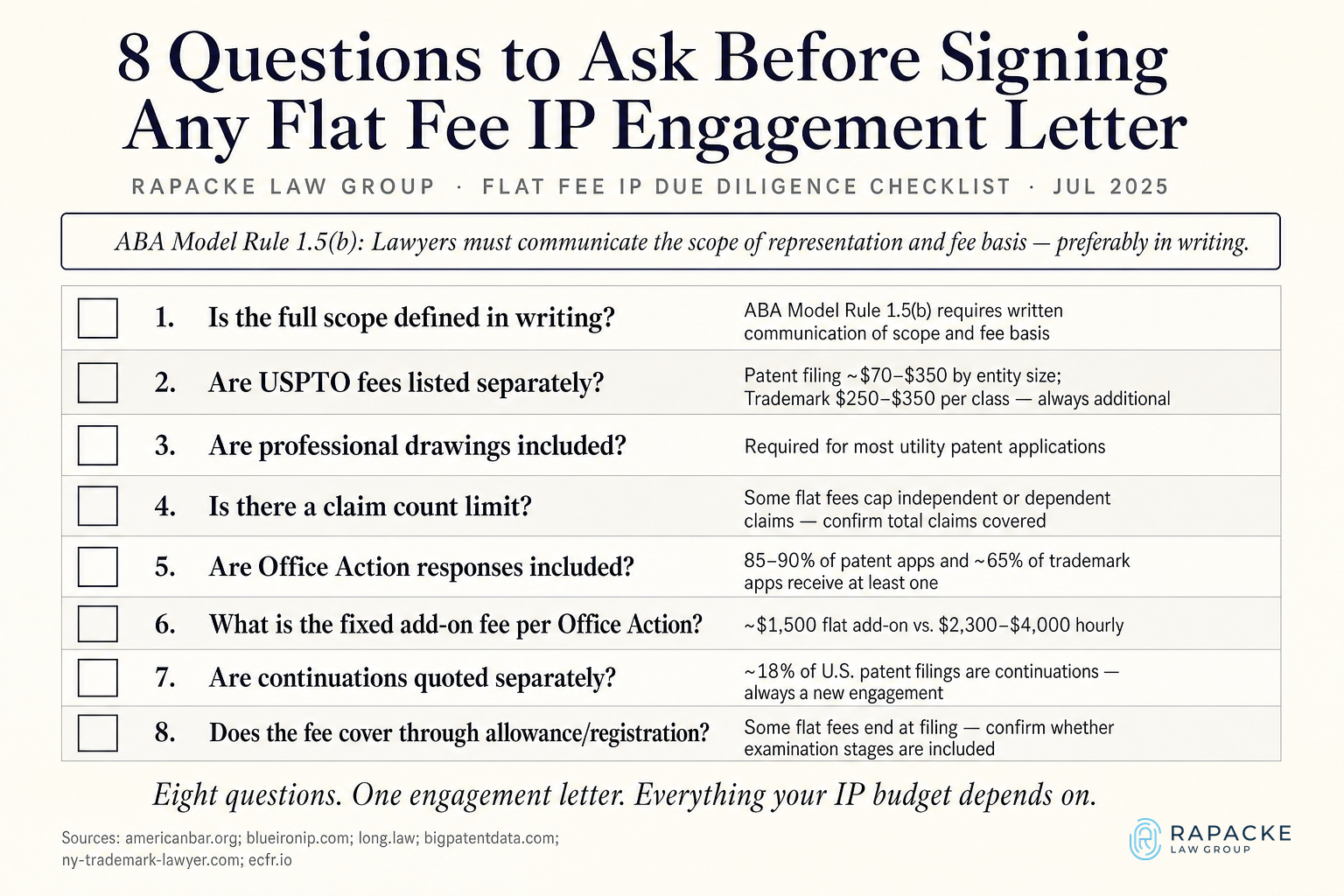
Per ABA Model Rule 1.5(b), attorneys are required to communicate the scope of legal representation and the basis of their fee to clients, preferably in writing. Any firm that resists providing a written scope document before accepting payment is operating outside professional norms. For a direct comparison of what each model costs over time, see Flat Fee vs Hourly Attorney, The Death of The Billable Hour.
Transparent Pricing vs. Teaser Rates: Red Flags to Watch For
Watch for these specific red flags in any flat fee IP engagement, pricing described as "starting at," scope language that excludes "additional office actions," engagement letters that do not define the number of claims or drawing sheets included, and fees that cover only filing without addressing prosecution. Each signals that the advertised flat fee is a teaser rate with deferred billing built in. If you encounter open-ended scope language, request a defined scope addendum before signing. Reputable flat fee attorneys will provide one without hesitation.
An easy online ordering process and a secure streamlined online platform are hallmarks of firms that have built their practice around cost transparency, thanks flat fee team structures that eliminate billable hour accumulation.
What the RLG Guarantee Means for Cost Predictability
Rapacke Law Group's flat fee model is backed by the RLG Guarantee, a written commitment that the agreed flat fee is the final fee with no additional charges if the scope of work does not change, providing trademark protection from day one. For trademarks, RLG guarantees approval and delivery of your trademark registration certificate or you pay nothing, a 100% refund if your application is rejected. For provisionals, you receive a full refund if the USPTO denies the application. This type of guarantee-backed transparent flat fee pricing is the standard that founders should hold all flat fee IP attorneys and any intellectual property lawyer they hire to. If a firm won't commit in writing to a fixed total cost for a defined scope, it is not truly operating on a flat fee model.
What Flat Fee Trademark Registration Covers from Search to Certificate
A full-scope flat fee trademark registration engagement moves through five defined stages, comprehensive trademark search, attorney opinion letter, preparation and filing of the trademark application to file trademark application properly, USPTO examination monitoring, and office action response if needed. The trademark process from filing to first action currently runs 8-9 months according to USPTO performance data. The flat fee for a trademark application is $2,250 for one class, which includes the conflict search, all office action responses, the USPTO filing fee, and the money-back guarantee. Additional classes are $550 each. USPTO filing fees are incorporated into this flat fee rather than billed separately. For current filing cost details, see New USPTO Fee Changes Just Raised Your Trademark Filing Cost, Here's What to Expect.
Comprehensive Trademark Search Packages and Why They Matter
A basic USPTO database search checks only federally registered marks, missing common law marks, state registrations, and phonetically similar brand name conflicts in the same goods and services class. Licensed US trademark attorneys include a comprehensive search, a written search report, and a written opinion letter in full-scope flat fee packages. Likelihood of confusion under Section 2(d) is the most common basis for USPTO refusals, meaning the search directly determines whether your application survives examination and achieves successful registration. Treating the comprehensive trademark search as an optional upsell is the leading cause of wasted filing fees, refiled applications, and weakened brand identity.
Get Your Trademark approved or pay nothing. We guarantee it. That guarantee starts with a search thorough enough to find conflicts before you file.
USPTO Examination and Office Action Response Under a Flat Fee Model
After the initial filing of the trademark application, a USPTO examining attorney reviews it and issues either an approval for publication or an office action requiring a response within three months (six-month maximum deadline). Attorney fees for a trademark office action response on an hourly model run $750 to $2,500, making professional trademark services under a flat fee model far more predictable. Flat fee trademark attorneys who include at least one office action response in their standard package provide the most complete scope coverage. Office actions fall into two categories, procedural issues (easily corrected) and substantive refusals like likelihood of confusion (requiring legal argument and evidence). Prioritize flat fee attorneys who handle both types within the quoted scope. An experienced U.S. trademark attorney will distinguish between these categories immediately and respond with a targeted strategy.
The Real Difference Between Flat Fee and Hourly IP Firms for Tech Startups
The billing model decision shapes how founders build an IP portfolio over time. Under hourly billing, uncertain legal expenses cause founders to delay filings and underinvest in protection. Under a flat fee structure, a founder can project the cost of three patent applications and two trademark registrations over 24 months and include that number in the operating budget. Flat fee patent attorneys with fixed-price portfolio management, freedom-to-operate analyses, and IP assignment agreements make pre-Series A diligence significantly more straightforward, thanks to their transparent legal services structure.
AI Patents and Software Patents Under a Flat Fee Structure
AI and software patents require specialized claim drafting to satisfy 35 U.S.C. § 101 patent eligibility requirements. Historically, § 101 rejection rates for software-related applications have run 40-60% or higher depending on the technology category and claim strategy. Flat fee patent attorneys who work regularly with AI patent applications charge at the upper end of the utility patent range, typically $8,000 to $15,000 or more, because these applications demand more sophisticated claim strategies than mechanical or hardware inventions. This fee includes attorney fees to draft, prepare formal patent drawings, and USPTO filing fees as a micro entity. Confirm that any flat fee patent attorney or intellectual property attorney you consider has documented experience with AI and software prosecution before signing an engagement. For a deeper resource, see the SaaS Patent Guide 2.0 and the guide to SaaS Patents.
IP Due Diligence and Portfolio Strategy as Flat Fee Services
Beyond individual filings, startups approaching a funding round need freedom-to-operate analyses, IP assignment agreements, and portfolio strategy work — including trade secrets protection — completed before investor diligence begins. IP issues, spanning patents, trademarks, and trade secrets, surface as material findings in a significant percentage of M&A and venture deals. Flat fee ranges for a freedom-to-operate analysis typically run $2,000 to $6,000 depending on the technology field. Ask your IP attorney for a complete flat fee menu covering these services before your Series A process begins, not after a VC flags a gap. Review the Why The Rapacke Law Group? page to see how fixed-fee portfolio strategy is structured in practice.
Frequently Asked Questions
What is a flat fee IP attorney?
A flat fee IP attorney charges a single pre-agreed price for a defined legal service, such as filing a patent application or registering a trademark to secure exclusive rights, rather than billing by the hour. The total cost is known before work begins, giving founders and small businesses the budget certainty that hourly billing cannot provide, making it a simple flat fee approach to legal services. This model also makes it easier to evaluate whether you are receiving top level quality service relative to what you paid.
How much does a flat fee patent attorney cost for a utility patent?
Attorney flat fees for a non-provisional utility patent application typically range from $8,000 to $15,000, with the fee including attorney fees to draft, prepare formal patent drawings, and USPTO filing fees as a micro entity. Provisional patent applications are priced at $4,000 to $7,000 and include the same comprehensive scope. These flat fees are all-inclusive for the defined scope, so founders know their total cost before work begins.
Are USPTO filing fees included in a flat fee attorney quote?
No. USPTO government filing fees are always separate from attorney flat fees and are paid directly to the USPTO. Always request a total cost breakdown that shows attorney fees and government fees as two distinct line items.
What happens if the USPTO sends an office action?
Whether an office action response is included depends entirely on the engagement agreement. Because 85-90% of patent applications and approximately 65% of trademark applications receive at least one office action, this distinction significantly affects your total cost. Confirm scope in writing before filing.
How do I know if a flat fee IP attorney quote is fair?
Compare quotes by deliverable checklist, not dollar amount. A lower quote often signals narrower scope, fewer claims included, no drawings, or office action responses excluded. Request an itemized scope from each attorney and compare line by line before signing. Excellent legal trademark services and patent services both require clarity on what is and is not covered from day one.
What are the disadvantages of flat fees?
Flat fees require precise scope definition upfront. If the scope of your invention changes materially after work begins, the flat fee may need to be renegotiated. Complex prosecutions requiring multiple appeals or continuation filings may also exceed the boundaries of a standard flat fee engagement.
Is a flat fee IP attorney right for AI or software patent filings?
Yes, but only if the attorney has documented experience with USPTO § 101 patent eligibility rejections for software and AI applications and can address your specific needs. Not every patent attorney can navigate these rejections effectively. Confirm experience and ensure the flat fee reflects the additional complexity of these filings compared to mechanical inventions.
Your Next Steps to Flat Fee IP Success
Three decisions determine whether a flat fee IP engagement delivers the cost certainty it promises. An initial consultation to confirm scope in writing, what is explicitly included and what triggers additional fees. Verify that the attorney is a registered U.S. patent attorney or one of the licensed US trademark attorneys, or a licensed u.s. attorneys firm, with documented experience in your technology area. Get a total cost projection that separates attorney flat fees from USPTO government fees and addresses office action responses directly.
The bottom line: affordable led trademark services and weak patent coverage share a common failure mode, vague scope language that leaves founders exposed. Top level quality service means every deliverable is named in the engagement letter before a dollar changes hands.
Founders who delay IP filings because of billing uncertainty pay a different kind of price, they arrive at Series A without clean assignments, without granted patents, and without the leverage that early filings provide. The cost of a flat fee engagement is fixed and knowable today. The cost of filing too late is not.
Action items before you hire a flat fee IP attorney:
- Schedule a Free IP Strategy Call to get a transparent flat fee quote for your specific patent or trademark need, backed by the RLG Guarantee, with no hourly clock running
- Request a written scope document before signing any engagement letter
- Confirm whether office action responses are included or priced separately
- Ask whether the firm offers excellent legal trademark services and AI/software patent prosecution under the same fixed-fee model
- Review the Flat Fee vs Hourly Attorney comparison if you want a deeper analysis of the billing model tradeoffs
A flat fee model backed by a written guarantee is not a marketing claim, it is a contractual commitment. Hold every IP attorney you consider to that standard, and you will never open a surprise invoice again.
To Your Success,
Andrew Rapacke Managing Partner, Registered Patent Attorney Rapacke Law Group