


Nick Shirley’s viral videos exposing Somali fraud networks in Minnesota and hospice fraud in California have dominated recent headlines, but the numbers tell a very different story about where the most damaging economic crimes are actually occurring. The FBI estimates that intellectual property theft linked to China costs U.S. businesses between $225 billion and $600 billion every single year, a figure that dwarfs virtually every other form of fraud in the news cycle by orders of magnitude.
While media coverage currently is fixated on schemes amplified by creators like Shirley, China’s state-directed IP theft operates on an entirely different level, and Made in China 2025 gave that theft a government-sanctioned target list. Launched in May 2015, Made in China 2025 is not a procurement label or a quality standard. It is a state industrial masterplan that named ten specific high-tech sectors, set explicit domestic market share benchmarks, and mobilized subsidies, state loans, and intelligence resources to reach them.
The scale of this operation puts any other fraud story in the current news cycle to shame. A decade later, the plan’s original deadline has passed, but the China Made in China 2025 industrial policy logic behind it has not.
Understanding what it set out to do, what it actually accomplished, and how it connects to documented espionage activity in the United States is now essential context for any tech founder, inventor, or innovator building in a sector China has formally designated as a national strategic priority.
Key Takeaways
- Made in China 2025 targeted ten specific sectors and set domestic market share benchmarks that structurally disadvantaged foreign firms already operating in China.
- The Commission on the Theft of American Intellectual Property estimated annual losses of $225 billion to $600 billion, with the Department of Justice finding that approximately 80% of all economic espionage prosecutions involve conduct benefiting China.
- China overdelivered in electric vehicles and high speed rail while falling significantly short in advanced semiconductors, where U.S. export controls have blocked access to critical fabrication equipment.
- The most common theft vector in prosecuted cases is an insider with legitimate access, which means trade secret protections and IP assignment agreements are more urgent than litigation preparedness.
- The underlying china industrial policy did not end in 2025; it was absorbed into successor frameworks including the 14th Five-Year Plan and China Standards 2035, extending the competitive and espionage threat for at least another decade.
What Made in China 2025 Actually Set Out to Do
China’s State Council unveiled Made in China 2025 in May 2015 under Premier Li Keqiang as a comprehensive blueprint to transform the country from a low-cost assembly economy into a global leader in advanced manufacturing. The plan was modeled partly on Germany’s “Industrie 4.0” initiative but operated at a fundamentally different scale, backed by state resources and policy instruments that no private-sector initiative could match, and it drew on a long tradition of indigenous innovation strategies within Chinese industrial planning as part of a long term plan to dominate advanced industries globally. This china industrial policy, rooted in decades of state-directed industrial policies, represented one of the most ambitious government-directed economic transformations in modern history.
The Ten Strategic Sectors at the Heart of the Plan
According to the U.S.-China Economic and Security Review Commission, the plan targeted ten sectors: next generation information technology, advanced robotics and automation, aerospace equipment, new energy vehicles, advanced rail transportation equipment including high speed rail, high tech ships and ocean engineering equipment, advanced agricultural machinery, new materials, high performance medical devices, and electric power equipment. The scope was deliberately comprehensive, covering every domain where Chinese companies trailed global leaders and where acquiring technological leadership would shift China’s position in the global value chain from commodity manufacturer to technological innovation hub with a robust national innovation system.
The plan’s internal documents outlined more than 250 specific targets, including a stated goal of 70% self sufficiency in core basic components and key materials by 2025. If your technology touches any of these ten sectors, you are operating in territory China has formally identified as a national strategic priority, and that designation shapes how Chinese state actors, state-linked companies, and intelligence services approach your innovations. Understanding how to patent your idea in the USA before entering any of these sectors is essential groundwork.
Domestic Market Share Targets That Put Foreign Firms on Notice
The plan was direct about its competitive intent. It called for Chinese firms to capture 80% of the domestic market in sectors like high-end machine tools and 70% or more in advanced robotics, while also targeting large enterprises in foreign markets, as documented in the USCC’s analysis. These were not aspirational targets framed around innovation competition; they were benchmarks that could only be met by displacing foreign companies already operating in the Chinese market.
The European Union Chamber of Commerce in China flagged this problem early. Its analysis concluded that the domestic market share goals were structurally designed to squeeze out foreign investment through subsidized competition, innovation subsidies, and preferential procurement rather than market-driven innovation. Chinese government guidance funds, low interest loans to state-owned enterprises, and preferential procurement for domestic products created an uneven playing field that was particularly dangerous for foreign firms operating through joint ventures, since technology transfer was often an informal condition of market access.
Any joint venture arrangement in China requires robust contractual IP protections before technical disclosures begin. The commercial relationship itself creates an IP exposure that contracts need to address explicitly, not as an afterthought.
Why China Quietly Stopped Promoting the Slogan After 2018
After the Trump administration launched a Section 301 investigation under the 1974 Trade Act, Chinese officials noticeably scaled back public references to Made in China 2025. The shift was strategic communications, not policy retreat. The plan was absorbed into successor frameworks: the 14th Five-Year Plan (2021-2025) continued funding all ten strategic sectors under updated language, and discussions of an extended “Made in China 2035” roadmap emerged alongside the China Standards 2035 initiative, which targets international standard-setting bodies in digital economy technologies including artificial intelligence, 5G, and the Internet of Things.
According to PBS Frontline, the rebranding was driven by the realization that the plan’s explicit ambitions had become a diplomatic liability. Treating 2025 made in china as a historical policy rather than an ongoing industrial strategy leaves your IP exposed to a competitive and intelligence threat that never actually stopped.
Intellectual Property Theft China Has Turned Into a National Strategy
The relationship between china industrial policy and china and intellectual property theft is not circumstantial. The sectors targeted by the plan align with documented theft patterns in federal prosecutions and intelligence assessments with a precision that makes the connection explicit. Intellectual property theft in china has emerged as one of the defining economic security challenges of the current decade, and the 2025 Made in China framework provided the strategic map that directed it.
The Economic Scale of China’s IP Theft Against U.S. Businesses
The Commission on the Theft of American Intellectual Property estimated in its 2017 report that china intellectual property theft costs the U.S. economy between $225 billion and $600 billion annually. That figure encompasses counterfeit goods, pirated software, and trade secret theft, and it places China as by far the largest source of global intellectual property theft targeting American businesses.
The Department of Justice has stated that approximately 80% of all economic espionage prosecutions it brings involve conduct intended to benefit the Chinese state. Approximately 60% of all federal trade secret theft cases have some nexus to China. FBI leadership has described China’s state-directed intellectual property theft china operations as operating on a scale unprecedented in history, constituting one of the largest transfers of wealth ever recorded.
If you are commercializing technology in any of the ten Made in China 2025 sectors, the documented theft pattern confirms your category is actively targeted. Getting started with technology patents before any commercial disclosure is one of the most effective ways to establish defensible IP rights early.
Technology Transfer, Joint Ventures, and the Softer Forms of IP Acquisition
Not all IP acquisition by Chinese companies is illegal. The 2025 Made in China framework relies on a spectrum of methods ranging from outright theft to legally gray arrangements embedded in market access agreements. The 2018 USTR Section 301 investigation documented that foreign firms in sectors including advanced robotics and new energy vehicles felt coerced into sharing technology as a condition of China market access, through requirements involving local joint ventures and licensing terms that favored Chinese partners. According to the Office of the U.S. Trade Representative’s Section 301 Report, these “soft” pressures were systematic rather than incidental, and they complemented illicit methods by accelerating China’s technology absorption in MIC25 priority sectors.
Foreign automakers entering China’s EV market, for instance, historically faced pressure to establish joint ventures with domestic companies, through which battery designs, software architectures, and manufacturing processes transferred to Chinese partners. These “soft” pressures were systematic rather than incidental, and they complemented illicit methods by accelerating China’s technology absorption in MIC25 priority sectors.
Contracts governing any China-facing partnership must include explicit IP ownership clauses, carve-outs for core technology, and trade secret protections before any technical disclosure occurs.
How Chinese Invention Patents Factor Into the Strategy
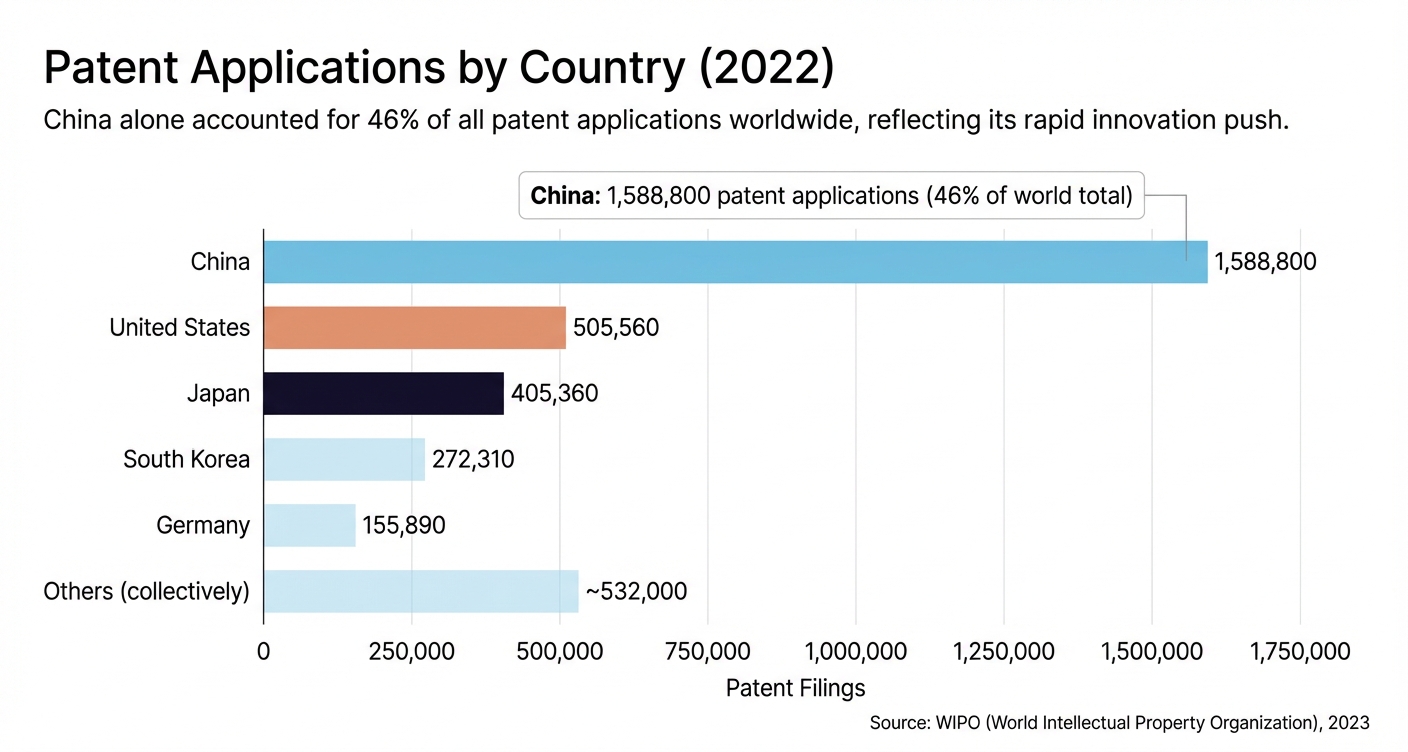
China has dramatically increased its domestic patent filings over the past decade. According to WIPO data, China surpassed all other countries in total patent applications, with filings in AI, advanced manufacturing, and new materials growing substantially since the 2015 launch of Made in China 2025. The growth reflects a state-directed effort to build IP portfolios through technology r&d investment that create freedom-to-operate barriers for foreign companies competing in or selling into the Chinese market.
Chinese invention patents in strategic sectors function as both a defensive and offensive tool. Defensively, they limit the scope of foreign patent enforcement in China. Offensively, a large volume of filings, even if many patents are of lower quality, creates a thicket that foreign competitors must navigate before launching products. Conducting a freedom-to-operate analysis that includes China-origin patents is now essential for any tech company competing in Made in China 2025 sectors globally, not just in the Chinese domestic market. Understanding how to read a patent and evaluate competitive filings is an increasingly important skill for founders operating in these spaces.
China Intellectual Property Theft and Industrial Espionage Targeting U.S. Innovation Hubs
The FBI has described China as conducting the largest theft of intellectual property and sensitive information in human history, and chinese espionage in the united states has been documented across every major technology hub. Federal prosecution data from 2018 through 2024 confirms that assessment and maps the activity directly onto the sectors Made in China 2025 prioritized. Industrial espionage china operations have targeted companies across every major technology hub in the United States, from Silicon Valley to Research Triangle to the aerospace corridors of the Pacific Northwest.
How Federal Prosecutions Map Onto Made in China 2025 Sectors
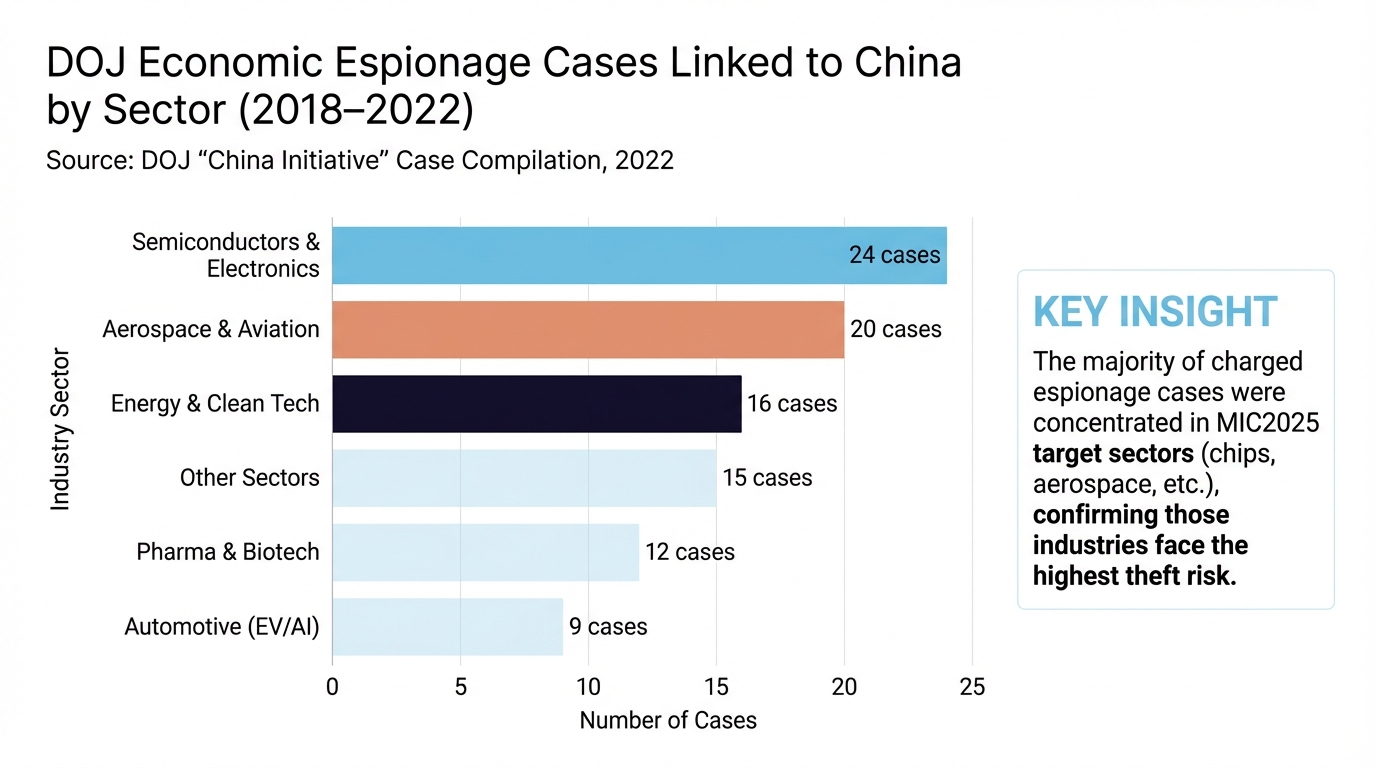
DOJ cases brought over this period span precisely the ten MIC25 sectors: semiconductor designs stolen by former employees of U.S. chipmakers, aerospace schematics obtained through compromised engineers, AI training data acquired through front companies, and agricultural machinery sensor technology taken by academic researchers with undisclosed ties to Chinese institutions. The DOJ’s China Initiative, launched in 2018 and closed in 2022 amid civil liberties concerns, produced more than 150 cases during that period. Intelligence officials have testified in public hearings that Chinese state direction shapes the priorities of both government-linked hackers and civilian operatives, meaning the alignment between prosecuted cases and MIC25 sectors is not accidental.
The risk is not abstract. Mapping your technology against the ten Made in China 2025 sectors is a practical starting point for assessing your actual exposure level. Patent prosecution that anticipates this competitive landscape is structurally different from standard domestic filing strategy.
Industrial Espionage China Operations and Tactics Used Against U.S. Companies
Chinese intelligence and state-linked actors use a diversified operational playbook that combines cyber intrusion, human intelligence, and commercial relationship exploitation. On the cyber side, the group known as APT10 conducted the “Cloud Hopper” campaign, targeting managed service providers to reach technology companies indirectly, a technique that CISA has specifically warned U.S. firms about. By compromising IT, cloud infrastructure, and high technology shipping logistics providers, APT10 gained access to dozens of Western technology companies without ever directly targeting those companies’ networks.
On the human intelligence side, the Department of Justice has documented that China’s Thousand Talents Plan actively recruits overseas scientists and explicitly rewards individuals for bringing proprietary foreign technology back to China. Chinese espionage operations and tactics exploit professional networking platforms to identify employees with access to proprietary technology, university research partnerships to extract pre-commercial innovations, and conference attendance to develop long-term relationships with engineers and researchers. China stealing technology through insider recruitment is well-documented. These cases frequently involve insiders who are recruited over months or years before any data transfer occurs.
Employee offboarding procedures, trade secret policies, and monitoring of professional networking engagement are operational security measures that go beyond human resources formalities in any company working in high tech industries.
Recent Chinese Espionage Cases That Illustrate the Pattern
High-profile prosecutions make the threat concrete, and chinese espionage news coverage of these cases has brought unprecedented public attention to the pattern. In 2023, GE Aviation engineer Xiaoqing Zheng was sentenced to prison for stealing jet turbine designs to benefit China’s aviation sector, according to Al Jazeera’s reporting on the conviction. The prosecution revealed that Zheng had hidden proprietary turbine files inside encrypted photographs and emailed them out of the country. In 2022, former Apple autonomous vehicle engineer Xiaolang Zhang pleaded guilty to stealing self-driving car chip designs for a Chinese EV startup, as reported by Al Jazeera. In a separate agriculture-sector case, a Chinese-American scientist at Monsanto was caught at the airport in 2017 with stolen crop algorithm trade secrets intended for a Chinese employer.
These industrial espionage china cases follow an identical structural pattern: an insider with legitimate access to valuable IP, a connection to a Chinese company or institution in a MIC25 sector, and proprietary technology that fills a documented gap in China’s domestic development. The FBI has consistently stated that prosecuted cases represent a fraction of total theft activity. The most common active vector is a current or departing employee, which means trade secret protection begins with internal access controls and IP assignment agreements, not litigation after the fact.
How Far China Has Actually Come Toward Meeting Its 2025 Made in China Goals
Assessing 2025 Made in China against its own benchmarks produces a mixed picture. China significantly exceeded its targets in some sectors while falling well short in others, and the pattern reveals where competitive pressure from Chinese companies is most acute today.
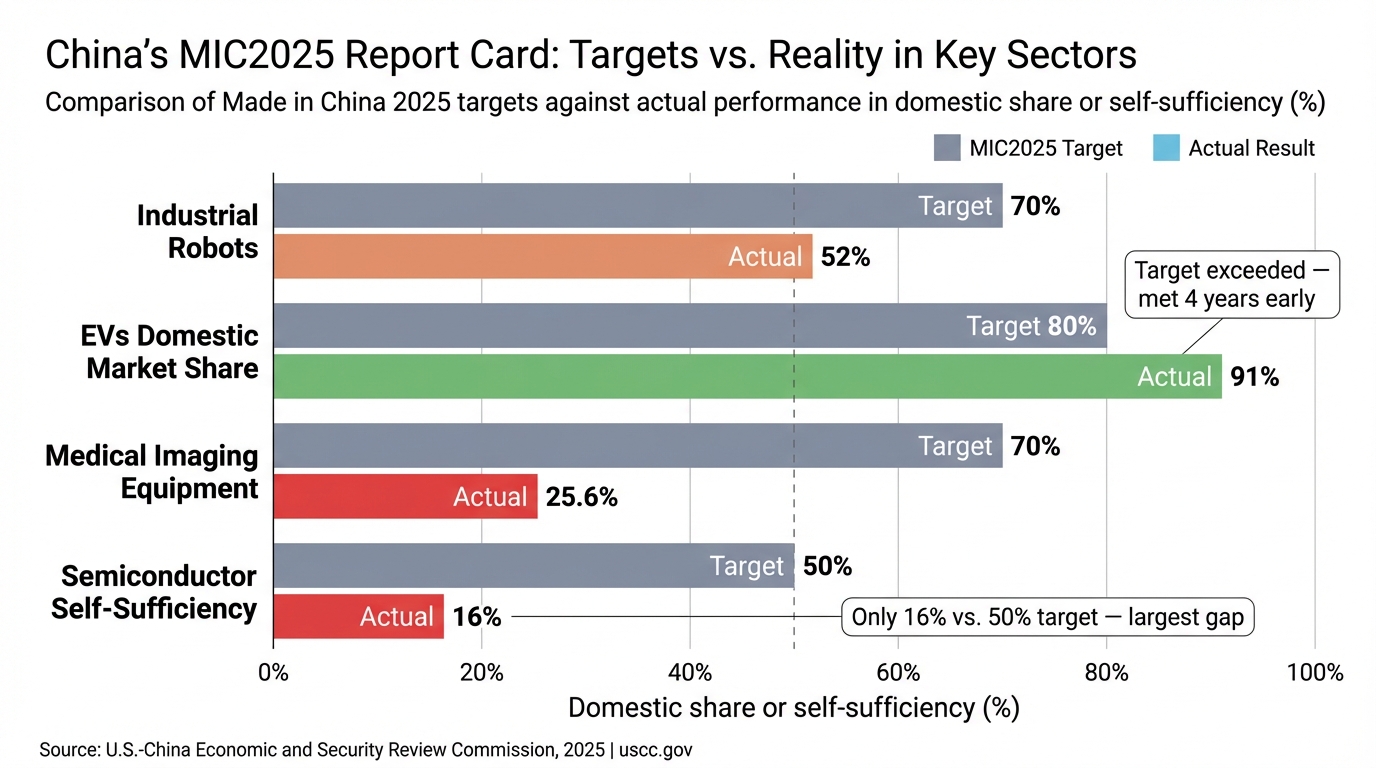 China’s MIC2025 Report Card: Targets vs. Reality in Key Sectors. Source: U.S.-China Economic and Security Review Commission, 2025
Where China Overdelivered on Its Own Targets
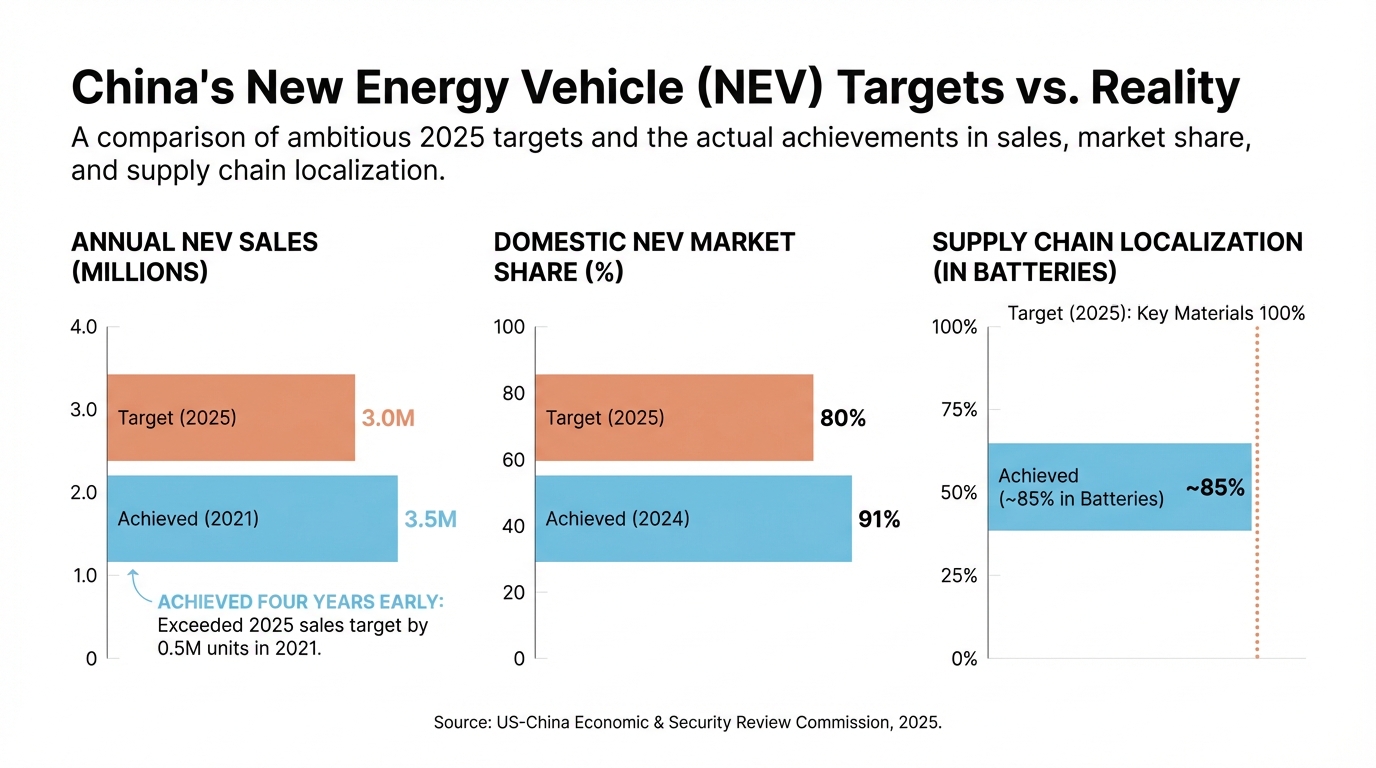
New energy vehicles are the clearest overperformance. The MIC25 target of 3 million NEV sales by 2025 was met four years early, with Chinese companies selling 3.5 million NEVs in 2021, according to the USCC’s comprehensive evaluation. By 2024, domestic brands held approximately 91% of China’s EV market. BYD’s sales grew from roughly 69,000 NEVs in 2015 to 4.27 million in 2024, and China surpassed Japan to become the world’s largest vehicle exporter in 2023, shipping approximately 4.9 million vehicles, as AP News reported.
High speed rail tells a similarly dramatic story. China now operates the world’s largest high speed rail network, with over 40,000 kilometers of track, and has exported its rail technology internationally, including the Jakarta-Bandung high speed rail line completed in Indonesia, according to AP News. Domestic firm CRRC dominates global rail construction orders, demonstrating how the chinese industrial policy framework converted state investment into global market share leadership. In renewable energy equipment, China leads globally in solar panel and wind turbine manufacturing, with Chinese companies commanding the majority of global capacity in both categories and driving economic growth in downstream supply sectors.
In sectors where China has achieved genuine technological leadership, competing means having a patent portfolio, strong innovation capability, and innovation pipeline that are clearly differentiated, not just incrementally better. Improvement patents that extend protection beyond core inventions are particularly valuable in domains where Chinese competitors are rapidly closing the technology gap.
Where the Plan Fell Short and Why
Semiconductors remain China’s most significant failure against its own targets. The MIC25 plan sought 50% chip self-sufficiency by 2020. China reached approximately 16% by that year, according to USCC data, and still imports over $350 billion in chips annually as of 2024. Despite pouring roughly $150 billion into its National Integrated Circuit Industry Investment Fund, known as the “Big Fund,” Chinese companies cannot produce advanced 5nm-7nm chips at scale, a failure that underscores the limits of state-directed key technology r&d investment when foundational equipment access is blocked. U.S. export controls blocking China’s access to ASML’s extreme ultraviolet lithography machines have created a technological ceiling that domestic investment alone cannot overcome.
High performance medical devices represent another significant shortfall rooted in the same structural problem. The goal of 70% local hospital procurement was not met; as of mid-2024 only 25.6% of China’s medical imaging equipment was domestically produced, with most advanced MRI and CT systems still sourced from foreign suppliers, according to the USCC evaluation. For U.S. companies developing high performance medical devices, this gap represents a durable competitive window, but only if those innovations are patent-protected before Chinese manufacturers close the distance. The difficulty of replicating ecosystems of specialized suppliers and tacit engineering knowledge across global supply chains has proven harder to overcome through policy and funding than the plan’s architects anticipated.
Export controls and tariff regimes create compliance obligations for U.S. tech companies with any China supply chain exposure, and those obligations are actively evolving. More strategically, they also create competitive time advantages for U.S. companies in sectors where China has not yet closed the gap.
What Made in China 2035 and Successor Frameworks Signal for the Next Decade
The china industrial policy logic behind Made in China 2025 has not concluded; it has expanded. China’s 14th Five-Year Plan (2021-2025) continued funding the same strategic emerging industries under updated terminology. Discussions of an extended roadmap through 2035 indicate that state-directed industrial push will continue for at least another decade. The China Standards 2035 initiative specifically targets international standard-setting bodies in artificial intelligence, 5G, and IoT, where controlling the technical standard over cutting edge technologies is often more valuable than controlling individual patents because it shapes the entire technology stack that follows.
For tech founders, filing international patents and participating in standards bodies are both strategic moves, not optional additions, in sectors where China is pursuing a standards-capture strategy. The global AI patent landscape illustrates how rapidly Chinese companies are building IP portfolios in high tech industries that will constrain competitors for years. The window to establish prior art and patent priority in these domains is narrowing as Chinese companies accelerate their own filings.
The Industries Most Exposed to China Theft of Intellectual Property Right Now
China intellectual property theft does not distribute evenly across the economy. Documented cases and intelligence assessments point to specific sectors with disproportionate exposure, and they align almost perfectly with the ten high tech industries named in the 2025 Made in China framework.
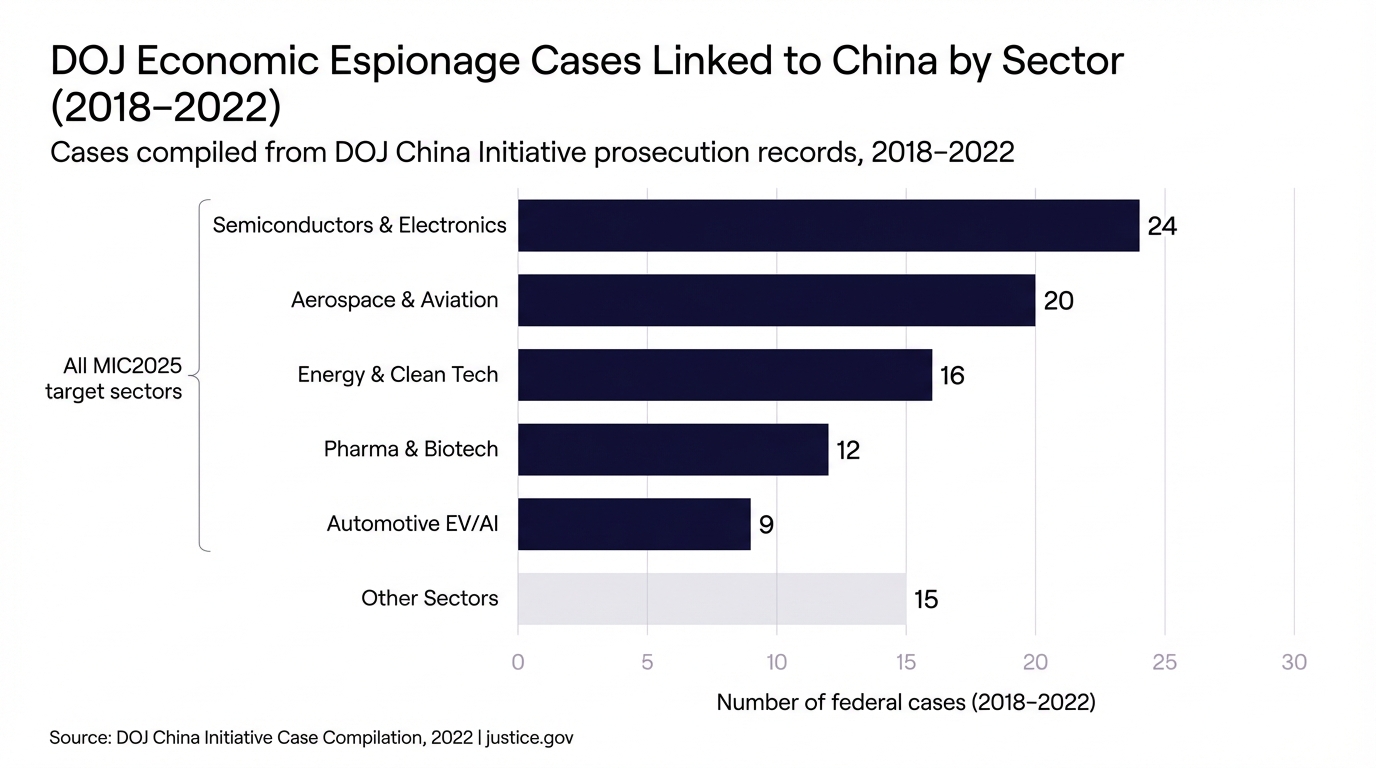 DOJ Economic Espionage Cases Linked to China by Sector (2018–2022). Source: DOJ China Initiative Case Compilation, 2022
Artificial Intelligence and Software Face a Unique Threat Profile
Next generation information technology was listed first among the ten MIC25 sectors deliberately, and artificial intelligence represents its current leading edge. China’s AI development goals are explicit in the State Council’s 2017 New Generation Artificial Intelligence Development Plan and in ongoing military-civil fusion policies that blur the boundary between commercial AI research and national security applications.
U.S. AI companies and SaaS founders face theft vectors specific to software and new technologies: training datasets, model architectures, and software patents are harder to protect than physical hardware designs because they move through digital channels, are difficult to fingerprint, and are often inadequately protected by founders who underestimate their value before commercialization. China theft of intellectual property in the AI domain frequently involves data pipeline access rather than physical document theft. AI model architectures, training pipelines, and proprietary datasets should be covered by a combination of trade secret protections and patent filings before any public demonstration or partnership discussion occurs. Recent software patent examples from leading companies illustrate how effective IP layering works in practice.
Advanced Manufacturing, Robotics, and the Supply Chain Exposure Point
Advanced robotics and smart manufacturing represent a sector where Chinese companies have made significant inroads, partly through acquisition of foreign robotics firms before investment screening tightened and partly through industrial espionage china targeting manufacturing sector process innovations. The USCC’s evaluation found that China reached approximately 52% domestic market share in industrial robots by 2024, still short of the 70% target, meaning foreign robot makers supply nearly half of China’s industrial automation needs and remain active targets for competitive intelligence gathering.
China industrial espionage cases in this sector frequently involve supply chain relationships rather than network intrusion. U.S. manufacturers that move production to facilities in China or involve Chinese suppliers expose manufacturing process trade secrets, tooling designs, and process know-how through the commercial relationship itself, without any formal agreement to share them. Any manufacturing relationship with Chinese facilities or suppliers requires an IP audit to identify what process knowledge is exposed and whether it can be segmented or protected contractually. IP renewal management becomes especially critical when maintaining protection across international jurisdictions over extended periods.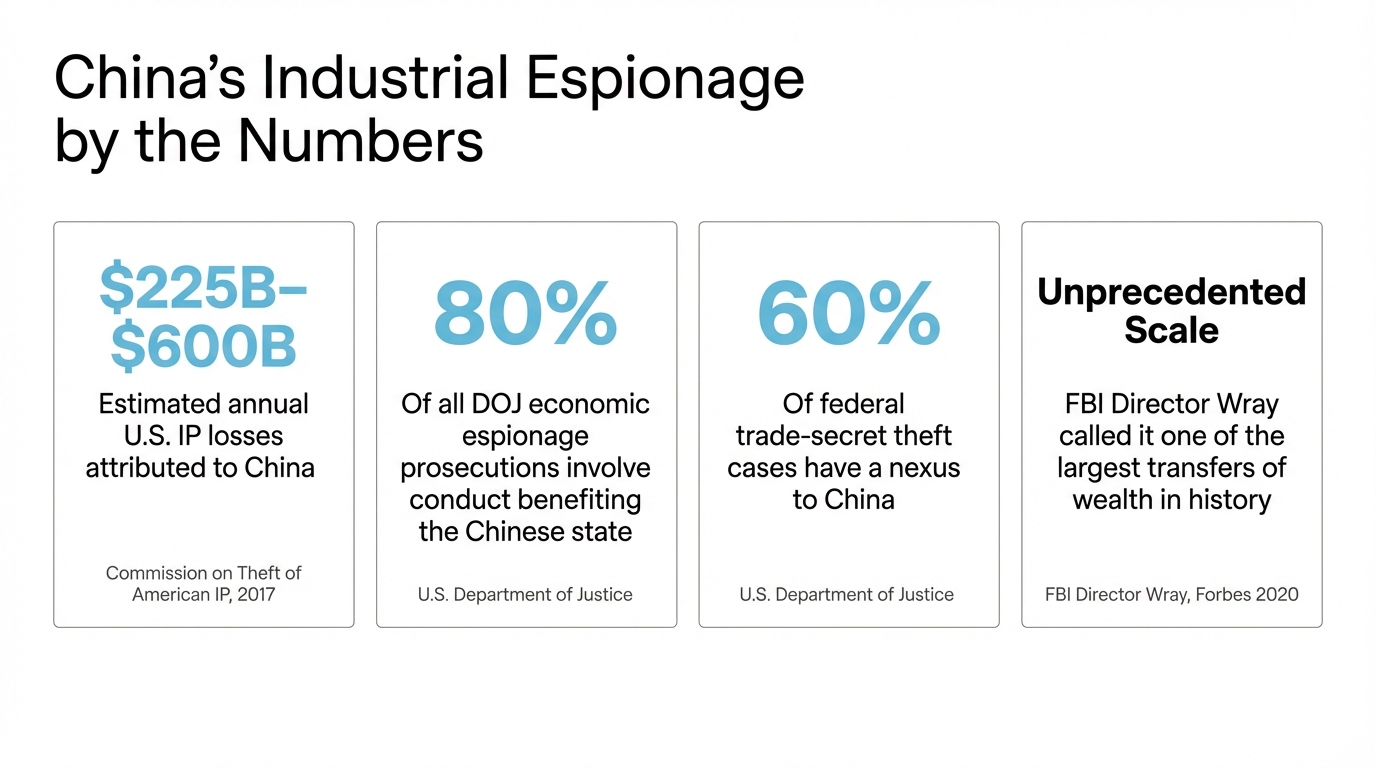 China’s Industrial Espionage by the Numbers. Source: U.S. Department of Justice, 2022; Commission on Theft of American IP, 2017; Forbes, 2020
Biotech, High Performance Medical Devices, and the Less-Discussed Theft Targets
Agricultural machinery and high performance medical devices receive far less media coverage than semiconductor theft, but documented federal cases show significant activity in both sectors. China’s failure to reach its domestic procurement targets for high performance medical devices means foreign manufacturers in imaging, diagnostics, and surgical robotics remain both active competitors and active theft targets for Chinese state actors trying to close the technology gap.
The FBI’s Kansas City field office has specifically highlighted the agricultural technology sector, including cases involving theft of proprietary seed genetics, new materials industry inputs, and precision agriculture sensor technology. The 2017 Monsanto crop algorithm case and multiple prosecutions involving theft of corn seed genetics demonstrate that food security and precision agriculture IP represent active targets among China’s high tech industries priorities.
Medical device IP theft targets both the device designs and the clinical data underlying regulatory approvals, which represent years of irreplaceable investment. Biotech and agricultural technology founders who discount their exposure because they are not in the headline sectors of AI or semiconductors are operating with an inaccurate threat model. Sector-specific threat awareness matters: if your technology touches food security, precision agriculture, or high performance medical devices, you sit in a documented high-theft category regardless of your company’s size.
How China and the United States Are Responding Through Policy and Trade
The policy response to Made in China 2025 has evolved across multiple administrations and now encompasses tariffs, investment screening, export controls, and allied coordination.
The Trump Administration’s Section 301 Investigation and Its Lasting Impact
The Trump administration investigation in 2018 under Section 301 represented the first comprehensive U.S. government action that directly named Made in China 2025 as a threat to U.S. technological leadership. The Office of the U.S. Trade Representative’s Section 301 Report documented specific practices including required joint ventures, restrictive licensing terms, and state-directed acquisition of U.S. companies for their technology. The resulting tariffs on $250 billion in Chinese goods were framed explicitly around IP theft and forced technology transfer concerns.
The tariff structure remained largely intact through the Biden administration, which layered targeted semiconductor export controls on top of it. The Trump administration’s second term has continued developing and expanding the export control regime, particularly restrictions on advanced chip designs and chipmaking equipment. For U.S. tech companies, compliance obligations arising from this evolving framework are not static, and any company with China supply chain exposure needs ongoing legal review of its export control obligations.
CFIUS, Export Controls, and the Investment Screening Response
The Committee on Foreign Investment in the United States was significantly expanded through the Foreign Investment Risk Review Modernization Act, known as FIRRMA, in 2018, directly in response to Chinese acquisitions of U.S. technology companies across MIC25 sectors and advanced industries, marking the first time Congress granted CFIUS such broad authority over minority investments. The expanded CFIUS jurisdiction now covers minority investments in critical technology companies across key industries, not just controlling acquisitions, which closed a gap that Chinese venture capital had been exploiting to obtain technology access without triggering traditional review.
According to Treasury Department annual CFIUS reports, case volumes involving Chinese investors increased substantially after FIRRMA’s passage, reflecting both greater Chinese investment interest and greater regulatory scrutiny driven in part by concerns about advanced technologies flowing to state-linked entities. For tech founders, CFIUS implications now arise at the term sheet stage when foreign investment is involved. If your startup is in an advanced technology sector and you receive interest from Chinese investors or investors with significant Chinese limited partner exposure, consulting IP counsel before due diligence begins is not optional. Ensuring your patents are granted and enforceable before a funding process begins protects your leverage at the negotiating table.
What the EU-China Dynamic Reveals About Global Tech Competition
The European Union’s response to Made in China 2025 has followed a different trajectory than the U.S. approach but has converged on similar conclusions about the threat posed by China’s state-directed model to global markets. The EU Chamber of Commerce in China issued early warnings about market access discrimination tied to MIC25 domestic market share goals. The EU ultimately imposed provisional tariffs on Chinese electric vehicles in 2024 following an anti-subsidy investigation that found Chinese EV producers had received state subsidies sufficient to materially distort competition with European manufacturers.
The EU-China dynamic illustrates that the IP and competitive concerns raised by the 2025 Made in China china industrial policy are not uniquely American and reflect how china efforts to dominate strategic industries have reshaped trade relationships worldwide. They reflect a structural tension between China’s state-directed industrial policy and market-economy IP frameworks that any company selling globally must understand. International patent filing strategy should account for both U.S. and EU protection if your technology competes in markets where Chinese companies are globally active.
What Tech Founders and Inventors Can Do to Protect Their IP From State-Sponsored Threats
Understanding the threat is necessary. Building protection that can withstand it is the actual work, and it starts well before any legal dispute arises.
Building a Patent Portfolio That Survives Competitive Pressure From State-Backed Rivals
A single patent protecting your core innovation is structurally insufficient when competing against Chinese companies with state-subsidized research budgets and explicit domestic market share targets backed by government policy. An effective patent strategy in this environment requires layered protection: utility patents on core inventions, continuation patents covering design variations and application-specific implementations, and international filings through the Patent Cooperation Treaty, or PCT, that establish priority dates globally before any manufacturing or partnership discussions in China begin.
According to USPTO data on patent prosecution timelines, the average time from filing to grant for a utility patent is roughly 23 months, which means filing decisions made today shape your competitive position years from now. Continuation strategy needs to be built into your prosecution plan from the beginning, not added after the initial grant. File before you disclose, file internationally if your market extends beyond the United States, and approach patent prosecution as an ongoing strategic process rather than a one-time transaction.
Trade Secret Protocols That Close the Gaps Patents Cannot Cover
Patents protect disclosed innovations. Trade secrets protect everything you choose not to disclose, including manufacturing processes, training datasets, proprietary algorithms, and pre-patent-application innovations. For tech founders, trade secret protection often provides more immediate coverage than patent protection because it applies from day one without any filing requirement, provided you take documented steps to maintain secrecy.
The Defend Trade Secrets Act of 2016 created a federal civil cause of action for trade secret misappropriation, giving U.S. companies a federal court option for enforcement. But the DTSA’s protections are only available if you can demonstrate that you treated the information as a secret. That demonstration requires documented access controls, NDA protocols with contractors and partners, confidentiality provisions in employment agreements, and clear IP assignment clauses that prevent departing employees from taking innovations with them. A trade secret is only legally protectable if you can show you treated it as one. Document your protection measures as rigorously as you document the innovation itself.
When to Bring in IP Counsel Before a Partnership, Investment, or Market Entry Decision
The most common and costly mistake founders make is treating IP counsel as a response to a problem rather than a pre-emptive strategic asset. In the context of Made in China 2025 and state-directed IP acquisition, the risk window opens at the first substantive conversation with a potential Chinese partner, investor, or distribution relationship, not when a lawsuit is filed or a federal agent calls.
An IP strategy session before any material technical disclosure, before any term sheet is signed involving foreign investors, and before any international filing decision should be standard operating procedure for any tech company operating in a MIC25-adjacent sector. The question is not whether you can afford IP counsel at the strategy stage. It is whether you can afford to discover three years later that you transferred your most valuable asset in a due diligence meeting before anyone reviewed what was being shared.
According to Rapacke Law Group, the firm’s flat-fee model and the RLG Guarantee are specifically designed to make this kind of pre-emptive IP strategy accessible without open-ended legal billing. Strong protection does not require an unlimited legal budget; it requires building the right structure before the exposure occurs.
Frequently Asked Questions
Has China achieved Made in China 2025?
China’s results against its own targets are mixed. In sectors like new energy vehicles, high speed rail, and electric power equipment, Chinese companies met or exceeded their domestic market share goals and became globally competitive exporters. In advanced semiconductors and high performance medical devices, China fell well short: semiconductor self-sufficiency reached only around 16% against a 2020 target of 50%, and only 25.6% of China’s medical imaging equipment was domestically produced as of mid-2024, according to USCC research. The most accurate summary is that 2025 Made in China was a significant success in sectors where market scale and manufacturing capacity determined outcomes, and a significant shortfall in the most technically complex domains.
What happened to Made in China 2025 as a policy program?
The Chinese government reduced public references to Made in China 2025 after 2018 when U.S. trade pressure intensified, but the underlying china industrial policy continued under successor frameworks. The 14th Five-Year Plan (2021-2025) continued funding all ten strategic sectors under updated terminology, and ongoing discussions of a roadmap extending through 2035 indicate that the strategic intent behind the original plan has never been abandoned. According to PBS Frontline, the rebranding was a diplomatic communications decision, not a policy reversal.
Which sectors face the highest risk of intellectual property theft china today?
Based on documented DOJ prosecutions and FBI threat assessments, the highest-risk sectors align closely with Made in China 2025 priorities: advanced semiconductors and chip designs, artificial intelligence and machine learning architectures, aerospace technology including propulsion and avionics, agricultural biotechnology including precision agriculture sensors and seed genetics, and next generation information technology broadly. The FBI has specifically identified these high tech industries as experiencing the highest volume of documented economic espionage activity. China intellectual property theft remains most intensely concentrated in these categories.
How does china theft of intellectual property happen at U.S. companies?
China uses a documented spectrum of methods: state-linked cyber operations targeting company networks and cloud infrastructure, including through managed service provider compromises; human intelligence recruitment of employees and contractors with access to proprietary technology; talent recruitment programs that incentivize bringing foreign innovations back to China; technology transfer requirements embedded in joint venture and market access agreements; and acquisition of early-stage technology companies before investment screening can block the transaction. Industrial espionage china cases show that insiders are the most common active vector in successfully prosecuted cases, which makes internal access controls the most important preventive measure.
Which country has the most manufacturing in 2025?
China remains the world’s largest manufacturing economy by output, accounting for approximately 28-29% of global manufacturing value added, a position it has held since surpassing the United States around 2010, cementing its status as a global manufacturing powerhouse. Made in China 2025 was designed not just to maintain that volume leadership but to shift China’s position as a china manufacturing base from low-cost assembly toward high-technology, high-margin production in advanced high tech industries. By 2025, China leads globally in electric vehicle production, high speed rail equipment, solar panels, and several new materials categories, while lagging in advanced semiconductors and high performance medical devices.
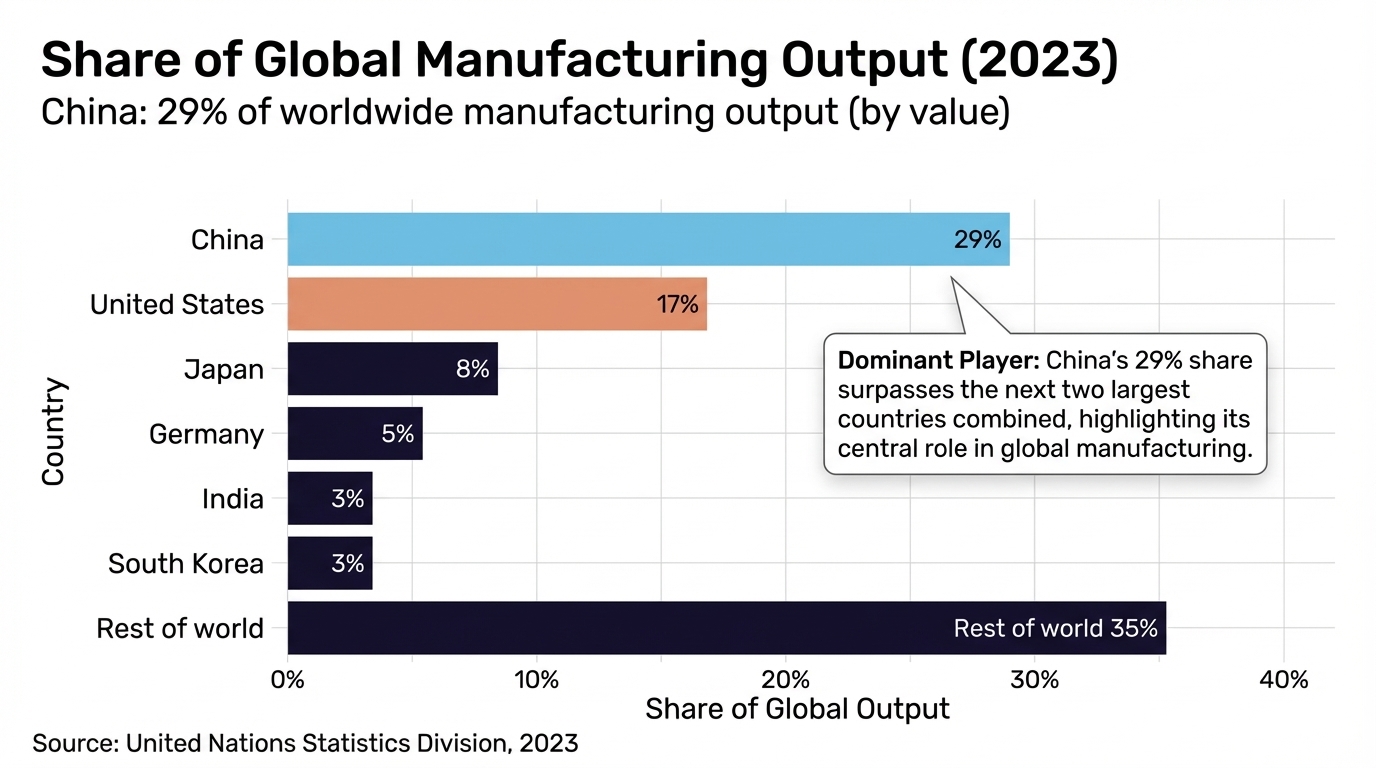 China Holds 29% of Global Manufacturing Output — Nearly Double the U.S. Share — Source: United Nations Statistics Division, 2023
What are Chinese espionage operations targeting in the U.S. technology sector specifically?
According to FBI Director Christopher Wray’s public testimony and ODNI annual threat assessments, industrial espionage china operations in the United States prioritize technology that directly maps to Made in China 2025 gaps: advanced semiconductor designs, AI training data and model architectures, aerospace propulsion and avionics technology, quantum computing research, and biotechnology including agricultural genetics. University research partnerships and professional networking platforms are documented recruitment channels. Front companies are used to acquire technology through commercial relationships that avoid triggering counterintelligence scrutiny. Federal court records consistently show this sectoral focus across china intellectual property theft prosecutions.
Is intellectual property theft by China actually prosecuted, and what do those cases look like?
Yes, and the case record is substantial. The DOJ’s China Initiative between 2018 and 2022 produced more than 150 cases. Prosecuted cases include the GE Aviation turbine design theft, the Apple autonomous vehicle chip theft, multiple semiconductor process technology cases, and numerous agricultural genetics cases. The consistent pattern across intellectual property theft china-linked prosecutions is a current or former employee with legitimate access, a connection to a Chinese company or institution in a Made in China 2025 sector, and technology that fills a documented development gap in China’s high tech industries targets. The FBI has stated repeatedly that prosecuted cases are a fraction of total theft activity.
Your IP Strategy Cannot Wait Until After the Exposure
Made in China 2025 is a state-directed china made policy with documented china and intellectual property theft as one of its acquisition tools, and the sectors it targets map almost exactly onto where U.S. tech founders and inventors are building. The plan did not end in 2025 and was never truly abandoned after its initial rollout, despite the eventual communications retreat. Its successor frameworks, funding streams, and intelligence priorities remain active and are expanding into new domains including artificial intelligence and international standards bodies.
Rapacke Law Group builds patent protection, trade secret protocols, and international filing structures calibrated to the actual competitive environment tech founders face, not generic IP advice that treats all threats as equivalent. According to Rapacke Law Group, the firm’s flat-fee model and the RLG Guarantee mean that serious IP strategy does not require an open-ended legal budget.
If your technology touches any of the sectors Made in China 2025 targets, the right time for a strategy conversation is before your next disclosure, partnership discussion, or funding round. Schedule a Free IP Strategy Call with Andrew Rapacke to assess your exposure and build the protection structure your innovations require.
By Andrew Rapacke, Managing Partner and Registered Patent Attorney, Rapacke Law Group. This article provides general legal information and does not constitute legal advice. IP strategy decisions should be made in consultation with qualified legal counsel based on the specific facts of your situation.