

IP theft costs the U.S. economy anywhere from $225 billion to $600 billion annually, according to estimates from the Commission on the Theft of American Intellectual Property, though the actupapal range is debated among researchers depending on methodology. The vast majority of what gets stolen is not physical inventory but ideas, code, brand equity, and proprietary processes. If you are building a tech company without a clear strategy for intellectual property rights in business, you are building something a well-resourced competitor can legally dismantle or copy the moment you gain traction.
Key Takeaways
- Patents, trademarks, copyrights, and trade secrets each protect a different type of asset and require a different legal strategy to secure and .
- Intangible assets now make up approximately 92% of the S&P 500's market value, which means IP is not a legal formality for modern businesses; it is the business.
- Copyright protection attaches automatically, but you must register with the U.S. Copyright Office before you can sue for infringement or collect statutory damages.
- Trade secret protection has no expiration date and no registration requirement, but it evaporates the moment you fail to take reasonable steps to keep information confidential.
- Early, strategic IP filing before a funding round or product launch costs a fraction of what it costs to fix ownership gaps or defend infringement claims after the fact.
Why Intellectual Property Rights Determine Whether Your Business Can Be Copied
Tangible vs. Intangible Assets – S&P 500 Market Value (2025)
Tangible vs. Intangible Assets – S&P 500 Market Value (2025) — Source: Ocean Tomo, 2025
Your Intangible Assets Are Often Your Most Valuable Ones
For most modern businesses, especially SaaS companies and tech startups, the assets that matter most are the ones you cannot touch. Source code, proprietary algorithms, brand names, and customer data models are rarely on any balance sheet, yet these intellectual assets represent the overwhelming majority of a company's real market value. According to Ocean Tomo's Intangible Asset Market Value Study, intangible assets now comprise approximately 92% of the market value of S&P 500 companies, up from just 17% in 1975. That shift makes intellectual property rights less a legal formality and more the foundation of competitive advantage itself.
The economic scale is equally striking. According to the USPTO's most recent "Intellectual Property and the U.S. Economy" report, IP-intensive industries accounted for $7.8 trillion in U.S. GDP (41% of total GDP) and directly supported 47.2 million jobs in 2019. These are not abstract statistics. They reflect what happens when businesses treat ideas as assets worth defending rather than advantages that will somehow protect themselves, and they underscore how intellectual property ip fuels economic growth across the entire economy.
The actionable step this week: list your top three business assets and ask whether each one has registered intellectual property protections in place. If the answer is no for any of them, that gap is the starting point for your IP strategy.
IP Rights Create Exclusive Rights That Competitors Cannot Legally Cross
Exclusive rights are the foundation of every IP protection. They give the owner the legal authority to prevent others from making, using, selling, or distributing a protected creation without permission. Think of it as owning the only legal recipe for a product: competitors can build something in the same category, but they cannot copy what you built and sell it as their own.
Two federal agencies administer these rights in the United States. The United States Patent and Trademark Office (USPTO) grants and records patents and trademark registrations. The United States Copyright Office maintains registration records for original works of authorship and issues the registration certificates needed to file an infringement lawsuit in federal court. In FY 2022, the U.S. patent office granted 382,559 patents, including 325,445 utility patents, each one representing a set of exclusive rights that competitors cannot legally cross without a license.
Understanding which exclusive rights your business currently holds is not just a legal exercise. Unregistered IP is an asset only until someone copies it and you cannot stop them.
Intellectual Property Protection Drives Competitive Advantage and Investor Confidence
Investors and acquirers do not just look at revenue. They look at defensibility. A startup with a registered patent portfolio and clean IP ownership documentation commands a materially higher valuation than one with identical technology but no formal legal protections in place. IP ownership is a standard line item in venture capital due diligence checklists, and gaps found during that review cost significantly more to fix under a term sheet deadline than they would have cost to address six months earlier.
The competitive logic is straightforward: registered intellectual property rights signal that the business has built something no one else can legally replicate. That exclusivity justifies premium pricing, deters fast-following competitors, and gives founders real leverage in licensing negotiations and M&A conversations. Before your next investor meeting, confirm your core IP assets are registered and documented so they appear as genuine assets rather than wishful thinking.
The Four Main Types of Intellectual Property Every Business Owner Must Understand
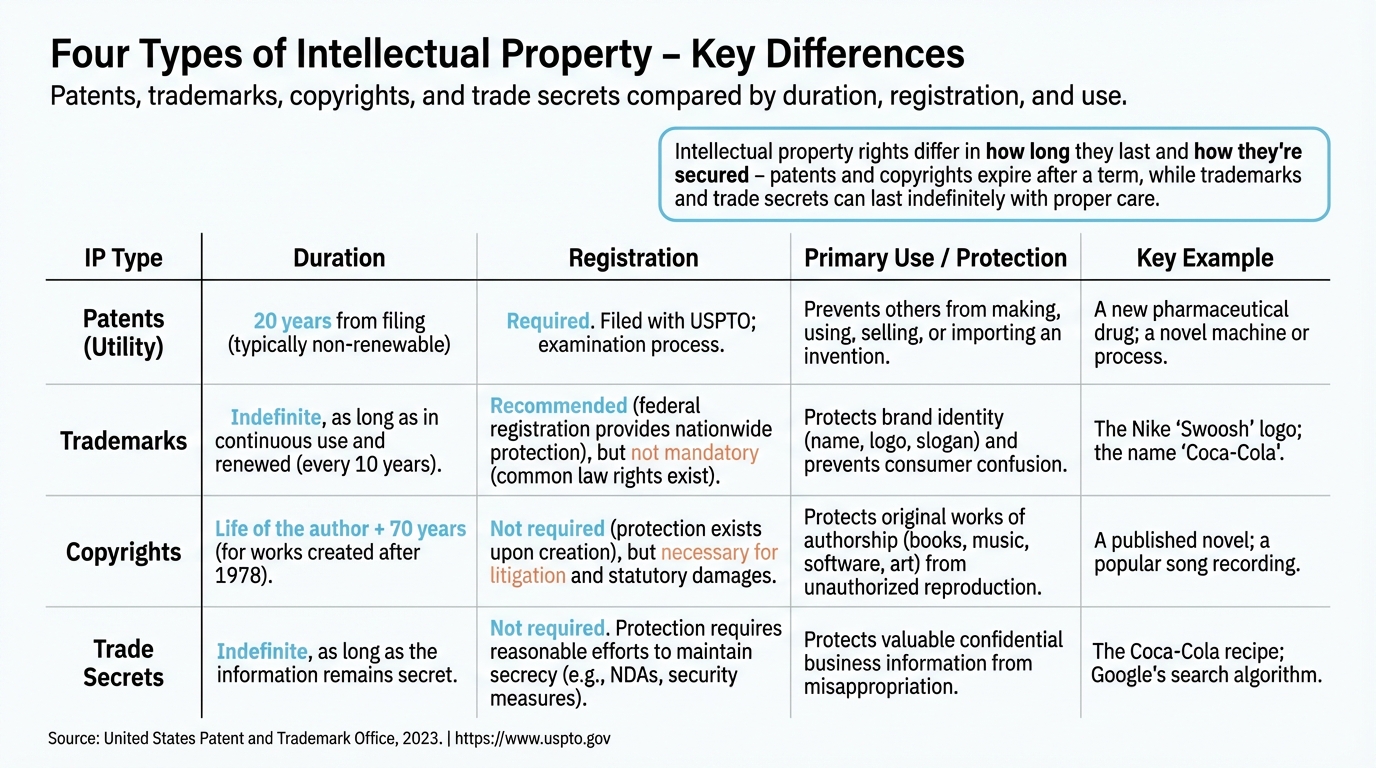
The different types of intellectual property protection are not interchangeable. Each covers a specific category of asset, follows a different legal process, and provides a different scope of protection. Understanding which type applies to which asset is the prerequisite for building any coherent IP strategy.
Patents: Protecting New Inventions for Up to 20 Years
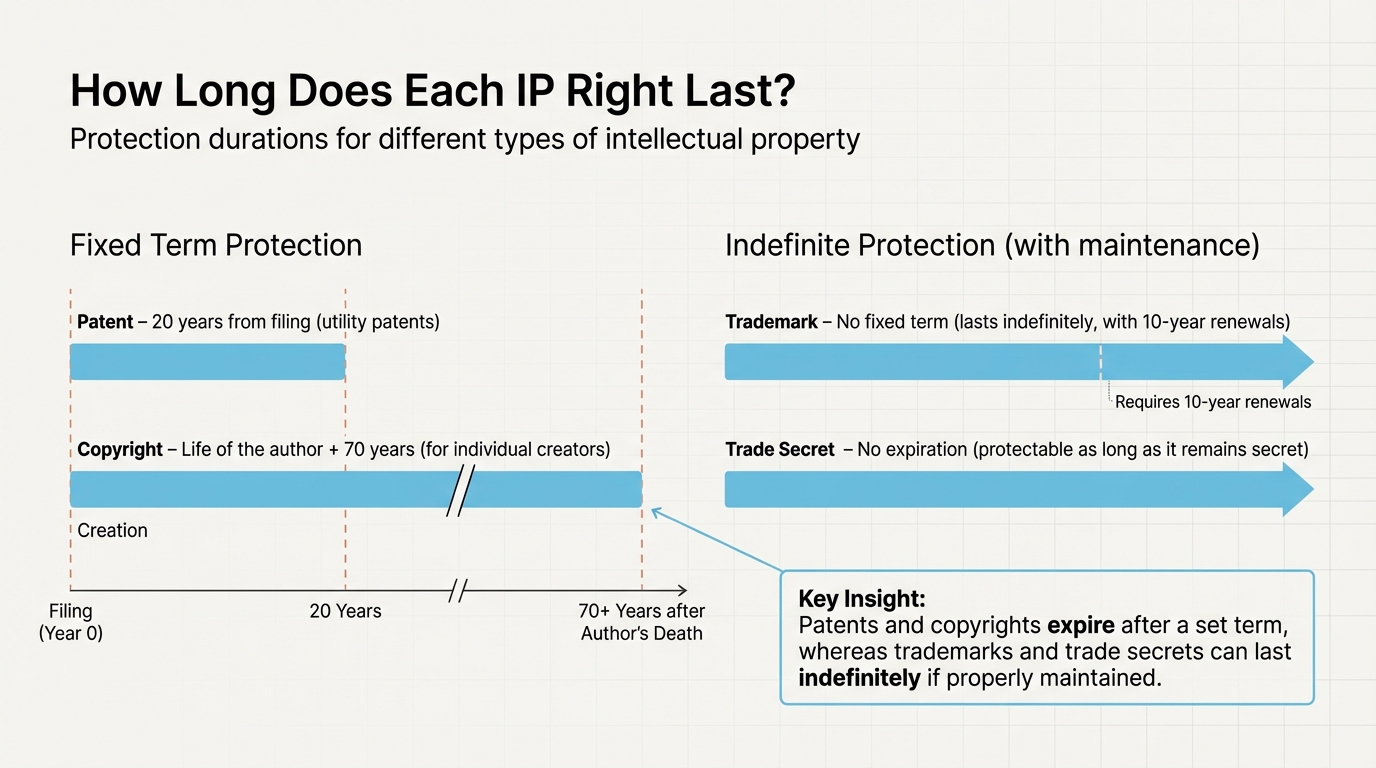
A United States utility patent grants the patent owner the exclusive right to make, use, and sell an invention for 20 years from the filing date. That right must be actively claimed through a formal patent application with the United States Patent and Trademark Office and maintenance fees are required; it does not arise automatically. Once the term expires, the invention enters the public domain.
There are three main patent types relevant to most tech businesses. Utility patents are the most common and cover new processes, machines, and compositions of matter. For tech founders, utility patents covering computer software processes and artificial intelligence methods are the primary vehicle. Design patents cover the ornamental appearance of a functional item.
Business method patents deserve particular attention for founders building fintech, SaaS, and e-commerce platforms. These are a recognized subcategory of utility patents that protect novel processes for conducting business activities, such as a proprietary checkout flow, a unique method for matching buyers and sellers, or an algorithmic approach to subscription pricing. To qualify, the claimed method must be tied to a specific technical implementation rather than a purely abstract concept.
Business method patents are a particularly important subcategory of utility patents for founders building fintech, SaaS, and e-commerce platforms. A business method patent protects a novel process for conducting a business activity, such as a unique method for processing online transactions, a proprietary system for dynamic pricing, or an algorithmic approach to fraud detection.
The landmark State Street Bank v. Signature Financial Group (1998) decision opened the door to business method patents in the United States by holding that a method producing a useful, concrete, and tangible result is patentable subject matter. Subsequent rulings under Alice Corp. v. CLS Bank International (2014) raised the bar significantly: the Supreme Court held that merely implementing an abstract idea on a generic computer is not enough to make a claim patentable. The USPTO now applies a two-step Alice framework to evaluate whether a software-implemented business method claims something meaningfully more than an abstract idea.
To survive Alice scrutiny, a business method patent application must demonstrate that the claimed method is directed to a specific technical improvement rather than a generic business concept. Successful examples include claims that recite a particular data structure, a defined sequence of computational steps, or a system architecture that solves a concrete technical problem in a way that is novel and non-obvious. Founders in fintech and SaaS should document not just what their process does but how it does it at a technical level, because that specificity is what separates a patentable claim from one the USPTO will reject.
Founders should work with patent counsel to frame business method claims around the specific technical steps and system architecture that make the process novel and non-obvious. Early claim drafting that anticipates Alice challenges is significantly less expensive than amending or appealing rejected claims after prosecution has begun.
As of early 2025, the average time from filing to first office action at the United States Patent Office is approximately 21.3 months for a u.s. patent, with total pendency to allowance or abandonment running longer depending on office actions and amendments. This is why filing strategy matters as much as filing timing, and the first inventor to file a complete application holds the priority date that determines ownership under current U.S. patent law. For startups still building, a provisional patent application locks in a priority date giving every inventor to file an early foothold at $130 for small entities (or $325 for large entities) per the USPTO's 2025/2026 fee schedule, and gives the inventor a 12-month runway to develop the product further before converting to a full non-provisional application. If your product has a novel technical process at its core, file a provisional within 12 months of first public disclosure or you lose the right permanently.
For software-specific considerations, the strategies to protect software intellectual property and software intellectual property rights guidance covers exactly how these rules apply to code-based inventions.
Trademarks: Defending Your Brand Identity in the Marketplace
A trademark protects brand identifiers, including names, logos, slogans, and trade dress, that distinguish your goods or services from competitors in the marketplace. Unlike patents, trademark protection can last indefinitely as long as the mark remains in active use and renewal fees are paid on schedule. A registered trademark secured through federal registration gives the owner the right to use the ® symbol and to pursue infringement claims in federal court. The McDonald's Golden Arches sometimes called the McDonald golden arches in brand case studies is the textbook illustration: a simple visual element that became a legally protected asset worth billions in brand equity.
The United States Patent and Trademark Office received over 737,000 trademark applications in 2023, and the average time from application to registration now runs approximately 10 to 12 months as of early 2026. Trademark law governs both the registration process and the enforcement of trademark rights against unauthorized use in the marketplace. Roughly 70% of applications face an initial office action, most commonly for likelihood of confusion with an existing mark or for being too descriptive of the goods or services. This is why searching the USPTO's TESS database before naming a product or company matters. An uncleared name that conflicts with an existing registered trademark turns a branding investment into a rebranding liability.
Copyrights: Automatic Protection for Original Works of Authorship
Copyright protection attaches automatically the moment an original work is fixed in a tangible medium, including software code, literary works, marketing copy, website content, design files, and training data documentation. You do not need the U.S. Copyright Office to register the work for the copyright to exist. But registration is required before the copyright owner can file a copyright claim in federal court, and it is the prerequisite for recovering statutory damages.
Those statutory damages matter. Under 17 U.S.C. § 504, willful copyright infringement can result in up to $150,000 per work infringed. Without registration, the owner is limited to actual damages, which are often difficult to quantify and rarely sufficient to justify the cost of litigation. The online registration fee through the U.S. Copyright Office is $65 per claim, which is among the most cost-effective legal moves any business can make. Copyright protection for works created after 1978 lasts for the life of the author plus 70 years.
One important boundary: copyright protects expression, not ideas. A competitor can independently develop a similar product. They cannot copy your specific code or text.
Trade Secrets: Protecting Confidential Business Information Without Registration
Trade secrets are the only intellectual property type that requires no government registration under federal law, making them unique among the protections available under IP laws a distinction worth understanding when first encountering the term intellectual property in a legal context. Any confidential business information that provides competitive advantage qualifies as a trade secret under the federal Defend Trade Secrets Act (DTSA) as long as the owner takes reasonable measures to keep it secret. Proprietary algorithms, customer acquisition methodologies, pricing models, and manufacturing processes all qualify.
The upside of trade secret protection is duration: there is no expiration date. The Coca-Cola formula has been maintained as a trade secret for over a century through strict confidentiality practices, a fact documented in IP law textbooks and business case studies, with Coca-Cola explicitly stating the formula is protected as a trade secret rather than patented. The downside is fragility. Trade secret protection evaporates the moment information becomes public, whether through a data breach, a disgruntled employee, or an inadequate NDA.
Insider threats are a particularly acute risk. According to the DTEX/Ponemon 2025 Cost of Insider Risk Report, malicious insider incidents take an average of 86 days to contain once detected, and the costs of a single incident can run into the millions. Trade secrets are among the most difficult categories of IP theft to remedy in court because proving misuse of confidential information requires demonstrating both that the information was secret and that the defendant actually misappropriated it.
Audit your NDAs, employee agreements, and system access controls today. Reasonable secrecy measures are the legal prerequisite for trade secret protection to survive a federal court challenge.
How to Protect Intellectual Property Before a Competitor Does It First
Identify What You Own Before You File Anything
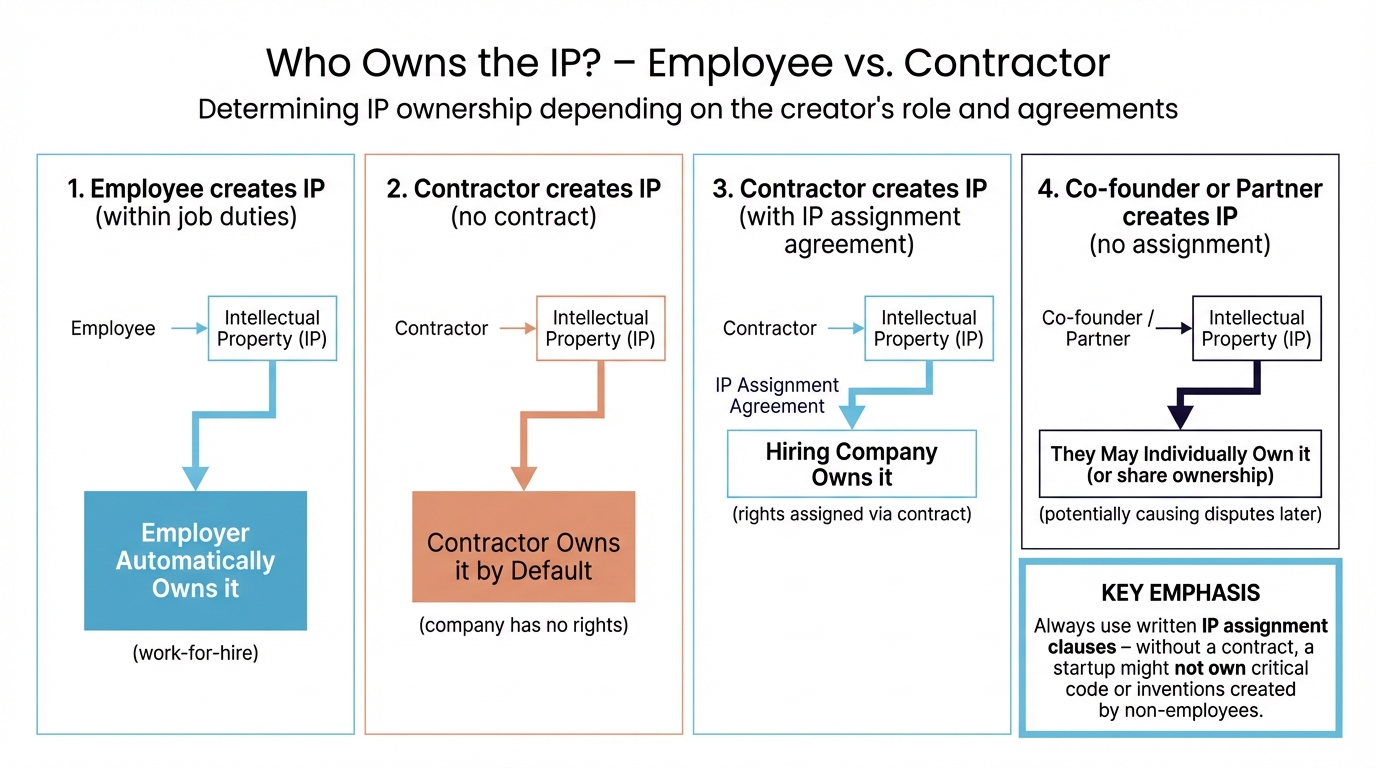
Most founders underprotect not because they are careless but because they never stopped to map what they actually own. A formal IP audit follows three steps: list every asset that gives your business a competitive edge, categorize each one as patent, trademark, copyright, or trade secret eligible, and verify that every employee, contractor, and co-founder has signed an IP assignment agreement.
That last step is where startups most often get burned. Under Copyright law, work created by an independent contractor is not automatically owned by the company that hired them, unlike work created by a W-2 employee within the scope of their role. Without a written IP assignment agreement, the contractor who built your MVP may have a legally defensible ownership claim to the code they wrote. This is not a theoretical risk. It is one of the most common issues surfaced during startup due diligence, and it creates real valuation problems at the worst possible time.
Add an IP assignment clause to every contractor agreement before the next line of code is written. The entrepreneur's IP protection guide walks through this audit process in detail for early-stage founders.
File Strategically: Provisional Patents, Trademark Classes, and Copyright Registration
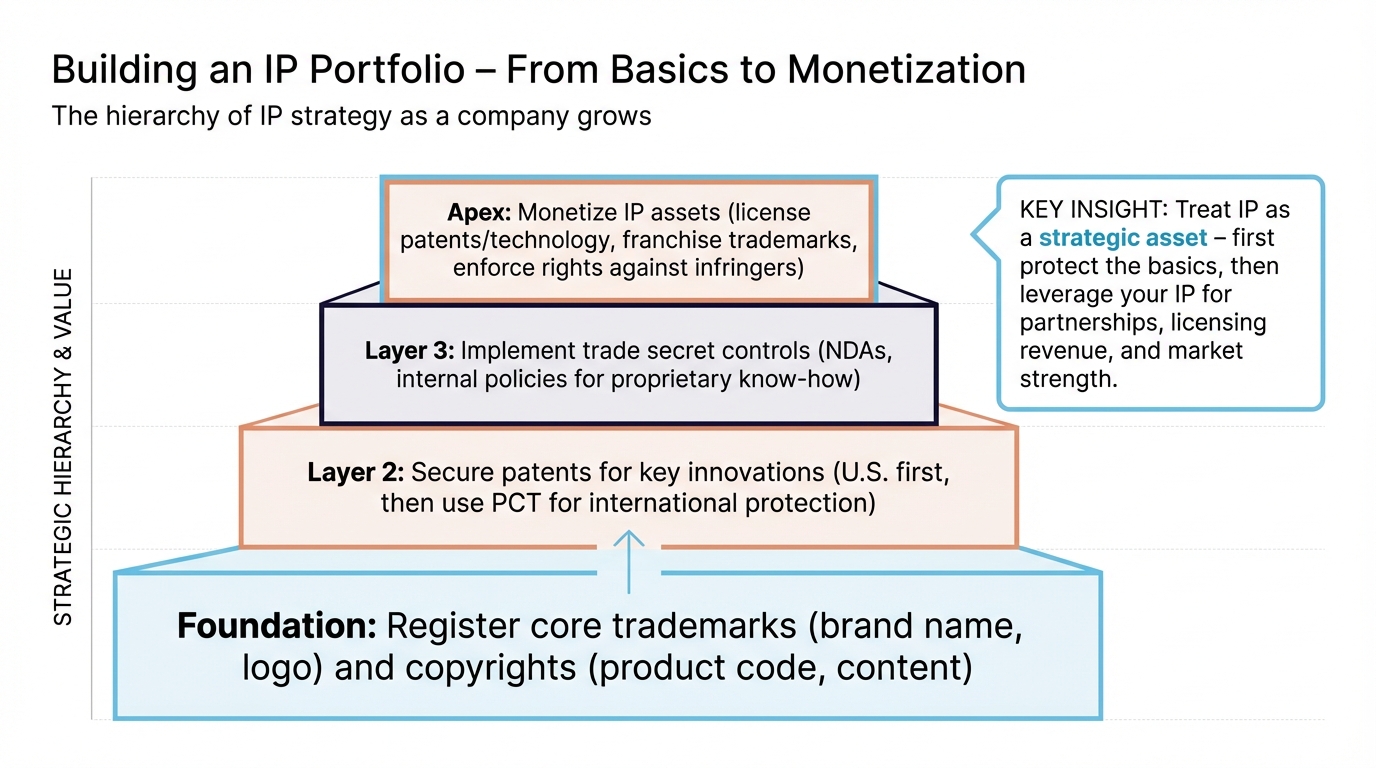
Smart IP sequencing gives startups maximum protection with minimum upfront cost. The sequence that works for most early-stage companies: file a provisional patent application to secure a priority date while the product is still being built, file a trademark application in the specific USPTO classes that cover your goods and services, and register copyrights for core software and content assets.
For international reach, the Patent Cooperation Treaty (PCT) simplifies global patent protection. A single PCT application can cover 158 countries simultaneously, providing a cost-effective pathway for startups planning to operate or compete across borders. The PCT filing buys time: inventors have up to 30 months from the priority date to enter individual national phases, giving the business time to validate market demand before committing to country-specific prosecution costs.
Treat IP filings as product launch milestones, not afterthoughts. Schedule them on the same timeline as your MVP release dates. For a structured approach to sequencing, the 5 essential IP protection strategies for tech startups resource covers exactly how to prioritize when budget and time are limited.
Use Contracts to Close the Gaps Registration Cannot Cover
Registered IP rights protect you from strangers. Contracts protect you from partners, employees, and clients. Every business needs three foundational documents: NDAs before sharing any sensitive information with outside parties, IP assignment agreements with all employees and contractors, and IP ownership clauses in client contracts, especially for custom software builds where clients routinely assume they own code that the contract does not actually assign to them.
Trade secret protection legally depends on these agreements. Courts in the legal system have thrown out trade secret claims under the DTSA where the company failed to implement basic confidentiality safeguards, finding that the owner had not taken the "reasonable measures" the statute requires. No NDA, no case. Review your standard contractor agreement and client services agreement this week. If they lack IP assignment and confidentiality clauses, they are a liability, not a protection.
How to Avoid Intellectual Property Infringement in Your Own Business
Conduct a Clearance Search Before Launching Any Brand or Product
IP infringement claims are among the most common legal problems startups face, and most are preventable with a few hours of upfront research. A trademark clearance search through the USPTO's TESS database combined with a common law search for unregistered marks in active use is relatively quick and inexpensive. A patent freedom-to-operate analysis requires a strong technical background and is more complex, but essential before launching a product in a technically crowded space.
The reason to invest in clearance searches is simple arithmetic. According to the American Intellectual Property Law Association's Economic Survey, the average cost to defend a patent lawsuit through trial ranges from $1 million to $4 million. A clearance search that reveals a conflict before launch costs a fraction of that and gives the business options: modify the design, obtain a license, or choose a different brand name before any infringement has occurred. Budget a clearance search into every new product launch. It is the cheapest insurance your business can buy.
Understand What Employee and Contractor IP Means for Your Business
The "work made for hire" doctrine under copyright law is one of the most misunderstood rules in startup legal work. Work created by full-time employees within the scope of their employment is automatically owned by the employer. Work created by independent contractors is not, unless a written agreement with explicit work-for-hire language or an IP assignment clause says otherwise. That distinction has derailed more acquisitions and funding rounds than almost any other IP issue.
There is a second risk that gets less attention: employees who previously worked at competitors. A new hire who brings trade secrets from a former employer, even inadvertently, exposes the company to a DTSA claim. This risk can also arise from a joint work created with an outside collaborator without a clear ownership agreement. Classify every contributor to your product correctly and have a signed IP agreement in place before the relationship begins. SaaS founders face a particularly nuanced version of these issues; the SaaS founder IP protection guide covers the most common ownership pitfalls specific to subscription software businesses.
What Intellectual Property Infringement Means and What Happens When It Occurs
The Three Most Common Infringement Scenarios for Tech Startups
Patent infringement occurs when someone makes, uses, or sells a patented invention without authorization from the patent owner. The legal standard is whether the accused product or process falls within the scope of the patent claims, which is exactly why claim drafting quality matters so much. Trademark infringement occurs when a mark is used in commerce in a way that is likely to cause consumer confusion with a registered mark, and remedies are available against any unauthorized use that meets that standard. Copyright infringement occurs when protected expression is copied, distributed, or incorporated into derivative works without permission.
Remedies across all three categories can include injunctions stopping the infringing activity, actual damages, disgorgement of the infringer's profits, statutory damages under copyright law (up to $150,000 per willful infringement under 17 U.S.C. § 504), and attorney's fees in egregious cases. If you receive a cease-and-desist letter alleging IP infringement, do not respond without legal counsel. The response strategy, including whether to respond at all initially, directly determines your exposure. Understanding the full scope of rights of patent before a dispute arises is considerably less expensive than learning them during litigation.
How to Respond If Your IP Is Being Infringed
The response to active IP infringement follows a clear escalation ladder. First, document everything: screenshots, purchase records, timestamps, and URLs. Second, verify that your registration and ownership documentation are airtight before threatening legal action, because a claim built on a shaky ownership chain collapses quickly. Third, send a formal cease-and-desist through counsel with a clear demand and deadline. Fourth, for online infringement, file DMCA takedown notices for copyright violations or use marketplace brand registry programs for trademark violations. Amazon's Brand Registry, for example, has removed millions of counterfeit listings for registered trademark owners. Fifth, if infringement continues, file in federal court.
Early documentation matters for damages calculations. Courts look at when the infringement was discovered and what steps the plaintiff took to stop it. Build an infringement monitoring system now: monitor the google search algorithm results for your brand name and product names, subscribe to a trademark watching service, and run periodic searches at the united states patent office to catch applications that conflict with your registered marks before they are approved.
When to Work With an Intellectual Property Attorney and What They Actually Do
What an Intellectual Property Lawyer Handles Beyond Filing Paperwork
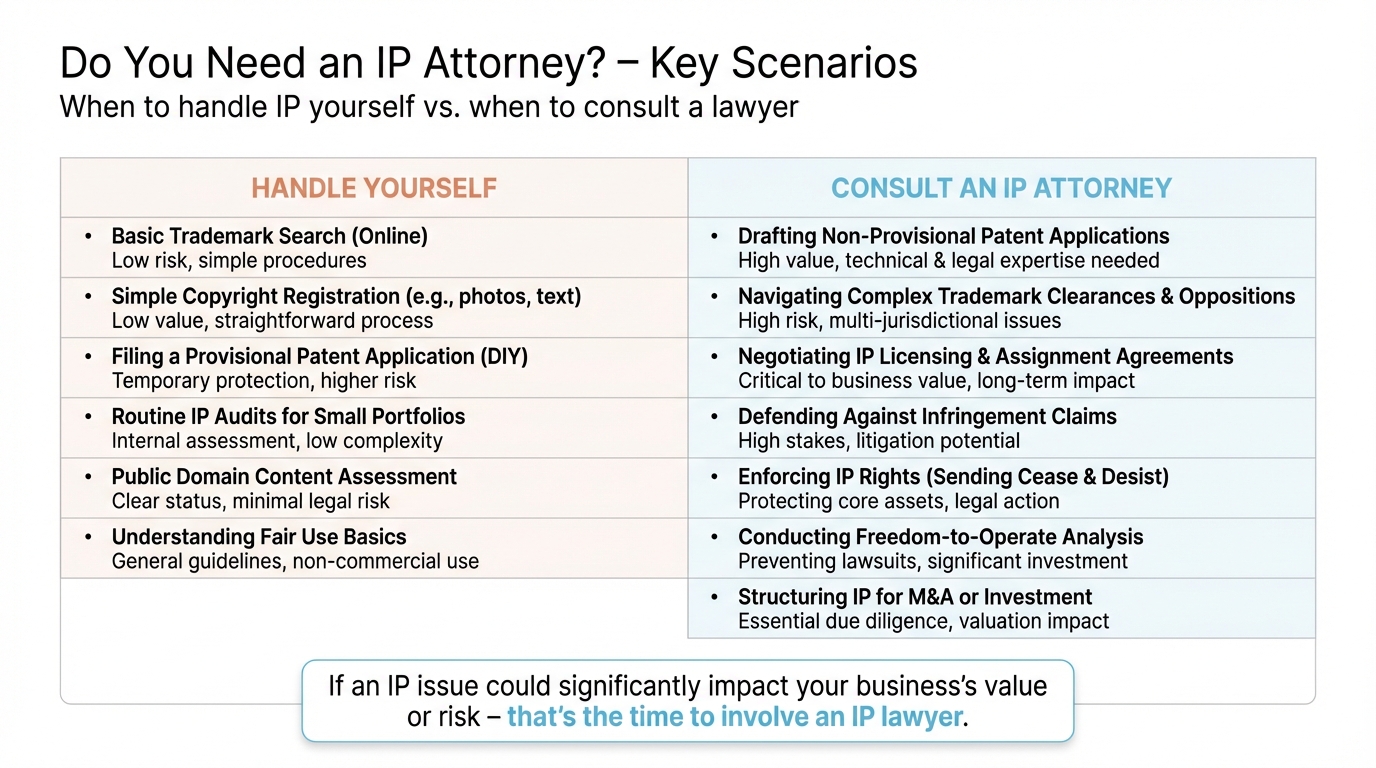
Intellectual property lawyers do far more than submit forms. Patent prosecution and patent counseling and drafting claims that are broad enough to be commercially valuable but narrow enough to survive examination at the united states patent office is a specialized skill that determines how much protection the patent actually provides in the real world. A broad claim that covers the core inventive concept is worth exponentially more than a narrow claim a competitor can design around with minor modifications. USPTO data consistently shows that pro se (self-filed) patent applications have materially lower grant rates than attorney-filed applications, and even granted pro se patents tend to have narrower claim scope.
Trademark attorneys conduct clearance searches, draft applications, respond to office actions (recall that roughly 70% of applications receive at least one), and negotiate licensing agreements. IP attorneys also advise on portfolio strategy: which assets to protect, in what order, and how to allocate a limited legal budget across competing filing priorities. According to Rapacke Law Group, the firm approaches this work with flat-fee pricing so founders know the cost before committing, not after the invoice arrives.
Recognizing When Your Business Has Outgrown DIY IP Management
There are five situations that signal it is time to retain an IP attorney rather than continue managing IP internally. First, you are preparing for a funding round and IP will be scrutinized in due diligence. Second, you have received a cease-and-desist letter. Third, you are expanding into international markets and need PCT or foreign filing strategy. Fourth, you are negotiating a licensing agreement and need to know what you are actually licensing. Fifth, a competitor has launched a product that looks suspiciously similar to yours and you need to know whether your IP portfolio gives you enforcement options.
Framing this as a strategic investment rather than a legal expense is the right mental model, and seeking qualified legal advice early is the most cost-effective step a founder can take. The gap between what early IP counseling costs and what IP litigation defense costs can be measured in hundreds of thousands of dollars. The proprietary vs. patented analysis is a useful resource for founders weighing which protection strategy gives them the most durable competitive advantage before engaging counsel.
Building an IP Strategy That Protects Your Business as It Scales
Prioritize IP Filings Based on Business Risk, Not Legal Convenience
Most startups operate with limited legal budgets and cannot protect everything at once. The right sequencing prioritizes based on business risk: the assets most likely to be copied and the assets whose loss would cause the most competitive damage get protected first. A brand name already in active commercial use is often a higher priority than a patent on a secondary product feature. A simple prioritization matrix works: multiply the likelihood of copying by the business impact of losing the asset. The highest scores go to the front of the filing queue.
The World Intellectual Property Organization (WIPO) tracks innovation and IP filing trends globally through its WIPO Global Innovation Index, and the data consistently show that businesses with structured IP portfolios outperform those that treat filings as reactive rather than strategic. Rank your top five IP assets by business impact this week and match each to the appropriate filing type and timeline.
Use IP as a Revenue Asset, Not Just a Defensive Shield
IP rights generate direct revenue, not just competitive moats. A registered patent can be licensed by the patent holder to competitors in exchange for ongoing royalty income. A strong trademark can anchor a franchising or brand licensing arrangement. Copyrighted software can be white-labeled or sublicensed. According to WIPO, global IP licensing revenue runs into the hundreds of billions of dollars annually, representing a category of income that many startups leave entirely unclaimed.
Startups that treat IP as a revenue stream alongside a legal barrier extract significantly more enterprise value from the same underlying assets, and technology transfer agreements are one of the primary mechanisms for converting registered rights into recurring income. Ask your IP attorney whether any of your registered rights are currently licensable. You may already own revenue you have not claimed.
Frequently Asked Questions
What is intellectual property for business?
Intellectual property for business refers to the legal rights a company holds over its intangible assets, including inventions, brand identifiers, original creative works, and confidential information. These IP rights are governed by intellectual property laws administered by agencies including the USPTO and U.S. Copyright Office. They allow businesses to prevent competitors from copying, using, or profiting from intellectual property ip assets the business created, and for most modern companies they represent the most valuable items on the balance sheet.
What are the four main types of intellectual property rights?
The four main types are patents, trademarks, copyrights, and trade secrets. Patents protect new inventions for 20 years and are administered by the United States Patent and Trademark Office, operating under federal laws that define the scope and duration of each right. Trademarks protect brand identifiers indefinitely with proper renewal through the trademark office. Copyrights protect original works of authorship automatically upon creation and last for the life of the author plus 70 years. Trade secrets protect confidential business information for as long as it remains secret, with no registration required under federal law and the Defend Trade Secrets Act.
What are the 7 types of intellectual property rights?
Beyond the four core types (patents, trademarks, copyrights, and trade secrets), additional categories recognized in some contexts include industrial designs and geographical indications. The World Intellectual Property Organization formally recognizes all of these in international frameworks including the Patent Cooperation Treaty. For most United States businesses, the four primary types are the practical focus, though industrial design protection via design patents and geographical indications are relevant for specific industries like fashion and food and beverage.
What are the 4 examples of intellectual property?
Four concrete examples: a startup's patented software algorithm (patent), the startup's brand name registered with the United States Patent and Trademark Office (trademark), the startup's original source code (copyright protected automatically upon creation), and the startup's proprietary customer acquisition methodology documented in internal systems and protected by NDAs (trade secret). Each represents a different type of intellectual property protection and requires a different legal strategy to secure and enforce under intellectual property law.
How do intellectual property rights affect small businesses differently than large corporations?
Small businesses face higher relative risk because they typically have fewer resources for IP audits, filings, and enforcement while remaining just as vulnerable to infringement. Large corporations have dedicated IP departments and litigation budgets. A startup defending a client patent infringement claim in federal court without prior counsel faces average litigation costs of $1 million to $4 million through trial, according to the American Intellectual Property Law Association's Economic Survey. That asymmetry makes early, strategic IP filing disproportionately valuable for smaller companies.
Can I protect intellectual property without hiring a lawyer?
You can register copyrights and file basic trademark applications without an attorney, and provisional patent applications can be self-filed. However, the quality of protection varies significantly. USPTO data shows that pro se patent applications have lower grant rates than attorney-filed applications, and even granted pro se patents tend to have narrower claim scope, meaning competitors can design around them more easily. For trade secret protection, the NDAs and IP assignment clauses that courts require as evidence of "reasonable measures" need professional drafting to hold up under the DTSA.
Protect What You Built Before Someone Else Does
In a market where a competitor can copy a product overnight, the only durable advantage is one a court will enforce. Unregistered intellectual property is an asset only until someone takes it and you have no legal basis to stop them. The businesses that scale without being displaced are the ones that treat IP filings as core infrastructure, not optional legal overhead.
According to Rapacke Law Group, the firm works specifically with tech founders and startups to build IP portfolios that hold up in due diligence, deter infringement, and create licensing leverage, all with flat-fee pricing so founders know their costs before committing. Whether you need a patent strategy for your software, trademark protection for your brand, or a complete IP audit before a fundraising round, the conversation starts with a clear picture of where you stand.
Schedule a free IP strategy call to learn which IP rights apply to your business, what to file first, and how to build protection that scales with your company. The call produces a prioritized action plan, not a sales pitch.
For founders building in AI and software, the AI Patent Mastery resource and The Must-Have SaaS Patent Guide 2.0 are practical starting points for understanding what is protectable in your specific technology stack. If contracts are the next gap to close, the SaaS Agreement Checklist for Tech Founders covers the IP ownership provisions — including the intellectual property section of every services agreement — every founder needs in place before the next deal is signed.