


Key Takeaways
- Copyright protects your source code automatically, but you must register before you can sue, and timely registration unlocks statutory damages up to $150,000 per work for willful infringement plus attorney's fees.
- A provisional patent application costs as little as $65 to $325 in USPTO fees depending on entity size, and establishes a filing date, giving you 12 months to file a nonprovisional application claiming priority to it.
- Trade secrets can last indefinitely as long as the information keeps economic value from being secret and you take reasonable measures to keep it confidential.
- Copyright covers your code, not your functionality, so competitors can legally clone features unless you hold a utility patent.
- Startups that receive a first patent grow sales 80% more over five years than comparable startups without one.
*Written by Andrew Rapacke, Managing Partner, Registered Patent Attorney.* Andrew Rapacke is a registered patent attorney and the Managing Partner of The Rapacke Law Group, a full-service intellectual property law firm specializing in intellectual property law across software and emerging technologies. He helps individuals and corporations across industries with the protection, prosecution, licensing, and enforcement of their intellectual property, with deep experience in patent, trademark, and copyright matters spanning software, AI and machine learning, blockchain, medical devices, and autonomous vehicle technology. A graduate of the United States Naval Academy, Andrew served as a Naval Engineering Officer before pursuing law and remains active in the startup and inventor communities throughout Florida.
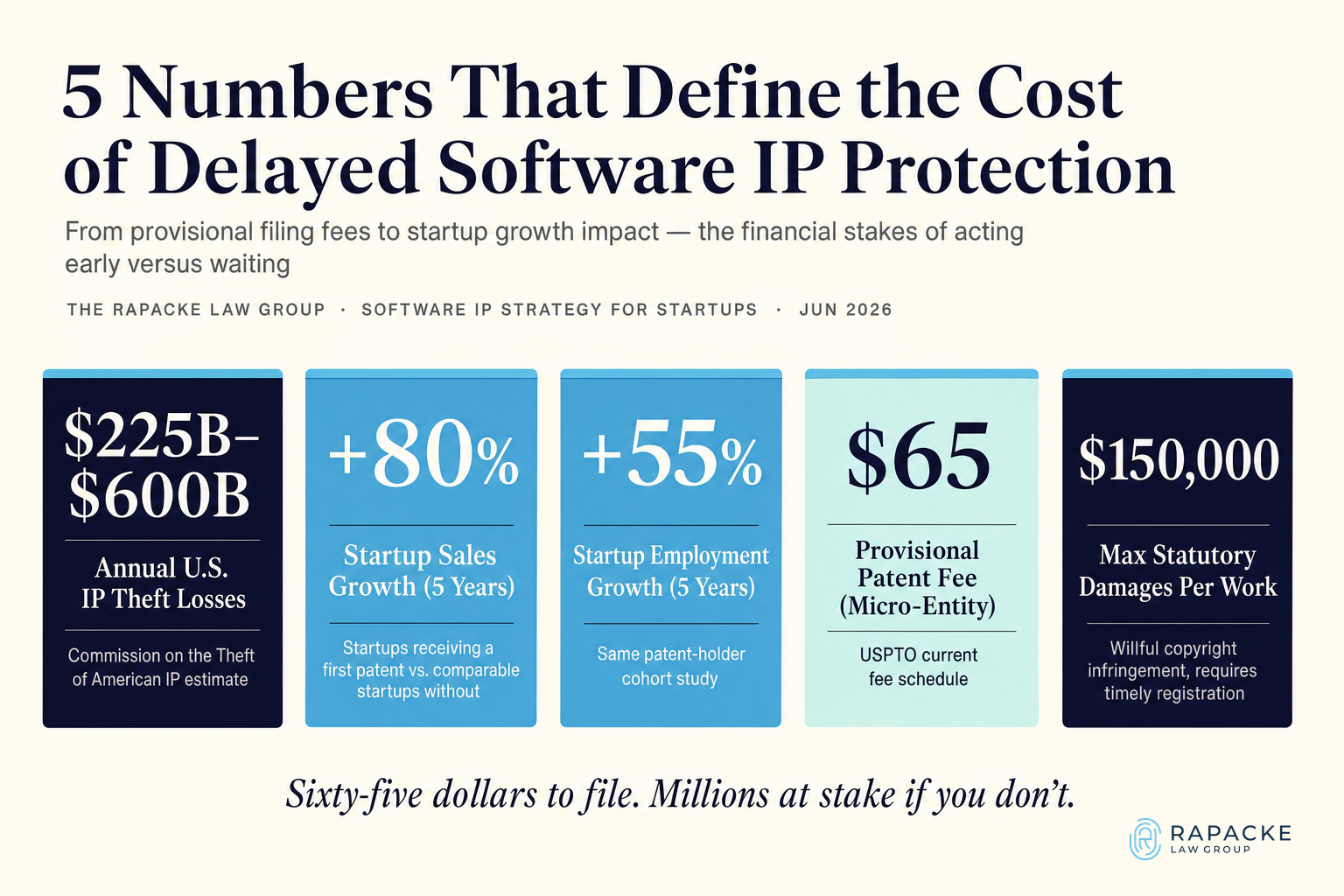
A SaaS founder gives a demo to a potential partner. Six months later, an almost identical product launches under a competitor's brand, and the founder has no legal recourse because nothing was protected. The Commission on the Theft of American Intellectual Property estimates that IP theft costs the U.S. economy $225 billion to $600 billion per year, and software startups are among the most exposed because founders assume that building something means owning it legally.
This article walks through exactly how to protect software intellectual property before a funding round, partnership, or competitor forces the issue. For a deeper reference on the underlying rights, our guide to software intellectual property rights covers each protection in detail.
What "Software Intellectual Property" Actually Covers (and What It Does Not)
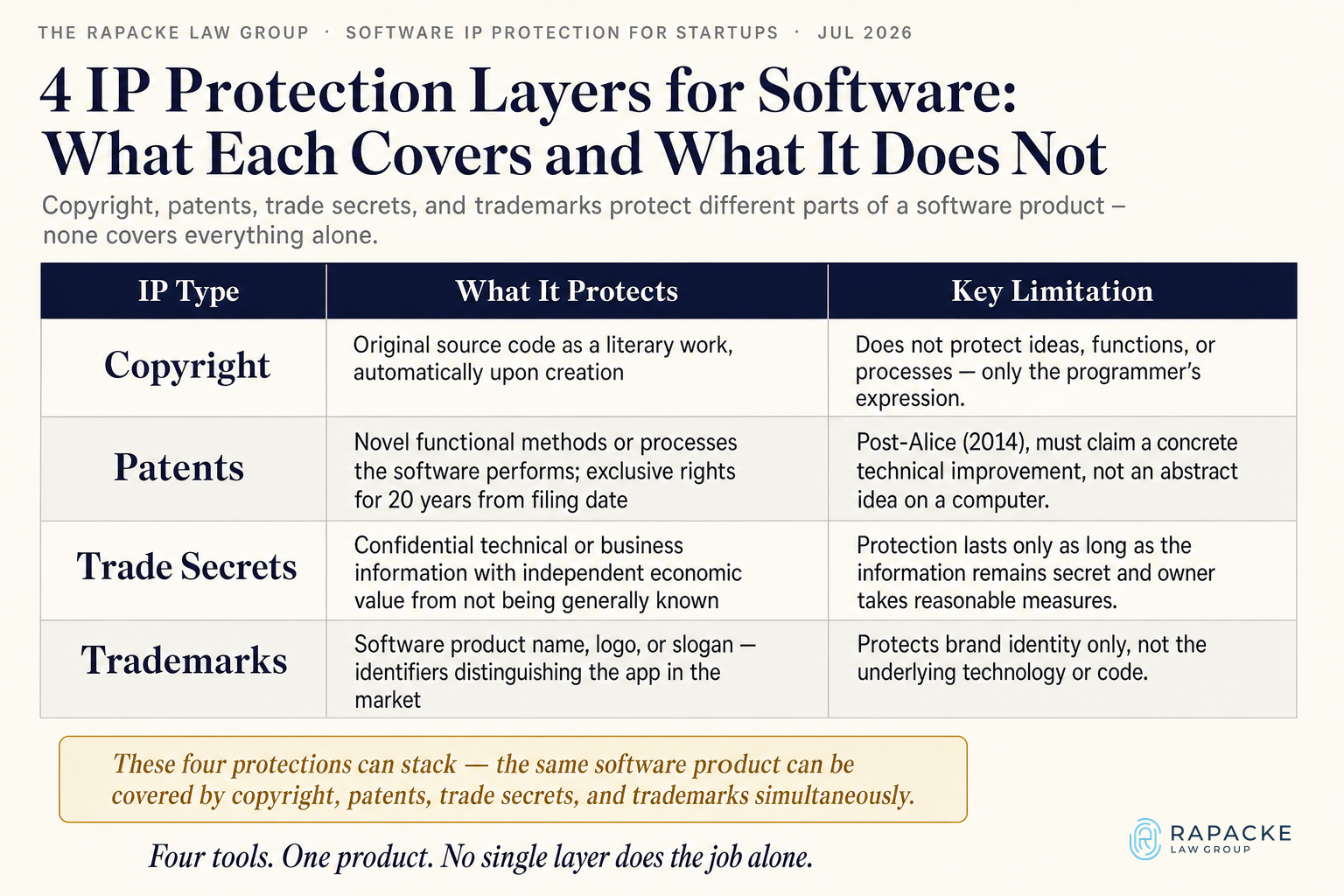
Understanding intellectual property IP rights as a set of overlapping legal protections, and knowing which parts of your product each one covers, is the difference between real protection and false confidence.
Your Source Code Is Protected by Copyright Automatically
Copyright attaches to original software code the moment it is written, establishing ownership rights in the work. Under U.S. law, computer programs are treated as literary works, and no registration is required for the right to exist. Registration is still worth doing because it unlocks statutory damages and the right to sue. Because source code intellectual property and computer code are so easy to copy, treating registration as optional is a common early mistake.
Your Features and Processes Are Not Protected by Copyright Alone
Copyright covers expression, not functionality. House Report 94-1476 makes this explicit, noting that the actual processes or methods embodied in a program fall outside copyright's scope. This is why a competitor can legally clone your product's functionality using entirely different code. If protecting how your software works matters, our breakdown of software patent vs copyright shows where each tool starts and stops.
Proprietary Algorithms and Methods Fall Into a Gray Zone
Proprietary algorithms and technical workflows, including those powering artificial intelligence systems, may qualify for patent protection or trade secret status depending on how you document and deploy them. The 2014 decision in Alice Corp. v. CLS Bank International tightened patent eligibility for abstract software ideas across the computer industry, so know where your algorithm sits before assuming it is unprotectable.
Why Patents Are the Strongest (and Most Strategic) Protection for Software Innovations
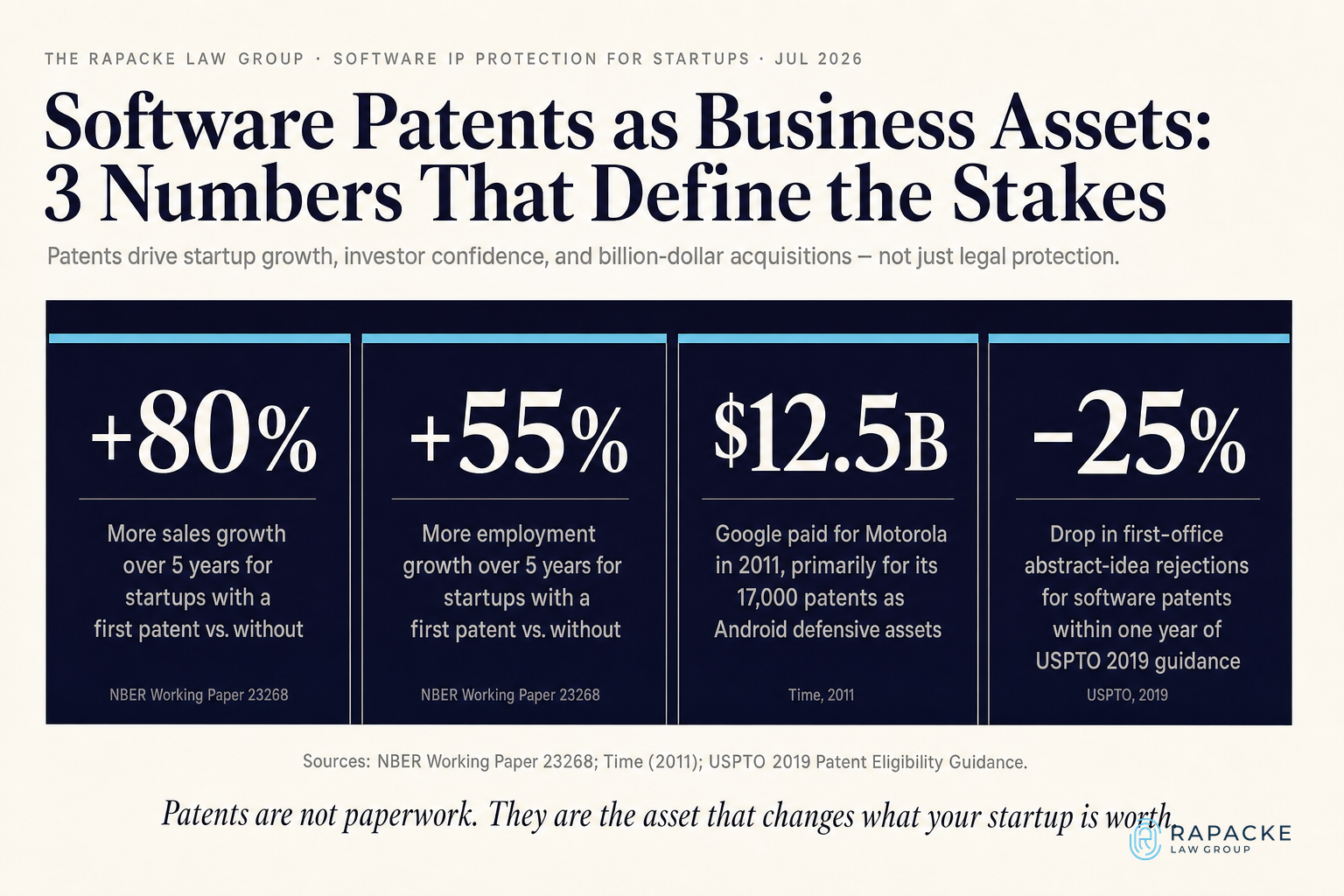
Investors look for patents. Competitors fear them. One NBER study found that startups receiving a first patent grew sales 80% more and employment 55% more over five years than similar startups without patents. If you are weighing whether filing is worth it, our data-driven look at whether software patents are enforceable puts the business case in perspective.
What a Software Patent Actually Protects
A utility patent protects the functional method or process your software performs, not the code itself, giving the patent owner exclusive rights for up to 20 years from the filing date. If your software invention solves a technical problem in a novel way, a prior art search is the logical first step.
The Alice Problem and How Modern Software Patents Get Around It
Post-Alice, software patents must claim a concrete technical improvement in computer technology, not an abstract idea running on a computer. The USPTO's 2019 eligibility guidance clarified this, and within a year the rate of first-office rejections for ineligible abstract ideas fell by 25%. Work with a patent attorney versed in patent law to frame claims around the technical result.
Filing a Provisional Patent Application to Lock In Your Priority Date
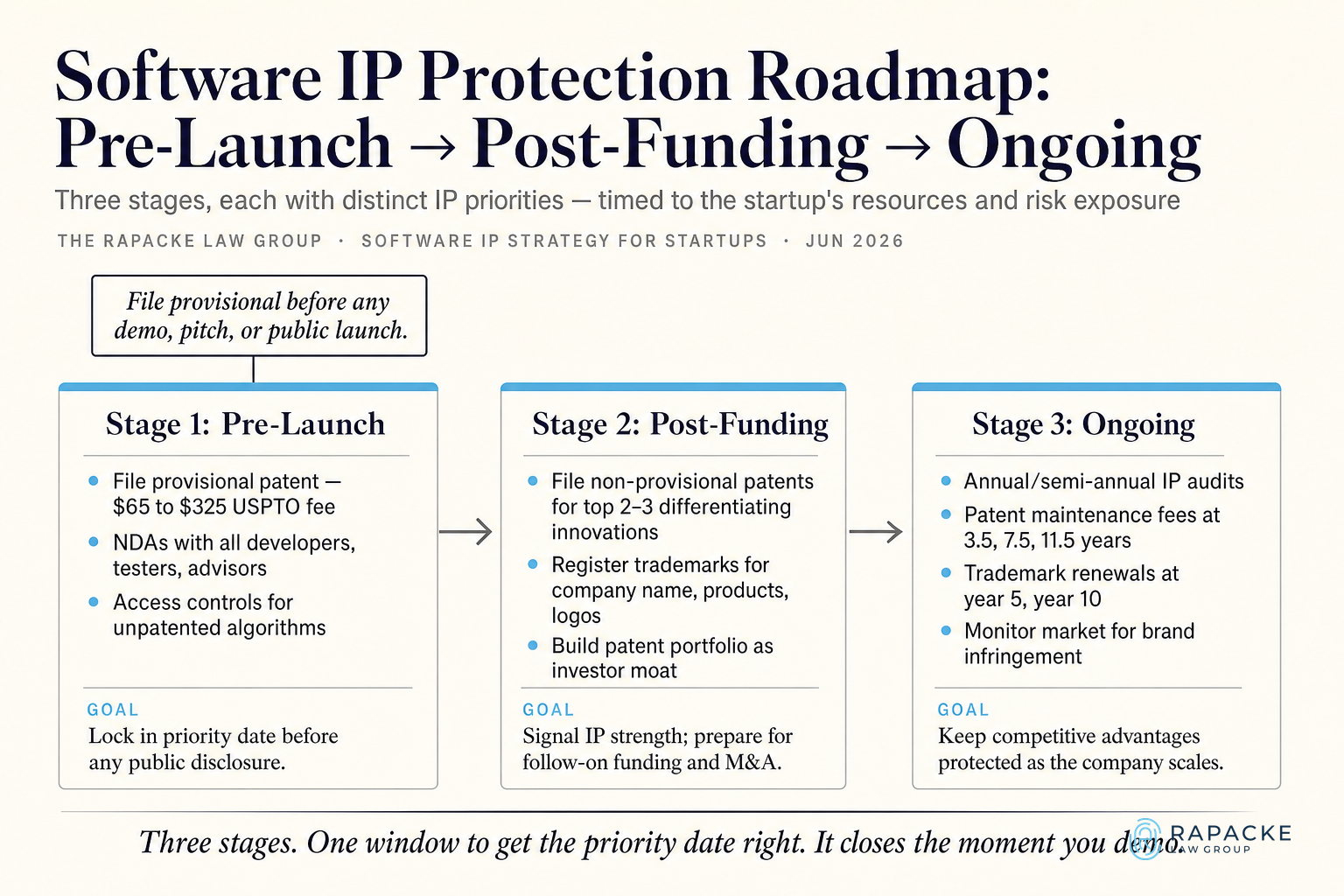
A provisional patent application secures a filing date and gives you a 12-month window to file the full non-provisional. The USPTO fee is just $325, or $65 for micro-entities. File before any public demo to preserve foreign patent rights in jurisdictions with absolute novelty rules, note that U.S. law provides a one-year grace period for disclosures made by the inventor. For SaaS teams, our SaaS Patent Guide walks through how to frame claims that survive examination.
The Cost of Waiting Is Higher Than the Cost of Filing
The math favors early action. IP theft drains $225 billion to $600 billion from the U.S. economy each year, with trade secret theft alone accounting for $180 billion to $540 billion. Against that, a few thousand dollars in filings looks cheap.
Filing Fees Versus Litigation Costs
A provisional patent application prepared on a flat fee runs in the low thousands. Patent infringement lawsuits routinely reach millions in legal fees. The startups that grow sales 80% faster with a first patent captured that advantage by filing before they needed to defend anything.
Priority Dates Expire, and So Do Your Options
Most countries will not grant a patent if the invention was publicly disclosed before filing. One conference demo or investor pitch without a provisional on file can permanently forfeit foreign patent rights. For a wider view, see our top strategies to protect your software intellectual property.
How Trade Secrets Protect What Patents Cannot
Trade secrets are underused by software startups and often more practical than patents for software protection of the details that make a product valuable.
What Qualifies as a Software Trade Secret
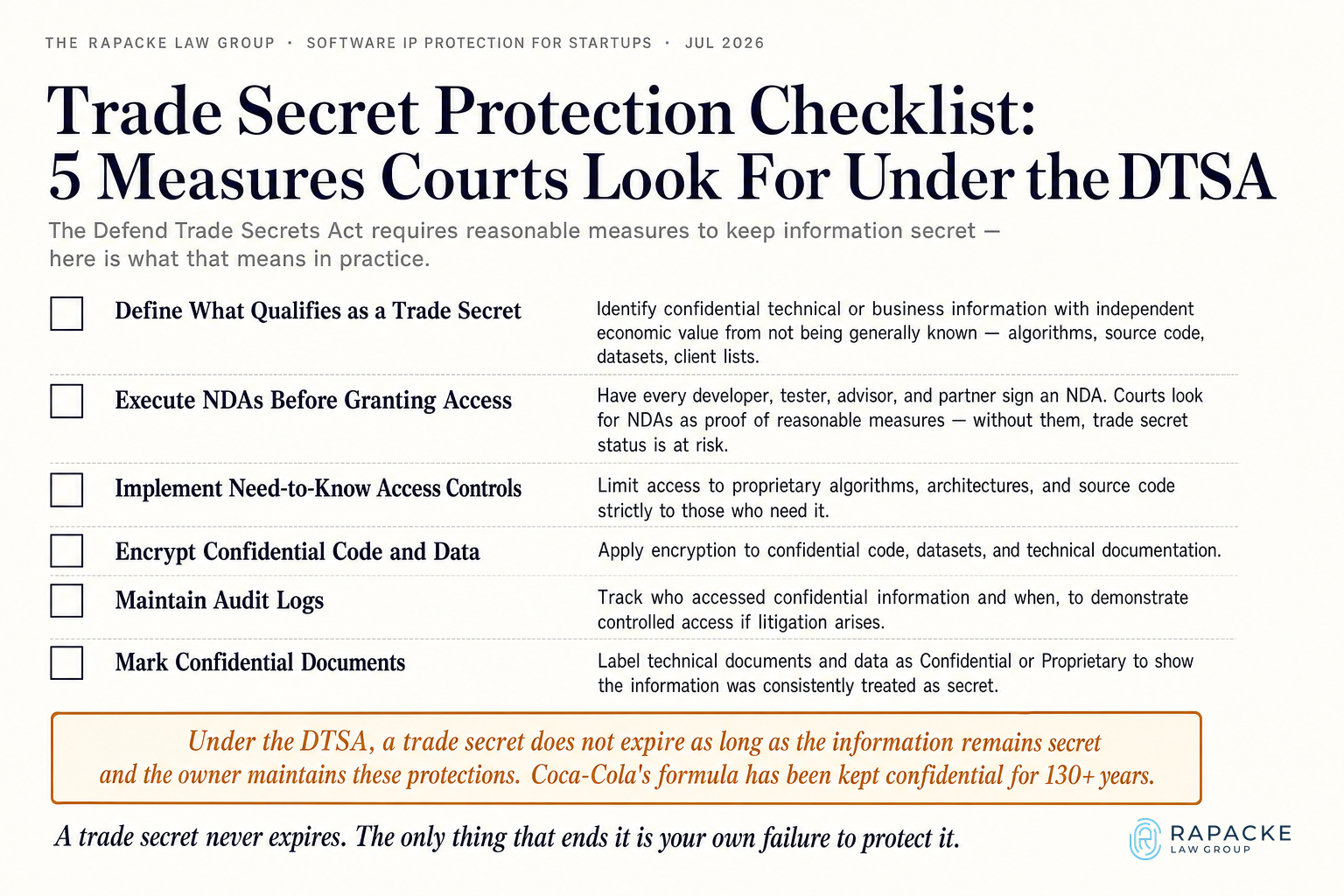
The Defend Trade Secrets Act defines a trade secret as information that has independent economic value from not being generally known and that the owner takes reasonable measures to keep secret. This includes training data used by ai models, proprietary algorithms, and system architectures. Unlike patents, trade secrets can last indefinitely as long as those conditions hold. Coca-Cola's formula has stayed confidential for more than 130 years.
Non-Disclosure Agreements Are Your First Line of Defense
Non-disclosure agreements convert an informal expectation of confidentiality into an enforceable obligation. Every employee, contractor, software developer, and partner who touches sensitive information should sign one before access is granted. Courts treat NDAs as key evidence that a company took reasonable measures. No NDA, no trade secret protection. Our SaaS agreement checklist helps you confirm the right agreements are in place.
Access Controls and Internal Security Policies Reinforce Legal Protection
Courts examine whether a company took reasonable technical and organizational steps to guard confidential information. Role-based access controls, audit logs, and documented security policies prevent unauthorized access, strengthen a trade secret claim, and support legal action if an ex-employee misappropriates code or data.
Copyright Registration and Licensing Give You Practical Enforcement Tools
Copyright exists automatically, but registration turns it from a passive right into an active enforcement tool.
Why Registering Your Source Code With the U.S. Copyright Office Matters
Registration with the United States Copyright Office is required before you can sue for infringement in federal court. Registering before infringement or within three months of publication unlocks statutory damages up to $150,000 per work for willful infringement, plus attorney's fees. Without timely registration, you are limited to actual damages.
Software Licensing Defines Who Can Use Your Code and How
A software license grants users limited rights while you keep ownership. Proprietary licenses and SaaS terms restrict usage, users, and reverse engineering, guarding against unauthorized use of your software. Open source software licenses like GPL and MIT grant broad rights but carry conditions, GPL, for example, requires disclosing the source code of derivative works. Every deployment should be governed by a clear license agreement that addresses digital rights management, and if you build in the software and SaaS space, license terms are core to how you keep control of your product.
Trademarks Protect the Brand Identity Built Around Your Software
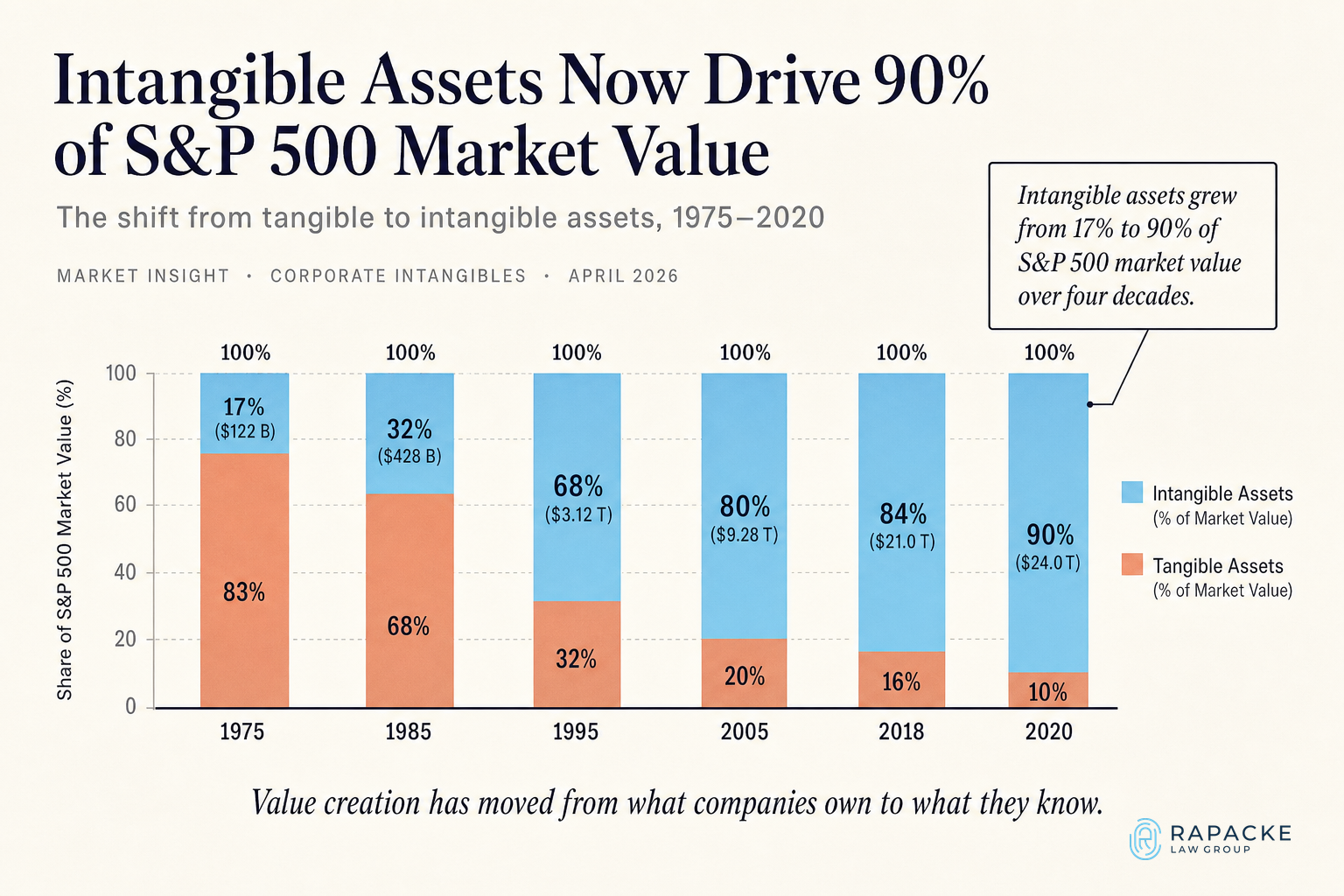
Patents and trade secrets protect what your software does. Trademarks protect how customers recognize it. This matters more than founders expect, because by 2020 intangible assets made up more than 90% of the S&P 500's market value.
What a Trademark Covers for a Software Company
A trademark protects the name, logo, and brand identity associated with your product. USPTO registration gives you nationwide exclusive rights and the standing to stop confusingly similar marks. As of mid-2026, the average time from filing to registration is about 9.9 months, so file early.
Trademark Protection Supports Investor Confidence and Exit Value
Investors conducting IP due diligence expect registered trademarks alongside patents, and trademark infringement risks are a key concern they flag during review. A clean trademark portfolio signals that the company owns its brand outright, reducing acquisition risk. For founders mapping the full picture, our overview of the types of IP for SaaS startups shows how brand rights fit alongside patents and trade secrets.
How to Protect Software Intellectual Property: Building a Strategy That Fits Your Stage and Budget
Not every startup can afford full patent prosecution on day one. The right sequence depends on what you have built and where you sit in the company lifecycle.
Pre-Launch: Lock In Priority and Confidentiality First
Before any public disclosure, file a provisional patent application for core innovations and execute NDAs with everyone who has seen the technology. Both steps are low-cost relative to the risk they eliminate. Our founder's playbook on intellectual property rights in business walks through how to sequence these moves.
Post-Funding: Build a Patent Portfolio Around Core Features
After a seed or Series A round, identify the two or three features most critical to your competitive advantage and prioritize non-provisional patent applications around them. Startups with patents are more likely to secure follow-on funding and successful exits, and those patents become the moat that matters during Series B due diligence. If your product is app-based, our guide to intellectual property for apps shows how the same layers apply.
Ongoing: Audit, Document, and Enforce IP Rights Regularly
Schedule annual audits to identify new patentable innovations, confirm trade secret policies are current, and monitor for infringement to keep your IP portfolio defensible. Track maintenance deadlines too. Protecting software IP is a process, not a single filing event. For a wider survival guide and related articles, see how to protect your IP.
Frequently Asked Questions
Can software be protected by intellectual property rights?
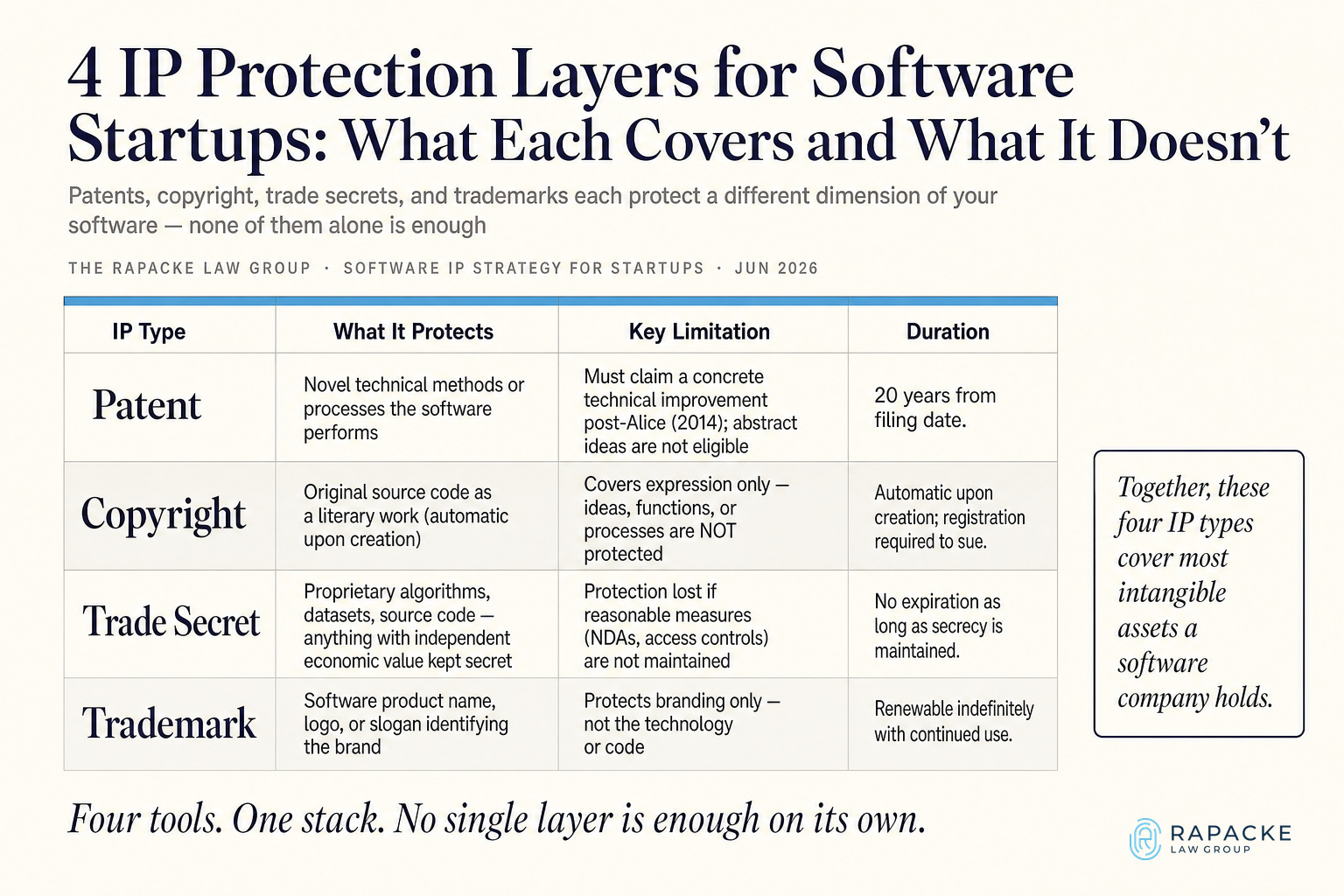
Yes, by multiple different types of protection at once: copyright attaches automatically to code, patents cover novel methods, trade secrets protect confidential algorithms and architectures, and trademarks protect names and logos.
How do you protect digital intellectual property?
Match each asset to the right tool, register copyrights, file provisional patents before public disclosure, execute NDAs with everyone who touches sensitive information, and file trademark applications for your name and logo.
What are the 4 types of IP protection?
Patents, copyrights, trademarks, and trade secrets. Software companies typically use all four.
How do you protect intellectual property for an app?
File a provisional patent before launch for any novel technical method, register the copyright on the code and UI, trademark the name and logo, and have every developer and tester sign an NDA.
Does registering a copyright prevent competitors from copying my app's features?
No. Copyright only protects the specific expression, not functionality. Protecting the functional innovation requires a utility patent.
The Cost of Waiting Is Higher Than the Cost of Filing
The founder who waits until a competitor launches or an investor asks for an IP summary has already lost time and leverage. The tools to protect software intellectual property are accessible, but time-sensitive. Patent rights depend on filing dates. Trade secret status depends on confidentiality measures already in place.
The bottom line: A weak IP position leaves you exposed to legal copycats and shaky in due diligence. A strong position, layered patents, registered copyrights, documented trade secrets, and registered trademarks, turns your intellectual property into a defensible moat and a real asset at your next raise.
Every month you wait, your priority dates slip further out of reach and a competitor gets closer to filing first. In a first-to-file system, that delay can cost you the market you built.
Here are your next steps:
- Schedule a Free IP Strategy Call to map your software assets against the right protection tools before your next funding round or launch.
- Inventory your source code, key algorithms, brand assets, and confidential data.
- File a provisional patent application for core innovations before any public disclosure.
- Register your source code with the U.S. Copyright Office and put NDAs in place with your team.
With Rapacke Law Group's flat-fee pricing and the RLG Guarantee, you know exactly what you'll pay before you commit. No hourly billing surprises, no hidden fees. The RLG Guarantee means that if a patentability search determines your invention is not novel, you receive a 100% refund of your flat fee. It's a risk-free way for startup founders to explore patent protection without the fear of wasting limited resources on an invention that may not qualify. When you're racing to protect software intellectual property while managing product development and fundraising, that kind of financial certainty and transparency isn't just a nice-to-have, it's essential.
To Your Success, Andrew Rapacke, Managing Partner, Registered Patent Attorney
Connect on LinkedIn, or follow @rapackelaw on X and Instagram.
Andrew Rapacke Managing Partner, Registered Patent Attorney Rapacke Law Group